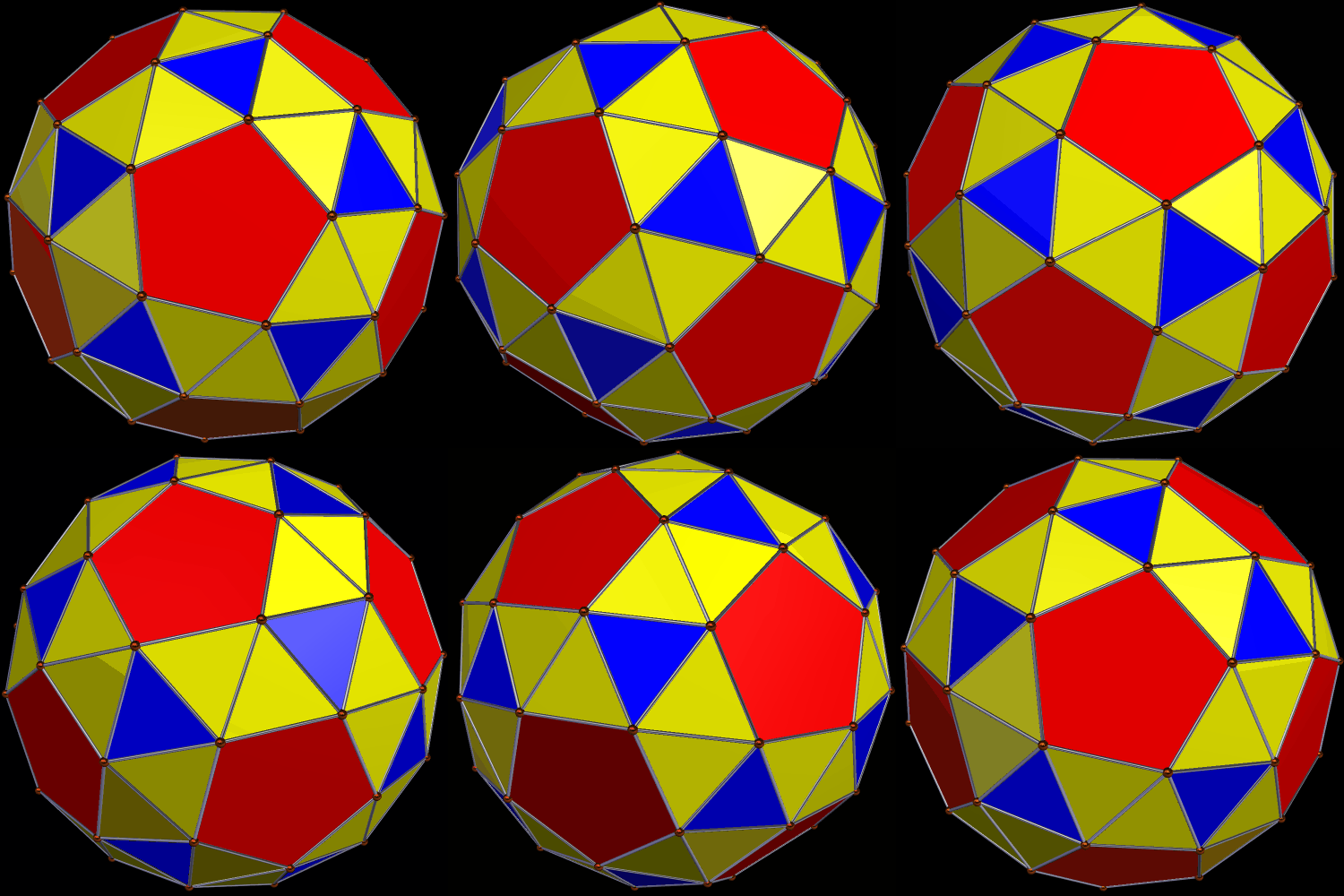
The Snub Dodecahedron and Related Polyhedra, Including Compounds

Snub Dodeca

The dual of the snub dodecahedron (above) is called the pentagonal hexacontahedron (below, left). The compound of the two is shown below, at right. (Any of the smaller images here may be enlarged with a click.)

Like all chiral polyhedra, both these polyhedra can form compounds with their own mirror-images, as seen below.

Finally, all four polyhedra — two snub dodecahedra, and two pentagonal hexacontahedra — can be combined into a single compound.

Compound of enantiomorphic pair and base-dual compound snub dodeca

This polyhedral manipulation and .gif-making was performed using Stella 4d, a program you can find here.

Three Different Views of a 962-Faced Zonohedron

This zonohedron contains faces which are regular decagons (12 of them), equilateral octagons (30, all of the same type), equilateral hexagons (380 of them, of 7 types, with one of these 7 types, of which there are 20, being regular), squares (60), and non-square rhombi (480 of 8 types, counting reflections as separate types). With each polygon-type, including the reflections, given a different color, this zonohedron looks like this.

Zonohedron with 962 faces colored by face type

If reflected face-types are not counted as separate types, then the coloring-by-face-type uses four fewer colors, and looks like this:

Zonohedron with 962 faces colored by face type 2nd version

Another view simply colors faces by numbers of sides, and is shown below. Each of these rotating images was created with Stella 4d, a program you may buy, or try for free, at http://www.software3d.com/Stella.php.

Zonohedron with 962 faces colored by face number of sides

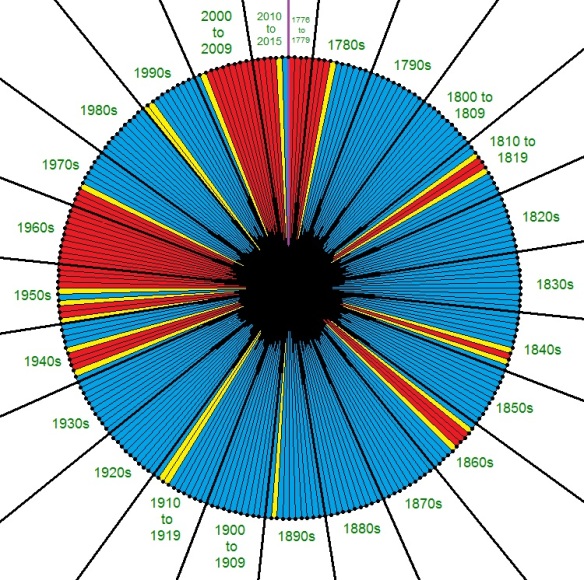
The American Historical Clock of War and Peace

SANYO DIGITAL CAMERA

The yellow years are ones in which the USA was getting into or out of major wars — or both, in the case of the brief Spanish-American War. The red years are war years, and the blue years are years of (relative) peace.

The sectors are each bounded by two radii, and a 1.5° arc. The current year is omitted intentionally because 2016 isn’t over yet, and we don’t know what will happen during the rest of it. 

Four Convex Polyhedra with Icosidodecahedral Symmetry

The smaller images above may be enlarged with a click. All these polyhedra were made using Stella 4d, available here.

A Hollow Faceting of the Rhombicosidodecahedron, and Its Hollow Dual

The images above all show a particular faceting of the rhombicosidodecahedron which, to my surprise, is hollow. It has the vertices of a rhombicosidodecahedron, but two different face-types, as seen in the smaller pictures: yellow hexagons, and red isosceles trapezoids. (To enlarge any image in this post, simply click on it.)

The dual of this polyhedron is even more obviously hollow, as seen below. Its faces, as seen in the still picture, are crossed hexagons — with edges which cross three times per hexagon, no less.

The software I used to make these polyhedra, Stella 4d, will return an error message if the user attempts to make a polyhedron which is not mathematically valid. When I’ve made things that look (superficially) like this before, I used “hide selected faces” to produce hollow geometrical figures which were not valid polyhedra, but that isn’t what happened here (I hid nothing), so this has me confused. Stella 4d (software you can buy, or try for free, here) apparently considers these valid polyhedra, but I am at a loss to explain such familiar concepts as volume for such unusual polyhedra, or how such things could even exist — yet here they are. Clarifying comments would be most appreciated.

12-Fold Dihedral Polyhedral Explorations

Augmented 12- Antiprism

Above is a dodecagonal antiprism, augmented by 24 more dodecagonal antiprisms. This was the starting point for making all the polyhedra below, using Stella 4d, software available here. Each of these smaller pictures may be enlarged with a click.

When We Build Our Dyson Sphere, Let’s Not Use Enneagonal Antiprisms

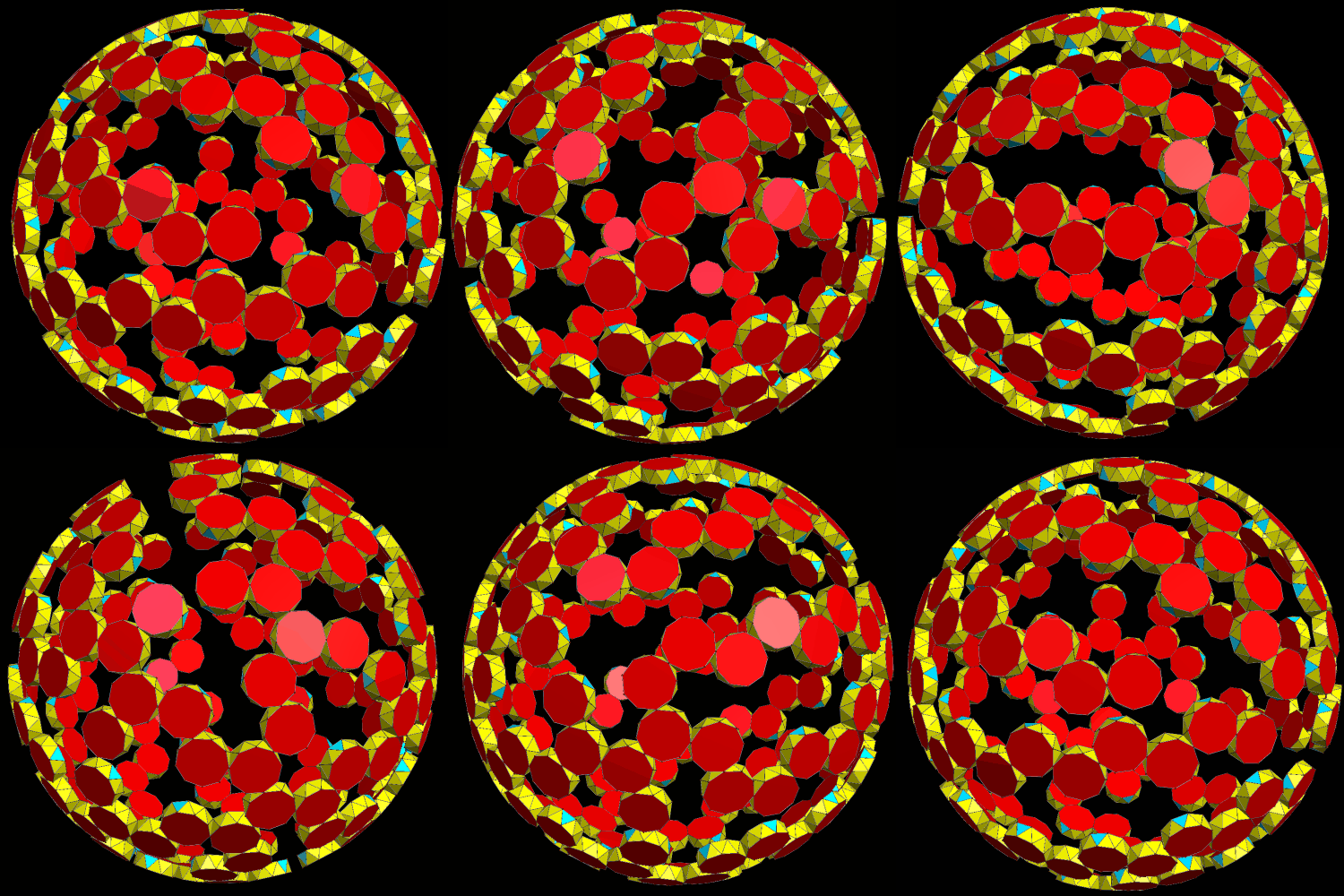
Before an undertaking as great as building a Dyson Sphere, it’s a good idea to plan ahead first. This rotating image shows what my plan for an enneagonal-antiprism-based Dyson Sphere looked like, at the hemisphere stage. At this point, the best I could hope for is was three-fold dihedral symmetry.

Augmented 9- Antiprism

I didn’t get what I was hoping for, but only ended up with plain old three-fold polar symmetry, once my Dyson Sphere plan got at far as it could go without the unit enneagonal antiprisms running into each other. Polyhedra-obsessives tend to also be symmetry-obsessives, and this just isn’t good enough for me.

Augmented 9- Antiprism complete

If we filled in the gaps by creating the convex hull of the above complex of enneagonal antiprisms, in order to capture all the sun’s energy (and make our Dyson Sphere harder to see from outside it), here’s what this would look like, in false color (the real thing would be black) — and the convex hull of this Dyson Sphere design, in my opinion, especially when colored by number of sides per face, really reveals how bad an idea it would be to build our Dyson sphere in this way.

Dyson Sphere Convex hull

We could find ourselves laughed out of the Galactic Alliance if we built such a low-order-of-symmetry Dyson Sphere — so, please, don’t do it. On the other hand, please also stay away from geodesic spheres or their duals, the polyhedra which resemble fullerenes, for we certainly don’t want our Dyson Sphere looking like all the rest of them. We need to find something better, before construction begins. Perhaps a snub dodecahedron? But, if we use a chiral polyhedron, how do we decide which enantiomer to use?

[All three images of my not-good-enough Dyson Sphere plan were created using Stella 4d, which you can get for yourself at this website.]

A Second Coloring-Scheme for the Chiral Tetrated Dodecahedron

For detailed information on this newly-discovered polyhedron, which is near (or possibly in) the “fuzzy” border-zone between the “near-misses” (irregularities real, but not visually apparent) and “near-near-misses” (irregularities barely visible, but there they are) to the Johnson solids, please see the post immediately before this one. In this post, I simply want to introduce a new coloring-scheme for the chiral tetrated dodecahedron — one with three colors, rather than the four seen in the last post.

chiral tet dod 2nd color scheme

In the image above, the two colors of triangle are used to distinguish equilateral triangles (blue) from merely-isosceles triangles (yellow), with these yellow triangles all occurring in pairs, with their bases (slightly longer than their legs) touching, within each pair. This is the same coloring-scheme used for over a decade in most images of the (original and non-chiral) tetrated dodecahedron, such as the one below.

Tetrated Dodeca

Both of these images were created using polyhedral-navigation software, Stella 4d, which is available here, both for purchase and as a free trial download.

[Later edit: I have now found out I was not the first person to find what I had thought, earlier today, was an original discovery. What I have simply named the chiral tetrated dodecahedron has been on the Internet, in German, since 2008, or possibly earlier, and may be seen here: http://3doro.de/polyeder/.]

The Chiral Tetrated Dodecahedron: A New Near-Miss?

The images above show a new near-miss (to the Johnson solids) candidate I just found using Stella 4d, software you can try here. Like the original tetrated dodecahedron (a recognized near-miss shown at left, below), making this polyhedron relies on splitting the Platonic dodecahedron into four three-pentagon panels, moving them apart, and filling the gaps with triangles. Unlike that polyhedron, though, this new near-miss candidate is chiral, as you can see by comparing the left- and right-handed versions, above. The image at the right, below, is the compound of these two enantiomers.

Next are shown nets for both the left- and right-handed versions of the chiral tetrated dodecahedron (on the right, top and bottom), along with the dual of this newly-discovered polyhedron (on the left). Like the rest of the images in this post, any of them may be enlarged with a click.

A key consideration when it is decided if the chiral tetrated dodecahedron will be accepted by the community of polyhedral enthusiasts as a near-miss (almost a Johnson solid), or will be relegated to the less-strict set of “near-near-misses,” will be measures of deviancy from regularity.The pentagons and green triangles are regular, with the same edge length. The blue and yellow triangles are isosceles, with their bases located where blue meets yellow. These bases are each ~9.8% longer than the other edges of the chiral tetrated dodecahedron. By comparison, the longer edges of the original tetrated dodecahedron, where one yellow isosceles triangle meets another, are ~7.0% longer than the other edges of that polyhedron. Also, in the original, the vertex angle of these isosceles triangles measures ~64.7°, while the corresponding figure is ~66.6° for the chiral tetrated dodecahedron.

[Later edit: I have now found out I was not the first person to find what I had thought, earlier today, was an original discovery. What I have simply named the chiral tetrated dodecahedron has been on the Internet, in German, since 2008, or possibly earlier, and may be seen here: http://3doro.de/polyeder/.]

Standard and Faceted Versions, Side by Side, of Each of the Thirteen Archimedean Solids

These two polyhedra are the truncated tetrahedron on the left, plus at least one faceted version of that same Archimedean solid on the right. As you can see, in each case, the figures have the same set of vertices — but those vertices are connected in a different way in the two solids, giving the polyhedra different faces and edges.

(To see larger images of any picture in this post, simply click on it.)

The next three are the truncated cube, along with two different faceted truncated cubes on the right. The one at the top right was the first one I made — and then, after noticing its chirality, I made the other one, which is the compound of the first faceted truncated cube, plus its mirror-image. Some facetings of non-chiral polyhedra are themselves non-chiral, but, as you can see, chiral facetings of non-chiral polyhedra are also possible.

The next two images show a truncated octahedron, along with a faceted truncated octahedron. As these images show, sometimes faceted polyhedra are also interesting polyhedra compounds, such as this compound of three cuboids. 

The next polyhedra shown are a truncated dodecahedron, and a faceted truncated dodecahedron. Although faceted polyhedra do not have to be absurdly complex, this pair demonstrates that they certainly can be.

Next are the truncated icosahedron, along with one of its many facetings — and with this one (below, on the right) considerably less complex than the faceted polyhedron shown immediately above.

The next two shown are the cuboctahedron, along with one of its facetings, each face of which is a congruent isosceles triangle. This faceted polyhedron is also a compound — of six irregular triangular pyramids, each of a different color.

The next pair are the standard version, and a faceted version, of the rhombcuboctahedron, also known as the rhombicuboctahedron.

The great rhombcuboctahedron, along with one of its numerous possible facetings, comes next. This polyhedron is also called the great rhombicuboctahedron, as well as the truncated cuboctahedron.

The next pair are the snub cube, one of two Archimedean solids which is chiral, and one of its facetings, which “inherited” its chirality from the original.

The icosidodecahedron, and one of its facetings, are next.

The next pair are the original, and one of the faceted versions, of the rhombicosidodecahedron.

The next two are the great rhombicosidodecahedron, and one of its facetings. This polyhedron is also called the truncated icosidodecahedron.

Finally, here are the snub dodecahedron (the second chiral Archimedean solid, and the only other one, other than the snub cube, which possesses chirality), along with one of the many facetings of that solid. This faceting is also chiral, as are all snub dodecahedron (and snub cube) facetings.

Each of these polyhedral images was created using Stella 4d: Polyhedron Navigator, software available at this website.