One Aspect of Having Asperger’s (at least for one of us)

Image

One Aspect of Having Asperger's (at least for one of us)

Aspies (a term for ourselves, used by those with diagnosed or undiagnosed Asperger’s) sometimes have trouble understanding what people say, because we tend to view things literally, while many others often say things in non-literal, or even anti-literal, ways.

For example, without reasons known to us, person A says something offensive to person B. Why deliberately offend someone, without good cause? We don’t know. Person B then says, in response, “Say that again!” — and Aspies who hear this (and we do, for we’re everywhere) often become even more confused. Clearly, person B does not actually want to be offended again, yet is telling person A to do exactly that which person B does not really want person A to do. I’ve asked people to explain this behavior more than once, tried to understand it, and each time I revisit the subject, I become more confused than before, for understanding the explanation would involve bending my mind in a direction it simply won’t bend. I also must admit I do not want my mind to bend that direction, either, for fear that doing so would weaken my ability to reason logically.

This is true for much of what I hear. Things that do not make logical sense are inherently hard to understand, at least for us . . . and I don’t even understand why everyone isn’t like us in this respect, either.

The Story of the Void, Chapter Two

Image

The Story of the Void, Chapter Two

For chapter one: https://robertlovespi.wordpress.com/2014/01/18/the-story-of-the-void-chapter-one/

* * *

Richard had no way to know how long he’d been flat on his back, in a bed, in a dark, locked, otherwise-empty room. He was angered when the lights came on. They were bright. The door opened. A man in an expensive suit walked in.

Richard’s brain went into “attack mode,” and told his body to kill this intruder. Having recently undergone major abdominal surgery, though, his body wasn’t up to the task. He collapsed in a heap at the man’s feet.

“That wasn’t very smart, Richard. However, we don’t need you for your mind. You’ll work fine.” The man turned to speak more loudly, in the direction of the open door. “This one will work! Have him ready to launch in a week!”

“Launch? What launch?” Richard hadn’t been conscious since being shot by police after a killing spree. He was furious, but powerless to do anything about it. “Who are you? Don’t I get a lawyer or something?”

“You killed twenty-two people. You were captured and shot by the police. A doctor worked for hours to save you. As far as anyone knows, though, he failed. The world thinks you’re dead, and absolutely no one misses you, or will look for you. Don’t expect a lawyer. Yes, you’ll be perfect.” The man left before Richard could gather the strength to attempt attack again. The lights stayed on — for the rest of the time Richard was in the room.

Richard received drugs through an IV tube. He got angry at one point, and ripped the IV out of his arm, spraying blood all over the place. Gas then entered the room through a panel in the ceiling, and, when he could finally hold his breath no more, he inhaled a small amount, and it knocked him out.

When he next regained consciousness, he was held motionless by restraints. A new IV was in his other arm, and a feeding tube had been placed down his throat. He was surprised he didn’t gag, for he had no way to know that one of the drugs entering his body through the IV tube suppressed his gag reflex. His fury filled his thoughts, after only a little while, but it made no difference. He could do nothing except heal. A week later, he was judged healthy enough to survive a launch into space — maybe — by a team of doctors whom he never saw. Most of them had medical and/or ethical reservations, of course, and expressed them. These objections were ignored.

One doctor never voiced objections. He was the one who was monitoring this unusual patient when he had a strong sedative administered, and then taken to a small space probe, atop a tall rocket. By that point, the other doctors had all been reassigned, and some were already dead, seemingly from natural causes. The rest followed soon thereafter, by “disease” or “accident.”

Richard was still heavily sedated when the rocket was launched. Accelerating him into space nearly killed him, but that didn’t bother the computer which piloted the space probe. It didn’t need Richard’s assistance, and simply monitored his vital signs, relaying them back to Houston Space Central. He had no viewport, and so did not know that he had been placed into orbit around the sun, in earth’s orbit, but in the opposite direction.

Months earlier, a powerful, automated telescope, in solar orbit, had detected something no one in NASA had been able to explain. It was located in earth’s orbit, also, on the far side of the sun, where the earth would be or was, six months into the future or past. It revolved around the sun at the same speed as the earth, and in the same direction. It might have just appeared there, or it might have been there for billions of years. There was no way to tell, for the simple reason that no one had looked at that region of space before.

After it was discovered that the object’s x-ray signature resembled that of a black hole, the decision was quickly made to keep the anomaly a secret, lest a panic begin. In other wavelengths, though, it appeared as a planet-sized object of the expected temperature, or didn’t appear at all. The distribution of readings along the electromagnetic spectrum baffled all who were allowed access to this discovery. It wasn’t perturbing any orbits with the gravitational pull it would have if it had, say, the mass of the earth, or even of earth’s moon. As far as NASA’s scientists could tell, it had no gravitational effect on anything.

A robotic probe was sent to the far side of the sun, equipped with observational and communications equipment. It sent signals, right up to the point when it had encountered the anomaly. At that moment, it fell permanently silent.

The loss of a $950,000,000 space probe would be hard to hide from Congress, so the second probe, the one containing Richard Wayne Dahmer, was stripped down, and less expensive. It did not have the sophisticated sensing equipment on the first probe. It was sent simply to learn what effect, if any, close proximity, and then an actual encounter with, the enigma in earth’s orbit would have on a human being, and then send that medical data back to earth. No well-known, expensively-trained astronaut was needed; what was, rather, was someone deemed completely expendable. Richard, therefore, fit the criteria for this mission perfectly. No one connected to the mission saw any reason to inform Richard, himself, of any of this, and so he had no idea what awaited him. But, then again, neither did those people who merely thought they were controlling his mission.

He got furious, repeatedly, but that didn’t matter. After three months, his windowless probe encountered the anomaly. Once again, mission monitors for NASA saw all communications from a probe go dark, all at the same time. The conclusion was that the anomaly was incompatible with human life, and that the involuntary passenger on the probe had died.

Richard wasn’t dead, however. He, and his probe, fell into the mysterious singularity. Like a black hole, it had an event horizon. The probe passed through it, entering a void out of which it could send no signals back to earth, and inside which it detected, just as it vanished, the first, purely-robotic probe NASA had sent. The message about this discovery could not escape the event horizon, however, and so there it stayed.

The singularity woke up. It was conscious now. It had reversed direction, acquiring the momentum of Richard’s probe, in its entirety, as if the singularity itself had no mass. It was headed toward earth, along that planet’s orbit. It also vanished from the view of the sun-orbiting telescope which had first detected it. No one on earth knew it was coming.

Richard Wayne — no, just Richard, that was enough, he needed no other name now — was awake, and undrugged, now. There was no evidence of the probe that had held him for the last three months. He saw only the void. He didn’t see the singularity. He was the singularity, and the singularity was him.

The brain tumor that had been exerting ever-increasing pressure on that part of the brain responsible for moral reasoning — for ethical behavior — was now gone, along with Richard’s physical brain, itself. Only his consciousness remained, unimpaired by the undiscovered tumor which had turned him into a raging psychopath.

He wasn’t angry any longer, and, although he didn’t know it, he was now heading towards home.

* * *

The Story of the Void continues here: https://robertlovespi.wordpress.com/2014/02/01/the-story-of-the-void-chapter-three/.

The Story of the Void, Chapter One

Image

The Story of the Void, Chapter One

He couldn’t blame his parents for naming him Richard Wayne Dahmer. He was born years before Richard Ramirez, John Wayne Gacy, or Jeffrey Dahmer had killed their first victim, after all. However, he was not so old that he escaped being tormented in school because he shared names with serial killers.

He hated school, and had dropped out.

Richard had then, predictably, found a low-paying job. He was a janitor. Dealing with other people’s trash, and cleaning things, wasn’t a big deal to him. He found the job easy. He stayed there a few years, and finally moved out of his parents’ house, and into the lowest-rent studio apartment he could find.

Then, one day, everything changed for him. It was payday, and, when his shift was over, not having a bank account, he walked to a nearby grocery store which cashed checks for a small fee. Leaving for home, he was followed. It was getting dark. No one was around when a bigger man stepped around the corner of a building, pulled a gun on him, and demanded his money.

There was no fear in Richard. There was only rage. Richard lunged at the man, and struck him with both hands, on the side of the man’s head. This did, of course, give the would-be robber a chance to fire the gun, and the bullet did hit Richard, but it didn’t kill him. He was moving so fast, in a weaving path, that the robber nearly missed, and the bullet merely grazed Richard’s neck. He was bleeding, but not heavily.

The other man didn’t fare so well. After Richard hit his head, as hard as he could, it slammed into side of the nearby building. Knocked unconscious, he dropped the gun as he fell to the sidewalk, and stopped moving, except to breathe. His eyes were closed.

With his attacker unconscious, Richard was completely out of danger, but his rage didn’t fade. Three hundred dollars was all he had, and this guy had tried to take it by force? Without pausing to think, Richard already had his hands around the guy’s throat. He tightened his grip. Just as the choking man made his final noises, a third person came around the corner of the building. Amy Fletcher was blonde, five foot five inches tall, and dressed like she was on the hunt for sex. She wasn’t expecting to see a man getting strangled, and she screamed when she found herself facing exactly that.

“No witnesses,” said Richard, primarily to himself, and he grabbed the nearby, dropped gun. Amy ran, back the way she had come. Richard followed her until he could see her retreating form clearly, and then he stopped, aimed the gun as best he could, and fired.

This was Richard’s first time to ever fire anything bigger than a BB gun, and he missed. He fired three more times, and missed each of those times, as well. The fifth shot, however, severed Amy’s femoral artery, and she bled out within two minutes. Richard saw her drop, assumed she was dead, and simply ran. Another woman who lived nearby heard the shots, and called 911. The police arrived quickly, and found the two bodies, but Richard was gone.

When police detectives had blood from the crime scene analyzed, though, they learned that three blood types were present, The O-negative blood was that of the strangled man, and the B-positive blood was found to be Amy’s. There was no body to match up with the A-positive blood from Richard’s neck, and spots of it were later found, in a winding trail, leading generally South for nearly six blocks. At that point, Richard’s wounds had clotted, and no more blood had fallen for the police to find.

His rage still consumed him, however. The next person he encountered, he decided, would be the third one to die that night.

After that, there was a fourth. Before sunrise, a fifth was added. When the sun came up, Richard stumbled upon a manhole, removed the cover, and lowered himself into the sewer-drain below, then replaced the cover. There was very little water in the tunnel underneath, but it had a foul smell. He found a dry spot, laid down, and went quickly to sleep.

After sleeping for about twenty minutes, Richard had a seizure. He had several more before waking up, many hours later. When he found another exit, it was dark again. He was calm.

He was calm, that is, until he encountered another human being. At that point, the rage returned, and he started killing again. He killed many, one after another, that second night. The day after, he slept under a bridge. This time, the police caught him. Once awake, he resisted. The police, acting in self-defense, shot him.

Everything went black for Richard. He did not know about the ambulance arriving on the scene minutes later, or the successful efforts of a surgeon, working for hours at a nearby hospital, to save his life.

Few others knew about this success, either. The doctor was found dead shortly thereafter, the victim of an apparent heart attack — and the official spokesman for the hospital announced that Richard Wayne Dahmer, suspected killer of twenty-two people, had died in surgery. No one outside his family mourned his fabricated death. Not even his family questioned it, for a cadaver from the hospital’s morgue was altered to resemble Richard. The ruse worked, and Richard’s shocked parents were fooled.

Richard was alone, and awake, in a completely dark room, weeks later, his rage finally fading. As far as anyone but his captors knew, he was as dead as his victims.

* * *

This story continues here:  https://robertlovespi.wordpress.com/2014/01/19/the-story-of-the-void-chapter-two/

Issues of Control

Image

Issues of Control

There’s a common phrase which has been said to me many times — often enough, in fact, that I sometimes now find it amusing when I hear it. You’ve probably heard it, also, or perhaps have said it to other people, yourself: “You have control issues.”

I sometimes wonder why anyone would feel the need to point this out to me. It’s something that is so blindingly obvious, to myself, and to all who know me well, that it really doesn’t even need to be said. My usual response, the last few years, has been the following: “Control issues? I don’t merely have control issues. I’ve got a lifetime subscription.”

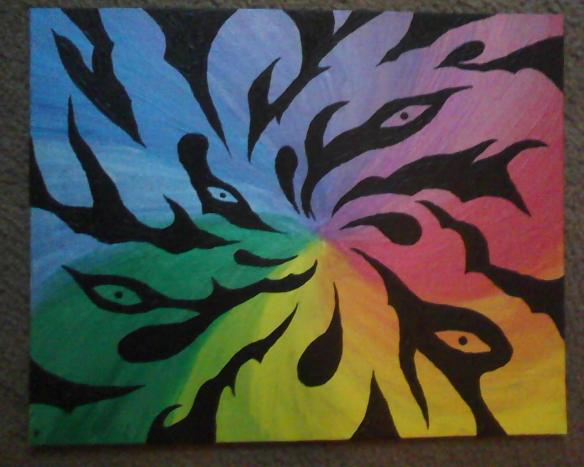
The painting at the top of this post was a self-portrait I painted many years ago, while still struggling with (metaphorical) inner “demons” that bother me much less now, compared to how I was even a few years ago, at a time when my mental health was far more precarious.

Am I, to use an informal term for it, a “control freak?” Well, yes, I am — but not of the common variety. I’ve discerned that there are two very different types of control freak in existence, and have labeled them, simply, as type I and type II control freaks. I’m of the second type, but the first type is far more common.

Type I control freaks, as I define them, put a lot of time and energy into controlling other people, or at least trying to do so. I see such people as insecure, on an unconscious level, and suspect they have a strong drive to force their will on others, simply as a way to help them feel more secure about themselves. Such people are extremely unpleasant for me to be around, and I avoid them whenever I can. When forced to be around them, conflict is common.

Type II control freaks are very different from those of the first type. They — or, rather, we — have no particular urge to control other people. We do, however, still have very strong issues related to control, and, yes, this can cause problems at times.

(As an aside, I should explain my use of the word “freak,” since some people find that word offensive. It’s a word I’ve applied to myself since childhood. I don’t ever use this word as an insult. If I call someone “normal,” though, that’s another matter. “Normal” is a word I do use, when I use it, as an insult — a synonym for such terms as “boring,” “ordinary,” or “typical.” The idea of being normal is, to me, horrifying in the extreme — and to be a “freak” is, of course, the exact opposite.)

So what’s up with these people I call type II control freaks? In short, what’s our problem, and how do we differ from control freaks of the more common variety? Well, in my case (and that of others like me, I suspect), we were subjected, when very young, to extreme amounts of manipulative, controlling behavior by others — to such an extreme degree that we are now hypersensitive to any real (or perceived) efforts to control us. In my case, this overly-controlling person — the overwhelming monster of my childhood — was my father, deceased since mid-2010, and, at least by me, completely unmourned. When I painted the painting above, he was still alive. Now that he is gone, and can, therefore, never harm another person, the chains depicted in this painting have, after many decades, finally been broken, even though I still have to deal with lingering PTSD, and likely always will, because of the trauma he inflicted on me in childhood. (The difference is that, now, I simply have to deal with the fact that I used to be “chained up,” and cope with the resulting memories, whereas, before he died, the chains were still “on,” even though we were estranged for many years.) Hearing the news of his death was, quite possibly, the most liberating moment of my life.

Type II control freaks have no need to control others — we simply have an overwhelming need to keep others from controlling us. We are lovers of freedom and liberty, and need it almost as intensely as all humans need oxygen. At least in my case, I can’t even stand to see the first type of control freak in action, against another, without feeling an overwhelming urge to do almost anything in my power to stop them.

I have no qualms about being, and openly admitting to being, a control freak of the second type. It’s simply a part of who I am. There are certainly less healthy ways to react to childhood trauma, after all — such as when someone turns into the same type of monster that terrorized him or her in the first place, thus perpetuating a multi-generational cycle which is unhealthy in the extreme.

As for the type I control freaks, I am unable to feel any sympathy for them. They victimize others whenever they can. They’re bullies. They need to be opposed, and they need to be stopped. They are, in a word, evil — and that’s not a word I use often, nor one I use lightly.

I’m a permanent part of the resistance to such people, and have no reservations about this. If it were in my power to change this part of who I am — and it isn’t, anyway — I certainly would not choose to do so.

Self-Distraction Attempt

Image

Self-Distraction Attempt

This is based on a picture I found of the ceiling of the Hampton Court Palace, with variations of my own.

As a self-distraction attempt, however, I wish it were working better.

On Writing Treaties with Memory

Image

Writing a Treaty with Memory

At an age of four years or so, my favorite song was Simon & Garfunkel’s song “The Boxer,” which I had not listened to in a very long time, until this morning. I still remember the lyrics well, and was singing along with the song. If you’d like to hear it for yourself, here it is:

Everything was fine, until I found myself singing this part of the song: “In the clearing stands a boxer, and a fighter by his trade, and he carries the reminders of every glove that laid him down, or cut him ’till he cried out, in his anger and his shame — I am leaving, I am leaving, but the fighter still remains.”

I made it to the words “his anger and his” — before literally choking on the word “shame.” Music is a powerful tool for evoking memories, I now realize, and sometimes that can be dangerous.

I choked because some horrific, repressed memory was brought close to the surface of my consciousness by this part of the song.

Despite the picture here of “The Man Without Fear,” fear is not something I lack. However, these days, I almost never fear that which is right in front of me. I can face down bullies, and other tyrants, in my present life, especially if people I care about are threatened, and now I have a better understanding of the reasons for this: such present threats are as nothing, when compared to the horrors I now only half-remember from when I was very young. The parts I do not remember at all are blank spaces for which I am grateful, for those are memories I do not need.

What exact memory did this song dredge up, from the depths of my own unconscious? I can’t tell you that, because I simply don’t know the details. I do know that this part of that song — or, rather, my reaction to it — instantly dropped me into a nearly-comatose state for the better part of an hour, and prompted me, in that state, to do an emergency-rewrite of the software installed in my brain, re-submerging the memories that had nearly surfaced. I then wrote, and proceeded to install — yes, I view my own brain as a computer, which it is — new safety protocols to protect myself from such problems in the future. This is by no means the only time something like this has happened, and I am tired of being temporarily disabled by such events.

These new safety subroutines were written to recognize repressed memories that are in the process of surfacing, before panic sets in, but they don’t simply push them back down, as previous versions have attempted, with limited success. Instead, they break off a small, invisible piece of mind which can operate independently of, and simultaneously with, my primary consciousness. Internally, it “sits down” with the dangerous memory in question, and has a conversation with it, calming myself down without medication, until the past can be safely left in the past, where it belongs. The process leaves me tired, and the scars of memory are, of course, still there, just as Matt Murdock’s/Daredevil’s scars are visible, in the picture above. These memory-scars will exist as long as I do. However, a scar is nothing but a wound that no longer hurts, and has been healed by the passage of time, to the point where it no longer has to be dangerous. The job of my newly-installed subroutine isn’t simply to repress memories, but to actually write treaties with them, something I had never attempted before today. It was necessary. I didn’t fully leave this semi-comatose state until a treaty with this particular memory had been both written and implemented.

After emerging back into full consciousness, I tested my new software-patch — by listening to, and singing along with, “The Boxer,” more than once. I was able to do this without incident, which tells me my efforts were successful.

My new self-programming will be further analyzed, and debugged, when I next sleep. If necessary, it will be re-written altogether. I do this every time I sleep, a technique which took me decades to develop, but which has increased my ability to adapt to whatever life demands of me — in the present, in the future, and when dealing with my memories of the past, whether those memories are fully accessible, or not.

Everyone may do this sort of thing, although few are aware of it. This might be an undiscovered purpose of sleep — or it might not. Whether all people do this, or not, I am aware that I do it, and know that these metacognitive techniques are helping me get better.

I like getting better.

Lifesaver (2010 painting)

Image

Lifesaver

acrylic on canvas, 2010; 16′ x 20′ before slight cropping of this image

For more information about this molecule: http://en.wikipedia.org/wiki/Alprazolam

How I Found the Nagel Line While Playing with Triangles

Several days recently swirled down the drain in a depression-spiral. Needing a way out, I spent my Saturday morning playing with triangles, after first getting plenty of sleep. It worked. This technique, however, probably would not transfer to those who are not geometry obsessives. Perhaps any favorite activity would work? I leave that to others to explore.

Here’s what I did that worked for me:

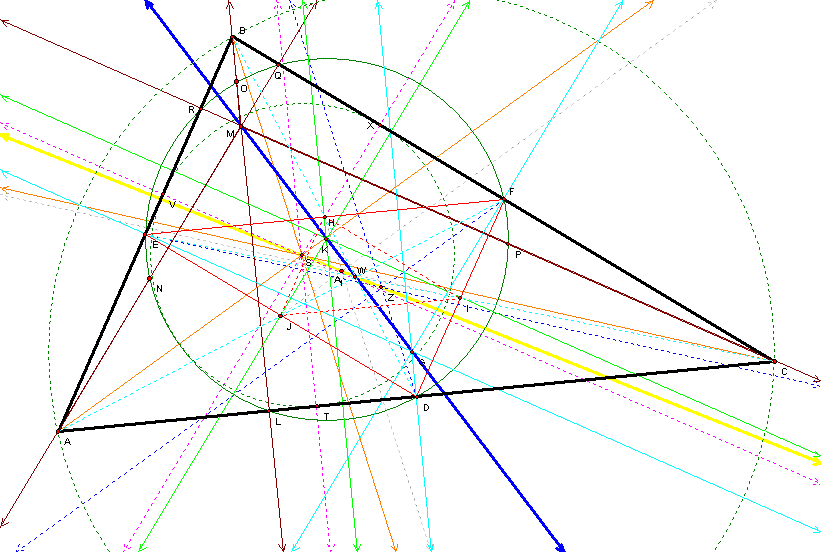
ImageThe original triangle is ABC, and is in bold black. The bold blue line is its Euler Line, and contains the orthocenter (M), circumcenter (G), nine-point center (K), and centroid (point W). It does not, however, contain the incenter (S).

It struck me as odd that the incenter would be different in this way, so I investigated it further. It is the point of concurrence of the three angle bisectors of a triangle. On a lark, I constructed the midsegments of triangle ABC, forming a new, smaller triangle, shown in red. When I then found the incenter of this smaller triangle (Z), it appeared to be collinear with S and W. I checked; it was, and this line is shown in bold yellow. Moreover, the process could be continued with even smaller midsegment-triangle incenters, and they were also on this yellow line.

I wondered if I had discovered something new, and started to check. It didn’t take long to find out that Nagel had beaten me to it. The Nagel line is the official name of this yellow line I stumbled upon, and here is my source:  http://mathworld.wolfram.com/NagelLine.html — but, as far as I know, I did discover that these midsegment-derived points also lie on the Nagel line.

Someone else may have known this before, of coruse. I don’t know, and it doesn’t matter to me, for I had my fun morning playing with triangles, and now feel better than I have in days.

[Side note:  this is my 100th post, and I’d like to thank all my readers and followers, and also thank, especially, those who encouraged me to try WordPress to get a fresh start after Tumblr-burnout. It worked!]


Vortex II

Image

Vortex II

This is one of my earliest paintings (2002), and I painted it when very depressed. It was around this time that I noticed that painting improved my mood, so I kept painting more.

(acrylic on canvas, 16″ x 20″)

An Alternative Explanation for ADD and ADHD

ADD and ADHD are being treated, mostly in children too young to give informed consent themselves, with powerful, addictive, dangerous stimulants. How dangerous? Children have died because of such drugs as Ritalin and its relatives, all of which are amphetamines (feel free to check that with Google). Amphetamines are, of course, commonly known as speed. A large experiment is being conducted with many of America’s youth, with no control group, and woefully inadequate safety protocols.

The ADD/ADHD genes have not been found, nor has the virus, bacteria, nor parasite. Either the cause of ADD and ADHD is very good at hiding, or there simply isn’t one. Serious consideration is due to whether the term “disorder” actually applies to these conditions.

Consider this alternative explanation to the “disease model.” Humans evolved with certain characteristics related to paying attention, which is an obvious survival trait. One can try to pay attention to the myriad things going on, which I call a “wide focus,” or one can tune out most things to focus on one particular thing — a “narrow focus.”

I naturally have a narrow focus, and it takes considerable effort (and is exhausting) to widen it for sustained periods. There’s evidence on this blog:  all those geometrical patterns I like to make require intense concentration, for substantial periods, on a single activity. If ADD is real, I have its opposite.

By contrast, those who have a wide focus are more likely to notice, say, an approaching attacker than I am. Therefore, wide-focus attention is an even better survival trait that merely paying attention, or at least it has been for most of human history. Noticing lots of things, though, makes one naturally distractable, and that doesn’t mesh well with the expectations modern schools have for students — so a lot of students end up labeled and drugged, simply because they are more adapted to certain un-schoollike environments than is the average person. The natural environment in which our species evolved is, of course, nothing like school. If I were alive in the Stone Age, that wouldn’t remain true for long; some sabre-tooth tiger would easily catch me while I was drawing triangles in the dirt with a stick.

The people with a wide focus aren’t sick. There’s nothing wrong with them — except that a characteristic of theirs is not liked by many in education, who then encourage parents to turn to the medical profession — simply to alleviate conflict, in many cases, despite the very real risks to the students who are drugged, often against their will.

Evolution is a natural part of the universe. School, on the other hand, is a human invention. If there is a mismatch, as there often is, where, then, truly lies the disorder? In the students . . . or in the schools themselves?