
OLYMPUS DIGITAL CAMERA
When I read, recently, that “every gallon of gas you save not only helps your budget, it also keeps 20 pounds of carbon dioxide out of the atmosphere,” (source) I reacted with skepticism. Twenty pounds? That seemed a bit high to me.
Just because it seems high, to me, though, doesn’t mean it’s wrong, any more than “about.com” putting it on the Internet makes the statement correct. No problem, I thought: I’ll just do the math, and check this for myself.
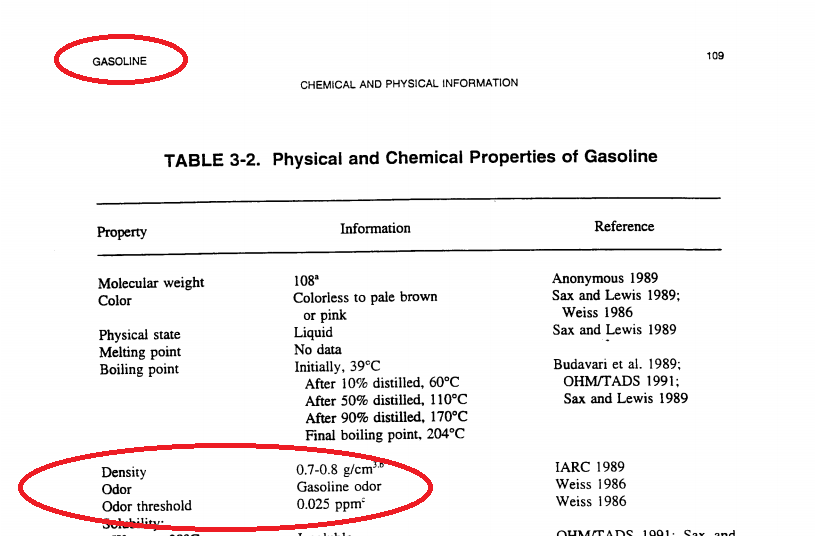
So, in this problem, we start with a gallon of gasoline. In units I can more easily work with, that’s 3.785 liters (yes, they rounded it incorrectly on the gas can shown above). Google tells me that the density of gasoline varies from 0.71 to 0.77 kg/L (reasonable, since it floats on water, but is still heavy to lug around), so I’ll use the average of that range, 0.74 kg/L, to find the mass of a gallon of gasoline: (3.785 L)(0.74 kg/L) = 2.8 kg.
Next, I need to find out how much of that 2.8 kg of gasoline is made of carbon. That would be an easy chemistry problem if gasoline were a pure chemical, but it isn’t, so I’ll estimate. First, I’ll ignore the elements which only make up a minor part of gasoline’s mass, leaving only hydrogen and carbon to worry about. Next, I consider these things:
- Alkanes larger than methane (major gasoline components), whether branched-chain or not, have slightly more than two hydrogen atoms for every carbon atom. This ratio doesn’t exceed three, though, and is equal to three only for ethane, which has too high a boiling point to remain in liquid form at typical temperatures and pressures, anyway.
- Cycloalkanes, another major component of gasoline, have exactly two hydrogen atoms for every carbon atom.
- Aromatic hydrocarbons can have fewer than two hydrogen atoms for every carbon atom, and these chemicals are also a major component of gasoline. For the simplest aromatic hydrocarbon, benzene, the H:C ratio drops to its lowest value: 1:1.
For the reasons above, I’m choosing two to one as a reasonable estimate for the number of atoms of hydrogen for every atom of carbon in gasoline. Carbon atoms, however, have twelve times the mass of hydrogen atoms. Gasoline is therefore ~12/14ths carbon, which reduces to ~6/7. I can now estimate the mass of carbon in a gallon of gasoline: (6/7)(2.8 kg) = 2.4 kg.
So how much carbon dioxide does that make? Well, first, does a car actually burn gasoline completely, so that every carbon atom in gasoline goes out the tailpipe as part of a carbon dioxide molecule? The answer to this question is simple: no.
However, this “no” doesn’t really matter, and here’s why. In addition to carbon dioxide, automobile exhaust also contains carbon present as carbon monoxide, unburned carbon, and unburned or partially-burned hydrocarbons. To have an environmental impact, though, it isn’t necessary for a given carbon dioxide molecule to come flying straight out of the tailpipe of one’s car. In our oxygen-rich atmosphere, those carbon atoms in car exhaust which are not yet fully combusted (to each be part of a carbon dioxide molecule) are quite likely to end up reacting with oxygen later on — certainly within the next year, in most cases — and the endpoint of carbon reacting with oxygen, once combustion is complete, is always carbon dioxide. What’s carbon monoxide, then? Well, one way to look at it is this: molecules of carbon monoxide are simply half-burned carbon atoms. When the other half of the burning (combustion) happens, later, carbon dioxide is the product. So, for purposes of this estimate, I am assuming that all 2.4 kg of carbon in a gallon of gasoline ends up as carbon dioxide — either directly produced by the car, or produced in other combustion reactions, later, outside the car.
The molar mass of elemental carbon is 12 grams. For oxygen, the corresponding figure is 16 g, but that becomes 32 g of oxygen in carbon dioxide, with its two oxygen atoms per molecule. Add 12 g and 32 g, and you have carbon dioxide’s molar mass, 44 g. Therefore, 12 g of carbon is all it takes to make 44 g of carbon dioxide; the rest of the mass comes from oxygen in the air. By use of ratios, then, I can now find the mass of carbon dioxide formed from burning a gallon of gasoline, with its 2.4 kg of carbon.
Here is the ratio needed: 2.4 kg of carbon / unknown mass of carbon dioxide produced = 12 g of carbon / 44 g of carbon dioxide. By cross-multiplication, and using “x” for the unknown, this equation becomes (12 g)(x) = (44 g)(2.4 kg), which simplifies to 12x = 105.6 kg, so, by division, x = 8.8 kg of carbon dioxide produced from one gallon of gasoline.
Each kilogram (of anything), near sea level on this planet, weighs about 2.2 pounds. This 8.8 kg of carbon dioxide, then, translated into “American,” becomes (8.8 kg)(2.2 pounds/kg) = 19.36 pounds. Given the amount of estimation I had to do to obtain this answer, this is close enough to twenty pounds for me to conclude that the statement I was examining has survived my testing. In other words, yes: burning a gallon of gasoline goes, indeed, put about twenty pounds of carbon dioxide into the atmosphere.
However, I’m not quite finished. Carbon dioxide is an invisible gas, making it quite difficult to picture what twenty pounds of it “looks” like. To really understand how much carbon dioxide this is, it would be helpful to know its volume. So I have a new problem: 8.8 kg of pure carbon dioxide is trapped, in a balloon, at standard temperature and pressure. What is the balloon’s volume?
To solve this problem, one needs the density of carbon dioxide under these conditions, which chemists refer to as “STP” (standard temperature and pressure). According to Google, the density of carbon dioxide at STP is about 1.98 kg per cubic meter. Since 8.8 kg / (1.98 kg/m³) = 4.44 m³, this means that a gallon of gasoline can produce enough carbon dioxide, held at STP, to inflate this balloon to a volume of 4.44 cubic meters. For the benefit of those who aren’t used to thinking in metric units, that volume equals the volume of a perfect cube with an edge length of ~5.4 feet. You could fit a bunch of people into a cube that large, especially if they were all on friendly terms.
Now, please consider this: all of that was from one gallon of gasoline. How many gallons of gas do you typically buy, when you fill up your car’s gas tank? Well, multiply by that number. How many times do you fill up your car, on average, in a year? Multiply again. Next, estimate the total number of years you will drive during your lifetime — and multiply again. You now have your own personal, lifetime carbon dioxide impact-estimate from just one activity: driving.
This may sound like a change of topic, but it isn’t: what’s the hottest planet in the solar system? Even though Mercury is much closer to the Sun, the answer is Venus, and there is exactly one reason for that: Venus has a thick atmosphere which is chock-full of carbon dioxide. In other words, yes, the planet nearest the Earth, and the brightest object in the sky (behind the Sun and the Moon), Venus, is one of the best warnings about global warming known to exist, and we’ve known this for many decades. One wonders if any theologian has ever speculated that the creator of the universe designed Venus this way, and then put it right there “next door,” on purpose, specifically as a warning, to us, about the consequences of burning too much carbon.
The science, and the math which underlies it, are both rock-solid: climate change is real. Lots of politicians deny this, but that’s only because of the combined impact of two things: their own stupidity, plus lots of campaign contributions from oil companies and their political allies. Greed and stupidity are a dangerous combination, especially when further combined with a third ingredient: political power. Voting against such politicians helps, but it isn’t enough. One additional thing I will do, immediately, is start looking for ways to do the obvious, in my own life: reduce my own consumption of gasoline. Since I’m putting this on the Internet, perhaps there will be others persuaded to do the same.
The truth may hurt, but it’s still the truth: the United States is a nation of petroleum junkies, and we aren’t just harming ourselves with this addiction, either. It’s time, as a people, for us to invent, and enter, fossil-fuel rehab.
[Image credit: “GasCan” by MJCdetroit – Own work. Licensed under CC BY 3.0 via Wikimedia Commons – https://commons.wikimedia.org/wiki/File:GasCan.jpg#/media/File:GasCan.jpg]




 RobertLovesPi.net