“Antisemitism” has become an inherently confusing word. Here’s how to fix this problem.

symbols

When referring to the Holocaust, it never caused confusion to refer to Nazis as “antisemitic.” German is not a Semitic language, and the non-Semite Nazis were trying to exterminate an ethnoreligious group, the Jews, who are a Semitic people. In that context, the word “antisemitism,” in a European setting, is not difficult to understand. This is also true of antisemitism earlier in European history.

Decades later, and outside of Europe, however, the situation has changed, and the word “antisemitism” is now far less clear in its meaning. The one nation most closely identified with the Jewish people is Israel, and Israel is not in conflict with Germany. Israel is, of course, currently in an active conflict with an organization, Hamas, which has been firing rockets from nearby Gaza across the border, into Israel. In response, Israel has been retaliating, using even greater force than that wielded by Hamas. In this current conflict, there have been numerous deaths of noncombatants, including many children, in Gaza, but no deaths (so far) in Israel. For this reason, some people have raised their voices in criticism of the actions of the Israeli government in the current conflict. Predictably, but not logically, those who are criticizing Israel’s actions are now being accused of antisemitism.

When the word “antisemitic” gets thrown around, in the context of conflicts in the Middle East which involve Israel, it doesn’t help anyone understand anything. The word is actually an impediment to understanding. The reason for this is that “Semite” does not mean what many people think it means. For one thing, most Semites are not Jews.

“Semites” refers to a collection of ethnolinguistic groups — people who speak, or are descended from those who spoke, any of a large collection of languages known as the Semitic languages . . . and one of the Semitic languages is Arabic. Are Jews Semites? Yes, they are, but so are Arabs. The current conflict in the Middle East is a conflict between two different groups of people, both of whom are Semitic. To throw the emotionally-charged word “antisemitic” into the middle of the fray, therefore, makes no sense. It increases confusion, and clarifies nothing. The word also further enflames the emotions of those arguing and fighting, on both sides, in a situation where the exact opposite is needed.

It doesn’t help that many Westerners believe a fallacy related to Arabs, using “Arab” (which refers to an ethnic group) interchangeably with “Muslim,” which is not an ethnic term at all, but one that simply refers to anyone who practices the religion known as Islam. In reality, there are many Arabs who are not Muslims, and there are hundreds of millions of Muslims who are not Arabs. For example, consider the people who live in Iran. The governments of Israel and Iran are often hostile to each other, and Iran has very few Arabs, despite being a nation where an overwhelming majority practice Islam.

When Israel has conflicts with other nations (or organizations, for Hamas is not a nation) in the Middle East, those conflicts are political in nature, with religion playing a strong role as well. Israel is associated with the religion of Judaism (even though much of its Jewish population is only ethnically Jewish, not Jewish in the religious sense of the term), and is often in conflict with others in the Middle East who are associated with the religion called Islam. “Antisemitic,” used as a synonym for anti-Jewish bigotry, is an unfortunate misnomer, but there are alternatives which are better, in the sense that they are more specific, and therefore more clear. There is already a word in common use for fear and hatred of Islam and/or Muslims:  “Islamophobia.”  The corresponding term for fear and hatred of Judaism and/or Jews, including those who are Jewish only in the ethnic sense of the word, is “Judeophobia.” Most of the time, when people use the word “antisemitism,” they actually mean Judeophobia. Since Arabs are, themselves, a subset of the Semites, it would be illogical to refer to a specific person who is both an Arab, and a hater of Jews, as an “antisemitic Arab.”  To describe that person as a “Judeophobic Arab,” on the other hand, makes perfect sense.

Finally, it must be recognized that there are numerous people, within both Judaism and Islam, who do not have within them the blind, furious hatred of the other group that has caused so much death and destruction in the Middle East since the founding of the modern nation of Israel, in the years following World War II. I am referring, of course, to non-Islamophobic Jews, and non-Judeophobic Muslims. One does not often see them featured in the news, especially when conflicts such as the current one are raging, but such people do exist, and their existence should give all people who prefer peace over war hope for the future. May their numbers increase.


Seven Moving Lights in the Sky, the Seven Days of the Week, and Other Significant Sets of Seven

days of week and lights in the sky

Have you ever wondered why the number seven appears in all the places it does? We have seven days in the week. Churches teach about the seven deadly sins, and “seven heavens” is a common phrase. There are seven wonders of the ancient world, and seven of the modern world. The number seven has appeared in many other socially significant ways, in societies all over the world, for millennia.

It is no coincidence, I think, that the ancients were able to see seven lights in the sky which are either visible in daylight, or move against the background of “fixed” stars at night. They ascribed great significance to what went on in the sky, since they viewed “the heavens” as the realm of the gods in which they believed. The evidence for this lives on today, in the names of the seven days of the week, and numerous other sets of seven, all over the world.

It is possible to see the planet Uranus without a telescope, but it is very dim, and you have to know exactly where to look. No one noticed it until after the invention of the telescope. If Uranus were brighter, and had been seen in numerous ancient societies, I have no doubt that we would have eight days in the week, etc., rather than seven.

Forgiveness: Not a Virtue, But a Dangerous Practice

Over the millennia, religion has done much harm, in myriad ways. Of the major world religions, the one that places the greatest emphasis on forgiveness is, to my knowledge, Christianity. This was an error in reasoning made many centuries ago, and it is impossible to calculate the amount of harm this doctrine has caused . . . but the number of people harmed by this terrible idea certainly numbers in the millions.

Consider one of the most oft-quoted passages from the New Testament concerning this topic, from Matthew 18:21-22 (NASB):  “Then Peter came and said to Him, ‘Lord, how often shall my brother sin against me and I forgive him? Up to seven times?’ Jesus said to him, ‘I do not say to you, up to seven times, but up to seventy times seven.’” Seventy times seven is, of course, 490, but it is rare to find anyone who takes that number literally. It is much more common to encounter the explanation that large numbers were viewed differently in the ancient world, and “seventy times seven” was simply a way for Jesus to say, in a way Peter would understand, “an indefinitely large number.”

Now, consider what we know about the modern world. At least one-third of women are raped during their lifetimes. Serial killers often murder dozens of people before getting caught. Powerful people, in positions of public trust and great responsibility, betray that trust for their own selfish reasons. This list could be much longer, but I trust the point has been made:  you live in a world with many others in it who are not nice people . . . and many of them have no intention of changing.

Consider this:  a newly-married woman discovers her husband is betraying her in one of the worst possible ways, by sexually molesting children who live in nearby homes. She decides to leave him, and contacts her (devoutly religious) family, asking for help – only to be told that marriage is a sacred covenant, divorce is a sin, and the evil deeds of others are, according to the Bible, supposed to be forgiven. “Pray for him,” she is told — but the real support she is asking for is not given. She tries to forgive him. She stays in the marriage for many more years. The unsurprising result? Dozens more children are abused by the man over the following decades, with far-reaching, horrible consequences.

That last example was not hypothetical. The woman, and her family, are people I know.

There are people – many of them – who simply do not deserve to be forgiven for the crimes they commit. They are dangerous, and will remain so, until and unless they are stopped. Some stop only when they die — and those deaths, I do not mourn. Others are caught, tried, convicted, and imprisoned. However, those people are, too often, released while still dangerous, due to another nonsensical idea (that of having paid one’s “debt to society”), or simply because prisons are overcrowded with many people who only committed non-violent illegal acts. Both problems are easy to solve, however. First, we should stop locking up non-violent offenders – that’s the obvious part of the solution. The other part is more difficult, for it would require major legislative changes:  the abolition of specific, time-limited sentences for violent criminals.  Why lock up, say, a murderer or rapist for ten years, and then let them go, more dangerous than ever? It would make more sense to leave such people – anyone who is clearly dangerous to the rest of us – locked up for life, or at least until they have become so weakened by illness or advancing age that they are no longer capable of harming other people.

What about lesser offenses? What if, for example, you catch someone you know in a harmful, deliberate, and malicious lie? Should you forgive them? My answer is often a flat “no” – at least, not until the person has regained the trust they have damaged or destroyed, and sometimes that simply is not possible. (Who decides when trust is restored? The person who was lied to, of course.) Forgive a pathological liar, and what you are really doing is inviting them to lie to you again. A far better thing to do would be to warn others not to trust the liar, and explain exactly why that is the case.

Some who wish to cling to their religious beliefs, even when those very beliefs cause obvious problems, have devised a way to try to get around the problem that forgiving those who harm you, or your loved ones, invites further harm. You are likely to have heard it, or something like it:  “I forgive them, but I will not forget what they have done, for they may well do it again, and I must be on my guard.” Such a statement is an improvement over total, unconditional forgiveness, but it is not without problems. First, if one is constantly vigilant for a repeat offense, has forgiveness really taken place? Not by the Biblical standard of divine forgiveness of the evil deeds of people, it hasn’t, as Hebrews 8:12 (NIV) makes clear: “For I will forgive their wickedness and will remember their sins no more.” Many other verses tie the acts of forgiving and forgetting together. Separating the two, as many people do now, is an improvement, to be certain . . . but it is in no sense an idea rooted in either the Bible, or in traditional Christian doctrine. It is, instead, a modern concession to reason and common sense.

What about really small things?  Accidents, honest mistakes . . . that sort of thing?  Is there a problem with forgiveness in those sorts of situations?  No, there isn’t . . . but there also would have been no problem with not getting angry at a person for such a “crime” in the first place. As a good rule of thumb, if it made perfect, rational sense to get angry at someone because they did something truly terrible, then it does not make sense to forgive them for it ten minutes later, nor the next day . . . perhaps not even until they die, because at that point, the chances of them repeating the offense drops to zero. In other words, it isn’t yet time to forgive a person who still poses a danger. This is simple logic.

Monsters in human form, like everything and everyone else, are part of the physical universe. If one or more of them does something terrible to you, or to someone you care for, it makes sense to take steps to prevent their repeating such an act. It does not make sense to forgive them for it. To do so is the equivalent of telling the universe that you want you or your loved ones to have to endure further suffering. That is not a logical way to live one’s life. “Forgiveness is a virtue” is a pernicious idea – one we should, as a species, leave in the past, if we want to make progress in the future.

Stained-Glass Window for the Church of the Sun

Image

Stained Glass Window from the Church of the Sun

If there actually is a Church of the Sun somewhere, they have my permission to use this as a design for a stained glass window, free of charge. It’s based on a semi-regular tessellation of the plane which uses regular dodecagons, squares, and triangles.

The True Story of My Attempt, with a Friend, To Invent a Religion

Image

The True Story of My Attempt, with a Friend, To Invent a Religion

Many years ago, with the help of a friend, I attempted to create a new religion. The idea to try this was prompted by observation:  everywhere we looked, we saw examples of religion gone horribly wrong (persecution of gays, oppression of women, religious wars, etc.), although we were willing to concede that, centuries ago, many or most religions might have started with good intentions.

This took place in the American South, during the Reagan era, and that, no doubt, had a strong influence on our approach. First and foremost, we wanted to make certain that nothing be included in this new religion which was ever incorrect, or could be subject to misuse — and so anything proposed for inclusion had to be thoroughly analyzed and debated, with an eye towards the tendency of human beings to screw everything up. If we were going to go to all the trouble of inventing a religion, after all, we did not want that to happen to it.

It took a while for us to decide where to begin. Selecting a supreme being was rejected as a starting point, on the grounds that neither of us had compelling evidence for such a being’s existence. Therefore, we turned away from considerations of the supernatural, and instead examined questions of ethics and human behavior.

An important question came up in our discussion: what were things people actually do which are always wrong, in the sense that such actions could never, under any circumstances, be justified? It seemed like a good place to start. First, we considered various acts of violence, starting with people killing people.

This provided a good jumping-off point for considering specific acts for our “things not to do” list, but it didn’t take long to decide against including the act of killing someone on our list of acts that could never be justified. Sometimes, after all, people have good cause to use deadly force against an attacker, in self-defense. We also discussed the situation where someone has to choose between letting an attacker kill their family, or killing the attacker first, to prevent a larger slaughter. For these reasons, therefore, we did not include a prohibition against killing — although we certainly weren’t going to encourage it, either. Most killings of people, after all, cannot be justified — but we were looking only for those acts which could never be justified.

We then turned our attention to the crime of rape. This was not a hypothetical topic to us, at all; both of us knew people, very close to us, who had survived being raped. We could think of no set of circumstances which could ever possibly justify such an act, and so we agreed that we had found the first item on our list of acts which were always wrong. Don’t rape: what sane person could possibly argue with that?

Having settled on that, we tried to find another never-justifiable act. We discussed the taking of others’ possessions — stealing — and quickly realized that neither of us would be willing to condemn a person who stole food from a store to feed their starving family. Theft, therefore, did not make our list.

What about torture, though? The only possible situation we were even willing to consider where torture might be justified was for the purposes of obtaining vital information in an emergency. For example, if some lunatic is known to have planted a bomb somewhere, is the use of torture, to find the bomb’s location in time to disarm it, a justifiable act?

We decided it was not, on the grounds that, when tortured, people can be coerced to say anything, true or false. In other words, information gained via the use of torture is simply unreliable. Having disposed of the only proposed justification we could think of for the use of torture, we decided it should be included, with rape, on our list of unjustifiable acts.

At that point, I looked around. We were outside, in a large open area near both a school, and several apartment complexes. I noticed empty beer cans, and broken glass bottles, all over the place. The wind blew paper and plastic debris past us. I then spotted several mostly-unused trash cans, and imagined a small child running around, barefooted. If people had actually made the small effort to put all this trash I was seeing in the trash cans, such a child could run around much more safely — but, as things actually were, the simple act of a child playing barefoot wouldn’t be safe at all. One misstep, and a happily playing child would become a crying kid, bleeding, due to broken glass which could easily have been thrown away properly — and should have been.

“I’ve got a third one,” I said, as I picked up a nearby piece of discarded, broken glass, and threw it away. “Littering. Who needs trash, like this, all over the place?”

My friend responded with laughter, but did not disagree. Our list of unjustifiable acts was now up to three: rape, torture, and littering.

After that, we kept talking, but moved on to other topics. We were teenagers, after all, and our attempt to invent a new religion had already occupied our minds for much longer than the typical teenager’s attention-span. This was as far as we made it, on this particular project.

Now that I consider it, decades later, though, perhaps we didn’t take this any further because there simply was no need to do so. Imagine, for a moment, how much more pleasant life would be if no one committed rape, nobody was ever tortured, and people stopped throwing their trash everywhere. Also, try — just try — to imagine someone perverting such a simple set of three ethical principles into a holy war, an inquisition, or an effort to oppress some hated subgroup of the population. I can’t see it happening, myself.

This much is certain: many other attempts have been made to invent religions, and some have succeeded . . . with, in many cases, much harm happening as a result. Religion, and religious differences, have been the cause of millions of deaths, throughout history, and our brief foray into religion-building will have no such dire consequences.

James Randi, on the Limited Effectiveness of Belief

Image

James Randi, On the Effectiveness of Belief

One of the high points of my life was the day I got to have several conversations with James Randi. I enjoyed them. Some others who were there, though, not so much.

An example of how one of the question-and-answer sessions went:

Question: What happens to us after we die?
Randi’s answer: What happens to a computer after you turn off the power?

Apparently the questioner was rather upset by this reply, but I didn’t figure that out myself, even though I was present. I learned about it later, from others. Randi’s response simply made sense to me.

Can a Public School Student Read a Bible in Class?

Image

Can a public school student read a Bible in class?

Yes, but not loudly, waving it around, while I am explaining the safety protocols for laboratory use of silver nitrate in chemistry class.

It’s dangerous stuff, as you can see here: http://www.sciencelab.com/msds.php?msdsId=9927411.

Did this actually happen? Of course — I don’t think I could make up a story like that. It happened in a different class than the one I am teaching this year, though. The student’s name is being withheld, to protect his identity (and my job).

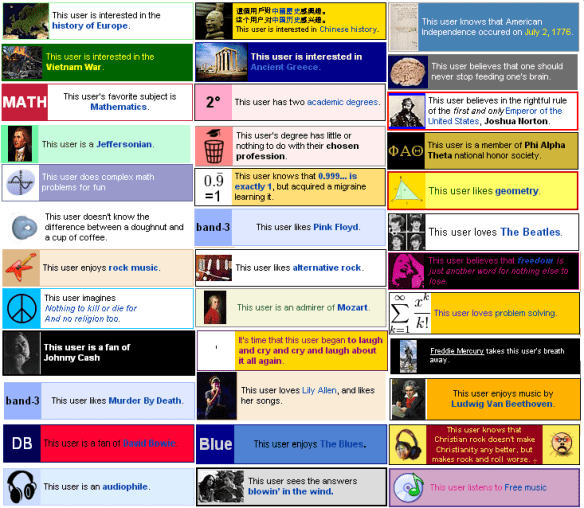
My Wikipedia Userboxen Collection, Part III

Image

My Wikipedia Userboxen Collection, Part III

And, yes, there are even more….

My Wikipedia Userboxen Collection, Part II

Image

My Wikipedia Userboxen Collection, Part II

Collecting userboxen on Wikipedia is fun, but almost no one (except other Wikipedians) ever sees such collections. Since you can learn a lot about a given Wikipedian by their collection of userboxen, my blog seems like a good place to re-post my collection. It’s being done in pieces, simply to maintain legibility.

My Wikipedia Userboxen Collection, Part I

Image

My Wikipedia Userboxen Collection, Part I

I’ve been editing Wikipedia under my own (legal) name for years, although I just submitted a request to have my Wikipedia-name changed to match the name of this blog. Every Wikipedia user has a user page, and can put these userboxen on it. Here’s the first part of my collection.