Amazing Discovery! Gasoline Smells Like . . . .

duh

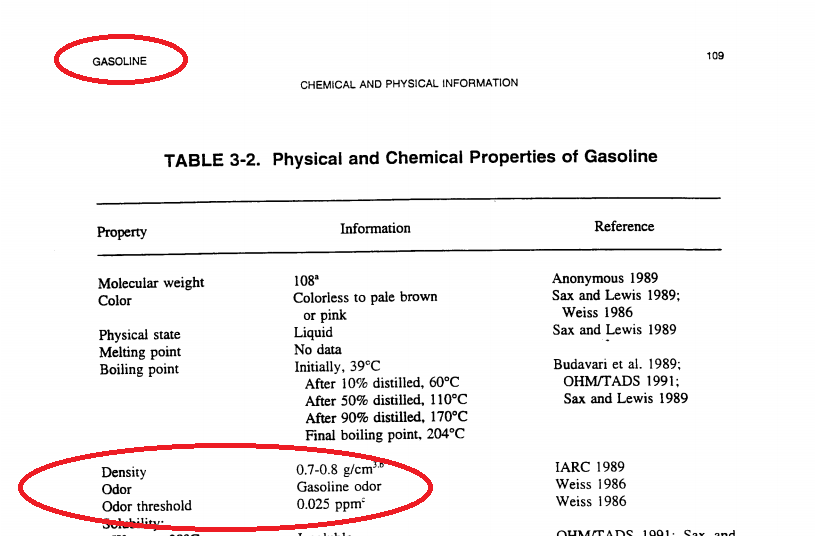
In this source, http://www.atsdr.cdc.gov/toxprofiles/tp72-c3.pdf, on p. 109, the CDC oh-so-helpfully describes the odor of gasoline as a “gasoline odor.” Yes, really. They even cite a source for this fact, as if it were ever questioned by anyone. I’m glad to see my tax dollars going to such ground-breaking research — aren’t you? Here’s a screenshot (I added the red ellipses):

gasoline smells like gasoline

Now I have a headache.

Riddle: How did the chemist accidentally kill his dog?

Answer: He fed him a whole can of aluminum phosphate.

Aluminum phosphate

Disclaimers: (1) no actual dogs were harmed in the making of this awful pun, and (2) yes, I actually did the math regarding the toxicity of aluminum phosphate. Don’t feed it to your dog!

Orcus and Vanth

There’s a binary dwarf-planet-candidate / large satellite pair, way out in the outer solar system, called Orcus and Vanth. Much like the “double dwarf planet” Pluto/Charon, and the other satellites in that system, Orcus and Vanth orbit the sun in a 3:2 resonance with Neptune, and this orbit crosses that of Neptune, as well. The Orcus/Vanth binary system is sometimes referred to as the “anti-Pluto,” because, unlike most “plutinos” (as such distant objects, in orbital resonance with Neptune, are called), Orcus and Vanth have a strange — and, so far, unexplained — relationship with the Pluto/Charon system. When Pluto and Charon are closest to the sun (perihelion), Orcus and Vanth are at their furthest from the sun (aphelion), and vice-versa. So far as I have been able to determine, this is not true for any other known plutinos. For more on the real Orcus and Vanth, please check this Wikipedia page.

Those are the scientific facts, as we know them . . . and now, it’s time for some silliness. On Facebook, recently, I mentioned that “Orcus” and “Vanth” really would make good names for comic book characters, but that I couldn’t decide what they should look like, nor what powers they should have. A discussion with some of my friends followed, and, together, we decided that Orcus should be a tough fighter-type, while “Vanth” sounded like a name for some sort of spell-caster. It didn’t take long before I decided I should visit one of the numerous create-your-own-comic-book-character websites, and go ahead and make quasi-anthropomorphized images of Orcus and Vanth — the characters, not the outer solar-system objects.

I used a website called Hero Machine for this diversionwhich you can find here. First, I created an image for a character named Orcus.

orcus

Unfortunately, I didn’t discover (until it was too late) that this website allows the user to change the background . . . and I didn’t want to re-make Orcus, so I went ahead and created an image of his companion, Vanth, instead.

vanth

I don’t have the time, nor the artistic talent, to write and illustrate actual comic book stories featuring this pair of characters . . . but perhaps someone will read this, and decide they want to take on such a project. That’s fine with me . . . but I want credit (in writing, each issue) for creating them, and, if the endeavor makes any money, I want at least 20% of the profits, and that’s if I have nothing more to do with creating Orcus and Vanth stories, beyond what is posted here. If I do have additional involvement, of course, we’ll need to carefully negotiate the terms of a contractual agreement. I consider 20% fair for simply creating images of this pair of characters, but actually co-creating stories would be something else altogether.

By the way, although Orcus certainly looks scarier, Vanth is actually the more formidable of the pair. She just pretends to play the “side-kick” role, in order to preserve the element of surprise, for situations when, during their adventures, Orcus finds himself in over his head, and Vanth then needs to really cut loose with the full extent of her abilities.

A Table of Known Masses for Numerous Objects in the Solar System, in Kilograms, Solar Masses, Jovian Masses, Terran Masses, and Lunar Masses

solar system object masses

The source of the information in the first two columns is this Wikipedia page. I calculated the numbers in the other columns, so any errors there are my own.

There are many other objects of known mass in the solar system, but I tried not to skip any, as I worked from larger-mass objects down toward those of smaller mass. Skipping some was necessary, though, for there are many objects (the likely dwarf planet Sedna is but one example) for which the mass is simply unknown. The next one I encountered after the asteroid Pallas did not have a name, but merely an alphanumerical designation, so I decided to stop there.

Richard Feynman, on Solving New Problems

richard-feynman on solving new problems

Albert Einstein, on Morality

albert-einstein-14

Richard Feynman, on Computers

feynman on computers

“You Majored in WHAT?”

I’m in my twentieth year of teaching mostly science and mathematics, so it is understandable that most people are surprised to learn that I majored in, of all things, history.

It’s true. I focused on Western Europe, especially modern France, for my B.A., and post-WWII Greater China for my M.A. My pre-certification education classes, including student teaching, were taken between these two degree programs.

Student teaching in social studies did not go well, for the simple reason that I explain things by reducing them to equations. For some reason, this didn’t work so well in the humanities, so I took lots of science and math classes, and worked in a university physics department, while working on my history M.A. degree, so that I could job-hunt in earnest, a year later, able to teach physics and chemistry. As it ended up, I taught both my first year, along with geometry, physical science, and both 9th and 12th grade religion. Yes, six preps: for an annual salary of US$16,074.

History to mathematics? How does one make that leap? In my mind, this explains how:

  • History is actually the story of society over time, so it’s really sociology.
  • Sociology involves the analysis on groups of human minds in interaction. Therefore, sociology is actually psychology.
  • Psychology is the study of the mind, but the mind is the function of the brain, one of the organs of the human body. Psychology, therefore, is really biology.
  • Biological organisms are complex mixtures of interacting chemicals, and, for this reason, biology is actually chemistry.
  • Chemistry, of course, breaks down to the interactions of electrons and nuclei, governed by only a few physical laws. Chemistry, therefore, is really physics.
  • As anyone who has studied it knows, physics often involves more mathematics than mathematics itself.

…And that at least starts to explain how someone with two history degrees ended up with both a career, and an obsession, way over on the mathematical side of academia.

Does Everything Move at the Speed of Light?

everything moves at c

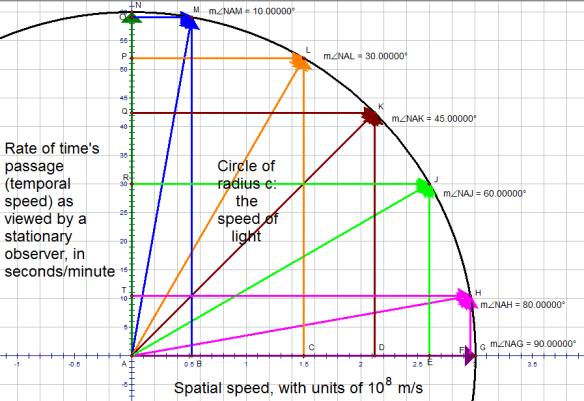
I have a friend who once explained to me his way of understanding spacetime, and what Einstein discovered about it, which was to start with the idea that, as he put it, “everything is traveling at c,” and proceed from there. Light travels at c, of course, but time does not pass for light, forming vector AG, shown in purple. A spatially-stationary rock is still traveling — temporally, into the future, at a rate of sixty seconds per minute, as represented by dark green vector AN. My friend’s idea was to interpret this rate of time-passage — the normal time passage-rate we generally experience — as another form of c. Sublight moving objects are moving at c, according to this idea, as a vector sum of temporal and spatial velocities. In this diagram, all spatial dimensions are collapsed into one direction (parallel to the x-axis), while time runs up (never down) the y-axis, into the future (never the past).

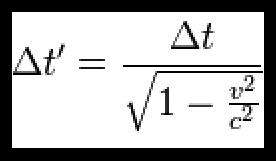
I don’t know why it took me perhaps a decade to see that my friend’s idea is testable. Better than that, the data needed to test it already exist! All I need to do is cross-check the predictions of my friend’s idea against a thoroughly-tested formula regarding relativistic time dilation. The relevant equation for time dilation is this one, which you can find in any decent Physics textbook:

equation for time dilation

In the diagram at the top of this post, the blue horizontal component-vector NM represents a spatial velocity of (c)sin(10º) = 0.173648c. It is a component of the total velocity of the object represented by blue vector AM, which is, if my friend is correct, is c, as a vector-sum total velocity — the sum, that is, of temporal and spatial velocities. By the equation shown above, then, the measured elapsed time for an event — say, the “minute,” in “seconds per minute” — to take place, at an object with that speed, as measured by a stationary observer, should be 1/sqrt[1-(0.173648)²] = 1/sqrt(1 – 0.0301537) = 1/sqrt(0.969846) = 1/0.984808 = 1.01543 times as long as the duration of the same event, for the observer, with the event happening at the observer’s location.

Now, if time is taking longer to pass by, then an object’s temporal speed is shrinking, so this slightly longer elapsed time corresponds to a slightly slower temporal speed. As seen in the equations above, near the end of the calculation, the two have a reciprocal relationship, so such an object’s temporal speed would only be 0.984808(temporal c) = 0.984808(60 seconds/minute) = 59.0885 seconds per minute. Therefore, an object moving spatially at 0.173648c would experience time at 0.984808k, where k represents the temporal-only c of exactly 60 seconds per minute — according to Einstein.

Next, to check this against my friend’s “everything moves at c” idea, I need only compare 0.984808 to the cosine of 10º, since, in the diagram above, based on his idea, vector BM = (vector AM)cos(10º). The cosine of 10º = 0.984808, which supports my friend’s hypothesis. It has therefore just passed its first test.

As for the other sets of vectors in the diagram, they provide opportunities for additional testing at specific relativistic spatial velocities, but I’m going to skip ahead to a generalized solution which works for any spatial velocity from zero to c, corresponding to angles in the diagram from zero to ninety degrees. Substituting θ for 10º, the spatial velocity, (c)sin(10º), becomes simply (c)sinθ, which corresponds to a temporal velocity of (c)cosθ, with it then necessary to show that the “cosθ” portion of this expression is equivalent to the reciprocal of 1/sqrt[1 -(sinθ)²],  after the cancellation of c² in the numerator and denominator of the fraction, under the radical, in the denominator of Einstein’s equation for time dilation. By substitution, using the Pythagorean trigonometric identity 1 = (sinθ)² + (cosθ)², rearranged as 1 – (sinθ)² = (cosθ)², the expression 1/sqrt[1 -(sinθ)²] = 1/sqrt[(cosθ)²] = 1/cosθ, the reciprocal of which, is, indeed, cosθ, which is what needed to be shown for a generalized solution.

My friend’s name is James Andrew Lemley. When I started writing this post (after the long process of preparing the diagram), I did not know what result I would get, comparing what logically follows from Andrew’s idea with the well-tested conclusions of Einstein’s time-dilation formula, at even one specific relativistic speed. Andrew, I salute you, and think this this looks quite promising. Based on the calculations above, and after all these years, I must tell you that I now think you are, indeed, correct: in a sense that allows us to better understand spacetime, we are all moving at c.

Star and Protostar

First, Protostar:

2012 protostar ic

In nature, protostars collapse under their own gravity until enough heat is generated to ignite nuclear fusion, at which point they become stars. The image above is my interpretation of a protostar, just before the moment it becomes a star. As for Star, my post-ignition interpretation, here it is:

2012 star ic

While I did just make these images, they are simply inverted-color versions of images I made back in 2012, using Geometer’s Sketchpad. Here are the original-color versions (which I don’t like as much, myself), presented in a smaller size. You may enlarge either or both with clicks, if you wish.

2012 protostar2012 star