Attention, Tumblr: Learn the Meaning of the Word “Literally”

I just got an e-mail, from Tumblr (I used to blog a lot there, before coming here to WordPress). The e-mail has the title, “Your Dashboard is literally on fire.” I’m now afraid to go look at my car, OR log on to my old Tumblr account. I dislike being burned.

On Sportsball, As Viewed By One Aspie

Image

On the Varieties of Sportsball

Since I live in the American South, I hear a lot of talk about about sportsball. I have a hard time, though, telling exactly which variety of sportsball is being discussed. I don’t find sportsball interesting, and so I’m not fluent in any variant of sportsball jargon. For that reason, it can be difficult for me to tell which sportsballspeak-dialect is being used.

So, sometimes, just to try to make friendly conversation (while still being myself), I ask sportsball-fans questions, in order to find out which version they’re so intently discussing. (Figuring out why people obsessively talk about sportsball so much, I think, is a mystery I’ll never solve. Understanding the strange behavior of non-Aspies is much more difficult than the types of problems I enjoy trying to solve. As Albert Einstein said, when declining the presidency of Israel, “I have no head for human problems.”)

Here’s an example of one such question: “Are you talking about the type of sportsball often played inside, with a bunch of people chasing an orange sphere around on a wooden rectangle, and trying to get the sphere to pass through a metallic, elevated circle of slightly larger diameter than the sphere itself?”

Now, if someone mentions the sportsball game most people call “football,” there’s an obvious follow-up question that needs to be asked . . . so, of course, I ask it:  “Which one?”

Replies to that question usually go something like this: “Whaddya mean, which one? Football! We’re talking about football, ya nerd!”

“But there are at least two games called by that name, which confuses me. Do you mean the sportsball-version where the players chase a prolate spheroid, or a rounded version of a truncated icosahedron?”

If they don’t understand that question, I attempt clarification: “You know, both those versions of sportsball are played on rectangles covered with grass . . . but the one with the prolate spheroid has two giant tuning forks at opposite sides end of the grassy rectangle, is usually played in the USA, and has a far higher rate of injuries, even fatal ones. The one that uses a truncated icosahedron doesn’t have tuning forks, is called ‘football’ by far more people than that American game, and isn’t nearly as dangerous. I think it’s at least a little more interesting than that other game people call ‘football,’ because of the Archimedean solid they chase around, since I like polyhedra. Which one are you discussing?”

If they tell me they’re talking about American football, I usually follow-up with a brief rant, for that sportsball-variant’s name confuses me. “Why do people call it that, anyway? I’ve seen it being play a few times — not for a full game, of course, but I can stand to watch it for a few minutes. That’s long enough to tell that the players only rarely use their feet to kick the prolate spheroid, and usually carry or throw it instead, using, of course, their hands. They usually use their feet just to run around chasing each other. Calling that version of sportsball by the term ‘football’ doesn’t make sense at all. In the game the rest of the world calls ‘football,’ the players kick the ball all the time, so I can understand why it has that name, but that prolate-spheroid version really should be called something else! Also, why are the games sometimes called ‘bowl games?’ They still play on a rectangle, and chase a prolate spheroid — there’s no actual bowl involved, is there?”

On occasion, they aren’t talking about any of these three varieties, though, but yet another form of sportsball. (Why are there so many?)

baseball

“Oh! You must mean the one played on a ninety-degree sector of a circle, with a square (confusingly called a ‘diamond,’ for some reason) in its interior, positioned such that one of its vertices is at the circle’s center. At that vertex, there’s a convex-but-still-irregular pentagon on the ground, while the other three vertices of the large, grass-covered square have much smaller squares on the ground, instead of a pentagon. The guy standing at the pentagon is always trying to hit a red-and-white sphere with a wooden or aluminum stick, but he usually misses. The guy who throws the sphere toward the region above that pentagon usually scratches himself, and spits — a lot. He must be important in some way, for he’s provided with a small hill to stand on, literally placing him above the rest of the players. Have I got it now?”

Sometimes, people try to get me to stop calling these strange activities “sportsball,” by bringing up hockey as an objection. “You can’t call all sports ‘sportsball!’ What about hockey? It doesn’t even have ball! It’s got a puck!”

I’m always ready for this objection, though. “You mean the one with the short black cylinder that slides across ice? That’s a sport? I thought it was just an excuse to have fights!”

One Aspect of Having Asperger’s (at least for one of us)

Image

One Aspect of Having Asperger's (at least for one of us)

Aspies (a term for ourselves, used by those with diagnosed or undiagnosed Asperger’s) sometimes have trouble understanding what people say, because we tend to view things literally, while many others often say things in non-literal, or even anti-literal, ways.

For example, without reasons known to us, person A says something offensive to person B. Why deliberately offend someone, without good cause? We don’t know. Person B then says, in response, “Say that again!” — and Aspies who hear this (and we do, for we’re everywhere) often become even more confused. Clearly, person B does not actually want to be offended again, yet is telling person A to do exactly that which person B does not really want person A to do. I’ve asked people to explain this behavior more than once, tried to understand it, and each time I revisit the subject, I become more confused than before, for understanding the explanation would involve bending my mind in a direction it simply won’t bend. I also must admit I do not want my mind to bend that direction, either, for fear that doing so would weaken my ability to reason logically.

This is true for much of what I hear. Things that do not make logical sense are inherently hard to understand, at least for us . . . and I don’t even understand why everyone isn’t like us in this respect, either.

“Strong Grape Juice”

Image


My earliest memory of a church service involves a trip to visit relatives, and I started discovering how different from others I was at a very young age. This is one of the episodes which played a major role in that discovery.

I was only four or five years old, and had already developed an intense hatred of being bored. Ignoring the sermon seemed like an even more boring prospect that actually paying attention to it, so I consciously chose the latter, which I’ve observed is often not the choice young children make.

This church’s denomination is one of those that teaches that drinking alcohol is sinful. They are also Biblical literalists. This, of course, poses a problem, for there is a lot of drinking of wine to be found in the Bible. This preacher didn’t avoid the contradiction, though. His task, that Sunday morning, was to deal with it head-on, and he did so with the following claim: when Jesus, his disciples, and numerous other people from the Bible are described as drinking wine, that wine actually contained no alcohol. It was not wine as we know it today. It was, rather, merely “strong grape juice.” Those were his exact words.

Even at that young age, I had already started working on building, in my own mind, the best crap-detector I could possibly create. (Improving it is still something I work on today.) I didn’t yet realize that real wine would be far safer, before refrigeration existed, than grape juice, simply because alcohol, at the concentrations found in wine, kills lots of disease-causing bacteria. However, that morning, I had learned enough to instantly recognize this “strong grape juice” claim as absolute crap.

Dismissing the preacher as not worthy of further attention, I stood up in our pew, and turned around to face the back of the church. We were sitting near the front, so this let me see most of the congregation. I didn’t need to speak to them — I just wanted to look at them. I remember being stunned by what I saw. Nearly everyone appeared quite attentive to the sermon. Some mouths were half-open, and numerous heads were nodding in agreement with the preacher’s droning nonsense. I figured it out: they were actually accepting what this man was saying as the truth, and were doing so without question! They believed him! At first, I felt dizzy, and then, later, I felt sick. The more I thought about the experience, the worse I felt, and I could think about nothing else for a long time after that church service finally ended.

I’d been exposed to religion many times before, but it always seemed to me that adults didn’t really believe what they were saying, any more than when they told children my age about the Tooth Fairy or Santa Claus. At that moment, though, I realized I had been mistaken. This was no act. These people, in that church that day, actually believed what they were told. Why? I didn’t know. I still don’t. If that man told them that two plus two equals six, would they believe that? I suspected they would.

I was surrounded by a herd of sheep. That moment of clarity, when I realized this fact, scared me. It made me wonder, and not for the last nor first time, if I had been secretly planted on earth by aliens, as a baby, and without a guidebook.

This is only one of many experiences that convinced me of the importance of skepticism. The fact that it is so clear, in my memory, leads me to think it was one of the more important of those experiences. It cemented, in my mind, a scary truth: the world is infested with large numbers of incredibly gullible, deluded people. They weren’t like me. I didn’t understand them. They were everywhere. I wasn’t anything like them, and didn’t want to be, either. I was, however, stuck here with them.

I was stranded on the wrong planet, with no prospect for escape, any time soon. That was over forty years ago, and I’m still here.

Asperger’s and Social Conventions

A common misconception about Aspies, in my opinion, is that we simply are not capable of understanding many social conventions, and that’s why we’re known for “failure” to follow them.

In some cases from my life, it is exactly that simple, but not most of the time. The whole of reality is messy and complicated, and there’s another explanation that accounts for more of this phenomenon.

Remember, Aspies think differently from other people, by definition. Sometimes, we have analyzed a set of social conventions carefully — for how else are we going to understand them? — and see them, therefore, for what they really are.

What are they, really? Well, some are insidious and evil. Consider, for example, the social conventions which have played strong roles in creating eating disorders. What good do those memes do anyone? Would we not all be better off without them? In a sense, then, some Aspies know some social conventions too well to follow them, and we do this on purpose. If you see through something, you’ll notice if it’s idiotic, and, if it is, then it’s perfectly natural to want nothing to do with it.

Not all social conventions are without merit, but many are not only that, but are actively pernicious. The ability to often identify which these are, and then avoid them, is not something I would quickly trade away.

Thoughts On Asperger’s


Image

After many years of curiosity, I took a detailed Asperger’s test on-line. This graph shows the results. When I discussed the possibility with my psychiatrist, he said “It’s entirely possible,” but shied away from a definitive diagnosis, for that takes a team, and has a high cost, in terms of time and money, as well.

Many (I’m one) view Asperger’s as a difference, not a disorder, nor disease, in need of treatment or cure. (What we need is for the rest of the world to begin behaving logically, but that’s a separate rant.) I suspect my doctor agrees with this, which would be an additional, understandable reason for him not to liberally hand out “Asperger’s” labels.

I know this much: I either have it, or I share a lot of characteristics with those who do. I also know that a difference which makes no difference is not a real difference. I therefore see no reason to shell out thousands of dollars for a useless diagnosis. Why would it be useless? Well, there is no treatment, and I wouldn’t want one if it became available, anyway. I’m used to being this way, I like who I am, and am not remotely interested in being more like most people.

Other people (many of them, anyway) drive me nuts, for more reasons than I could easily list, but “they care what others think” is near the top, and is surely the most baffling of these reasons, to me.

Most diagnosed Aspies I’ve met are, by contrast, comforting for me to talk to. Since we find the same things about social life bizarre, it’s much like talking to people from the same planet as my own who have found themselves on this alien world called Earth, uncertain how we got here. It’s a lonely existence (no matter how many friends surround you, for you’re still trapped in your own head), and it helps, somehow, to talk to others with similar perceptions.

I have run into a small number of Aspies who dislike those who consider themselves to be part of the Aspie community, as I do, yet have not had a formal diagnosis. One benefit of being like I am, though, is that it is incredibly easy for me to disregard what particular people think, feel, or say — if I simply choose to — and that is what I have done with the small number of “Aspie Exclusives.” Their attitudes only affect me if I allow that to happen, and I simply choose not to do that.

The bottom line is this: so far, studying Asperger’s helps me understand myself. It clears up many long-standing puzzles when I see that my years of talk about “the normals” is a excellent match for the way Aspies describe, and discuss, what they call “neurotypicals.” I’m not a big fan of the term “neurotypical,” though, for it seems like a condescending and vaguely-insulting term to me, and I do not see that as helpful to anyone, inside or outside the Aspie community. (I do understand the motivation for it, though, for my motives were similar when I talked about “the normals,” in years long past.) My proposal for an alternative term is non-judgmental, and non-insulting, but remains accurate, and is simple in the extreme: I refer to the people who are not Aspies by the clear, concise, easy-to-understand term, “non-Aspies,” or, when a more formal term is called for, “people without Asperger’s.”

I also don’t care to seek an official diagnosis — because that whole enterprise completely misses the point. Aspies aren’t defective, except in the sense that all people are, with the defects (and strengths) simply in different areas. There could simply be an Asperger’s mutation, which could be the beginning of a long process of speciation. If homo aspergerus is coming, it won’t be here for a long time — speciation takes a long time to happen, but happen it does. Evolution doesn’t stop. Evolution also doesn’t guarantee improvement. New species (of any animal) will be different (or they wouldn’t be new species), but that doesn’t make them “superior” or “more evolved.” Every living thing on earth, after all, has been evolving for the same amount of time: ~3.85 billion years.

I will oppose any efforts to “cure” Asperger’s because, well, that would be genocide. I will also oppose any who try to label hypothetical new species as inherently superior, or inferior. We’ve been down that road enough times, throughout history, to see where it leads, and no sane person, Aspie or not, would want to venture further in that direction.

What Is Wrong (and Right) with Me?

Wrong (i.e., problems):

  • Panic disorder, which initially presented with agoraphobia
  • PTSD (post-traumatic stress disorder)
  • An absurd amount of work-related stress, aggravating both of these conditions

Right (I’m glad I have these going for me):

  • Asperger’s (similar to high-functioning autism)
  • Ongoing professional treatment for the three problems listed above

Without Asperger’s (we call ourselves “Aspies”), which can help me shut down emotions when I need to, and look at things from a logical, problem-solving perspective, thinking out ways to cope with the first three would be virtually impossible. Also, without the professional treatment mentioned above, I’d be in a rubber room, or worse, by now.

These lists are obviously not complete. I’m focusing on things related to mental health, because I want to do everything I can to de-stigmatize mental health problems, and getting diagnosis and treatment for them, for everyone. That’s the purpose of this blog-post.

Mathematical Therapy

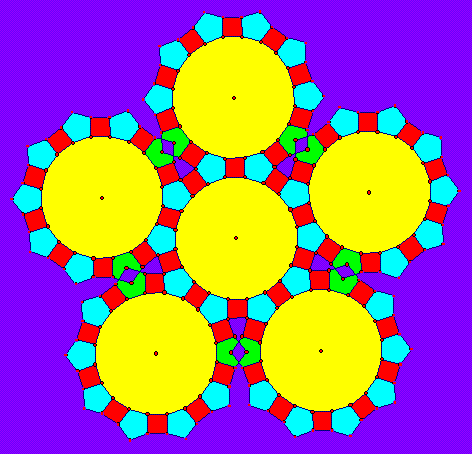
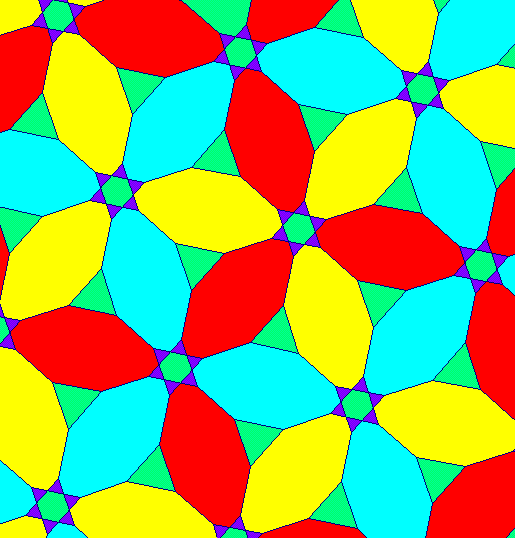
When I need to, I make mathematical images to improve my mood. For me, it works. These are three I created yesterday, using MS-Paint and Geometer’s Sketchpad.

I have a hunch this sort of thing would only work for a very few people, and we’re probably all Aspies, whether diagnosed or not.

I also call this sort of thing “recreational mathematics.” It’s better than Prozac, at least for me.

I’ve been doing this sort of thing for far longer than I’ve been on WordPress. These are just the latest such images.