The Vacuum Cleaner Enigma

Image

The Vacuum Cleaner Enigma

A vacuum is, by definition, a region of space devoid of matter. While a perfect vacuum is a physical impossibility, very good approximations exist. Interplanetary space is good, especially far from the sun. Interstellar space is better, and intergalactic space is even better than that.

Along come humans, then, and they invent these things:

vacuum-cleaner-upright

. . . and call them “vacuum cleaners.”

Now, this makes absolutely no sense. There isn’t anything cleaner than a vacuum — and the closer to an ideal vacuum a real vacuum comes, the cleaner it gets. Since vacuums are the cleanest regions of space around already, why would anyone pay good money for a machine that supposedly cleans them? They’re already clean!

Even cleaning in general is a puzzle, without vacuums being involved at all. To attempt to clean something — anything — is, by definition, an attempt to fight the Second Law of Thermodynamics. Isn’t it obvious that any such effort is, in the long run, doomed from the outset?

—–

[Image note:  I didn’t create the images for this post, but found them using Google. I assume they are in the public domain.]

M33, the Triangulum Galaxy, Adorning the Faces of a Pentagonal Icositetrahedron

Image

M33, the Triangulum Galaxy, Adorning the Faces of a Pentagonal Icositetrahedron

Evidence suggests that M33 is a satellite galaxy of the even better-known Andromeda Galaxy (M31), which happens to be on a collision course with our own Milky Way. In 1.5 billion years or so, Andromeda and the Milky Way will merge to form a giant elliptical galaxy already pre-named Milkomeda. At that point, the Triangulum Galaxy may become a satellite of Milkomeda (probably one of several), or be gravitationally ejected, or simply be absorbed into Milkomeda itself.

Here, it is projected on each face of the Catalan solid which is dual to the snub cube, using software you can try at http://www.software3d.com/Stella.php.

Oceans, Further from the Sun

Image

Oceans, Further from the Sun

Since earth’s oceans will be boiled away by the sun’s increasing luminosity, as I mentioned in my last post, we’ll eventually need to find other oceans elsewhere — or learn to do without water, which seems even less likely.

The news today is running a story about a subsurface ocean under Enceladus, a moon of Saturn. Here, in an obviously-photoshopped picture from one of those news stories, it’s shown in an impossible location, next to the U.K., for the purposes of size comparison. In addition to this moon, subsurface water is expected to exist on Titan, another moon of Saturn, as well as three of the four Galilean moons of Jupiter: Europa, Callisto, and Ganymede.

The Jovian system doesn’t get closer than 4.2 AUs from earth, and Saturn’s moons are further out still — but at least our descendants do have other places to go, once our oceans become too hot to stay liquid. They’re expected to be boiled away, by the sun’s increasing luminosity, in ~1.5 billion years.

Time Is Running Out

Image

Time Is Running Out

A lot of people are complacent about the long-term fate of the earth because they know the sun won’t turn into a red giant for >4 billion years. However, we don’t have even half that long to find another place to live. The sun’s luminosity is increasing — so quickly that the oceans will boil away ONLY ~1.5 billion years from now.

Let’s get going with extraterrestrial colonization, people!

~~~

[Note: I didn’t create this image, but simply found it with a Google image-search.]

The Galilean Moons of Jupiter on a Rotating Dodecahedron

Image

The Galilean Moons of Jupiter On a Rotating Dodecahedron

Software credit: see http://www.software3d.com/stella.php

Rhombic TriacontaSaturn

Image

Rhombic TriacontaSaturn

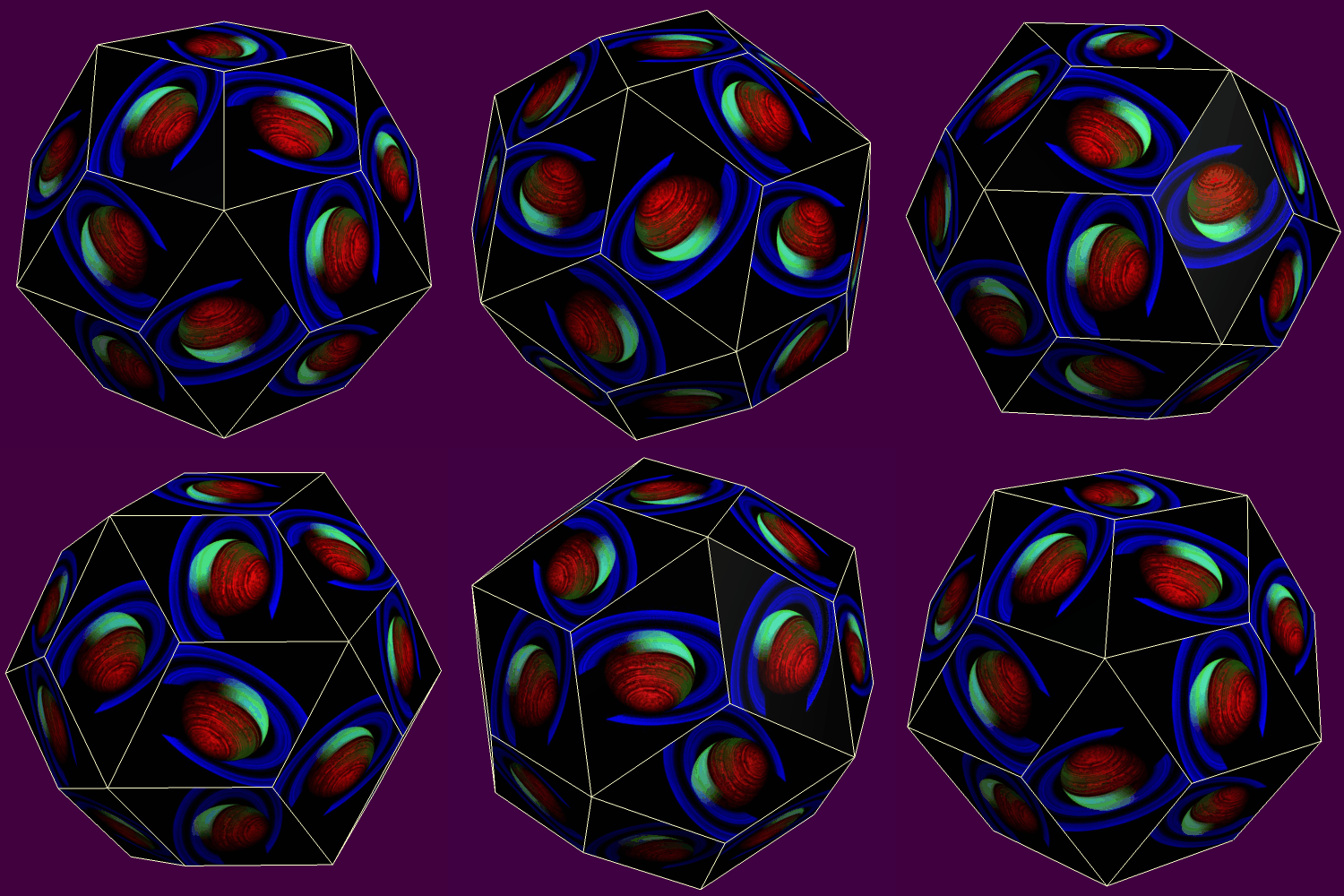
One of many photographs of Saturn provided by the Cassini spacecraft, and then projected onto the faces of a rhombic triacontahedron with the software available at http://www.software3d.com/stella.php.

Sol, Terra, and Luna On a Rhombicosidodecahedron

Image

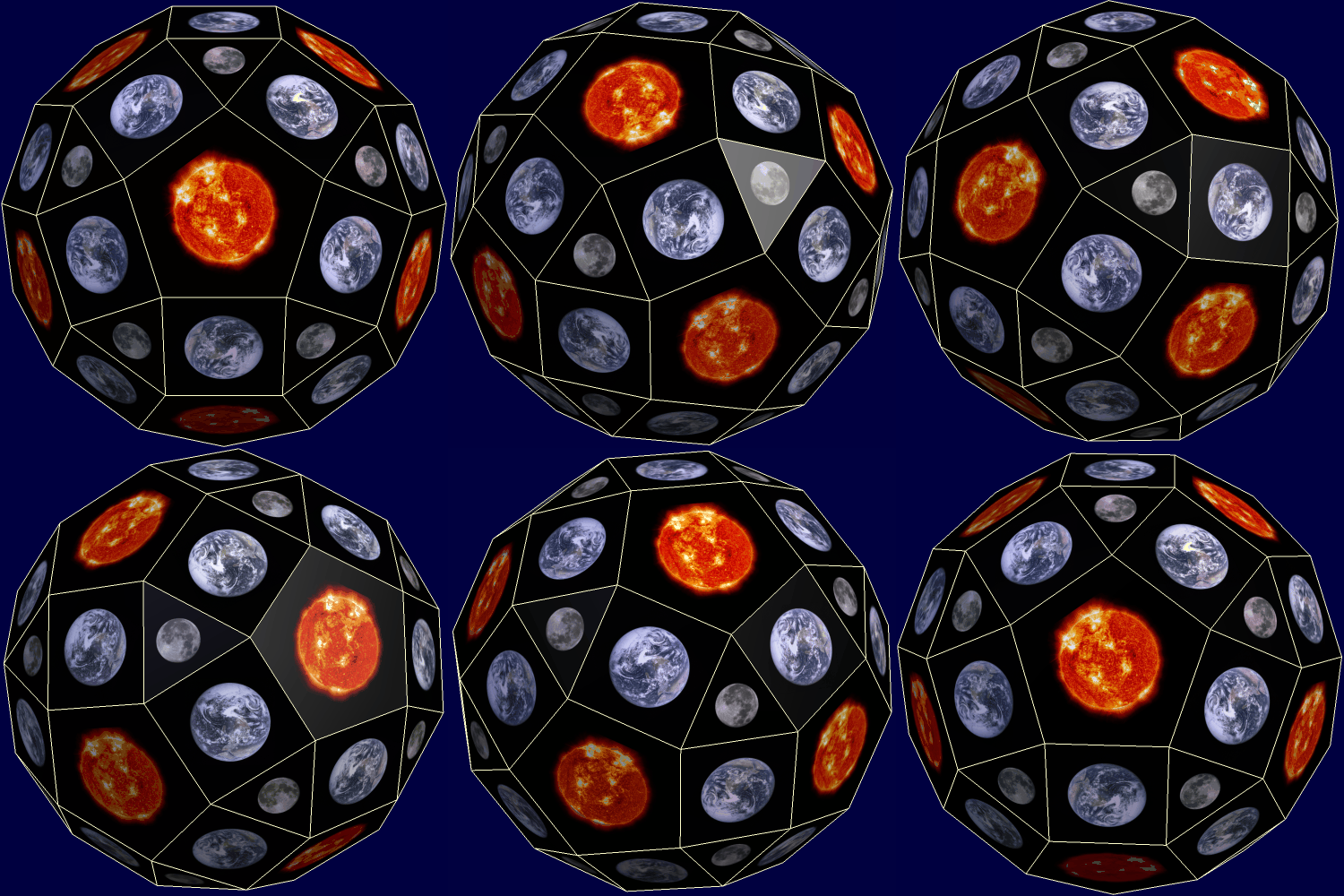
Sol, Terra, and Luna On a Rhombicosidodecahedron

Projecting images on the sun, earth, and moon onto the faces of a rhombicosidodecahedron was accomplished with Stella 4d, software you may try for free at http://www.software3d.com/Stella.php.

Two Saturnian Moons Adorning a Rhombic Dodecahedron

Image

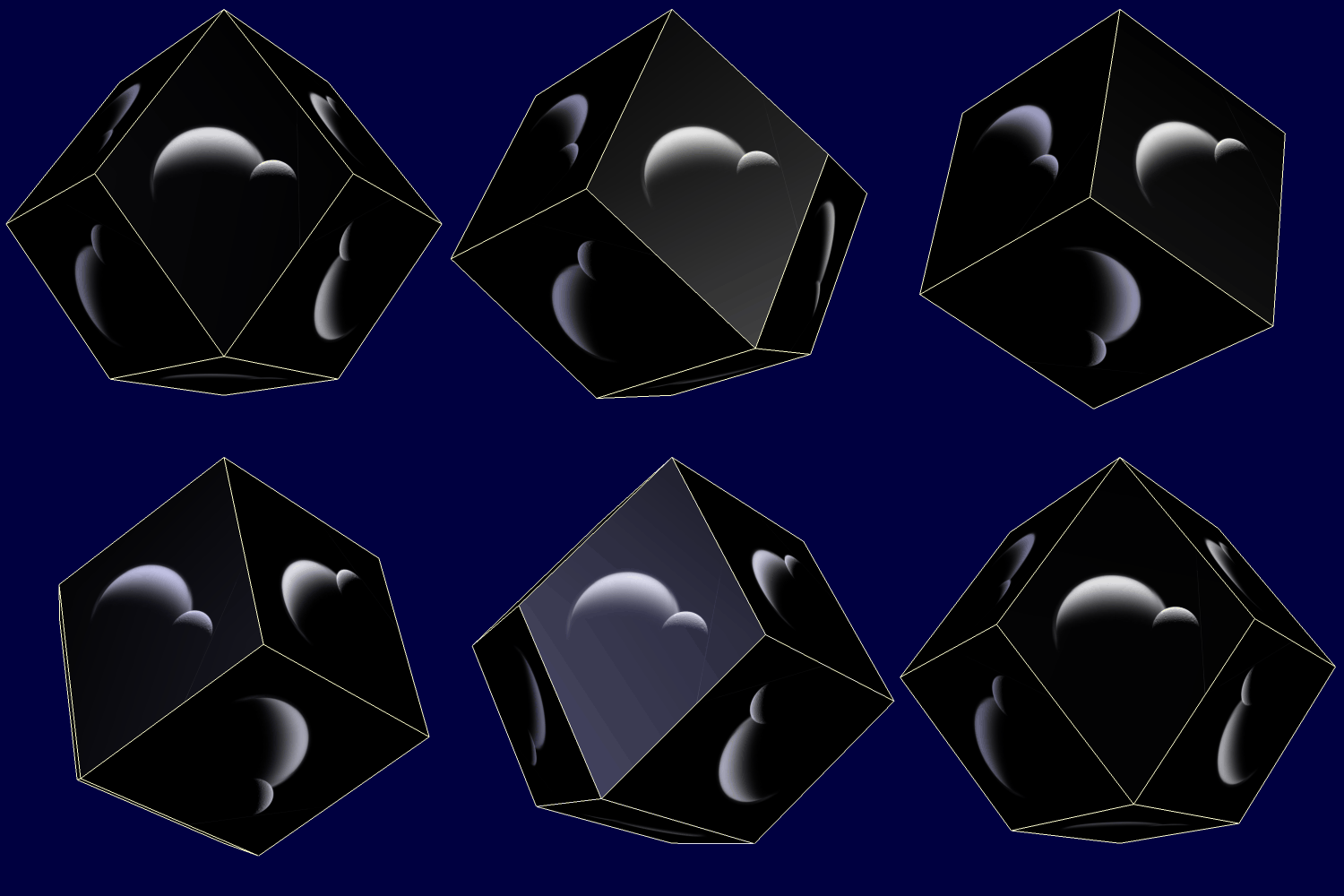
Two Saturnian Moons Adorning a Rhombic Dodecahedron

The larger moon shown, Saturn’s largest, is Titan, recognizable by its hazy atmosphere. The smaller one, which looks more like our own moon, is Rhea.

This image was captured by the Cassini spacecraft, which has been investigating the Saturnian system now for years.

Projecting the images onto the faces of a rhombic dodecahedron was done with Stella 4d, software you may try for free at http://www.software3d.com/stella.php.

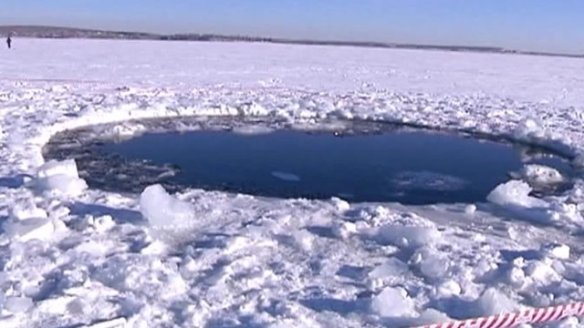
Russian Impact Crater Found in Frozen Lake By Fishermen

Image

Russian Impact Crater Found in Frozen Lake By Fishermen

Can you imagine what it would be like to encounter such a thing as this crater?

Can you imagine what it is like to have every window in your whole region suddenly turned into a shower of broken glass, with the temperature at -15 degrees Celsius, as many thousands did?

Thus far, no deaths are known to have happened from this February 15 airburst, nor the 1908 Tunguska Event, the largest in recorded history. In that sense, the Russians lucked out. Twice.

[image source: screenshot posted to Wikipedia]

How To Destroy a Planet

Let me make it clear from the outset that this is a purely academic exercise. I don’t REALLY want to destroy any planet, let alone the one we live on, even though the beginning of this song — http://www.youtube.com/watch?v=rR5xTgMwpiM — is my cell phone ringtone. I will admit that much.

But, seriously, how would one destroy a planet? I don’t mean kill everything on it — I mean utterly obliterate the whole ball of rock.

Well, let’s assume it isn’t a rogue planet, but one like ours. It orbits a star, in a nearly-circular orbit, and rotates on its axis. Let’s say it’s the blue one in this picture:

…and we want to know a way to destroy it — just as an interesting puzzle to solve. That’s all — I promise.

Well, planets that are closer to their stars orbit faster, which is why the planet Mercury is the fastest-moving planet in our solar system. Speed up the orbital velocity, then, and a planet’s orbit will get smaller in diameter, for faster planets orbit more quickly. In the diagram (not even close to being at scale for anything real), this is why the red planet’s velocity vector is shown as being longer (faster) than that of the blue planet.

So, speed up a planet enough, and its orbit will decay until it falls into its star, which should destroy it most effectively.

So it’s really pretty simple. On the blue planet, pile up a bunch of nuclear weapons, rocket engines — whatever you can find that invokes Newton’s Third Law of Motion — and start blasting at the position where you see the orange triangle (sundown, local time), right on the equator (unless there is axial tilt involved; correct for that if there is, and keep the blast site in the plane of the ecliptic). Keep blasting as the planet rotates for one-fourth of a rotation (counterclockwise), until the blast site is at midnight local time, and then stop. Repeat at the next sundown, and so on.

All of this blasting will speed up the blue planet’s orbital velocity. Eventually, it will end up where the red planet is, if you do this gradually enough to maintain near-circularity of the orbit (get too eccentrically elliptical, and other results may occur). Keep up this madness, and the target planet will end up slowly spiraling into its star.

That’s it. Game over.

Please do not try this at home, though. All my stuff is here.

[Later edit:  I showed this to many of my science-geek friends, and they tore it to shreds. There are a lot of mistakes here. I considered taking it down, out of embarrassment, but have decided to leave it posted to remind myself that I can, and do, screw things up. I need such reminders!]