The Misadventures of Jynx the Kitten, Chapter One

We have a new kitten, and his name is Jynx. He’s between four and five months old, and has short black fur.

As the adults of the house were enjoying a nice, peaceful, Saturday afternoon nap, we were suddenly awakened by multiple crashes, along with the sound of glass breaking, from the nearby bathroom. According to eyewitness reports, my reaction was to jump straight up into the air, hair standing on end, yelling a long, colorful string of profanity, which I shall not post here. It’s difficult for me to remember what I do, or say, immediately upon waking, and I don’t want to misquote myself, you see.

As it turns out, Jynx had been running back and forth along the counter in the bathroom, trying to get to the “other kitten” in the mirror, and knocking just about everything off the counter in the process. Our evidence: horizontally-smeared, feline nose-prints, at kitten-height, on the mirror — plus a big mess, all over the bathroom floor. Jynx, having scared himself silly, is now hiding under the bed, and I’ve thrown away all the tiny glass-shards I could find.

Blog-posts here usually come with pictures, and I tried to obtain one . . . but Jynx isn’t ready to come out from under the bed yet. My camera doesn’t have a flash, and it’s pretty obvious what a “no-flash” picture of a black kitten, hiding under a bed, would look like, is it not?

Migraine

Image

Migraine

I thought I would try to paint a migraine headache, and a few years ago, I did so, and painted this. I then fell asleep, and woke up, with, of course, a migraine.

Time Is Running Out

Image

Time Is Running Out

A lot of people are complacent about the long-term fate of the earth because they know the sun won’t turn into a red giant for >4 billion years. However, we don’t have even half that long to find another place to live. The sun’s luminosity is increasing — so quickly that the oceans will boil away ONLY ~1.5 billion years from now.

Let’s get going with extraterrestrial colonization, people!

~~~

[Note: I didn’t create this image, but simply found it with a Google image-search.]

One Aspect of Having Asperger’s (at least for one of us)

Image

One Aspect of Having Asperger's (at least for one of us)

Aspies (a term for ourselves, used by those with diagnosed or undiagnosed Asperger’s) sometimes have trouble understanding what people say, because we tend to view things literally, while many others often say things in non-literal, or even anti-literal, ways.

For example, without reasons known to us, person A says something offensive to person B. Why deliberately offend someone, without good cause? We don’t know. Person B then says, in response, “Say that again!” — and Aspies who hear this (and we do, for we’re everywhere) often become even more confused. Clearly, person B does not actually want to be offended again, yet is telling person A to do exactly that which person B does not really want person A to do. I’ve asked people to explain this behavior more than once, tried to understand it, and each time I revisit the subject, I become more confused than before, for understanding the explanation would involve bending my mind in a direction it simply won’t bend. I also must admit I do not want my mind to bend that direction, either, for fear that doing so would weaken my ability to reason logically.

This is true for much of what I hear. Things that do not make logical sense are inherently hard to understand, at least for us . . . and I don’t even understand why everyone isn’t like us in this respect, either.

Issues of Control

Image

Issues of Control

There’s a common phrase which has been said to me many times — often enough, in fact, that I sometimes now find it amusing when I hear it. You’ve probably heard it, also, or perhaps have said it to other people, yourself: “You have control issues.”

I sometimes wonder why anyone would feel the need to point this out to me. It’s something that is so blindingly obvious, to myself, and to all who know me well, that it really doesn’t even need to be said. My usual response, the last few years, has been the following: “Control issues? I don’t merely have control issues. I’ve got a lifetime subscription.”

The painting at the top of this post was a self-portrait I painted many years ago, while still struggling with (metaphorical) inner “demons” that bother me much less now, compared to how I was even a few years ago, at a time when my mental health was far more precarious.

Am I, to use an informal term for it, a “control freak?” Well, yes, I am — but not of the common variety. I’ve discerned that there are two very different types of control freak in existence, and have labeled them, simply, as type I and type II control freaks. I’m of the second type, but the first type is far more common.

Type I control freaks, as I define them, put a lot of time and energy into controlling other people, or at least trying to do so. I see such people as insecure, on an unconscious level, and suspect they have a strong drive to force their will on others, simply as a way to help them feel more secure about themselves. Such people are extremely unpleasant for me to be around, and I avoid them whenever I can. When forced to be around them, conflict is common.

Type II control freaks are very different from those of the first type. They — or, rather, we — have no particular urge to control other people. We do, however, still have very strong issues related to control, and, yes, this can cause problems at times.

(As an aside, I should explain my use of the word “freak,” since some people find that word offensive. It’s a word I’ve applied to myself since childhood. I don’t ever use this word as an insult. If I call someone “normal,” though, that’s another matter. “Normal” is a word I do use, when I use it, as an insult — a synonym for such terms as “boring,” “ordinary,” or “typical.” The idea of being normal is, to me, horrifying in the extreme — and to be a “freak” is, of course, the exact opposite.)

So what’s up with these people I call type II control freaks? In short, what’s our problem, and how do we differ from control freaks of the more common variety? Well, in my case (and that of others like me, I suspect), we were subjected, when very young, to extreme amounts of manipulative, controlling behavior by others — to such an extreme degree that we are now hypersensitive to any real (or perceived) efforts to control us. In my case, this overly-controlling person — the overwhelming monster of my childhood — was my father, deceased since mid-2010, and, at least by me, completely unmourned. When I painted the painting above, he was still alive. Now that he is gone, and can, therefore, never harm another person, the chains depicted in this painting have, after many decades, finally been broken, even though I still have to deal with lingering PTSD, and likely always will, because of the trauma he inflicted on me in childhood. (The difference is that, now, I simply have to deal with the fact that I used to be “chained up,” and cope with the resulting memories, whereas, before he died, the chains were still “on,” even though we were estranged for many years.) Hearing the news of his death was, quite possibly, the most liberating moment of my life.

Type II control freaks have no need to control others — we simply have an overwhelming need to keep others from controlling us. We are lovers of freedom and liberty, and need it almost as intensely as all humans need oxygen. At least in my case, I can’t even stand to see the first type of control freak in action, against another, without feeling an overwhelming urge to do almost anything in my power to stop them.

I have no qualms about being, and openly admitting to being, a control freak of the second type. It’s simply a part of who I am. There are certainly less healthy ways to react to childhood trauma, after all — such as when someone turns into the same type of monster that terrorized him or her in the first place, thus perpetuating a multi-generational cycle which is unhealthy in the extreme.

As for the type I control freaks, I am unable to feel any sympathy for them. They victimize others whenever they can. They’re bullies. They need to be opposed, and they need to be stopped. They are, in a word, evil — and that’s not a word I use often, nor one I use lightly.

I’m a permanent part of the resistance to such people, and have no reservations about this. If it were in my power to change this part of who I am — and it isn’t, anyway — I certainly would not choose to do so.


“You’re turning into a politician.”

Someone close to me said this recently. My response was immediate: “There’s no need to be insulting!”

However, the observation has proved to be accurate. I did not know then than I would run for, and win, an officer position in my labor union, nor did I expect to spend a day at my state capitol, lobbying against a bill in committee. I did not anticipate becoming a near-constant activist. However, all these things have happened.

I could say I’ll never run for a governmental office, but my record on pronouncements doesn’t seem to be good. I do know this much, though:  I didn’t go looking for this. Events simply happened to my co-workers and myself. We didn’t go looking for a fight.

Living through a protracted struggle isn’t easy in any line of work. Teaching is no exception. The simple fact is this, however:  we aren’t giving up.

No matter what.

How I Found the Nagel Line While Playing with Triangles

Several days recently swirled down the drain in a depression-spiral. Needing a way out, I spent my Saturday morning playing with triangles, after first getting plenty of sleep. It worked. This technique, however, probably would not transfer to those who are not geometry obsessives. Perhaps any favorite activity would work? I leave that to others to explore.

Here’s what I did that worked for me:

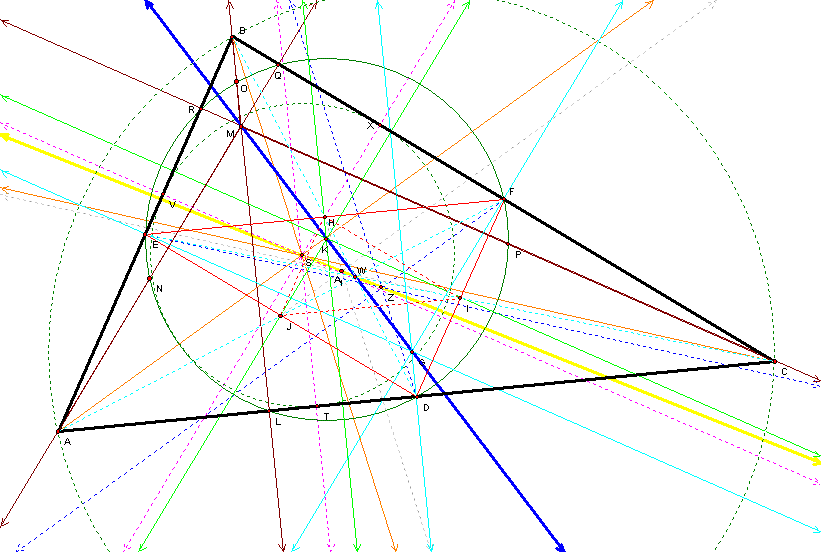
ImageThe original triangle is ABC, and is in bold black. The bold blue line is its Euler Line, and contains the orthocenter (M), circumcenter (G), nine-point center (K), and centroid (point W). It does not, however, contain the incenter (S).

It struck me as odd that the incenter would be different in this way, so I investigated it further. It is the point of concurrence of the three angle bisectors of a triangle. On a lark, I constructed the midsegments of triangle ABC, forming a new, smaller triangle, shown in red. When I then found the incenter of this smaller triangle (Z), it appeared to be collinear with S and W. I checked; it was, and this line is shown in bold yellow. Moreover, the process could be continued with even smaller midsegment-triangle incenters, and they were also on this yellow line.

I wondered if I had discovered something new, and started to check. It didn’t take long to find out that Nagel had beaten me to it. The Nagel line is the official name of this yellow line I stumbled upon, and here is my source:  http://mathworld.wolfram.com/NagelLine.html — but, as far as I know, I did discover that these midsegment-derived points also lie on the Nagel line.

Someone else may have known this before, of coruse. I don’t know, and it doesn’t matter to me, for I had my fun morning playing with triangles, and now feel better than I have in days.

[Side note:  this is my 100th post, and I’d like to thank all my readers and followers, and also thank, especially, those who encouraged me to try WordPress to get a fresh start after Tumblr-burnout. It worked!]


Thoughts On Asperger’s


Image

After many years of curiosity, I took a detailed Asperger’s test on-line. This graph shows the results. When I discussed the possibility with my psychiatrist, he said “It’s entirely possible,” but shied away from a definitive diagnosis, for that takes a team, and has a high cost, in terms of time and money, as well.

Many (I’m one) view Asperger’s as a difference, not a disorder, nor disease, in need of treatment or cure. (What we need is for the rest of the world to begin behaving logically, but that’s a separate rant.) I suspect my doctor agrees with this, which would be an additional, understandable reason for him not to liberally hand out “Asperger’s” labels.

I know this much: I either have it, or I share a lot of characteristics with those who do. I also know that a difference which makes no difference is not a real difference. I therefore see no reason to shell out thousands of dollars for a useless diagnosis. Why would it be useless? Well, there is no treatment, and I wouldn’t want one if it became available, anyway. I’m used to being this way, I like who I am, and am not remotely interested in being more like most people.

Other people (many of them, anyway) drive me nuts, for more reasons than I could easily list, but “they care what others think” is near the top, and is surely the most baffling of these reasons, to me.

Most diagnosed Aspies I’ve met are, by contrast, comforting for me to talk to. Since we find the same things about social life bizarre, it’s much like talking to people from the same planet as my own who have found themselves on this alien world called Earth, uncertain how we got here. It’s a lonely existence (no matter how many friends surround you, for you’re still trapped in your own head), and it helps, somehow, to talk to others with similar perceptions.

I have run into a small number of Aspies who dislike those who consider themselves to be part of the Aspie community, as I do, yet have not had a formal diagnosis. One benefit of being like I am, though, is that it is incredibly easy for me to disregard what particular people think, feel, or say — if I simply choose to — and that is what I have done with the small number of “Aspie Exclusives.” Their attitudes only affect me if I allow that to happen, and I simply choose not to do that.

The bottom line is this: so far, studying Asperger’s helps me understand myself. It clears up many long-standing puzzles when I see that my years of talk about “the normals” is a excellent match for the way Aspies describe, and discuss, what they call “neurotypicals.” I’m not a big fan of the term “neurotypical,” though, for it seems like a condescending and vaguely-insulting term to me, and I do not see that as helpful to anyone, inside or outside the Aspie community. (I do understand the motivation for it, though, for my motives were similar when I talked about “the normals,” in years long past.) My proposal for an alternative term is non-judgmental, and non-insulting, but remains accurate, and is simple in the extreme: I refer to the people who are not Aspies by the clear, concise, easy-to-understand term, “non-Aspies,” or, when a more formal term is called for, “people without Asperger’s.”

I also don’t care to seek an official diagnosis — because that whole enterprise completely misses the point. Aspies aren’t defective, except in the sense that all people are, with the defects (and strengths) simply in different areas. There could simply be an Asperger’s mutation, which could be the beginning of a long process of speciation. If homo aspergerus is coming, it won’t be here for a long time — speciation takes a long time to happen, but happen it does. Evolution doesn’t stop. Evolution also doesn’t guarantee improvement. New species (of any animal) will be different (or they wouldn’t be new species), but that doesn’t make them “superior” or “more evolved.” Every living thing on earth, after all, has been evolving for the same amount of time: ~3.85 billion years.

I will oppose any efforts to “cure” Asperger’s because, well, that would be genocide. I will also oppose any who try to label hypothetical new species as inherently superior, or inferior. We’ve been down that road enough times, throughout history, to see where it leads, and no sane person, Aspie or not, would want to venture further in that direction.