A True Story from My Childhood: Roman Numeral Dollar Signs

roman numeral dollar signs

When I was a child, I learned Roman numerals before I learned about the dollar sign. When I first encountered a dollar sign, I interpreted it as an “S” with a Roman numeral one superimposed over it. It then followed (I thought at the time) that the symbols for $2 through $10 would look like those shown above.

Fortunately, it didn’t take long before I figured out this would be impractical. I certainly would not want to have to write the symbol for $3,978, after all.

“The Whole World’s Wrong, and You’re Right!”

081007hoffman

I can’t think of a better response, Abbie.

My First Solution to the Zome Cryptocube Puzzle, with Special Guest Appearances by Jynx the Kitten

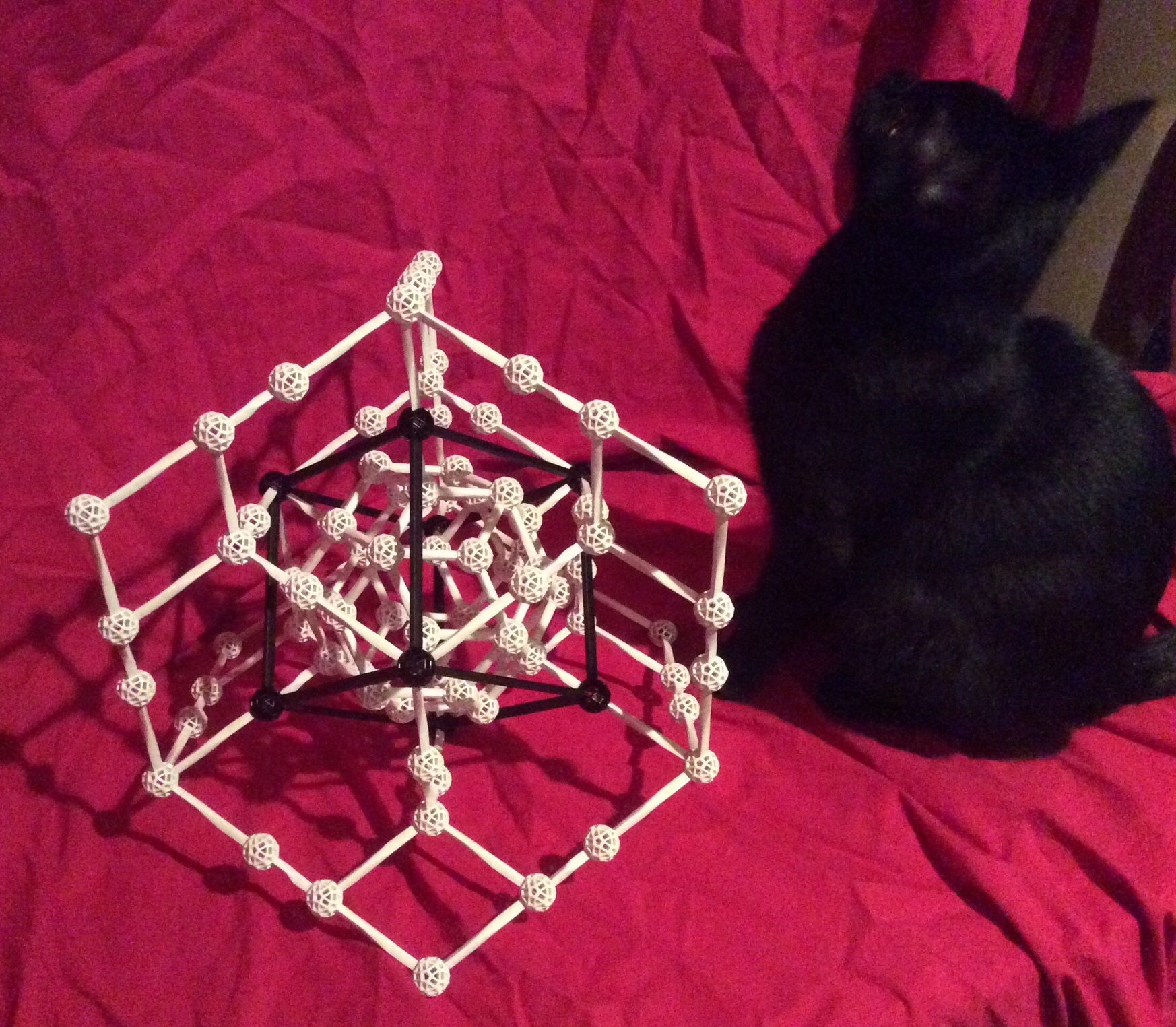
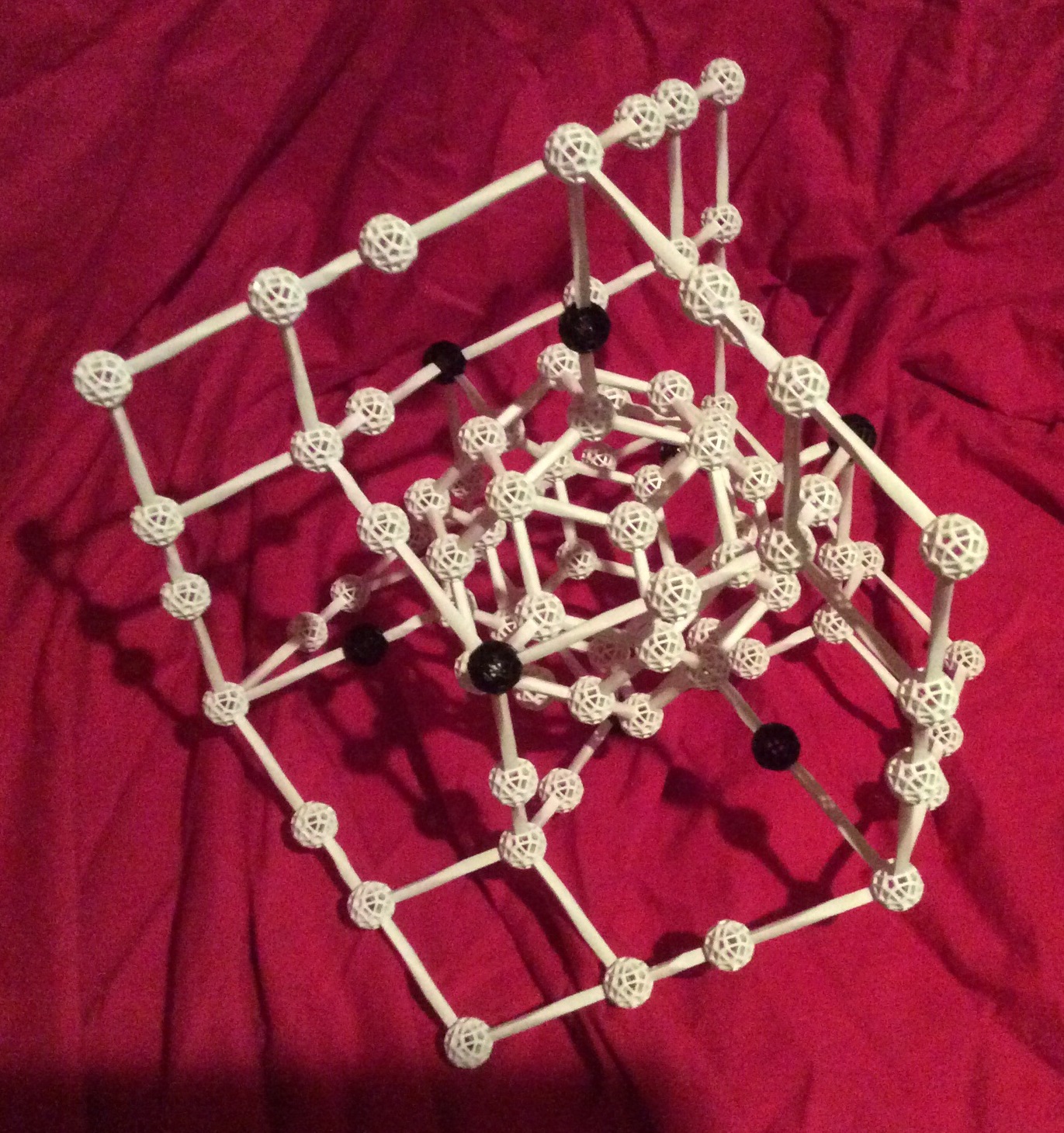
Last month, in a special Christmas promotion, the Zometool company (www.zometool.com) briefly sold a new kit (which will return later) — a fascinating game, or puzzle, called the “Cryptocube.” Zome usually comes in a variety of colors, with each color having mathematical significance, but the Cryptocube is produced in black and white, which actually (in my opinion) makes it a better puzzle. Here’s how the Crypocube challenge works:  you use the black parts to make a simple cube, and then use the smaller white parts to invent a structure which incorporates the cube, is symmetrical, is attractive, and can survive having the twelve black cube-edges removed, leaving only the cube’s eight black vertices in place. I had a lot of fun making my first Cryptocube, and photographed it from several angles.

imageIf this was built using standard Zome colors, the round white figure inside the cube, a rhombic triacontahedron, would be red, and the pieces outside the cube, as well as those joining the rhombic triacontahedron to the cube (from inside the cube), would be yellow.

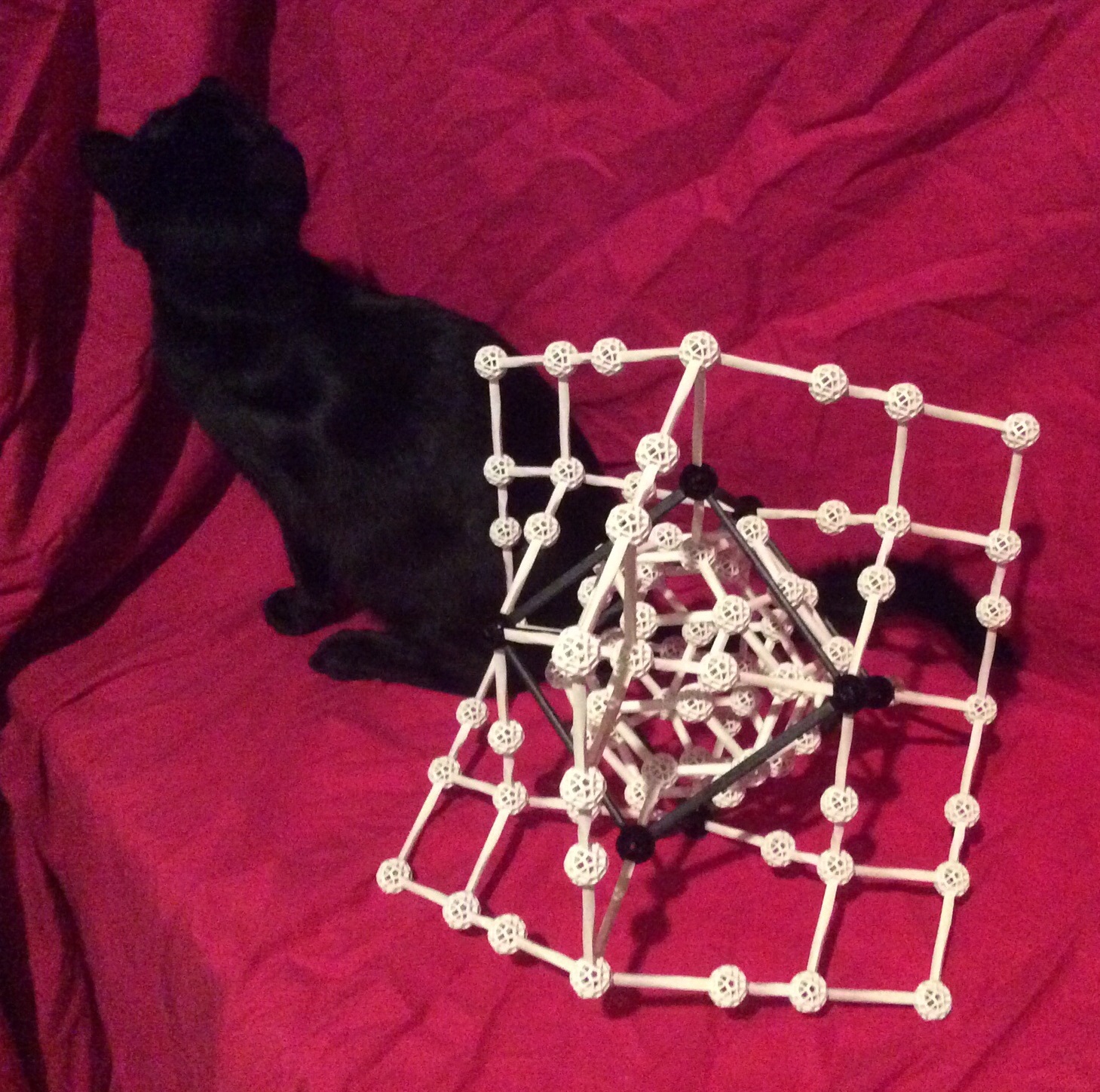
It isn’t only humans who like Zome, by the way. Jynx the Kitten had to get in on this!

image (1)

Jynx quickly became distracted from the Cryptocube by another puzzle, though: he wanted to figure out how to pull down the red sheet I had attached to the wall, as a photographic backdrop for the Cryptocube. Jynx takes his feline duties as an agent of entropy quite seriously.

image (2)As usually happens, Jynx won (in his never-ending struggle to interfere with whatever I’m doing, in this case by pulling the sheet down) and it took me quite a while to get the red sheet back up, in order to take kitten-free pictures of my Cryptocube solution, after removal of the black cube’s edges.

image (3)

Here’s the view from another angle.

image (4)

The Cryptocube will be back, available on the Zometool website, later in 2015. In the meantime, I have advice for anyone not yet familiar with Zome, but who wants to try the Cryptocube when it returns: go ahead and get some Zome now, at the link above, in the standard colors (red, blue, and yellow, plus green in advanced kits), and have fun building things with it over the next few months. The reason to do this, before attempting to solve the Crypocube, is simple: the colors help you learn how the Zome system works, which is important before trying to solve a Zome puzzle without these colors visible. After gaining some familiarity with the differing shapes of the red, blue, yellow, and green pieces, working with them in white becomes much easier.

On a related note, Zome was recommended by Time magazine, using the words “Zometool will make your kids smarter,” as one of the 14 best toys of 2013. I give Zome my own strong, personal recommendation as well, and, as a teacher who uses my own Zome collection in class, for instructional purposes, I can attest that Time‘s 2013 statement about Zome is absolutely correct. Zome is definitely a winner!

“How are you today?”

how are you

At least in this part of the world, “How are you today?” — or variations thereof — is commonly used as a way to start conversations, as a bit of “small talk.” The odd part of this social convention is that, when people ask this, they usually don’t really want to hear an honest answer — or, indeed, any answer at all that isn’t part of the standard “small talk” script.

The usual answer (“Fine, thanks,” or something like it) is yet another empty phrase — more small talk. Unusual answers, though, have great potential for fun. I first encountered this idea in a class I took, many years before, where the teacher told us that his habit was to answer, instead, with an upbeat, “Getting better!” I’ve tried this, and the facial expressions often seen, in response, are indeed quite entertaining. Small talk is annoying — to me, anyway — but disrupting it, by simply deviating from the usual script, can be a lot of fun.

Here are some other possible answers, but this game is probably most fun if you make up your own.

  • “I’m glad you asked. Actually, my feet hurt. Do you know why?”
  • “Well, I’d feel a lot better if I hadn’t just blown my whole budget for the week on chocolate. It tasted good when I ate it all for breakfast this morning, though!”
  • “Hopefully, I’ll be able to answer your question in a few minutes. Say, where’s the nearest restroom?”
  • “Terrible. My beloved pet cricket just died.”
  • “I’m hoping it gets better soon. Could you recommend a good mechanic nearby, as well as a chiropractor?”
  • “I’m feeling great! There is nothing like a couple of extra-strength placebos to start the day!”
  • “I’m okay now, but I’m not looking forward to this afternoon at all. You have heard about the giant asteroid heading straight for us, right? It’s supposed to hit somewhere near downtown, at about four o’clock.”
  • “Well, I’m broke. May I borrow fifty bucks until next month?”

While I do greatly value honesty, I obviously exclude jokes from the category of lies. Also, suggestions for other funny responses, in comments, would be much appreciated.

Kaizen

kaizen

I painted this many years ago, as a classroom poster, and then moved it from classroom to classroom, for years, until the posterboard on which it was painted was finally too damaged for further use. At some point, I will have to make a replacement.

Kaizen is a Japanese word which translates only loosely into English, as “continuous improvement.” To me, it means more than that:  it means never being content with simply staying the person I am today, and going to sleep, each night, with the sincere intention to be a better person tomorrow.

Does this always actually work, as each day becomes the next one? No, I must admit that it doesn’t — but that does nothing to change the fact that keeping the kaizen principle in mind is an excellent way to live one’s life. On a year-to-year basis, it works much better, in practice, than it does from day to day. I am confident that I am a better person now than I was 365 days ago, even though there have, of course, been ups and downs, as the last year has passed.

Setbacks, which happen to everyone, are no reason to give up, and personal improvement, in all important parts of life, will always be a goal worth pursuing.

A Recurring Asperger’s-Related Conversation

This conversation has happened more than once, since I discovered I am an “Aspie,” as many of those with Asperger’s call ourselves, and then received all the confirmation I needed from a doctor of mine, without paying for expensive testing, and an official diagnosis. I did not seek testing and diagnosis because no treatment exists for Asperger’s — and I would not want one, if it existed, anyway. The conversation below is paraphrased, for the ideas involved matter far more than the exact words which were used — and, also, slightly different words were used each time this conversation happened.

Me:  “I’d like to share something with you. I’ve discovered one of the reasons I’m so different from other people — I believe I have Asperger’s Syndrome.”

Friends/Colleagues:   “Oh, we figured that out months ago! We were just afraid to tell you because we thought you’d be offended, and get angry at us, if we mentioned it.”

Me (laughing):  “Don’t worry about it at all! I’m not the slightest bit offended, nor angry. You see, I like being the way I am!”

Several of my friends figured this out before I did, it seems, but we all know about it now — and I prefer it that way. There is no shame in being open about being an Aspie — it is part of who I am. I would not want to be without Asperger’s, in fact, for a great many reasons. Other posts on this blog, in the “Asperger’s” category, explain some of these reasons, and I invite anyone who is curious to read any, or all, of them.

On Life, and Death, in the Marvel Comics Universe

o death

To write this, I did a lot of research, and had much help from friends. One of them, Craig Deaton, gave permission for his name to be used, but the others have not. I am grateful to them all.

This is a compilation of three lists, for purposes of comparison and analysis, and concerns life, death, being “unkilled,” then “re-killed” after being unkilled, and then, sometimes, being “re-unkilled,” and so on. In other words, the topic here is bad writing, and a terribly overused plot device. To (try to) keep this simple, I’m limiting this survey to the primary Marvel Comics universe, in which Earth is called, for reasons I do not understand, Earth-616. I started this yesterday, by simply posting some questions on Facebook, and watched, with growing amazement, as the information started pouring in.

The shortest of these lists includes only comic book characters who are currently dead, but whom I have high confidence Marvel will unkill, before too long.

  1. Wolverine, a/k/a James “Logan” Howlett
  2. Uatu, a/k/a The Watcher
  3. Charles Xavier, a/k/a Professor X

At least two of these characters (Wolverine and Professor X) have been killed, and then resurrrected, before, and I will be shocked if this process is not repeated, again (and again, and again, and again…).

The next list includes characters who have been killed, have actually remained dead, so far, and whose resurrections I do not (at least not fully) expect.

  1. The Abomination
  2. The Ancient One (associated with Dr. Strange)
  3. Hector Ayala, the Black, Hispanic, male version of the White Tiger, killed after Matt Murdock failed to secure his acquittal on a murder charge, of which Ayala was innocent
  4. Blink, of the X-Men
  5. Daken, son of Wolverine
  6. Jean DeWolf, a police detective who used to work with Spider-Man
  7. Dr. Doom’s mother
  8. Leland Drummond, a corrupt FBI man involved in “outing” Daredevil’s secret identity
  9. Richard Fisk, son of the Kingpin (Wilson Fisk)
  10. Flashback, a little-known mutant killed in a weird time-travel scenario created by his own superpowers
  11. Bill Foster, a/k/a Goliath, a/k/a Black Goliath
  12. Adolf Hitler, a/k/a Hate Monger (brought back from the dead, and then re-killed)
  13. Karen Page, the primary love interest of Matt Murdock’s (Daredevil’s) life
  14. Mar-Vell, a Kree warrior who went by the name “Captain Marvel”
  15. Microbe, of the New Warriors
  16. “Battlin’ Jack” Murdock, best-known as Daredevil’s father
  17. Namorita, of the New Warriors
  18. Night Thrasher, of the New Warriors
  19. Scott Perkins, a police officer whom Hector Ayala (see above) was falsely convicted of killing, despite Matt Murdock’s best efforts, as his lawyer, to secure Ayala’s acquittal
  20. Pyro, one of many foes of the X-Men, who was killed, brought back as a zombie, and then killed again
  21. Spider-Man’s father
  22. Spider-Man’s mother
  23. Spider-Man’s Uncle Ben
  24. Gwen Stacy, former girlfriend of Spider-Man
  25. Katherine Anne Summers, the mother of the mutants Cyclops, Havok, and Vulcan
  26. Turbo (the original one)
  27. The chain of unnamed criminals who first got Daredevil’s secret identity from Karen Page to Wilson Fisk, the Kingpin of crime, and were then ordered killed by Fisk
  28. Numerous unnamed people who lack superpowers, and also lack connections to superheroes who are neither Daredevil, nor Spider-Man
  29. The unnamed woman whom Daredevil’s wife Milla, under the influence of mind control, pushed in front of an oncoming subway train, leading to Milla’s institutionalization
  30. At least one person affected by the Wendigo curse (killed by the Red Hulk)

What can we learn from the list above? Well, for one thing, characters in the Marvel Universe who have no superpowers should stay far away from both Daredevil and Spider-Man.

The last list, and easily the longest, includes characters who have recovered from death at least once, and are currently alive in this fictional universe — one where death obviously “has a very loose grip,” as one of my friends on Facebook phrased it.

  1. Bucky Barnes / The Winter Soldier, and, briefly, Captain America
  2. Bullseye
  3. Cannonball
  4. Captain America / Steve Rogers
  5. Colossus, of the X-Men
  6. Cyclops / Scott Summers, of the X-Men
  7. Cypher / Doug Ramsey, of the New Mutants
  8. Daredevil / Matt Murdock
  9. Darwin, of the X-Men
  10. Dead Girl (except that she’s still sort of dead, being, after all, Dead Girl)
  11. Elektra
  12. Firebrand
  13. Vanessa Fisk, estranged wife of Wilson Fisk, the Kingpin
  14. Galactus
  15. Jean Grey (not exactly the same as Phoenix)
  16. The Grim Reaper (brother of Wonder Man)
  17. Havok / Alex Summers
  18. Hawkeye / Clint Barton / Ronin
  19. The Human Torch (original android version)
  20. Loki, Norse God of Mischief
  21. Longshot, of the X-Men
  22. Moira McTaggert, friend of the X-Men
  23. Mockingbird, ex-wife of Hawkeye
  24. Mysterio / Quintin Beck
  25. Nightcrawler, of the X-Men
  26. The Owl / Leland Owlsley
  27. Petra, of the X-Men
  28. Phoenix (not exactly the same as Jean Grey)
  29. Agent Preston
  30. Kathryn “Kitty” Pryde, of the X-Men
  31. Madelyne Pryor, estranged wife of Cyclops / Scott Summers
  32. Psylocke, of the X-Men
  33. The Punisher / Frank Castle
  34. The Red Skull
  35. Rogue, of the X-Men
  36. The Sentry
  37. Speed, of the Young Avengers
  38. Spider-Man / Peter Parker
  39. Spider-Man’s Aunt May
  40. Spider-Man’s clone
  41. Storm / Ororo Munroe, of the X-Men
  42. Hope Summers, of the X-Men
  43. Sway, of the X-Men
  44. Tarot
  45. The Thing / Benjamin Grimm
  46. Thunderbird, of the X-Men
  47. Toro, the original (android) version of the Human Torch
  48. Trickshot
  49. The Vision
  50. Vulcan, of the X-Men (brother of Cyclops and Havok)
  51. Wiccan, of the Young Avengers
  52. Wonder Man
  53. Wong, associated with Dr. Strange
  54. Zzzax

It is clear that the most effective way to cheat death, in the Marvel Universe, is simply to be one of the X-Men. Are there more characters who should be on this list? Yes, but we all got tired after several hours of this, and moved on to other things.

Seriously, though, Marvel needs to stop doing this.

However . . . they won’t.

The Five Fictional Characters Who Have Most Strongly Influenced My Life

These five fictional characters have strongly influenced me, and I will always be grateful to the brilliant people who created them. I am presenting them in chronological order — using the time when this influence started, rather than their date of creation.

#1: Snoopy

Snoopy2

When I was very young — before my memory-record begins, actually — I was given Peanuts books. They were simply left in my possession, as far as I know; no explanation was necessary. The antics of Snoopy, in particular, were extremely entertaining to the little-kid version of me. Since I could see Snoopy dancing around, playing baseball, typing, irritating Lucy, etc., I wanted to understand what was actually going on with all this activity — and this provided the necessary motivation for me to teach myself how to read. There wasn’t any other way for me to tell what was going on in these comic strips!

The fact that I learned to read in this manner led to some very funny moments, due to the fact that the number of words whose meaning I understood, generally from context, exceeded the number of words I knew how to pronounce — and, no doubt, still does. Once, in elementary school, I was laughed at by an entire class, after saying something about the “Eeffel Tower” (yes, that’s how I pronounced it). I also remember pronouncing the “b” in “doubt,” much to the amusement of my parents. Even in graduate school, I made a history professor groan in agony when I made a reference to the Weimar Republic — and pronounced the “W” as it is pronounced in English, rather than German.

#2: Mr. Spock

Spock

A scientist aboard a starship, exploring the galaxy, who uses logic to try to understand two things:  the nature of the universe (much of which he understood), and the behavior of illogical humans (something which confuses me to this day, just as it often confounded him). The first person I remember seeing on television had pointed ears, and there were several of them in that episode, “Amok Time.” In other episodes, of course, few Vulcans other than Mr. Spock appeared, and I always found him, to use one of his favorite words, “fascinating.” He influenced me in several ways, and still does, to this day. I am grateful to the creators of this character for inspiring my passion for science, ability to use logic, appreciation of diversity, and strong desire to maintain control of my emotions.

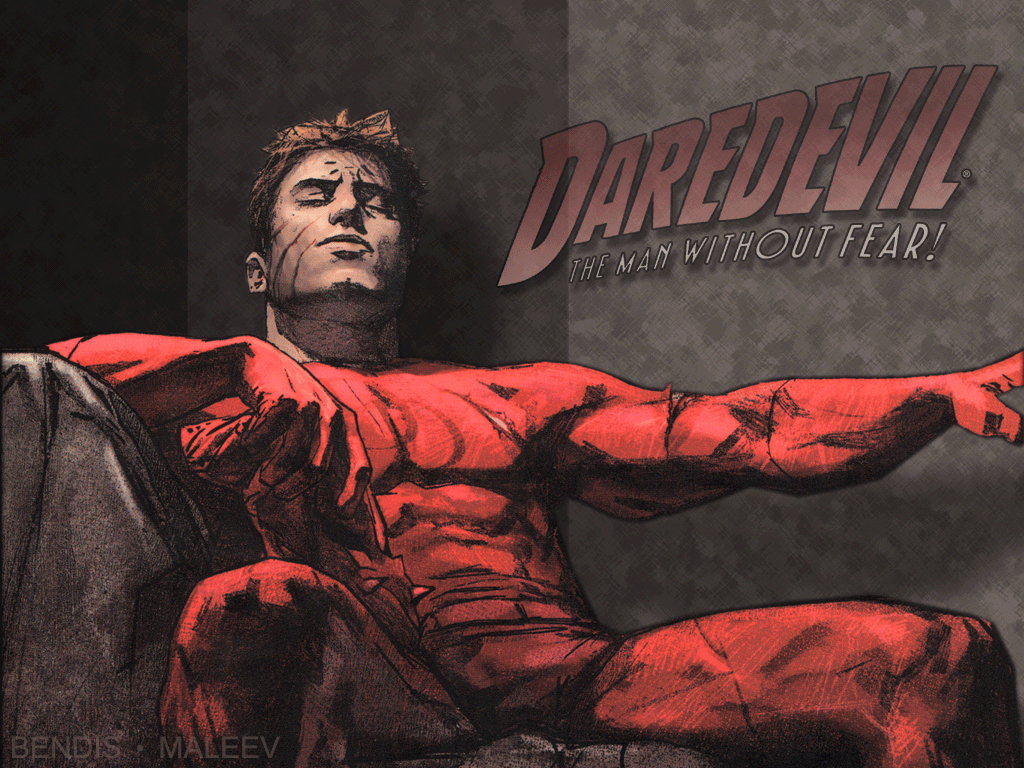
#3: Matt Murdock / Daredevil
daredevil

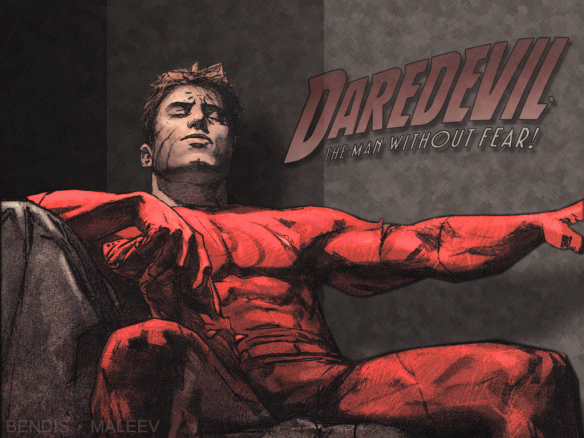
I may not have red hair, but I share many other characteristics with Daredevil — and I mean the character from comic books, not that disappointing B-movie (which deserves no further mention). Other than amplified senses — which I experience (unpleasantly) when I get migraines — Daredevil has no superpowers, yet he faces, and does battle with, super-powered villains, and usually wins. He is also a study in contradictions: a lapsed Catholic, who spends a lot of time dressed in a devil costume; a lawyer, with a second “career” as a costumed vigilante; and a blind man, who nonetheless perceives the world around him more clearly than anyone else. Matt Murdock has inspired me to respect the concept of justice, has influenced me to study what laws I need to understand, and, most importantly, has shown me, by example, how to face down those who would do harm to those I care about — and do it, as Daredevil does, without fear. I have also developed my “never give up” attitude, toward my adversaries (bullies, mostly), with inspiration from this character.

Matt Murdock and I have also had very rocky histories when it comes to romantic relationships. I have (finally) found happiness in this aspect of life, and am writing this next to my beloved, sleeping wife. Unfortunately, the writers of Daredevil, while they will let Matt Murdock enjoy temporary happiness in relationships with women, will never allow him to keep it.

#4: Data

Data2366

Data is amazing to me:  a sentient android, and an artificial person. He actually had to go on trial to assert his rights to personhood, and, with the aid of Captain Picard, won the case. He has a lightning-speed calculator, built right in to his positronic brain, which far exceeds the abilities of my own, not-too-shabby mental calculator. I have long had the ambition to gain the ability to reprogram my own brain’s “software,” and have written, on this blog, about how I finally gained that ability, after working on developing it for roughly thirty years. Data, of course, had this ability from the moment he was activated, but, unlike me, he does not have to sleep for it to work.

Despite his claim to experience no emotions, Data often expressed a feeling of being perpetually alone, for there was no one else like him anywhere — until he met his brother, another android, who turned out to be malicious. That feeling of being unlike everyone else is quite familiar to me.

Both Data, and Mr. Spock, display many characteristics of Asperger’s Syndrome, and my study of these two characters helped me figure out that I am, myself, an “Aspie” — our nickname for ourselves.

#5: Calvin

Calvin_by_Watterson

When I am playing (and, yes, I play a lot, especially with mathematics), and someone asks me why I, an adult, am playing, I have a standard reply: “Because I’m six.” This is a reference to Calvin, who was six years old during the entire ten-year run of Calvin and Hobbes, the best comic strip ever created. I read it from the first day it appeared in newspapers, and have the boxed set of the complete collection of these comic strips only a meter away, as I write this. Calvin is a six-year old prodigy, as one can tell from his expansive vocabulary, but is prone to making social errors, due to a lack of understanding of social conventions — and both of these things mirror my own life. (I grew up, literally, in science laboratories, unsupervised for hours at a time, designing and conducting my own experiments, and that sort of thing simply doesn’t happen without having profound effects on a child’s development — but, then again, why would I want to be normal?) Calvin, like myself, found elementary school boring in the extreme, and so he slipped, frequently, into his own inner life of fantasy. The fact that, being socially isolated (no siblings, and no friends, other than his stuffed tiger), he is usually alone, never stopped Calvin from having fun. Just like Calvin, I can have unlimited fun, in solitude — because I choose to be this way. Some adults lose the child within them, but, thanks to Calvin’s inspiration, that will never happen to me. I’m actually 46 years old now — so I’m pretty sure that, if I was ever going to lose the ability to have fun, it would have happened already.

To those brilliant people who invented these five characters: thank you.

On Divorce and Remarriage

divorce and remarriage

The Misadventures of Jynx the Kitten, Chapter Two: Jynx vs. My Computer

20140827_204903_resized (2)

Jynx: 1, Computer: 0.

Tonight’s feline insanity started while we were watching Star Trek — the episode where Captain Kirk and Mr. Spock go up against a planet full of nuclear-armed Space Nazis.

Apparently, cats — or, at least, this cat — find Nazis disturbing, which, of course, they were — and will be again, if they appear in the 23rd Century . . . because some half-crazed future historian went and violated the Prime Directive, becoming, a few years later, a fully-crazed future historian. Jynx was so incredibly disturbed by the Space Nazis, in fact, that he bounced over pillows and blankets, in a series of nicely Newtonian . . .


&^ (Stop that, Jynx!)

. . . parabolic arcs, to land on my computer. He then proceeded to pause the episode — then close my browser (the picture-moment, with my wife laughing hysterically as she took it), and finally tried to bite the heads off several Space Nazis as the screen slowly darkened. After due consideration, Jynx decided this was not enough, and so, next, he reached out a paw, and quickly turned my computer completely off. A smug look followed. You haven’t seen a look this smug, unless, maybe, you’ve also seen one on the face of a kitten.

Getting it (my computer, not Jynx) turned back on was not easy. For a little while, in fact, I thought Jynx had destroyed the Internet. In reality, the Internet had been fine all along, for this picture, taken a little earlier, with a tablet, got to my e-mail account almost instantly. It took much longer, however, for me to actually get to my e-mail account.

My computer now has tiny bite marks all over it, and plays Radiohead’s song “2 + 2 = 5” so slowly that it’s turned the song into “1.5 + 1.5 = π” – and that song sounds terrible.

I hope my computer lives long enough for this post to make it to my blog. In the meantime, Jynx reigns — OW! — triumphant.

[2016 update: that computer is now officially dead. Jynx the Cat lives on.]