Places I Have Been, #2: When Was I Last There?

This is a more detailed version of one of the earliest posts on this blog, “Places I Have Been.” In this version, I color-coded the states and provinces to show when I was last in each of these places (the color-coding is explained below the picture). Also, no, I haven’t left North America — yet — but visits to all the other continents on Earth, plus the Moon, are definitely on my lifetime “to do” list.

placesihavebeen-1

Here’s the color-key. It starts in the present, and then proceeds in reverse chronological order.

Red — I’m here right now. Arkansas is also the state where I have spent well over 90% of my life, and I was born here, as well, 47½ years ago (January, 1968).

Pink — These are states I’ve been to since turning 45, not counting where I am at the moment. It’s also the set of states my wife and I have visited together — so far.

Purple — I was last in each of these states during the first half of my forties.

Dark blue — I was last in Kansas in my thirties, flying there, with two other math teachers, for an educational conference.

Yellow — Louisiana is the only state which I last visited in my twenties.

Green — These are states I last visited at age nineteen. So far, that’s the furthest I have traveled in a single year. The green Mexican state on the map is Chihuahua, where I visited Cuidad Juárez, just across the Rio Grande from El Paso, Texas.

Light blue — These are the states and provinces I last visited as a “tween” (ages 10-12). The Northern vacation trip was with my family, and, so far, that’s the only time I’ve been to Canada. Virginia made the map when I won a trip to Washington, DC (too small to be seen above), as one of a busload of young newspaper carriers, for selling twenty newspaper subscriptions to Arkansas Gazette — one of America’s many “lost newspapers,” and one which I very much miss. Alabama and Florida are included because of a field trip, all the way to Key West, with a college class — one of the benefits of growing up as a “professor’s kid” who spent a lot of time on campus.

Brown — I have been to South Carolina once, but I wasn’t even close to ten years old at the time, and now I barely remember this family trip to the Atlantic coast.

Gray — I was so young, when my parents took me to Colorado, that I have no memories from that trip at all. I don’t think my younger sister had even been born yet, in fact. All I remember is being told, much later, that, yes, I have been to Colorado.

My New Middle Initial and Name: A Mathematical Welcome-Back Gift from My Alma Mater

UALR-Logo-1

I just had a middle initial assigned to me, and then later, with help, figured out what that initial stood for. With apologies for the length of this rambling story, here’s an explanation for how such crazy things happened.

I graduated from high school in 1985, and then graduated college, for the first time, with a B.A. (in history, of all things), in 1992. My alma mater is the University of Arkansas at Little Rock, or UALR, whose website at http://www.ualr.edu is the source for the logo at the center of the image above.

Later, I transferred to another university, became certified to teach several subjects other than history, got my first master’s degree from there (also in history) in 1996, and then quit seeking degrees, but still added certification areas and collected salary-boosting graduate hours, until 2005. In 2005, the last time I took a college class (also at UALR), I suddenly realized, in horror, that I’d been going to college, off and on, for twenty years. That, I immediately decided, was enough, and so I stopped — and stayed stopped, for the past ten years.

Now it’s 2015, and I’ve changed my mind about attending college — again. I’ve been admitted to a new graduate program, back at UALR, to seek a second master’s degree — one in a major (gifted and talented education) more appropriate for my career, teaching (primarily) mathematics, and the “hard” sciences, for the past twenty years. After a ten-year break from taking classes, I’ll be enrolled again in August.

As part of the process to get ready for this, UALR assigned an e-mail address to me, which they do, automatically, using an algorithm which uses a person’s first and middle initial, as well as the person’s legal last name. With me, this posed a problem, because I don’t have a middle name.

UALR has a solution for this: they assigned a middle initial to me, as part of my new e-mail address: “X.” Since I was not consulted about this, I didn’t have a clue what the “X” even stands for, and mentioned this fact on Facebook, where several of my friends suggested various new middle names I could use.

With thanks, also, to my friend John, who suggested it, I’m going with “Variable” for my new middle name — the name which is represented by the “X” in my new, full name.

I’ve even made this new middle initial part of my name, as displayed on Facebook. If that, plus the e-mail address I now have at UALR, plus this blog-post, don’t make this official, well, what possibly could?

My “Take” On Montessori Schools, and a Video About Them

I went to a Montessori school for a year and a half: third grade, and the first half of the fourth. I then re-entered public school. That was a shock.

I wouldn’t trade that year and a half for anything. That was when I started learning algebra, for example.

The problem, of course, is that most families can’t afford the tuition at such schools. I have an idea, then: why not make public schools more like Montessori schools?

I didn’t have anything to do with the creation of the video below. I merely wrote this introduction to it. Enjoy. Questions are welcome.

Cats Make Good Scapegoats (with Jynx the Cat)

blame_jynx

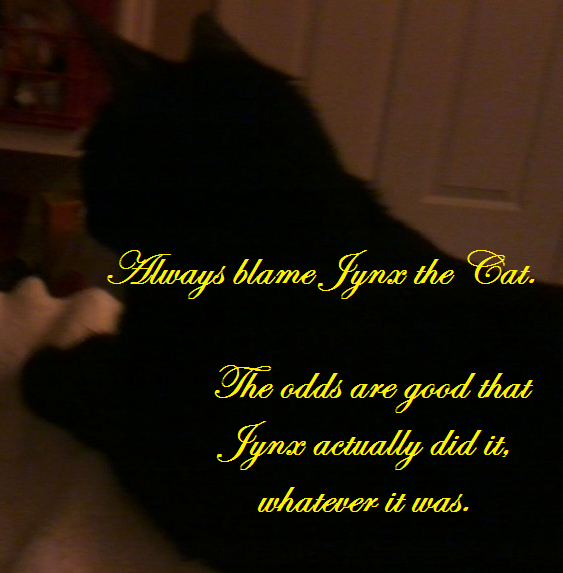
Jynx the Cat is the official scapegoat of our home, when blame cannot otherwise be determined.

Revise, and Re-install, Unconscious Mental Subroutine

tess chiral 2012

Sleep eventually takes your awareness from you, and, at the end, you don’t even resist.

Asleep now. Initialization of nREM startup program in progress.

Stop. Evaluate time elapsed since last sleep-reprogramming. Identify areas of concern.

Rank items of concern in priority order,

Schedule upcoming REM cycle to allow the “playing out” out of necessary “real-word” drama to address the top priority concern. Maintain focus on that concern until it is replaced by another one, new, and of more importance. Keep an eye on all areas of past conflict, while watching for new ones, hoping for early detection.

If unavoidable, implement “the best you can fake it” multitasking coping-mode.

Realize that memory of this sleeping activity will be fragmentary at best.

Know also, nonetheless, that you are the one one writing the program, at both ends of the consciousness-spectrum, the autism spectrum, and any other spectra I find myself standing on.

To answer the obvious question: yes, this blog-post is deliberately being written in the grey zone between sleep and wakefulness. If parts of it make no sense, that’s the reason.

~~~

Note upon waking: I found this, written but not published, on my computer, when my alarm clock went off. I guess I’ll post it now!

A Chiral Solution to the Zome Cryptocube Puzzle

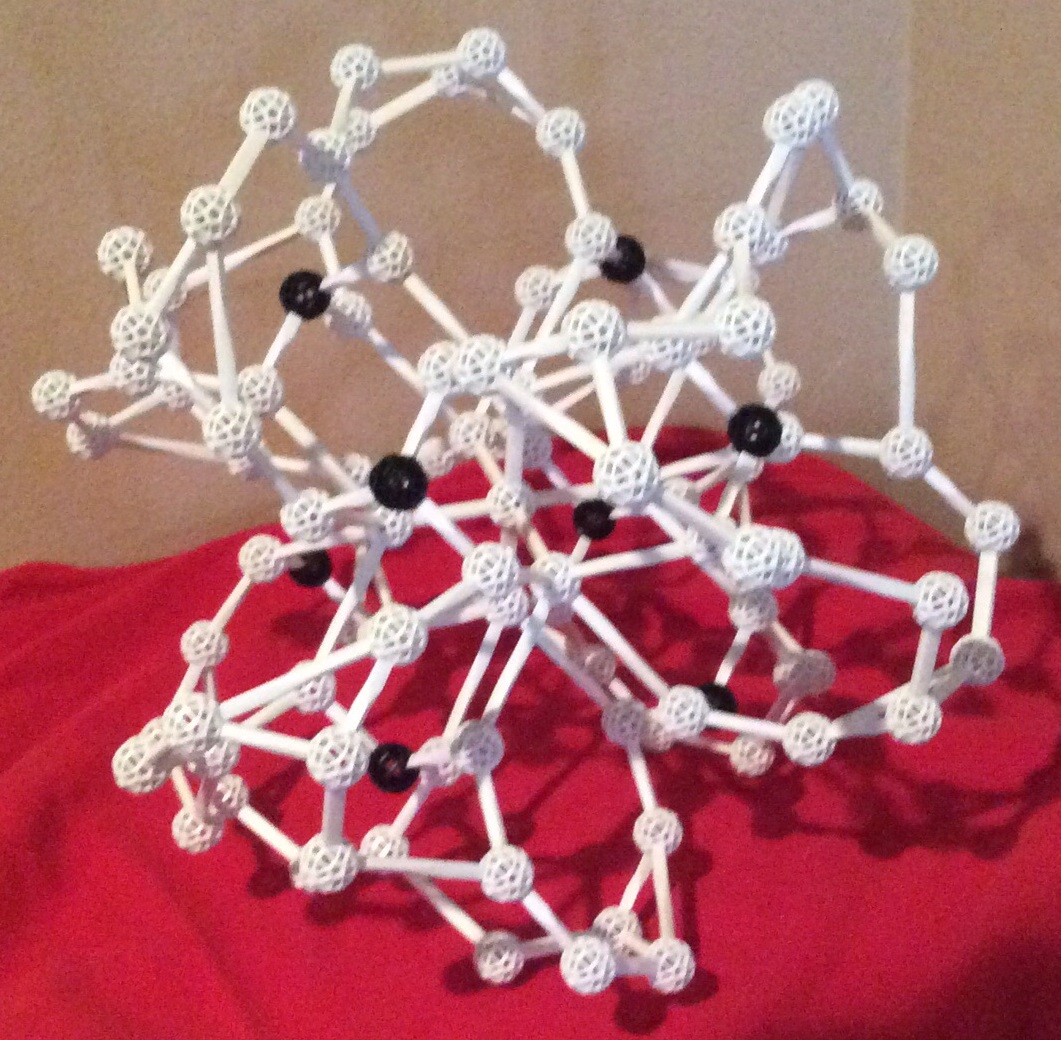
This is my second solution to the Zome Cryptocube puzzle. In this puzzle, you start with a black cube, build a white, symmetrical, aethetically-pleasing geometrical structure which incorporates it, and then, finally, remove the cube. In addition, I added a rule of my own, this time around: I wanted a solution which is chiral; that is, it exists in left- and right-handed forms.

image (34)

It took a long time, but I finally found such a chiral solution, one with tetrahedral symmetry. Above, it appears with the original black cube; below, you can see what it looks like without the black cube’s edges.

image (35)

So an Ancestor of Mine Fed Insects to George Washington . . . .

“I have two cooks … one of them, Mr. Foutz … fancies himself quite the expert in worldly cuisine. … If we fed this army in the same manner Mr. Foutz has attempted to feed me, there would be mass desertion. He actually set out an elaborate dinner whose main attraction was bugs. Covered in some kind of sauce, mind you, but bugs nonetheless. I made the decision at that moment that Mr. Foutz would better serve this army by shouldering a musket.” ~George Washington, to Benjamin Franklin (Source: Rise to Rebellion, by Jeff Shaara, p. 385.)

I’ve just been told that this guy, whose name we know as Andrew Fouts, is an ancestor of mine. I rather like the idea of being descended from someone who fed insects to George Washington.

The Human Reaction, When Mathematics No Longer Seems to Make Sense: What Is This Sorcery?

Cubes 5

Unless you understand all of mathematics — and absolutely no one does — there is a point, for each of us, where mathematics no longer makes sense, at least at that moment. Subjectively, this can make the mathematics beyond this point, which always awaits exploration, appear to be some form of sorcery.

Mathematics isn’t supernatural, of course, but this is a reaction humans often have to that which they do not understand. Human reactions do not require logical purpose, and they don’t always make sense — but there is always a reason for them, even if that reason is sometimes simply that one is utterly bewildered.

In my case, this is the history of my own reactions, as I remember them, to various mathematical concepts. The order used is as close as I can remember to the sequence in which I encountered each idea. The list is, of necessity, incomplete.

  • Counting numbers: no problem, but what do I call the next one after [last one I knew at that time]? And the next one? And the next? Next? Next? [Repeat, until everyone within earshot flees.]
  • Zero exists: well, duh. That’s how much of whatever I’m snacking on is left, after I’ve eaten it all.
  • Arithmetic: oh, I’m glad to have words for this stuff I’ve been doing, but couldn’t talk about before.
  • Negative numbers: um, of course those must exist. No, I don’t want to hear them explained; I’ve got this already. What, you want me to demonstrate that I understand it? Ok, can I borrow a dollar? Oh, sure, I’ll return it at some point, but not until after I’ve spent it.
  • Multiple digits, the decimal point, decimal places, place value: got it; let’s move on, please. (I’ve never been patient with efforts to get me to review things, once I understand them, on the grounds that review, under such conditions, is a useless activity.)
  • Pi: love at first sight.
  • Fractions: that bar means you divide, so it all follows from that. Got it. Say, with these wonderful things, why, exactly, do we need decimals, again? Oh, yeah, pi — ok, we keep using decimals in order to help us better-understand the number pi. That makes sense.
  • “Improper” fractions: these are cool! I need never use “mixed numbers” again (or so I thought). Also, “improper” sounds much more fun than its logical opposite, and I never liked the term “mixed numbers,” nor the way those ugly things look.
  • Algebra: ok, you turned that little box we used before into an “x” — got it. Why didn’t we just use an “x” to begin with? Oh, and you can do the same stuff to both sides of equations, and that’s our primary tool to solve these cool puzzles. Ok. Got it.
  • Algebra I class: why am I here when I already know all this stuff?
  • Inequality symbols: I’m glad they made the little end point at the smaller number, and the larger side face the larger number, since that will be pretty much impossible to forget.
  • Scientific notation: well, I’m glad I get to skip writing all those zeroes now. If only I knew about this before learning number-names, up to, and beyond, a centillion. Oh well, knowing those names won’t hurt me.
  • Exponents: um, I did this already, with scientific notation. Do not torture me with review of stuff I already know!
  • Don’t divide by zero: why not? [Tries, with a calculator]: say, is this thing broken? [Tries dividing by smaller and smaller decimals, only slightly larger than zero]: ok, the value of the fraction “blows up” as the denominator approaches zero, so it can’t actually get all the way there. Got it.
  • Nonzero numbers raised to the power of zero equal one: say what? [Sits, bewildered, until thinking of it in terms of writing the number one, using scientific notation: 1 x 10º.] Ok, got it now, but that was weird, not instantly understanding it.
  • Sine and cosine functions: got it, and I’m glad to know what those buttons on the calculator do, now, but how does the calculator know the answers? It can’t possibly have answers memorized for every millionth of a degree.
  • Tangent: what is this madness that happens at ninety degrees? Oh, right, triangles can’t have two right angles. Function “blows up.” Got it.
  • Infinity: this is obviously linked to what happens when dividing by ever-smaller numbers, and taking the tangent of angles approaching a right angle. I don’t have to call it “blowing up” any more. Ok, cool.
  • Factoring polynomials: I have no patience for this activity, and you can’t stop me from simply throwing the quadratic formula at every second-order equation I see.
  • Geometry (of the type studied in high school): speed this up, and stop stating the obvious all the time!
  • Radicals: oh, I was wondering what an anti-exponent would look like.
  • Imaginary numbers: well, it’s only fair that the negative numbers should also get square roots. Got it. However, Ms. _____________, I’d like to know what the square root of i is, and I’d like to know this as quickly as possible. (It took this teacher and myself two or three days to find the answer to this question, but find it we did, in the days before calculators would help with problems like this.)
  • The phrase “mental math” . . . um, isn’t all math mental? Even if I’m using a calculator, my mind is telling my fingers which buttons to press on that gadget, so that’s still a mental activity. (I have not yielded from this position, and therefore do not use the now-despised “mental math” phrase, and, each time I have heard it, to date, my irritation with the term has increased.)
  • 0.99999… (if repeated forever) is exactly equal to one: I finally understood this, but it took attacks from several different directions to get there, with headaches resulting. The key to my eventual understanding it was to use fractions: ninths, specifically.
  • The number e, raised to the power of i‏π, equals -1: this is sorcery, as far as I can see. [Listens to, and attempts to read, explanations of this identity.] This still seems like sorcery!
  • What it means to take the derivative of an expression: am I just supposed to memorize this procedure? Is no one going to explain to me why this works?
  • Taking the derivative of a polynomial: ok, I can do this, but I don’t have the foggiest idea why I’m doing it, nor why these particular manipulations of one function give you a new function which is, at all points along the x-axis, the slope of the previous function. Memorizing a definition does not create comprehension.
  • Integral calculus: this gives me headaches.
  • Being handed a sheet of integration formulas, and told to memorize them: hey, this isn’t even slightly fun anymore. =(
  • Studying polyhedra: I finally found the “sweet spot” where I can handle some, but not all, of the puzzles, and I even get to try to find solutions in ways different from those used by others, without being chastised. Yay! Math is fun again! =)
  • Realizing, while starting to write this blog-post, that you can take the volume of a sphere, in terms of the radius, (4/3)πr³, take its derivative, and you get the surface area of the same sphere, 4πr²: what is this sorcery known as calculus, and how does it work, so it can stop looking like sorcery to me?

Until and unless I experience the demystification of calculus, this blog will continue to be utterly useless as a resource in that subfield of mathematics. (You’ve been warned.) The primary reason this is so unlikely is that I haven’t finished studying (read: playing with) polyhedra yet, using non-calculus tools I already have at my disposal. If I knew I would live to be 200 years old, or older, I’d make learning calculus right now a priority, for I’m sure my current tools’ usefulness will become inadequate in a century or so, and learning calculus now, at age 47, would likely be easier than learning it later. As things are, though, it’s on the other side of the wall between that which I understand, and that which I do not: the stuff that, at least for now, looks like magic — to me.

Please don’t misunderstand, though: I don’t “believe in” magic, but use it simply as a label of convenience. It’s a name for the “box ,” in my mind, where ideas are stored, but only if I don’t understand those ideas on first exposure. They remain there until I understand them, whether by figuring the ideas out myself, or hearing them explained, and successfully understanding the explanation, at which point the ideas are no longer thought of, on any level, as “magic.”

To empty this box, the first thing I would need would be an infinite amount of time. Once I accepted the inevitability of the heat death of the universe, I was then able to accept the fact that my “box of magic” would never be completely emptied, for I will not get an infinite amount of time.

[Image credit: I made a rainbow-colored version of the compound of five cubes for the “magic box” picture at the top of this post, using Stella 4d, a program you may try here.]


Some Stereotypes Are Based on Reality (with Jynx the Kitten)

stereotypes

When the Westboro Baptist Church Protests Leonard Nimoy’s Funeral, What Is the Appropriate Phaser Setting?

leonard-nimoy-westboro-baptist-church-665x385

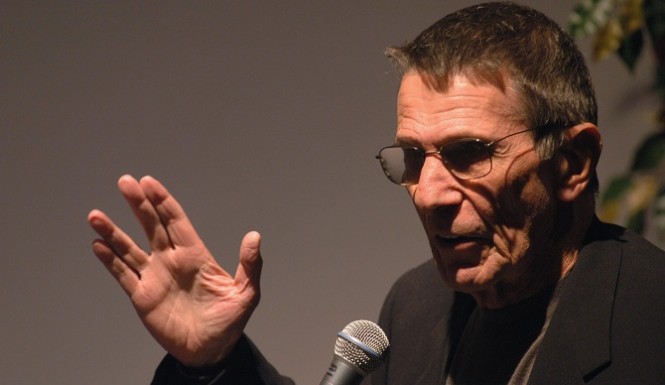
I’ve been trying to determine the appropriate phaser setting for dealing with these people, and have decided to go with “heavy stun.”

Heavy stun is kinder than the WBC adults deserve, but some of those WBC people are infants and children, and they have a chance of throwing off their brainwashing as they grow up. I would not deny them that chance.

[Photo credit: This website is where I found this image. It’s a story about the WBC announcing their intent to protest Leonard Nimoy’s funeral.]