
This was created by augmenting a great dodecahedron with more great dodecahedra, and then augmenting the result with even more of them.
The software I used was Stella 4d, which you can find right here.
This was created by augmenting a great dodecahedron with more great dodecahedra, and then augmenting the result with even more of them.
The software I used was Stella 4d, which you can find right here.

The Platonic Icosahedron has twenty faces which are equilateral triangles. In the Golden Icosahedron, twelve of those triangles (the yellow ones) have been replaced by acute, isosceles triangles with a leg:base ratio which is the Golden Ratio.
To try the software I used to make this, just visit http://www.software3d.com/stella.php.
The simplest polyhedron is the tetrahedron, and it is self-dual. The compound of two tetrahedra puts these duals together, and is most often called the Stella Octangula, a name Johannes Kepler gave it in the early 17th Century.

In hyperspace, or 4-space, the simplest polychoron is the pentachoron, or 5-cell. Like the tetrahedron in 3-space, it is also self-dual. Here is the compound of two of them: hyperspace’s version of the Stella Octangula.

Website to find the software used to make these images: www.software3d.com/stella.php

Software credit: visit http://www.software3d.com/stella.php to try or buy Stella 4d, without which I could not have made this.
Now that the latest version of Stella 4d allows users to make rotating .gifs, I post those here (see the last post for an example). However, before I started blogging on WordPress, I made a blog on Tumblr with many still images produced using earlier versions of Stella. Here is an example:

The link above is to that blog’s archive — just click on any small pic there to make it larger. Unlike other Tumblr-blogs of mine, this one has no reblogged material — it was the banality of reblogging, you see, that drove me from Tumblr in the first place.
Info on getting/trying Stella 4d for yourself: www.software3d.com/stella.php

Website to try polyhedra-making software used to make this image: http://www.software3d.com/stella.php

In this polyhedron, there are, easily visible, twenty light blue faces which are equilateral triangles. Inside the polyhedron (and therefore harder to spot) are thirty purple faces which are Golden rectangles, along with twelve large, orange regular pentagonal faces.
To try the software I used to make this polyhedron, please visit www.software3d.com/stella.php.
The software used to produce this image may be tried as a free trial download at http://www.software3d.com/Stella.php.
Creating zonish polyhedra (related to zonohedra) and creating rotating polyhedral .gifs are two features newly added to Stella, the program used to make this, which may be tried for free at http://www.software3d.com/stella.php
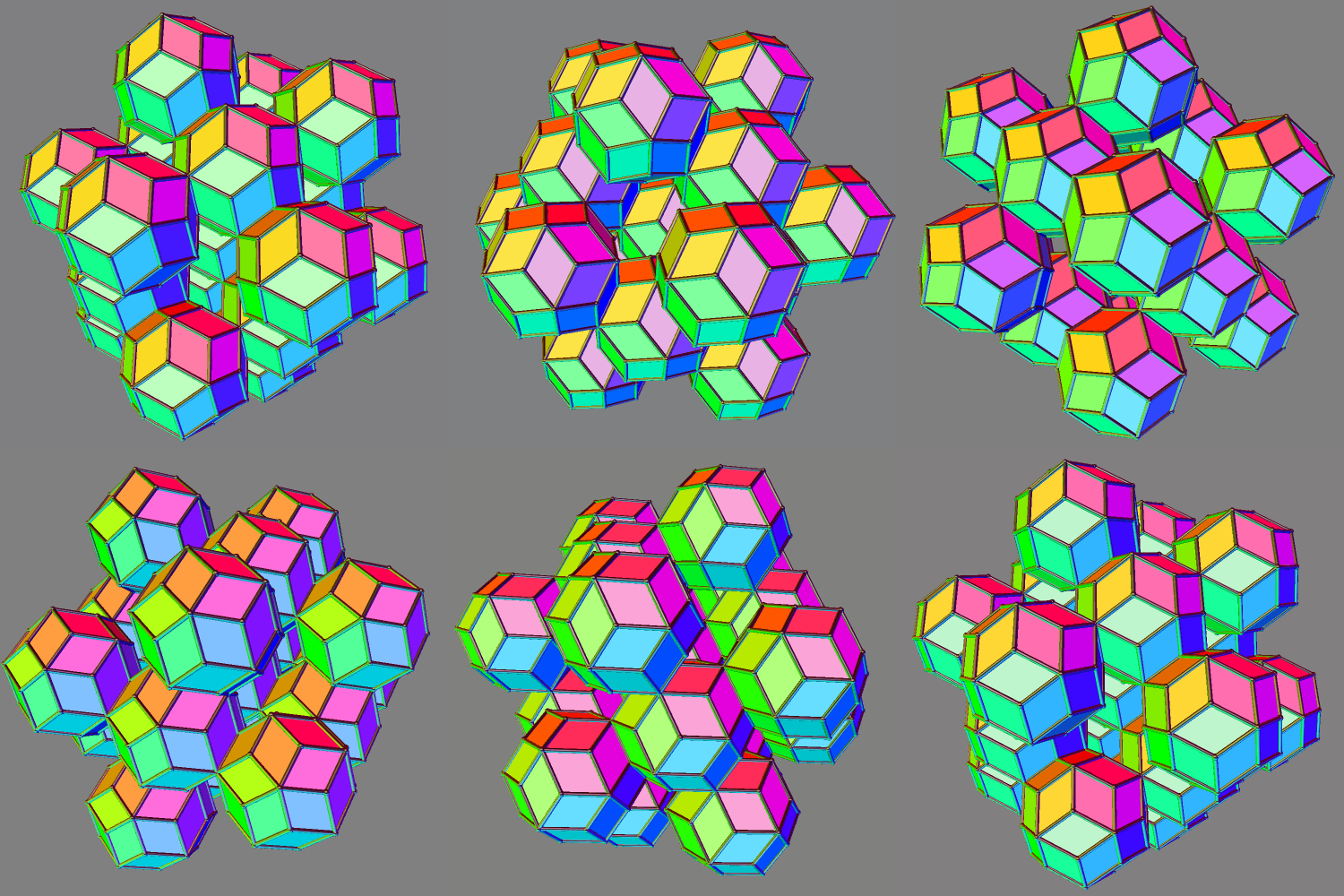
So I wondered, what would happen if I took rhombic dodecahedra…

…and then affixed them to the sixty wider faces of a rhombic enneacontahedron?

Well, it turns out that this is what you get:
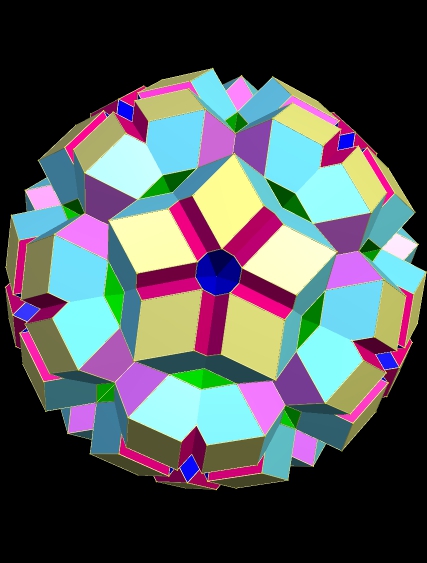
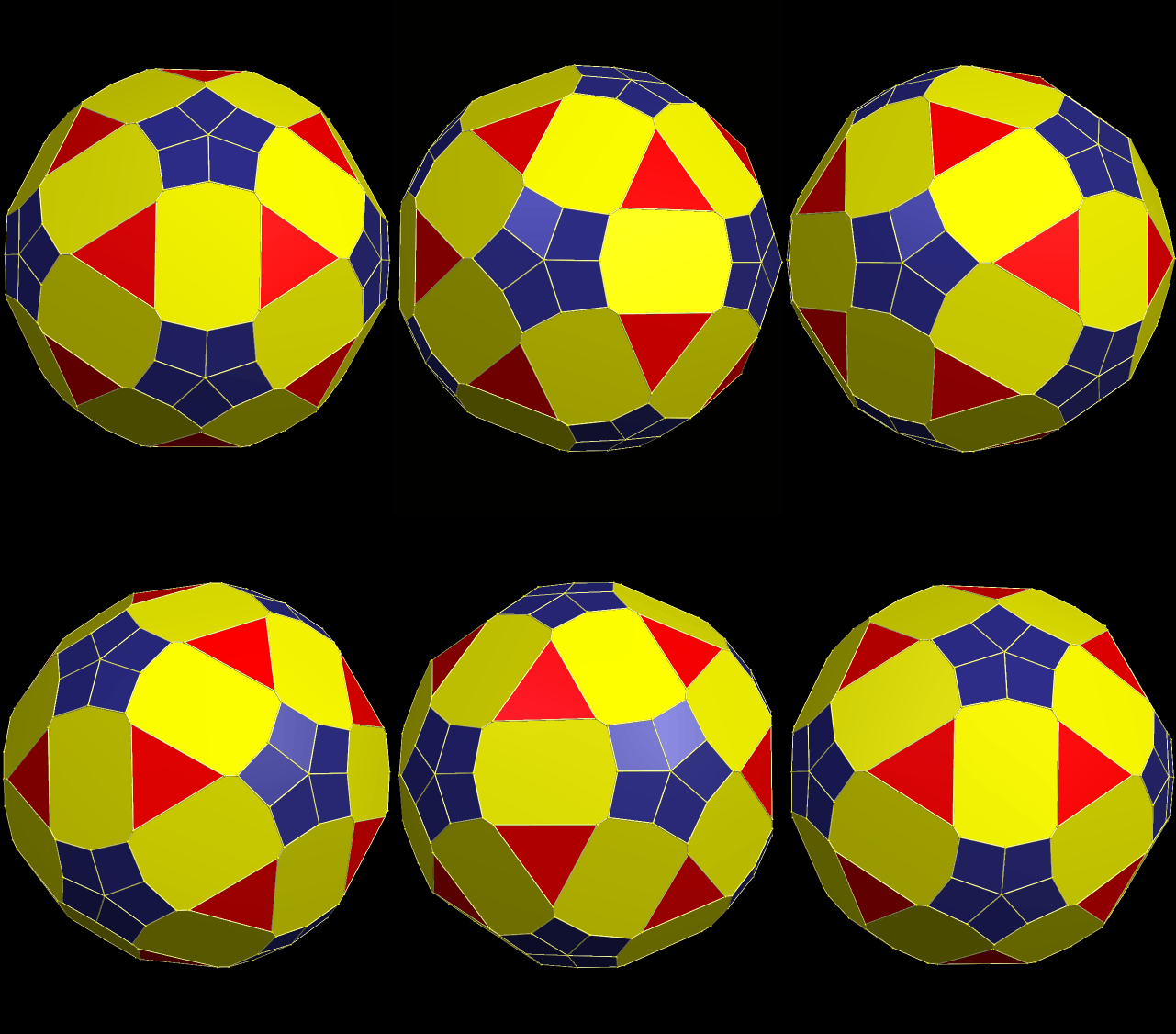
It’s at time like these — urgent situations in recreational mathematics — that I am most glad I bought Stella 4d, the program with which I made these images (and which you can try, for free, at http://www.software3d.com/stella.php). This would have taken months to figure out without the proper software! The next thing that occurred to me was to take the convex hull of the last polyhedron. That’s like draping a sheet around it and then pulling it tight. Here’s the result:

Stella owes its name, in part, to a complex operation involving extensions of edges into lines, or faces into planes, called stellation. Stellating the above figure gave me something I didn’t like, but stellating it again gave me this:

And then, after six more stellations, I arrived at the end of this particular polyhedral journey.

 RobertLovesPi.net