A Polyhedral Journey, Beginning with the Snub Cube / Pentagonal Isositetrahedron Base/Dual Compound

The snub cube and its dual make an attractive compound. Since the snub cube is chiral, its chirality is preserved in this compound.

Penta Icositetra & snub cube compound

If you examine the convex hull of this compound, you will find it to be chiral as well.

Convex hull of snub cube& dual compound

Here is the mirror image of that convex hull:

Convex hull mirror image

These two convex hulls, of course, have twin, chiral, duals:

dual of Convex hull of snub cube& dual compound

Dual of Convex hull mirror image

The two chiral convex hulls above (the red, blue, and yellow ones), made an interesting compound, as well.

Compound of enantiomorphic pair not dual

This is also true of their chiral duals:

Compound of enantiomorphic pair

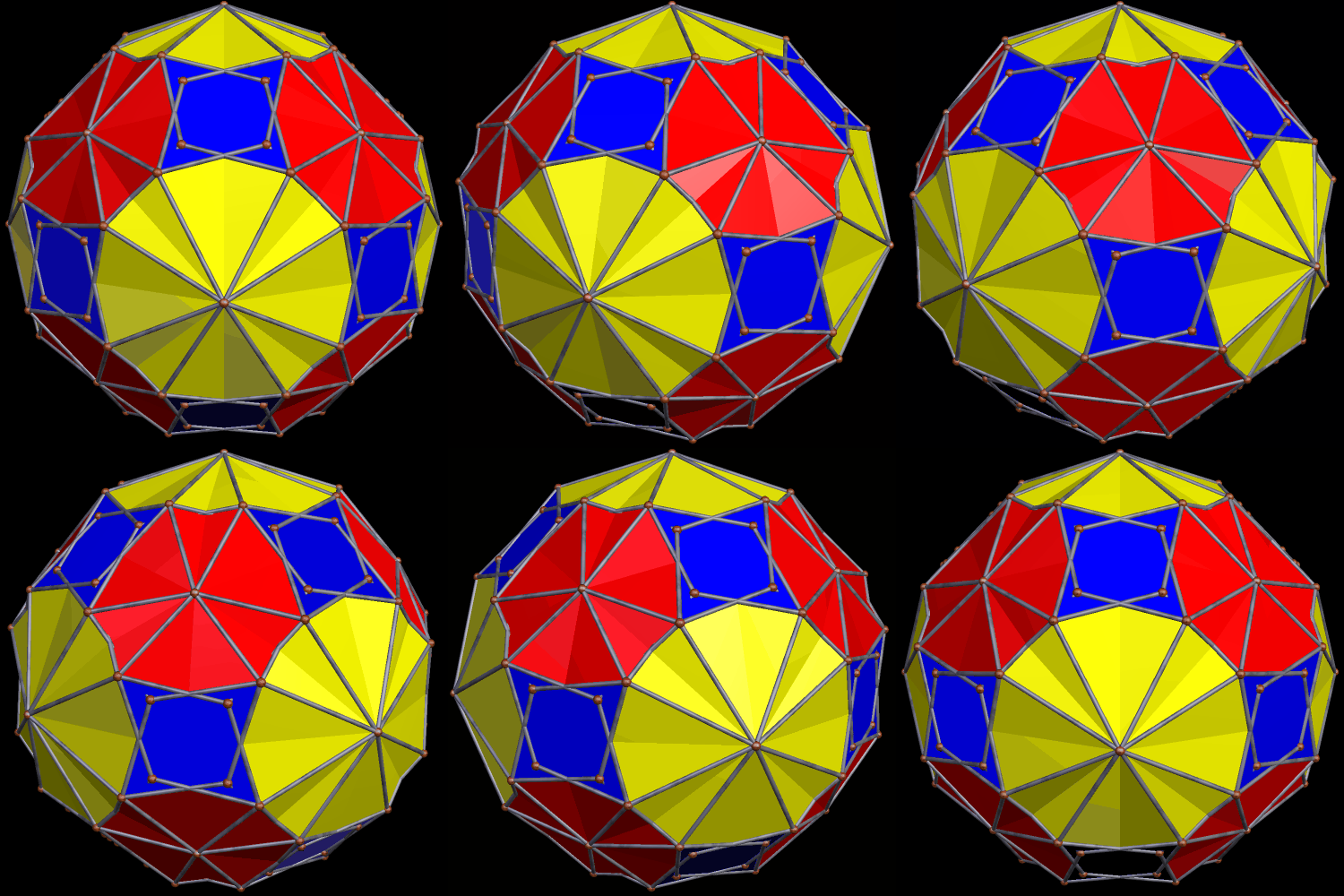
I next stellated this last figure numerous times (I stopped counting at ~200), to obtain this polyhedron:

Stellated Compound of enantiomorphic pair dual

After seeing this, I wanted to know what its dual would look like — and it was a nice polyhedron on which to end this particular polyhedral journey.

dual of Stellated Compound of enantiomorphic pair dual

I  make these transformations of polyhedra, and create these virtual models, using a program called Stella 4d. It may be purchased, or tried for free, at http://www.software3d.com/Stella.php.

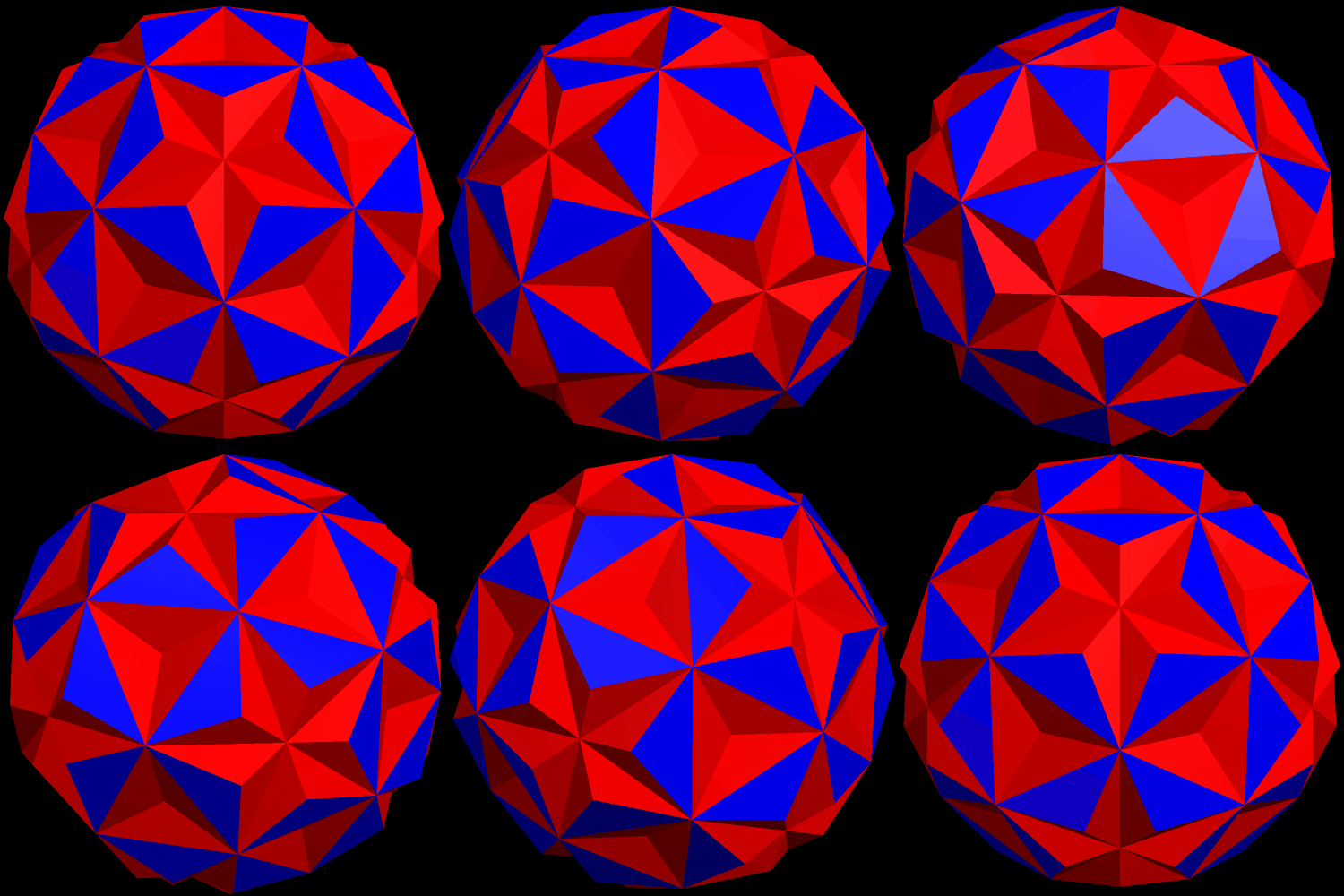
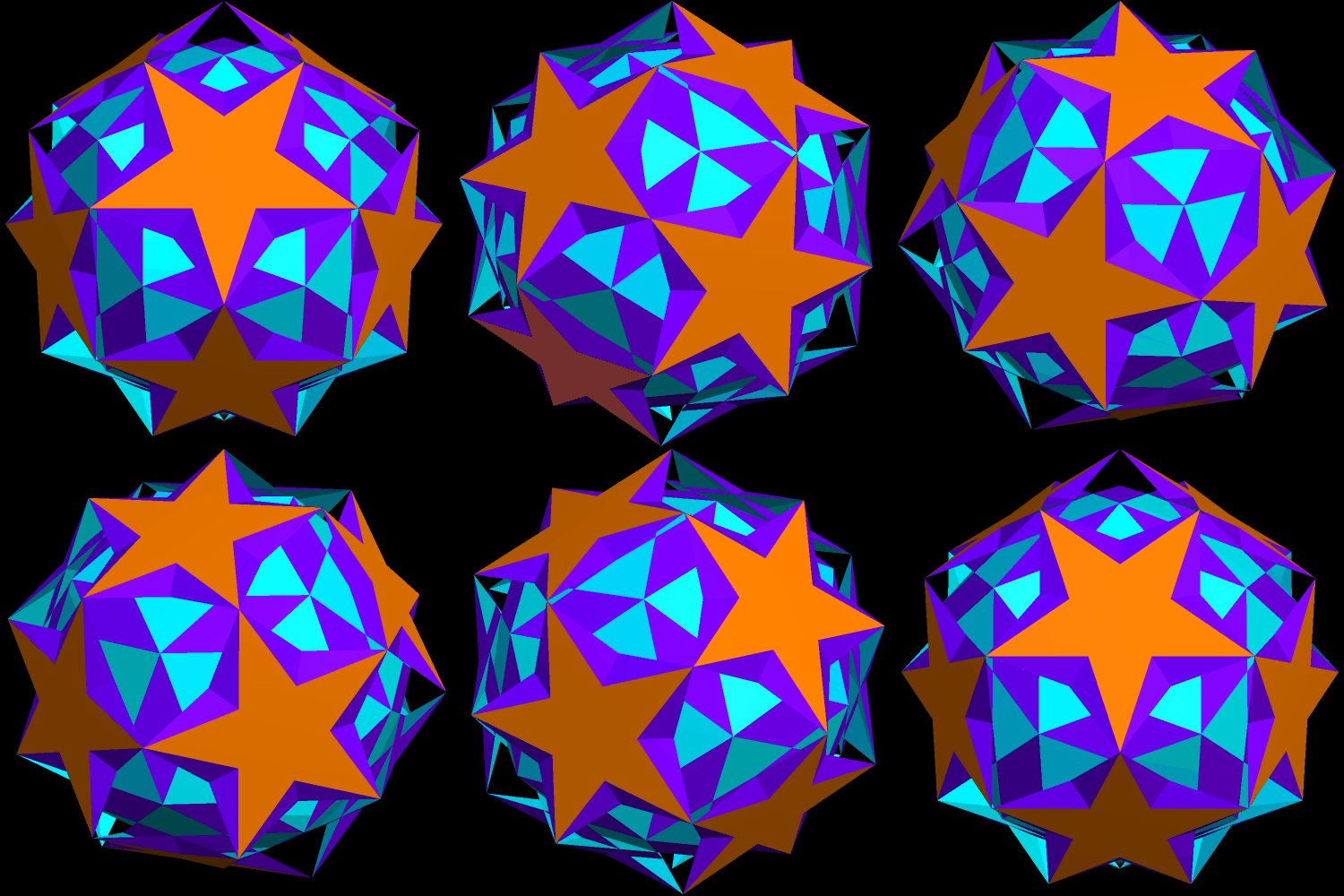
Five Variants of the Icosidodecahedron

a stellation of a faceted icosidodecahedron

another stellation of a faceted icosidodecahedron

Faceted Icosidodeca

Faceted Stellated Rhombic Triaconta

Stellated Faceted IcosidodecaI made all of these icosidodecahedron-variants using a program called Stella 4d: Polyhedron Navigator. It may be purchased, or tried for free (as a trial version), at http://www.software3d.com/Stella.php.

Polygons Related to the Golden Ratio, and Associated Figures in Geometry, Part 2: Quadrilaterals

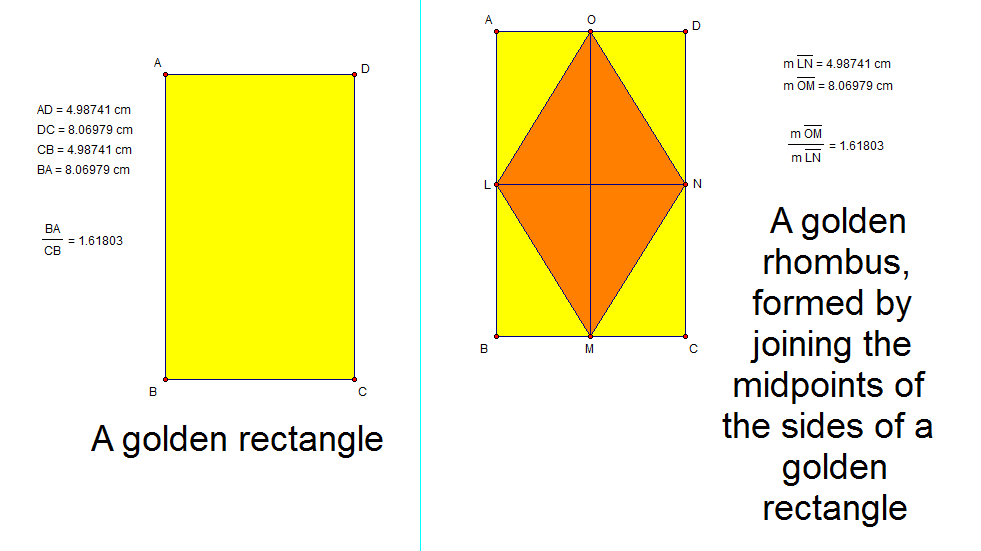
The golden ratio, also known as φ, has a value of [1 + sqrt(5)]/2, or ~1.61803. It is associated with a great many figures in geometry, and also appears in numerous other contexts. The most well-known relationship between a geometric figure and the golden ratio is the golden rectangle, which has a length:width ratio equal to the golden ratio. An interesting property of the golden rectangle is that, if a square is removed from it, the remaining portion is simply a smaller golden rectangle — and this process can be continued without limit.

golden rectangle

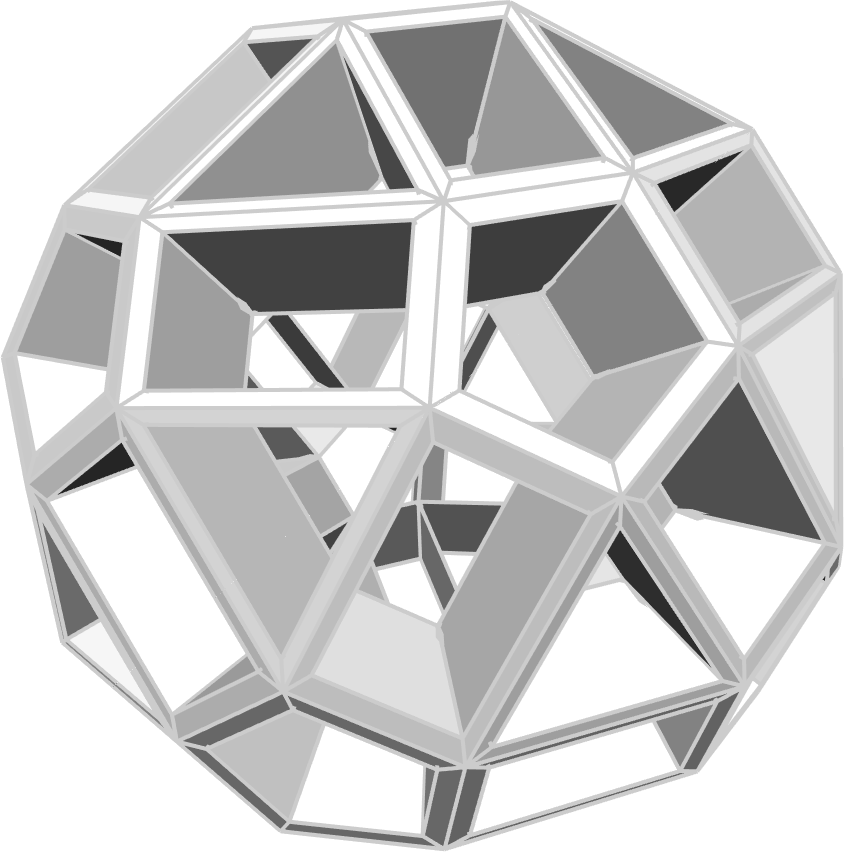
While the golden ratio is related to many polyhedra, this relationship does not always involve golden rectangles, but sometimes it does. For example, it is possible to modify a rhombicosidodecahedron, by replacing that figure’s squares with golden rectangles (with the longest side adjacent to the triangles, not the pentagons), to obtain a “Zomeball” — the node which is at the heart of the Zometool ball-and-stick modeling system for polyhedra, and other phenomena. The entire Zome system is based on the golden ratio. Zome kits are available for purchase at http://www.zometool.com, and this image of a Zomeball was found at http://www.graphics.rwth-aachen.de/media/resource_images/zomeball.png.

zomeball

In some cases, the relationship between a golden rectangle, and a polyhedron, is more subtle. For example, consider three mutually-perpendicular golden rectangles, each with the same center:

3 GOLDEN RECTANGLES

While this is not, itself, a polyhedron, it is possible to create a polyhedron from it, by creating its convex hull. A convex hull is simply the smallest convex polyhedron which can contain a given figure in space. For the three golden rectangles above, the convex hull is the icosahedron, one of the Platonic solids:

ICOSAl

In addition to the golden rectangle, there are also other quadrilaterals related to the golden ratio. For example, a figure known as a golden rhombus is formed by simply connecting the midpoints of the sides of a golden rectangle. The resulting rhombus has diagonals which are in the golden ratio.

golden rhombus

One of the Archimedean solids, the icosidodecahedron, has a dual called the rhombic triacontahedron. The rhombic triacontahedron has thirty faces, and all of them are golden rhombi.

Rhombic Triaconta

There are also other polyhedra which have golden rhombi for faces. One of them, called the rhombic hexacontahedron (or “hexecontahedron,” in some sources), is actually the 26th stellation of the rhombic triacontahedron, itself. It has sixty faces, all of which are golden rhombi.

Rhombic Triaconta 26th stellation

Other quadrilaterals related to the golden ratio can be formed by reflecting the golden triangle and golden gmonon (described in the post right before this one) across each of their bases, to form two other types of rhombus.

rhombi for penrose tilings

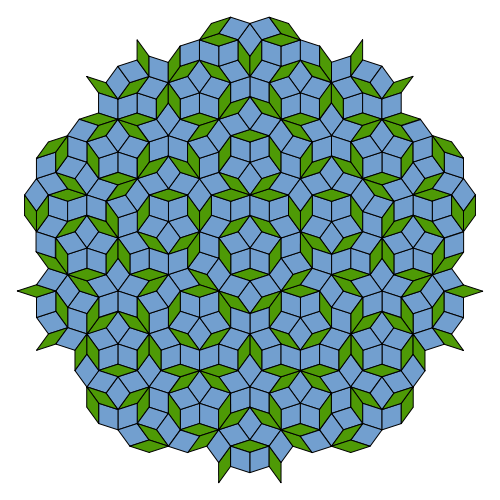
In these two rhombi, the golden ratio shows up as the side-to-short-diagonal ratio (in the case of the 36-144-36-144 rhombus), and the long-diagonal-to-side ratio (in the case of the 72-108-72-108 rhombus). These two rhombi have a special property:  together, they can tile a plane in a pattern which never repeats itself, but, despite this, can be continued indefinitely. This “aperiodic tiling” was discovered by Roger Penrose, a physicist and mathematician. The image below, showing part of such an aperiodic tiling, was found at https://en.wikipedia.org/wiki/Penrose_tiling.

500px-Penrose_Tiling_(Rhombi).svg

There are also at least two other quadrilaterals related to the golden ratio, and they are also formed from the golden triangle and the golden gnomon. The procedure for making these figures, which could be called the “golden kite” and the “golden dart,” is similar to the one for making the rhombi for the Penrose tiling above, but has one difference: the two triangles are each reflected over a leg, rather than a base.

kite and dart for for penrose tilings

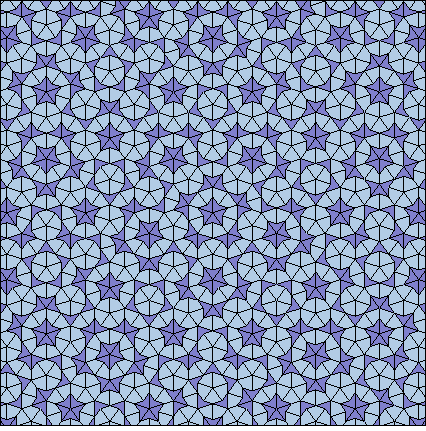
In the case of this kite and dart, it is the longer and shorter edges, in each case, which are in the golden ratio — just as is the case with the golden rectangle. Another discovery of Roger Penrose is that these two figures, also, can be used to form aperiodic tilings of the plane, as seen in this image from http://www.math.uni-bielefeld.de/~gaehler/tilings/kitedart.html.

kitedart

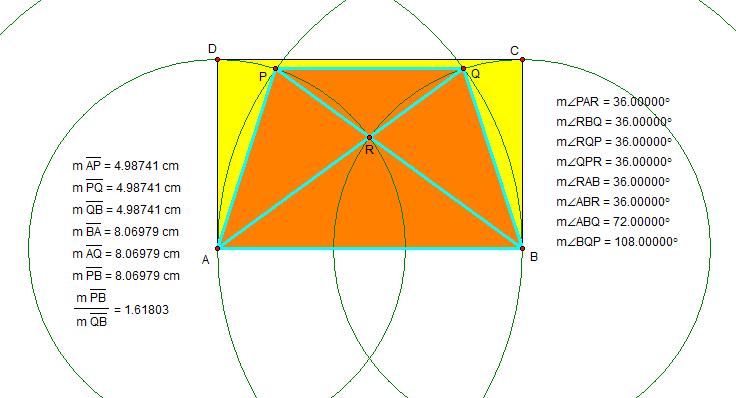
There is yet another quadrilateral which has strong connections to the golden ratio. I call it the golden trapezoid, and this shows how it can be made from a golden rectangle, and how it can be broken down into golden triangles and golden gnomons. However, I have not yet found an interesting polyhedron, not tiling pattern, based on golden trapezoids — but I have not finished my search, either.

golden trapezoid

[Image credits:  see above for the sources of the pictures of the two Penrose tilings, as well as the Zomeball, shown in this post. Other “flat,” nonmoving pictures I created myself, using Geometer’s Sketchpad and MS-Paint. The rotating images, however, were created using a program called Stella 4d, which is available at http://www.software3d.com/Stella.php.]

Polygons Related to the Golden Ratio, and Associated Figures in Geometry, Part 1: Triangles

golden triangles

There are two isosceles triangles which are related to the golden ratio, [1 + sqrt(5)]/2, and I used to refer to them as the “golden acute isosceles triangle” and the “golden obtuse isosceles triangle,” before I found out these triangles already have other names –the ones shown above. The golden triangle, especially, shows up in some well-known polyhedra, such as both the great and small stellated dodecahedron. The triangles which form the “points” or “arms” of regular star pentagons (also known as pentagrams) are also golden triangles.

These triangles have sides which are in the golden ratio. For the golden triangle, it is the leg:base ratio which is golden, as shown above. For the golden gnomon, this ratio is reversed:  the base:leg ratio is φ, or ~1.61803 — the irrational number known as the golden ratio.

The angle ratios of each of these triangles are also unique. The golden triangle’s angles are in a 1:2:2 ratio, while the angles of the golden gnomon are in a ratio of 1:1:3.

Another interesting fact about these two triangles is that each one can be subdivided into one of each type of triangle. The golden triangle can be split into a golden gnomon, and a smaller golden triangle, while the golden gnomon can be split into a golden triangle, and a smaller golden gnomon, as seen below.

golden triangles 2

This process can be repeated indefinitely, in each case, creating ever-smaller triangles of each type.

Polyhedra which use these triangles, as either faces or “facelets” (the visible parts of partially-hidden faces) are not uncommon, as previously mentioned. The three most well-known examples are three of the four Kepler-Poinsot solids. In the first two shown below, the small stellated dodecahedron and the great stellated dodecahedron, the actual faces are regular star pentagons which interpenetrate, but the facelets are golden triangles.

Small Stellated Dodeca

Great Stellated Dodeca

The next example is also a Kepler-Poinsot solid: the great dodecahedron. Its actual faces are simply regular pentagons, not star pentagons, but, again, they interpenetrate, hiding much of each face from view. The visible parts, or “facelets,” are golden gnomons.

Great Dodeca

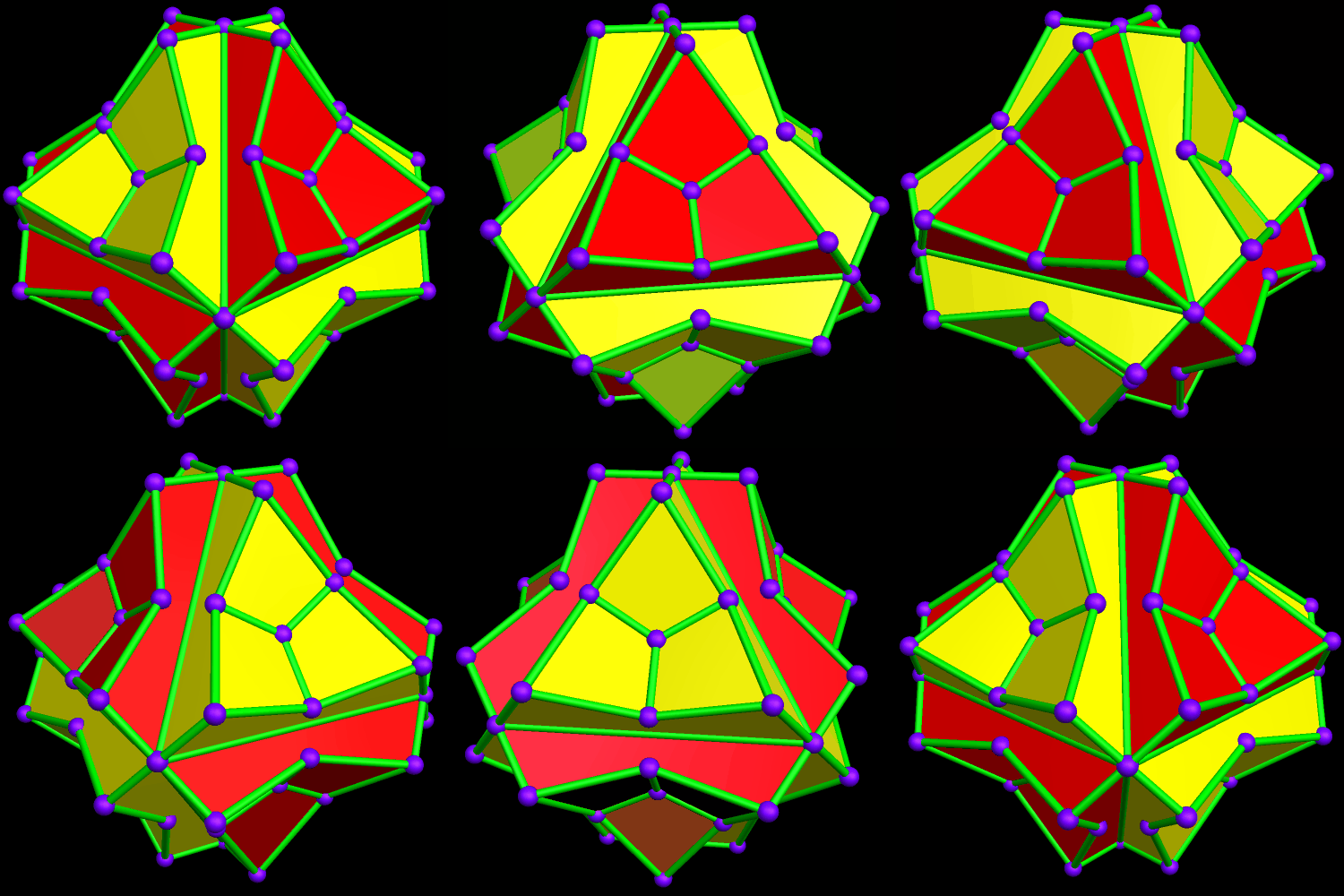
For another example of a polyhedron made of golden gnomons, I made one myself — meaning that if anyone else has ever seen this polyhedron before, this fact is unknown to me, although I cannot rule it out. I have not given it a name. It has thirty-six faces, all of which are golden gnomons. There are twelve of the larger ones, shown in yellow, and twenty-four of the smaller ones, shown in red. This polyhedron has pyritohedral symmetry (the same type of symmetry seen in the seam-pattern of a typical volleyball), and its convex hull is the icosahedron.

36 golden gnomons

[Picture credits: to create the images in this post, I used both Geometer’s Sketchpad and MS-Paint for the two still, flat pictures found at the top. To make images of the four rotating polyhedra, I used a different program, Stella 4d: Polyhedron Navigator. Stella is available for purchase, with a free trial download available, at http://www.software3d.com/Stella.php.]

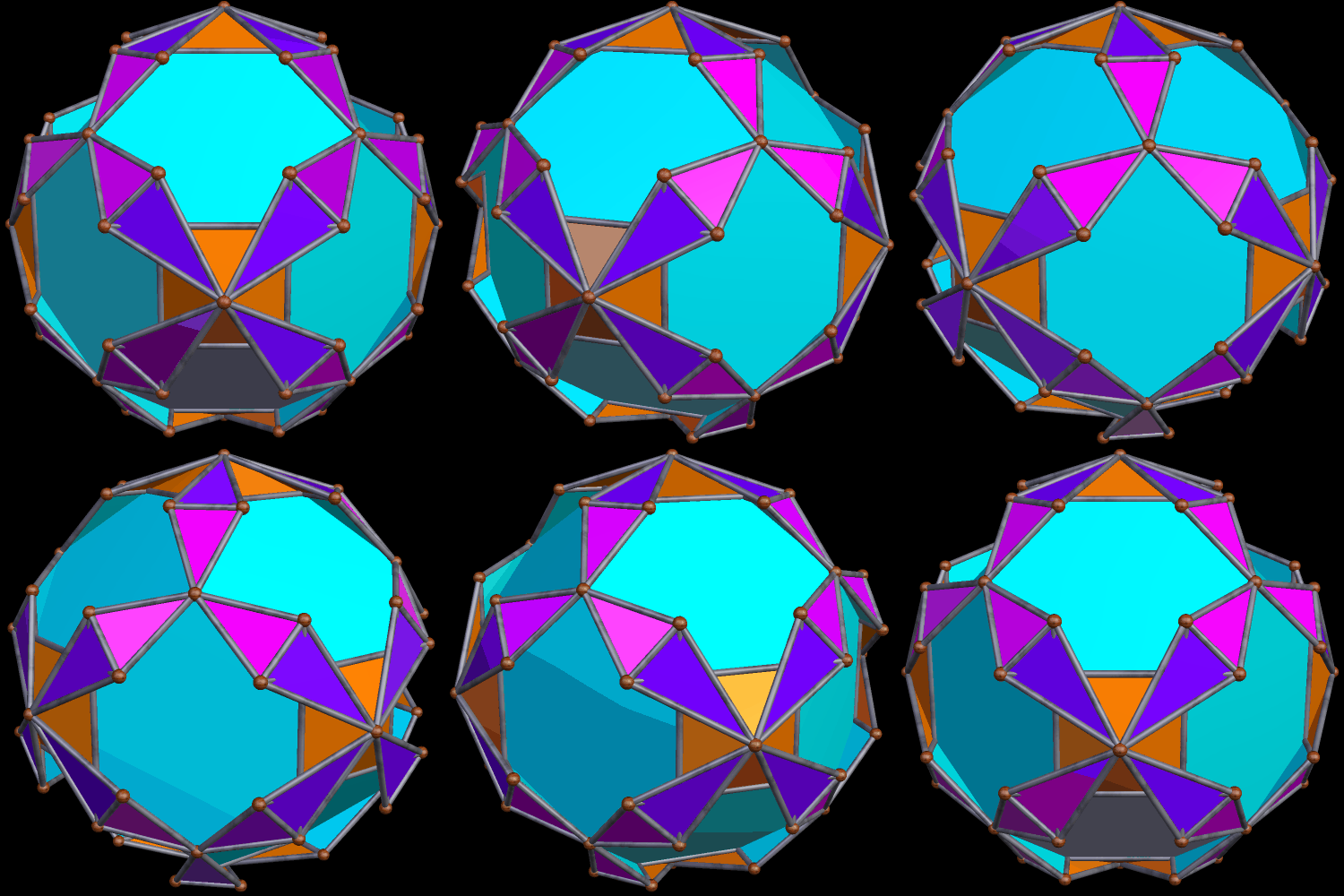
An Unusual Presentation of the Icosahedron/Dodecahedron Base/Dual Compound

Leonardo Icosahedron

In this model, the usual presentation of the icosahedron/dodecahedron dual compound has been altered somewhat. The “arms” of star pentagons have been removed from the dodecahedron’s faces, and the icosahedron is rendered “Leonardo-style,” with smaller triangles removed from each of the faces of the icosahedron, with both these alterations made to enable you to see the model’s interior structure. Also, the dodecahedron is slightly larger than usual, so that its edges no longer intersect those of the icosahedron.

This model was made using Stella 4d, software you can obtain for yourself, with a free trial download available, at http://www.software3d.com/Stella.php.

Three Variations of Kepler’s Stella Octangula

The Stella Octangula was the name Johannes Kepler gave, centuries ago, to the compound of two tetrahedra. Here are three variations on it, all created using Stella 4d, a program you may try at http://www.software3d.com/Stella.php.

stella octangular variantstella octangular variant anotherstella octangular variant third

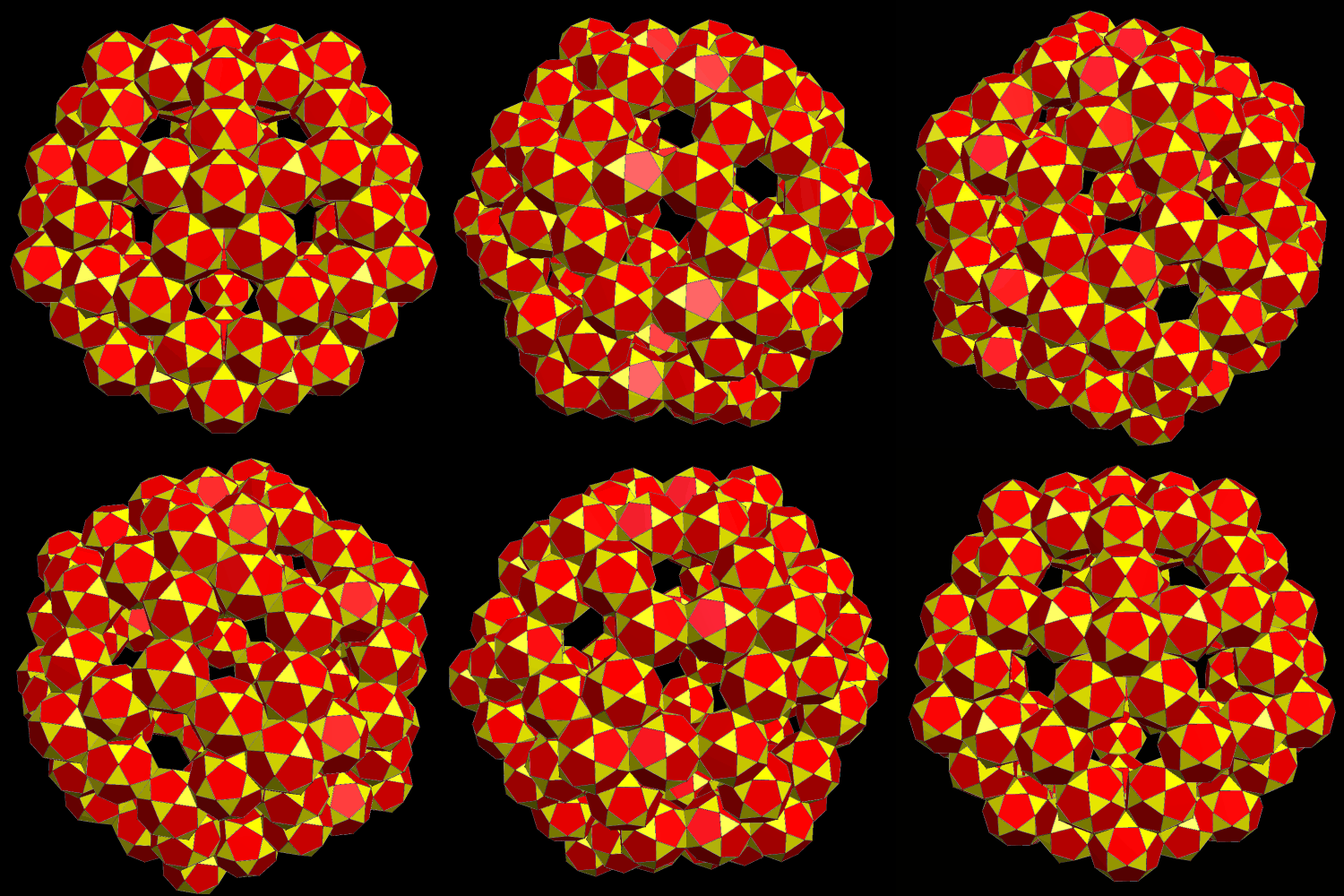
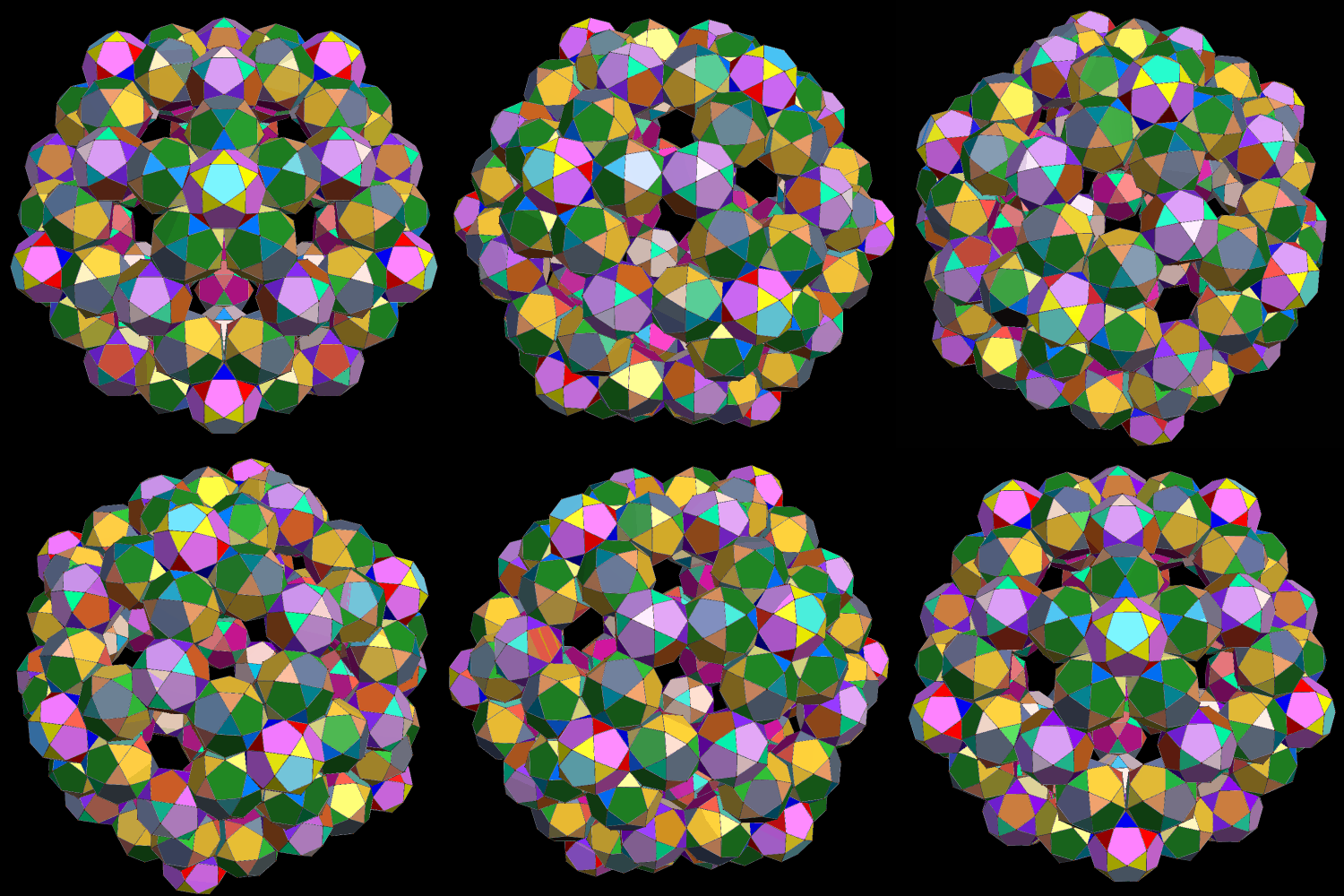
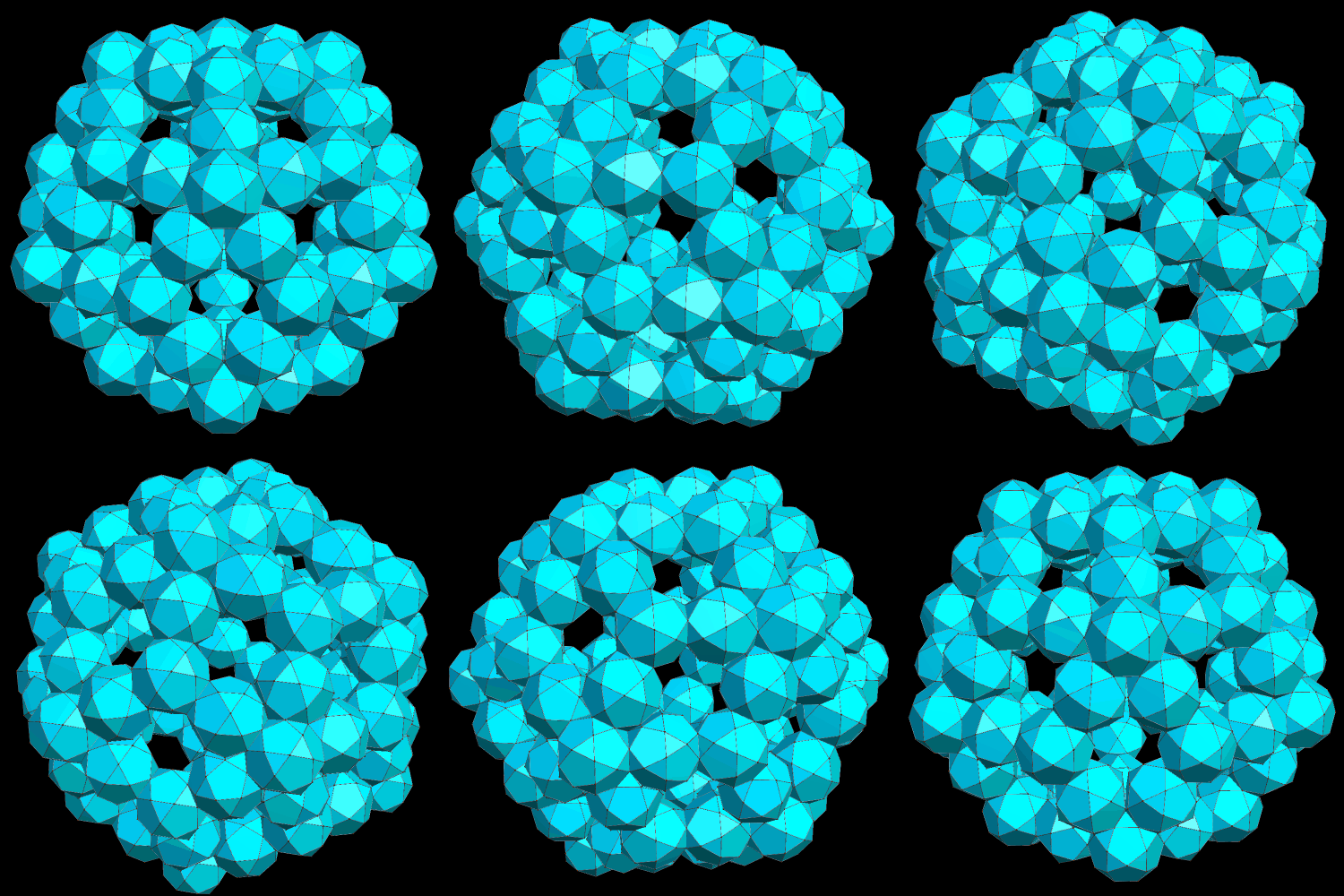
A Rhombic Triacontahedron, Made of Icosidodecahedra

It turns out that it is possible to use multiple icosidodecahedra as building blocks to build that polyhedron’s dual, the rhombic triacontahedron. This construction appears below, in four different coloring-schemes.

Augmented IcosidodecaAugmented Icosidodeca2Augmented Icosidodeca3Augmented Icosidodeca4

These rotating virtual models were constructed using Stella 4d, a program available at http://www.software3d.com/Stella.php.

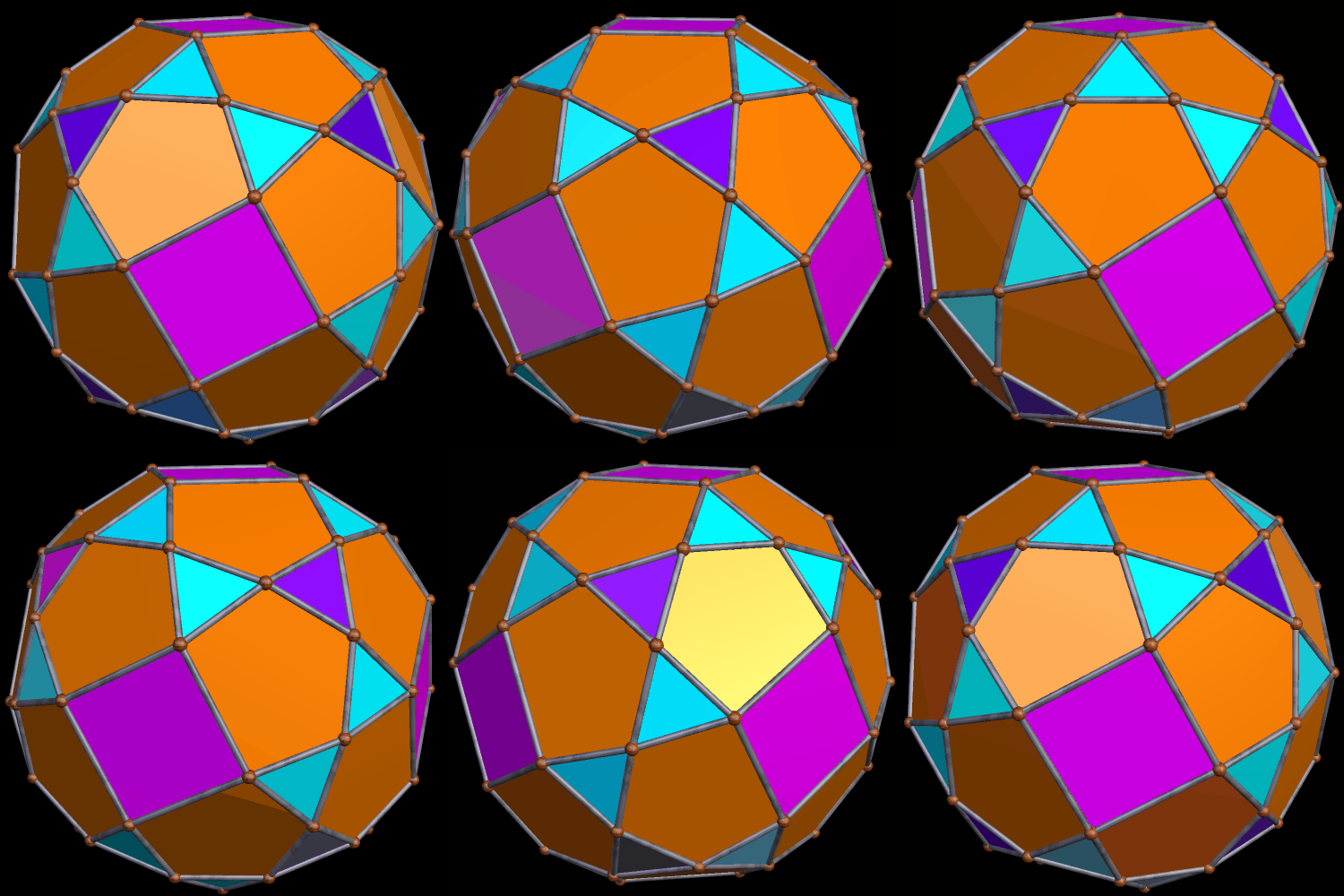
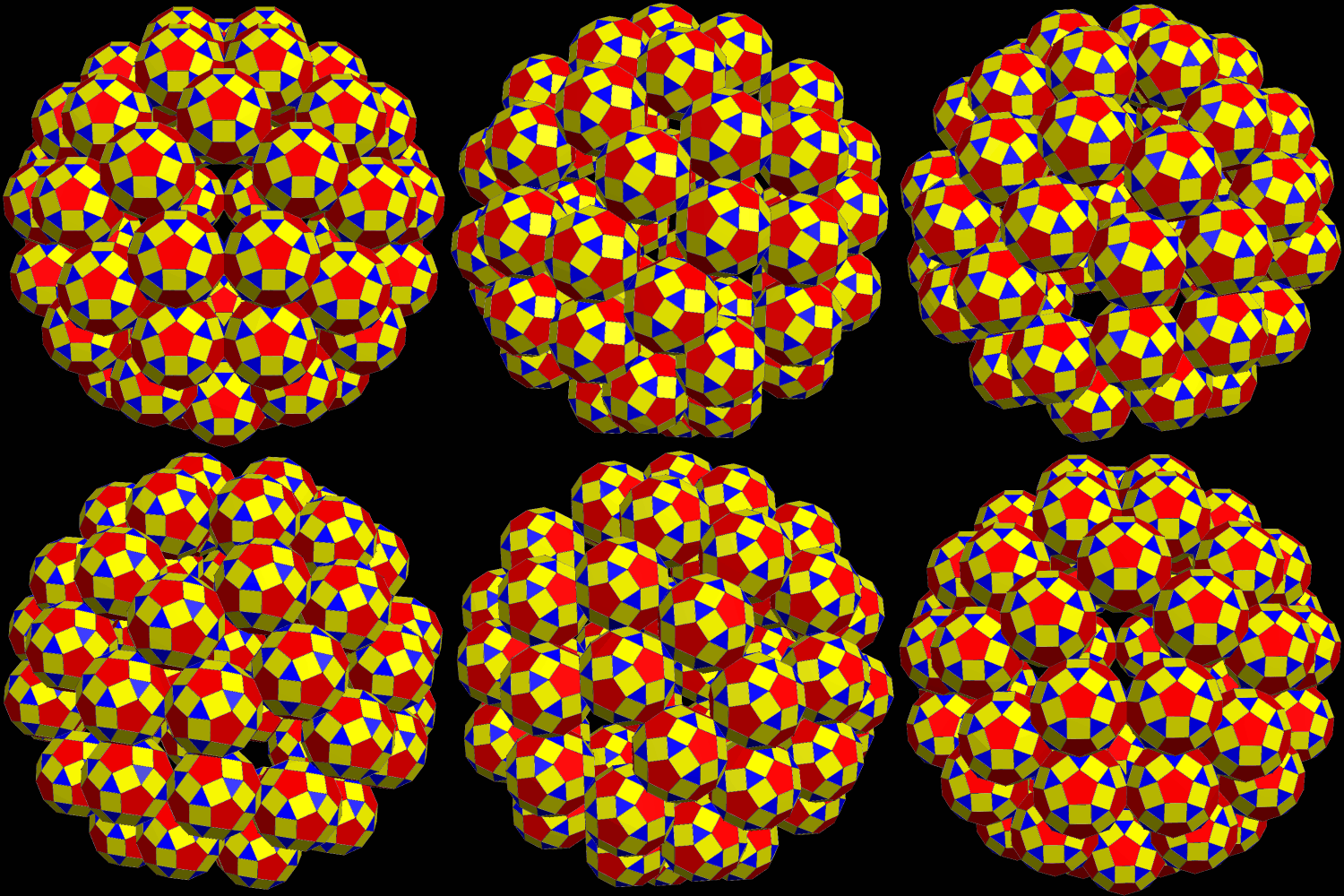
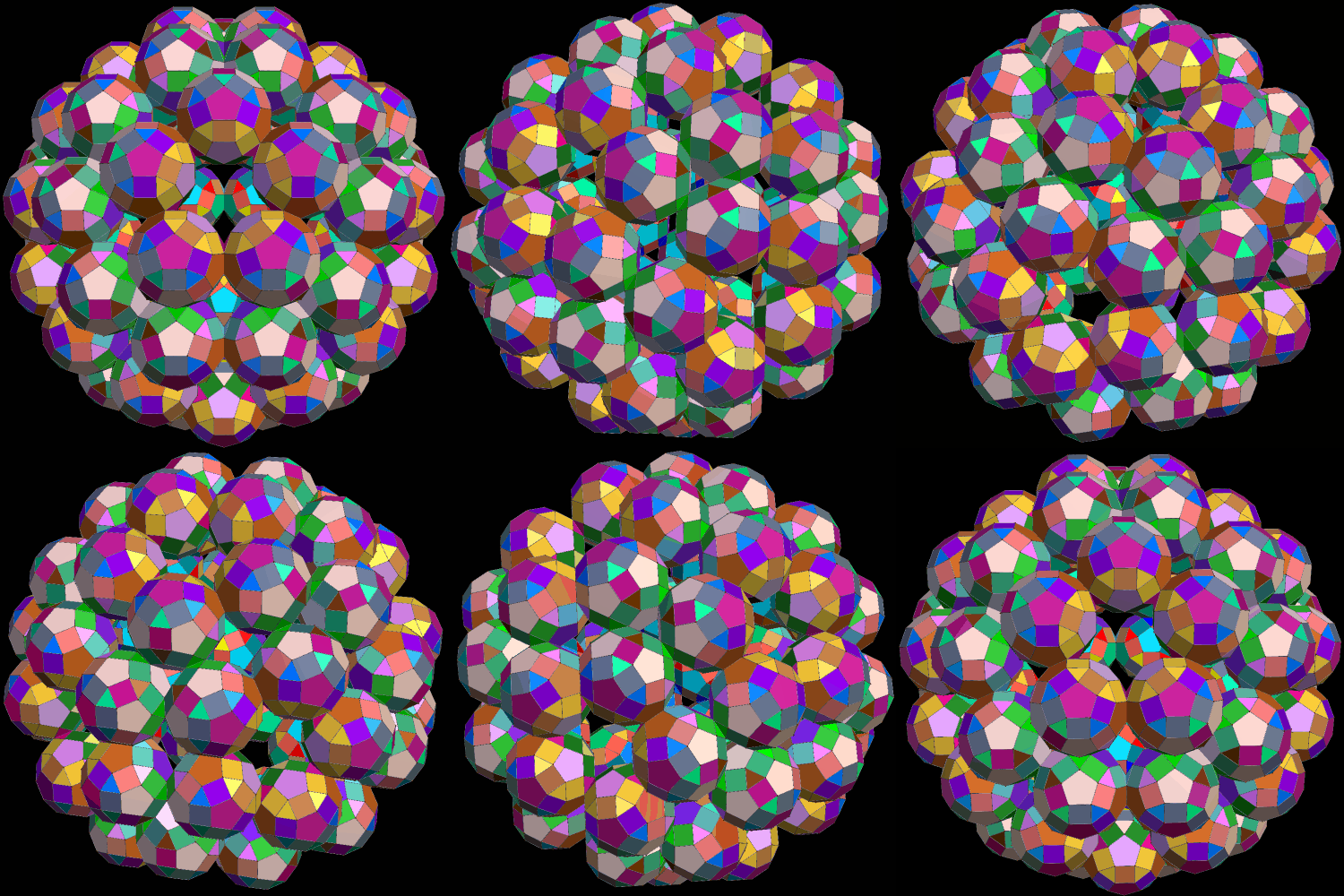
A Rhombicosidodecahedron, Made of Rhombicosidodecahedra

This “metarhombicosidodecahedron” took a long time to build, using Stella 4d, which you can find at http://www.software3d.com/Stella.php — so, when I finished it, I made five different versions of it, by altering the coloring settings. I hope you like it.

Augmented Rhombicosidodeca

Augmented Rhombicosidodeca2

Augmented Rhombicosidodeca4

Augmented Rhombicosidodeca5

Augmented Rhombicosidodeca6

A Collection of Unusual Polyhedra

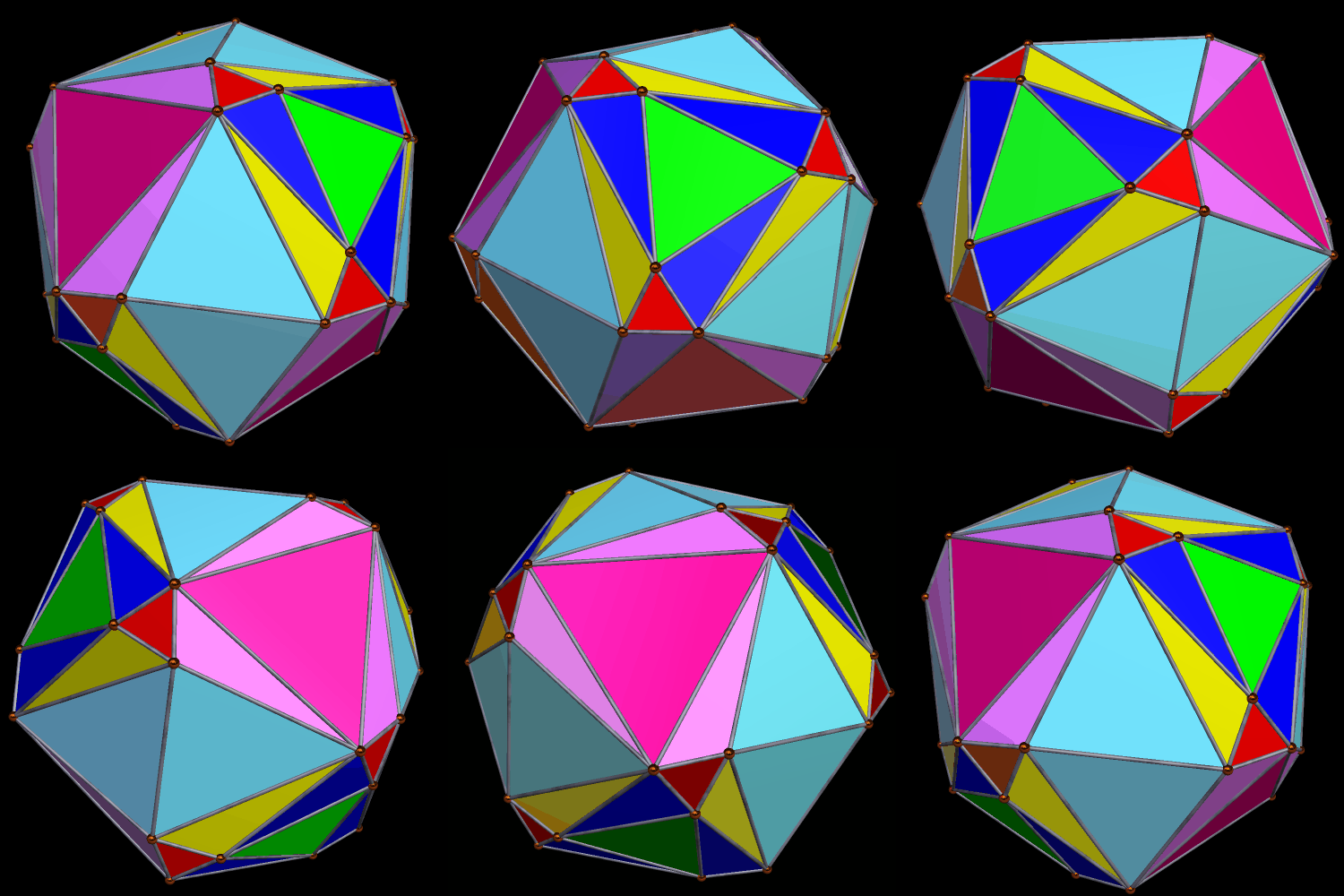
In the post directly before this one, the third image was an icosahedral cluster of icosahedra. Curious about what its convex hull would look like, I made it, and thereby saw the first polyhedron I have encountered which has 68 triangular faces.

68 triangles Convex hull

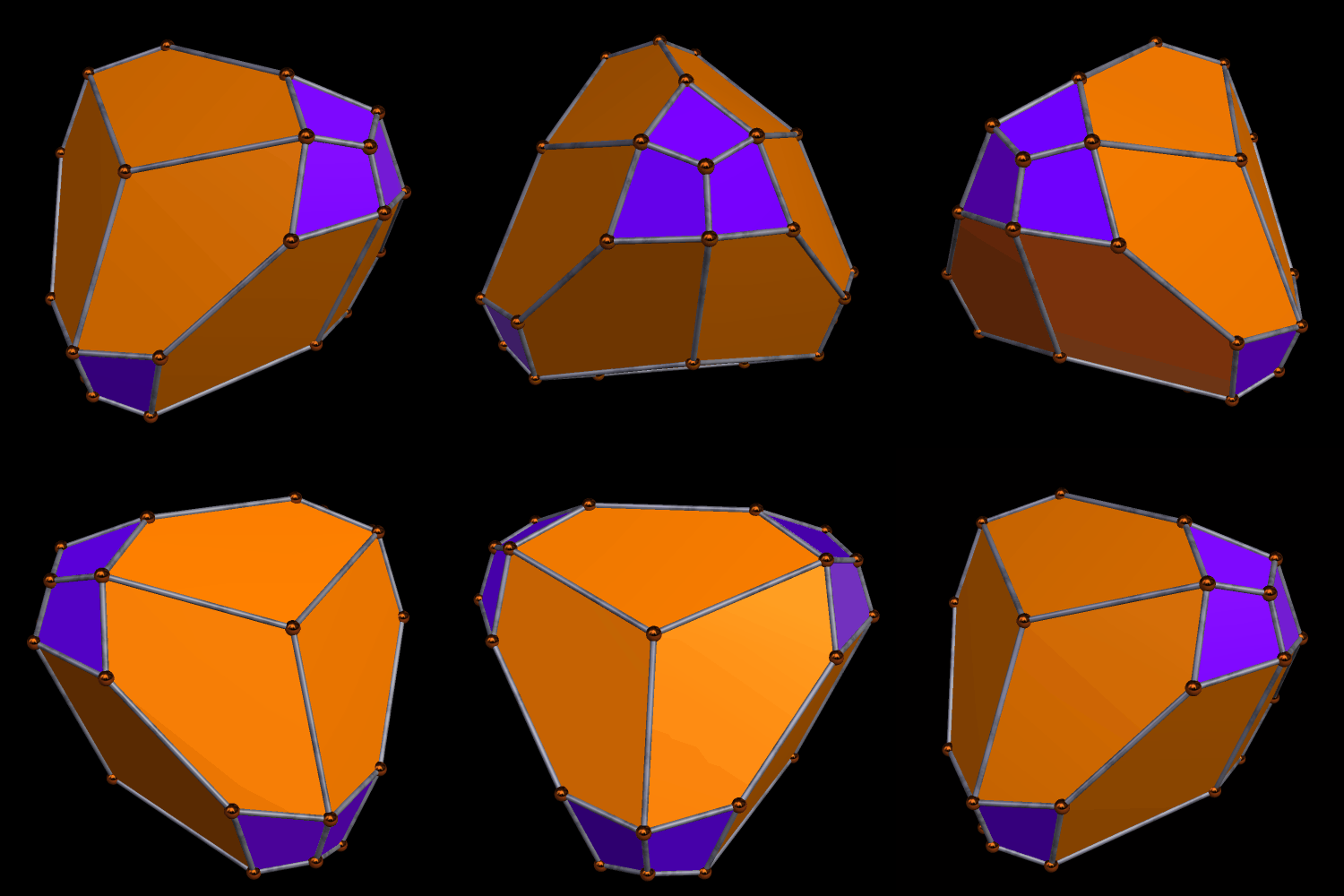
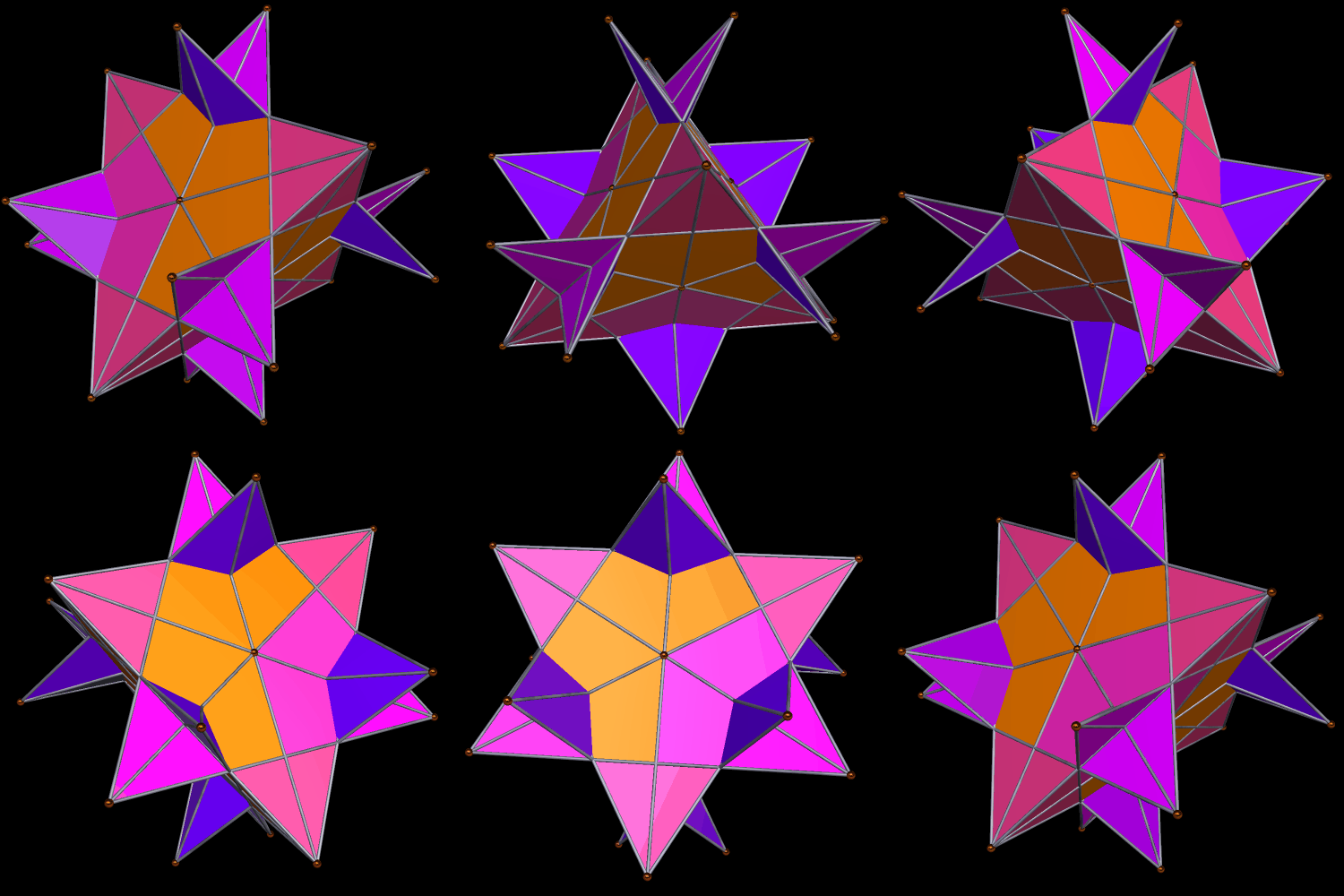
Still curious, I next examined this polyhedron’s dual. The result was an unusual 36-faced polyhedron, with a dozen irregular heptagons, and two different sets of a dozen irregular pentagons.

dual of 68 triangles Convex hull -- this dual has 36 faces including 12 heptagons and 12 each of two types of pentagon

Stella 4d (the program I used to make all these images), which is available at http://www.software3d.com/Stella.php, has a “try to make faces regular” function, and I tried to use it on this 36-faced polyhedron. When making the faces regular is not possible, as was the case this time, it sometimes produce surprising results — and this turned out to be one of these times.
dual of the 68-triangle polyhedron after 'try to make faces regular' used

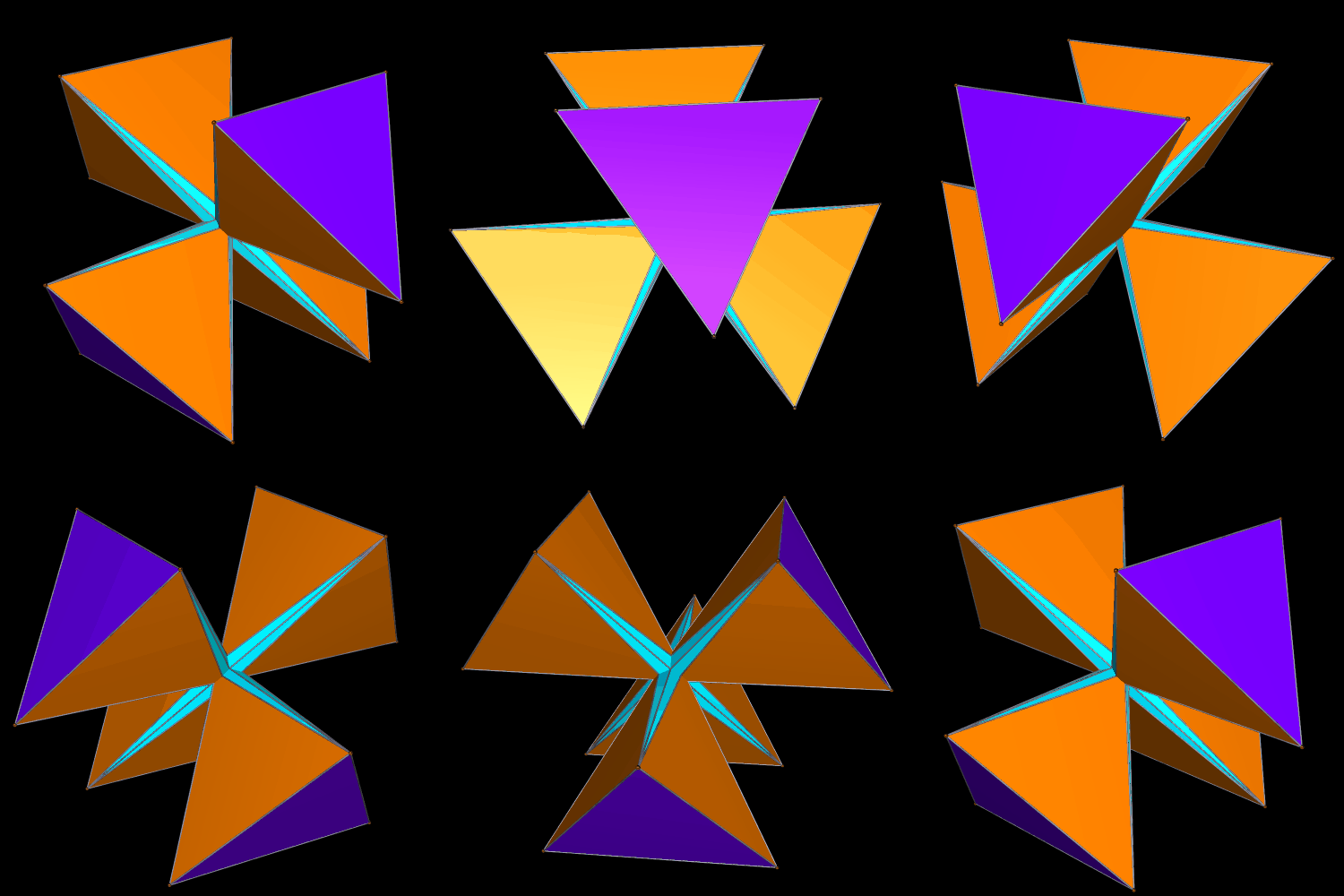
The next thing I did was to examine the dual of this latest polyhedron. The result, a cluster of tetrahedra and triangles, was completely unexpected.
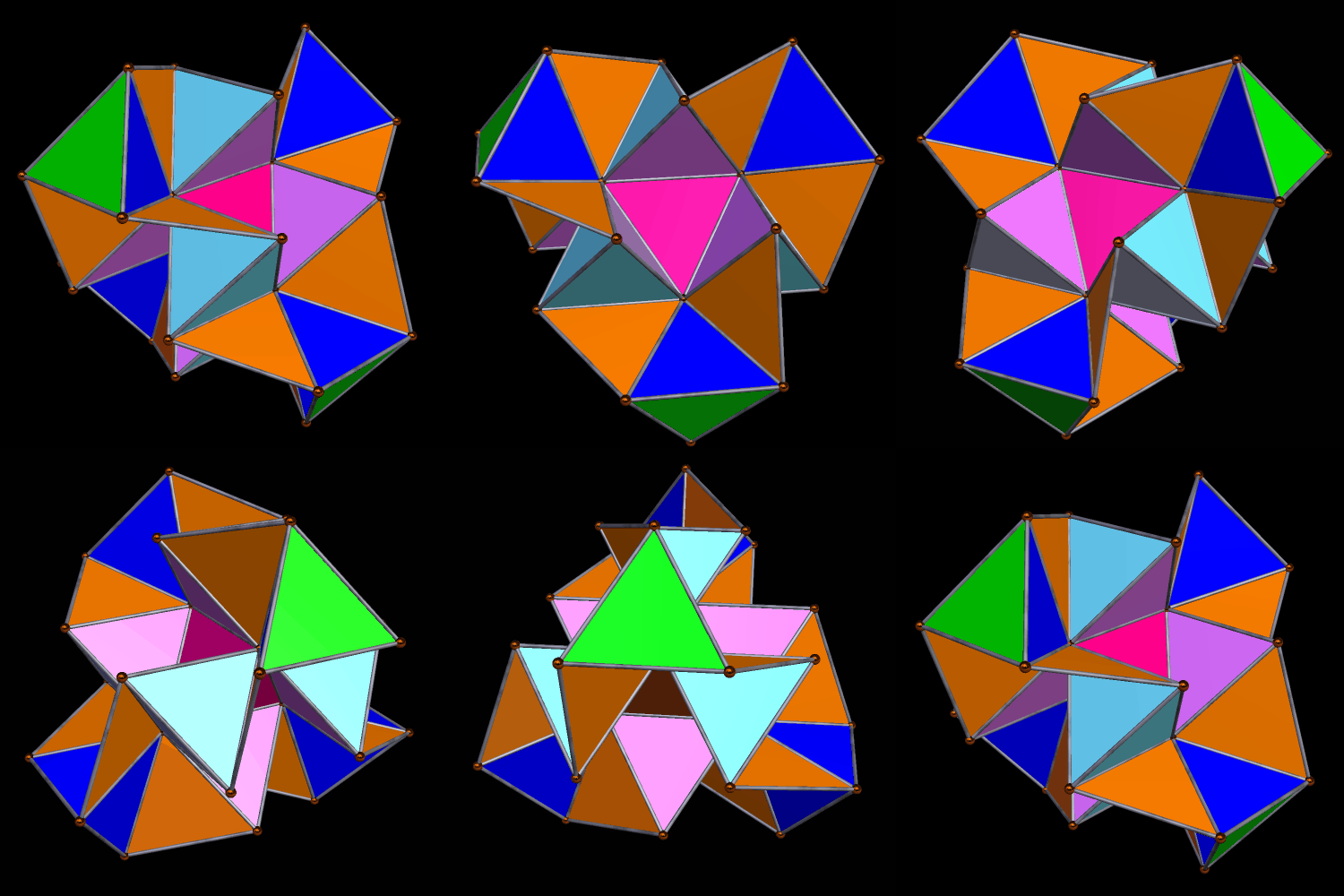
dual of the dual of the 68-triangle polyhedron after 'try to make faces regular' used

The next alteration I performed was to create the convex hull of this cluster of triangles and tetrahedra.
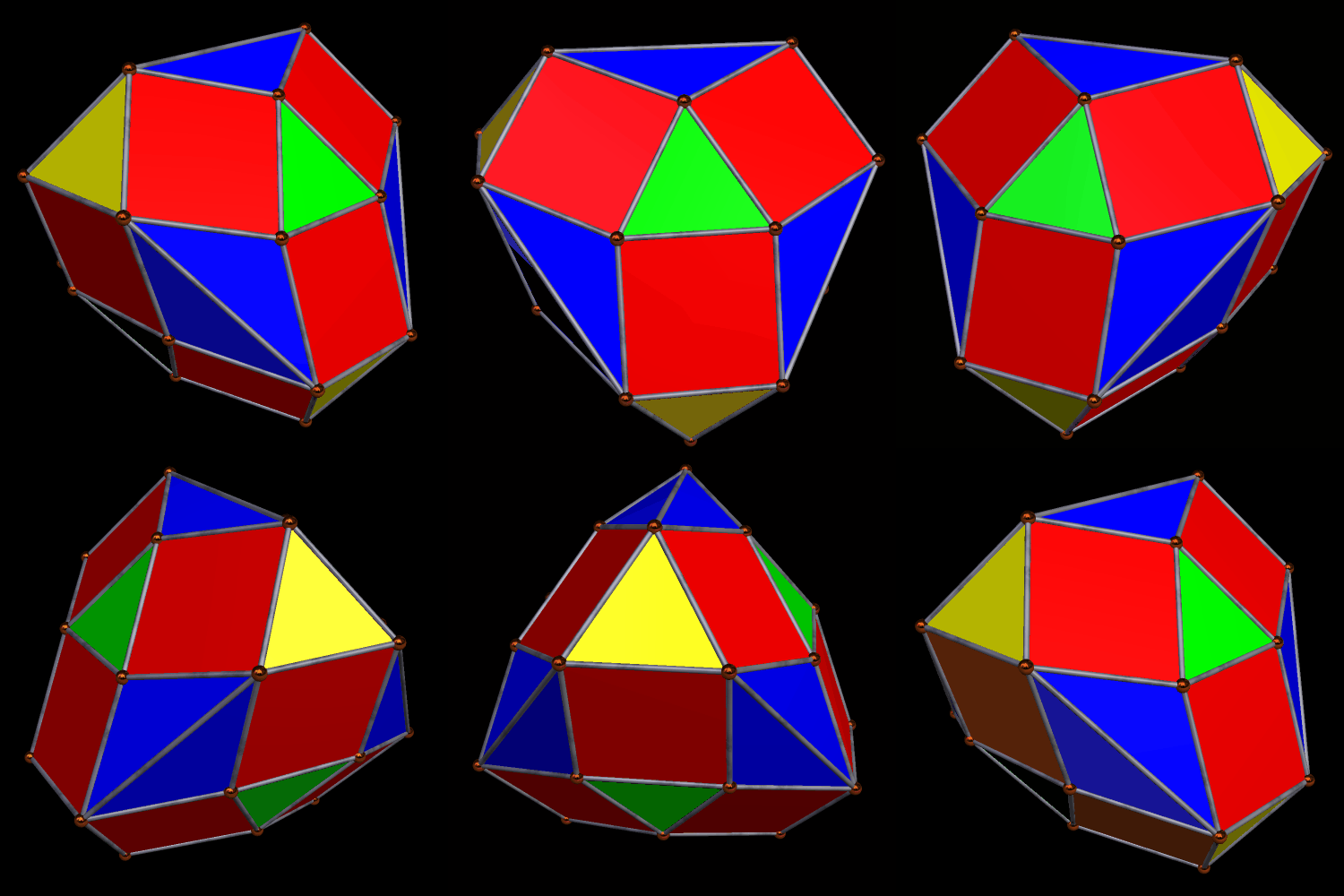
Convex hull of that triangular mess

Having seen that, I wanted to see its dual, so I made it. It turned out to have a dozen faces which are kites, plus another dozen which are irregular pentagons.

dual of the Convex hull of that triangular mess 12 kites and 12 irregular pentagons

Next, I tried the “try to make faces regular” function again — and, once more, was surprised by the result.
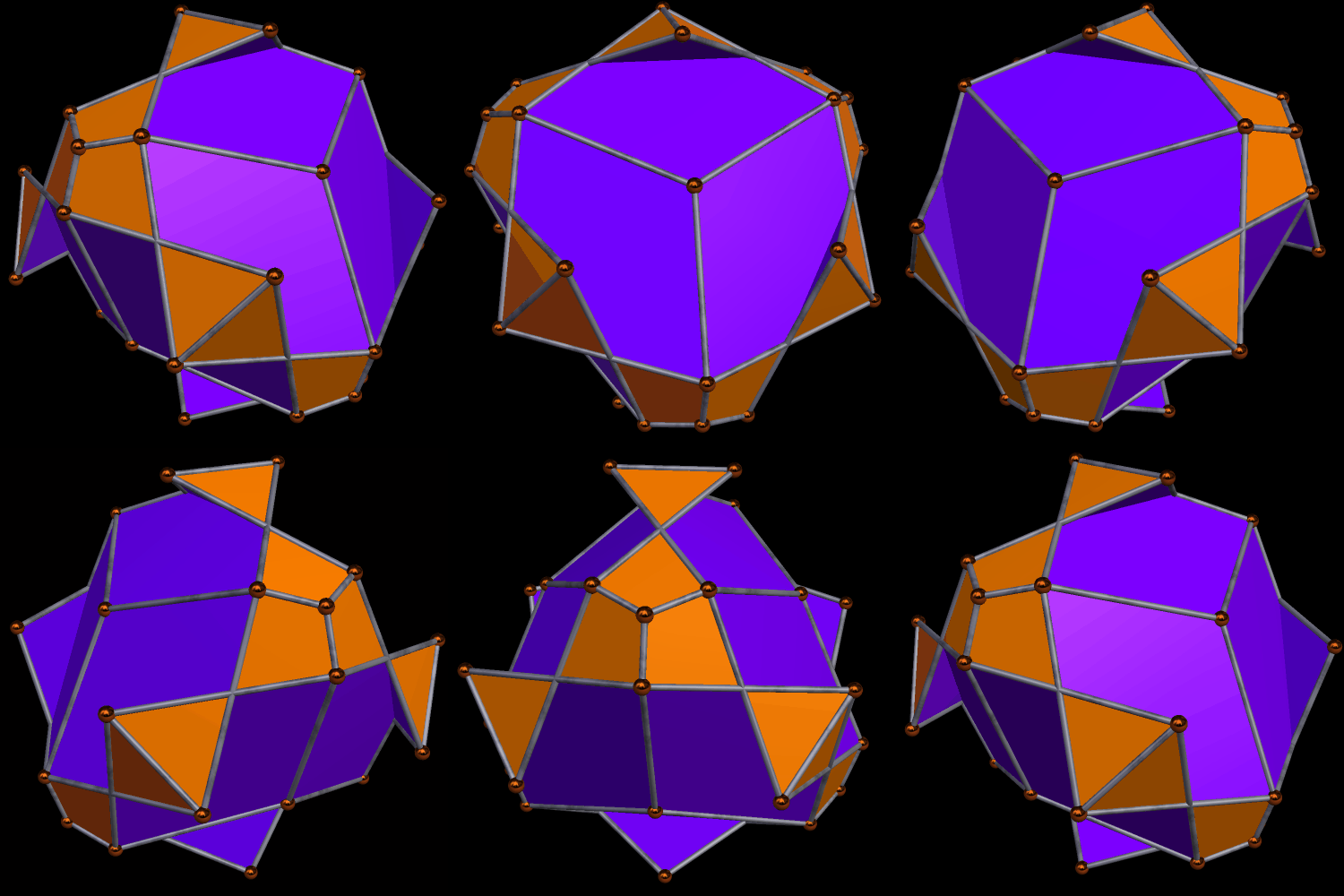
dozen kites and dozen pentagons after 'try to make faces regular' used

Out of curiosity, I then created this latest polyhedron’s convex hull. It turned out to have four faces which are equilateral triangles, a dozen other faces which are isosceles triangles, and a dozen faces which are irregular pentagons.

Convex hull Z

Next, I created the dual of this polyhedron, and it turns out to have faces which, while not identical, can be described the same way: four equilateral triangles, a dozen other isosceles triangles, and a dozen irregular pentagons — again. To find such similarity between a polyhedron and its dual is quite uncommon.
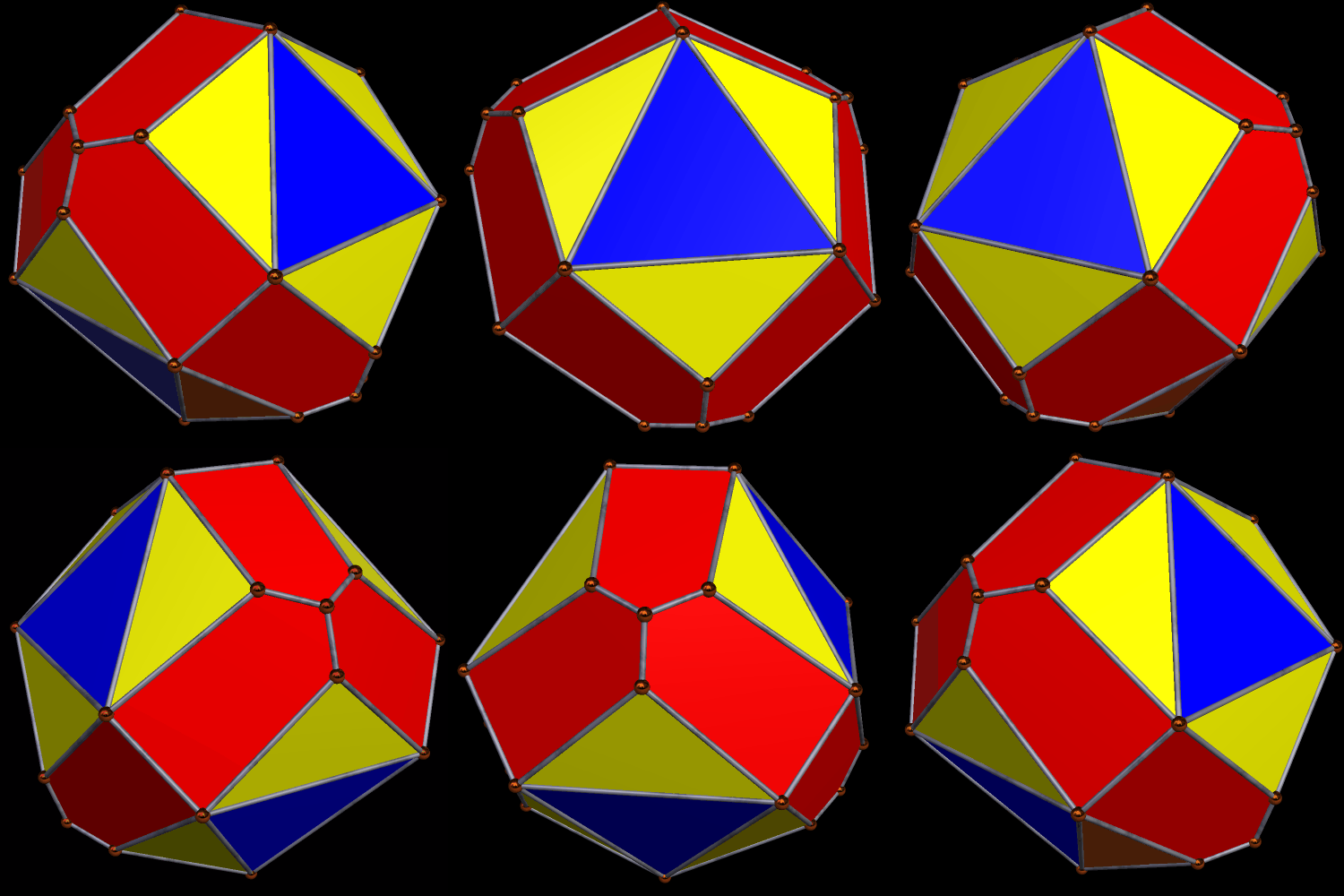
dual of Convex hull Z

I next attempted the “try to make faces regular” function, once more. Stella 4d, this time, was able to make the pentagons regular, and the triangles which were already regular stayed that way, as well. However, to accomplish this, the twelve other isosceles triangles not only changed shape a bit, but also shifted their orientation inward, making the overall result a non-convex polyhedron.
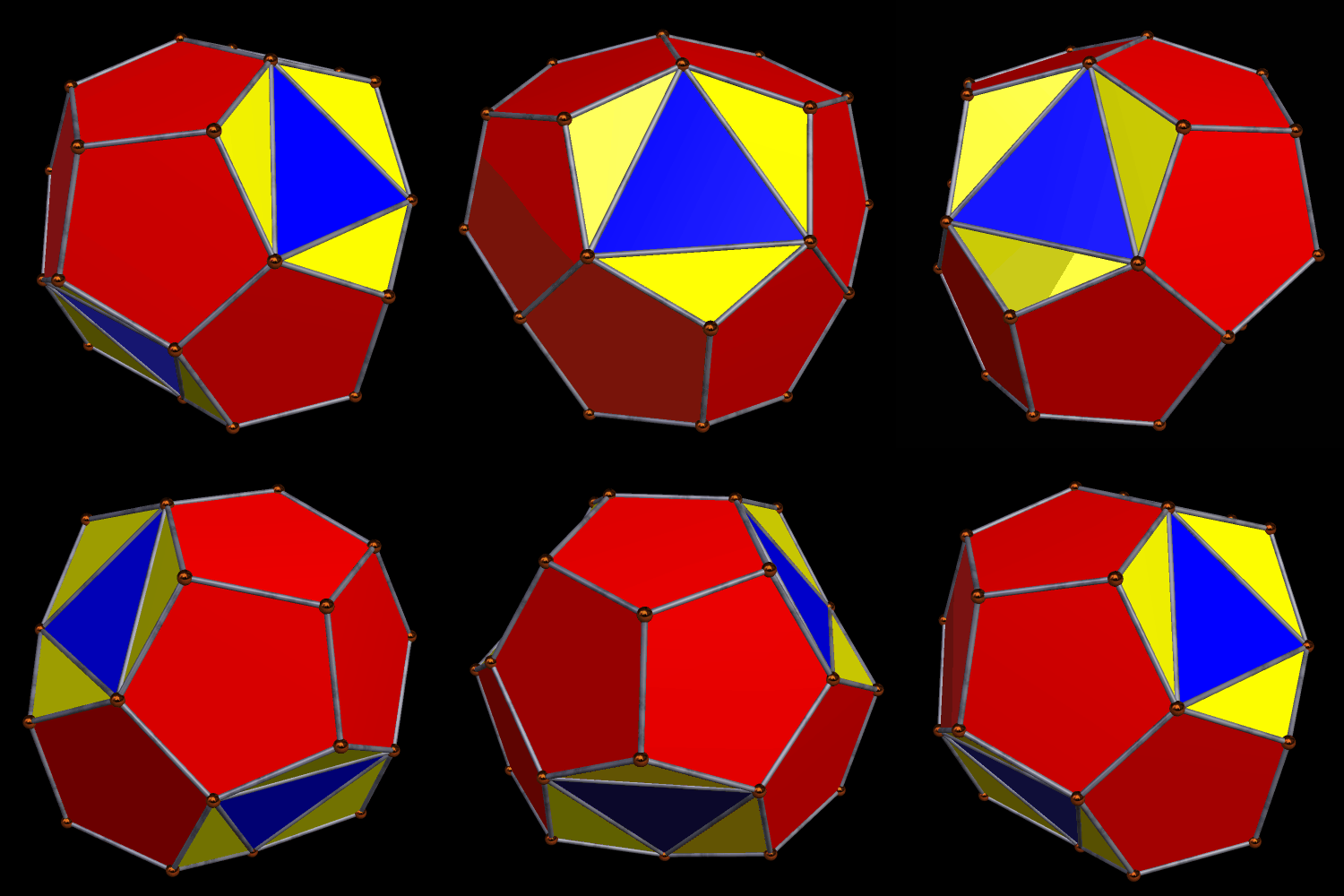
TTMFR

Having a non-convex polyhedron on my hands, the next step was obvious: create its convex hull. One more, I saw a polyhedron with faces which were four equilateral triangles, a dozen other isosceles triangles, and a dozen regular pentagons.

Convex hull

I then created the dual of this polyhedron, and, again, found myself looking at a polyhedron with, as faces, a dozen irregular pentagons, a dozen identical isosceles triangles, and four regular triangles. However, the arrangement of these faces was noticeably different than before.
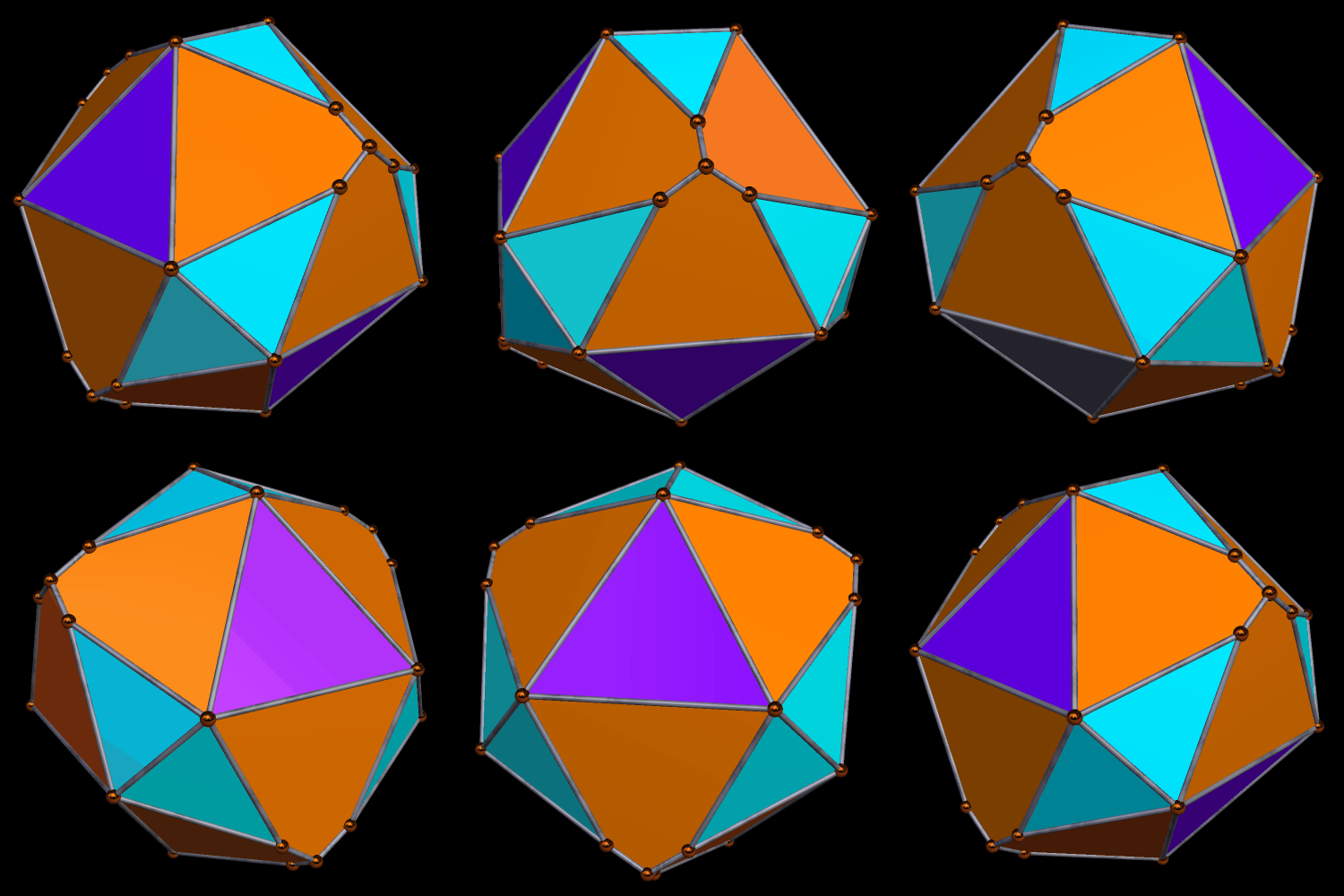
latest Convex hull

Given this difference in face-arrangement, I decided, once more, to use the “try to make faces regular” function of Stella 4d. The results were, as before, unexpected.

TTMFRA

Next, I created this latest polyhedron’s dual.

TTMFRA dual

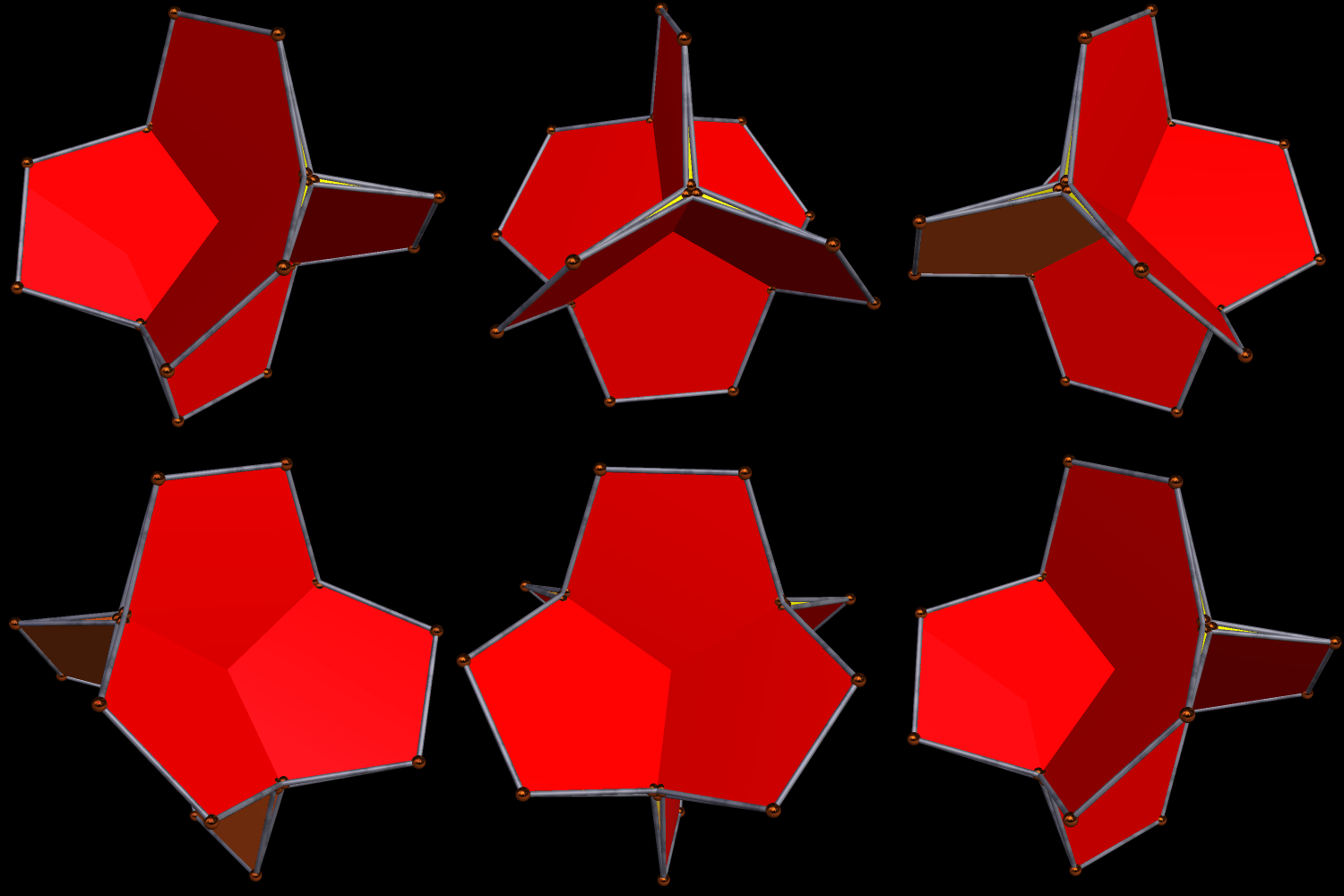
At no point in this particular “polyhedral journey,” as I call them, had I used stellation — so I decided to make that my next step. After stellating this last polyhedron 109 times, I found this:

109 stellationsTTMFRA dual

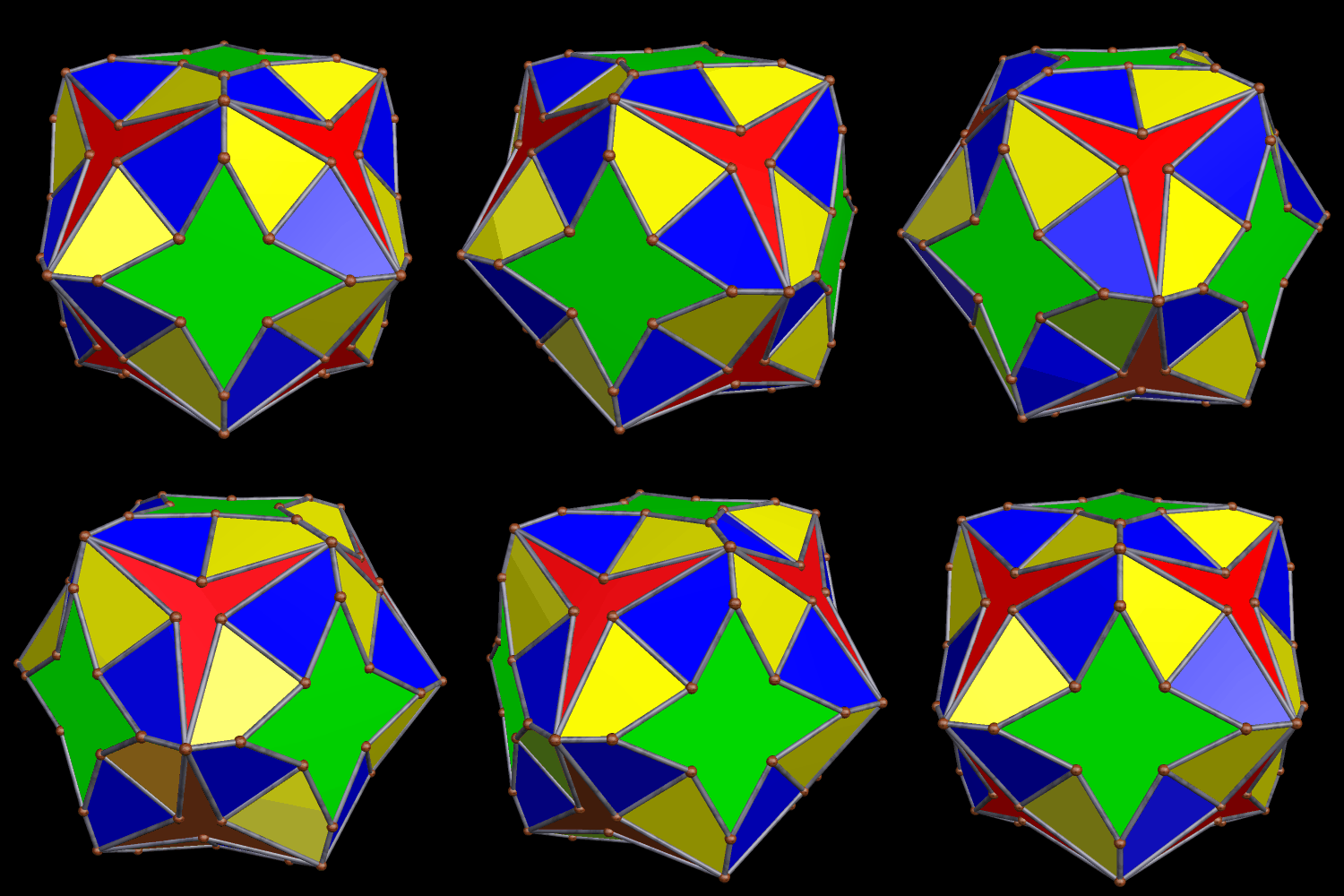
I then created the dual of this polyhedron. The result, unexpectedly, had a cuboctahedral appearance.
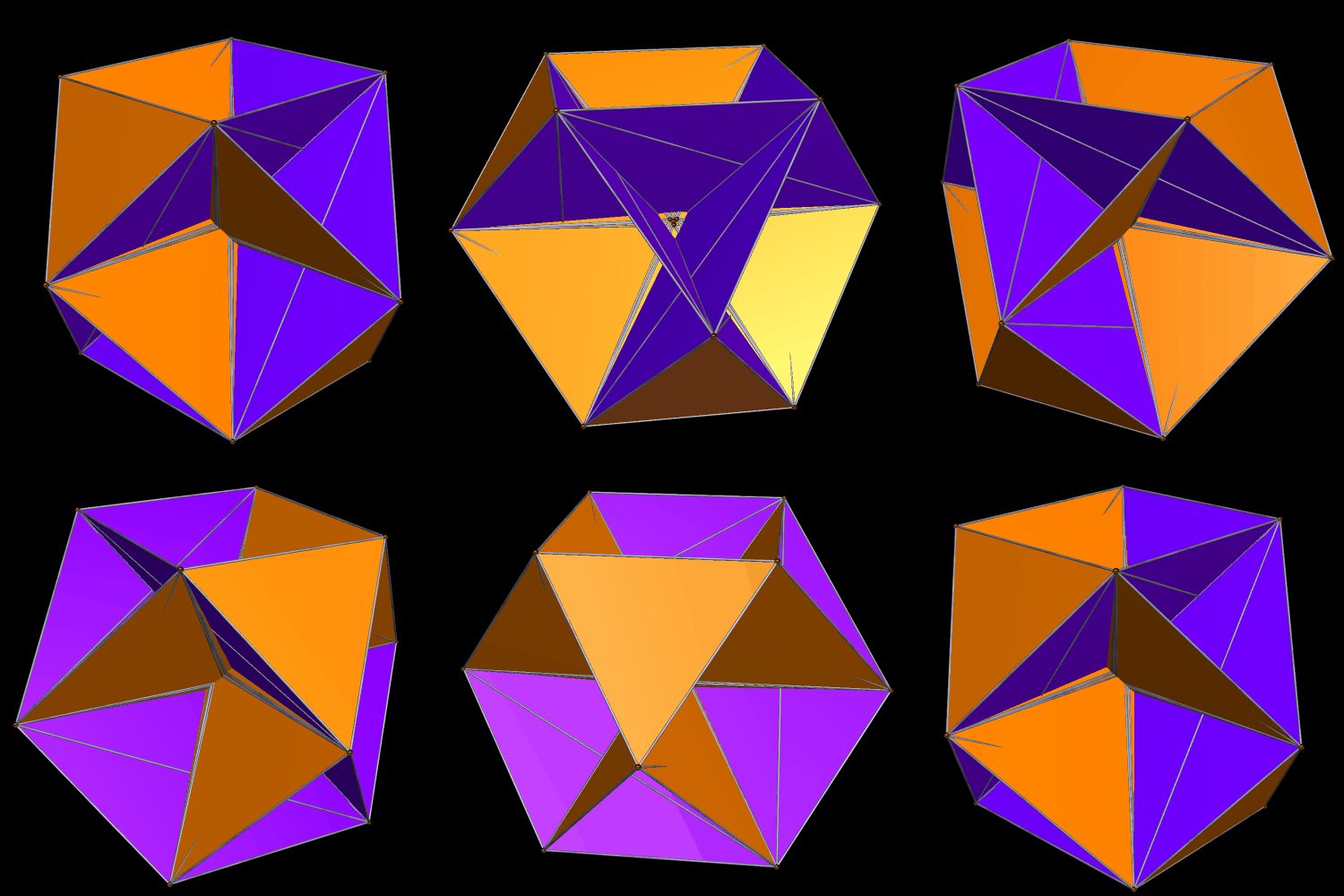
Faceted Dual

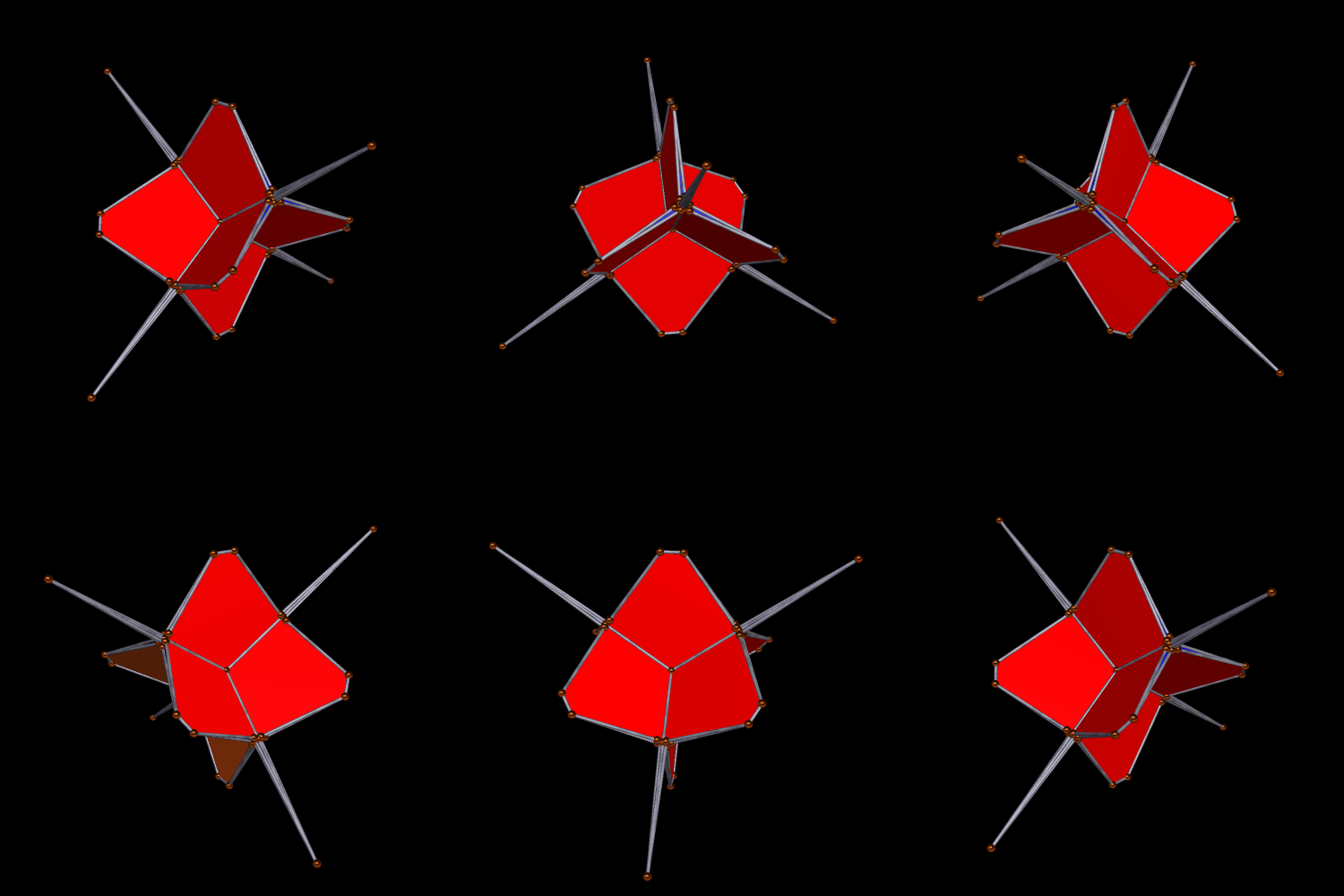
A single stellation of this latest polyhedron radically altered its appearance.
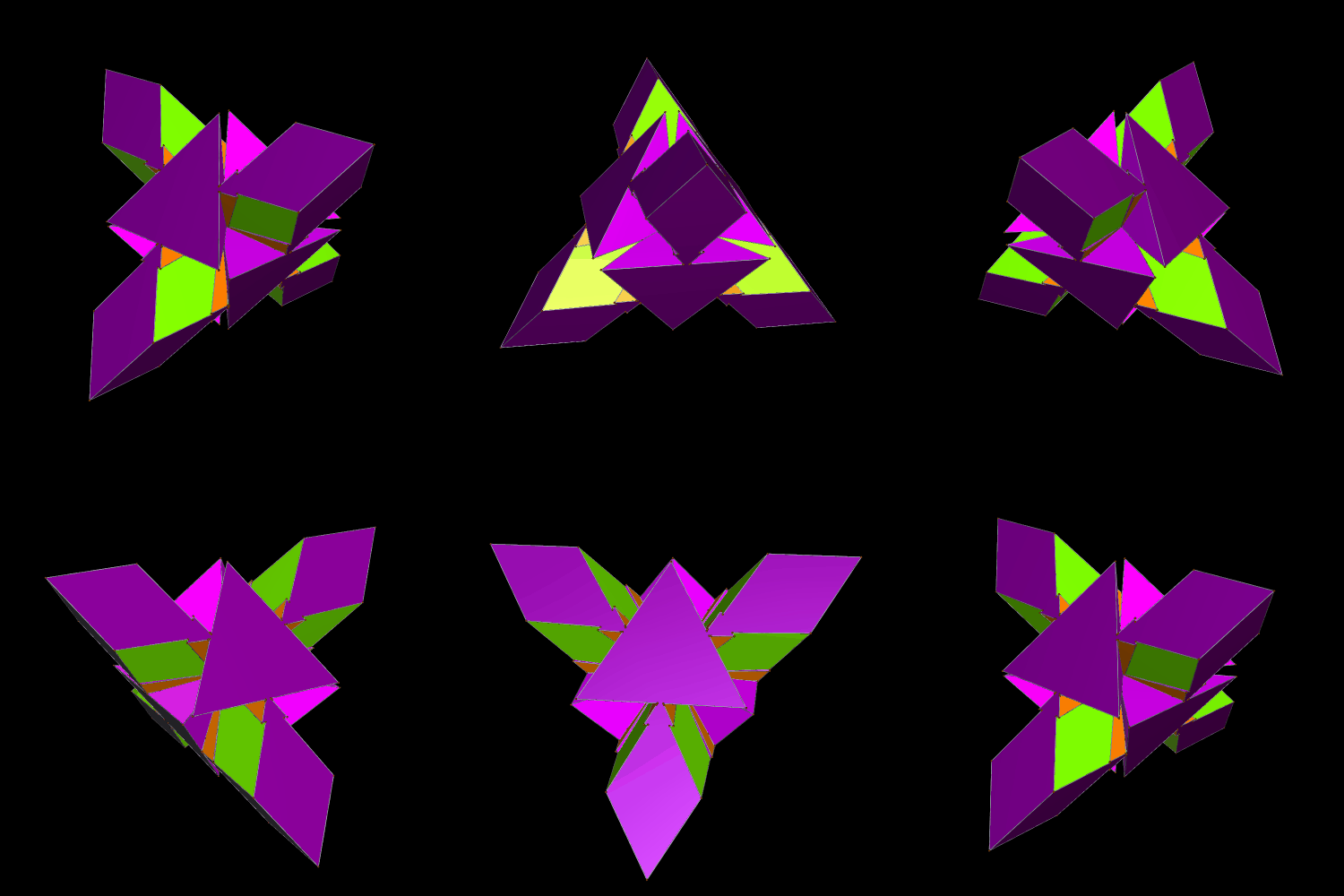
stellation Faceted Dual

My next step was to create the dual of this polyhedron.
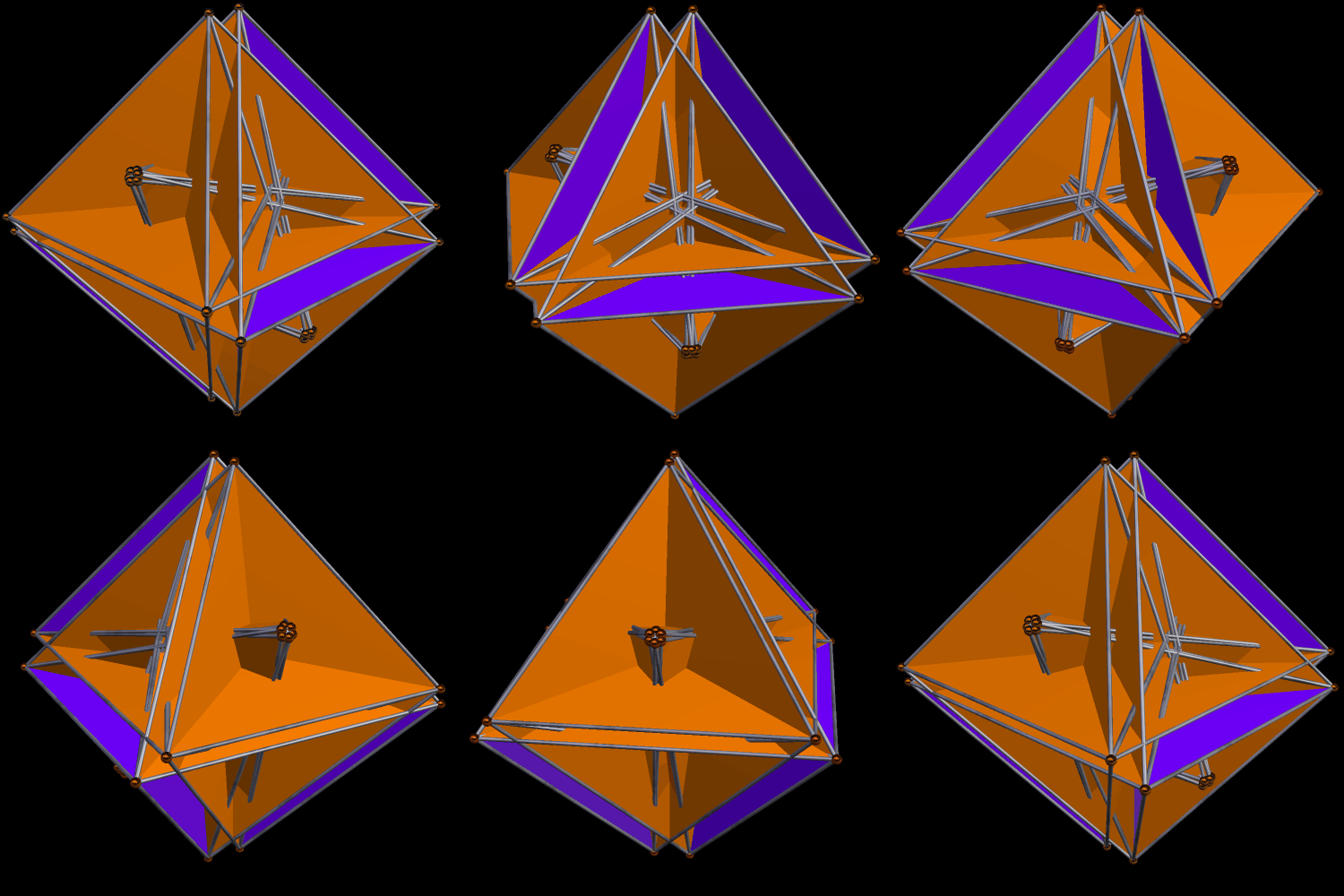
dual Faceted Stellated Poly

This seemed like a good place to stop, and so I did.
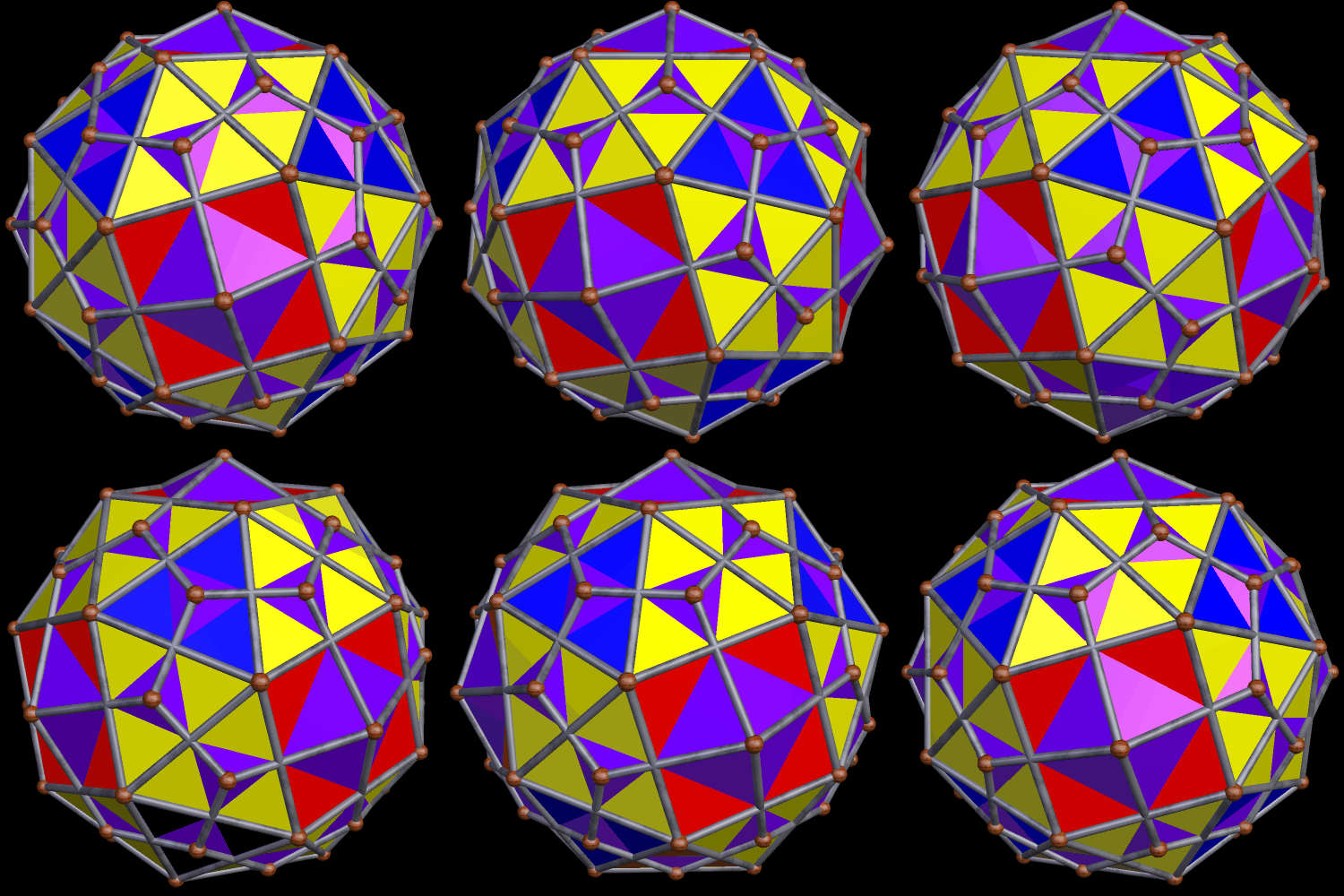
Three Polyhedral Clusters of Icosahedra

In the last post on this blog, there were three images, and the first of these was a rotating icosahedron, rendered in three face-colors. After making it, I decided to see what I could build, using these tri-colored icosahedra as building blocks. Augmenting the central icosahedron’s red and blue faces with identical icosahedra creates this cubic cluster of nine icosahedra:
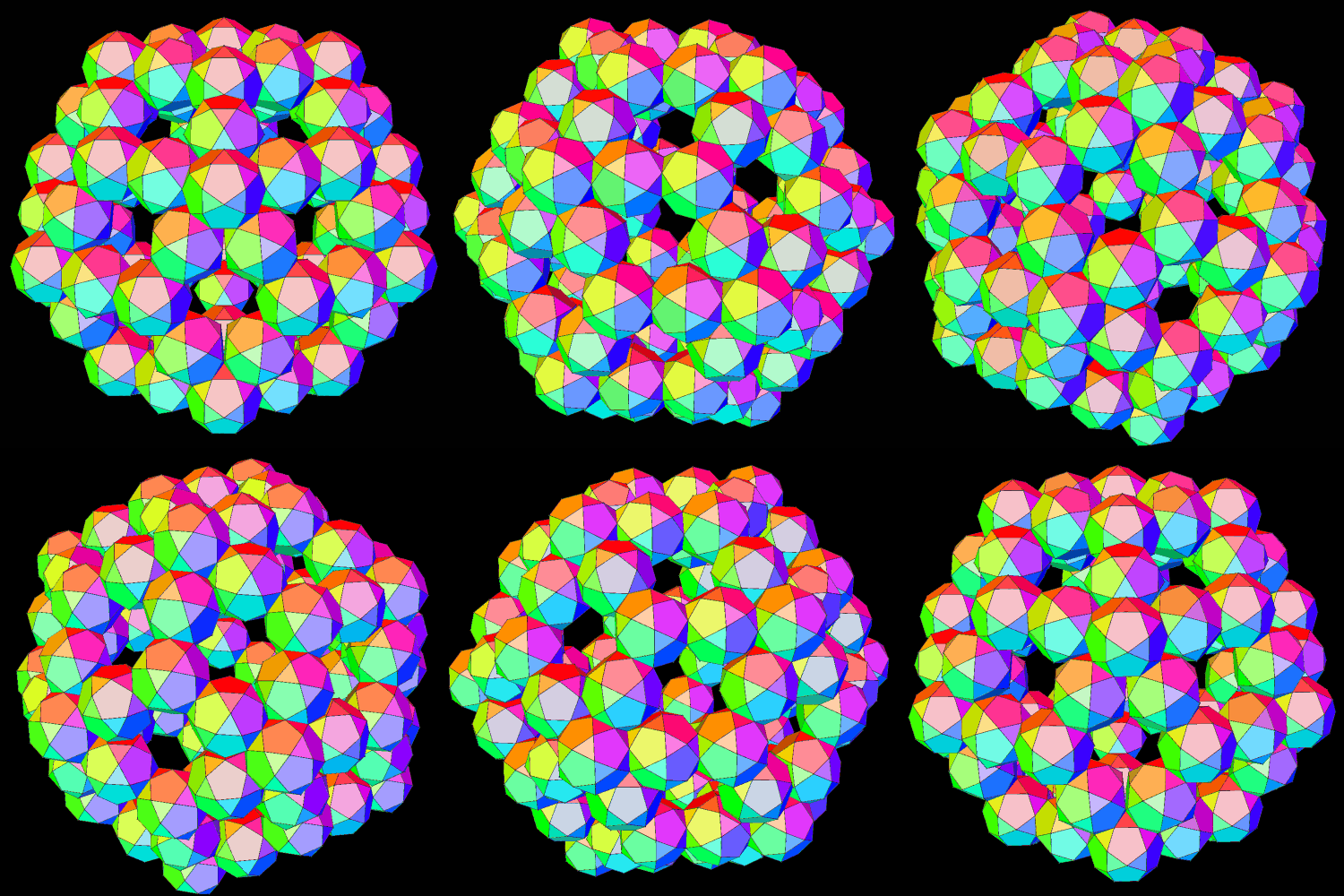
cube of icosahedra

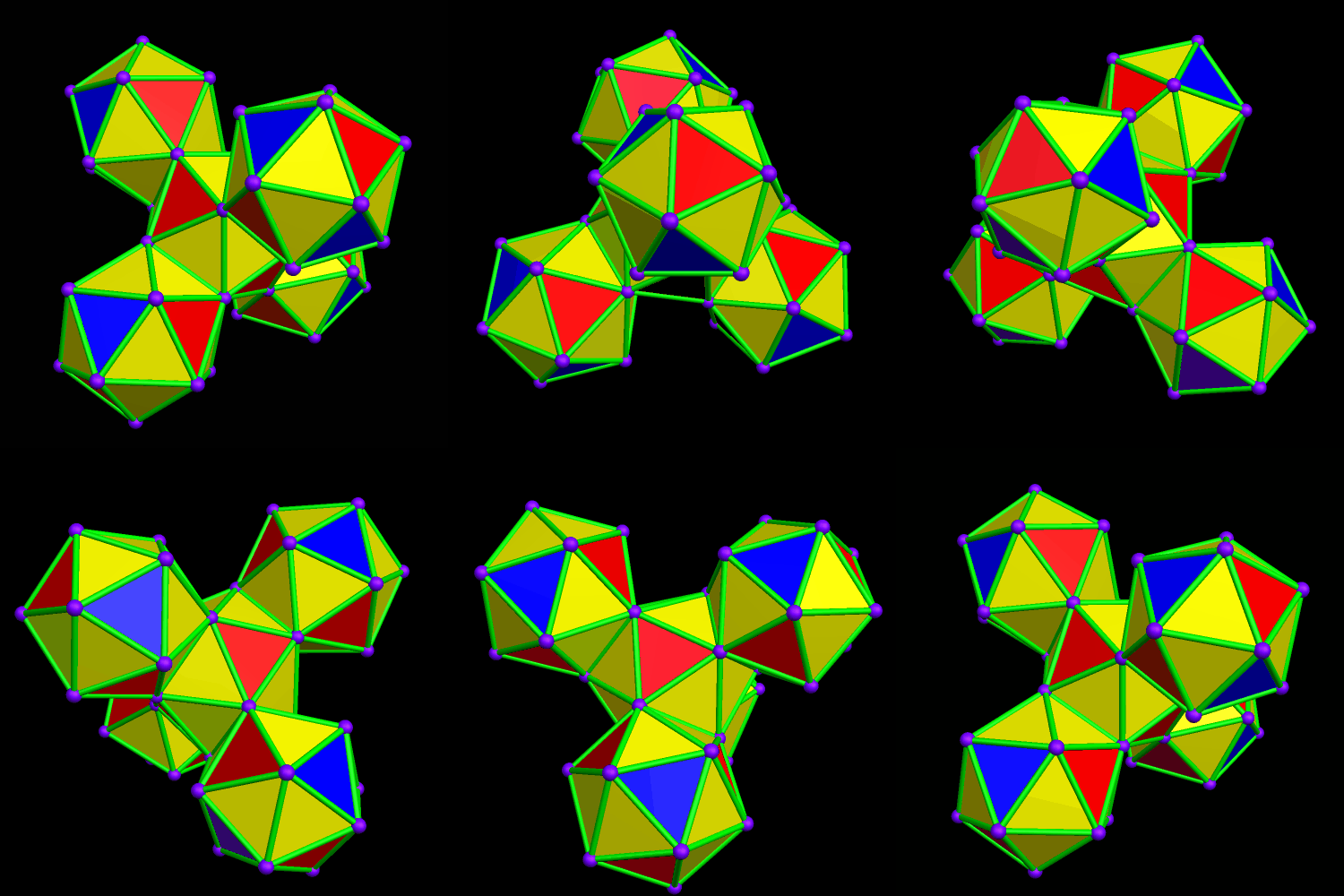
If, on the other hand, this augmentation is performed only on the blue faces of the central icosahedron, the result is a tetrahedral cluster of five icosahedra:

5 icosa

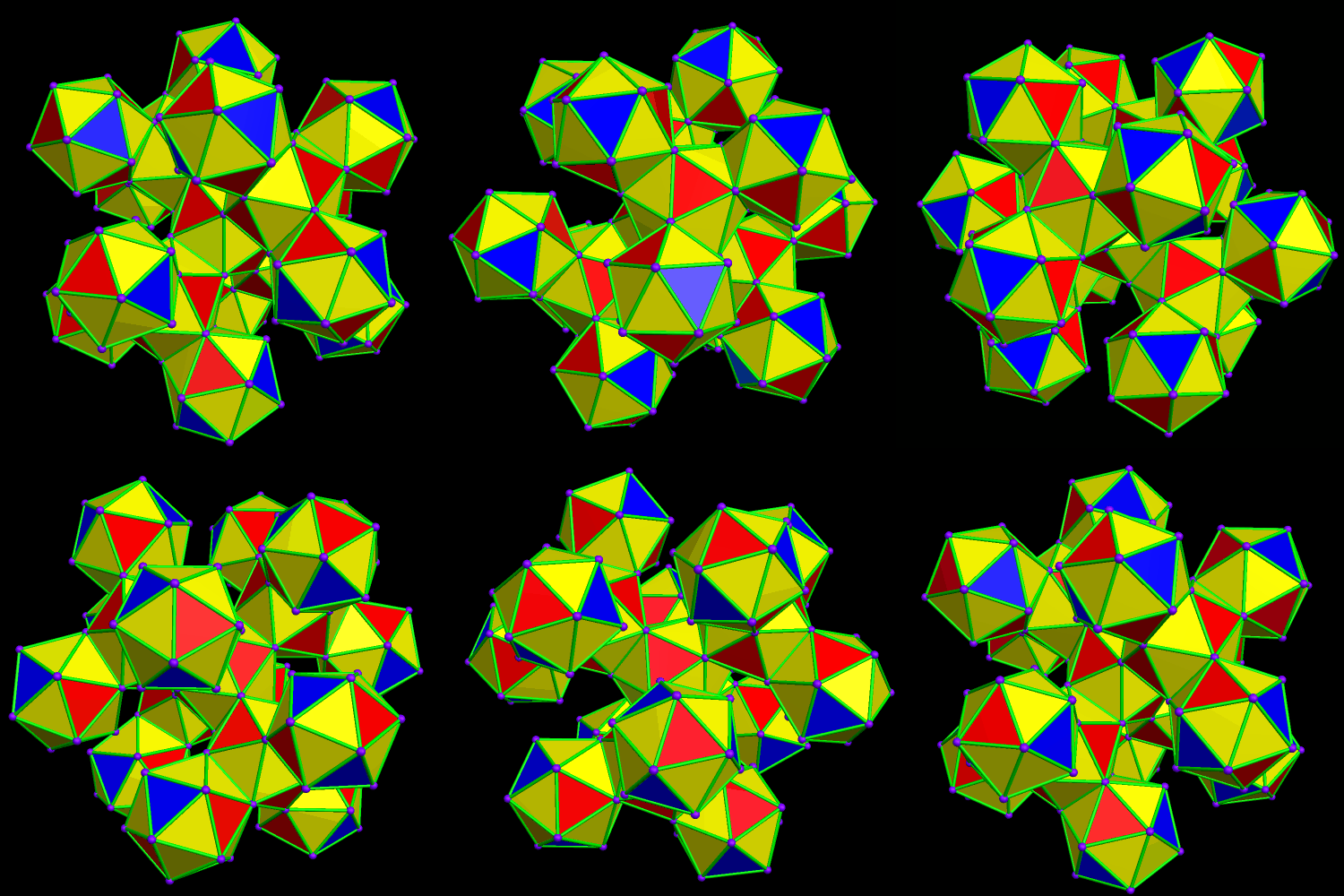
The next augmentation I performed started with this tetrahedral cluster of five icosahedra, and added twelve more of these icosahedra, one on each of the blue faces of the four outer icosahedra. The result is a cluster of 17 icosahedra, with an overall icosahedral shape.

icosa made of icosa

All of these images were made using Stella 4d, which is available at http://www.software3d.com/Stella.php.