Richard Feynman, on Computers

feynman on computers

So an Ancestor of Mine Fed Insects to George Washington . . . .

“I have two cooks … one of them, Mr. Foutz … fancies himself quite the expert in worldly cuisine. … If we fed this army in the same manner Mr. Foutz has attempted to feed me, there would be mass desertion. He actually set out an elaborate dinner whose main attraction was bugs. Covered in some kind of sauce, mind you, but bugs nonetheless. I made the decision at that moment that Mr. Foutz would better serve this army by shouldering a musket.” ~George Washington, to Benjamin Franklin (Source: Rise to Rebellion, by Jeff Shaara, p. 385.)

I’ve just been told that this guy, whose name we know as Andrew Fouts, is an ancestor of mine. I rather like the idea of being descended from someone who fed insects to George Washington.

“That which does not kill us makes us stronger.” Oh, really?

I have observed that many people often stop thinking about a phrase, and simply accept it, if they hear it repeated enough times. Since I don’t want to make this error, I’ve developed a habit of questioning such phrases. This quote, from Friedrich Nietzsche, definitely qualifies as a phrase which many believe because it’s repeated a lot, and it is certainly questionable. More than that, in fact: it is utter nonsense — and I can prove it.

The method I will use for this proof is reductio ad absurdam, in which one temporarily assumes the statement is true, then shows that it leads to a conclusion which is pure nonsense, which, in turn, shows that the original assumption of truth was a faulty one.

So the Nietzsche quote, purely for the purposes of this proof, is now (temporarily) assumed to be true. Since being stronger is beneficial, it now follows that we should actually seek out things which damage us, but without killing us. It isn’t hard to think of examples of such behaviors.
SONY DSC

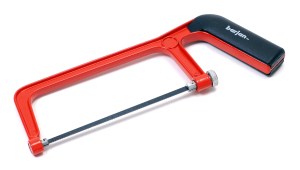
If a person were to drive to a hospital’s emergency room, and, while standing just outside the entrance with a hacksaw, started using one hand to attempt to saw off the other one (warning: do not try this yourself!), damage would certainly result. This hypothetical person probably wouldn’t completely lose his hand, for (a) hacksaws are not fast, and (b) someone else would no doubt notice, and take action to stop the self-damage, in time to get him medical attention. He is, after all, already in the perfect place for it.

Another, much more common example:
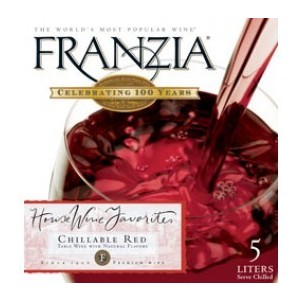
img-thing

It’s possible for a person to drink these boxes of inexpensive red wine at a rate of five a week, but it’s an incredibly bad idea. Alcohol will do serious damage, consumed at that rate, given enough time, as can be verified with virtually any physician. Surviving prolonged binge-drinking is possible (but not guaranteed), even if done for a few years; I know this to be true because I have witnessed it. It wasn’t a pretty thing to watch, and the binge drinker could not be persuaded to stop. The binge drinking finally ended, but with an emergency trip in an ambulance needed, for immediate medical care, to prevent imminent death.

In each case, (1) the hypothetical person who tries to saw off his own hand while standing outside an emergency room, and (2) the real person (an adult whom I will not name) who consumed dangerous quantities of alcohol, something happens which damages them, but doesn’t kill them. Does it make them stronger? The first person could easily lose some functionality in his hand, and could also end up in a psychiatric institution. The second person suffered numerous forms of permanent damage to multiple systems of the body, resulting in permanent disability. Both rack up huge medical bills. These aren’t good things, for either person, and they are quite unlikely to “make one stronger.” A far more likely outcome is the exact opposite — each person is weakened, in the sense that are are rendered less able to deal effectively with the rest of their lives.

The proof is now complete. It turns out that those things which do not kill you can, quite possibly, weaken you, and expecting them to make you stronger simply makes no sense. So, world, please stop repeating this insipid Nietzsche-quote. Not only is it logically invalid; it’s also become one of the most annoying clichés in existence.

Fortunately, for those who want advice which actually makes sense, there are many sources available which are not Friedrich Nietzsche.

[Note: I did not create the images in this post, but simply found them with Google image-searches for “hacksaw” and “box of wine.”]

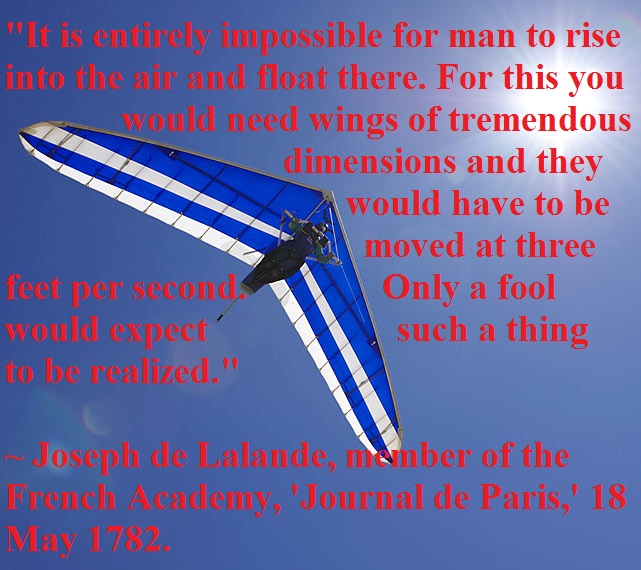
“Entirely Impossible”?

hang_gliding_K2R5860PC1

“The Whole World’s Wrong, and You’re Right!”

081007hoffman

I can’t think of a better response, Abbie.

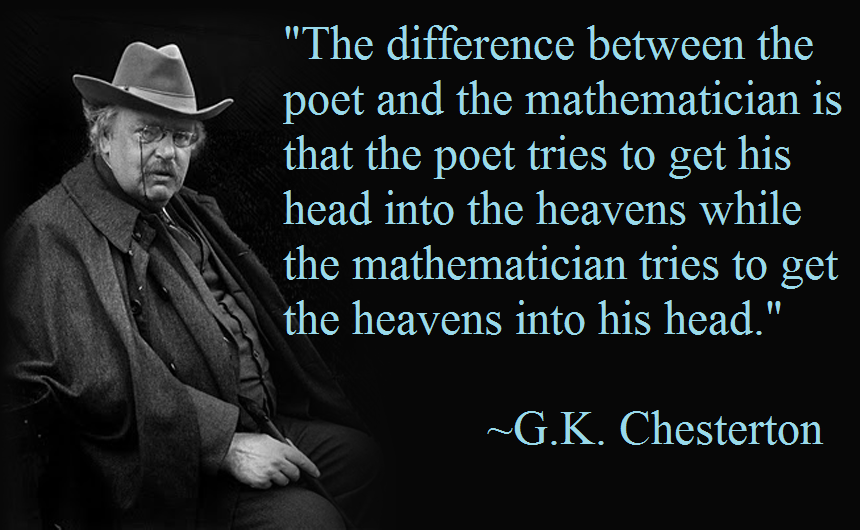
G.K. Chesterton, on Poets and Mathematicians

chesterton_slidebg-870x530

J. Michael Straczynski, on Worrying

G'Kar

J. Michael Straczynski, on Understanding

understanding

Not Poker — Chess. I Am Not Captain Kirk.

Not Chess Mr Spock

poker

Something I have in common with the fictional Captain Kirk, from the original Star Trek series, is that I enjoy playing both poker and chess. In the scene depicted above, from the episode “The Corbomite Maneuver,” the Enterprise is facing an adversary who dramatically outpowers them — and Kirk escapes the situation with an outrageous bluff, right after making this reference to the game of poker.

Unlike Captain Kirk, however, I am not skilled at bluffing, with two consequences:  (1) I’m a terrible poker player, and (2) I do not attempt bluffing as a strategy, unless I am actually playing poker.

I’ve been an activist for a large variety of causes, for decades, and, because of this activism, have acquired a rather large number of adversaries. Many of them have figured out that I don’t bluff, but some — rather surprisingly, considering they have known me for years — have not. The amusing thing, to me, is that I’ve always been quite open about this, but some still fail to realize it, despite my candor on the subject. When engaged in any struggle, I only make statements I believe to be true, for one simple reason: I’m so terrible at bluffing, or other forms of lying, that any untrue statement I were to make would be instantly recognized as dishonest. Since I figured this out, about myself, decades ago, I deliberately choose to only employ strategies which are completely honest. It would be stupid, after all, for me to employ strategies with which I know I have weak skills.

So, unless I’m actually playing real poker, and am engaged in any sort of struggle, I’m basically playing metaphorical chess. This involves figuring out what my opponents are thinking, devising strategies to counter theirs, and remaining at least three moves ahead of my adversaries, at all times. I’m far more like Mr. Spock than I am like Captain Kirk, and always have been. This isn’t going to change.

I find it hilarious that I can post these absolutely-true statements right here,  on the Internet, where anyone can see them — and have full confidence that those who persist in their mistaken belief that I’m bluffing, about anything, will continue to make this enormous error in judgment — until it’s too late. For them, that is.

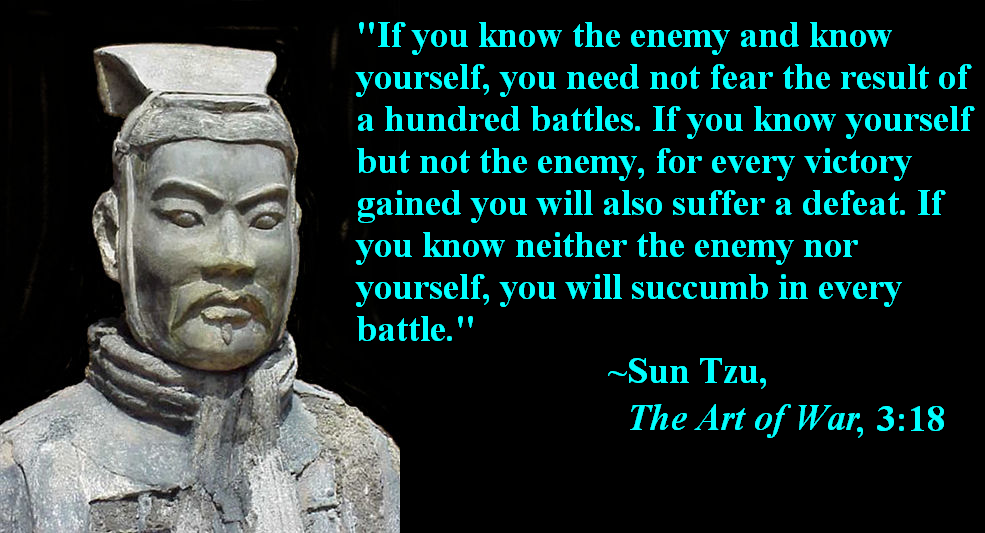
sun_tzu_strategy

On Boiling Eggs, William Shakespeare, and Richard Feynman

Not long ago, I boiled a dozen eggs.

After accidentally misquoting Shakespeare, while watching these eggs boil (“Boil, boil, toil and trouble, fire burn and cauldron bubble”), I then correctly quoted Shakespeare at the eggs, by shouting, “You egg!” at them, as they boiled.

What . . . you’ve never talked to your food? If not, just try it some time, for it makes life more interesting. If you’re worried about people thinking you’re crazy, I have another quote, from the physicist Richard Feynman, for you to consider:  “What do you care what other people think?”

Little seems to be going right today, for correctly quoting Shakespeare meant being, at the same time, mathematically incorrect. Twelve and one are, of course, not the same number, but I’m not willing to deliberately misquote Shakespeare, for that would be, well, wrong.

I was then asked, by someone who heard me, um, shouting at boiling eggs, exactly which of Shakespeare’s plays it is, in which the line “you egg” appears. Since I did not know the answer to this question, I immediately used this situation as an opportunity to test the alleged omniscience of Google, which I test, and re-test, frequently. (So far, Google always passes these experimental tests, but I will post an announcement here if this fact ever changes.) I also googled my earlier, failed attempt to quote Shakespeare, which is how I now know that I was misquoting him.

In case you’re wondering why I was fact-checking myself, here’s another Feynman quote, offered as explanation:  “The first principle is that you must not fool yourself — and you are the easiest person to fool.” Those are words to live by — and I do.

Not only did Google know that the two-word quote I remembered (from 10th grade English class, over thirty years ago, simply because I found it funny) comes from Macbeth, Act 4, Scene 2, but it also, very helpfully, showed me the way to the YouTube video which you can see below.

For those few readers of my blog who have not already noticed this, I lead a strange life.

Of course, I certainly wouldn’t want a normal one, but, clearly, I don’t need to worry about that.