The Human Reaction, When Mathematics No Longer Seems to Make Sense: What Is This Sorcery?

Cubes 5

Unless you understand all of mathematics — and absolutely no one does — there is a point, for each of us, where mathematics no longer makes sense, at least at that moment. Subjectively, this can make the mathematics beyond this point, which always awaits exploration, appear to be some form of sorcery.

Mathematics isn’t supernatural, of course, but this is a reaction humans often have to that which they do not understand. Human reactions do not require logical purpose, and they don’t always make sense — but there is always a reason for them, even if that reason is sometimes simply that one is utterly bewildered.

In my case, this is the history of my own reactions, as I remember them, to various mathematical concepts. The order used is as close as I can remember to the sequence in which I encountered each idea. The list is, of necessity, incomplete.

  • Counting numbers: no problem, but what do I call the next one after [last one I knew at that time]? And the next one? And the next? Next? Next? [Repeat, until everyone within earshot flees.]
  • Zero exists: well, duh. That’s how much of whatever I’m snacking on is left, after I’ve eaten it all.
  • Arithmetic: oh, I’m glad to have words for this stuff I’ve been doing, but couldn’t talk about before.
  • Negative numbers: um, of course those must exist. No, I don’t want to hear them explained; I’ve got this already. What, you want me to demonstrate that I understand it? Ok, can I borrow a dollar? Oh, sure, I’ll return it at some point, but not until after I’ve spent it.
  • Multiple digits, the decimal point, decimal places, place value: got it; let’s move on, please. (I’ve never been patient with efforts to get me to review things, once I understand them, on the grounds that review, under such conditions, is a useless activity.)
  • Pi: love at first sight.
  • Fractions: that bar means you divide, so it all follows from that. Got it. Say, with these wonderful things, why, exactly, do we need decimals, again? Oh, yeah, pi — ok, we keep using decimals in order to help us better-understand the number pi. That makes sense.
  • “Improper” fractions: these are cool! I need never use “mixed numbers” again (or so I thought). Also, “improper” sounds much more fun than its logical opposite, and I never liked the term “mixed numbers,” nor the way those ugly things look.
  • Algebra: ok, you turned that little box we used before into an “x” — got it. Why didn’t we just use an “x” to begin with? Oh, and you can do the same stuff to both sides of equations, and that’s our primary tool to solve these cool puzzles. Ok. Got it.
  • Algebra I class: why am I here when I already know all this stuff?
  • Inequality symbols: I’m glad they made the little end point at the smaller number, and the larger side face the larger number, since that will be pretty much impossible to forget.
  • Scientific notation: well, I’m glad I get to skip writing all those zeroes now. If only I knew about this before learning number-names, up to, and beyond, a centillion. Oh well, knowing those names won’t hurt me.
  • Exponents: um, I did this already, with scientific notation. Do not torture me with review of stuff I already know!
  • Don’t divide by zero: why not? [Tries, with a calculator]: say, is this thing broken? [Tries dividing by smaller and smaller decimals, only slightly larger than zero]: ok, the value of the fraction “blows up” as the denominator approaches zero, so it can’t actually get all the way there. Got it.
  • Nonzero numbers raised to the power of zero equal one: say what? [Sits, bewildered, until thinking of it in terms of writing the number one, using scientific notation: 1 x 10º.] Ok, got it now, but that was weird, not instantly understanding it.
  • Sine and cosine functions: got it, and I’m glad to know what those buttons on the calculator do, now, but how does the calculator know the answers? It can’t possibly have answers memorized for every millionth of a degree.
  • Tangent: what is this madness that happens at ninety degrees? Oh, right, triangles can’t have two right angles. Function “blows up.” Got it.
  • Infinity: this is obviously linked to what happens when dividing by ever-smaller numbers, and taking the tangent of angles approaching a right angle. I don’t have to call it “blowing up” any more. Ok, cool.
  • Factoring polynomials: I have no patience for this activity, and you can’t stop me from simply throwing the quadratic formula at every second-order equation I see.
  • Geometry (of the type studied in high school): speed this up, and stop stating the obvious all the time!
  • Radicals: oh, I was wondering what an anti-exponent would look like.
  • Imaginary numbers: well, it’s only fair that the negative numbers should also get square roots. Got it. However, Ms. _____________, I’d like to know what the square root of i is, and I’d like to know this as quickly as possible. (It took this teacher and myself two or three days to find the answer to this question, but find it we did, in the days before calculators would help with problems like this.)
  • The phrase “mental math” . . . um, isn’t all math mental? Even if I’m using a calculator, my mind is telling my fingers which buttons to press on that gadget, so that’s still a mental activity. (I have not yielded from this position, and therefore do not use the now-despised “mental math” phrase, and, each time I have heard it, to date, my irritation with the term has increased.)
  • 0.99999… (if repeated forever) is exactly equal to one: I finally understood this, but it took attacks from several different directions to get there, with headaches resulting. The key to my eventual understanding it was to use fractions: ninths, specifically.
  • The number e, raised to the power of i‏π, equals -1: this is sorcery, as far as I can see. [Listens to, and attempts to read, explanations of this identity.] This still seems like sorcery!
  • What it means to take the derivative of an expression: am I just supposed to memorize this procedure? Is no one going to explain to me why this works?
  • Taking the derivative of a polynomial: ok, I can do this, but I don’t have the foggiest idea why I’m doing it, nor why these particular manipulations of one function give you a new function which is, at all points along the x-axis, the slope of the previous function. Memorizing a definition does not create comprehension.
  • Integral calculus: this gives me headaches.
  • Being handed a sheet of integration formulas, and told to memorize them: hey, this isn’t even slightly fun anymore. =(
  • Studying polyhedra: I finally found the “sweet spot” where I can handle some, but not all, of the puzzles, and I even get to try to find solutions in ways different from those used by others, without being chastised. Yay! Math is fun again! =)
  • Realizing, while starting to write this blog-post, that you can take the volume of a sphere, in terms of the radius, (4/3)πr³, take its derivative, and you get the surface area of the same sphere, 4πr²: what is this sorcery known as calculus, and how does it work, so it can stop looking like sorcery to me?

Until and unless I experience the demystification of calculus, this blog will continue to be utterly useless as a resource in that subfield of mathematics. (You’ve been warned.) The primary reason this is so unlikely is that I haven’t finished studying (read: playing with) polyhedra yet, using non-calculus tools I already have at my disposal. If I knew I would live to be 200 years old, or older, I’d make learning calculus right now a priority, for I’m sure my current tools’ usefulness will become inadequate in a century or so, and learning calculus now, at age 47, would likely be easier than learning it later. As things are, though, it’s on the other side of the wall between that which I understand, and that which I do not: the stuff that, at least for now, looks like magic — to me.

Please don’t misunderstand, though: I don’t “believe in” magic, but use it simply as a label of convenience. It’s a name for the “box ,” in my mind, where ideas are stored, but only if I don’t understand those ideas on first exposure. They remain there until I understand them, whether by figuring the ideas out myself, or hearing them explained, and successfully understanding the explanation, at which point the ideas are no longer thought of, on any level, as “magic.”

To empty this box, the first thing I would need would be an infinite amount of time. Once I accepted the inevitability of the heat death of the universe, I was then able to accept the fact that my “box of magic” would never be completely emptied, for I will not get an infinite amount of time.

[Image credit: I made a rainbow-colored version of the compound of five cubes for the “magic box” picture at the top of this post, using Stella 4d, a program you may try here.]

On Triangle Congruence, and Why SSA Does Not Work

Those who have taught geometry, when teaching triangle congruence, go through a familiar pattern. SSS (side-side-side) triangle congruence is usually taught first, as a postulate, or axiom — a statement so obvious that it requires no proof (although demonstrations certainly do help students understand such statements, even if rigorous proof is not possible). Next, SAS (side-angle-side) and ASA (angle-side-angle) congruence are taught, and most textbooks also present them as postulates. AAS (angle-angle-side) congruence is different, however, for it need not be presented without proof, for it follows logically from ASA congruence, paired with the Triangle Sum Theorem. With such a proof, of course, AAS can be called a theorem — and one of the goals of geometricians is to keep the number of postulates as low as possible, for we dislike asking people to simply accept something, without proof.

At about this point in a geometry course, because the subject usually is taught to teenagers, some student, to an audience of giggling and/or snickering, will usually ask something like, “When are we going to learn about angle-side-side?”

The simple answer, of course, is that there’s no such thing, but there’s a much better reason for this than simple avoidance of an acronym which many teenagers, being teenagers, find amusing. When I’ve been asked this question (and, yes, it has come up, every time I have taught geometry), I accept it as a valid question — since, after all, it is — and then proceed to answer it. The first step is to announce that, for the sake of decorum, we’ll call it SSA (side-side-angle), rather than using a synonym for a donkey (in all caps, no less), by spelling the acronym in the other direction. Having set aside the silliness, we can then tackle the actual, valid question: why does SSA not work?

This actually is a question worth spending class time on, for it goes to the heart of what conjectures, theorems, proof, and disproof by counterexample actually mean. When I deal with SSA in class, I refer to it, first, as a conjecture:  that two triangles can be shown to be congruent if they each contain two pairs of corresponding, congruent sides, and a pair of corresponding and congruent angles which are not included between the congruent sides, of either triangle. To turn a conjecture into a theorem requires rigorous proof, but, if a conjecture is false, only one counterexample is needed to disprove its validity. Having explained that, I provide this counterexample, to show why SSA does not work:

no SSA

In this figure, A is at the center of the green circle. Since segments AB and AC are radii of the same circle, those two segments must be congruent to each other. Also, since congruence of segments is reflexive, segment AD must be congruent to itself — and, finally, because angle congruence is also reflexive, angle D must also be congruent to itself.

That’s two pairs of corresponding and congruent segments, plus a non-included pair of congruent and corresponding angles, in triangle ABD, as well as triangle ACD. If SSA congruence worked, therefore, we could use it to prove that triangle ABD and triangle ACD are congruent, when, clearly, they are not. Triangle ACD contains all the points inside triangle ABD, plus others found in isosceles triangle ABC, so triangles ABD and ACD are thereby shown to have different sizes — and, by this point, it has already been explained that two triangles are congruent if, and only if, they have the same size and shape. This single counterexample proves that SSA does not work.

Now, can this figure be modified, to produce an argument for a different type of triangle congruence? Yes, it can. All that is needed is to add the altitude to the base of isosceles triangle ABC, and name the foot of that altitude point E, thereby creating right triangle AED.

HL

It turns out that, for right triangles only, SSA actually does work! The relevant parts of the right triangle, shown in red, are segment DA (congruent to itself, in any figure set up this way), segment AE (also congruent to itself), and the right angle AED (since all right angles are congruent to each other). However, as I’ve explained to students many times, we don’t call this SSA congruence, since SSA only works for right triangles. To call this form of triangle congruence SSA (forwards or backwards), when it only works for some triangles, would be confusing. We use, instead, terms that are specific to right triangles — and that’s how I introduce HL (hypotenuse-leg) congruence, which is what SSA congruence for right triangles is called, in order to avoid confusion. Only right triangles, of course, contain a hypotenuse.

This is simply one example of how to use a potentially-disruptive student question — also known as a teenager being silly — and turn it around, using it as an opportunity to teach something. Many other examples exist, of course, in multiple fields of learning.

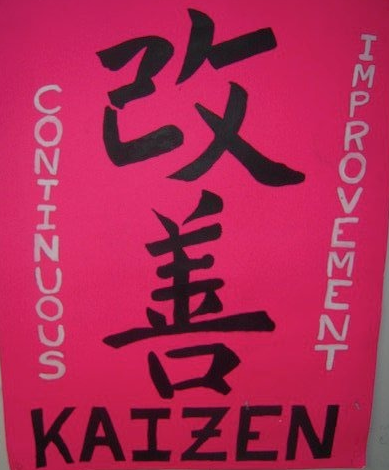
Kaizen

kaizen

I painted this many years ago, as a classroom poster, and then moved it from classroom to classroom, for years, until the posterboard on which it was painted was finally too damaged for further use. At some point, I will have to make a replacement.

Kaizen is a Japanese word which translates only loosely into English, as “continuous improvement.” To me, it means more than that:  it means never being content with simply staying the person I am today, and going to sleep, each night, with the sincere intention to be a better person tomorrow.

Does this always actually work, as each day becomes the next one? No, I must admit that it doesn’t — but that does nothing to change the fact that keeping the kaizen principle in mind is an excellent way to live one’s life. On a year-to-year basis, it works much better, in practice, than it does from day to day. I am confident that I am a better person now than I was 365 days ago, even though there have, of course, been ups and downs, as the last year has passed.

Setbacks, which happen to everyone, are no reason to give up, and personal improvement, in all important parts of life, will always be a goal worth pursuing.

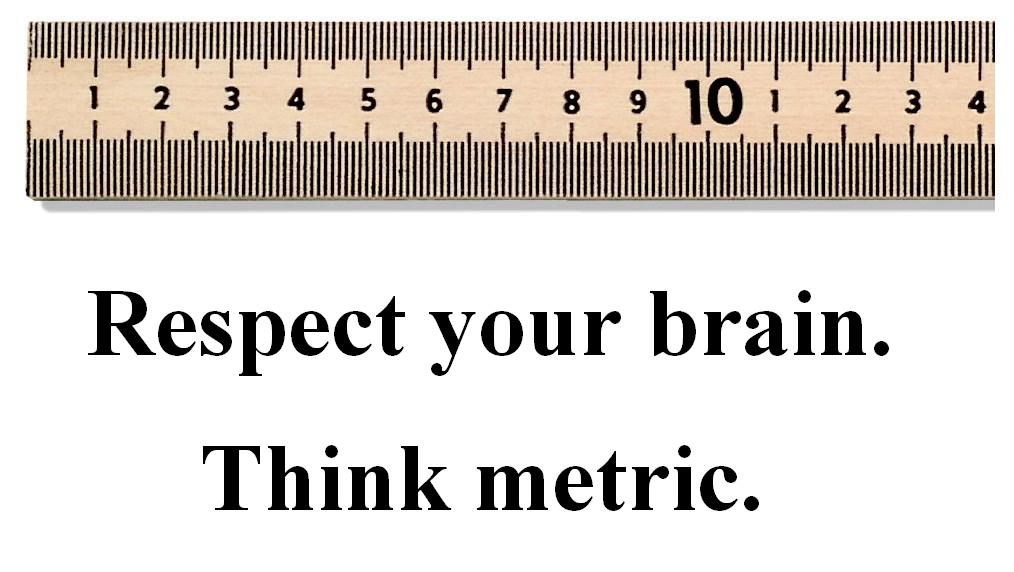
“How Tall Are You?”

metric system

When I am asked for my height, anywhere — especially at school — I answer the question honestly. I am 1.80 meters tall.

I also live in the USA, one of only three remaining countries (the other two holdouts are Liberia and Myanmar) which have stubbornly refused to adopt the metric system. However, I am every bit as stubborn as other Americans, but, on this issue, I choose to be stubborn in the opposite direction.

It should surprise no one who knows me well that my classroom, whether I am teaching science or mathematics, is, by design, an all-metric zone. After all, like >99% of people, I have ten fingers (assuming thumbs are counted as fingers), ten toes, and almost always use the familiar base-ten number system when counting, measuring, doing arithmetic, or doing actual mathematics. (Doing arithmetic is not the same thing as doing real mathematics, any more than spelling is equivalent to writing.) Using the metric system is consistent with these facts, and using other units is not.

Admittedly, I do sometimes carry this to an extreme, but I do so to make a point. Metric units are simply better than non-metric units. Why should anyone need to memorize the fact that there are 5,280 feet in one mile? It actually embarrasses me that I have that particular conversion-factor memorized. By “extreme,” I mean that I have been known to paint the non-metric side of meter sticks black, simply to make it impossible for students in my classes to confuse inches and centimeters, and prevent them from measuring anything with the incorrect units.

To those who object that American students need to understand non-metric units, I simply point out that there are plenty of other teachers who take care of that. This is, after all, the truth.

Often, after giving my height as 1.80 meters, I am asked to give it in other units. Unless the person asking is a police officer (in, say, a traffic-stop situation), however, I simply refuse to answer with non-metric units. What do I say, instead? “I’m also 180 centimeters tall. Would you like to know my height in kilometers?”

If pressed on this subject in class — and it comes up, because we do lab exercises where the height of people must be measured — I will go exactly this far:  I am willing to tell a curious student that there are 2.54 centimeters in an inch, 12 inches in a foot, and 3.28 feet in a meter. Also, I’m willing to loan calculators to students. Beyond that, if a student of mine really wants to know my height in non-metric units, he or she simply has to solve the problem for themselves — something which has not yet happened. I do not wish to tell anyone my height in feet and inches, for I do not enjoy headaches, and uttering my height, in those units I despise, would certainly give me one. Also, obviously, you won’t find my height, expressed in non-metric units, on my blog, unless someone else leaves it here, in a comment — and I am definitely not asking anyone to do that.

I might, just for fun, at some point, determine my height in cubits. For all I know, a person’s height, measured with their own cubits, might be a near-constant. That would be an interesting thing to investigate, and my students, now that I’ve thought about the question, might find themselves investigating this very issue, next week. The variability of cubits, from one person to another, makes them at least somewhat interesting. It also makes cubits almost completely useless, which explains why they haven’t been used since biblical times, but that’s not the point. One can still learn things while investigating something which is useless, if one is sufficiently clever about it.

Feet and inches, however, are not interesting — at all. They are obsolete, just as cubits are, and they are also . . . offensive. It is not a good thing to insult one’s own brain.

Zome: Strut-Length Chart and Product Review

This chart shows strut-lengths for all the Zomestruts available here (http://www.zometool.com/bulk-parts/), as well as the now-discontinued (and therefore shaded differently) B3, Y3, and R3 struts, which are still found in older Zome collections, such as my own, which has been at least 14 years in the making.

Zome

In my opinion, the best buy on the Zome website that’s under $200 is the “Hyperdo” kit, at http://www.zometool.com/the-hyperdo/, and the main page for the Zome company’s website is http://www.zometool.com/. I know of no other physical modeling system, both in mathematics and several sciences, which exceeds Zome — in either quality or usefulness. I’ve used it in the classroom, with great success, for many years.

My Australia Story

australia

I once got into a huge argument, as a 7th grade student, in a “talented and gifted” section of Social Studies. The issue:  how many countries are there in the continent of Australia?

The assignment was to choose a continent, and draw a map of it on a full-size posterboard. I had worked for hours on this map, only to get it back, ruined, for the teacher had taken a red ball-point pen, slashed through my line “state and territorial boundaries” in my map’s key, and had written, as a correction, “not states — COUNTRIES.” She also docked points from my grade, but that was a minor issue, to me, compared to her ruining my map. She could have, at least, written her incorrect comment on the back of my map!

When I confronted her about her mistake, she maintained that the political divisions you see above are independent countries. In my opinion, “Northern Territory,” especially, doesn’t sound particularly sovereign, and I said so, but she may not have understood the definition of “sovereign,” for that did not work. Confronted with this absurd situation, I proceeded to grab the “Q” volume of a nearby encyclopedia, and began reading the article about Queensland, loudly enough for the entire class to hear: “Queensland: one of the states of Australia….” I freely admit that, at the time, my goal was to embarrass and humiliate her right out of the teaching profession — for the benefit of her present and future students. I’ve changed my approach, a lot, since then.

A huge brouhaha ensued, and we ended up taking each other to the assistant principal’s office:  her, to report a disruptive and defiant student; and me, to report an incompetent teacher, who, in my view, at that age, should have been fired on the spot. Dealing with this situation was probably one of the stranger, and more difficult, situations of that assistant principal’s career, for he knew that Australia is both a single country, and a continent — but he could not, for political reasons I did not yet understand, agree with me in front of this teacher. As for me, I was simply incredulous that someone could be a certified social studies teacher, and not know this basic fact about world geography. The whole scenario, to me, was surreal.

The assistant principal handled it well. To the teacher, he said, “You can go back to class — I’ll handle Robert.” He then “handled” me, after she left, in the only way that could have possibly worked: with an apology, and a polite request to do my best to endure her ignorance until the upcoming end of the year. I respect honesty, was being given a request, not an order, and he had conceded that I was correct. I therefore chose to cooperate — with his polite request.

If he had not taken this approach, I likely would have added him to the list I had, at the time, of people (a mixture of administrators and teachers) whom I was trying to drive out of the education profession, for the benefit of all — but he did the right thing, thus earning my respect.

As for the teacher, I survived the rest of her class, brain intact, and assume she is now retired, this being well over thirty years ago. I’m now in my twentieth year as a teacher, myself, and am pleased to report that average teacher quality has dramatically improved since this fiasco happened. (I wish I could say the same about average administrator quality, but there are, at least, a few competent people working in that field, as well.) During my years of teaching, I haven’t encountered a single teacher who lacked this basic bit of knowledge about world geography. In fact, I count, among my colleagues, many of the smartest people I know.

I am glad, however, that I don’t have to call the teacher in this story a colleague. I simply cannot respect willful, stubborn ignorance, especially in the face of evidence that one is wrong. When one of my students catches me making a mistake, I do the right thing: I thank them, make certain everyone understands the correction, and then we move on with the lesson. That’s what this 7th grade teacher of mine should have done, as well.

A True Story of a Young Aspie Getting in Trouble with “Show and Tell”

In elementary school, in the 5th grade, I managed to get in trouble for a “show and tell” project. As usual, getting in trouble was not my objective, but it happened anyway. This was decades before I learned I have Asperger’s, but, looking back, none of this would have happened were I not an “Aspie,” as we call ourselves.

This image, which I found here, is very much like the poster I made, by hand, and used for this project:

nuclear chain reaction

That was the “show” part of this “show and tell” project. For the “tell” part, I explained how nuclear chain reactions work, and then explained how nuclear bombs are made. It’s very simple:  you have two slightly sub-critical masses of uranium-235 or plutonium-239, and physically bring them together, so that the total mass exceeds the critical mass. At that point: boom.

The hard part, of course, is actually obtaining the U-235 or Pu-239, for those aren’t things you can simply buy at the local hardware store. Ironically, I did know where to find both uranium and plutonium — at the very same university, about an hour away, where I’d spent far too much time conducting mostly-unsupervised experiments with both elements, along with lots of liquid mercury, before my tenth birthday. (I still suspect that all that radiation may have turned me into a mutant.) However, I also knew that the uranium and plutonium there would not have nearly enough of the correct isotope of either element, making this information irrelevant to my “show and tell” report, and so, for this reason, I did not tell them where to find the uranium and plutonium I had previously used for experiments.

I didn’t figure this out in class that day, since I’m not particularly good at “reading” emotions, facial expressions, and body language, but, apparently, I really upset, and scared, my teacher. This became apparent when she called my mother, and, later, my mother asked me to tell her what I’d done in school that day. Being excited about the “show and tell” presentation I’d given that day, I immediately told my mother all about it. When she told me the teacher had called her, concerned about me explaining to my class how to build atomic bombs, I was confused, since I didn’t understand, at all, why what I had actually said posed any problem. To explain this to my mother, I simply said, “But, Mom, I didn’t tell the class where to actually get the uranium-235 or plutonium-239! I don’t know where to find those isotopes!”

This was enough to convince my mother that I had not, in fact, done anything wrong. She called the teacher back, and simply asked if I had, or had not, included that critical bit of information: where to find the actual fissionable material needed for a nuclear bomb to work. When the teacher replied that I had not done that, my mother’s response was both sensible, and logical:  “Well, then, what’s the problem?”

—–

Postscript, for those who might be worried about the childhood experiments I mentioned above: at around age 40, I asked a physician about my worries regarding early exposure to mercury vapor and radiation. He told me that any problems I might have, as a result of such experiments, would have already showed up by then, and that I could, therefore, stop worrying about this. Thus reassured, I did exactly that.

My Complete List of Complaints About My New School

For the last three weeks, for the beginning of my twentieth year as a teacher, I’ve been teaching at a different high school. I am much happier, now, due to this change. This being a personal blog, it is my policy not to name my school, nor school district, here. However, I see no problem with posting my complete list of complaints about this new school. Here it is:

complaints

Public Schools in the United States Should Rename the “Free Lunch”

tanstaafl

If you live in the USA, you are probably familiar with the phrase “free lunch,” or “free and reduced lunch,” as used in a public-school context. For those outside the USA, though, an explanation of what that phrase means, in practice, may be helpful, before I explain why a different name for such lunches should be used.

The term “free and reduced lunch” originated with a federal program which pays for school lunches, as well as breakfasts, with money collected from taxpayers — for students whose families might otherwise be unable afford these meals. The program’s eligibility requirements take into account both family income and size. There’s a problem with it, though:  the inaccuracy of the wording used, especially the troublesome word “free.” The acronym above, “TANSTAAFL,” is familiar to millions, from the works of Robert A. Heinlein (science fiction author), Milton Friedman (Nobel-Prize-winning economist), and others. It stands for the informally-worded phrase, “There ain’t no such thing as a free lunch,” which gets to the heart of the problem with the terminology we use when discussing school lunches. (Incidentally, I have seen an economics textbook use the phrase “TINSTAAFL,” in its place, to change “ain’t no” to “is no.” I do not use this version, though, for I am unwilling to correct the grammar of a Nobel laureate.)

The principle that “free lunches” simply do not exist is an important concept in both physics and economics, as well as other fields. In physics, we usually call it the Law of Conservation of Mass and Energy, or the First Law of Thermodynamics. This physical law has numerous applications, and has been key to many important discoveries. Learning to understand it, deeply, is an essential step in the education of anyone learning physics. Those who teach the subject, as I have in many past years, have an even more difficult task:  helping students reach the point where they can independently apply the TANSTAAFL principle to numerous different situations, in order to solve problems, and conduct investigations in the laboratory. It is a fundamental statement of how the universe works:  one cannot get something for nothing.

TANSTAAFL applies equally well in economics, where it is related to such things as the fact that everything has a cost, and those costs, while they can be shifted, cannot be made to simply disappear. It is also related to the principle that intervention by governments in the economy always carries costs. For example, Congress could, hypothetically, raise the federal minimum wage to $10 per hour — but the cost of doing so would be increased unemployment, especially for those who now have low-paying jobs. Another possible cost of a minimum-wake hike this large would be a sudden spike in the rate of inflation, which would be harmful to almost everyone.

To understand what people have discovered about the fundamental nature of physical reality, physics must be studied. To understand what is known about social reality in the modern world, economics must be studied. Both subjects are important, and understanding the TANSTAAFL principle is vital in both fields. Unfortunately, gaining that understanding has been made more difficult, for those educated in the United States, simply because of repeated and early exposure to the term “free lunch,” from childhood through high school graduation. How can we effectively teach high school and college students that there are no free lunches, when they have already been told, incessantly, for many years, that such things do exist? The answer is that, in many cases, we actually can’t — until we have first helped our students unlearn this previously-learned falsehood, for it stands in the way of the understanding they need. It isn’t a sound educational practice to do anything which makes it necessary for our students to unlearn untrue statements.

I am not advocating abolition, nor even reduction, of this federal program, which provides essential assistance for many families who need the help. Because I am an American taxpayer, in fact, I directly participate in funding this program, and do not object to doing so. I do take issue, however, with this program teaching students, especially young, impressionable children in elementary school, something which is untrue.

We need to correct this, and the solution is simple:  call these school lunches what they actually are. They aren’t free, for we, the taxpayers, pay for them. Nothing is free. We should immediately replace the phrase “free and reduced lunch” with the phrase “taxpayer-subsidized lunch.” The second phrase is accurate. It tells the truth, but the first phrase does the opposite. No valid reason exists to try to hide this truth.

The Unintentional Bomb: A True Story

picric acid

Nineteen years ago, I began my teaching career at a small, private Arkansas high school. One of the classes I taught was Chemistry, and my principal happened to be a former chemistry teacher, himself.  We were both new to the school, and knew that there was a high turnover rate there for teachers in that field. They’d had perhaps eight teachers for that class in the previous five years. I stayed there six years, teaching chemistry every year.

The new principal saw the need for upgraded laboratory facilities, and we got them, including a new, larger chemical stockroom. The old stockroom was a nightmare, and the chemicals needed to be transferred to their new home. This was a massive undertaking, for many of my predecessors had ordered chemicals, not taking the time to inventory the stockroom to see if the school already had what they needed. Even worse, the chemicals were stored in approximate alphabetical order.

Experienced chemists and chemistry teachers know how scary the phrase “alphabetical order” is, in this context. For reasons of safety, chemicals need to be stored by families, using a shelving pattern that keeps incompatible chemicals far apart. I was not an experienced teacher of anything at this point, but the principal showed me the classification scheme he’d used before, himself. It’s the one recommended by Flinn Scientific, and you can see it at http://www.flinnsci.com/store/Scripts/prodView.asp?idproduct=16069. At his direction, over a couple of weeks, I took the chemicals from the old storage area to the new one, de-alphabetizing them into a much safer arrangement, onto category-labelled shelves. In the process, of course, I saw every laboratory chemical that school had, recognizing many (jar after jar of liquid mercury, for example) as highly dangerous, and making certain proper precautions were taken with such substances. If I didn’t recognize a chemical well enough to categorize it (sulfates together, halides together, etc.), I looked it up, in order to find its place. I wouldn’t even open a container with an unfamiliar chemical in it, until researching it. As it turned out, my caution with unfamiliar chemicals literally saved my life.

There are hundreds of different acids, and I doubt anyone knows them all. When I encountered a hand-labeled jar reading “picric acid,” I had never heard of that chemical, the structure for which is shown above. When I looked it up, I learned picric acid is safe if it is all in solution with water, but is a shock-sensitive explosive in solid form. I examined the liquid carefully, without actually touching the container. Sure enough, solid crystals had already started to form, over the years, as some of the water in the container slowly evaporated, and escaped.

Great, I thought, sarcastically — a shock-sensitive explosive. I then kept reading the hazard alerts, and noticed that they stated that picric acid should never be stored in any container with a metallic lid, because that invites the formation of explosive metal picrates which can be detonated simply by the friction caused by an attempt to open the lid. The picric acid I was dealing with, of course, not only had the dangerous solid crystals — it also had a metal lid, and a partially corroded one at that.

I never so much as touched that lid. Very carefully, I gently carried this container to the new stockroom, gave it a shelf all by itself, and didn’t so much as give it a nasty look, for the rest of the time I taught there. Leaving it alone, with me being the only person with access to that room, was the safest thing I could think of to do, as long as I was teaching there. For six school years, since it was carefully undisturbed, the picric acid behaved itself — and then, seeking a higher salary, I found a job for the following Fall, teaching at a public school. I knew I would not be able to leave this private school, though, without dealing with this picric acid problem once and for all, along with other dangerous chemicals the school did not need. I could have simply turned my keys in, and left, but that would have risked a potentially-fatal explosion in that school in future years, for I could not safely assume the next chemistry teacher would be familiar with, nor research, picric acid. My conscience would not permit that.

The school year being over, I went to see the school’s new principal. Unlike his predecessor, the new principal had never taught chemistry, but he’d been on the faculty, before his promotion, for longer than I had been there, and so we knew each other well. When I went into his office, with my keys, for end-of-the-year checkout, and calmly told him that there were many serious toxins and an unexploded bomb down the hall, he knew immediately that I wasn’t joking. With his permission, I kept my keys into the beginning of the Summer, getting things ready for professional chemical-disposal experts to come in and remove the dangerous materials. Before long, four cardboard boxes had been filled with dangerous chemicals the school did not need, slated for disposal — and that’s after I had already disposed of most things that needed to go, if I had the knowledge, and means, to dispose of them properly.

The first group of professionals who were called in, for help, were from the local fire department. They took some of the chemicals away, without charge, but only the ones that they knew how to deal with safely. The principal and I were informed that, for the remaining chemicals (down to one box now, in which was the picric acid), a professional “hazmat” team would need to be called in, and it wouldn’t be cheap.

It wasn’t. The bill from the hazmat team exceeded US$2000. They took away three or four kilograms of mercury, as well as a lot of other nasty stuff, but also told us, with apologies, that they weren’t taking the picric acid, it being too dangerous for a “mere” professional hazmat team. To get rid of that, we were told, we’d need to call in the bomb squad from the state’s capital city, Little Rock.

I had heard the phrase “bomb squad” in movies, and on TV, but not in real life. Judging from the look on his face, the same can be said for the principal. As it happened, I wasn’t in town on the day the bomb squad came to school, but I did hear numerous first-hand accounts of what transpired, when I came back the following day to turn in my keys.

One of many surprises reported to me by these witnesses is that the FBI arrived with the bomb squad, asking questions and interviewing people. Apparently there wasn’t supposed to be any picric acid in Arkansas schools, for a statewide sweep had been made to gather it all up, and dispose of it, in the 1970s. My guess, and that’s all it is, is that this very old bottle had been overlooked because of it being in a private, rather than a public, school. If the FBI wants to contact me now to ask me questions about this stuff, I’ll answer them, but, at the time, I didn’t mind a bit that I missed out on the interrogation-portion of these events. After the FBI had finished their on-site investigation, the bomb squad began their work.

This K-12 school has a very large campus, with multiple buildings, and my classroom was at one corner of it. The disposal site they chose — the nearest area sufficiently remote from people and buildings — was far behind the gymnasium, at least half a kilometer away, at the opposite corner of the campus. As it was described to me, two bomb squad guys put on what I call “moon suits,” wrapped the picric acid bottle up, with a lot of padding, and placed this padded bundle on a stretcher.  They then walked the stretcher, with its deadly cargo, around and between buildings, across railroad tracks and a street, around the gymnasium, and back into an empty lot, where a deep hole was dug. One of the guys in moon suits then put the picric acid container at the bottom of the hole, along with a stick of dynamite, the idea being to use the smaller dynamite explosion to trigger the much larger explosion of the picric acid.

The bomb-squad “astronaut” lit the long fuse on the dynamite, and scrambled out of the hole as quickly as his moon suit would permit. The fuse burned, right up to the dynamite — and then, just as everyone expected a deafening explosion, it fizzled out. They had unknowingly used a stick of dynamite with a defective fuse.

After waiting a while, just to give the dynamite time to, well, change its “mind” about exploding (which didn’t happen), the suited-up bomb squad guy was sent back into the hole, with a second stick of dynamite, which he placed next to the first one. I hope he got paid extra for this, for I would have quit, immediately, rather than re-enter that hole. He, however, did enter, lit the second dynamite stick, and got out in time. This time, the detonation was successful, and the picric acid and both sticks of dynamite were utterly obliterated.

At the time of the explosion, a former student of mine, who had graduated from this same school a few years before, was working in an office building, three or four kilometers away. I got an e-mail from him, and laughed when I read it. Apparently the entire building he was working in had just been shaken by an explosion in the direction of his former school, and he had one question for me:  had I had anything to do with this? I laughed, and replied with an honest answer.