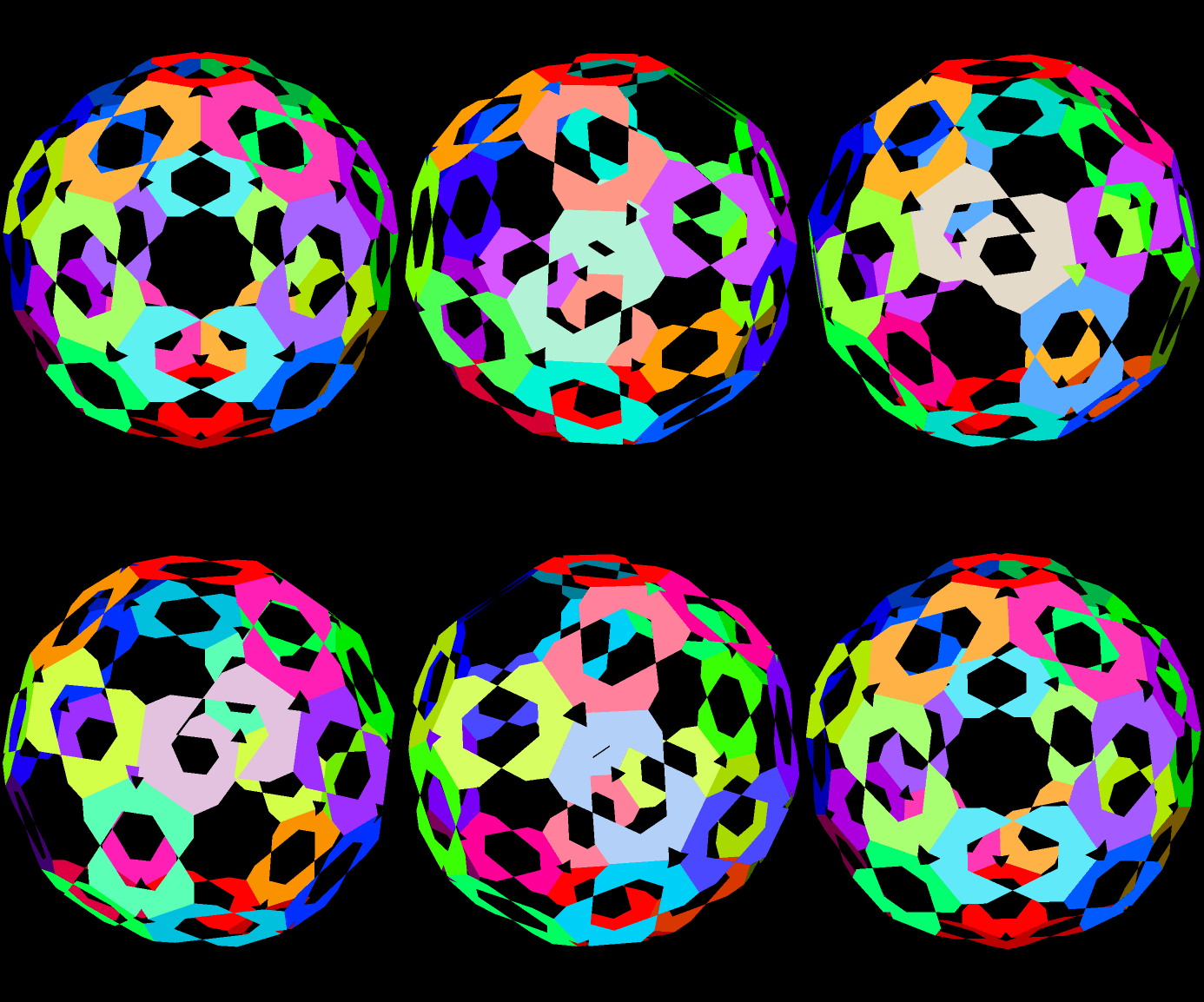
Medium: electrons and photons, arranged carefully using Stella 4d: Polyhedron Navigator, software I bought at http://www.software3d.com/Stella.php. There is a free trial download available at the same website.
Medium: electrons and photons, arranged carefully using Stella 4d: Polyhedron Navigator, software I bought at http://www.software3d.com/Stella.php. There is a free trial download available at the same website.
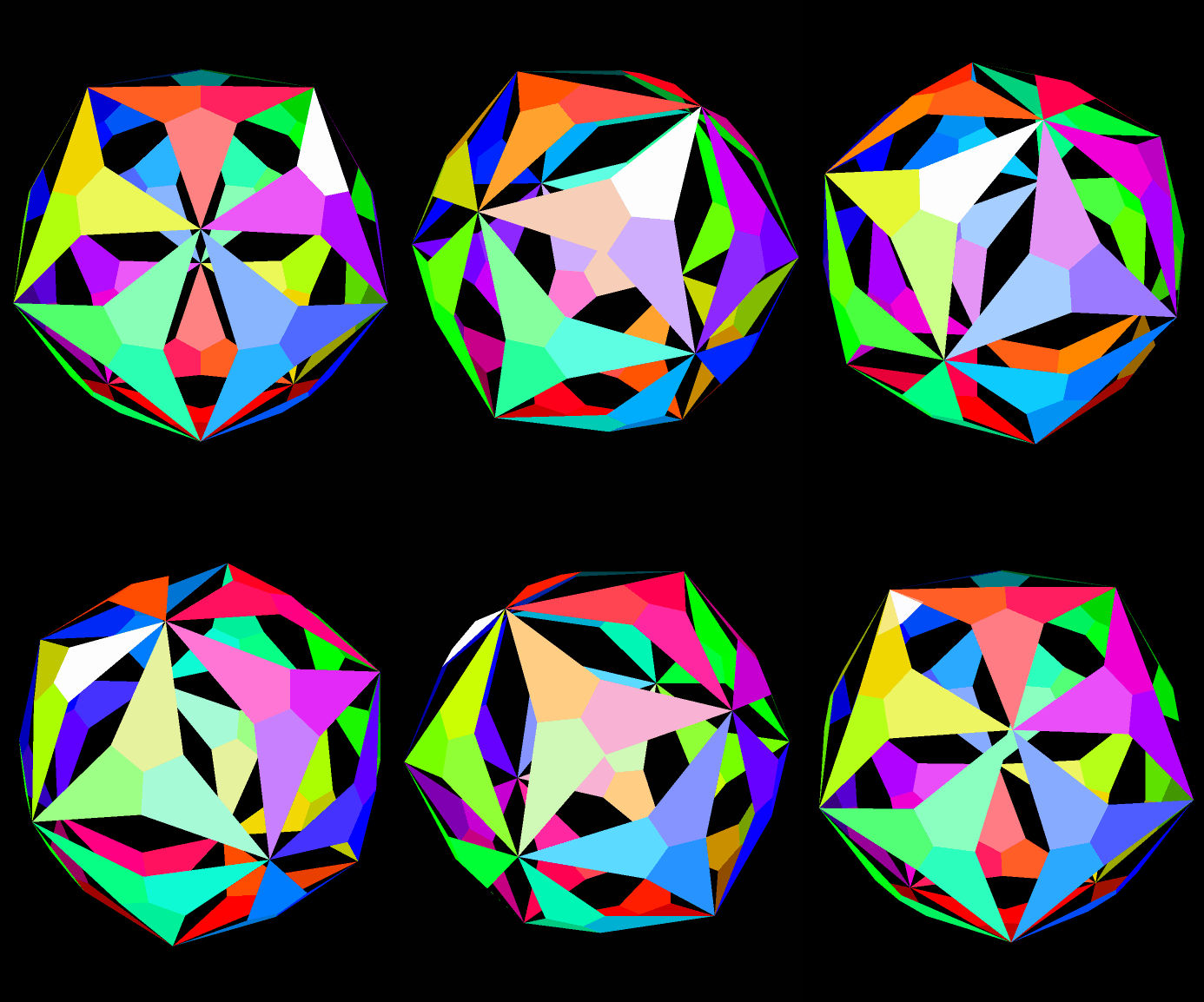
Created using Stella 4d, software available at http://www.software3d.com/Stella.php.

I created this using Stella 4d: Polyhedron Navigator, a program you can find athttp://www.software3d.com/Stella.php.
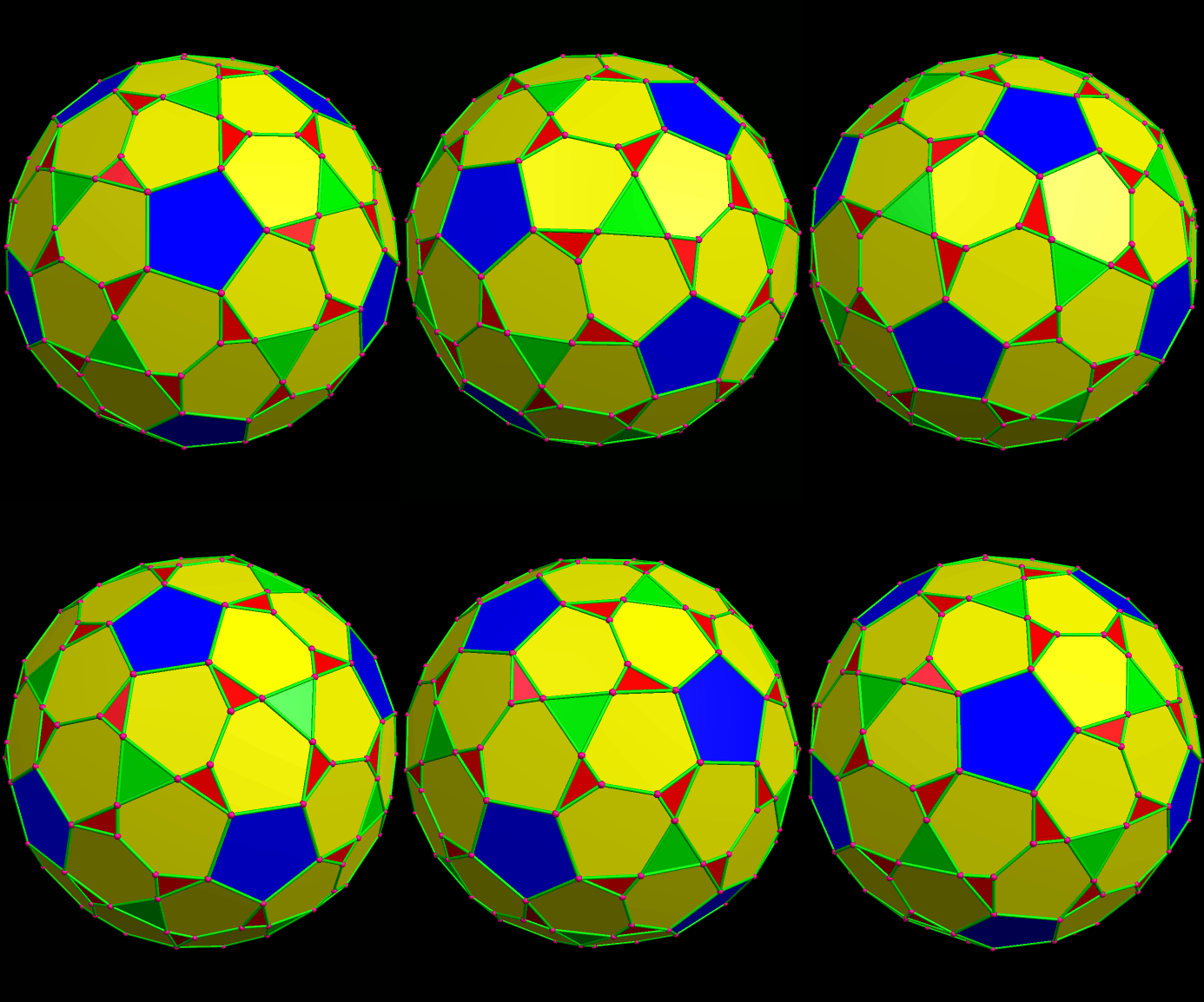
To make this, I started with the dual of the great rhombicosidodecahedron, a polyhedron known as the dysdyakis triacontahedron. I then augmented half of its faces with tall prisms (thereby creating the chirality in this polyhedron), and took the convex hull of the result. The sixty red triangles are the tops of the augmentation-prisms.
A stellation of the above polyhedron, and a color-change, produced this result, also chiral. It may be enlarged with a click.
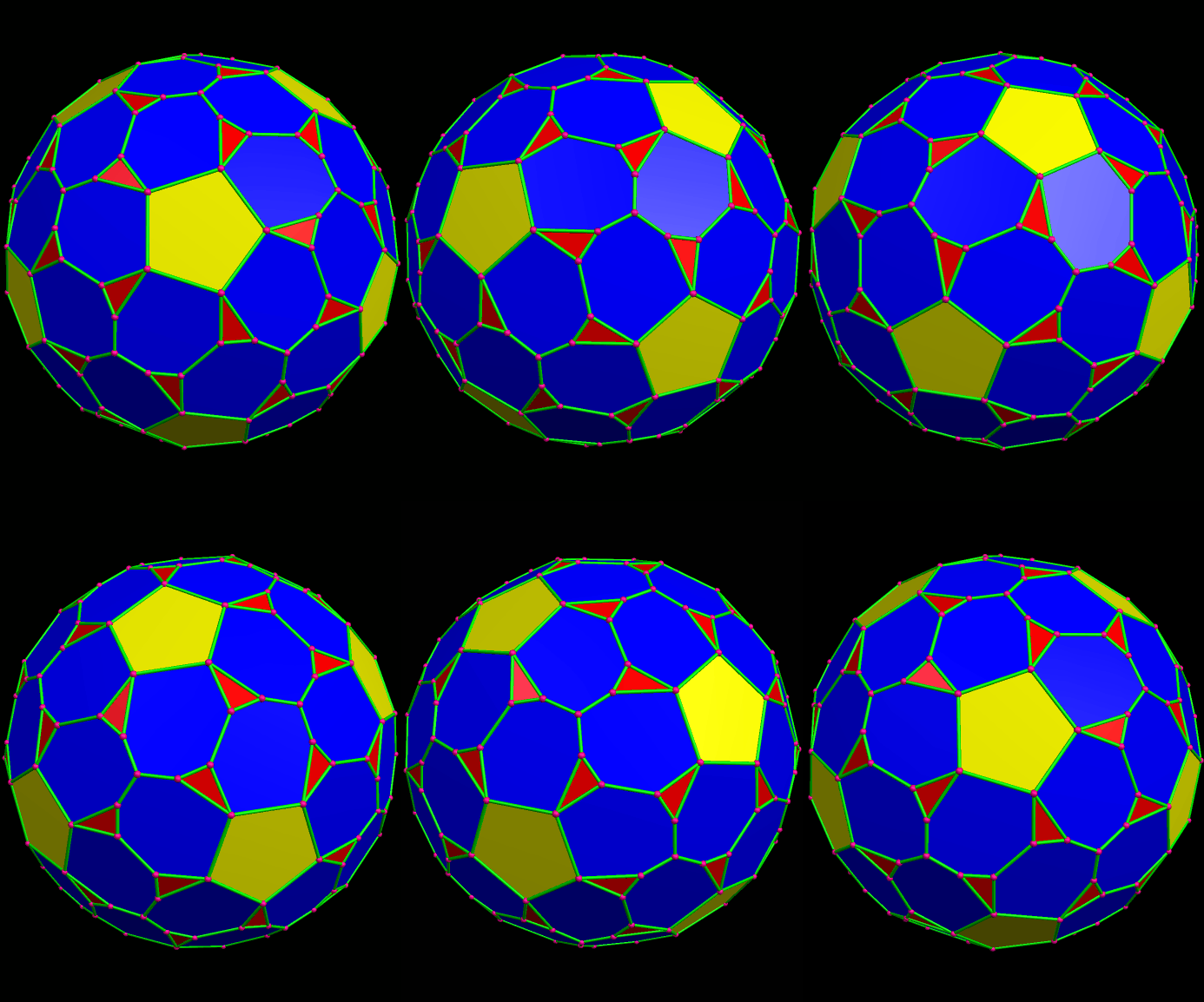
These polyhedra were created using Stella 4d, a program which you may buy — or try for free, as a trial download — at http://www.software3d.com/Stella.php.

I created this using Stella 4d: Polyhedron Navigator, a program you can find at http://www.software3d.com/Stella.php.
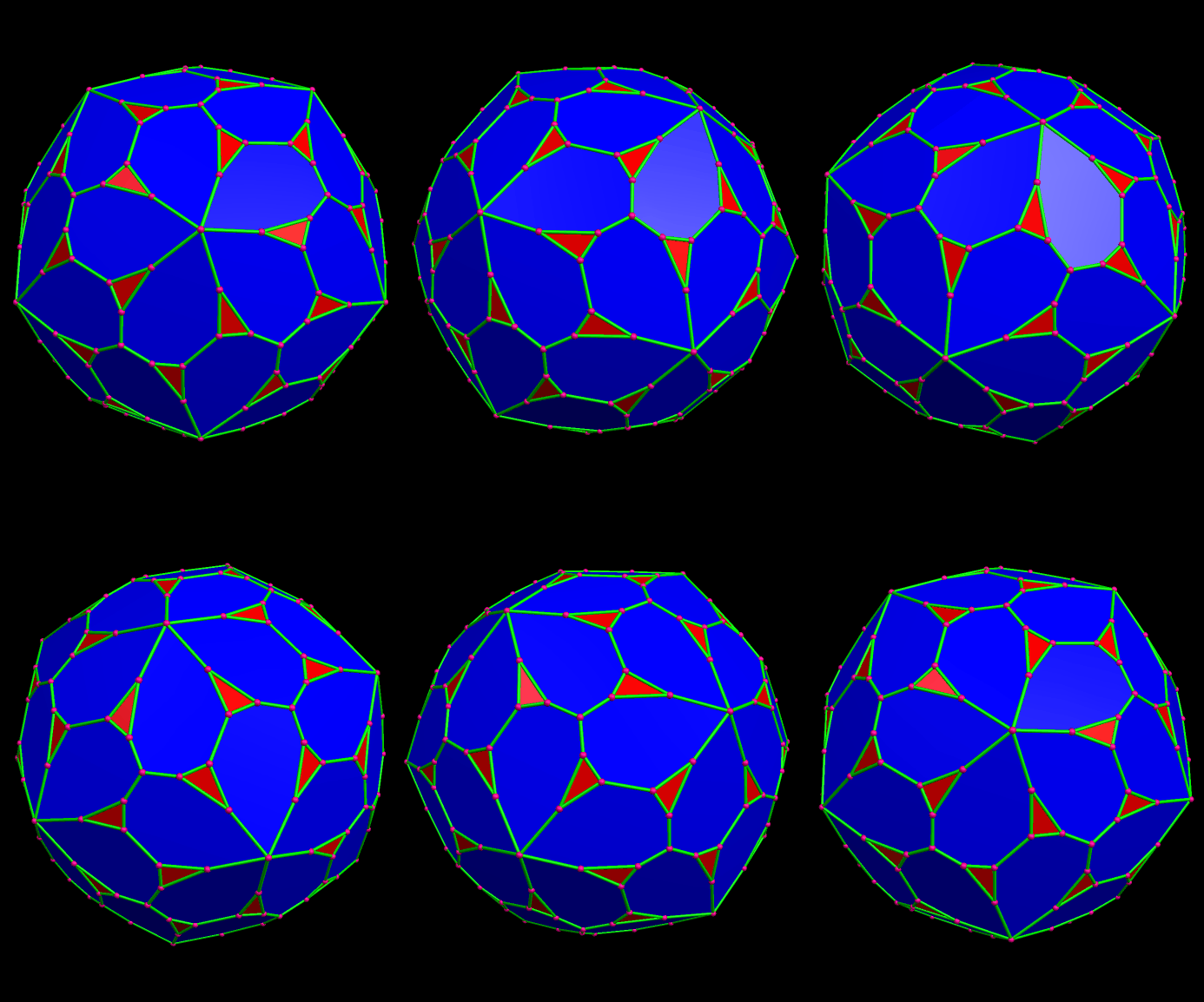
If someone had asked me if it were possible to form a symmetric polyhedra out of irregular triangles and octagons, using exactly sixty of one type each, I would have guessed that it were not possible. Why does it work here? Part of the reason is that each triangle borders three octagons, and each octagon borders three triangles — a necessary, but not sufficient, condition. This is a partial truncation of an isomorph of the pentagonal hexacontahedron, the dual of the snub dodecahedron. As such, no surprise — it’s chiral.
This was made while stumbling about in the wilderness of the infinite number of possible polyhedra using Stella 4d: Polyhedron Navigator. You can get it here: http://www.software3d.com/Stella.php.
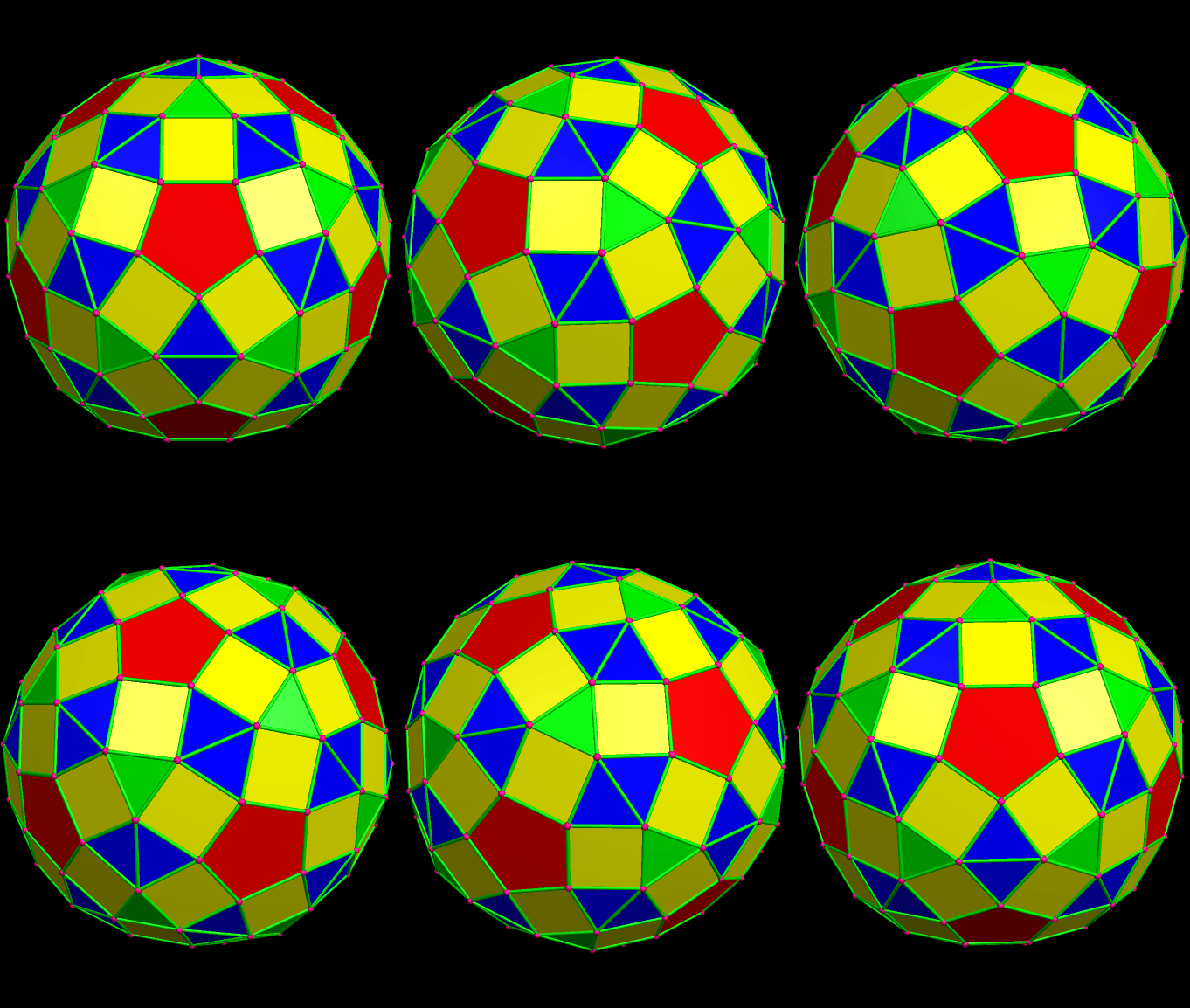
To make this polyhedron using Stella 4d: Polyhedron Navigator (a program which is available at this website), I started with an icosidodecahedron, augmented all faces with prisms of height 1.6 times greater than their bases’ edge length, and then took the convex hull of the result. I’m proposing it as a candidate for the loosely defined group of polyhedra called near-misses to the 92 Johnson solids: convex polyhedra which are almost, but not quite, Johnson solids, due to slight irregularity in some of their faces.
In this case, the pentagons and green triangles are regular, and have the same edge length. The blue triangles, however, are isosceles, with vertex angles of ~67.6687 degrees. The yellow almost-squares are actually rectangles, with edges next to blue triangles which are ~2.536% longer than the edges next to pentagons or green triangles.
I stumbled upon this design earlier today, while simply exploring polyhedra more-or-less randomly, using Stella. Below is the prototype I found at that time, which I merely made a .gif of, but did not perform measurements on.
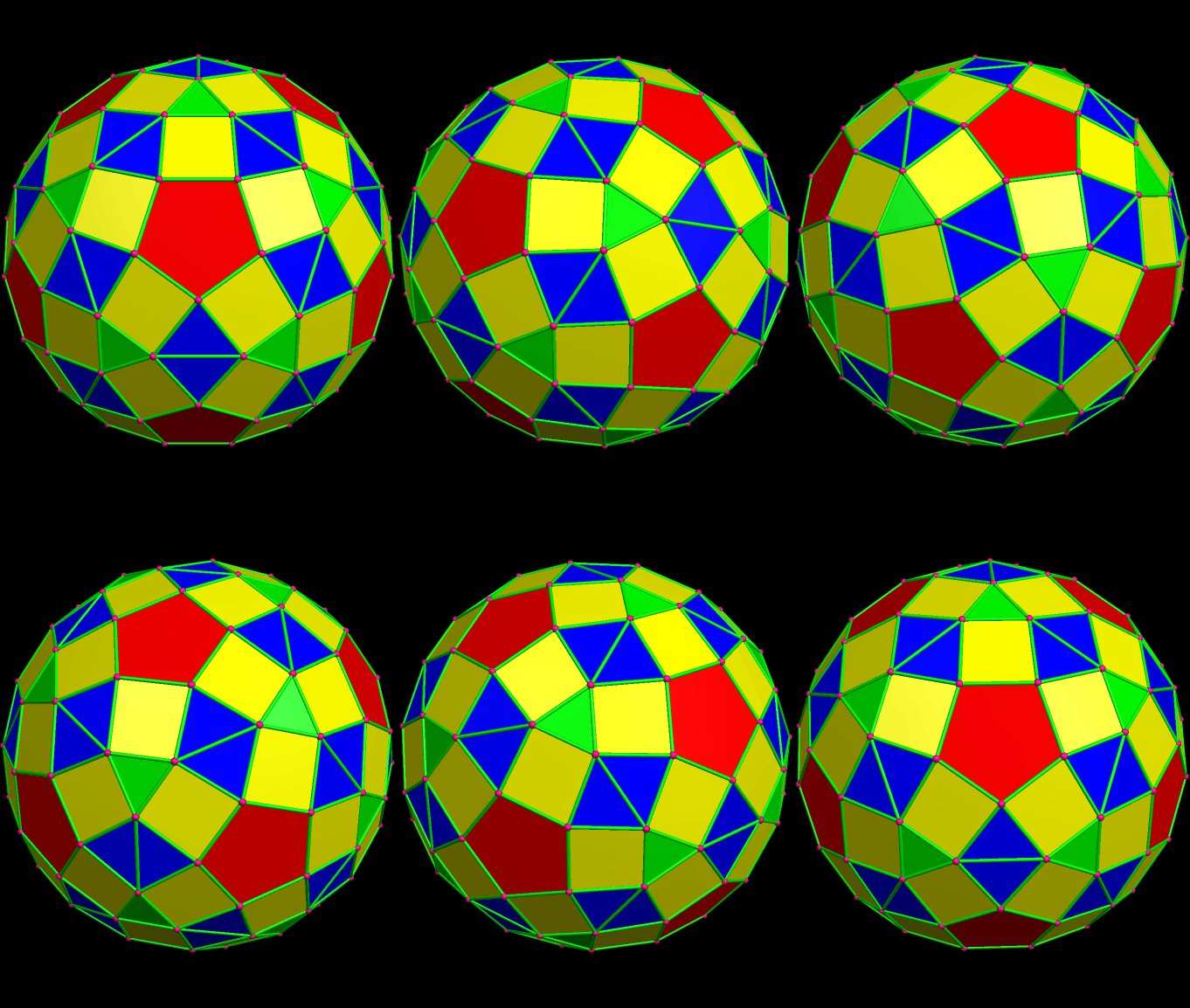
In this prototype, the most significant difference I can detect is in the yellow faces, which are trapezoids, rather than rectangles, since the pentagon edge-length is slightly longer than that of the green triangles.
Stella has a “try to make faces regular” function built-in to try to help improve upon polyhedra such as these, but here’s what happens when that function is used on the first polyhedron shown above:
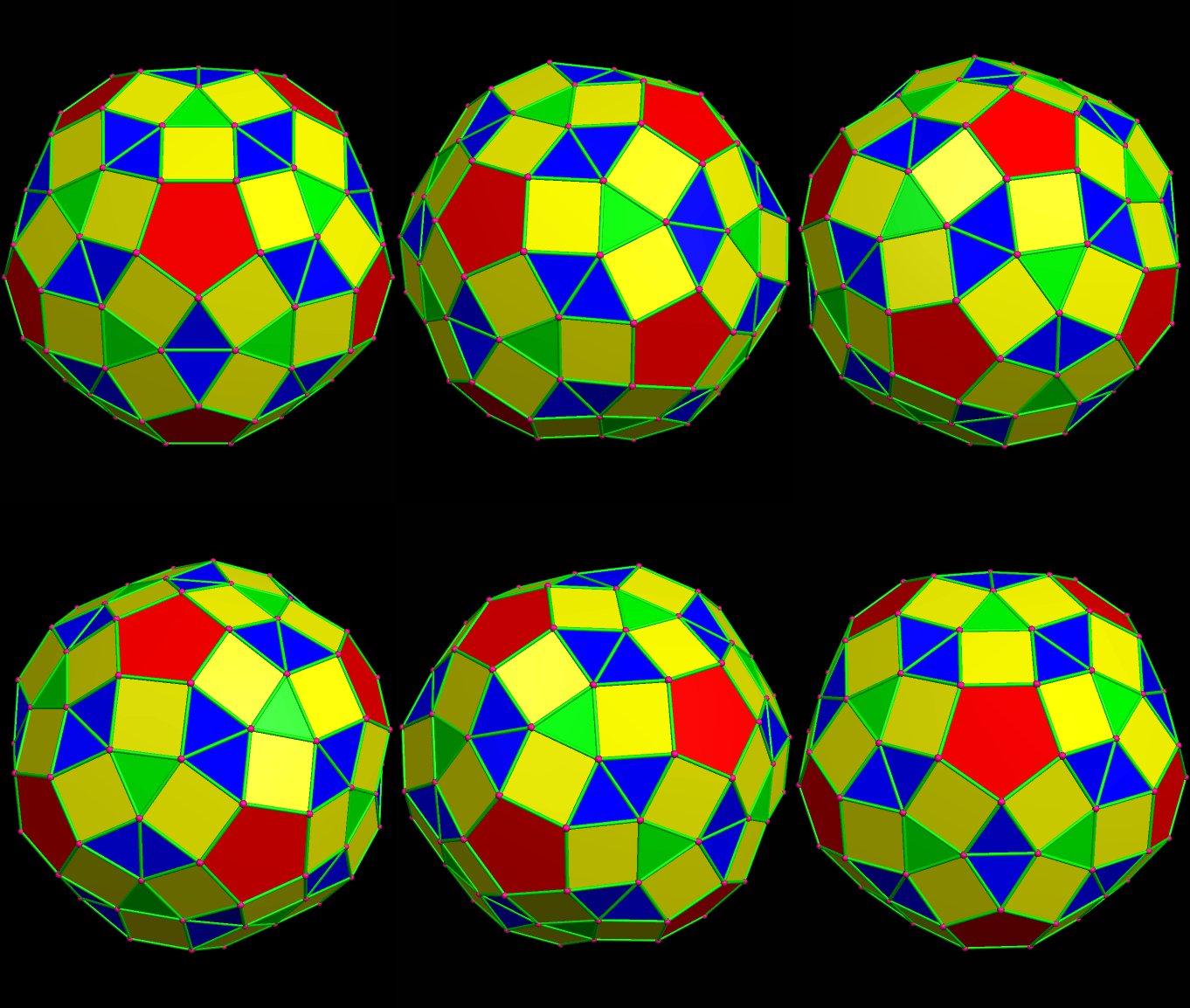
Behold! It worked — all of the faces are perfectly regular. However, that caused another problem to appear, and you can see it most easily by looking at the blue triangle-pairs: this polyhedron is slightly non-convex. It’s also easily described as a truncated dodecahedron, with each of the twelve decagonal faces augmented by a pentagonal rotunda.
I’ll show this to some other people who are polyhedron-experts, and will update this post with what I find after I’ve talked to them. My questions for them, as usual in such situations, are two in number:
1. Has this polyhedron been found before?
2. Is it close enough to regularity to qualify for “near-miss” status?
If it hasn’t been found before, but is judged unworthy of “near-miss” status, it will at least join the newly-described group I call “near near-misses” — polyhedra which don’t quite qualify for near-miss status, by visual inspection. Obviously, this new group’s definition is even more “fuzzy” than that of the near-misses, but there is a need for such a category, nonetheless.
[Update: Robert Webb, who wrote Stella 4d (and is not the blogger here, despite our sharing a first name), has seen this before, so it isn’t an original discovery of mine. He doesn’t accept it as a near-miss on the grounds that it naturally “wants” to be non-convex, as seen in the last of the three images in this post, and I agree with his reasoning. I’m therefore considering this to be a “near-near-miss.”]

After using Google to find the image of this galaxy, I used software called Stella 4d (available at http://www.software3d.com/Stella.php) to project it onto the twelve pentagonal faces of an icosidodecahedron, and then hid the triangular faces, as well as the vertices and edges — and then set the galaxies to rotate on the faces, as well as around the axis of the polyhedron.
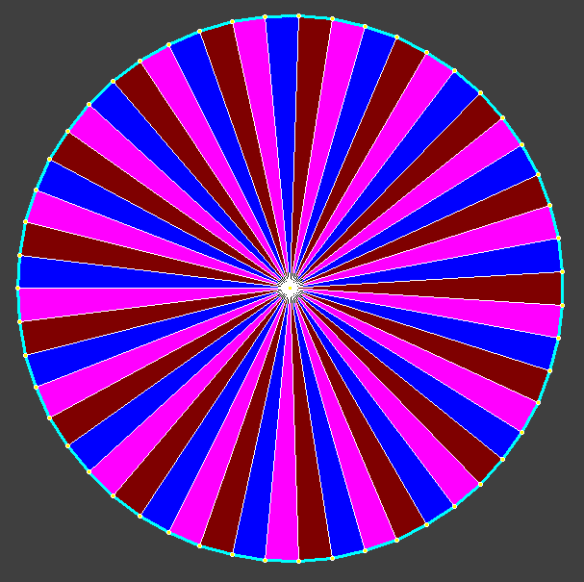
This is simply the inverted-color version of the second image in the last post on this blog, where I explain how to construct this 51-sided polygon using compass and straightedge, starting with the heptadecagon, which has 17 sides.

After completing the heptadecagon construction shown in the last post on this blog, I wondered if I could pull off a similar trick to the one mentioned there of combining the pentagon and triangle constructions to construct a regular pentadecagon — but using the heptadecagon and triangle, instead, to construct a regular polygon with (17)(3) = 51 sides, known as the henkaipentacontagon.
The answer: yes, I was able to, but certainly not in the simplest way possible, for I ended up having to go to 204, first, to get to 51. First, I extended two adjacent radii of the heptadecagon in the upper left as rays, just to give me room to work. Next, I placed point B1 on the lower of those two rays, to be used as the center of the large circle in which to construct my 51-sided regular polygon. I then constructed a line through B1 which was parallel to the upper of these two rays, thus duplicating the ~21.17647º central angle of the heptadecagon, but in the center of my new, larger circle. Next, I constructed the yellow equilateral triangle with this heptadecagon-central-angle inside it, in such a way that the lower half of the yellow triangle would be a 30-60-90 triangle, ΔA1B1C1, with the ~21.17647° angle inside, and sharing a ray with, this triangle’s 30° angle. By subtraction, that made a ~8.8235° angle, with its vertex at the center of the largest circle shown.
Next, I divided ~8.8235 into 360 . . . and, to my dismay, didn’t get a whole number as an answer, but 40.8, instead. I then noticed that one can multiple 40.8 by five, and obtain 204 as the product. Armed with this knowledge, I used my ~8.8235° angle, and 204 circles of equal radius, to locate 204 points, evenly-spaced, around the large circle.
51 is one-fourth of 204, so I connected every fourth point around the large circle with heavy blue segments, and made those 51 points (one fourth of the total) blue, as well. These blue points and segments are the sides and vertices of the regular henkaipentacontagon, shown inscribed, above, inside the largest circle in the diagram.
Since this polygon looks a lot like a circle, I then rendered a lot of things from the diagram above invisible, in order to produce this second image: the henkaipentacontagon alone, with different colors for its vertices and sides, all radii added, and three alternating colors for the 51 triangles each formed by two adjacent radii and a side.

 RobertLovesPi.net