For years, I have used Zometools (sold here: http://www.zometool.com) to teach geometry. The constructions for the icosahedron and dodecahedron are easy to teach and learn, due to the use of short reds (R1s) and medium yellows (Y2s) for radii for the two of them, as shown below, with short blue (B1) struts as edges for both polyhedra.

Unexpectedly, a student (name withheld for ethical and legal reasons) combined the two models, making this:
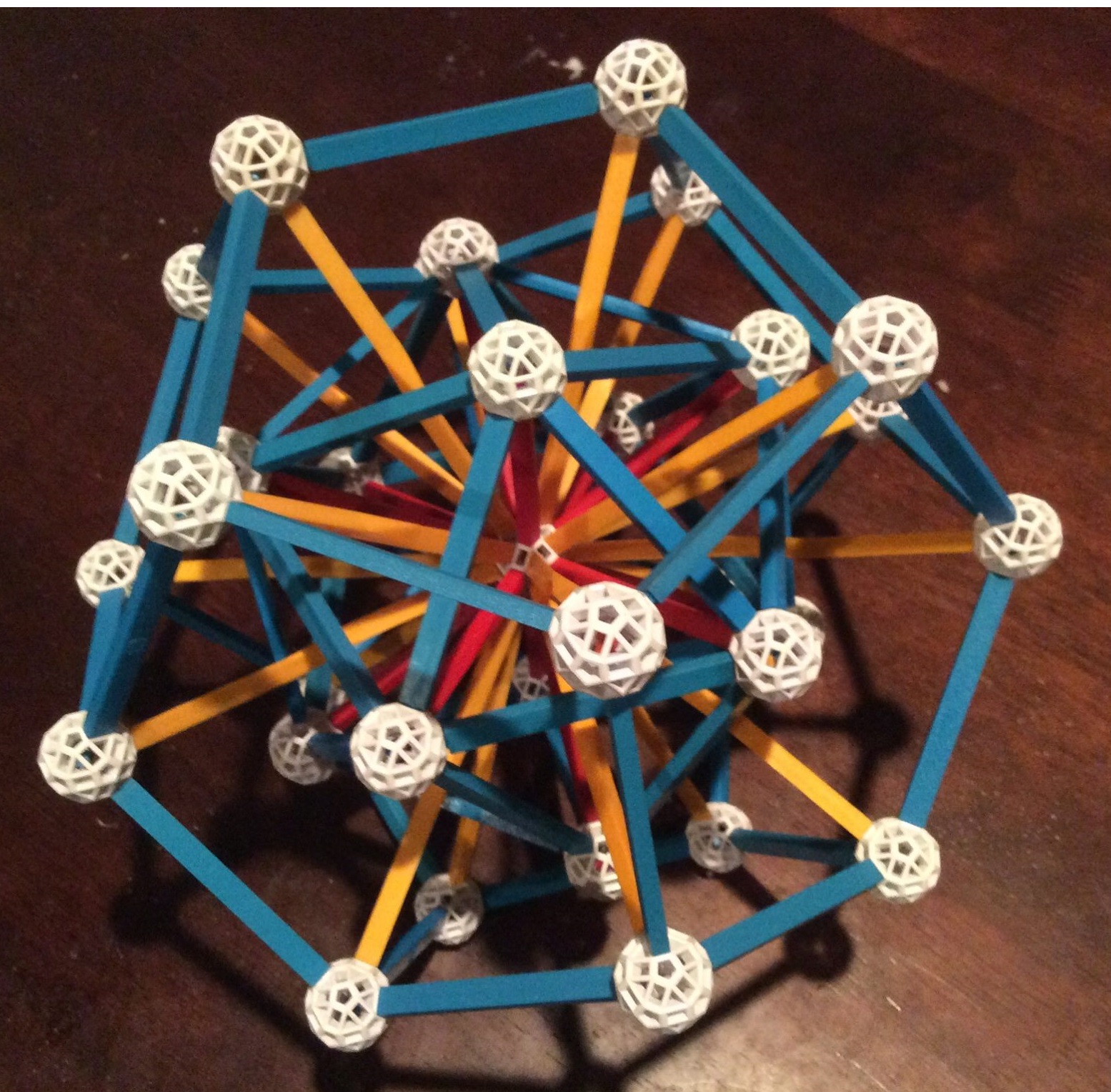 I saw it, and wondered if the two combined Platonic solids could be expanded along the edges, to stellate both polyhedra, with medium blues (B2s), to form the great and small stellated dodecahedron. By trying it, I found out that this would require intersecting blue struts — so a Zomeball needed to be there, at the intersection. Trying, however, only told me that no available combination would fit. After several more attempts, I doubled each edge length, and added some stabilizing tiny reds (R0s), and found a combination that would work, to form a compound of the great and small stellated dodecahedron in which both edge lengths would be equal. In the standard (non-stellated) compound of the icosahedron and dodecahedron, in which the edges are perpendicular, they are unequal in length, and in the golden ratio, which is how that compound differs from the figure shown directly above.
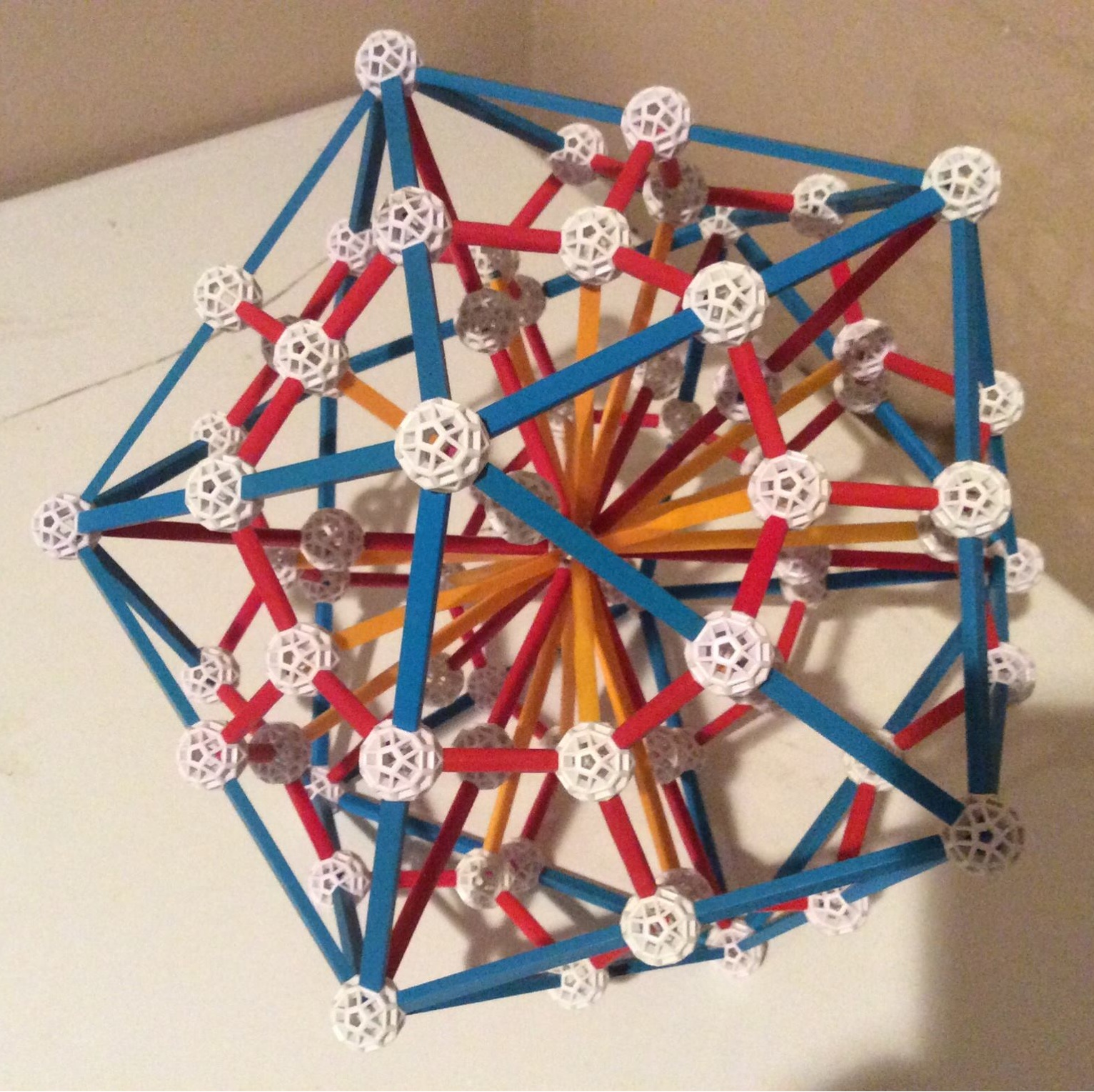
Here’s the stabilized icosahedral core, after the doubling of the edge length:
 This enabled stellation of each shape by edge-extension. Each edge had a length twice as long as a B2 added to each side — and it turns out, I discovered, that 2B2 in Zome equals B3 + B0, giving the golden ratio as one of three solutions solution to x² + 1/x = 2x (the others are one, and the golden ratio’s reciprocal). After edge-stellation to each component of the icosahedron/dodecahedron quasi-compound, this is what the end product looked like. This required assembling the model below at home, where all these pictures were taken, for one simple reason: this thing is too wide to fit through the door of my classroom, or into my car.
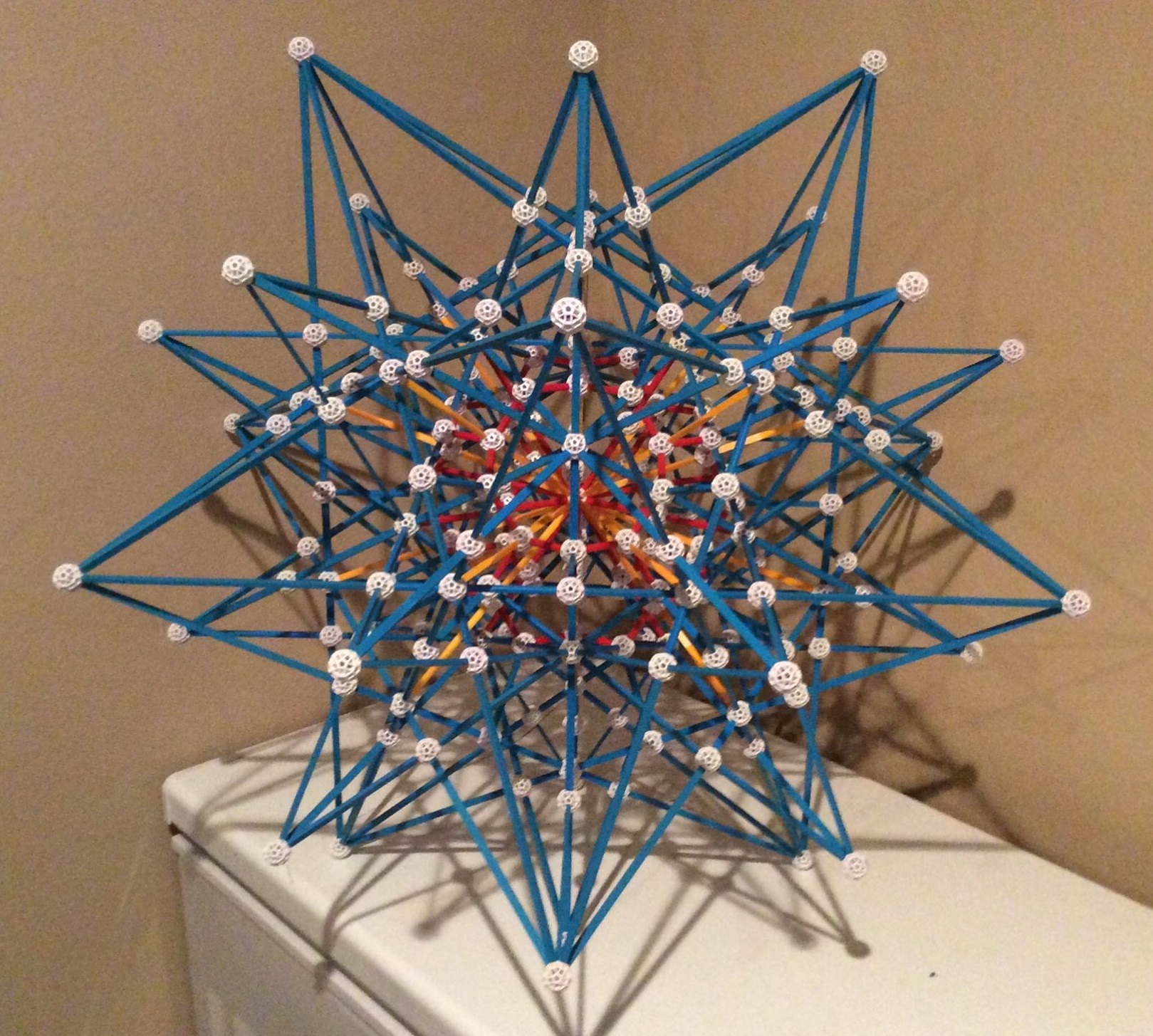
Here’s a close-up of the central region, as well.



 RobertLovesPi.net