A Cluster of Thirty-One Rhombic Enneacontahedra

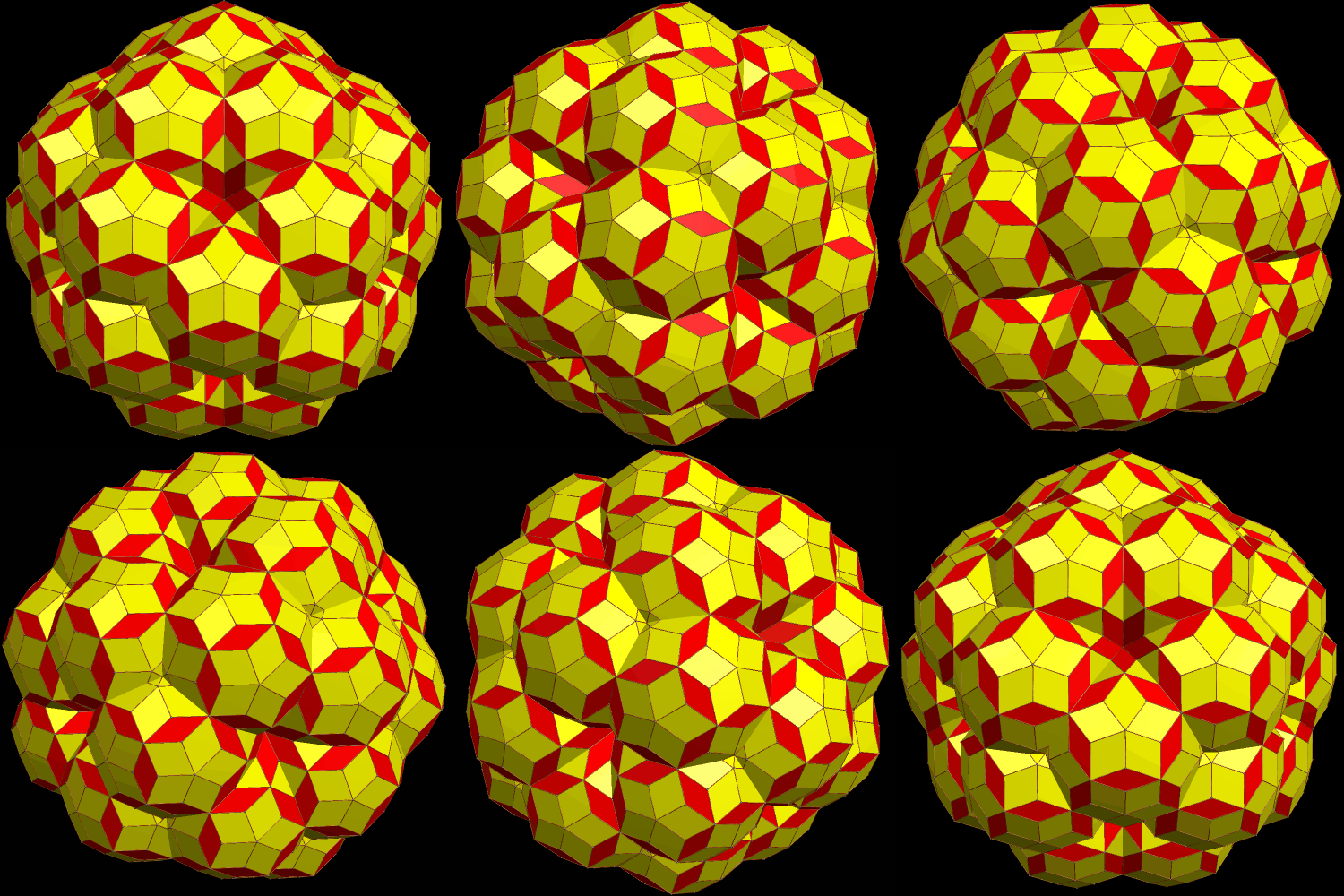
31 RECs

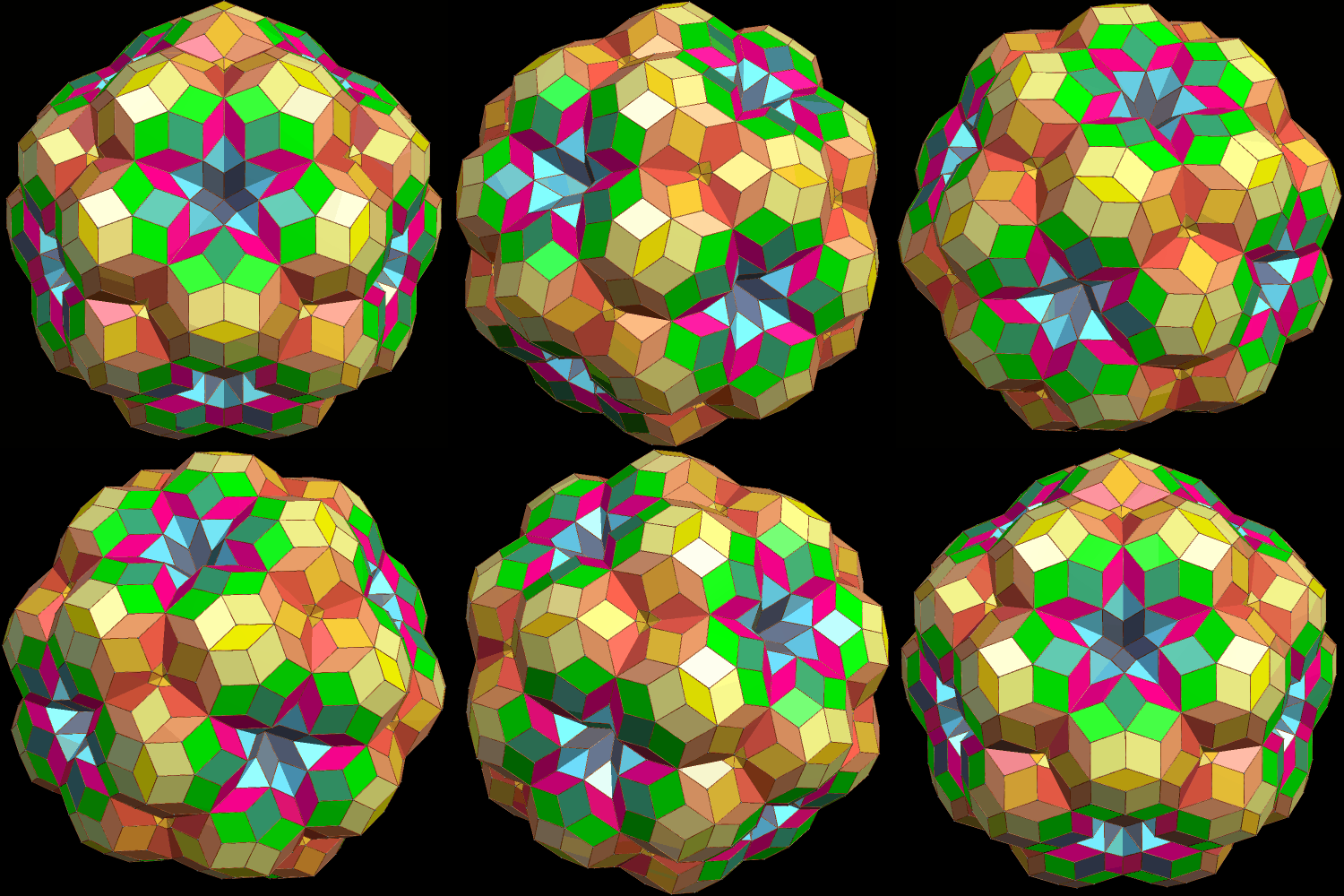
The rhombic enneacontahedron has thirty faces which are narrow rhombi, and sixty faces which are wider rhombi. It is also known as a vertex-based zonohedrified dodecahedron. To create this cluster-polyhedron, I started with one rhombic enneacontahedron in the center, and then augmented its thirty red faces (the narrow rhombi) with additional rhombic enneacontahedra. In the image above, I kept the yellow color for all the wide rhombi, and red for all the narrow ones. In the next image, however, the rhombi are colored by face type, referring to their position in the entire cluster-polyhedron.

31 RECs 2

Software credit: I created this using Stella 4d, software you can buy, or try for free, at this website.

Imp: A Painting from 2004

imp 2004

The medium I used for this 2004 painting, Imp, was acrylic on canvas. It turns out I have blogged this before, here, and I did not mean to create a duplicate post — but the colors appear different in the two photographs, so I have decided to leave them both on-line, anyway.

Op Art from 2010

op art from 2010

I recently found this “lost artwork” I made in 2010, two years before starting this blog. Traditionally, “op art” is black and white, only — but “traditionally” is a word seldom applied to anything I do, and I see no reason to change that now.

Rebecca West, on Feminism — and My Own, Personal Reasons for Calling Myself a Feminist

feminism

Of my two parents, one (no longer living) was a misogynistic, manipulative, abusive monster, with a list of surviving victims longer than this entire blog-post. My mother, however, is living, and has always been a feminist. I was raised by one loving, feminist parent, while constantly doing mental, verbal, and sometimes even physical battle, in self-defense, against my other parent — as a matter of survival.

This accounts, I am certain, with the fact that, to this day, it is far easier for me to form friendships with women than with men. Simply put, it is difficult for me to trust men. Men commit an overwhelming majority of the murders which happen, as well as virtually all of the rapes, and it is male politicians, as a rule, who start most — perhaps all — of the world’s far-too-numerous wars, both in the present, and the past. When one’s earliest memory is having one’s mother save one’s own life, from death by shaken baby syndrome, at age 2 ½, inflicted by one’s own father, there is no escape from lifelong psychological fallout from such a traumatic event. This is my earliest memory, and one of the causes of my PTSD, with which I will have to struggle with for the rest of my life, for this condition, unfortunately, has no cure.

When my parents (finally) divorced, around my 20th birthday, I actually went to the trouble (and expense) to legally change my last name to my mother’s maiden name, and I did this to show everyone whose side I was on — and to shed a surname which I associate, to this day, only with negative things in my life. I regret nothing about this decision. I am glad that the monster found out about this name-change, shortly after I did it, for he deserved the pain I deliberately inflicted on him by this action.

I can follow exactly half of the Biblical commandment to “Honor thy father and they mother” (Exodus 20:12), but I cannot follow the other half, for this particular monster had no honor, nor did he deserve any, now, or at any time I can remember.

I also regret nothing about the fact that my deceased parent — the monster — is no longer able to hurt anyone, since what’s left of him is, well, underground, in the literal sense of the word. I did not attend the monster’s funeral, nor was I saddened, even in the slightest, when I learned of his death. He is completely unmourned by me — and I make no apologies for any of these things.

I do not speak, nor do I write, my original last name. There are over 1400 posts on this blog, and that name appears in none of them. The reason is simple: it is not my name.

I completely agree with Rebecca West’s perfectly-reasonable definition of feminism, shown above, and, since I do subscribe to the “radical notion” that women are actually people, I see no problem whatsoever with applying the word “feminist” to myself. I’m male, after all, only as an accident of birth, and am not going to let that “coin-flip” keep me from adopting labels of my own choosing. “Feminist” is a label I wear with pride, and for highly personal reasons, as explained above. I always have been, and will remain, opposed to any efforts (such as those from the radical religious right in America) to oppress the female majority of the population. If those efforts end up destroying the Republican Party in America — which will happen, unless they reform themselves first — then Republicans will have no one to blame but themselves, and their willingness to tolerate extreme misogyny among their own ranks.
Social Protest, the Easy Way!

Image

socks 2011

A Forgotten Mandala, from 2010

Someone found this, and “liked” it, in my old Facebook pictures. I had forgotten all about it, until this happened. It is a mandala, made of rhombi, with nine-fold symmetry, made in 2010 with Geometer’s Sketchpad — two years before I started this blog.

from 2010

Eight Selections from the Stellation-Series of the Rhombic Enneacontahedron

33rd stellation of the rhombic triacontahedron

The stellation-series of the rhombic enneacontahedron has many polyhedra which are, to be blunt, not much to look at — but there are some attractive “gems” hidden among this long series of polyhedral stellations. The one above, the 33rd stellation, is the first one attractive one I found — using, of course, my own, purely subjective, esthetic criteria.

The next attractive stellation I found in this series is the 80th stellation. Unlike the 33rd, it is chiral.

80th stellation of the rhombic triacontahedron

And, after that, the 129th stellation, which is also chiral:

129th stellation of the rhombic triacontahedron

Next, the 152nd (and non-chiral) stellation:

152nd stellation of the rhombic enneacontahedron

I also found the non-chiral 158th stellation worthy of inclusion here:

158th stellation of the rhombic enneacontahedron

After that, the chiral 171st stellation was the next one to attract my attention:

171st stellation of the rhombic enneacontahedron

The next one to attract my notice was the also-chiral 204th stellation:

204th stellation of the rhombic enneacontahedron

Some polyhedral stellation-series are incredibly long, with thousands, or even millions, of stellations possible before one reaches the final stellation, after which stellating the polyehdron one more time causes it to “wrap around” to the original polyhedron. Knowing this, I lost patience, and simply jumped straight to the final stellation of the rhombic triacontahedron — the last image in this post:

final stellation of the rhombic enneacontahedron

All of these images were created using Stella 4d: Polyhedron Navigator, a program available at http://www.software3d.com/Stella.php. For anyone interested in seriously studying polyhedra, I consider this program an indispensable research tool (and, no, I receive no compensation for all this free advertising for Stella which appears on my blog). There’s a free trial version available — why not give it a try?

A Twice-Zonohedrified Dodecahedron, Together with Its Dual

Zonohedrified Dodeca

This polyhedron was created by performing vertex-based zonohedrifications of a dodecahedron — twice. The first zonohedrification produced a rhombic enneacontahedron, various version of which I have blogged many times before, but performing a second zonohedrification of the same type was a new experiment. It has 1230 faces, 1532 vertices, and 2760 edges. All of its edges have equal length. I created the models in this post using Stella 4d, a program you can buy, or try for free, right here.

Here is the dual of this zonohedron, which has 1532 faces, 1230 vertices, and 2760 edges. This “flipping” of the numbers of faces and vertices, with the number of edges staying the same, always happens with dual polyhedra. I do not know of a name for the class of polyhedra made of zonohedron-duals, but, if any reader of this post knows of one, please leave this name in a comment.

Zonohedrified Dodeca dual

A Pyritohedral Coloring-Scheme for the Truncated Icosahedron

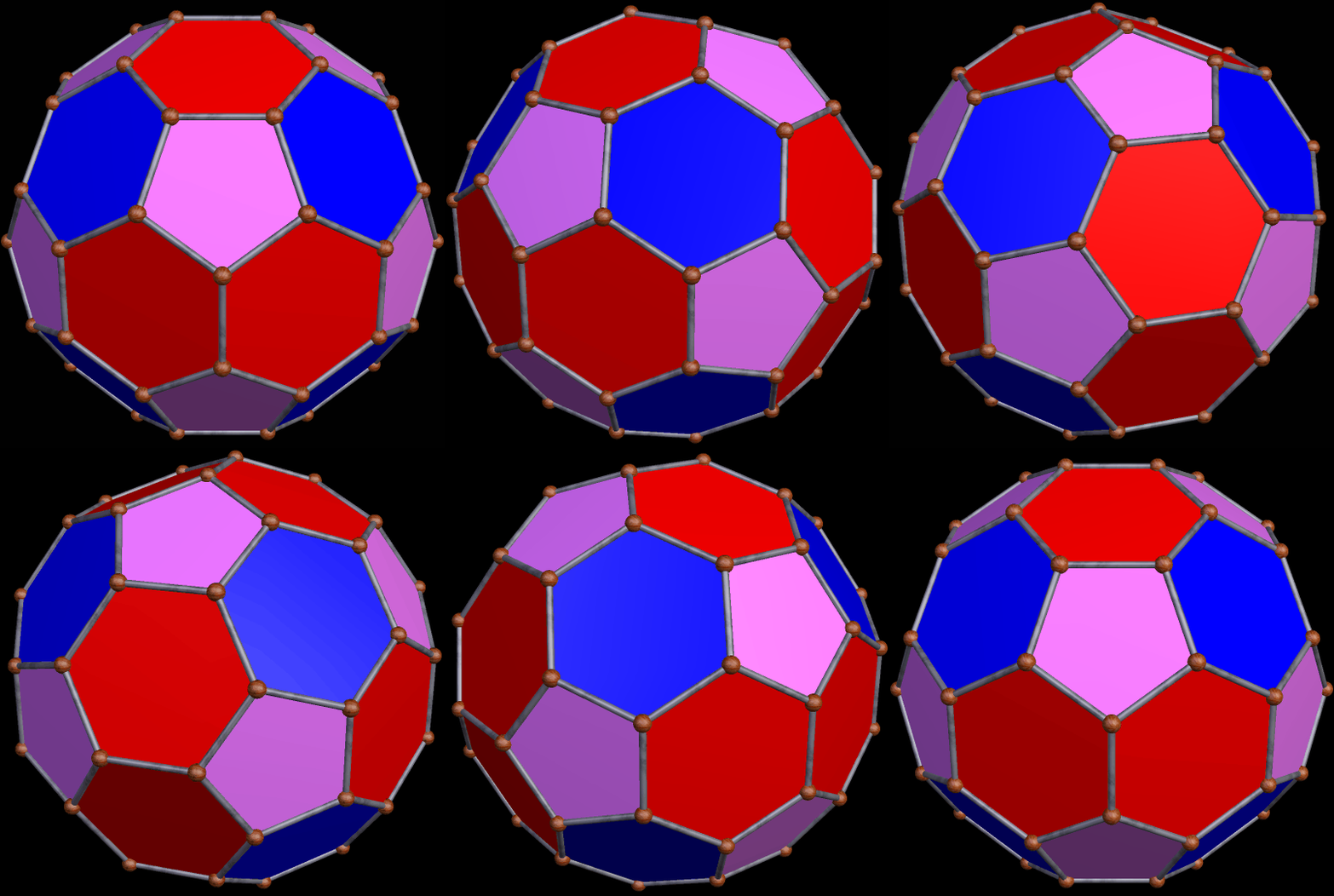
pyritohedral coloring of the truncated icosahedron

While the polyhedron above, informally known as the “soccer ball,” has icosidodecahedral symmetry, its coloring-scheme does not. Instead, I colored the faces in such a way that the coloring-scheme has pyritohedral symmetry — the symmetry of a standard volleyball. This rotating image was made with Stella 4d, a program you can buy, or try for free, right here: http://www.software3d.com/Stella.php.

My Centripetal Force Joke: A True Story

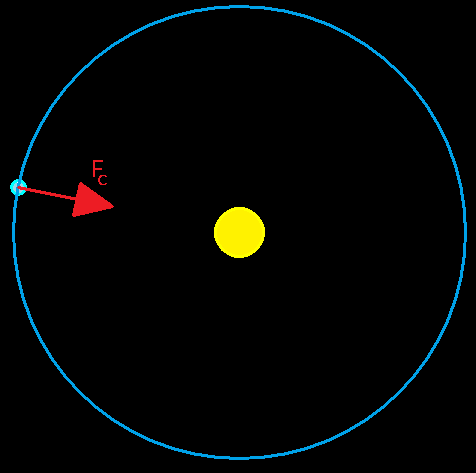
orbit

In the Summer of 2014, with many other science teachers, I took a four-day-long A.P. Physics training session, which was definitely a valuable experience, for me, as a teacher. On the last day of this training, though, in the late afternoon, as the trainer and trainees were winding things up, some of us, including me, started getting a little silly. Physics teachers, of course, have their own version of silly behavior. Here’s what happened.

The trainer: “Let’s see how well you understand the different forces which can serve as centripetal forces, in different situations. When I twirl a ball, on a string, in a horizontal circle, what is the centripetal force?”

The class of trainees, in unison: “Tension!”

Trainer: “In the Bohr model of a hydrogen atom, the force keeping the electron traveling in a circle around the proton is the . . . ?”

Class: “Electromagnetic force!”

Trainer: “What force serves as the centripetal force keeping the Earth in orbit around the Sun?”

Me, loudly, before any of my classmates could answer: “God’s will!”

I was, remember, surrounded by physics teachers. It took the trainer several minutes to restore order, after that.