Explaining China, Part III: Basic International Etiquette Involving the Chinese, as well as their Korean and Japanese “Neighbors,” and Americans


Multiple East Asian nations are discussed in this post, the third of a series which began here, and is usually focused only on China, and the Han Chinese. Those nations are The People’s Republic of China (the PRC); Taiwan, officially known as the Republic of China (ROC); North Korea; South Korea; and Japan. Many Americans, when they see a person whom they think is from East Asia (based on appearance), will simply guess — and sometimes they go even further, and guess out loud. This is usually not intentional rudeness, but it is a socially-dangerous breach of etiquette, made all the more serious if a spoken guess is an incorrect one. The reasons for this are complex, involving such things as tense relationships between ethnic groups and historical atrocities. The etiquette-based solution to avoid walking into a metaphorical minefield, once understood, is a simple set of principles. If you simply want to look for the principles, and skip the explanation of how I learned these things, and why they make sense, simply look for the red, centered text.

1. Listen carefully, before and after talking.

2. Silence is seldom considered rude.

s-l500

3. Every interaction (as might happen playing the game above) is an opportunity to learn.

The board and stones above will be recognized, as the game of go, by many people around the world. Go is the national game of Japan. Although I would never say this if I were in Japan, this game originated in China. The Chinese call it weiqi (pronounced “way-chee”), and the Japanese call it igo (this word sounds like the English word “ego”). Japan introduced this game to the Western world, which is why its English name is similar to the Japanese, rather than the Chinese, name. However, I did not learn this game from a Chinese nor a Japanese person, so, when in the presence of this teacher (who taught me taekwondo as well), I had to remember to call the game baduk, its name in Korean.

4. If you must guess about ethnicity, keep your guesses to yourself.

At the time I learned both go and taekwondo, I was a young teenager. The angriest I ever saw this teacher was an occasion where an American adult assumed, out loud, that he was Japanese. Being young, I didn’t put cause and effect together by myself, but it was later explained to me: during World War II, which had ended less than forty years ago at that time, atrocities had been committed by Japanese during World War II in South Korea. My teacher immigrated to the United States from South Korea a generation later, in 1977, and the angriest I ever saw him was in reaction to this blunder by the American who called him Japanese, because of what had happened to his nation during WWII.

There have been many other conflicts between East Asian nations, as well, including China, which was also invaded by Japan. Following WWII (which ended with the USA dropping two atomic bombs on Japanese cities), the Korean War started, which brought China into conflict with both Koreans and the USA. All these conflicts are within living memory, meaning that there are people still alive who remember these things happening. These international conflicts (and earlier ones, of course) are a major reason for inter-ethnic conflict, and few people want to be confused with their historical enemies.

5. An understanding of history can explain much basic etiquette.

Later still, I encountered other ways people can make social blunders of related types. For example, anyone born in the USA is an American citizen, and can be legitimately called an American — and that’s a term to which most American citizens do not object. If the person’s parents came from, say, Taiwan, and they are ethnically of the Han, this creates a situation few Americans understand, for the whole China/Taiwan thing is certainly complex. Under such circumstances, it’s perfectly understandable that one might prefer to be called “American,” rather than having to try to explain exactly which China one’s parents immigrated from. Many Americans, after all, do not even know that two Chinese governments (the PRC’s in Beijing, and the ROC’s in Taipei, both claiming for decades to be the government of all of Greater China) exist. 

However, there is an even better way to refer to individual people — any people, anywhere.

6. When possible, use people’s names and/or titles, expressed politely, and pronounced correctly.

With my taekwondo and baduk teacher, for example, it was seldom necessary to call him anything other than “Mr. Lee,” or simply, “sir.” I knew he was Korean, and from South Korea, but that was seldom discussed. I learned much by simply paying attention to him, and he taught me a lot. Later, I learned things about Japan, mostly from exposure to, and conversation with, Japanese people. Still later, I began learning about China (both the PRC and the ROC) and the Han, and found that my best sources of information were — no surprise — people of the Han, themselves.

7. For more detailed advice on etiquette, seek insider sources.

This means that, if you’re preparing to visit mainland China (the PRC), and want advice to avoid social blunders there, you’ll get your best information from those who have lived in the PRC. Similar principles apply to other places, such as my learning elements of Korean etiquette from a Korean. With people who are currently located in the PRC, though, one must carefully stay on topic, and there is one topic which must be avoided.

8. To avoid putting them in danger from their own government, do not discuss political issues with anyone located in the People’s Republic of China.

This would also apply to North Korea (formally: the Democratic People’s Republic of Korea, or DPRK), but that is far less likely to come up, simply because the PRC now encourages foreign tourism there, while the DPRK remains a closed society, as the PRC was during the reign of Chairman Mao. Both of these governments are totalitarian, are perfectly willing to kill their own citizens, and will not tolerate any propaganda (discussing, say, democracy, or human rights, would count as propaganda), except for their own.

Principle #9, below, is essential to understanding anything about these East Asian nations. When I studied East Asian history in graduate school, this was my starting point.

9. China ≠ Japan ≠ Korea.

10. Remember that these are basic principles only, and use #7 to learn more.

It would be a mistake for anyone to take this as a complete list, for it is not.

[Image credit: I found the image of a weiqi/baduk/igo/go set on eBay, right here. It is for sale for the next few weeks.]

Calvin and Hobbes, and Election 2016

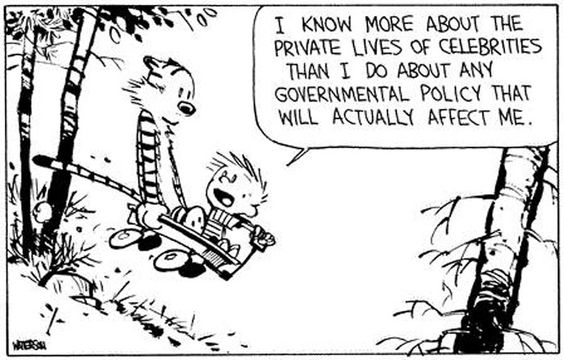
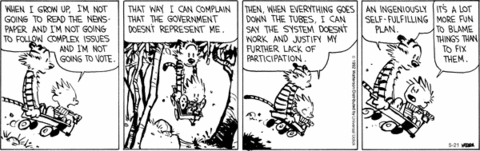
The current American election cycle was predicted, with amazing accuracy, in the late 20th Century, by Bill Watterson, the creator of Calvin and Hobbes. Evidence will follow. We’ll start with ignorance and apathy, both of which are certainly involved in American elections.

900b35f791cce9921b4119d2b3ed2e4c

28141d5022b2012f2fca00163e41dd5b-thumb-480x151-646

Not wanting to vote and not being allowed to vote are, of course, two different things to Calvin.

calvinvote

While he’s being ignorant and apathetic, Calvin is, at least, honest. Honesty is something which we definitely need, and currently do not have, in American politics, from the left or the right.

162943bdf715ffe34d954fafc9d7988b

If only this fictional duo qualified under the Constitution, we’d be facing this choice, which certainly seems better than the choice we actually have:

Watterson understood, well, the corrupting role of money in politics.

megalo

The big issue politicians do not talk about enough is the environment. Why do they not devote more energy to that? Money, of course. The love of money drives people to do harmful and irrational things, and this includes things with obviously-negative environmental impact.

calvin and dryer

He also created numerous cartoons about pollsters and lobbyists, taking them every bit as seriously as these people deserve to be taken.

Calvin-and-Hobbes-Attendance

calvin-hobbes-election-day1

ch_dadpost

polls2

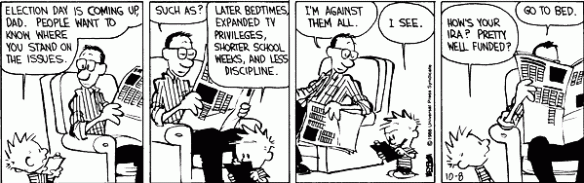
America has a lot of single-issue voters. They are not safe from Watterson’s satire. This cartoon is as on-target today as it was when it first appeared.

41jPq

For what purposes was Calvin willing to do research? Could his spray-painting ambitions include negative campaign ads?

aa7c0e40449f50ef43ad3629bd8401a3

I certainly think so. 

The next cartoon applies equally well, in my opinion, to the words and actions of both Donald Trump and Hillary Clinton.

ch9410131188056052

If the next cartoon doesn’t remind you of the Trump-or-Clinton choice we face, and what an amazing waste of time and energy it is to have to make such an absurd “choice,” please read it again. 

ch110419_thumb[1]

Finally, here’s Calvin’s invention of the perfect bipartisan slogan for this campaign season, and its nausea-inducing choice between bad (Clinton) and worse (Trump).

calvinapathy

“So what?” Indeed.

[To obtain all these cartoons, and many more, I recommend purchasing this boxed set: the complete collection of Calvin and Hobbes.]


SpinStar

Image

spinstar

A Pyritohedral Polyhedron Featuring Only Hexagonal and Rhombic Faces

Zonohedrified Stellated Icosa face-based zonohedron starting with a pyritohedral dodecahedron

Software credit: I used Stella 4d to make this, and you can find that program at http://www.software3d.com/Stella.php, with a free trial download available there.

Hillary Clinton’s Other E-mail Problem

This has nothing to do with those other e-mails tied to Hillary Clinton — the ones which have recently been under official investigation, and in the news. It’s a completely different thing: e-mails sent out by her campaign for the White House, and unrelated to her time as Secretary of State.

Hillary Needs Me

Other e-mails, entirely too much like this, preceded the “I need you” e-mail I received yesterday. I’ve been making fun of them on Facebook for quite some time, but hadn’t brought them to my blog until now. I’m simply using cropped screenshots from my e-mail account for these pictures, and keeping the e-mail senders, subject lines, and dates together, for each e-mail. If anyone wishes to check the authenticity of these e-mails with the Clinton campaign, that’s fine with me. You’ll find that these e-mails are real (or they’ll lie to you; I can’t rule that out). If lies are told, I’ve got the evidence in my e-mail account, as do many others. This is not a complete set, either; it’s just the most recent of these, um, strange e-mails from her campaign minions. 

Hillary Needs Me 2

I don’t know how I got on Hillary Clinton’s presidential-campaign e-mail list, but I am not complaining about it. If I wasn’t on her campaign’s list, after all, I wouldn’t know that all these e-mails are going out, with her name (and sometimes others, as seen above) as the sender, and such things as “re: last night” in the subject line. That would deprive me of this opportunity to use real campaign materials to ridicule a major-party presidential candidate, or, in other words, prevent this particular bit of fun. There were other such e-mails before June 29 — long before, actually — but this is all of this kind of thing I can stand to put on my blog.

To Hillary Clinton (the person, not her campaign staff): Really, H.C.? Do you not monitor your campaign flunkies at all? These e-mails could bring new meaning to the term “madame president,” and I really don’t think they will help you at the ballot box, either.

To Donald Trump, and his ilk: don’t think this means I support you. I don’t.

For whom will I cast my vote, some may wonder? Well, I have it narrowed down to two candidates, but neither of their names appear in this post. For more information regarding where my vote will go, simply click here.

Three Polyhedra Which Resemble Caltrops

Caltrops, when resting on a horizontal surface, have a sharp, narrow point sticking straight up. Stepping on such objects is painful. Most polyhedra do not have such a shape; the most well-known example of an exception to this is the tetrahedron. This fact is well-known to many players of role-playing games, who often use the term “d4” for tetrahedral dice, and who usually try to avoid stepping on them. Here are some other polyhedra which resemble caltrops. All were made using Stella 4d, software available at this website. The first two images may be made larger by simply clicking on them.

The third example, made with the same program, varies this idea somewhat: in physical form, resting on a floor, this caltrop-polyhedron would have three, not just one, potentially foot-damaging “spikes” sticking straight up.

12-pointed caltrop


A Mathematical Model for Human Intelligence

Curiosity and Intelligence

People have been trying to figure out what intelligence is, and how it differs from person to person, for centuries. Much has been written on the subject, and some of this work has helped people. Unfortunately, much harm has been done as well. Consider, for example, the harm that has been done by those who have had such work tainted by racism, sexism, or some other form of “us and them” thinking. This model is an attempt to eliminate such extraneous factors, and focus on the essence of intelligence. It is necessary to start, therefore, with a clean slate (to the extent possible), and then try to figure out how intelligence works, which must begin with an analysis of what it is.

If two people have the same age — five years old, say — and a battery of tests have been thrown at them to see how much they know (the amount of knowledge at that age), on a wide variety of subjects, person A (represented by the blue curve) may be found to know more, at that age, than person B (represented by the red curve). At that age, one could argue that person A is smarter than person B. Young ages are found on the left side of the graph above, and the two people get older, over their lifespans, as the curves move toward the right side of the graph.

What causes person A to know more than person B, at that age? There can be numerous factors in play, but few will be determined by any conscious choices these two people made over their first five years of life. Person B, for example, might have been affected by toxic substances in utero, while person A had no such disadvantage. On the other hand, person A might simply have been encouraged by his or her parents to learn things, while person B suffered from parental neglect. At age five, schools are not yet likely to have had as much of an impact as other factors.

An important part of this model is the recognition that people change over time. Our circumstances change. Illnesses may come and go. Families move. Wars happen. Suppose that, during the next year, person B is lucky enough to get to enroll in a high-quality school, some distance from the area where these two people live. Person B, simply because he or she is human, does possess curiosity, and curiosity is the key to this model. Despite person B‘s slow start with learning, being in an environment where learning is encouraged works. This person begins to acquire knowledge at a faster rate. On the graph, this is represented by the red curve’s slope increasing. This person is now gaining knowledge at a much faster rate than before.

In the meantime, what is happening with person A? There could be many reasons why the slope of the blue curve decreases, and this decrease simply indicates that knowledge, for this person, is now being gained at a slower rate than before. It is tempting to leap to the assumption that person A is now going to a “bad” school, with teachers who, at best, encourage rote memorization, rather than actual understanding of anything. Could this explain the change in slope? Yes, it could, but so could many other factors. It is undeniable that teachers have an influence on learning, but teacher quality (however it is determined, which is no easy task) is only one factor among many. Encouraging the “blame the teacher” game is not the goal of this model; there are already plenty of others doing that.

Perhaps person A became ill, suffered a high fever, and sustained brain damage as a result. Perhaps he or she is suddenly orphaned, therefore losing a previous, positive influence. There are many other possible factors which could explain this child’s sudden decrease of slope of the blue “learning curve” shown above; our species has shown a talent for inventing horrible things to do to, well, our species. Among the worst of the nightmare scenarios is that, while person B is learning things, at a distant school, the area where person A still lives is plunged into civil war, and/or a genocide-attempt is launched against the ethnic group which person A belongs to, as the result of nothing more than an accident of birth, and the bigotry of others. Later in life, on the graph above, the two curves intersect; beyond that point, person B knows more than person A, despite person B‘s slow start.  To give credit, or blame, to either of these people for this reversal would clearly be, at best, a severely incomplete approach.

At some point, of course, some people take the initiative to begin learning things on their own, becoming autodidacts, with high-slope learning curves. In other words, some people assume personal responsibility for their own learning. Most people do not. Few would be willing to pass such judgment on a child who is five or six years old, but what about a college student? What about a high school senior? What about children who have just turned thirteen years old? For that matter, what about someone my age, which is, as of this writing, 48? It seems that, the older a person is, the more likely we are to apply this “personal responsibility for learning” idea. Especially with adults, the human tendency to apply this idea to individuals may have beneficial results. That does not, however, guarantee that this idea is actually correct.

I must stop analyzing the graph above for now, because the best person for me to examine, at this point, in detail, is not on the graph above. He is, however the person I know better than anyone else: myself. I’ve been me now for over 48 years, and have been “doing math problems for fun” (as my blog’s header-cartoon puts it) for as long as I can remember. This is unusual, but, if I’m honest, I have to admit that there are inescapable and severe limits on the degree to which I can make a valid claim that I deserve credit for any of this. I did not select my parents, nor did I ask either of them to give me stacks of books about mathematics, as well as the mathematical sciences. They simply noticed that, when still young, I was curious about certain things, and provided me with resources I could use to start learning, early, at a rapid rate . . . and then I made this a habit, for, to me, learning is fun, if (and only if) the learning is in a field I find interesting. I had absolutely nothing to do with creating this situation. My parents had the money to buy those math books; not all children are as fortunate in this respect. Later still, I had the opportunity to attend an excellent high school, with an award-winning teacher of both chemistry and physics. To put it bluntly, I lucked out. As Sam Harris, the neuroscientist, has written, “You cannot make your own luck.”

At no point in my life have I managed to learn how to create my own luck, although I have certainly tried, so I have now reached the point where I must admit that, in this respect, Sam Harris is correct. For example, I am in college, again, working on a second master’s degree, but this would not be the case without many key factors simply falling into place. I didn’t create the Internet, and my coursework is being done on-line. I did not choose to be born in a nation with federal student loan programs, and such student loans are paying my tuition. I did not create the university I am attending, nor did I place professors there whose knowledge exceeds my own, regarding many things, thus creating a situation where I can learn from them. I did not choose to have Asperger’s Syndrome, especially not in a form which has given me many advantages, given that my “special interests” lie in mathematics and the mathematical sciences, which are the primary subjects I have taught, throughout my career as a high school teacher. The fact that I wish to be honest compels me to admit that I cannot take credit for any of this — not even the fact that I wish to be honest. I simply observed that lies create bad situations, especially when they are discovered, and so I began to try to avoid the negative consequences of lying, by breaking myself of that unhelpful habit. 

The best we can do, in my opinion, is try to figure out what is really going on in various situations, and discern which factors help people learn at a faster rate, then try to increase the number of people influenced by these helpful factors, rather than harmful ones. To return to the graph above, we will improve the quality of life, for everyone, if we can figure out ways to increase the slope of people’s learning-curves. That slope could be called the learning coefficient, and it is simply the degree to which a person’s knowledge is changing over time, at any given point along that person’s learning-curve. This learning coefficient can change for anyone, at any age, for numerous reasons, a few of which were already described above. Learning coefficients therefore vary from person to person, and also within each person, at different times in an individual’s lifetime. This frequently-heard term “lifelong learning” translates, on such graphs, to keeping learning coefficients high throughout our lives. The blue and red curves on the graph above change slope only early in life, but such changes can, of course, occur at other ages, as well.

It is helpful to understand what factors can affect learning coefficients. Such factors include people’s families, health, schools and teachers, curiosity, opportunities (or lack thereof), wealth and income, government laws and policies, war and/or peace, and, of course, luck, often in the form of accidents of birth. Genetic factors, also, will be placed on this list by many people. I am not comfortable with such DNA-based arguments, and am not including them on this list, for that reason, but I am also willing to admit that this may be an error on my part. This is, of course, a partial list; anyone reading this is welcome to suggest other possible factors, as comments on this post. 

If You Really Want to Scare Me, Don’t Use Thirteen.

House_Thirteen

I was alerted today, by e-mail, that a blog-proofreading service has found thirteen whole errors on my blog, and they’ll tell me where they are, exactly, if I send them money.

This blog is four years old. It has over 1,300 posts on it, so that’s, um, an average of one error for every 100+ posts. The logical thing to do, I believe, is to keep doing my own proofreading, which I do every time I look at posts, old or new.

I do hope those 13 errors are not disturbing anyone else, though.

Upon re-reading the e-mail, I found three errors. That’s in one e-mail. I’m definitely keeping my money!

Explaining China, Part II: What Do I Know, About China, and How Did I Learn It?

PRC and ROC and Barbarian Nations

In the map above, the People’s Republic of China (PRC) is shown in red, while the Republic of China (ROC) is shown in yellow. “Barbarian” nations (from the point of view of the Han, or the ethnic group we call “Chinese” in English) are shown in orange, and both oceans and large lakes are shown in blue. The third (and only other) majority-Han nation, the island city-state called Singapore, is not shown on this map, as it is too far to the South to be seen here. From the point of view of the Han, “barbarians” have been, historically, those humans who were not Han, while “the Han” can be translated as “the people.”

This historical xenophobia I just described among the Han is hardly unique; it is, in my opinion, simply human nature. The British rock band Pink Floyd explained this, quite well, in the following song, “Us and Them,” from 1973’s classic Dark Side of the Moon. This album, in the form of a cassette tape which had to be purchased by my parents (for I would not let go of it in the store we were in), happens to be the first musical album I actually owned, back when it was newly-released (I was born in 1968). If you choose to listen to this song, please consider this idea of xenophobia, as simply being a human characteristic, while it plays.

Ancient Greeks had the same “us and them” attitude about those who did not speak Greek, and the English word “barbarian” is derived from Greek, with a meaning which parallels what I have described in China. Eurocentrism, in general, in the study of “world history,” is well-known. Moving to another continent, the people where I live, the USA, are famous for learning geography one nation at a time . . . as we go to war with them, of course. Only a tiny percentage of Americans knew where either Korea was located until we went to war there, and we (as a people) did not know where Vietnam was until we went to war there. More recently, Americans learned — twice! — where Iraq is, though many of us still, inexplicably, confuse it with Iran. This list of xenophobic nations is far from complete, but these examples are sufficient to make the point.

When, in 1939, British Prime Minister Winston Churchill uttered the famous phrase, “It is a riddle, wrapped in a mystery, inside an enigma,” he was referring to the Soviet Union (or USSR), although the proper noun he actually used was “Russia.” However, this quotation applies equally well to the PRC, which has one indisputable advantage over the USSR: the People’s Republic of China still exists, while the Soviet Union does not. In the last post here, I began an ambitious series, with the goal of explaining China. I promised, then, that my next post in the series would explain my qualifications to write on the subject of the PRC, the ROC, Greater China, and the Han — so that’s what I need to do now.

I am currently working on my second master’s degree, in an unrelated field (gifted, talented, and creative education). However, my first master’s degree was obtained in 1996, when Deng Xiaoping, while no longer the PRC’s “paramount leader,” was still seen as its most prominent retired elder statesman. It was Deng Xiaoping, primarily, who made (and defended) the decision to send the tanks in, and crush the pro-democracy demonstrators in Tiananmen Square, in Beijing, in June of 1989, which I watched as they happened, on live TV. I was horrified by those events, and this has not changed.

During the early 1990s, I began studying the economic reforms which made the era of Deng Xiaoping so different from Chairman Mao’s China, trying to figure out the solution to a big puzzle: how so much economic growth could be coming from an area dominated by a huge, totalitarian, country which, at that time and now, was one of the few remaining nations on Earth which still claimed to be Communist. This study was done during the time of the “New Asia” investment bubble, as it was called after it “popped” (as all investment bubbles do, sooner or later). New Asia’s economic growth was led by the “Four Tigers” of Hong Kong (still a British colony, at that time), Singapore, Taiwan, and South Korea. South Korea is, of course, Korean, but the other three “tigers,” all had, and still have, majority-Han populations. What money I had, I invested in the Four Tigers, and I made significant profits doing so, which, in turn, led to a general interest in East Asia. 

Motivated by simple human avarice, I studied the Four Tigers intensely, leading me to focus (to the extent made possible by the course offerings) on 20th Century East Asian history, during the coursework for my first master’s degree. There was a problem with this, though, and I was unaware of it at the time. My university (a different one than the one I attend now) had only one East Asian history professor, and he was very much a Sinophile. Sinophiles love China uncritically, or with the minimal amount of criticism they can get away with. When we studied the rise to power of Mao Zedong, and the PRC under the thumb of Chairman Mao, I heard it explained by a man who viewed China, and Chairman Mao, through rose-colored glasses, even while teaching about others who made the same error, to an even greater degree. I had already read one book about the Cultural Revolution, earlier in the 1980s, so I was skeptical, but he was also my only professor. The result was confusion. This was the book I had already read, along with a link to a page on Amazon where you can purchase it, and easily find and purchase the Pink Floyd music posted earlier, if you wish to do so. This is Son of the Revolution, by Liang Heng and Judith Shapiro, and you can buy it at https://www.amazon.com/Son-Revolution-Liang-Heng/dp/0394722744/ref=sr_1_1?ie=UTF8&qid=1468869380&sr=8-1&keywords=son+of+the+revolution.

Son of the Revolution

This book was read for an undergraduate sociology course, at my first college, during the Reagan years. The important thing to know about Liang Heng, the book’s primary author, is that he was, himself, of the Han, as well as being from the PRC itself. The professor for this course wanted us to see the horror of a mass movement gone horribly wrong, and she chose this insider’s view of the Cultural Revolution, during which I was born, to do that. What I heard from my East Asian history professor did not mesh well with what I was taught by my East Asian history professor, and so I left that degree program confused. This professor’s argument, in a nutshell, was Chairman Mao was a figure of tremendous importance (true) who had good intentions (false), and tried to do amazing things (half-true, and half-false by omission, for these were amazing and horribly evil things), but had them turn out wrong (true), with many millions of his own people dying as a result, over and over (definitely true; Mao’s total death total exceeds that of Hitler or Stalin, either one). The “good intentions” part was what confused me, of course, for Mao was a monster, yet, from my later professor, I was hearing him described as a Great and Important Man.

I would have remained in this confused state, has I not also read this book, also written, primarily, by a person of the Han: the amazing Jung Chang, who has her own page on Amazon, at http://www.amazon.com/Jung-Chang/e/B00N3U50ZO/ref=sr_tc_2_0?qid=1468870698&sr=8-2-ent. (On that page, I notice she has a newer book out, which I have not read, and she is such a fantastic author that I am buying it now.) This, by contrast, was her first well-known book, and the one I read as an undergraduate:

wild swans

Wild Swans tells the story of three generations of Han women: Jung Chang’s maternal grandmother (who had bound feet, and could barely walk, for that reason), then the author’s mother, and then finally Jung Chang herself, who found herself a Red Guard during the Cultural Revolution at the age of 14. This book tells their story, and is riveting. It has nothing nice to say about Chairman Mao, and contains much criticism of “The Great Helmsman,” as his cult of personality enthusiastically called him, yet he is not the focus of Wild Swans. The author’s family, over three generations, is.

I did my master’s degree work from the Sinophile professor described earlier, and then, later on still, I encountered Sinophobes. The opposite of Sinophiles, people who have Sinophobia have nothing nice to say about China, nor the Han. They hate and fear things Chinese because they fear the unknown — in other words, Sinophobia is a more specific form of xenophobia. 

So, first, I read Liang Heng, and then, later, I started reading Jung Chang. Next, I heard the Maoist viewpoint explained quite thoroughly by my Sinophile professor, while my reading of Liang Heng and Jung Chang had exposed me to an anti-Mao, but non-Sinophobic, point of view, which is a direct consequence of the fact that both authors were actually of the Han, and had direct exposure to Maoism. Later came the Sinophobes, and their written and spoken, anti-Chinese, case for . . . whatever. (Actually, the Sinophobes never make a case for anything, unless one counts hating and fearing China and the Han as being “for” something. I do not.) Later still, one of my close friends studied ancient Chinese history and philosophy extensively, and we had (and still have) many talks about both ancient and modern China, including Chairman Mao, and the silliness of the Sinophobes, but this friend is more interested in talking about, say, Confucianism, rather than Maoism, or Mao himself. I was primed to learn the truth about Mao, but had to wait for the right opportunity.

Think about this, please. How many books have been written that accurately describe Stalin as a monster? How many exist about Hitler? I should not have had to wait so long to find out something about Mao I felt I could believe, and that described him as the monster he was, but wait I did, for no such book existed . . . until Jung Chang came to my rescue, with her next book, after 1991’s Wild Swans. All 800+ pages of it.

mao the unknown story

It took her many years to write this tome, and it was published in 2005. She grew up under Mao, having been born in 1952, not long after the revolution of 1949, which established the People’s Republic of China. Chairman Mao finally died in 1976. Two years after that, Jung Chang was sent to Great Britain as a college student, on a government scholarship. Being highly intelligent, and not wanting to return to China, she went on to become the first of the Han to receive a Ph.D. at any British university. This book, focused on Mao’s formative years, rise to power, and tyrannical rule, all the way to his death, is, as its subtitle states, “The Unknown Story” of this historical period. Jung Chang was uniquely qualified to write this story, having lived through so much of the events described in her book. She knew how expendable people were to Mao, having witnessed it, and survived. To the extent possible (and she was quite resourceful on this point) she used primary sources. This is why I give her much credibility. 

These are the ways I have learned about China: from three books by two of the Han, long talks with a personal friend, and two college professors with different points of view on China, and Mao in particular. I have rejected the points of view of both the Sinophiles and the Sinophobes, and now I try to learn what I can from other sources, especially sources who are, themselves, of the Han — although I am weakened in this respect by the fact that I am only bilingual, with my two languages being mathematics and English, in that order. If you think this approach makes sense, I hope you will read my other posts, past and future, about China and the Han.

Explaining China, Part I: The Scope of This Series, Which Includes the PRC, the ROC, the Han, and Greater China

China and environs

I’m bringing a new topic to my blog. I’m going to attempt to explain things about China, the largest nation in which the Han (that’s the way to write, in English, the Chinese name for the Chinese people, as an ethnic group) form the majority, as well as the largest nation on Earth, by population. The map above comes from this website. If you’re wondering why, in the map above, Taiwan is the same color as the People’s Republic of China, this series of blog-posts is definitely for you. In a future post, I will deal with the historical reasons for the China/Taiwan puzzle, and the current state of that interesting situation. (“May you live in interesting times” is not a nice thing to say directly to any of the Han, by the way, no matter where they live. It is considered by many people to be part of an ancient Chinese curse, although the veracity of this claim is disputed — a topic for another post, later in this series.)

If you find China, Taiwan, puzzles in general, mysteries which are not fictional, history, current events, and/or the Han to be interesting topics, then this irregularly-published series of blog-posts is for you. If you aren’t interested in any of those topics, my assumption is that you wouldn’t have read this far, anyway. To those who miss the other topics about which I blog, don’t worry: posts in this series will not be the only topic I blog about, by any means, for the fact that I am interested in many things, and blog on many topics, is not going to change.

The People’s Republic of China is also known as mainland China, Red China, the PRC, Communist China, or simply “China.” The government of the PRC is often referred to simply as “Beijing,” the city which is the capital of the PRC. Taiwan, by contrast, is officially known as the Republic of China, or the ROC, or even, by some people, “Taiwan, China” (a term I tend not to use). The ROC’s government can be referred to as “Taipei,” the ROC’s capital, to distinguish it from the government in Beijing. My preferred way to refer to the nation-state which is actually under the control of the Beijing government is to call it the PRC, and I use ROC, often, to refer to the nation-state actually under the control of the Taipei government, which most people call Taiwan, a term I also use. When I only write “China,” I mean the PRC. I also use the term “Greater China,” which is explained below.

The Han are in the majority in both the PRC and the ROC, and these two regions are collectively known as “Greater China,” which sounds like, and in some ways actually is, one nation with two governments, since both governments claim to be the only legitimate government of the nation which is all of Greater China (and, yes, that is confusing, along with “China Proper” on the map above). All of these topics: the nations, governments, regions, and people, are mysteries for most people on Earth — and topics for future posts in this series.

I am not of the Han. I do not speak, read, nor write any variety of the Chinese language. Also, I have yet to visit any part of Greater China. By contrast, I am known as a teacher of both science and mathematics, as someone who does “math problems for fun” (as my blog’s heading-cartoon, which I did not write, puts it), as well as a blogger on many topics that have previously had little to do with China, until this post, from yesterday, which analyzed current events worldwide, starting with recent developments in China. I do not want anyone to think I just started studying China yesterday, for that would not be correct. I do feel that I owe anyone who has read this far an explanation for exactly one thing: why should anyone care what I have to say on these subjects? I will explain that in Part II of this ongoing series . . . and tackling the PRC/ROC puzzle will be coming later, as will other topics.