Why Is Arkansas Political Geography Such a Mess?

Image

Why Is Arkansan Political Geography Such a Mess?

Technically, we live within the city limits of North Little Rock, but we’re surrounded by Maumelle, and also live in the Pulaski County Special School District, not the North Little Rock School District. Telling people we live in NLR causes confusion, so we say “Maumelle” instead, but mail won’t reach us unless it includes “North Little Rock” in the address. What’s more, that’s all in one county, Pulaski, near the center of the state.

The weirdness doesn’t stop there. Nearby is a city named Conway. I went to college there. It isn’t located in Conway County, though; that’s further West.

Head Southwest on I-30 from Little Rock, and you’ll soon encounter Benton (not in Benton County, although at least Bentonville is), and then get a chance to take an exit to go visit Hot Springs — but you won’t find it in Hot Spring County. Van Buren is right next to Oklahoma, and a long drive from Van Buren County. Is the City of Jacksonville to be found in Jackson County? Of course not — not in this state. Boonville, similarly, is not located in Boone County.

We have a Mississippi County here, and it borders two other states. We also have a long border with the state of Mississippi. However, Mississippi County, Arkansas isn’t one of several counties which do border the State of Mississippi. Instead, it borders Tennessee and Missouri.

Even things which seem intuitively obvious about my state’s political geography end up being wrong. Ask someone familiar with a U.S. map which state(s) you can find South of Arkansas, and they’ll almost certainly answer with Louisiana, perhaps including Texas, as well. However, the states of Oklahoma, Missouri, Tennessee, and Mississippi also include land that is South of carefully-chosen points in Arkansas. Here’s visual proof, which you can enlarge with a click:

arinus

Yes, all six states which border Arkansas are technically South of us, in a sense.

Perhaps the strangest thing about Arkansan political geography is that the town of Lonoke is actually in Lonoke County. It’s even their county seat. What are they trying to do there, confuse people?
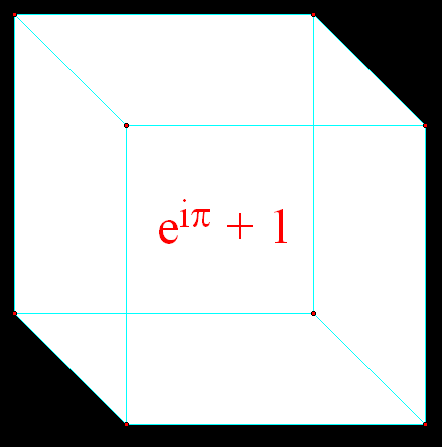
A Box, with Nothing In It

Image

A Box, with Nothing In It

Get it?

Which State Is South of Arkansas?

Image

Which State Is South of Arkansas?

This really happened, in a geography class I took, long ago, in an Arkansas elementary school.

Teacher: “Which state is south of Arkansas?”

Me: “There are six: Oklahoma, Missouri, Tennessee, Mississippi, Louisiana, and Texas.”

Teacher: “No, Robert, that’s wrong.”

Me: “No, YOU’RE wrong. I’m right, and I’ll prove it.” I then got up, walked to the large classroom map of Arkansas, and ran my finger downwards on the map, six times, along the arrows you see above, while shouting, “South! South! South! South! South! South!” It’s true: from some point in Arkansas, you can travel, due South, into some part of any of the six adjacent states.

The teacher called my mother. Her response? “What’s the problem? He was RIGHT, wasn’t he?”

The Erdős-Bacon Number

Image

What do Carl Sagan, Richard Feynman, and Natalie Portman have in common?

They all have the same Erdős-Bacon number:  six.

Natalie Portman collaborated (as Natalie Hershlag) with Abigail A. Baird, who wrote mathematical papers in a further collaborative path which leads to Joseph Gillis. Gillis, having co-written a paper with Paul Erdős himself, has an Erdős number of one. This gives Portman an Erdös number of five. Bacon and Portman both appear a movie (which one?  See the details in this Wikipedia article: http://en.wikipedia.org/wiki/Erd%C5%91s%E2%80%93Bacon_number), which gives Portman a Bacon number of one.

The Erdős-Bacon number is simply the sum of these two numbers — hence Natalie Portman’s six:  five plus one.

Feynman’s and Sagan’s sixes are more balanced. Richard Feynman’s is the most so, since his Erdős and Bacon numbers are both three.

I haven’t been able to determine who first thought of an Erdős-Bacon number, but . . . wow. It came from the blogosphere (Where else?) — Wikipedia reveals that much.

Some blogger might be obsessive enough, someday, to exhaustively determine exactly how many people even have such numbers. However, that person will not be me.

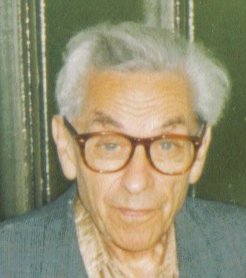
Meet Paul Erdős

Image

Meet Paul Erdös

As was written in The New York Times when his biography, The Man Who Loved Only Numbers, was reviewed (1998), Paul “Erdős (pronounced “air-dish”) structured his life to maximize the amount of time he had for mathematics. He had no wife or children, no job, no hobbies, not even a home, to tie him down.”

This was during most of the Cold War between, at the forefront of each side, swaggering mightily like something straight out of a comic book, the USA and the USSR. Except … this wasn’t a comic book. You really could die. Younger people don’t really know what this is like, for the simple reason that the threat of imminent. sudden extinction hasn’t been present since the Cold War ended. The world faces disasters, of course, but a sudden one, greater than the large-city scale, is unlikely in the extreme — now.

Erdős had little regard for Uncle Sam (that’s the United States), nor Uncle Joe (the Soviet Union, with “Joe” being a caricature of Josef Stalin), but he did enjoy clever ridicule, so he heaped contempt, publicly, on both sides, during the Cold War. He wasn’t a big fan of the S.F., either (that’s Supreme Fascist — of the Universe. Guess who. Yep. That’s the guy. Why is God always a guy?)

Erdős just wanted to do math, and this native of Hungary simply dismissed all else. Mathematicians need other mathematicians to talk to, for they are already crazy, in very specific and sometimes unintentionally useful ways, and need other people also so afflicted to talk to, lest they torment the uninterested with mathbabble. That is only one way of looking at it, of course, as people have explained to me about my own mathbabble, which is insufficiently advanced to allow me to comprehend that of Erdős himself.

Life was viewed differently by Erdős, and I do not mean in any way that would seem “normal” to any mathematics professor you might have met (feel free to ask them). If you worked on proving theorems, solving problems, proving certain problems can’t be done — all of which are varied ways of describing the same activity — then you were, to Erdős, “alive.” If you stopped doing mathematics, you “died.” I don’t know what he thought of those who never did mathematics, because he avoided interacting with them. With no home, he could simply get on a plane when all the local mathematicians were exhausted, their brains tired, and he would then go to another continent — there were several available, and he did this for decades — and the local mathematicians would welcome him with open arms, for it was an honor to have Erdős as a guest in one’s home.

Sources, and further reading:

The Man Who Loved Only Numbers: The Story of Paul Erdős and the Search for Mathematical Truth, biography by Paul Hoffman, 1998.

http://www.nytimes.com/books/first/h/hoffman-man.html

http://en.wikipedia.org/wiki/Erdös

More Erdős vocabulary:
“Women” were “bosses,” with “men” translating as “slaves,” in Erdős’s unique language of his own invention. Children were “epsilons,” and if you laughed at that, I do hope you are happy with the fact that you, too, are a math nerd. (For the benefit of those who aren’t, “epsilon” is a symbol often used, in mathematics, for variables with very small values.) There’s a lot more — and links to use to help you find it, right up there.

If Recent Trends Continue, Gasoline Will Soon Be Free

Here’s what gas prices have done in the U.S. during the last three months:

Image

The price of gas three months ago was $3.79 per gallon, and now it is $3.27, so, in three months, it dropped 52 cents per gallon.  That’s a rate of -$2.08 per year per gallon, so, if this recent trend continues, gasoline will cost not much more than a dollar a gallon a year from now, and will become free sometime later in 2014. In fact, by the end of 2014 (again, if this trend continues), gasoline will have a negative price, which means they’ll pay us to take the stuff.

Sheryl Crow must have known this day would come, for she wrote a song about gasoline becoming free a few years back, which you can find below (embedded from YouTube) –– a song called, of course, “Gasoline.” Enjoy!

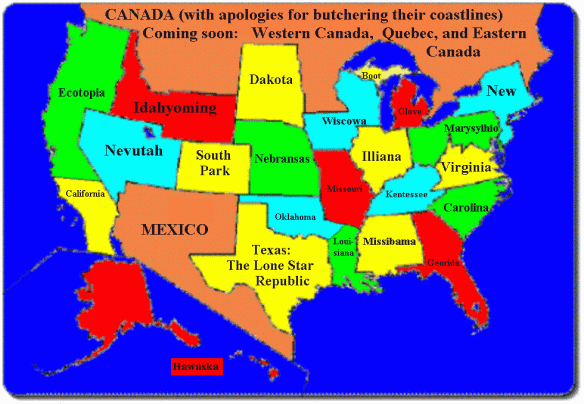
An Alternate Map of the USA

According to this map, I live in Little, Oklahoma.  I work in Rock, Louisiana, not far away. I buy most of my Chinese food (>50% of what I eat) a few kilometers to the North, in the former North Little Rock, now renamed Argenta, Missouri.

It was fun partitioning the state I live in (using the Arkansas River, and “Tornado Alley,” also known as Interstate 30, to do it), and otherwise playing around with the map of the country and continent where I live.

By the way, I actually do believe that if the USA ever falls apart, Soviet-Union-style, Texas really would be the only former state to give itself a subtitle.

The Best Way to Lose a Spelling Bee

bee

In 4th grade, I finished in second place in my school district’s spelling bee. This makes a much better story than winning, because of the word I could not spell correctly. That word was obeid (crap) obiedi (grrrr) obedei (blast it) obeedient that word that means you do as you are told.

My mother’s reaction was great:  “Of course he couldn’t spell it! He doesn’t know what that word means!”