We’re Going Back to School Tomorrow, and I’m the Teacher.

Trunc Icosa

This is my 22nd year teaching. This year, I teach in only one department. This is nice; I’ve spent much of my career in multiple departments, simply because I am certified in multiple subject areas. This year, in my building, I am one of three science teachers. Our high school has become so large that the 9th grade has been “spun off” to a new freshman campus, while remaining part of the high school, and I’m one of the teachers who gets to go to the new campus. This provides my students, my colleagues (especially at the new campus), and myself the opportunity for a fresh start, to a greater degree than is usually the case when a new school year begins.

My students are in just two subjects, this year: Physical Science, and Pre-AP Physical Science. I don’t want the students in the class without the “Pre-AP” prefix to feel that they are in a “lesser” class, in any sense of that word, so I am renaming “Physical Science,” slightly: “High School Physical Science.” It is my hope that this change in wording serves to communicate high expectations, and 9th grade is the first year of high school — which, in the USA’s public school systems, means 9th grade students must pass courses to earn credits toward graduation, usually for the first time.

In the other class, Pre-AP Physical Science, I am teaching that version of the course for the first time, but I feel well-prepared by the extensive training I had this Summer, and last school year, through my university, the school where the Summer training was held, and the College Board. Both classes will challenge students, but it is also true that the two classes will be different, for Pre-AP Physical Science have to leave students prepared to function effectively, later, in other Pre-AP and/or AP science courses. 

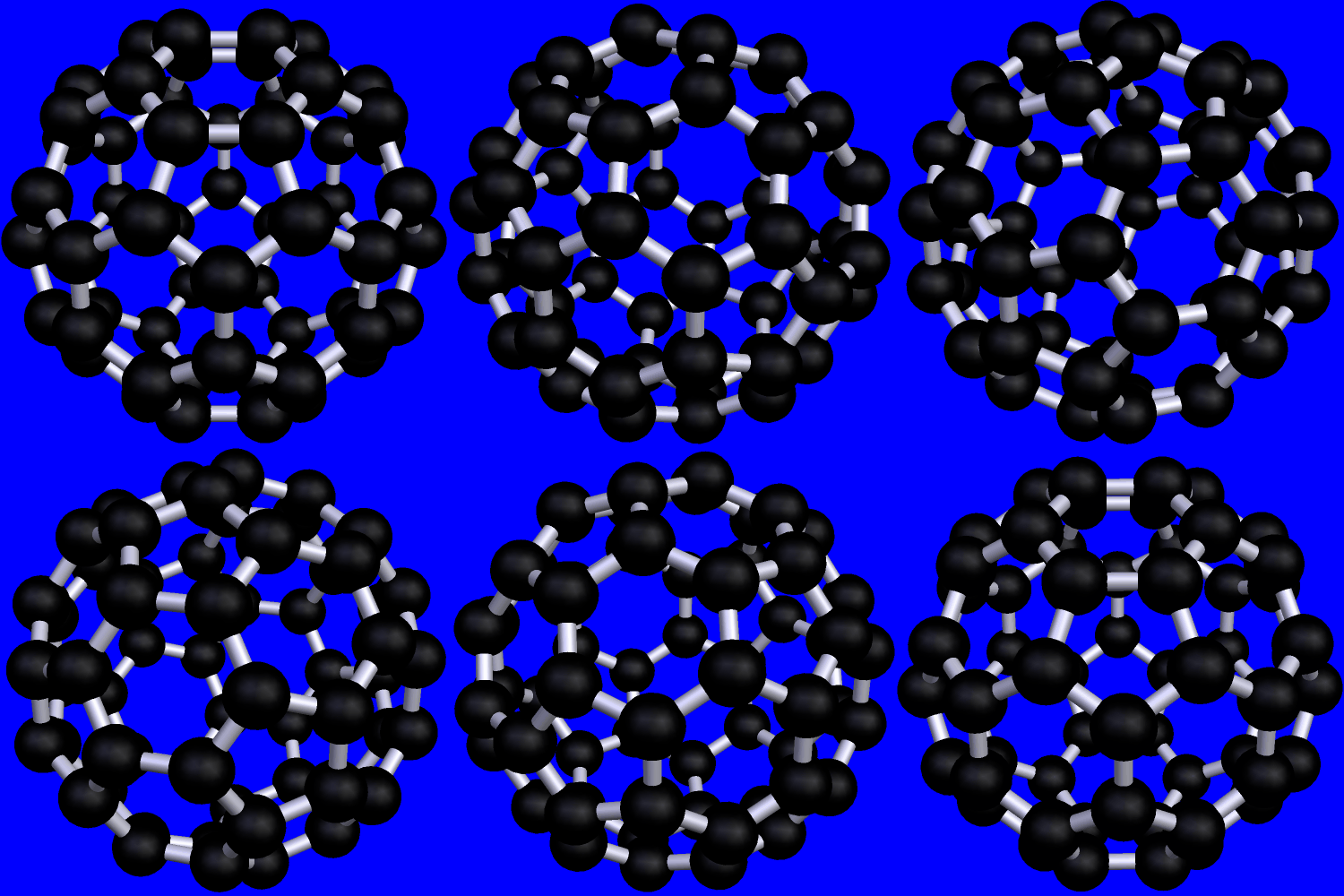
Physical Science is an introduction to two sciences: physics, and then chemistry, at least in my school district. It helps me that I have experience teaching both subjects as higher-level, “stand-alone” classes. In this class (both versions), we also touch on some other sciences which are also physical sciences, such as geology, astronomy, and the science of climate change. However, those sciences do not dominate these courses, as physics and chemistry do. The image above is from chemistry (and was created with Stella 4d, which you can try here), and shows a model of a sixty-atom all-carbon molecule called buckminsterfullerene, one of a class of roughly-spherical carbon allotropes called fullerenes. Mathematicians call this particular fullerene’s shape a “truncated icosahedron,” and, in sports, this same shape is known as the (non-American) “football” or “soccer ball.” Physical modes of this shape may be made with molecular model sets of various kinds, Zometools, and other materials. In both versions of my science classes this year, building models of this molecule will be one of many lab activities we will do; one of my goals this year is for my students to spend a third of their time doing labs. The legal requirement for science class time spent in lab, in my state, is at least one-fifth, so more than that is fine. Science classes helped me learn both science and mathematics, but what I remember the most is the labs. I don’t think that’s just me, either; students learn more effectively, I have observed, by conducting scientific experiments themselves, than by being “lectured at” for extended periods of time.

I’m looking forward to a good year — for all of us.

A Back-to-School Gift for GSAs Everywhere: Simple Internet Memes Explaining the Best Reason to Support Gay Rights

gay rights are human rights

Although I did make these images, they are deliberately copyright-free, and their use by Gay-Straight Alliances, or GSAs, at schools everywhere is encouraged. LGBTQ students have been tormented for far too long. Together, we can make this their best school year to date.

Gay_Rights_Are_Human_Rights

Marriage equality has (finally) been accomplished in the USA, thanks to our Supreme Court. However, suicide rates among gay teens remain extremely high, due to bullying and homophobia, especially in schools, making the work of GSAs (Gay-Straight Alliances) critically important. People should not be treated this way. Recognizing this simple fact supplies all the reason necessary to support gay rights; no argument stands against it.

gay rights are human rights 2

What Is Attempted Orthoism?

attempted orthoism

When the topic of labels for belief systems, life philosophies, and the like comes up, I find that I tend to become uncomfortable with labels which are also used by, well, anyone else. For this reason, I’ve named my own system “attempted orthoism,” which I will now try to explain.

First, I’ll deal with that elephant in the room: the Creator of the Universe, by any name. Does such an entity exist? Well, I simply don’t know, but I also realize that this could change. If there is a deity, and that entity chooses to make evidence of his/her/its existence known to me, I’ll pay attention to the evidence, and see where it leads me. This is, to me, given my present state, the only position that makes sense.

“Ortho-,” as a prefix, can mean “right” (as in a right angle), or “correct,” either one. The suffix “-ism” is used in words such as Catholicism, capitalism, materialism, socialism, Communism, Hinduism, etc. — the “-isms” are simply systems of belief and/or thought. The meaning of “attempted” is obvious, so if you put it all together, here’s what it means: I simply attempt to be correct. Less formally, I try do the right thing, in the various situations I encounter in life.

These are some of the features of attempted orthoism:

  • The desire to hold positions on various issues which are correct.
  • The desire to do the ethical thing in all situations.
  • Honesty. Lies are not helpful in any effort to be correct.
  • The willingness to admit it when I do not know something, once I realize that I do not know it.
  • The refusal to reject the possibility that supernatural entities exist, in the absence of empirical evidence for their non-existence.
  • The inability to embrace a belief in any supernatural entity, as long as no compelling, empirical evidence is found that such a being does exist.
  • Respect of the rights of others peacably disagree, on these or other issues.
  • Maintaining high standards for evidence, and acceptance of principles. This means using and testing hypotheses, reasoning logically, and guarding myself from error with a mental shield: my skepticism. To prove something to me, a mathematical proof would be an excellent approach. If you simply want me to accept that something happens provisionally, until and unless new evidence arises to disprove it, then the scientific method is the way to go. I place a premium on logic, and reasonable arguments.
  • Refusal to accept emotional arguments, or arguments from authority, for the simple reason that such methods so often lead to serious error.
  • Re-testing previously-accepted principles, for we can all fool ourselves better than anyone else.
  • Reservation of the right to question anything and/or anyone.

This is not a complete list. Attempted orthoism is a work in progress.

On Therapeutic Writing, and Putting Hexakaidekaphobia in Remission

hexadeka

When my mother died, last November 16, I wrote an obituary for her, which I was then asked (unexpectedly) to read at her funeral, as one of two eulogies. This was one of the most difficult things I have ever done, but writing it did help me (somewhat) with the immediate problem I was having dealing with grief.

After the funeral, I felt numb much of the time, for months, until May 16 arrived — exactly six months after she died — at which point my tightly-controlled emotional state shattered, leaving me in worse shape (in some ways) than I was on, say, November 17 of last year. This was unexpected, and caused significant problems, including the development of monthly hexakaidekaphobia, a morbid dread and fear of the 16th day of every month. (The word is a modification of “triskaidekaphobia,” an irrational fear of the number thirteen).

June 16 was worse than May 16 — absolutely full of PTSD attacks. (I’ve had PTSD for most of my life; my mother’s death made it worse.) Fortunately, I don’t try to hide mental health problems, as I once did — I try to find the help I need, from physicians, to deal with such problems, and, when I find things that help me, I write about them. I also have long used recreational mathematics to help me feel better when depressed.

It was in this context that mid-July arrived. I went to sleep on July 15th with the knowledge that it was extremely important for me to find better coping mechanisms before the start of school in August. When I woke up on July 16, which could have been another horrific day of severe depression, anxiety, and other problems, I did not feel those negative emotions. This does not mean I had “gotten over” the facts that my mother did die, and that I miss her terribly. However, it did mean I was experiencing grief differently: I was feeling grief, rather than letting feelings of grief control me — and there is a huge difference between the two.

That morning, July 16, I knew what I needed to do as soon as I woke up: I needed to write. For me, that generally means blogging, and that’s what happened. This “therapeutic writing,” as I call it, was helpful enough on July 16 that I continued it the next day. When I next spoke to my doctors, I told them I was doing this, and why, and they agreed that such writing (like the “mathematical therapy” I have done for years) was an excellent, helpful activity. (This “check with professionals” step is essential, and I do not recommend attempting mental health therapy without the help of at least one licensed, qualified psychiatrist, and/or other type of therapist, such as a clinical psychologist.)

Of course, I could do this therapeutic writing in a spiral notebook, and keep it private; no writing has to go on the Internet. Why, then, do I choose to post such material where anyone can see it? I first explained why I blog about mental health issues in this post, but the short version is this: I hope that my openness on this subject can help reduce the social stigma which, unfortunately, still surrounds topics related mental health. This stigma is harmful because it keeps millions of people from seeking the professional help they need. I have also found it a personally liberating experience to come out of the “closet” on such issues, for, as with other metaphorical “closets,” it is the truth that closets are not good places for people to live their lives.

School starts on August 15 — only four days from now — and I’m going to do everything I can to make that day, the next day (the formerly-dreaded 16th of the month), and the rest of the days in the school year as good as they can possibly be for my students, as well as myself. I could tell I was on the right track when I decided to write about monthly hexakaidekaphobia early this morning, but in the past tense. Before I started writing, I “warmed up” by constructing the geometric art at the top of this post, which, if you examine carefully, you will see is based on — what else? — the number sixteen. In my case, at least, mathematical therapy and therapeutic writing go hand-in-hand, and this is what I am doing to try to leave my monthly hexakaidecaphobia in the past, where it belongs.

I still miss my mother. She was once, as I am, a science teacher, and was also involved in education in many other ways. She would want me to have good school days on August 16th, September 16th, and so on, as well as the days in-between — and, to properly honor her memory, and give my students the education they deserve, I am determined to do my best to do exactly that.

My Answers to Facebook’s “Religious Views” and “Political Views” Questions

facebook

I don’t like to use terms I did not make up myself for things as important as questions such as these, and so I don’t. Attempted Orthoism rests on a foundation of skepticism, which is a metaphorical lens I try to apply to everything. Skepticism is, of course, essential for anyone who works in science and/or science education, and I am a science teacher. This is why science plays a role in both definitions above.

A Completely Unscientific Presidential Poll

The school year is about to begin, and I’m a teacher. Right now, my school district is in the traditional “week o’ meetings” which precedes the arrival of students. Yesterday’s meetings were about using Google products to enhance instruction, and one of the new skills I learned involves using Google forms. We were encouraged to make something, such as a poll, using this online tool, so I made one for the current US presidential election. If you would like to vote in this completely unscientific poll, here’s the link:

https://goo.gl/forms/Ki2x7OLyPoQoJviJ2

This poll is “completely unscientific,” of course, because I am making no attempt to poll a representative sample of the electorate. Here’s how the poll results look so far, with 17 responses.

poll results

Just 14 States Choose America’s Next President

14 states decide who the president is

If you live in one of the states shown in gold, congratulations — both the Trump and Clinton campaigns want your vote, for you live in a “battleground” or “toss-up” state, or at least one that only slightly “leans Democrat” in polls, or “leans Republican.” 

The states shown in purple, on the other hand, are taken for granted by one campaign, while the other campaign regards them as “lost causes.” My own state, Arkansas, for example, is solid Trump territory, even though I can’t stand the man. These states don’t offer a competitive race.

In a presidential campaign where most people are voting against someone, rather than voting for anyone, this map is important for strategic voting. In my case, for example, I see the two major parties as offering me a choice between bad (Clinton) and worse (Trump). If I lived in a golden state, I’d probably hold my nose and vote for Clinton, for, in such a state, the urge to stop Trump would compel me to vote against the person with the best chance of beating Trump.

However, my state is purple. It’s solid Trump-turf. Hillary Clinton herself knows she won’t carry Arkansas. My anti-Trump vote is largely symbolic, and, as such, I want to use it to send a message to both the Republican and Democratic parties. It’s a simple message: “give us better choices.” To send such a message, I need to vote for someone else, and there are two major alternatives: Gary Johnson, the Libertarian candidate (his website is at https://www.johnsonweld.com/), and Dr. Jill Stein, the Green candidate (her website is at http://www.jill2016.com/). To make a statement that the government needs to pay more attention to carbon emission and climate change (and the major parties need to give us better candidates in elections), I’ve decided to vote Green this year.

This same logic would hold true were I in, say, New York, also purple. New York is purple because both candidates know it is a “safe” Clinton state. If I lived there, Clinton would carry that state with or without my vote, so, again, I would cast my protest vote for Jill Stein.

To the majority who live in purple states, and dislike both Trump and Clinton, I ask you to consider casting your vote for either Johnson or Stein. Voters in the golden states, on the other hand, are involved in competitive races, and (pragmatically) should vote for Hillary Clinton if they want to do anything to stop Trump, or vote for Trump if they are willing to vote for anyone to keep Hillary Clinton out of the White House.

It is a shame that votes matter more in some states, and don’t matter as much in others. For this reason, I would favor an Amendment to the Constitution to abolish the electoral college, and choose our presidents by direct popular vote, with a two-person, nationwide runoff election a month later, if the candidate with the most votes only wins a plurality of the popular vote in November.

An Accomplishment

Image

accomplishment

Explaining China, Part III: Basic International Etiquette Involving the Chinese, as well as their Korean and Japanese “Neighbors,” and Americans


Multiple East Asian nations are discussed in this post, the third of a series which began here, and is usually focused only on China, and the Han Chinese. Those nations are The People’s Republic of China (the PRC); Taiwan, officially known as the Republic of China (ROC); North Korea; South Korea; and Japan. Many Americans, when they see a person whom they think is from East Asia (based on appearance), will simply guess — and sometimes they go even further, and guess out loud. This is usually not intentional rudeness, but it is a socially-dangerous breach of etiquette, made all the more serious if a spoken guess is an incorrect one. The reasons for this are complex, involving such things as tense relationships between ethnic groups and historical atrocities. The etiquette-based solution to avoid walking into a metaphorical minefield, once understood, is a simple set of principles. If you simply want to look for the principles, and skip the explanation of how I learned these things, and why they make sense, simply look for the red, centered text.

1. Listen carefully, before and after talking.

2. Silence is seldom considered rude.

s-l500

3. Every interaction (as might happen playing the game above) is an opportunity to learn.

The board and stones above will be recognized, as the game of go, by many people around the world. Go is the national game of Japan. Although I would never say this if I were in Japan, this game originated in China. The Chinese call it weiqi (pronounced “way-chee”), and the Japanese call it igo (this word sounds like the English word “ego”). Japan introduced this game to the Western world, which is why its English name is similar to the Japanese, rather than the Chinese, name. However, I did not learn this game from a Chinese nor a Japanese person, so, when in the presence of this teacher (who taught me taekwondo as well), I had to remember to call the game baduk, its name in Korean.

4. If you must guess about ethnicity, keep your guesses to yourself.

At the time I learned both go and taekwondo, I was a young teenager. The angriest I ever saw this teacher was an occasion where an American adult assumed, out loud, that he was Japanese. Being young, I didn’t put cause and effect together by myself, but it was later explained to me: during World War II, which had ended less than forty years ago at that time, atrocities had been committed by Japanese during World War II in South Korea. My teacher immigrated to the United States from South Korea a generation later, in 1977, and the angriest I ever saw him was in reaction to this blunder by the American who called him Japanese, because of what had happened to his nation during WWII.

There have been many other conflicts between East Asian nations, as well, including China, which was also invaded by Japan. Following WWII (which ended with the USA dropping two atomic bombs on Japanese cities), the Korean War started, which brought China into conflict with both Koreans and the USA. All these conflicts are within living memory, meaning that there are people still alive who remember these things happening. These international conflicts (and earlier ones, of course) are a major reason for inter-ethnic conflict, and few people want to be confused with their historical enemies.

5. An understanding of history can explain much basic etiquette.

Later still, I encountered other ways people can make social blunders of related types. For example, anyone born in the USA is an American citizen, and can be legitimately called an American — and that’s a term to which most American citizens do not object. If the person’s parents came from, say, Taiwan, and they are ethnically of the Han, this creates a situation few Americans understand, for the whole China/Taiwan thing is certainly complex. Under such circumstances, it’s perfectly understandable that one might prefer to be called “American,” rather than having to try to explain exactly which China one’s parents immigrated from. Many Americans, after all, do not even know that two Chinese governments (the PRC’s in Beijing, and the ROC’s in Taipei, both claiming for decades to be the government of all of Greater China) exist. 

However, there is an even better way to refer to individual people — any people, anywhere.

6. When possible, use people’s names and/or titles, expressed politely, and pronounced correctly.

With my taekwondo and baduk teacher, for example, it was seldom necessary to call him anything other than “Mr. Lee,” or simply, “sir.” I knew he was Korean, and from South Korea, but that was seldom discussed. I learned much by simply paying attention to him, and he taught me a lot. Later, I learned things about Japan, mostly from exposure to, and conversation with, Japanese people. Still later, I began learning about China (both the PRC and the ROC) and the Han, and found that my best sources of information were — no surprise — people of the Han, themselves.

7. For more detailed advice on etiquette, seek insider sources.

This means that, if you’re preparing to visit mainland China (the PRC), and want advice to avoid social blunders there, you’ll get your best information from those who have lived in the PRC. Similar principles apply to other places, such as my learning elements of Korean etiquette from a Korean. With people who are currently located in the PRC, though, one must carefully stay on topic, and there is one topic which must be avoided.

8. To avoid putting them in danger from their own government, do not discuss political issues with anyone located in the People’s Republic of China.

This would also apply to North Korea (formally: the Democratic People’s Republic of Korea, or DPRK), but that is far less likely to come up, simply because the PRC now encourages foreign tourism there, while the DPRK remains a closed society, as the PRC was during the reign of Chairman Mao. Both of these governments are totalitarian, are perfectly willing to kill their own citizens, and will not tolerate any propaganda (discussing, say, democracy, or human rights, would count as propaganda), except for their own.

Principle #9, below, is essential to understanding anything about these East Asian nations. When I studied East Asian history in graduate school, this was my starting point.

9. China ≠ Japan ≠ Korea.

10. Remember that these are basic principles only, and use #7 to learn more.

It would be a mistake for anyone to take this as a complete list, for it is not.

[Image credit: I found the image of a weiqi/baduk/igo/go set on eBay, right here. It is for sale for the next few weeks.]

Calvin and Hobbes, and Election 2016

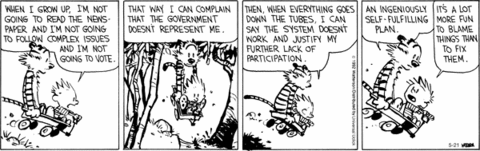
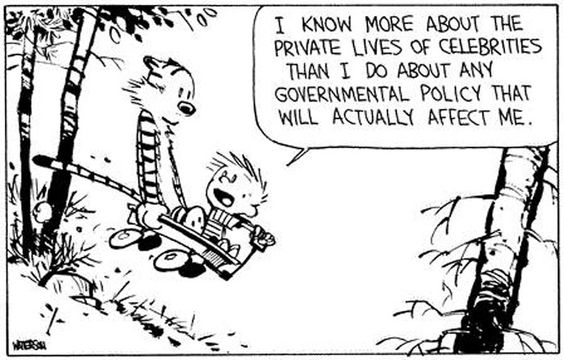
The current American election cycle was predicted, with amazing accuracy, in the late 20th Century, by Bill Watterson, the creator of Calvin and Hobbes. Evidence will follow. We’ll start with ignorance and apathy, both of which are certainly involved in American elections.

900b35f791cce9921b4119d2b3ed2e4c

28141d5022b2012f2fca00163e41dd5b-thumb-480x151-646

Not wanting to vote and not being allowed to vote are, of course, two different things to Calvin.

calvinvote

While he’s being ignorant and apathetic, Calvin is, at least, honest. Honesty is something which we definitely need, and currently do not have, in American politics, from the left or the right.

162943bdf715ffe34d954fafc9d7988b

If only this fictional duo qualified under the Constitution, we’d be facing this choice, which certainly seems better than the choice we actually have:

Watterson understood, well, the corrupting role of money in politics.

megalo

The big issue politicians do not talk about enough is the environment. Why do they not devote more energy to that? Money, of course. The love of money drives people to do harmful and irrational things, and this includes things with obviously-negative environmental impact.

calvin and dryer

He also created numerous cartoons about pollsters and lobbyists, taking them every bit as seriously as these people deserve to be taken.

Calvin-and-Hobbes-Attendance

calvin-hobbes-election-day1

ch_dadpost

polls2

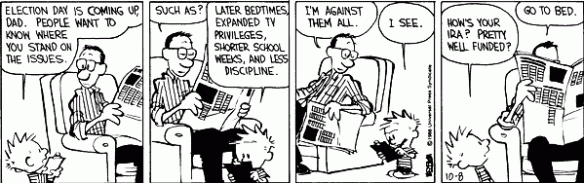
America has a lot of single-issue voters. They are not safe from Watterson’s satire. This cartoon is as on-target today as it was when it first appeared.

41jPq

For what purposes was Calvin willing to do research? Could his spray-painting ambitions include negative campaign ads?

aa7c0e40449f50ef43ad3629bd8401a3

I certainly think so. 

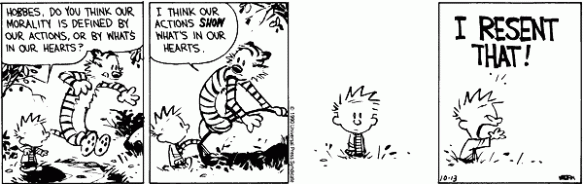
The next cartoon applies equally well, in my opinion, to the words and actions of both Donald Trump and Hillary Clinton.

ch9410131188056052

If the next cartoon doesn’t remind you of the Trump-or-Clinton choice we face, and what an amazing waste of time and energy it is to have to make such an absurd “choice,” please read it again. 

ch110419_thumb[1]

Finally, here’s Calvin’s invention of the perfect bipartisan slogan for this campaign season, and its nausea-inducing choice between bad (Clinton) and worse (Trump).

calvinapathy

“So what?” Indeed.

[To obtain all these cartoons, and many more, I recommend purchasing this boxed set: the complete collection of Calvin and Hobbes.]