My Antibirthday Occurs at Midnight Tonight

Birthday-Cake

Clearly, this requires some explanation.

January 12 is my birthday, and today is July 13, 2015.

  • Remaining days in January, after today: 19
  • Days in February through June, this year, which isn’t a leap year: 28 + 31 + 30 + 31 + 30 = 150
  • Days in July up to, and including, today: 13
  • Total days after my last birthday, up to and including today: 19 + 150 + 13 = 182

How long until my next birthday, starting at midnight, tonight?

  • The rest of July: 18 days
  • August through December: 31 + 30 + 31 + 30 + 31 = 153
  • Pre-birthday January days: 11
  • Total days between today and my next birthday: 18 + 153 + 11 = 182, also.

Since the number of days between the end of my last birthday, and midnight tonight, is exactly the same as my number of pre-birthday days which follow midnight, it follows that midnight tonight is the one point in time, this year, which is as far away from my birthday as one can get, on the calendar. The fact that antibirthdays are usually points in time, rather than full days, is a consequence of the fact that most years have an odd number of days. Subtract one for my birthday (or anyone’s, except for those rare people born on February 29 — we’ll get to them later), and 364 days remain in most years. Divide this by two, and there are 182 days to fall on either side of an antibirthday midnight, for most people, during most years.

Next year, 2016, is a leap year. What will happen to my antibirthday next year, then, with its 366 days? As it turns out, next year’s antibirthday, for me, will be a full day. Why? Adding “leap day” makes it necessary to subtract two days, rather than just one, to get 364. (An even number of post-subtraction days is needed for divisibility, by two, with no remainder.) My antibirthday in 2016 will be on July 13, all day long, because there are 182 days between that day and both of my nearest birthdays — one in that antibirthday’s near past, and one in its near future.

If we don’t have the same birthday, and you want to figure out when your own antibirthday is, you can follow the pattern above, with only minor adjustments, if your birthday, like mine, falls on or before February 28. Some additional adjustments will be needed for those with birthdays in March through December, though. Why it that? Simple: my birthday occurs before February, and this isn’t true for most people. My full-day antibirthdays occur during leap years only because of this fact. If your birthday occurs after February is over, you’ll still get full-day antibirthdays every four years, but those years won’t be leap years — they’ll be one year removed from leap years, instead. Whether this means such years will immediately precede, or follow, leap years is left as an exercise for the reader.

There’s a small group of people for whom this gets even more complicated: those whose birthdays only happen every four years, on “leap day,” February 29th. Of the people I know well, only one of them, my friend Todd, was born on a leap day, and, just to be a pest, I’m going to assign him the problem of figuring out his own antibirthdays. After all, he has plenty of time for this, since the fact that he only has a birthday every four years causes him to age at 25% of the normal rate. He looks only a bit older than me, having had only a few more birthdays that I’ve had, even though he was born in 1812, and can remember the American Civil War clearly. Fortunately for him, he was still a child in the 1860s, and this saved him from actually having to fight in that war, or any other. It must be nice to have a 280-year life expectancy, Todd!

[Image credit: before turning the birthday-cake picture above upside-down, I downloaded it from this website.]

Free the Frozen People!

150127_0000

After seeing this sign in a local grocery store, I carefully searched the entire frozen food section, but I could find neither the frozen Mexican, nor the frozen Asian. Since they were gone, but the sign indicates they were there at one point, I concluded that the experiment was over, and hoped they had thawed out both experimental test subjects, found them still healthy after a few days in cryogenic suspended animation, and sent them home, each with a fat check to compensate them for the huge risk they just took.

However, even with compensation and signed consent forms, I still have certain ethical reservations about scientists performing this sort of experiment on actual human beings. Why not freeze, thaw, refreeze, and rethaw mice, instead? Is PETA really that scary?

Are they still doing these experiments, in my town or elsewhere? If so . . . free the frozen people!

There is one last thing about this whole thing which I just can’t figure out, though, and that’s this: why were they storing their frozen, experimental, human test subjects in the middle of a central Arkansas grocery store in the first place?

I Can’t Stop Listening to the Unsilent Quiet

An incomplete list of things I can hear right now:

1. The spinning of my laptop’s hard drive
2. The spinning of the blades of the exhaust fans that keep my laptop from overheating
3. This apartment’s air conditioning
4. The ringing in my own ears, which I blame on living in a noisy world
5. The “sixty-cycle hum” — a 60 Hz humming sound produced by pretty much anything running off alternating current (refrigerators are the worst)
6. The sound of my own fingers typing on the keyboard of my laptop
7. The whirling blades of ceiling fans in several places in this apartment, and adjacent apartments
8. Traffic on nearby roads
9. My never-ending internal monologue

Except during power failures, which shorten the list a lot, this is about as quiet as it ever gets here. Another person might call this “silence.” It isn’t.

There is no silence.

Ever.

Testing a Climate Change Claim: Does Burning a Gallon of Gasoline Really Put Twenty Pounds of Carbon Dioxide Into the Atmosphere?

OLYMPUS DIGITAL CAMERA

OLYMPUS DIGITAL CAMERA

When I read, recently, that “every gallon of gas you save not only helps your budget, it also keeps 20 pounds of carbon dioxide out of the atmosphere,” (source) I reacted with skepticism. Twenty pounds? That seemed a bit high to me.

Just because it seems high, to me, though, doesn’t mean it’s wrong, any more than “about.com” putting it on the Internet makes the statement correct. No problem, I thought: I’ll just do the math, and check this for myself.

So, in this problem, we start with a gallon of gasoline. In units I can more easily work with, that’s 3.785 liters (yes, they rounded it incorrectly on the gas can shown above). Google tells me that the density of gasoline varies from 0.71 to 0.77 kg/L (reasonable, since it floats on water, but is still heavy to lug around), so I’ll use the average of that range, 0.74 kg/L, to find the mass of a gallon of gasoline: (3.785 L)(0.74 kg/L) = 2.8 kg.

Next, I need to find out how much of that 2.8 kg of gasoline is made of carbon. That would be an easy chemistry problem if gasoline were a pure chemical, but it isn’t, so I’ll estimate. First, I’ll ignore the elements which only make up a minor part of gasoline’s mass, leaving only hydrogen and carbon to worry about. Next, I consider these things:

  1. Alkanes larger than methane (major gasoline components), whether branched-chain or not, have slightly more than two hydrogen atoms for every carbon atom. This ratio doesn’t exceed three, though, and is equal to three only for ethane, which has too high a boiling point to remain in liquid form at typical temperatures and pressures, anyway.
  2. Cycloalkanes, another major component of gasoline, have exactly two hydrogen atoms for every carbon atom.
  3. Aromatic hydrocarbons can have fewer than two hydrogen atoms for every carbon atom, and these chemicals are also a major component of gasoline. For the simplest aromatic hydrocarbon, benzene, the H:C ratio drops to its lowest value: 1:1.

For the reasons above, I’m choosing two to one as a reasonable estimate for the number of atoms of hydrogen for every atom of carbon in gasoline. Carbon atoms, however, have twelve times the mass of hydrogen atoms. Gasoline is therefore ~12/14ths carbon, which reduces to ~6/7. I can now estimate the mass of carbon in a gallon of gasoline: (6/7)(2.8 kg) = 2.4 kg.

So how much carbon dioxide does that make? Well, first, does a car actually burn gasoline completely, so that every carbon atom in gasoline goes out the tailpipe as part of a carbon dioxide molecule? The answer to this question is simple: no.

However, this “no” doesn’t really matter, and here’s why. In addition to carbon dioxide, automobile exhaust also contains carbon present as carbon monoxide, unburned carbon, and unburned or partially-burned hydrocarbons. To have an environmental impact, though, it isn’t necessary for a given carbon dioxide molecule to come flying straight out of the tailpipe of one’s car. In our oxygen-rich atmosphere, those carbon atoms in car exhaust which are not yet fully combusted (to each be part of a carbon dioxide molecule) are quite likely to end up reacting with oxygen later on — certainly within the next year, in most cases — and the endpoint of carbon reacting with oxygen, once combustion is complete, is always carbon dioxide. What’s carbon monoxide, then? Well, one way to look at it is this: molecules of carbon monoxide are simply half-burned carbon atoms. When the other half of the burning (combustion) happens, later, carbon dioxide is the product. So, for purposes of this estimate, I am assuming that all 2.4 kg of carbon in a gallon of gasoline ends up as carbon dioxide — either directly produced by the car, or produced in other combustion reactions, later, outside the car.

The molar mass of elemental carbon is 12 grams. For oxygen, the corresponding figure is 16 g, but that becomes 32 g of oxygen in carbon dioxide, with its two oxygen atoms per molecule. Add 12 g and 32 g, and you have carbon dioxide’s molar mass, 44 g. Therefore, 12 g of carbon is all it takes to make 44 g of carbon dioxide; the rest of the mass comes from oxygen in the air. By use of ratios, then, I can now find the mass of carbon dioxide formed from burning a gallon of gasoline, with its 2.4 kg of carbon.

Here is the ratio needed: 2.4 kg of carbon / unknown mass of carbon dioxide produced = 12 g of carbon / 44 g of carbon dioxide. By cross-multiplication, and using “x” for the unknown, this equation becomes (12 g)(x) = (44 g)(2.4 kg), which simplifies to 12x = 105.6 kg, so, by division, x = 8.8 kg of carbon dioxide produced from one gallon of gasoline.

Each kilogram (of anything), near sea level on this planet, weighs about 2.2 pounds. This 8.8 kg of carbon dioxide, then, translated into “American,” becomes (8.8 kg)(2.2 pounds/kg) = 19.36 pounds. Given the amount of estimation I had to do to obtain this answer, this is close enough to twenty pounds for me to conclude that the statement I was examining has survived my testing. In other words, yes: burning a gallon of gasoline goes, indeed, put about twenty pounds of carbon dioxide into the atmosphere.

However, I’m not quite finished. Carbon dioxide is an invisible gas, making it quite difficult to picture what twenty pounds of it “looks” like. To really understand how much carbon dioxide this is, it would be helpful to know its volume. So I have a new problem: 8.8 kg of pure carbon dioxide is trapped, in a balloon, at standard temperature and pressure. What is the balloon’s volume?

To solve this problem, one needs the density of carbon dioxide under these conditions, which chemists refer to as “STP” (standard temperature and pressure). According to Google, the density of carbon dioxide at STP is about 1.98 kg per cubic meter. Since 8.8 kg / (1.98 kg/m³) = 4.44 m³, this means that a gallon of gasoline can produce enough carbon dioxide, held at STP, to inflate this balloon to a volume of 4.44 cubic meters. For the benefit of those who aren’t used to thinking in metric units, that volume equals the volume of a perfect cube with an edge length of ~5.4 feet. You could fit a bunch of people into a cube that large, especially if they were all on friendly terms.

Now, please consider this: all of that was from one gallon of gasoline. How many gallons of gas do you typically buy, when you fill up your car’s gas tank? Well, multiply by that number. How many times do you fill up your car, on average, in a year? Multiply again. Next, estimate the total number of years you will drive during your lifetime — and multiply again. You now have your own personal, lifetime carbon dioxide impact-estimate from just one activity: driving.

This may sound like a change of topic, but it isn’t: what’s the hottest planet in the solar system? Even though Mercury is much closer to the Sun, the answer is Venus, and there is exactly one reason for that: Venus has a thick atmosphere which is chock-full of carbon dioxide. In other words, yes, the planet nearest the Earth, and the brightest object in the sky (behind the Sun and the Moon), Venus, is one of the best warnings about global warming known to exist, and we’ve known this for many decades. One wonders if any theologian has ever speculated that the creator of the universe designed Venus this way, and then put it right there “next door,” on purpose, specifically as a warning, to us, about the consequences of burning too much carbon.

The science, and the math which underlies it, are both rock-solid: climate change is real. Lots of politicians deny this, but that’s only because of the combined impact of two things: their own stupidity, plus lots of campaign contributions from oil companies and their political allies. Greed and stupidity are a dangerous combination, especially when further combined with a third ingredient: political power. Voting against such politicians helps, but it isn’t enough. One additional thing I will do, immediately, is start looking for ways to do the obvious, in my own life: reduce my own consumption of gasoline. Since I’m putting this on the Internet, perhaps there will be others persuaded to do the same.

The truth may hurt, but it’s still the truth: the United States is a nation of petroleum junkies, and we aren’t just harming ourselves with this addiction, either. It’s time, as a people, for us to invent, and enter, fossil-fuel rehab.

[Image credit: “GasCan” by MJCdetroit – Own work. Licensed under CC BY 3.0 via Wikimedia Commons – https://commons.wikimedia.org/wiki/File:GasCan.jpg#/media/File:GasCan.jpg]

Amazing Discovery! Gasoline Smells Like . . . .

duh

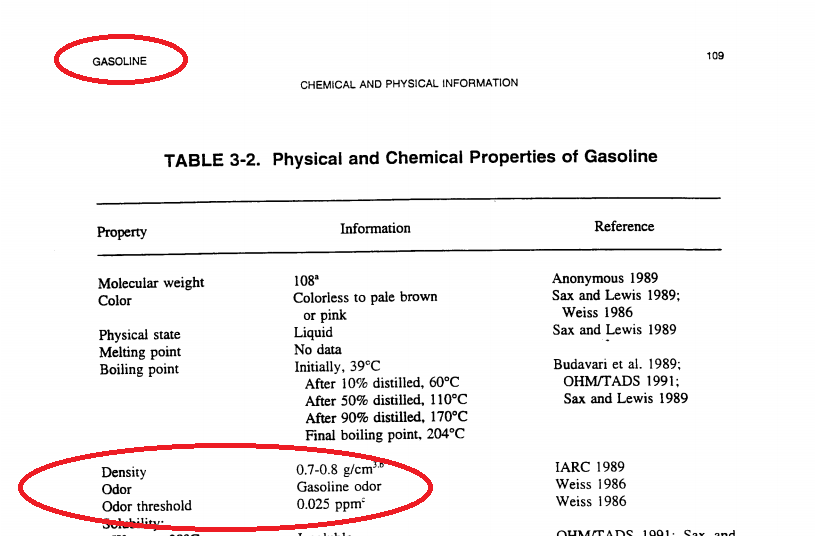
In this source, http://www.atsdr.cdc.gov/toxprofiles/tp72-c3.pdf, on p. 109, the CDC oh-so-helpfully describes the odor of gasoline as a “gasoline odor.” Yes, really. They even cite a source for this fact, as if it were ever questioned by anyone. I’m glad to see my tax dollars going to such ground-breaking research — aren’t you? Here’s a screenshot (I added the red ellipses):

gasoline smells like gasoline

Now I have a headache.

A Law of Blogging, in Venn Diagram Form

venn diagram about blogging

Places I Have Been, #2: When Was I Last There?

This is a more detailed version of one of the earliest posts on this blog, “Places I Have Been.” In this version, I color-coded the states and provinces to show when I was last in each of these places (the color-coding is explained below the picture). Also, no, I haven’t left North America — yet — but visits to all the other continents on Earth, plus the Moon, are definitely on my lifetime “to do” list.

placesihavebeen-1

Here’s the color-key. It starts in the present, and then proceeds in reverse chronological order.

Red — I’m here right now. Arkansas is also the state where I have spent well over 90% of my life, and I was born here, as well, 47½ years ago (January, 1968).

Pink — These are states I’ve been to since turning 45, not counting where I am at the moment. It’s also the set of states my wife and I have visited together — so far.

Purple — I was last in each of these states during the first half of my forties.

Dark blue — I was last in Kansas in my thirties, flying there, with two other math teachers, for an educational conference.

Yellow — Louisiana is the only state which I last visited in my twenties.

Green — These are states I last visited at age nineteen. So far, that’s the furthest I have traveled in a single year. The green Mexican state on the map is Chihuahua, where I visited Cuidad Juárez, just across the Rio Grande from El Paso, Texas.

Light blue — These are the states and provinces I last visited as a “tween” (ages 10-12). The Northern vacation trip was with my family, and, so far, that’s the only time I’ve been to Canada. Virginia made the map when I won a trip to Washington, DC (too small to be seen above), as one of a busload of young newspaper carriers, for selling twenty newspaper subscriptions to Arkansas Gazette — one of America’s many “lost newspapers,” and one which I very much miss. Alabama and Florida are included because of a field trip, all the way to Key West, with a college class — one of the benefits of growing up as a “professor’s kid” who spent a lot of time on campus.

Brown — I have been to South Carolina once, but I wasn’t even close to ten years old at the time, and now I barely remember this family trip to the Atlantic coast.

Gray — I was so young, when my parents took me to Colorado, that I have no memories from that trip at all. I don’t think my younger sister had even been born yet, in fact. All I remember is being told, much later, that, yes, I have been to Colorado.

My New Middle Initial and Name: A Mathematical Welcome-Back Gift from My Alma Mater

UALR-Logo-1

I just had a middle initial assigned to me, and then later, with help, figured out what that initial stood for. With apologies for the length of this rambling story, here’s an explanation for how such crazy things happened.

I graduated from high school in 1985, and then graduated college, for the first time, with a B.A. (in history, of all things), in 1992. My alma mater is the University of Arkansas at Little Rock, or UALR, whose website at http://www.ualr.edu is the source for the logo at the center of the image above.

Later, I transferred to another university, became certified to teach several subjects other than history, got my first master’s degree from there (also in history) in 1996, and then quit seeking degrees, but still added certification areas and collected salary-boosting graduate hours, until 2005. In 2005, the last time I took a college class (also at UALR), I suddenly realized, in horror, that I’d been going to college, off and on, for twenty years. That, I immediately decided, was enough, and so I stopped — and stayed stopped, for the past ten years.

Now it’s 2015, and I’ve changed my mind about attending college — again. I’ve been admitted to a new graduate program, back at UALR, to seek a second master’s degree — one in a major (gifted and talented education) more appropriate for my career, teaching (primarily) mathematics, and the “hard” sciences, for the past twenty years. After a ten-year break from taking classes, I’ll be enrolled again in August.

As part of the process to get ready for this, UALR assigned an e-mail address to me, which they do, automatically, using an algorithm which uses a person’s first and middle initial, as well as the person’s legal last name. With me, this posed a problem, because I don’t have a middle name.

UALR has a solution for this: they assigned a middle initial to me, as part of my new e-mail address: “X.” Since I was not consulted about this, I didn’t have a clue what the “X” even stands for, and mentioned this fact on Facebook, where several of my friends suggested various new middle names I could use.

With thanks, also, to my friend John, who suggested it, I’m going with “Variable” for my new middle name — the name which is represented by the “X” in my new, full name.

I’ve even made this new middle initial part of my name, as displayed on Facebook. If that, plus the e-mail address I now have at UALR, plus this blog-post, don’t make this official, well, what possibly could?

Orcus and Vanth

There’s a binary dwarf-planet-candidate / large satellite pair, way out in the outer solar system, called Orcus and Vanth. Much like the “double dwarf planet” Pluto/Charon, and the other satellites in that system, Orcus and Vanth orbit the sun in a 3:2 resonance with Neptune, and this orbit crosses that of Neptune, as well. The Orcus/Vanth binary system is sometimes referred to as the “anti-Pluto,” because, unlike most “plutinos” (as such distant objects, in orbital resonance with Neptune, are called), Orcus and Vanth have a strange — and, so far, unexplained — relationship with the Pluto/Charon system. When Pluto and Charon are closest to the sun (perihelion), Orcus and Vanth are at their furthest from the sun (aphelion), and vice-versa. So far as I have been able to determine, this is not true for any other known plutinos. For more on the real Orcus and Vanth, please check this Wikipedia page.

Those are the scientific facts, as we know them . . . and now, it’s time for some silliness. On Facebook, recently, I mentioned that “Orcus” and “Vanth” really would make good names for comic book characters, but that I couldn’t decide what they should look like, nor what powers they should have. A discussion with some of my friends followed, and, together, we decided that Orcus should be a tough fighter-type, while “Vanth” sounded like a name for some sort of spell-caster. It didn’t take long before I decided I should visit one of the numerous create-your-own-comic-book-character websites, and go ahead and make quasi-anthropomorphized images of Orcus and Vanth — the characters, not the outer solar-system objects.

I used a website called Hero Machine for this diversionwhich you can find here. First, I created an image for a character named Orcus.

orcus

Unfortunately, I didn’t discover (until it was too late) that this website allows the user to change the background . . . and I didn’t want to re-make Orcus, so I went ahead and created an image of his companion, Vanth, instead.

vanth

I don’t have the time, nor the artistic talent, to write and illustrate actual comic book stories featuring this pair of characters . . . but perhaps someone will read this, and decide they want to take on such a project. That’s fine with me . . . but I want credit (in writing, each issue) for creating them, and, if the endeavor makes any money, I want at least 20% of the profits, and that’s if I have nothing more to do with creating Orcus and Vanth stories, beyond what is posted here. If I do have additional involvement, of course, we’ll need to carefully negotiate the terms of a contractual agreement. I consider 20% fair for simply creating images of this pair of characters, but actually co-creating stories would be something else altogether.

By the way, although Orcus certainly looks scarier, Vanth is actually the more formidable of the pair. She just pretends to play the “side-kick” role, in order to preserve the element of surprise, for situations when, during their adventures, Orcus finds himself in over his head, and Vanth then needs to really cut loose with the full extent of her abilities.

Welcome to Arkansas: The Tornado State

arkansas the tornado stateWe’re under a tornado watch here, for approximately the thousandth time in my life. Seeing a “tornado watch” alert is about as rare here as seeing a Walmart.

Do wake me up if there’s a tornado warning, though, please.