Warning: Escaped Genetic Experiment on the Loose!

escaped genetic experiment

It amuses me to no end that telling the truth, publicly, is considered dangerous in some quarters.

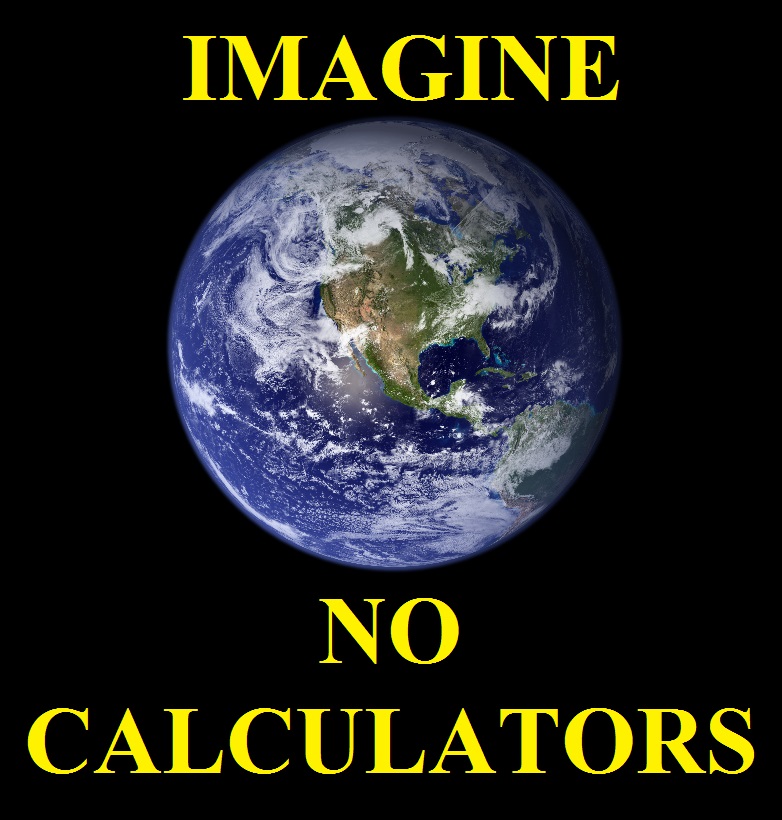
Halving and Rehalving, as Well as Doubling and Redoubling, as a Calculator-Free Calculating Strategy

bluemarblewest

I don’t like being too dependent on calculators. The future might bring an EMP (electromagnetic pulse) that would fry all such gadgets (and cell phones, cars, computers, etc.), and I want to be ready for a post-calculator world, if that happens.

My overarching strategy for doing math in my head is this: don’t have just one single strategy. Instead, devise one, on the fly, based on the problem you are trying to solve.

I do, however, use a few “go to” strategies for certain things, such as finding 25% of something, or multiplying by eight, or similar problems. This involves looking for, and take advantage of, powers of two, as well as their reciprocals. 25% is 1/4, which is simply halving twice, and multiplying by eight is three doublings, since 8 = 2³. With practice, doubling or halving numbers repeatedly and silently, in one’s head, becomes much faster and easier. If done out loud, it becomes easier still, and on paper, it’s extremely easy.

I intend to do more blog-posts in the future with calculator-free calculation strategies, but not all at once — instead, these techniques will be posted one at a time. However, these postings will stop immediately, in the event of an EMP.

The Rules of Cats

the rules of cats

Jynx the Kitten may not be fully grown yet, but he certainly knows these rules.

All cats (and kittens) know these rules, and efforts, by anyone, to get cats (or kittens) to break them are futile.

(Photo credit: my wife took this picture, after Jynx decided she needed to take a break from crotcheting. When Jynx tries to floss his teeth with the yarn, that’s always disruptive.)

At 47, My Age Is a Prime Number Again =D

For some reason, I like having my age be a prime number of years. Today, I turn 47, so I get to have a prime-number-age for a whole year now. This hasn’t happened since I was 43, so I made this 47-pointed star to celebrate:

47

I also make birthday-stars for composite-number ages as well, just because it’s fun, and you can find at least two others on this blog, on January 12, in past years. Also, I wouldn’t want to have to wait until I’m 53 (my next prime age) to make another one of these.

At the moment, I certainly don’t feel 47. There are times when I feel twenty-two . . .

There are also times when I feel six.

calvin-on-learning

At the moment, however, I feel about thirty. For that reason, I put the 47-pointed stars on the thirty faces of a rotating rhombic triacontahedron, because (a) it’s my birthday, (b) I want to, and (c) I can.

Rhombic Triaconta

Image/music credits:

  1. I created this using Geometer’s Sketchpad and MS-Paint.
  2. “When Yer Twenty-Two,” by The Flaming Lips, via a YouTube posting.
  3. Two panels from a Calvin and Hobbes cartoon, by Bill Watterson. (Calvin is perpetually six years old.)
  4. Created using the image at the top of this post, and the program Stella 4d: Polyhedron Navigator, which is available here.

My First Solution to the Zome Cryptocube Puzzle, with Special Guest Appearances by Jynx the Kitten

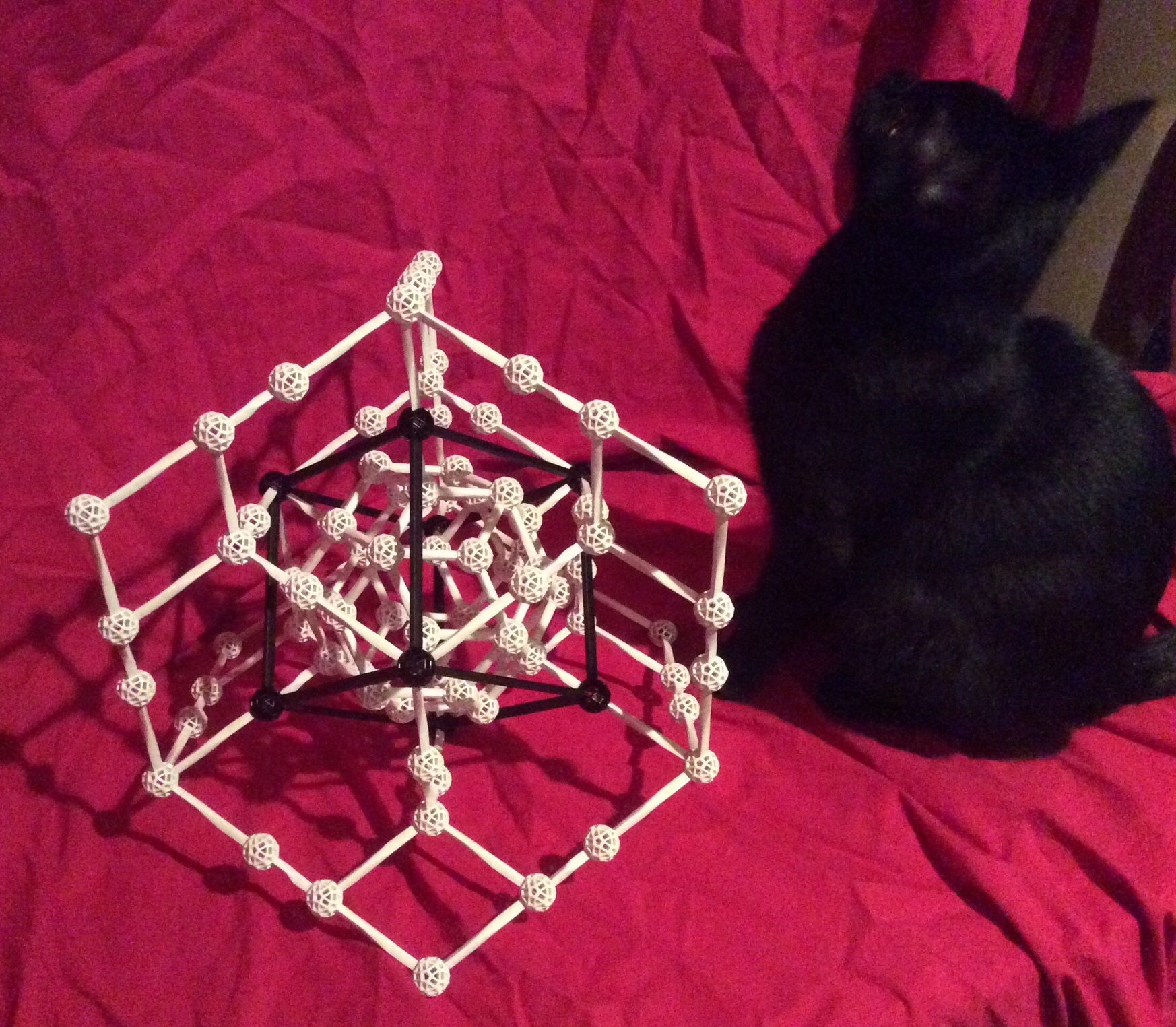
Last month, in a special Christmas promotion, the Zometool company (www.zometool.com) briefly sold a new kit (which will return later) — a fascinating game, or puzzle, called the “Cryptocube.” Zome usually comes in a variety of colors, with each color having mathematical significance, but the Cryptocube is produced in black and white, which actually (in my opinion) makes it a better puzzle. Here’s how the Crypocube challenge works:  you use the black parts to make a simple cube, and then use the smaller white parts to invent a structure which incorporates the cube, is symmetrical, is attractive, and can survive having the twelve black cube-edges removed, leaving only the cube’s eight black vertices in place. I had a lot of fun making my first Cryptocube, and photographed it from several angles.

imageIf this was built using standard Zome colors, the round white figure inside the cube, a rhombic triacontahedron, would be red, and the pieces outside the cube, as well as those joining the rhombic triacontahedron to the cube (from inside the cube), would be yellow.

It isn’t only humans who like Zome, by the way. Jynx the Kitten had to get in on this!

image (1)

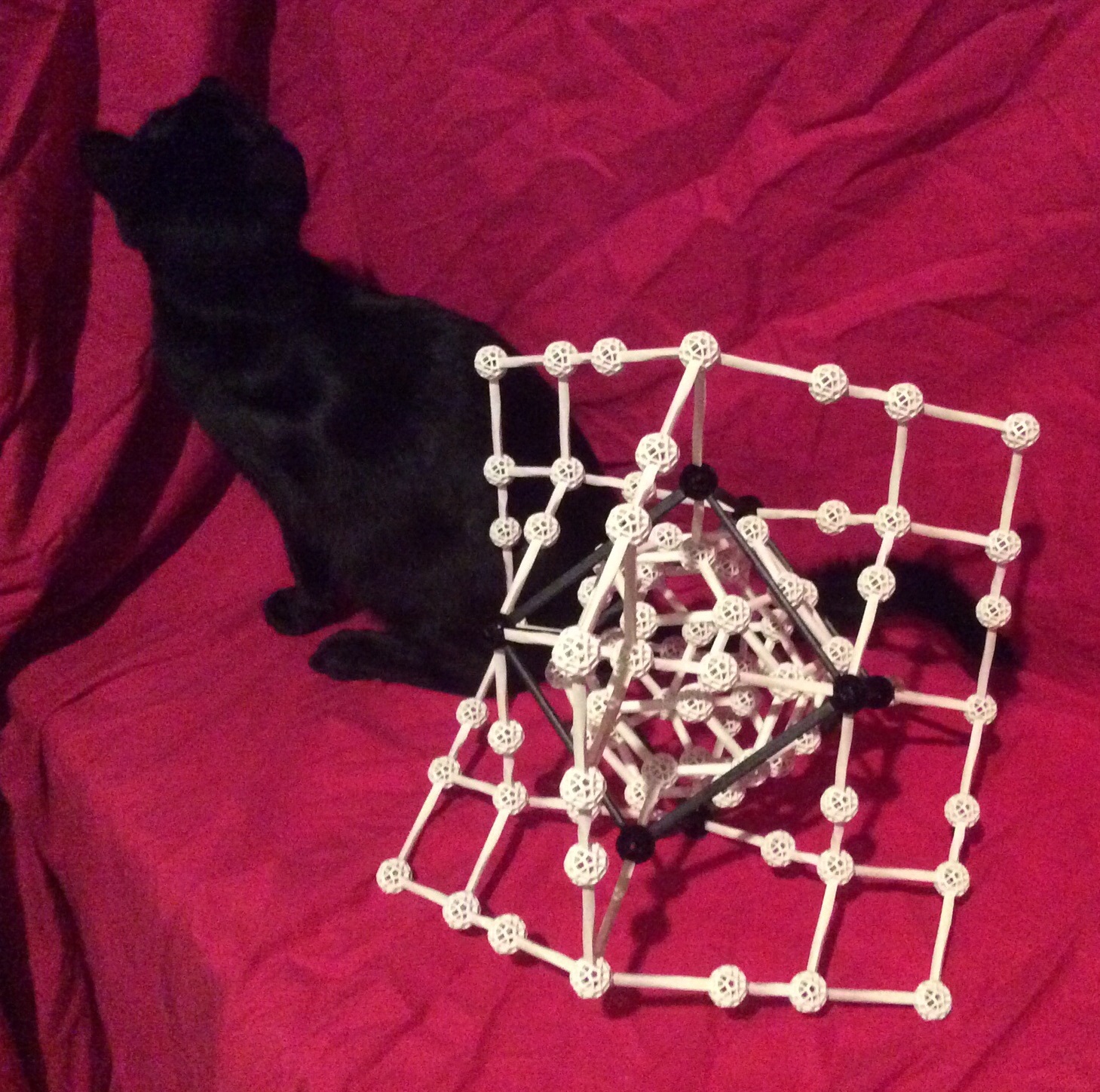
Jynx quickly became distracted from the Cryptocube by another puzzle, though: he wanted to figure out how to pull down the red sheet I had attached to the wall, as a photographic backdrop for the Cryptocube. Jynx takes his feline duties as an agent of entropy quite seriously.
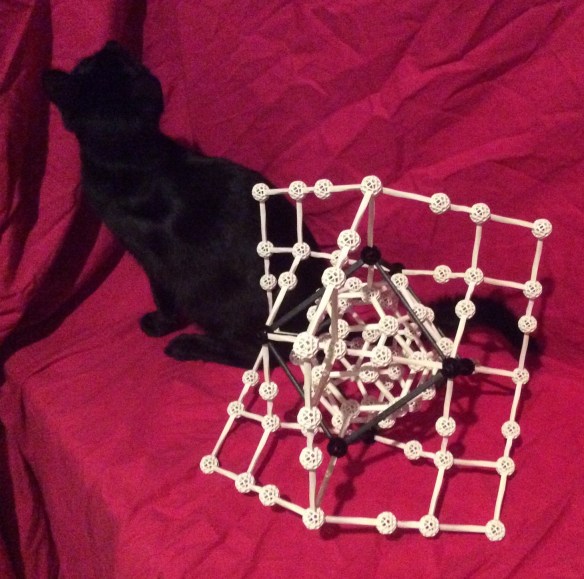
image (2)As usually happens, Jynx won (in his never-ending struggle to interfere with whatever I’m doing, in this case by pulling the sheet down) and it took me quite a while to get the red sheet back up, in order to take kitten-free pictures of my Cryptocube solution, after removal of the black cube’s edges.

image (3)

Here’s the view from another angle.

image (4)

The Cryptocube will be back, available on the Zometool website, later in 2015. In the meantime, I have advice for anyone not yet familiar with Zome, but who wants to try the Cryptocube when it returns: go ahead and get some Zome now, at the link above, in the standard colors (red, blue, and yellow, plus green in advanced kits), and have fun building things with it over the next few months. The reason to do this, before attempting to solve the Crypocube, is simple: the colors help you learn how the Zome system works, which is important before trying to solve a Zome puzzle without these colors visible. After gaining some familiarity with the differing shapes of the red, blue, yellow, and green pieces, working with them in white becomes much easier.

On a related note, Zome was recommended by Time magazine, using the words “Zometool will make your kids smarter,” as one of the 14 best toys of 2013. I give Zome my own strong, personal recommendation as well, and, as a teacher who uses my own Zome collection in class, for instructional purposes, I can attest that Time‘s 2013 statement about Zome is absolutely correct. Zome is definitely a winner!
Happy Second Anniversary of Your Simulated Existence

386145

The world ended on this day in 2012 — December 21 — when the Mayan calendar began a new cycle. We now secretly live in a computer simulation run by highly advanced ancient Mayan aliens. They have authorized me to wish you a happy second anniversary of the end of your previous existence.

[Image credit: within this simulation, you can find this picture at http://wall.alphacoders.com/by_sub_category.php?id=206132.]

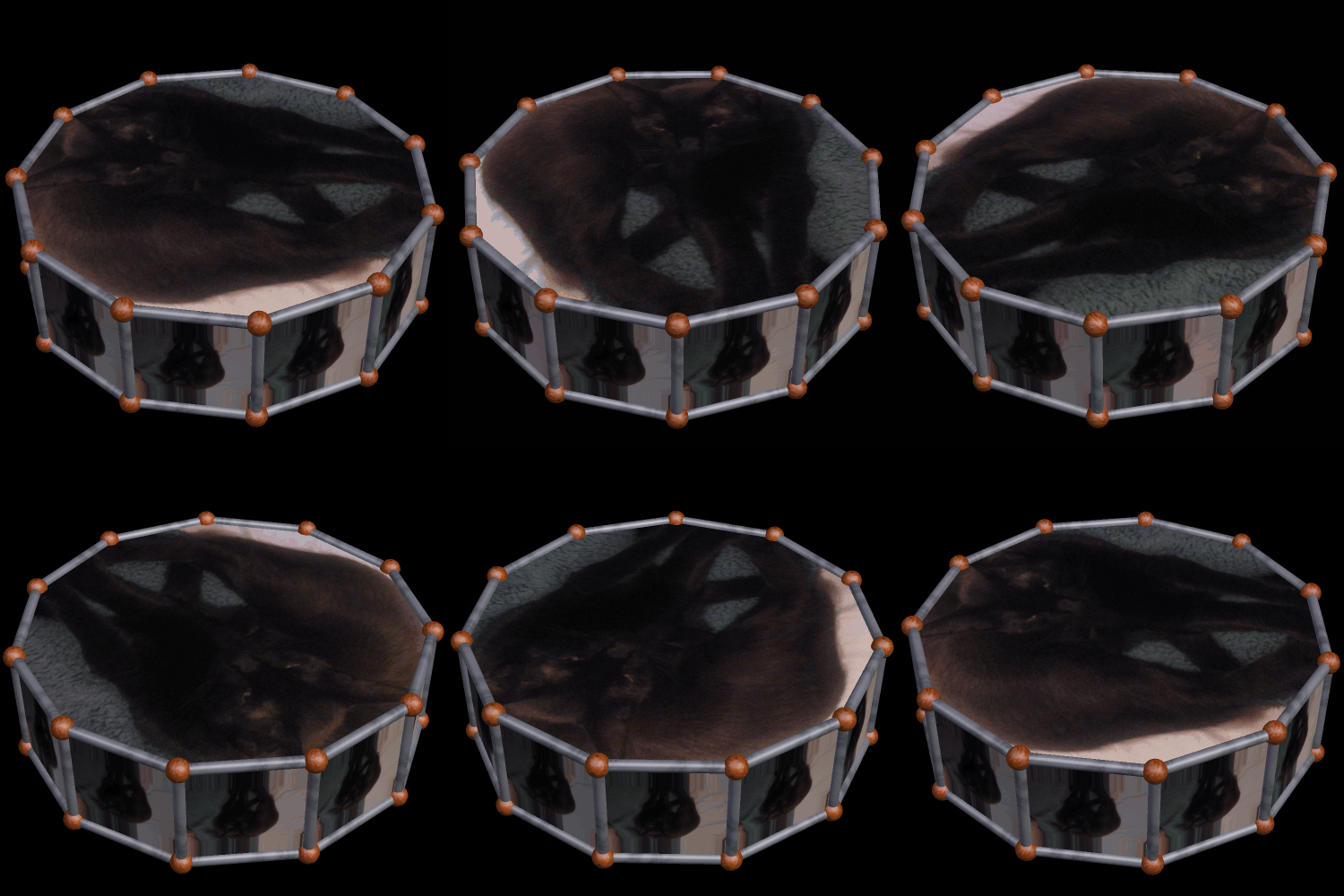
Thirteen Images, Each, of Jynx, the Black Kitten, on Two Hendecagonal Prisms

11- Prism

The above hendecagonal prism shows what Jynx is like when he’s in “hyperkitten” mode. (If you have a kitten, you know what that means.) It’s also rotating rapidly in an effort to make those who fear black cats, and/or the number thirteen, feel even more jumpy, in the hope that Jynx and I can, by working together, startle them into rationality.

On the other hand, Jynx does sometimes like to just lounge around, and watch the world go by — so I’ll show him in “tiredcat” mode as well.

11- Prism

Software credit:  I used Stella 4d: Polyhedron Navigator to make these images, a program which is available at this website.

J. Michael Straczynski, on Worrying

G'Kar

J. Michael Straczynski, on Understanding

understanding

“How are you today?”

how are you

At least in this part of the world, “How are you today?” — or variations thereof — is commonly used as a way to start conversations, as a bit of “small talk.” The odd part of this social convention is that, when people ask this, they usually don’t really want to hear an honest answer — or, indeed, any answer at all that isn’t part of the standard “small talk” script.

The usual answer (“Fine, thanks,” or something like it) is yet another empty phrase — more small talk. Unusual answers, though, have great potential for fun. I first encountered this idea in a class I took, many years before, where the teacher told us that his habit was to answer, instead, with an upbeat, “Getting better!” I’ve tried this, and the facial expressions often seen, in response, are indeed quite entertaining. Small talk is annoying — to me, anyway — but disrupting it, by simply deviating from the usual script, can be a lot of fun.

Here are some other possible answers, but this game is probably most fun if you make up your own.

  • “I’m glad you asked. Actually, my feet hurt. Do you know why?”
  • “Well, I’d feel a lot better if I hadn’t just blown my whole budget for the week on chocolate. It tasted good when I ate it all for breakfast this morning, though!”
  • “Hopefully, I’ll be able to answer your question in a few minutes. Say, where’s the nearest restroom?”
  • “Terrible. My beloved pet cricket just died.”
  • “I’m hoping it gets better soon. Could you recommend a good mechanic nearby, as well as a chiropractor?”
  • “I’m feeling great! There is nothing like a couple of extra-strength placebos to start the day!”
  • “I’m okay now, but I’m not looking forward to this afternoon at all. You have heard about the giant asteroid heading straight for us, right? It’s supposed to hit somewhere near downtown, at about four o’clock.”
  • “Well, I’m broke. May I borrow fifty bucks until next month?”

While I do greatly value honesty, I obviously exclude jokes from the category of lies. Also, suggestions for other funny responses, in comments, would be much appreciated.