Some Strange Laws We Have in Arkansas

Image

Some Strange Laws We Have in Arkansas

If you drink alcohol, and are about to travel in Arkansas, you might want to buy your booze before your trip. You can’t buy liquor on Sundays or religious holidays (a blatant First Amendment violation) in this state. In some counties, first-time visitors learn the term “dry county” when they are told by a clerk that they can’t buy alcohol there on any day of the week. Yes, we still have prohibition here, in many parts of Arkansas!

If you see the sign above, and have you have the urge to utter “Arkansasssss,” pronouncing the second “s,” you’d better do it quickly, if you want to mispronounce the name of our state legally. Once here, it’s actually against the law.

Husbands can even legally beat their wives here . . . but only once a month.

Blindfolding cattle on a public highway is illegal here, even though that’s just good sense, and probably would never be done if our state government hadn’t suggested it with this law. Here’s my favorite dumb Arkansas law, though:

lr-lrt-stc-main-st-bridge-238-20041204x_lh

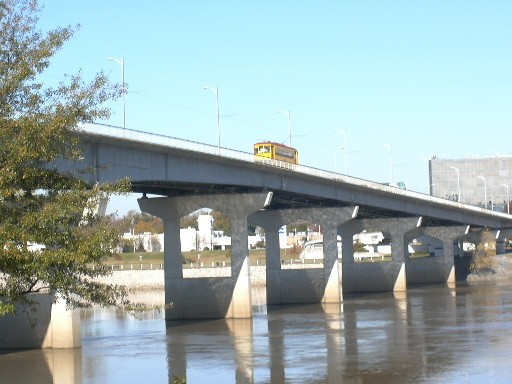
This is the Main Street Bridge across the Arkansas River. It separates Little Rock and North Little Rock. Perhaps as a flood-control measure, our state legislature (#50 among American state legislatures in college achievement) passed a law forbidding the Arkansas River from rising above the level of this bridge.

I’m sure there are more.

Why Is Arkansas Political Geography Such a Mess?

Image

Why Is Arkansan Political Geography Such a Mess?

Technically, we live within the city limits of North Little Rock, but we’re surrounded by Maumelle, and also live in the Pulaski County Special School District, not the North Little Rock School District. Telling people we live in NLR causes confusion, so we say “Maumelle” instead, but mail won’t reach us unless it includes “North Little Rock” in the address. What’s more, that’s all in one county, Pulaski, near the center of the state.

The weirdness doesn’t stop there. Nearby is a city named Conway. I went to college there. It isn’t located in Conway County, though; that’s further West.

Head Southwest on I-30 from Little Rock, and you’ll soon encounter Benton (not in Benton County, although at least Bentonville is), and then get a chance to take an exit to go visit Hot Springs — but you won’t find it in Hot Spring County. Van Buren is right next to Oklahoma, and a long drive from Van Buren County. Is the City of Jacksonville to be found in Jackson County? Of course not — not in this state. Boonville, similarly, is not located in Boone County.

We have a Mississippi County here, and it borders two other states. We also have a long border with the state of Mississippi. However, Mississippi County, Arkansas isn’t one of several counties which do border the State of Mississippi. Instead, it borders Tennessee and Missouri.

Even things which seem intuitively obvious about my state’s political geography end up being wrong. Ask someone familiar with a U.S. map which state(s) you can find South of Arkansas, and they’ll almost certainly answer with Louisiana, perhaps including Texas, as well. However, the states of Oklahoma, Missouri, Tennessee, and Mississippi also include land that is South of carefully-chosen points in Arkansas. Here’s visual proof, which you can enlarge with a click:

arinus

Yes, all six states which border Arkansas are technically South of us, in a sense.

Perhaps the strangest thing about Arkansan political geography is that the town of Lonoke is actually in Lonoke County. It’s even their county seat. What are they trying to do there, confuse people?

On Sportsball, As Viewed By One Aspie

Image

On the Varieties of Sportsball

Since I live in the American South, I hear a lot of talk about about sportsball. I have a hard time, though, telling exactly which variety of sportsball is being discussed. I don’t find sportsball interesting, and so I’m not fluent in any variant of sportsball jargon. For that reason, it can be difficult for me to tell which sportsballspeak-dialect is being used.

So, sometimes, just to try to make friendly conversation (while still being myself), I ask sportsball-fans questions, in order to find out which version they’re so intently discussing. (Figuring out why people obsessively talk about sportsball so much, I think, is a mystery I’ll never solve. Understanding the strange behavior of non-Aspies is much more difficult than the types of problems I enjoy trying to solve. As Albert Einstein said, when declining the presidency of Israel, “I have no head for human problems.”)

Here’s an example of one such question: “Are you talking about the type of sportsball often played inside, with a bunch of people chasing an orange sphere around on a wooden rectangle, and trying to get the sphere to pass through a metallic, elevated circle of slightly larger diameter than the sphere itself?”

Now, if someone mentions the sportsball game most people call “football,” there’s an obvious follow-up question that needs to be asked . . . so, of course, I ask it:  “Which one?”

Replies to that question usually go something like this: “Whaddya mean, which one? Football! We’re talking about football, ya nerd!”

“But there are at least two games called by that name, which confuses me. Do you mean the sportsball-version where the players chase a prolate spheroid, or a rounded version of a truncated icosahedron?”

If they don’t understand that question, I attempt clarification: “You know, both those versions of sportsball are played on rectangles covered with grass . . . but the one with the prolate spheroid has two giant tuning forks at opposite sides end of the grassy rectangle, is usually played in the USA, and has a far higher rate of injuries, even fatal ones. The one that uses a truncated icosahedron doesn’t have tuning forks, is called ‘football’ by far more people than that American game, and isn’t nearly as dangerous. I think it’s at least a little more interesting than that other game people call ‘football,’ because of the Archimedean solid they chase around, since I like polyhedra. Which one are you discussing?”

If they tell me they’re talking about American football, I usually follow-up with a brief rant, for that sportsball-variant’s name confuses me. “Why do people call it that, anyway? I’ve seen it being play a few times — not for a full game, of course, but I can stand to watch it for a few minutes. That’s long enough to tell that the players only rarely use their feet to kick the prolate spheroid, and usually carry or throw it instead, using, of course, their hands. They usually use their feet just to run around chasing each other. Calling that version of sportsball by the term ‘football’ doesn’t make sense at all. In the game the rest of the world calls ‘football,’ the players kick the ball all the time, so I can understand why it has that name, but that prolate-spheroid version really should be called something else! Also, why are the games sometimes called ‘bowl games?’ They still play on a rectangle, and chase a prolate spheroid — there’s no actual bowl involved, is there?”

On occasion, they aren’t talking about any of these three varieties, though, but yet another form of sportsball. (Why are there so many?)

baseball

“Oh! You must mean the one played on a ninety-degree sector of a circle, with a square (confusingly called a ‘diamond,’ for some reason) in its interior, positioned such that one of its vertices is at the circle’s center. At that vertex, there’s a convex-but-still-irregular pentagon on the ground, while the other three vertices of the large, grass-covered square have much smaller squares on the ground, instead of a pentagon. The guy standing at the pentagon is always trying to hit a red-and-white sphere with a wooden or aluminum stick, but he usually misses. The guy who throws the sphere toward the region above that pentagon usually scratches himself, and spits — a lot. He must be important in some way, for he’s provided with a small hill to stand on, literally placing him above the rest of the players. Have I got it now?”

Sometimes, people try to get me to stop calling these strange activities “sportsball,” by bringing up hockey as an objection. “You can’t call all sports ‘sportsball!’ What about hockey? It doesn’t even have ball! It’s got a puck!”

I’m always ready for this objection, though. “You mean the one with the short black cylinder that slides across ice? That’s a sport? I thought it was just an excuse to have fights!”

Thank You, Coca-Cola Inc., for Promoting Archimedean Solid Awareness!

Image

Thank You, Coca-Cola Inc., for Promoting Archimedean Solid Awareness!

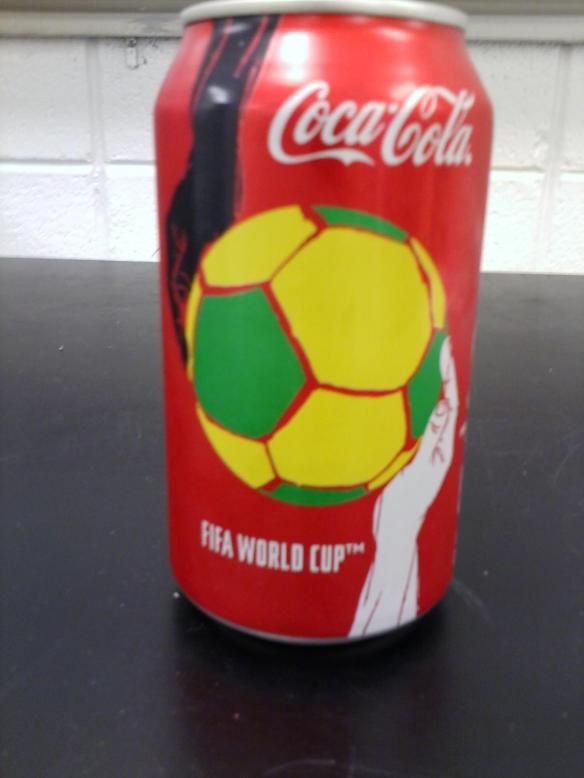
I was delighted to see that cans of Coca-Cola® now on sale feature a picture of a truncated icosahedron. This is real progress!

How To Make Tic-Tac-Toe Interesting

Image

How To Make Tic-Tac-Toe Interesting

Tic-tac-toe, played by the traditional rules, is so simple a game that few people with two-digit ages ever play it — just because it’s boring. It is so simple a game, in fact, that chickens can be trained to play it, through extensive operant conditioning. Such chickens play the game at casinos, on occasion — with the rules stating that if the game ends in a tie, or the chicken wins, the human player loses the money they paid to play the game. If the human wins, however, they are promised a large reward — $10,000, for example. Don’t ever fall for such a trick, though, for casinos only use chickens that are so thoroughly trained, by weeks or months of positive reinforcement, negative reinforcement, and punishment, that they will not ever lose. You’d be better off simply saving the same money until it’s cold, and then setting it on fire, just for the heat. At least that way you’d be warm for a little while, and that certainly beats the humiliation of being beaten, at any game, by a literal bird-brain.

With a small, simple alteration, though, tic-tac-toe can actually become a worthwhile, interesting game, even for adults. I didn’t invent this variation, but have forgotten where I read about it. I call it “mutant tic-tac-toe.”

In this variation, each player can choose to play either “x” or “o” on each play — and the first person to get three “x”s or three “o”s, in a row, wins the game. That’s it — but, if you try it, you’ll find it’s a much more challenging game. I am confident chickens will never be trained to play it successfully.

Consider the board pictured above, which happens to match a game I lost, to a high school student, earlier today. Red (the student) moved first, starting with the “o” in the center. I was playing with a blue marker, and chose to play an “x” in a corner spot. This was a mistake on my part, for the student’s next move — another “x,” opposite my “x,” effectively ended the game. I had to play next — passing is not allowed — and my playing an “x” or an “o,” in any of the six open spaces, would have led to an immediate victory by the student. If you study the board, you’ll see why this is the case.

Mutant tic-tac-toe is a great activity for semester exam week, at any school. Students who finish final exams earlier than their classmates can be taught the game quickly and quietly, and then they’ll entertain themselves with this game, rather than distracting students who are still working on their tests. What’s more, students have to really think to play this version of the game well, especially when they first learn it — and isn’t getting students to think what education is supposed to be all about, anyway?

Migraine

Image

Migraine

I thought I would try to paint a migraine headache, and a few years ago, I did so, and painted this. I then fell asleep, and woke up, with, of course, a migraine.

Who Reads This Blog?

Image

Who Reads This Blog?

The Zonish Cuboctahedron: A New Near-Miss Discovery?

Image

The Zonish Cuboctahedron:  A New Near-Miss Discovery?

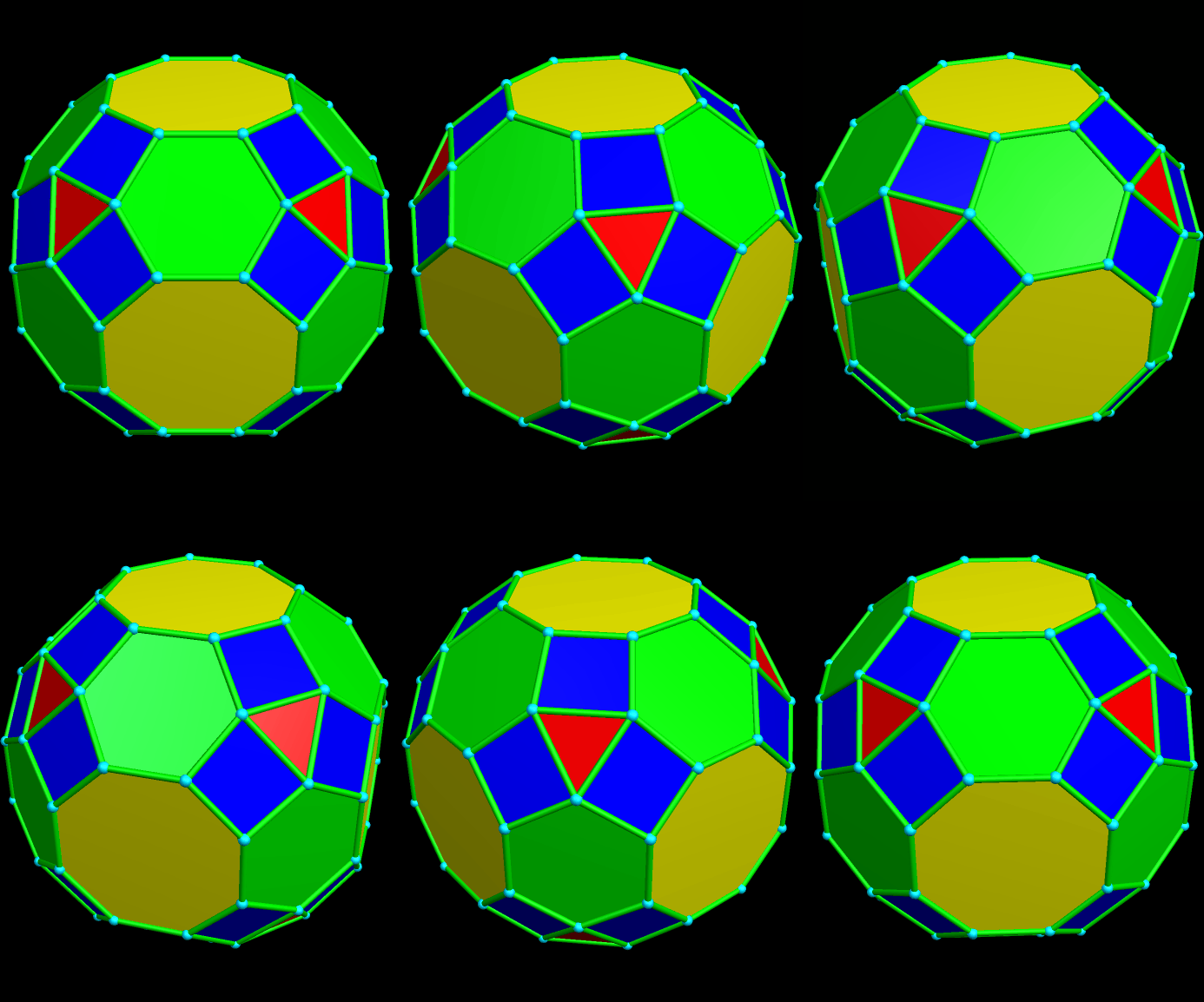
If one starts with a cuboctahedron, and then creates a zonish polyhedron from it, adding zones (based on the faces) to the faces which already exist, here is the result, below, produced by Stella 4d: Polyhedron Navigator (software you may buy or try at http://www.software3d.com/Stella.php):

new nearmiss before making faces regular its a face based zonish cuboctahedron

The hexagons here, in this second image, are visibly irregular. The four interior hexagon-angles next to the octagons each measure more than 125 degrees, and the other two interior angles of the hexagons each measure less than 110 degrees — too irregular for this to qualify as a near-miss to the Johnson solids. However, Stella includes a “try to make faces regular” function, and applying it to the second polyhedron shown here produces the polyhedron shown in a larger image, at the top of this post.

It is this larger image, at the top, which I am proposing as a new near-miss to the 92 Johnson solids. In it, the twelve hexagons are regular, as are the eight triangles and six octagons. The only irregular faces to be found in it are the near-squares, which are actually isosceles trapezoids with two angles (the ones next to the octagons) measuring ~94.5575 degrees, and two others (next to the triangles) measuring 85.4425 degrees. Three of the edges of these trapezoids have the same length, and this length matches the lengths of the edges of both the hexagons and octagons. The one side of each trapezoid which has a different length is the one it shares with a triangle. These triangle-edges are ~15.9% longer than all the other edges in this proposed near-miss.

My next step is to share this find with others, and ask for their help with these two questions:

    1. Has this polyhedron been found before?
    2. Is it close enough to being a Johnson solid to qualify as a near-miss?

Once I learn the answers to these questions, I will update this post to reflect whatever new information is found. If this does qualify as a near-miss, it will be my third such find. The other two are the tetrated dodecahedron (co-discovered, independently, by myself and Alex Doskey) and the zonish truncated icosahedron (a discovery with which I was assisted by Robert Webb, the creator of Stella 4d).

More information about these near-misses, one of my geometrical obsessions, may be found here:  https://en.wikipedia.org/wiki/Near-miss_Johnson_solid

My name made the “Stella 4d” library discovery credits!

Image

My name made the Stella library discovery credits!

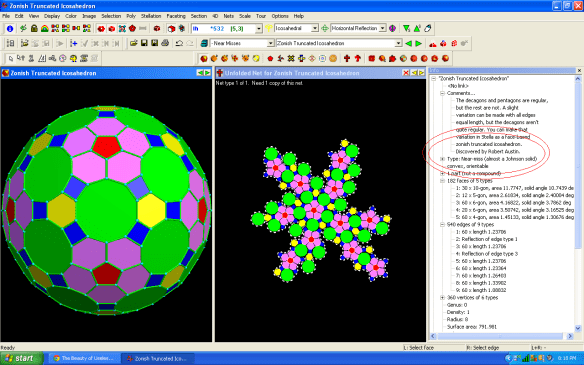
Stella’s creator just came out with a new version of Stella 4d, and a discovery of mine made the built-in library that comes with that software. This is my blog, so I get to brag about that, right? My legal name appears in the small print on the right side, at the end of the first long paragraph. I added the red ellipses to make it easier to find.

You can see the earlier posts related to my discovery of this zonish truncated icosahedron here:

https://robertlovespi.wordpress.com/2013/05/10/a-new-near-miss-to-the-92-johnson-solids/

https://robertlovespi.wordpress.com/2013/05/13/a-second-version-of-my-new-near-miss/

If you’d like to try (as a free trial) or buy this software (I recommend Stella 4d over the other available options), here’s the link for that: http://www.software3d.com/Stella.php.

The Beauty of Uselessness

Image

The Beauty of Uselessness

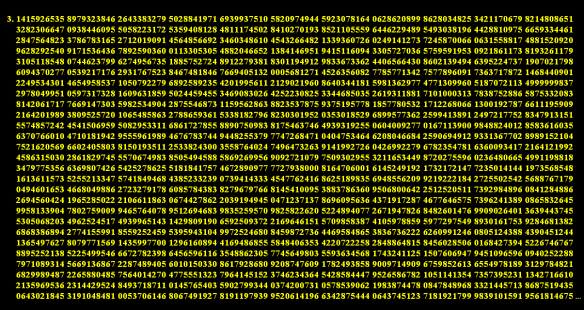
Given the name of this blog, and the familiarity of the number pictured above, I’m sure you recognize it as the beginning of my favorite number, pi. On various websites, you can find far more digits than are shown above. However, just the digits shown in the top row here are greater in number than that needed for any real-world, practical application. Is pi useful? Is mathematics itself useful? Of course they are . . . but those questions miss the point entirely.

Every teacher who has been in the field for long has heard the complaint, disguised as a question, “What are we ever going to use this for?” Unfortunately, most school systems, as well as teacher-training programs, have chosen to respond to this well-known complaint by repeatedly telling teachers, and teachers-in-training, that it is of extreme importance to show students how the curriculum is “relevant,” and adjust curricula to make them more so. This usually boils down, of course, to trying to convince students that learning is important because, supposedly, education = a better job in the future = more money. Sometime this “equation” works, and sometimes it does not, but it always misses a key point, one that should not be left out, but too often is.

It is a fallacy that learning has to have a practical application to be a worthwhile endeavor. There’s more to life than the fattening of bank accounts. Sadly, many of those making decisions in education do not realize this. Their attempts to reduce education to a strictly utilitarian approach are causing great harm.

This scenario has happened many times: a mathematician discovers an elegant proof to a surprising theorem, a physicist figures out something previously unknown about the nature of reality, or a researcher in another field does something comparable, and someone then asks them, “But what can this be used for?” On occasion, tired of hearing this utilitarian refrain, such researchers give unusually honest responses which surprise and confuse many people — such as, “Someone else might, at some point, find a practical application for this . . . but I sincerely hope that never happens.” Such a response is rarely understood, but it makes the person who says it feel better to vent some of their frustration with those who are obsessed with tawdry, real-world applications for everything.

Many humans — and this is a terrible shame — live almost their entire lives like rats in mazes, running down passages and around corners, chasing tangible rewards — cheese for the rats, or the ability to buy, say, a fancy new car, in the case of the people. People shouldn’t live like lab rats . . . and, unlike lab rats, we don’t have to. People are smart enough to find higher purposes in life. People can, in other words, find, understand, and appreciate beauty — in things which are useless, in the sense that they have no useful applications. We can appreciate things that transcend mere utility, if we choose to do so.

Much of life is utterly banal, for a great many people. They wake up each day, work themselves into exhaustion at horribly boring jobs, go home, numb themselves with television, massive alcohol consumption, or other hollow pursuits, fall asleep, and then get up and repeat the process the next day . . . and then they finally get old and die. Life can be so much more than that, though, and it should be.

The researchers I described earlier aren’t doing what they do for money, or even the potential for fame. Are such things as mathematics and physics useful? Yes, they are, but that isn’t why pure researchers do them. The same can be said for having sex: it’s useful because it produces replacement humans, but that isn’t why most people do it. People have sex, obviously, because they enjoy it. In simpler terms: it’s fun. Most people understand this concept as it relates to sex, but far fewer understand it when it relates to other aspects of life, particularly those of an academic nature.

Academic pursuits are of much greater value when the motivation involved is joy, and the fun involved, rather than avarice. As scrolling through this blog will show you, I enjoy searching for polyhedra which have not been seen before. I certainly don’t expect to get rich from any such discoveries I make in this esoteric branch of geometry, which is itself one subfield, among many, in mathematics. I do it because it is fun. It makes me happy.

Much of life is pure drudgery, but our lives can be enriched by finding joyous escapes from our routines. An excellent way to do that is to learn to appreciate the beauty of uselessness — uselessness of the type that elevates the human spirit, in a way that the pursuit of material goods never can.

This is the approach we should encourage students to have toward education. Learning is far too valuable an activity to be limited, in its purpose, to the pursuit of future wealth. It’s time to change our approach.