
When y=sin(x) is plotted on a polar coordinate system, with everything set, consistently, to radians, the resulting graph is a circle sitting atop the origin, with unit diameter.
When y=sin(x) is plotted on a polar coordinate system, with everything set, consistently, to radians, the resulting graph is a circle sitting atop the origin, with unit diameter.
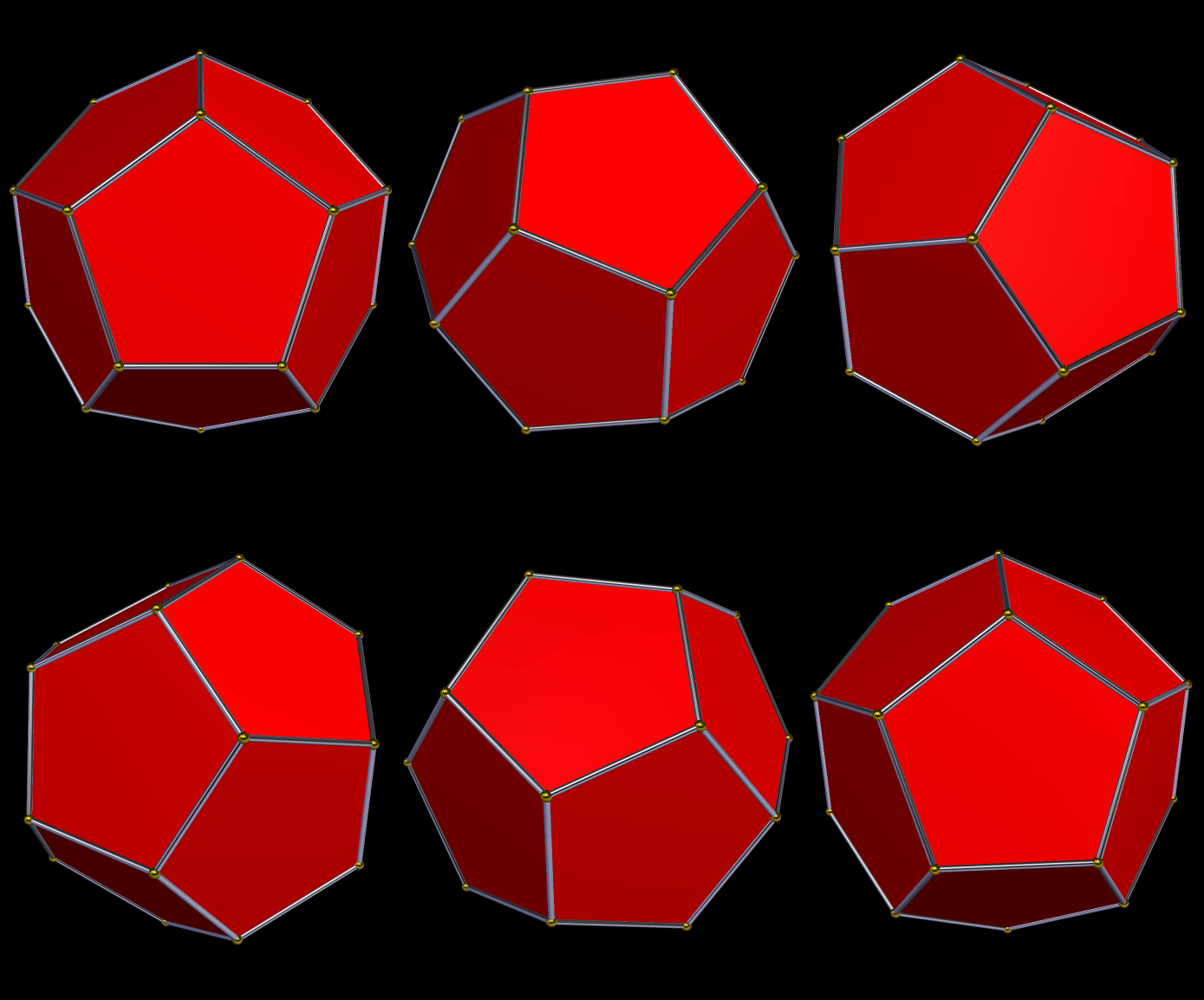
To make the compound of five cubes, begin with a dodecahedron, as seen above. Next, add segments as new edges, and let them be all of the diagonals of all the dodecahedron’s faces. Then, remove the pentagonal faces, as well as the original edges. What’s left is five cubes, in this arrangement.
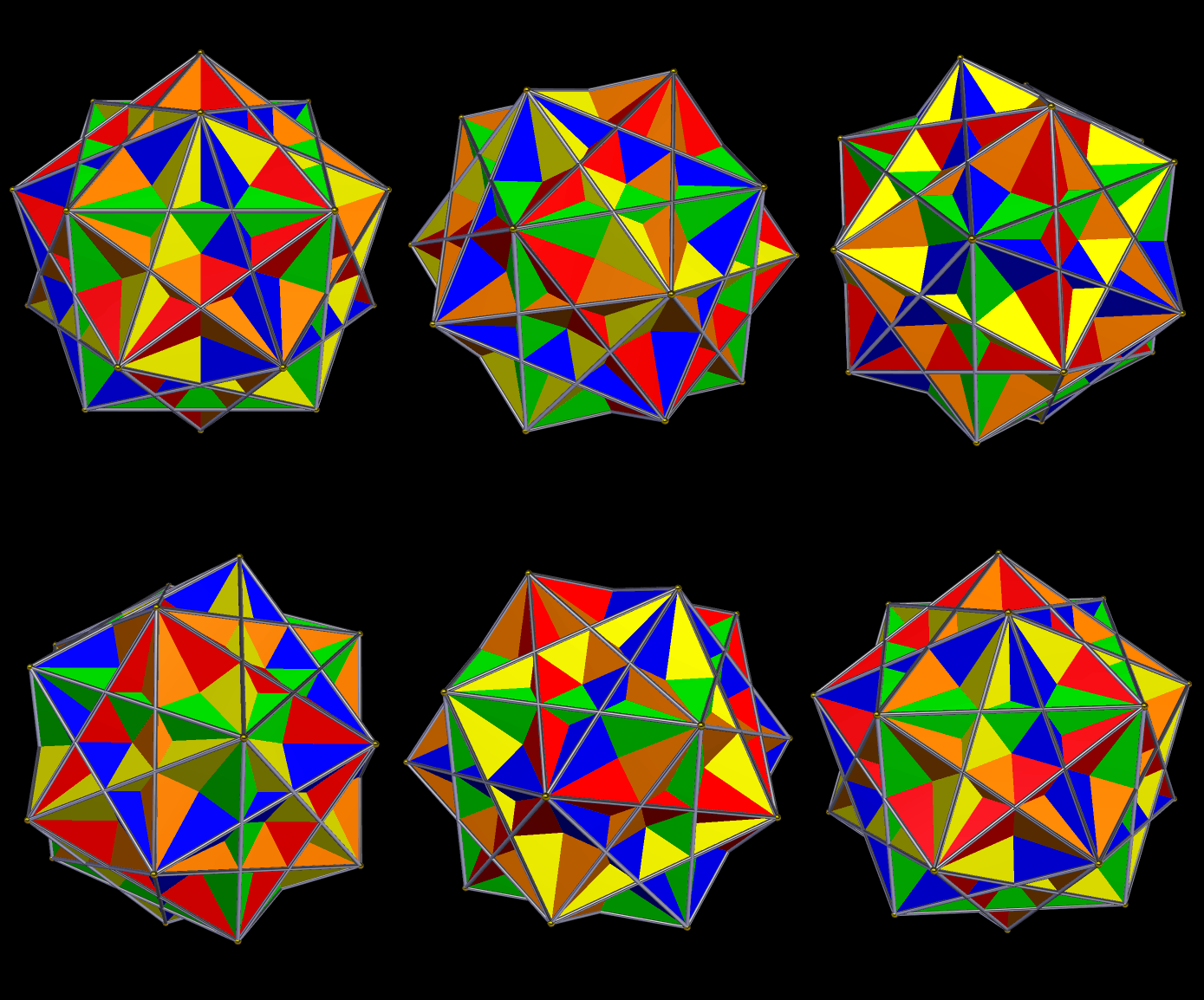
Using polyhedral manipulation software called Stella 4d (available at www.software3d.com/Stella.php), these five cubes can be removed one at a time. The first removal has this result:
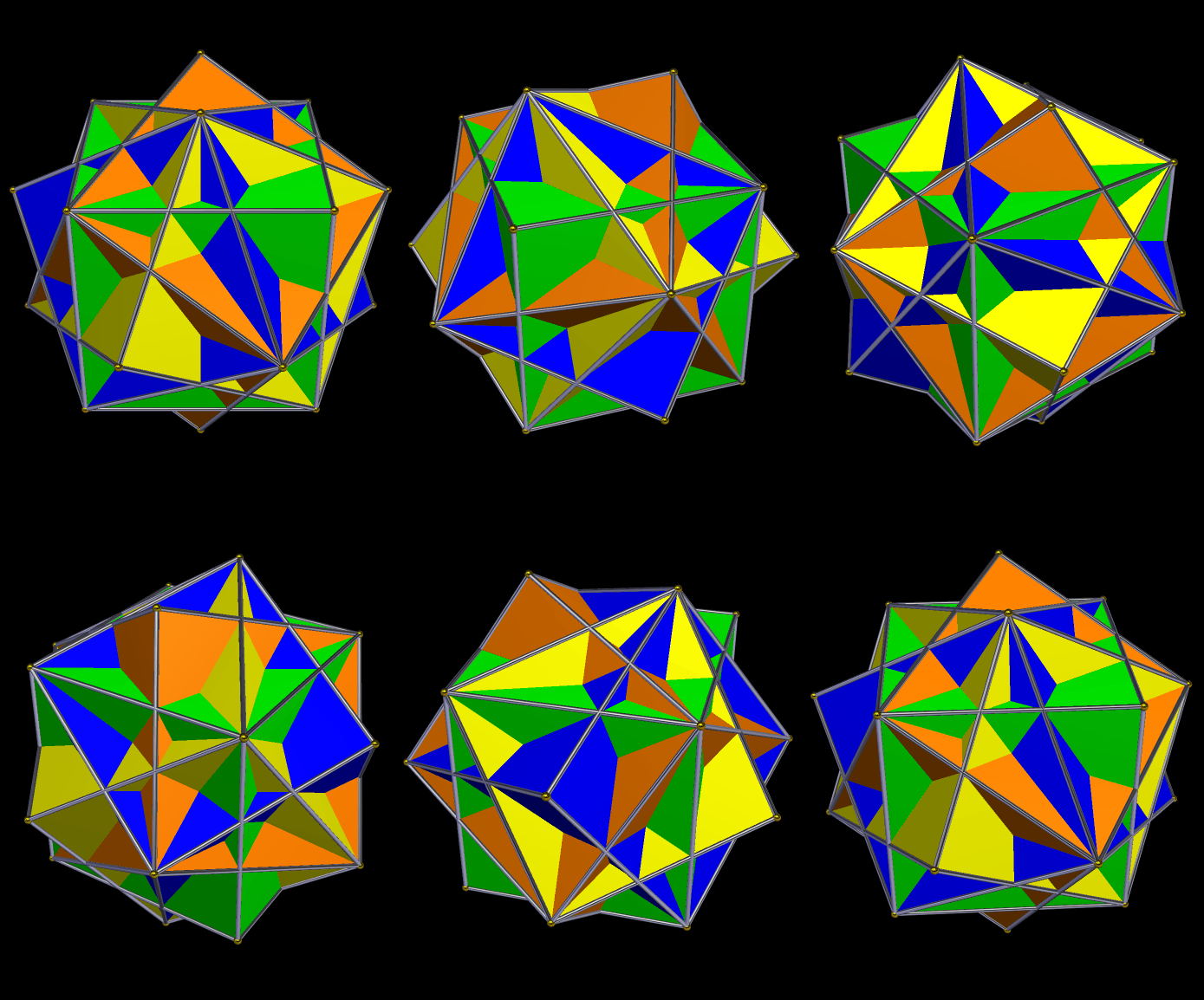
That left four cubes, so the next removal leaves three:

And then only two:
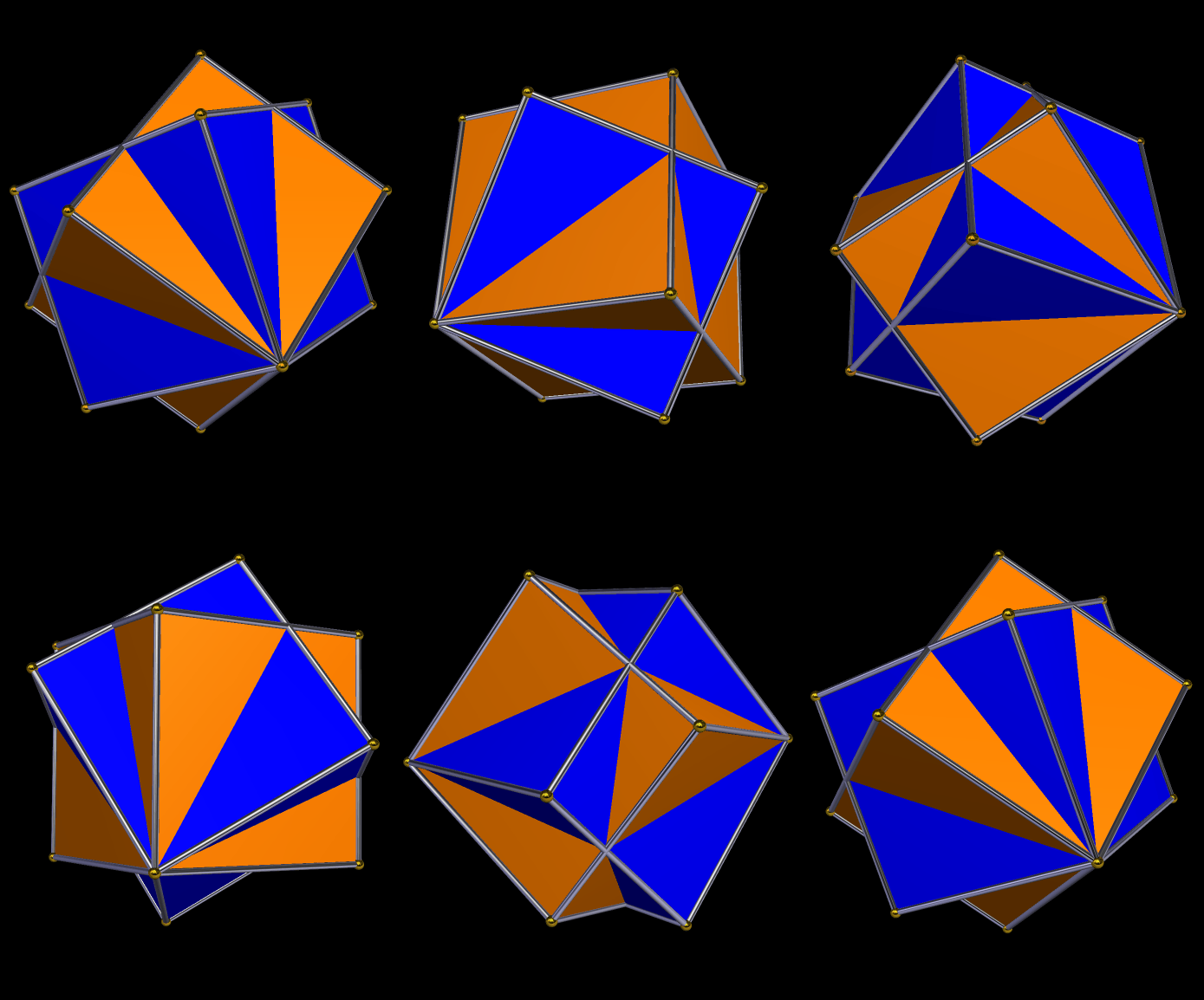
And, finally, only one remains:

Because their edges were pentagon-diagonals for the original dodecahedron, each of these cubes has an edge length equal to the Golden Ratio, (1 + √5)/2, times the edge length of that dodecahedron.

Evidence suggests that M33 is a satellite galaxy of the even better-known Andromeda Galaxy (M31), which happens to be on a collision course with our own Milky Way. In 1.5 billion years or so, Andromeda and the Milky Way will merge to form a giant elliptical galaxy already pre-named Milkomeda. At that point, the Triangulum Galaxy may become a satellite of Milkomeda (probably one of several), or be gravitationally ejected, or simply be absorbed into Milkomeda itself.
Here, it is projected on each face of the Catalan solid which is dual to the snub cube, using software you can try at http://www.software3d.com/Stella.php.

There are, as faces, 24 irregular heptagons, 6 irregular octagons of one type, and 12 of another, 24 rectangles of one type, and 24 of another, and 8 equilateral triangles. This was made using Stella 4d, which you may try or buy at http://www.software3d.com/Stella.php.
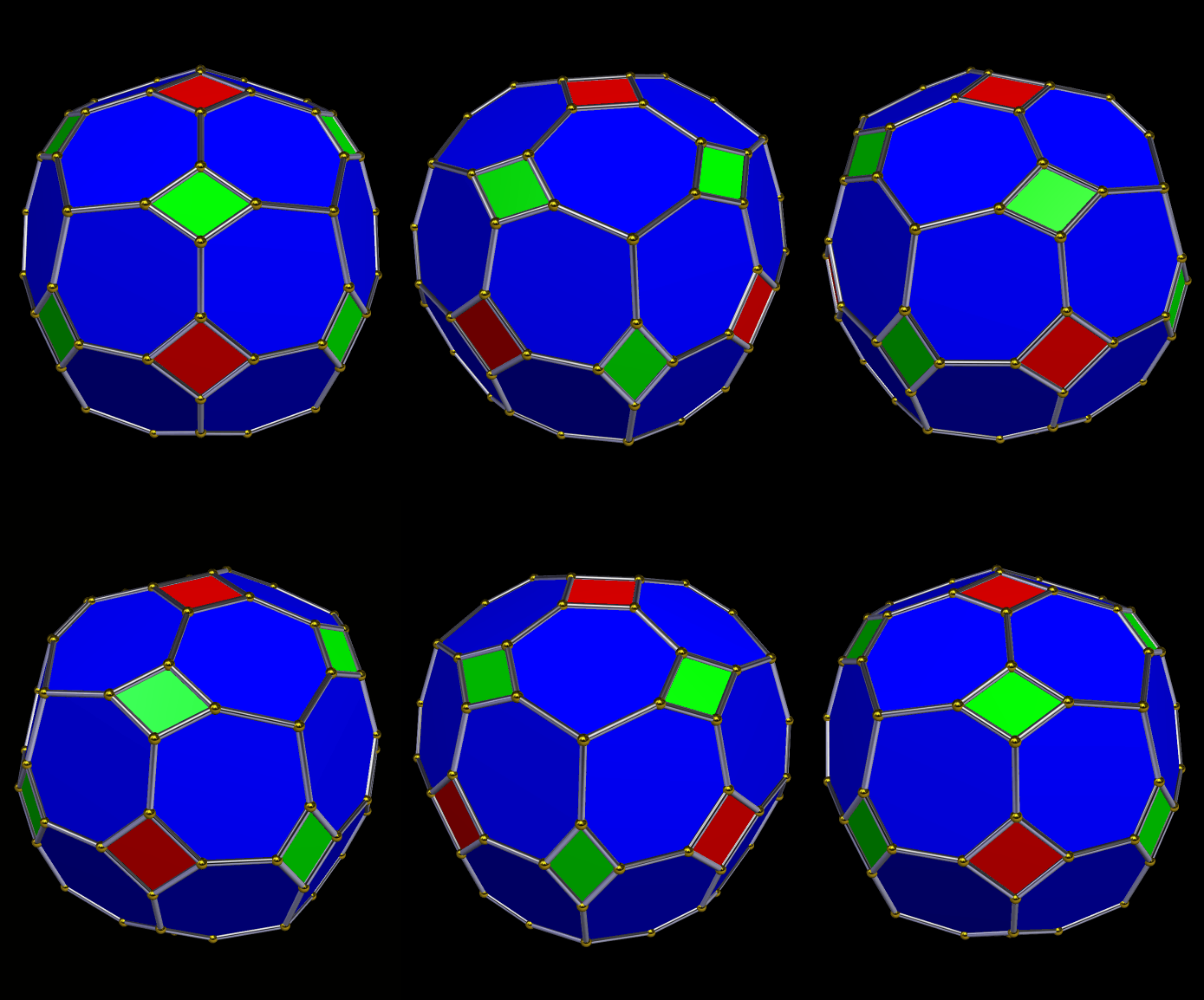
The blue faces are irregular heptagons, and are twenty-four in number. There are twelve of the green rhombi, and six of the red squares. This was made using Stella 4d, which you may try or buy at http://www.software3d.com/Stella.php.
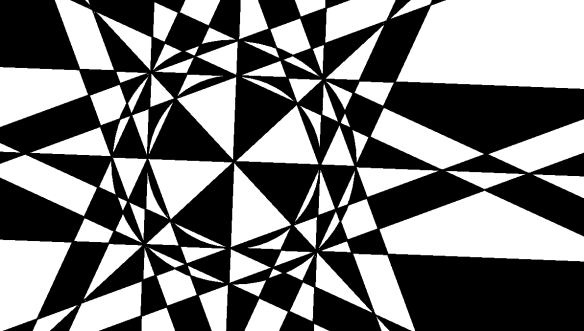
Eight led to this.
If you think about eight long enough, you will understand.
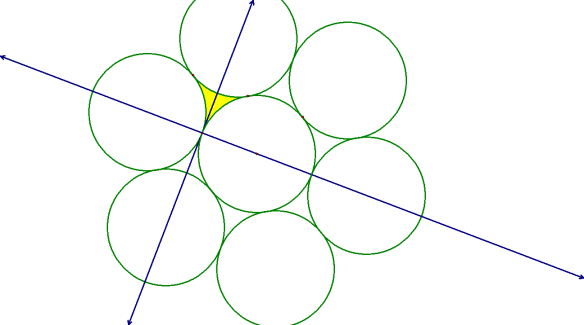
Regions between close-packed circles of equal radius resemble triangles, but with 60 degree arcs replacing the sides. As these regions are the only things left of a plane after all such circles are sliced out, and they each are outside all the circles used, I’ve decided to name them “circumslices.” Interestingly, the three interior angles of a circumslice each asymptotically approach zero degrees, as one approaches circumslice-vertices, which are also the points of contact of the circles.
Why did I name these things “circumslices?” Because they needed a name, that’s why!

Several recent posts here have been of tessellations I have made using Geometer’s Sketchpad and MS-Paint. To create this rotating polyhedron, I selected one of these tessellations, and projected it onto each face of a rhombic dodecahedron, using another program called Stella 4d. Unlike in the last, similar post, though, I set these tessellation-images to keep their orientation, from the point of view of a stationary observer watching the entire polyhedron rotate, from a distance. Since the polyhedron itself is rotating, this creates a rotation-effect for the tessellation-image on each face.
You can try Stella 4d for yourself, right here, for free: http://www.software3d.com.stella.php.

The last several posts here have been of tessellations I have made using Geometer’s Sketchpad and MS-Paint. To create this rotating polyhedron, I selected one of these tessellations (the one in the last post), and projected it onto each face of a rhombic triacontahedron, using another program called Stella 4d. You can try Stella 4d for yourself, right here, for free: http://www.software3d.com.stella.php.

Hexacontakaihexagons have 36 sides, and dodecagons, of course, have twelve. When a regular hexacontakaihexagon is surrounded by twelve regular dodecagons, in the manner shown here, adjacent dodecagons almost, but not quite, meet at vertices. The gaps between these near-concurrent vertices are so small that they cannot be seen in this diagram — a zoom-in would be required, with thinner line segments used for the sides of the regular polygons.
As a result, the yellow and purple concave polygons aren’t what they appear, at first, to be. They look like triconcave hexagons, but this is an illusion. The yellow ones, in sets of two regions that aren’t quite separate, are actually tetraconcave, equilateral dodecagons with a very narrow “waist” separating the two large halves of each of them. As for the purple ones, they appear to occur in groups of four — but each set of four is actually one polygon, with three such narrow “waists” separating four regions of near-equal area. These purple polygons are, therefore, equilateral and hexaconcave icosikaitetragons — that is, what most people would call 24-gons.
 RobertLovesPi.net