Explaining China, Part IV: A Response to “War with China” Hysteria

china-and-environs

[Note: the “Explaining China” series began here, and the source for the map above is given there as well.]

A persistent worry in the Western world, particularly among the political right, concerns a supposedly-coming-soon war with China, as if China were harboring ambitions to take over the world. Evidence for this idea’s existence can be easily obtained; simply enter “coming war with” into Google; it will supply China as the top choice with which to end the phrase.

People should stop worrying about a war with China. It isn’t hard to avoid one, and we have nothing to gain from such a war, anyway.

First, as with other nations, China will defend itself if attacked. Therefore, to avoid being at war with China, the first step is to refrain from attacking China.

The next step is to realize that China has a long history with invasion, particularly  from neighboring countries, and tries to maintain a “buffer zone” of controlled (or at least influenced) territory surrounding China — for defensive reasons, and with a rationale not unlike the one for the Monroe Doctrine in the Americas.

Since Deng Xiaoping changed the direction of China’s economy (“To be rich is glorious” is one of his famous quotations) from Maoist Communism to nominal-Communism, Chinese leaders have also become concerned about staying rich, and getting richer. To do this, they need markets to sell their stuff. Politically, what the Chinese want is simple: stability. Why? Also simple: China has had more than its share of instability, and this has often been fatal for millions of people. The Chinese have no desire for more instability. Therefore, they aren’t looking for a fight. They’ve let Hong Kong and Macau do pretty much what they want, relative t0 the rest of China, and they’ve tolerated their situation regarding Taiwan for decades. 

The only place where there has been outright war between the People’s Republic of China and the West has been the Korean peninsula, which is, of course, still a global “hot spot.” At the beginning of the Cold War, Korea was partitioned between the victors of World War II, as the USA and USSR, each with their allies, squared off against each other. This brought American troops into Korea. China did not become involved at first — not until Western forces were nearing the Yalu River, which separates North Korea from China. At that point, hundreds of thousands of Chinese “volunteers” crossed that river, pushing American forces back. Ultimately, a stalemate similar to the war’s starting point was reached, and is still there today, DMZ and all.

North Korea is dangerous, but that doesn’t mean China is seeking war there. Since the death of Mao, China has moved ever closer to the goal of political stability. The government of the Democratic People’s Republic of Korea (the DPRK, or North Korea’s absurd-but-official name) is a destabilizing force. If necessary, the governments in Beijing and Seoul can deal with Pyongyang. It would be best if the West did not get involved, unless (and this is unlikely) our assistance is requested.

It is a fact that we (the USA) have treaty obligations all over the place, and that is a problem we should fix. World War II is long over, as is the Cold War. Japan, Taiwan, and South Korea can now afford to pay for their own defenses. We should let them do this, and renegotiate the various treaties which would make it difficult for the United States to stay out of East Asian conflicts, on the grounds that these treaties (in present form) are no longer necessary.

The Chinese aren’t looking for a fight; they are quite busy, and have been for decades now, making lots of money by making things we need, and selling them to us. That might anger some people who bemoan the associated movement of jobs to China, but it is certainly no reason for war. The Chinese certainly won’t seek out war with us, for, without us, they can’t sell as much stuff, and would therefore make less money.

The people of China want stability, wealth, and more stability. They know, from their own history, that the opposite of these things often results in millions of deaths. Overt war is not on China’s agenda, nor should we put it there, by indulging in ill-considered American military (mis-)adventures in East Asia. There is no good reason for war with China to ever happen again. To avoid it, we must only do two things:

  1. Don’t attack China.
  2. Don’t get into violent conflicts with lands which share a border with China.

It would also help if the American political right would tone down the saber-rattling, but that’s probably not going to happen. On the other hand, as long as the rhetoric is not mixed with actual military actions, it can be safely tolerated. We have been doing that for decades, anyway, after all.

How America Typically Sees the World

how-america-sees-the-world

This problem reaches its worst levels during presidential campaign years. It’s particularly bad during 2016.

A Music Video: Janis Joplin’s “Mercedes Benz”

“A song of great social and political import” from the 1960s, as well as a fun song for which to make a music video — or sing, a capella, in public, loudly and obnoxiously. =D

A Back-to-School Gift for GSAs Everywhere: Simple Internet Memes Explaining the Best Reason to Support Gay Rights

gay rights are human rights

Although I did make these images, they are deliberately copyright-free, and their use by Gay-Straight Alliances, or GSAs, at schools everywhere is encouraged. LGBTQ students have been tormented for far too long. Together, we can make this their best school year to date.

Gay_Rights_Are_Human_Rights

Marriage equality has (finally) been accomplished in the USA, thanks to our Supreme Court. However, suicide rates among gay teens remain extremely high, due to bullying and homophobia, especially in schools, making the work of GSAs (Gay-Straight Alliances) critically important. People should not be treated this way. Recognizing this simple fact supplies all the reason necessary to support gay rights; no argument stands against it.

gay rights are human rights 2

My Answers to Facebook’s “Religious Views” and “Political Views” Questions

facebook

I don’t like to use terms I did not make up myself for things as important as questions such as these, and so I don’t. Attempted Orthoism rests on a foundation of skepticism, which is a metaphorical lens I try to apply to everything. Skepticism is, of course, essential for anyone who works in science and/or science education, and I am a science teacher. This is why science plays a role in both definitions above.

A Completely Unscientific Presidential Poll

The school year is about to begin, and I’m a teacher. Right now, my school district is in the traditional “week o’ meetings” which precedes the arrival of students. Yesterday’s meetings were about using Google products to enhance instruction, and one of the new skills I learned involves using Google forms. We were encouraged to make something, such as a poll, using this online tool, so I made one for the current US presidential election. If you would like to vote in this completely unscientific poll, here’s the link:

https://goo.gl/forms/Ki2x7OLyPoQoJviJ2

This poll is “completely unscientific,” of course, because I am making no attempt to poll a representative sample of the electorate. Here’s how the poll results look so far, with 17 responses.

poll results

Just 14 States Choose America’s Next President

14 states decide who the president is

If you live in one of the states shown in gold, congratulations — both the Trump and Clinton campaigns want your vote, for you live in a “battleground” or “toss-up” state, or at least one that only slightly “leans Democrat” in polls, or “leans Republican.” 

The states shown in purple, on the other hand, are taken for granted by one campaign, while the other campaign regards them as “lost causes.” My own state, Arkansas, for example, is solid Trump territory, even though I can’t stand the man. These states don’t offer a competitive race.

In a presidential campaign where most people are voting against someone, rather than voting for anyone, this map is important for strategic voting. In my case, for example, I see the two major parties as offering me a choice between bad (Clinton) and worse (Trump). If I lived in a golden state, I’d probably hold my nose and vote for Clinton, for, in such a state, the urge to stop Trump would compel me to vote against the person with the best chance of beating Trump.

However, my state is purple. It’s solid Trump-turf. Hillary Clinton herself knows she won’t carry Arkansas. My anti-Trump vote is largely symbolic, and, as such, I want to use it to send a message to both the Republican and Democratic parties. It’s a simple message: “give us better choices.” To send such a message, I need to vote for someone else, and there are two major alternatives: Gary Johnson, the Libertarian candidate (his website is at https://www.johnsonweld.com/), and Dr. Jill Stein, the Green candidate (her website is at http://www.jill2016.com/). To make a statement that the government needs to pay more attention to carbon emission and climate change (and the major parties need to give us better candidates in elections), I’ve decided to vote Green this year.

This same logic would hold true were I in, say, New York, also purple. New York is purple because both candidates know it is a “safe” Clinton state. If I lived there, Clinton would carry that state with or without my vote, so, again, I would cast my protest vote for Jill Stein.

To the majority who live in purple states, and dislike both Trump and Clinton, I ask you to consider casting your vote for either Johnson or Stein. Voters in the golden states, on the other hand, are involved in competitive races, and (pragmatically) should vote for Hillary Clinton if they want to do anything to stop Trump, or vote for Trump if they are willing to vote for anyone to keep Hillary Clinton out of the White House.

It is a shame that votes matter more in some states, and don’t matter as much in others. For this reason, I would favor an Amendment to the Constitution to abolish the electoral college, and choose our presidents by direct popular vote, with a two-person, nationwide runoff election a month later, if the candidate with the most votes only wins a plurality of the popular vote in November.

Explaining China, Part III: Basic International Etiquette Involving the Chinese, as well as their Korean and Japanese “Neighbors,” and Americans


Multiple East Asian nations are discussed in this post, the third of a series which began here, and is usually focused only on China, and the Han Chinese. Those nations are The People’s Republic of China (the PRC); Taiwan, officially known as the Republic of China (ROC); North Korea; South Korea; and Japan. Many Americans, when they see a person whom they think is from East Asia (based on appearance), will simply guess — and sometimes they go even further, and guess out loud. This is usually not intentional rudeness, but it is a socially-dangerous breach of etiquette, made all the more serious if a spoken guess is an incorrect one. The reasons for this are complex, involving such things as tense relationships between ethnic groups and historical atrocities. The etiquette-based solution to avoid walking into a metaphorical minefield, once understood, is a simple set of principles. If you simply want to look for the principles, and skip the explanation of how I learned these things, and why they make sense, simply look for the red, centered text.

1. Listen carefully, before and after talking.

2. Silence is seldom considered rude.

s-l500

3. Every interaction (as might happen playing the game above) is an opportunity to learn.

The board and stones above will be recognized, as the game of go, by many people around the world. Go is the national game of Japan. Although I would never say this if I were in Japan, this game originated in China. The Chinese call it weiqi (pronounced “way-chee”), and the Japanese call it igo (this word sounds like the English word “ego”). Japan introduced this game to the Western world, which is why its English name is similar to the Japanese, rather than the Chinese, name. However, I did not learn this game from a Chinese nor a Japanese person, so, when in the presence of this teacher (who taught me taekwondo as well), I had to remember to call the game baduk, its name in Korean.

4. If you must guess about ethnicity, keep your guesses to yourself.

At the time I learned both go and taekwondo, I was a young teenager. The angriest I ever saw this teacher was an occasion where an American adult assumed, out loud, that he was Japanese. Being young, I didn’t put cause and effect together by myself, but it was later explained to me: during World War II, which had ended less than forty years ago at that time, atrocities had been committed by Japanese during World War II in South Korea. My teacher immigrated to the United States from South Korea a generation later, in 1977, and the angriest I ever saw him was in reaction to this blunder by the American who called him Japanese, because of what had happened to his nation during WWII.

There have been many other conflicts between East Asian nations, as well, including China, which was also invaded by Japan. Following WWII (which ended with the USA dropping two atomic bombs on Japanese cities), the Korean War started, which brought China into conflict with both Koreans and the USA. All these conflicts are within living memory, meaning that there are people still alive who remember these things happening. These international conflicts (and earlier ones, of course) are a major reason for inter-ethnic conflict, and few people want to be confused with their historical enemies.

5. An understanding of history can explain much basic etiquette.

Later still, I encountered other ways people can make social blunders of related types. For example, anyone born in the USA is an American citizen, and can be legitimately called an American — and that’s a term to which most American citizens do not object. If the person’s parents came from, say, Taiwan, and they are ethnically of the Han, this creates a situation few Americans understand, for the whole China/Taiwan thing is certainly complex. Under such circumstances, it’s perfectly understandable that one might prefer to be called “American,” rather than having to try to explain exactly which China one’s parents immigrated from. Many Americans, after all, do not even know that two Chinese governments (the PRC’s in Beijing, and the ROC’s in Taipei, both claiming for decades to be the government of all of Greater China) exist. 

However, there is an even better way to refer to individual people — any people, anywhere.

6. When possible, use people’s names and/or titles, expressed politely, and pronounced correctly.

With my taekwondo and baduk teacher, for example, it was seldom necessary to call him anything other than “Mr. Lee,” or simply, “sir.” I knew he was Korean, and from South Korea, but that was seldom discussed. I learned much by simply paying attention to him, and he taught me a lot. Later, I learned things about Japan, mostly from exposure to, and conversation with, Japanese people. Still later, I began learning about China (both the PRC and the ROC) and the Han, and found that my best sources of information were — no surprise — people of the Han, themselves.

7. For more detailed advice on etiquette, seek insider sources.

This means that, if you’re preparing to visit mainland China (the PRC), and want advice to avoid social blunders there, you’ll get your best information from those who have lived in the PRC. Similar principles apply to other places, such as my learning elements of Korean etiquette from a Korean. With people who are currently located in the PRC, though, one must carefully stay on topic, and there is one topic which must be avoided.

8. To avoid putting them in danger from their own government, do not discuss political issues with anyone located in the People’s Republic of China.

This would also apply to North Korea (formally: the Democratic People’s Republic of Korea, or DPRK), but that is far less likely to come up, simply because the PRC now encourages foreign tourism there, while the DPRK remains a closed society, as the PRC was during the reign of Chairman Mao. Both of these governments are totalitarian, are perfectly willing to kill their own citizens, and will not tolerate any propaganda (discussing, say, democracy, or human rights, would count as propaganda), except for their own.

Principle #9, below, is essential to understanding anything about these East Asian nations. When I studied East Asian history in graduate school, this was my starting point.

9. China ≠ Japan ≠ Korea.

10. Remember that these are basic principles only, and use #7 to learn more.

It would be a mistake for anyone to take this as a complete list, for it is not.

[Image credit: I found the image of a weiqi/baduk/igo/go set on eBay, right here. It is for sale for the next few weeks.]

Calvin and Hobbes, and Election 2016

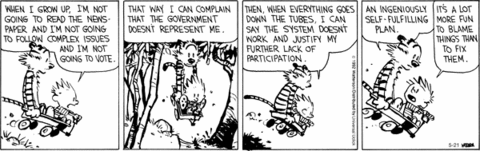
The current American election cycle was predicted, with amazing accuracy, in the late 20th Century, by Bill Watterson, the creator of Calvin and Hobbes. Evidence will follow. We’ll start with ignorance and apathy, both of which are certainly involved in American elections.

900b35f791cce9921b4119d2b3ed2e4c

28141d5022b2012f2fca00163e41dd5b-thumb-480x151-646

Not wanting to vote and not being allowed to vote are, of course, two different things to Calvin.

calvinvote

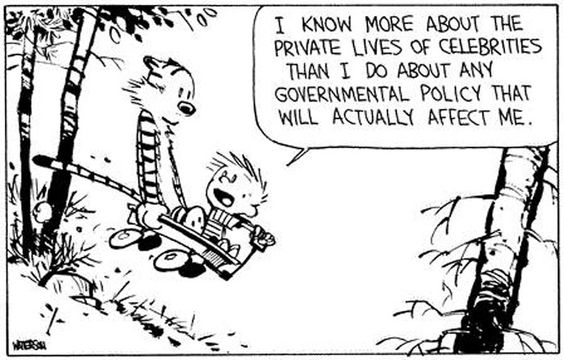
While he’s being ignorant and apathetic, Calvin is, at least, honest. Honesty is something which we definitely need, and currently do not have, in American politics, from the left or the right.

162943bdf715ffe34d954fafc9d7988b

If only this fictional duo qualified under the Constitution, we’d be facing this choice, which certainly seems better than the choice we actually have:

Watterson understood, well, the corrupting role of money in politics.

megalo

The big issue politicians do not talk about enough is the environment. Why do they not devote more energy to that? Money, of course. The love of money drives people to do harmful and irrational things, and this includes things with obviously-negative environmental impact.

calvin and dryer

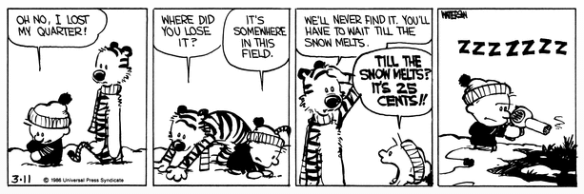
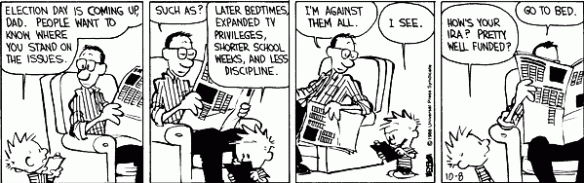
He also created numerous cartoons about pollsters and lobbyists, taking them every bit as seriously as these people deserve to be taken.

Calvin-and-Hobbes-Attendance

calvin-hobbes-election-day1

ch_dadpost

polls2

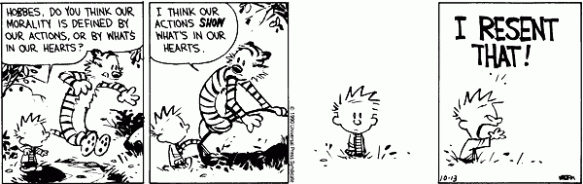
America has a lot of single-issue voters. They are not safe from Watterson’s satire. This cartoon is as on-target today as it was when it first appeared.

41jPq

For what purposes was Calvin willing to do research? Could his spray-painting ambitions include negative campaign ads?

aa7c0e40449f50ef43ad3629bd8401a3

I certainly think so. 

The next cartoon applies equally well, in my opinion, to the words and actions of both Donald Trump and Hillary Clinton.

ch9410131188056052

If the next cartoon doesn’t remind you of the Trump-or-Clinton choice we face, and what an amazing waste of time and energy it is to have to make such an absurd “choice,” please read it again. 

ch110419_thumb[1]

Finally, here’s Calvin’s invention of the perfect bipartisan slogan for this campaign season, and its nausea-inducing choice between bad (Clinton) and worse (Trump).

calvinapathy

“So what?” Indeed.

[To obtain all these cartoons, and many more, I recommend purchasing this boxed set: the complete collection of Calvin and Hobbes.]


Hillary Clinton’s Other E-mail Problem

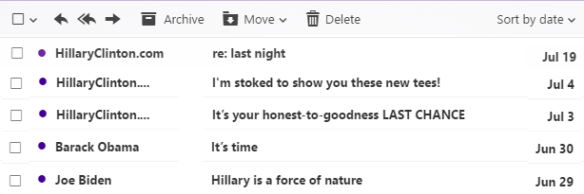
This has nothing to do with those other e-mails tied to Hillary Clinton — the ones which have recently been under official investigation, and in the news. It’s a completely different thing: e-mails sent out by her campaign for the White House, and unrelated to her time as Secretary of State.

Hillary Needs Me

Other e-mails, entirely too much like this, preceded the “I need you” e-mail I received yesterday. I’ve been making fun of them on Facebook for quite some time, but hadn’t brought them to my blog until now. I’m simply using cropped screenshots from my e-mail account for these pictures, and keeping the e-mail senders, subject lines, and dates together, for each e-mail. If anyone wishes to check the authenticity of these e-mails with the Clinton campaign, that’s fine with me. You’ll find that these e-mails are real (or they’ll lie to you; I can’t rule that out). If lies are told, I’ve got the evidence in my e-mail account, as do many others. This is not a complete set, either; it’s just the most recent of these, um, strange e-mails from her campaign minions. 

Hillary Needs Me 2

I don’t know how I got on Hillary Clinton’s presidential-campaign e-mail list, but I am not complaining about it. If I wasn’t on her campaign’s list, after all, I wouldn’t know that all these e-mails are going out, with her name (and sometimes others, as seen above) as the sender, and such things as “re: last night” in the subject line. That would deprive me of this opportunity to use real campaign materials to ridicule a major-party presidential candidate, or, in other words, prevent this particular bit of fun. There were other such e-mails before June 29 — long before, actually — but this is all of this kind of thing I can stand to put on my blog.

To Hillary Clinton (the person, not her campaign staff): Really, H.C.? Do you not monitor your campaign flunkies at all? These e-mails could bring new meaning to the term “madame president,” and I really don’t think they will help you at the ballot box, either.

To Donald Trump, and his ilk: don’t think this means I support you. I don’t.

For whom will I cast my vote, some may wonder? Well, I have it narrowed down to two candidates, but neither of their names appear in this post. For more information regarding where my vote will go, simply click here.