
Constructing the nine-point circle is an interesting exercise in geometry. In the above triangle ABC, the segments inside the triangle are its three altitudes, with the “feet” of the altitudes labeled E, F, and G. The midpoints of the sides of the triangle are labeled L, M, and N. The orthocenter, where the three altitudes meet, is labeled O, and then the midpoints of the three segments connecting the orthocenter to each of the triangle’s vertices are labeled X, Y, and Z.
It has been long proven that these three sets of three points each (E, F, G; L, M, N; and X, Y, Z) lie on the same circle, for any triangle. Point Q is at the center of this nine-point circle.
The diagram above uses, as triangle ABC, a triangle which is both acute and scalene — and in such a triangle, the nine points in question are in nine different locations. Of course, triangles do not have to be acute and scalene — and for some other types of triangle, the nine points end up in fewer than nine distinct locations.
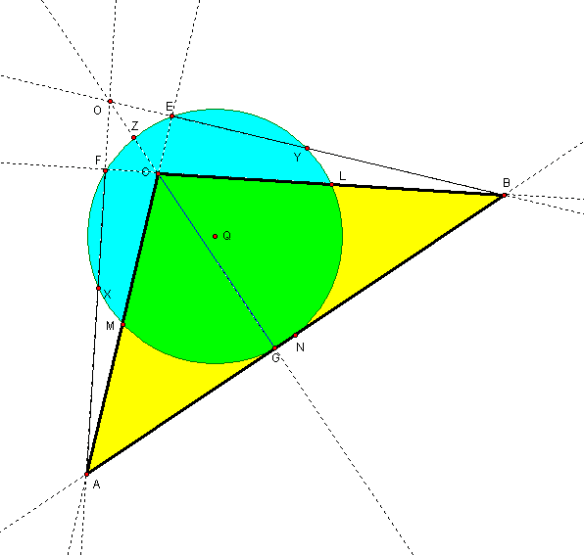
Of other classifications of triangle, only this one, an obtuse and scalene triangle, still has the nine points in nine different locations. With other triangles, the number of such locations decreases.
As a next step, consider a triangle which is acute and isosceles:

The base of this isosceles triangle is segment AB, and it is on segment AB that two of the nine points end up in the same place. Point G, the foot of the altitude to the base, is at the same place as point N, the midpoint of the base. Since the other seven points remain distinct, this type of triangle has its nine points in eight locations.

Another triangle which has eight distinct “nine-point circle” points is the obtuse, isosceles triangle, for the same reason: the foot of the altitude to the base (G) and the midpoint of the base (N) are in the same place. Eight is not the limit, though — this number can be reduced still further. As one attempts to do so, it doesn’t take long to figure out that there is no way to reduce this number to seven . . . but six is possible:
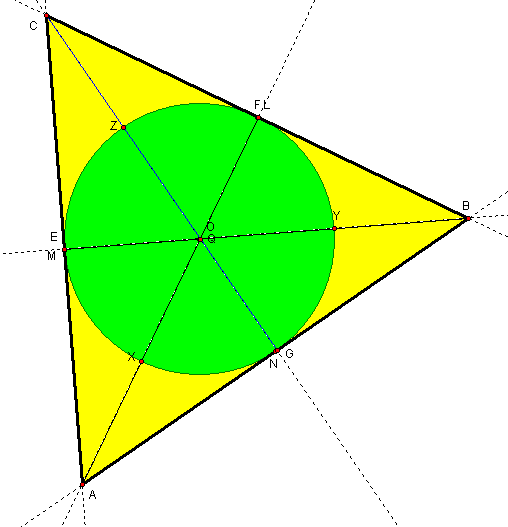
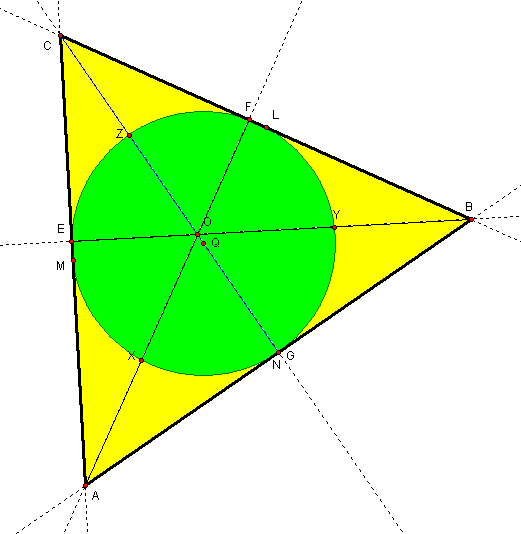
For the nine points under examination to end up in only six distinct locations, as seen immediately above, a triangle is needed which is equilateral (and equiangular as well, for you can’t have one without the other when dealing with triangles). In such a triangle, each side-midpoint ends up at the same place as an altitude-foot, providing three of the distinct six points. The other three are the midpoints of the segments connecting the orthocenter to each vertex. Also, it is only for this type of triangle that the orthocenter (O) is the center of the nine-point circle itself (Q). One might think that this type of triangle, being regular, would minimize the number of distinct locations for the “nine” points . . . but that is not the case.

To reduce this number below six, right triangles are needed. With a scalene right triangle, there end up being five such locations: the midpoint of each side, the vertex of the right angle, and the foot of the altitude to the hypotenuse. However, five is not quite the minimum.

If a right triangle is isosceles, rather than scalene, the foot of the altitude to the hypotenuse moves to the midpoint of the hypotenuse, and this reduces the number of distinct “nine-point circle” points to its absolute minimum: four. Such a triangle is also called, of course, a 45-45-90 triangle. Interestingly, these four points may be used as the vertices of a square (not shown in the diagram above) which has an area exactly one-half that of triangle ABC. The proof of this is left as an exercise for the reader.
{Later edit, March 2018: an alert reader pointed out to me that I “missed some obtuse [triangles] that have only eight or six points on the nine-point circle.” Good catch, F.D.!}







 RobertLovesPi.net