Explaining China, Part II: What Do I Know, About China, and How Did I Learn It?

PRC and ROC and Barbarian Nations

In the map above, the People’s Republic of China (PRC) is shown in red, while the Republic of China (ROC) is shown in yellow. “Barbarian” nations (from the point of view of the Han, or the ethnic group we call “Chinese” in English) are shown in orange, and both oceans and large lakes are shown in blue. The third (and only other) majority-Han nation, the island city-state called Singapore, is not shown on this map, as it is too far to the South to be seen here. From the point of view of the Han, “barbarians” have been, historically, those humans who were not Han, while “the Han” can be translated as “the people.”

This historical xenophobia I just described among the Han is hardly unique; it is, in my opinion, simply human nature. The British rock band Pink Floyd explained this, quite well, in the following song, “Us and Them,” from 1973’s classic Dark Side of the Moon. This album, in the form of a cassette tape which had to be purchased by my parents (for I would not let go of it in the store we were in), happens to be the first musical album I actually owned, back when it was newly-released (I was born in 1968). If you choose to listen to this song, please consider this idea of xenophobia, as simply being a human characteristic, while it plays.

Ancient Greeks had the same “us and them” attitude about those who did not speak Greek, and the English word “barbarian” is derived from Greek, with a meaning which parallels what I have described in China. Eurocentrism, in general, in the study of “world history,” is well-known. Moving to another continent, the people where I live, the USA, are famous for learning geography one nation at a time . . . as we go to war with them, of course. Only a tiny percentage of Americans knew where either Korea was located until we went to war there, and we (as a people) did not know where Vietnam was until we went to war there. More recently, Americans learned — twice! — where Iraq is, though many of us still, inexplicably, confuse it with Iran. This list of xenophobic nations is far from complete, but these examples are sufficient to make the point.

When, in 1939, British Prime Minister Winston Churchill uttered the famous phrase, “It is a riddle, wrapped in a mystery, inside an enigma,” he was referring to the Soviet Union (or USSR), although the proper noun he actually used was “Russia.” However, this quotation applies equally well to the PRC, which has one indisputable advantage over the USSR: the People’s Republic of China still exists, while the Soviet Union does not. In the last post here, I began an ambitious series, with the goal of explaining China. I promised, then, that my next post in the series would explain my qualifications to write on the subject of the PRC, the ROC, Greater China, and the Han — so that’s what I need to do now.

I am currently working on my second master’s degree, in an unrelated field (gifted, talented, and creative education). However, my first master’s degree was obtained in 1996, when Deng Xiaoping, while no longer the PRC’s “paramount leader,” was still seen as its most prominent retired elder statesman. It was Deng Xiaoping, primarily, who made (and defended) the decision to send the tanks in, and crush the pro-democracy demonstrators in Tiananmen Square, in Beijing, in June of 1989, which I watched as they happened, on live TV. I was horrified by those events, and this has not changed.

During the early 1990s, I began studying the economic reforms which made the era of Deng Xiaoping so different from Chairman Mao’s China, trying to figure out the solution to a big puzzle: how so much economic growth could be coming from an area dominated by a huge, totalitarian, country which, at that time and now, was one of the few remaining nations on Earth which still claimed to be Communist. This study was done during the time of the “New Asia” investment bubble, as it was called after it “popped” (as all investment bubbles do, sooner or later). New Asia’s economic growth was led by the “Four Tigers” of Hong Kong (still a British colony, at that time), Singapore, Taiwan, and South Korea. South Korea is, of course, Korean, but the other three “tigers,” all had, and still have, majority-Han populations. What money I had, I invested in the Four Tigers, and I made significant profits doing so, which, in turn, led to a general interest in East Asia. 

Motivated by simple human avarice, I studied the Four Tigers intensely, leading me to focus (to the extent made possible by the course offerings) on 20th Century East Asian history, during the coursework for my first master’s degree. There was a problem with this, though, and I was unaware of it at the time. My university (a different one than the one I attend now) had only one East Asian history professor, and he was very much a Sinophile. Sinophiles love China uncritically, or with the minimal amount of criticism they can get away with. When we studied the rise to power of Mao Zedong, and the PRC under the thumb of Chairman Mao, I heard it explained by a man who viewed China, and Chairman Mao, through rose-colored glasses, even while teaching about others who made the same error, to an even greater degree. I had already read one book about the Cultural Revolution, earlier in the 1980s, so I was skeptical, but he was also my only professor. The result was confusion. This was the book I had already read, along with a link to a page on Amazon where you can purchase it, and easily find and purchase the Pink Floyd music posted earlier, if you wish to do so. This is Son of the Revolution, by Liang Heng and Judith Shapiro, and you can buy it at https://www.amazon.com/Son-Revolution-Liang-Heng/dp/0394722744/ref=sr_1_1?ie=UTF8&qid=1468869380&sr=8-1&keywords=son+of+the+revolution.

Son of the Revolution

This book was read for an undergraduate sociology course, at my first college, during the Reagan years. The important thing to know about Liang Heng, the book’s primary author, is that he was, himself, of the Han, as well as being from the PRC itself. The professor for this course wanted us to see the horror of a mass movement gone horribly wrong, and she chose this insider’s view of the Cultural Revolution, during which I was born, to do that. What I heard from my East Asian history professor did not mesh well with what I was taught by my East Asian history professor, and so I left that degree program confused. This professor’s argument, in a nutshell, was Chairman Mao was a figure of tremendous importance (true) who had good intentions (false), and tried to do amazing things (half-true, and half-false by omission, for these were amazing and horribly evil things), but had them turn out wrong (true), with many millions of his own people dying as a result, over and over (definitely true; Mao’s total death total exceeds that of Hitler or Stalin, either one). The “good intentions” part was what confused me, of course, for Mao was a monster, yet, from my later professor, I was hearing him described as a Great and Important Man.

I would have remained in this confused state, has I not also read this book, also written, primarily, by a person of the Han: the amazing Jung Chang, who has her own page on Amazon, at http://www.amazon.com/Jung-Chang/e/B00N3U50ZO/ref=sr_tc_2_0?qid=1468870698&sr=8-2-ent. (On that page, I notice she has a newer book out, which I have not read, and she is such a fantastic author that I am buying it now.) This, by contrast, was her first well-known book, and the one I read as an undergraduate:

wild swans

Wild Swans tells the story of three generations of Han women: Jung Chang’s maternal grandmother (who had bound feet, and could barely walk, for that reason), then the author’s mother, and then finally Jung Chang herself, who found herself a Red Guard during the Cultural Revolution at the age of 14. This book tells their story, and is riveting. It has nothing nice to say about Chairman Mao, and contains much criticism of “The Great Helmsman,” as his cult of personality enthusiastically called him, yet he is not the focus of Wild Swans. The author’s family, over three generations, is.

I did my master’s degree work from the Sinophile professor described earlier, and then, later on still, I encountered Sinophobes. The opposite of Sinophiles, people who have Sinophobia have nothing nice to say about China, nor the Han. They hate and fear things Chinese because they fear the unknown — in other words, Sinophobia is a more specific form of xenophobia. 

So, first, I read Liang Heng, and then, later, I started reading Jung Chang. Next, I heard the Maoist viewpoint explained quite thoroughly by my Sinophile professor, while my reading of Liang Heng and Jung Chang had exposed me to an anti-Mao, but non-Sinophobic, point of view, which is a direct consequence of the fact that both authors were actually of the Han, and had direct exposure to Maoism. Later came the Sinophobes, and their written and spoken, anti-Chinese, case for . . . whatever. (Actually, the Sinophobes never make a case for anything, unless one counts hating and fearing China and the Han as being “for” something. I do not.) Later still, one of my close friends studied ancient Chinese history and philosophy extensively, and we had (and still have) many talks about both ancient and modern China, including Chairman Mao, and the silliness of the Sinophobes, but this friend is more interested in talking about, say, Confucianism, rather than Maoism, or Mao himself. I was primed to learn the truth about Mao, but had to wait for the right opportunity.

Think about this, please. How many books have been written that accurately describe Stalin as a monster? How many exist about Hitler? I should not have had to wait so long to find out something about Mao I felt I could believe, and that described him as the monster he was, but wait I did, for no such book existed . . . until Jung Chang came to my rescue, with her next book, after 1991’s Wild Swans. All 800+ pages of it.

mao the unknown story

It took her many years to write this tome, and it was published in 2005. She grew up under Mao, having been born in 1952, not long after the revolution of 1949, which established the People’s Republic of China. Chairman Mao finally died in 1976. Two years after that, Jung Chang was sent to Great Britain as a college student, on a government scholarship. Being highly intelligent, and not wanting to return to China, she went on to become the first of the Han to receive a Ph.D. at any British university. This book, focused on Mao’s formative years, rise to power, and tyrannical rule, all the way to his death, is, as its subtitle states, “The Unknown Story” of this historical period. Jung Chang was uniquely qualified to write this story, having lived through so much of the events described in her book. She knew how expendable people were to Mao, having witnessed it, and survived. To the extent possible (and she was quite resourceful on this point) she used primary sources. This is why I give her much credibility. 

These are the ways I have learned about China: from three books by two of the Han, long talks with a personal friend, and two college professors with different points of view on China, and Mao in particular. I have rejected the points of view of both the Sinophiles and the Sinophobes, and now I try to learn what I can from other sources, especially sources who are, themselves, of the Han — although I am weakened in this respect by the fact that I am only bilingual, with my two languages being mathematics and English, in that order. If you think this approach makes sense, I hope you will read my other posts, past and future, about China and the Han.

An Asymmetrical Static Equilibrium Physics Problem Involving Pulleys and Hanging Masses

An interesting phenomenon in physics, and physics education, is the simplicity of symmetric situations, compared to the complexity of similar situations which are, instead, asymmetrical. Students generally learn the symmetrical versions first, such as this static equilibrium problem, with the hanging masses on both left and right equal. 

static equilibrium pulley setup

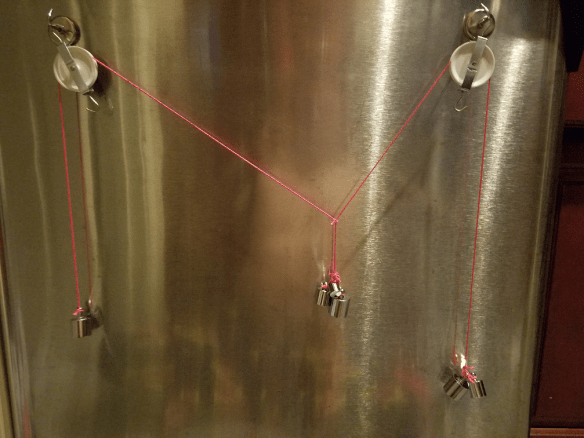
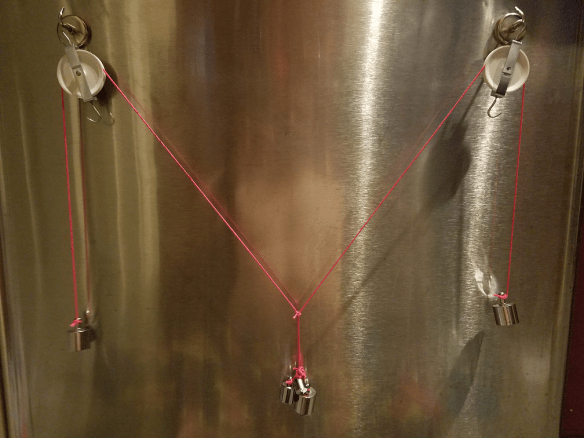
The problem is to find the measures of the three angles shown above, with values given for all three masses. Here is the setup, using physical objects, rather than a diagram.

100_170_100

The masses on the left and right are each 100 g, or 0.100 kg, while the central masses total 170 g, or 0.170 kg. Since all hanging masses are in static equilibrium, the forces pulling at the central point (at the common vertex of angles λ, θ, and ρ) must be balanced. Specifically, downward tension in the strings must be balanced by upward tension, and the same is true of tension forces to the left and to the right. In the diagram below (deliberately asymmetrical, since that’s coming soon), these forces are shown, along with the vertical and horizontal components of the tension forces held in the diagonal strings.

static equilibrium pulley setup force diagram

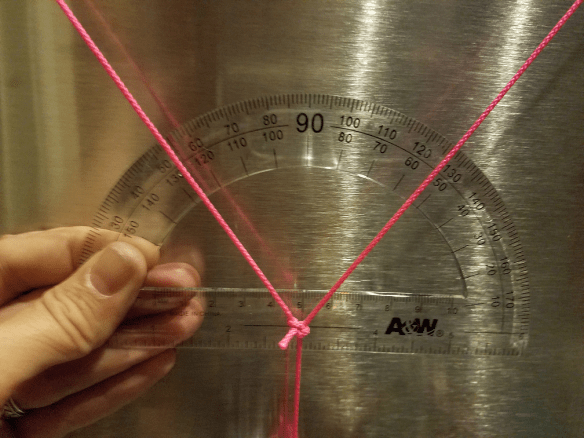
Because the horizontal forces are in balance, Tlx = Trx, so Mlgcosλ = Mrgcosρ — which is not useful now, but it will become important later. In the symmetrical situation, all that is really needed to solve the problem is the fact that the vertical forces are in balance. For this reason, Tc = Tly + Try, so Mcg = Mlgsinλ + Mrgsinρ. Since, due to symmetry, Ml = Mand λ = ρ,  Mr may be substituted for Ml, and ρ may be substituted for  λ, in the previous equation Mcg = Mlgsinλ + Mrgsinρ, yielding Mcg = Mrgsinρ + Mrgsinρ, which simplifies to Mcg =2Mrgsinρ. Cancelling “g” from each side, and substituting in the actual masses used, this becomes 0.170 kg = 2(0.100 kg)sinρ, which simplifies to 0.170 kg = (0.200 kg)sinρ, then 0.170/0.200 = sinρ. Therefore, angle ρ = sin-1(0.170/0.200) = 58°, which, by symmetry, must also equal λ. Since all three angles add up to 180º, the central angle θ = 180° – 58° – 58° = 64°. These answers can then be checked against the physical apparatus.

53_theta_53

When actually checked with a protractor, the angles on left and right are each about 53° — which is off from the predicted value of 58° by about 9%. The central angle, of course, is larger, at [180 – (2)53]° = 74°, to make up the difference in the two smaller angles. The error here could be caused by several factors, such as the mass of the string itself (neglected in the calculations above), friction in the pulleys, or possibly the fact that the pulleys did not hang straight down from the hooks which held them, but hung instead at a slight diagonal, as can be seen in the second image in this post. This is testable, of course, by using thinner, less massive string, as well as rigidly-fixed, lower-friction pulleys. However, reducing the error in a lab experiment is not my objective here — it is, rather, use of a simple change to turn a relatively easy problem into one which is much more challenging to solve. 

In this case, the simple change I am choosing is to add 50 grams to the 100 g already on the right side, while leaving the central and left sides unchanged. This causes the angles where the strings meet to change, until the situation is once more in static equilibrium, with both horizontal and vertical forces balanced. With the mass on the left remaining at 0.100 kg, the central mass at 0.170 kg, and the mass on the right now 0.150 kg, what was an easy static equilibrium problem (finding the same three angles) becomes a formidable challenge. 

100_170_150

For the same reasons as before (balancing forces), it remains true that Mlgcosλ = Mrgcosρ (force left = force right), and, this time, that equation will be needed. It also remains true that Mcg = Mlgsinλ + Mrgsinρ (downward force = sum of the two upward forces). The increased difficulty is caused by the newly-introduced asymmetry, for now Ml ≠ Mr, and λ ≠ ρ as well. It remains true, of course, that  λ + θ + ρ = 180°.

In both the vertical and horizontal equations, “g,” the acceleration due to gravity, cancels, so Mlgcosλ = Mrgcosρ becomes Mlcosλ = Mrcosρ, and Mcg = Mlgsinλ + Mrgsinρ becomes Mc = Mlsinλ + Mrsinρ. The simplified horizontal equation, Mlcosλ = Mrcosρ, becomes Ml²cos²λ = Mr²cos²ρ when both sides are squared, in order to set up a substitution based on the trigonometric identity, which works for any angle φ, which states that sin²φ + cos²φ = 1. Rearranged to solve it for cos²φ, this identity states that  cos²φ = 1 – sin²φ. Using this rearranged identity to make substitutions on both sides of the previous equation Ml²cos²λ = Mr²cos²ρ yields the new equation Ml²(1 – sin²λ) = Mr²(1 – sin²ρ). Applying the distributive property yields the equation Ml² – Ml²sin²λ = Mr² – Mr²sin²ρ. By addition, this then becomes -Ml²sin²λ = Mr² – Ml² – Mr²sin²ρ. Solving this for sin²λ turns it into sin²λ = (Mr² – Ml² – Mr²sin²ρ)/(-Ml²).

Next, Mc = Mlsinλ + Mrsinρ (the simplied version of the vertical-force-balance equation, from above), when solved for sinλ, becomes  sinλ = (Mrsinρ – Mc)/(- Ml). Squaring both sides of this equation turns it into sin²λ = (Mr²sin²ρ – 2MrMcsinρ + Mc²)/(- Ml.

There are now two equations solved for sin²λ, each shown in bold at the end of one of the previous two paragraphs. Setting the two expressions shown equal to sin²λ equal to each other yields the new equation (Mr² – Ml² – Mr²sin²ρ)/(-Ml²) = (Mr²sin²ρ – 2MrMcsinρ + Mc²)/(- Ml)², which then becomes (Mr² – Ml² – Mr²sin²ρ)/(-Ml²) = (Mr²sin²ρ – 2MrMcsinρ + Mc²)/(Ml)², and then, by multiplying both sides by -Ml², this simplifies to Mr² – Ml² – Mr²sin²ρ = – (Mr²sin²ρ – 2MrMcsinρ + Mc²), and then Mr² – Ml² – Mr²sin²ρ = – Mr²sin²ρ + 2MrMcsinρ – Mc². Since this equation has the term – Mr²sin²ρ on both sides, cancelling it simplifies this to  Mr² – Ml² = 2MrMcsinρ – Mc², which then becomes Mr² – Ml² + Mc² = 2MrMcsinρ, and then sinρ = (Mr² – Ml² + Mc²)/2MrM= [(0.150 kg)² – (0.100 kg)² + (0.170 kg)²]/[2(0.150 kg)(0.170 kg)] = (0.0225 – 0.0100 + 0.0289)/0.0510 = 0.0414/0.510 = 0.812. The inverse sine of this value gives us ρ = 54°.

Having one angle’s measure, of course, makes it far easier to find the others. Two paragraphs up, an equation in italics stated that sinλ = (Mrsinρ – Mc)/(- Ml). It follows that λ = sin-1[(Mrsinρ – Mc)/(- Ml)] = sin-1[(0.150kg)sinρ – 0.170kg)/(-0.100kg)] = 29°. These two angles sum to 83°, leaving 180° – 83° = 97° as the value of θ.

31_theta_58.png

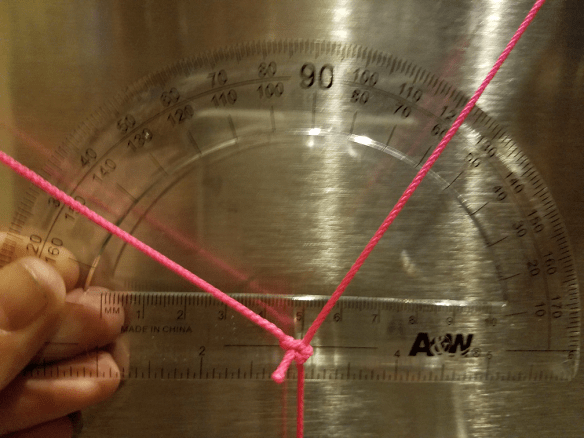
As can be seen above, these derived values are close to demonstrated experimental values. The first angle found, ρ, measures ~58°, which differs from the theoretical value of 54° by approximately 7%. The next, λ, measures ~31°, also differing from the theoretical value, 29°, by about 7%.The experimental value for θ is (180 – 58 – 31)° = 91°, which is off from the theoretical value of 97° by ~6%. All of these errors are smaller than the 9% error found for both λ and ρ in the easier, symmetrical version of this problem, and the causes of this error should be the same as before.

Beginning the Fractiles-7 Refrigerator Experiment

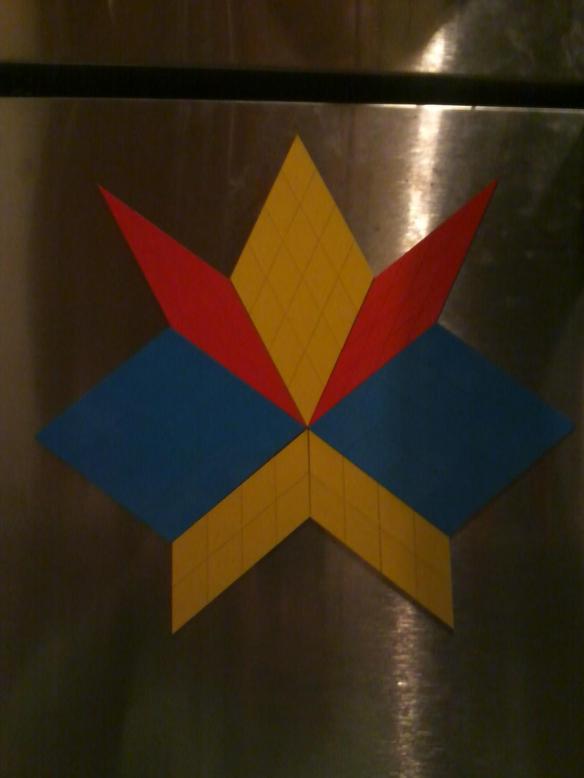
To begin this experiment, I first purchased two refrigerator-sized Fractiles-7 sets (available at http://fractiles.com/), and then, early on a Sunday, quietly arranged these rhombus-shaped magnets on the refrigerator in our apartment (population: 4, which includes two math teachers and two teenagers), using a very simple pattern.

160207_0000

Here’s a close-up of the center. There are 32 each, of three types of rhombus., in this double-set, for a total of 96 rhombic magnets, all with the same edge length.

160207_0001

The number of possible arrangements of these rhombi is far greater than the population of Earth.

The next step of the experiment is simple. I wait, and see what happens.

It should be noted that there is a limit on how long I can wait before my inner mathematical drives compel me to play with these magnets more, myself — but I do not yet know the extent of that limit.

On your nth birthday, you turn n – 1 years old.

birthday cake

As a teacher, I have had variants of this conversation many times. The specific details, however, are fictional, for this changes, somewhat, each time it happens.

  • Student: Guess what? It’s my birthday!
  • Me: Congratulations! How old are you?
  • Student: I’m seventeen!
  • Me: Well, happy 18th birthday, then!
  • Student: Huh?
  • Me: Look, on that one day, 17 years ago, when you were born, that was your birthday. That day has a better claim on being your birthday than any other day, because it’s the day you were born. That was your first birthday. But you weren’t one year old yet. You turned one year old a year later, on your next birthday . . . your second birthday. A year later, on your third birthday, you turned two years old. Do I need to continue?
  • Student: So I’m 18? I can buy cigarettes without a fake ID, and vote, and stuff?
  • Me: No, not for another year, because you’re only 17 years old — but you have had 18 birthdays. Say, here come some of your friends. Use this bit yourself, if you want to, and have fun with it.
  • Student, to other students: Hey, guys, it’s my birthday! I’m 18 today!

…At least I try. Also, sometimes, the educational outcome is better than in this fictionalized example.


[Image source: http://www.decorationnako.tk/birthday-cake/]

Goodbye, Mom

Mom's Dodecahedron

Soon, the Arkansas Democrat-Gazette will run my mother’s obituary. However, it would not be right for me to allow the obituary they print to be her only one.

Mom’s name when she was born, on January 4, 1942, was Mina Jo Austin. Later, she was known professionally as Mina Marsh. However, I chose to legally change my last name to her maiden name, in 1989, after my parents divorced. I did this so that I could have a last name I associated only with my good parent, for I only had one — the one now in this hospice room with me, as I write this, with little time remaining to her.

This is an old photograph of her, and her two younger sisters, taken when my mother was a teenager.

IMG_1188

Her father, whom I knew (all too briefly) as “Daddy Buck,” taught her many things, very early in life, just as Mom did, much later, for me. He taught her about justice, and its opposite, using as one example of injustice the internment camps for Japanese-Americans which were then operating, here in Arkansas, when my mother was a little girl. Even in the wake of Pearl Harbor, and in complete disagreement with the masses, my grandfather thought it an obscenity that people had been herded into these camps simply because of their ethnicity, and, in a world where evil does exist, he decided his daughter needed to know about it. Only with knowledge of evil can one stand up to it, oppose it, and speak truth to it, even when that evil is mixed with power, as happens all too often. He instilled in her a strong sense of justice, and taught her courage, at the same time.

Mom started college at Harding University, in Searcy, Arkansas, and demonstrated her courage, and refusal to tolerate injustice, there, during the 1960 presidential election campaign. The assembled students of Harding were told, in chapel, that it was their duty, as Christians, to go forth on election day, and cast their votes for Richard Nixon, because allowing John F. Kennedy, a Catholic, to become president would be a horrible, sinful thing to do. She found this offensive, in much the same way that her father had found America’s treatment of Japanese-Americans offensive during World War II. On principle, therefore, she withdrew from Harding, and transferred to the University of Arkansas (in Fayetteville) to complete her college coursework. She also, later, left the denomination associated with Harding, eventually becoming a member of the Episcopal Church. I am grateful to her church here in Fayetteville, Arkansas, for the many comforts they have given her over the years. They even went so far as to raise the funds needed, in 2010, for her emergency transportation, by air, to a Mayo Clinic in Minnesota, where surgery was performed to save her from a rare adrenal-gland tumor called a pheochromocytoma. Without this help from them, her life would have been shortened by over five years.

Mom is survived by two children. I came along in 1968, and my sister (who had three children herself — my mother’s three grandchildren) was born the following year. Mom is also survived by three step-grandchildren, and two step-great-grandchildren. Mom began to teach both my sister and myself, as early as she could, what her father had taught her, early in life. Strangely enough, one of my earliest memories of her doing this also involved Richard Nixon, for the first news event I clearly remember seeing on television was Nixon’s 1974 resignation speech. At that young age, and with my parents clearly disgusted with America’s most disgraced president to date, I blurted forth, “I wish he was dead!” Mom wasn’t about to let that pass without comment, and did not. I remember the lesson she taught me quite well: there was nothing wrong with wishing for him to lose his position of power, as he was doing — but to wish for the man to die was to cross a line that should not be crossed. One was right; the other was wrong. It is my mother who taught me how to distinguish right from wrong. From this point forward, I now have a new reason to try, in every situation, to do the right thing: anything less would dishonor my mother’s memory.

It was around this time that my sister and I started school, and to say Mom was deeply involved in our experiences at school would be to understate the issue. In a conservative state where many schools openly (and illegally) do such insane things as teach young-earth Creationism in “science” classes, and anti-intellectualism is sometimes actually seen as a virtue, our entry into the school system was not unlike entering a battleground. At this time, education specifically designed for gifted and talented students simply did not exist in Arkansas. Mom had already had some teaching experience herself, although she had since moved on to other work. She was often appalled by the inane things that happened in our schools, when we were students, such as this from the fifth grade, and this (also from elementary school), and this especially-awful example from the seventh grade. Never one to tolerate injustice, Mom was deeply involved, from the beginning, in the formation of an organization called AGATE (Arkansans for Gifted and Talented Education), which fought a long, uphill, but ultimately successful battle to bring special programs for the education of gifted and talented students into the public schools of our state. She did this for her own two children, true — I consider forcing someone (who already understands it) to “practice” long division, year after year, to be a form of torture, and she was trying to save me from such torture — but she also did it for thousands of other Arkansas students, and tens of thousands have since benefited from her work in this area.

mom

Mom was never content to fight in just one struggle at a time, for there is too much important work to do for such an approach. She was also a dedicated naturalist, a Master Gardener, and served as the Deputy Director of the Arkansas Natural Heritage Commission for 25 years, seeking ways to protect and preserve areas of natural beauty, and scientific significance, in our state. After retiring from that position, she later served on the board of directors of the Botanical Garden of the Ozarks, and also became the Development Director of the Ozark Natural Science Center.

My mother affected the lives of a great many people in her 73 years of life, including many who do not even know her name — but neither gaining credit, nor fame, was ever her goal. She will be deeply missed.

# # #

[About the rotating image: the picture of the banded agate, a reference to AGATE, the organization, on the faces of Mom’s dodecahedron, at the top of this post, came from here. The rotating dodecahedron itself, which the ancient Greeks associated with the heavens, was created using Stella 4d, software available at this website.]

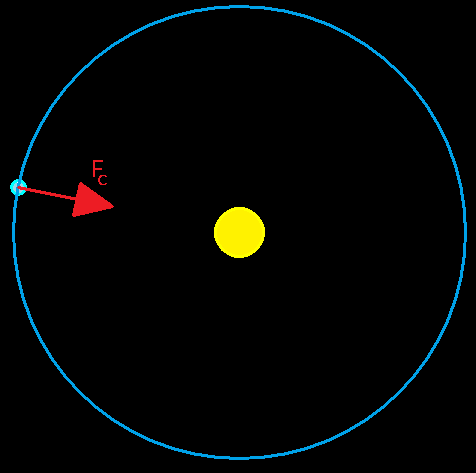
My Centripetal Force Joke: A True Story

orbit

In the Summer of 2014, with many other science teachers, I took a four-day-long A.P. Physics training session, which was definitely a valuable experience, for me, as a teacher. On the last day of this training, though, in the late afternoon, as the trainer and trainees were winding things up, some of us, including me, started getting a little silly. Physics teachers, of course, have their own version of silly behavior. Here’s what happened.

The trainer: “Let’s see how well you understand the different forces which can serve as centripetal forces, in different situations. When I twirl a ball, on a string, in a horizontal circle, what is the centripetal force?”

The class of trainees, in unison: “Tension!”

Trainer: “In the Bohr model of a hydrogen atom, the force keeping the electron traveling in a circle around the proton is the . . . ?”

Class: “Electromagnetic force!”

Trainer: “What force serves as the centripetal force keeping the Earth in orbit around the Sun?”

Me, loudly, before any of my classmates could answer: “God’s will!”

I was, remember, surrounded by physics teachers. It took the trainer several minutes to restore order, after that.

For John Lennon’s Birthday, the True Story of How I Observed This Holiday in 1983

lennon-306-1391778060

I’ve been a fan of John Lennon for as long as I can remember, and October 9, his birthday, has always been a special day for me. In 1983, when I was a high school junior, celebrating his birthday changed from something I simply did, by choice, into what, at the time, I considered a moral imperative.

In October of ’83, I was a student — a junior — at McClellan High School in Little Rock, Arkansas, and October 9th happened to be the day that all juniors were, according to that school’s administration, required to take the ASVAB: the Armed Services Vocational Aptitude Battery. While this is a standardized test, it isn’t like other standardized tests — it is actually a recruitment tool for the United States military.

At the time, Ronald Reagan was president, and we were in one of the many scary parts of the Cold War, with the threat of global thermonuclear war looming over us at all times. If you are too young to remember the Reagan era well, it may be hard to understand just how real, and how scary, it was to grow up with a president who did such things as making “jokes,” like this, in front of a microphone:

Reagan made this extremely unfunny “joke” the next year, in 1984, but the climate of fear in which he thought such a thing would be funny was already firmly in place in 1983, and I was already openly questioning the sanity of our president. My own anti-war attitudes, very much influenced by Lennon and his music, were already firmly in place. For the few unfamiliar with it, here is a sample of Lennon’s music.

So here I was, a high school junior, being told I had to take a test, for the military, on John Lennon’s birthday. I reacted to this in pretty much the same way a devout Jew or Muslim would react to being told to eat pork chops: I absolutely refused to cooperate. “Blasphemy” is not a word I use often now, and it wasn’t then, either, but to cooperate with this would have been the closest thing to blasphemy which I was capable of understanding at that age (I was 15 years old when this happened).

The other juniors got up and shuffled off, like good, obedient soldiers, when the intercom told them to go take the ASVAB. I simply remained seated.

The teacher told me it was time to go take the ASVAB. I replied, calmly, that no force on earth could compel me to take a test for the military on John Lennon’s birthday. At that point, I was sent to the office. Going to the office posed no ethical nor moral dilemmas for me, for I wanted the people there to know, also, that it was wrong for them to give a test for the military on October 9, of all days.

The principal, a man already quite used to dealing with me and my eccentricities, knew it would be pointless to argue with me about the ASVAB. He simply showed me a chair in the main office, and told me I could sit there that day, all day, and I did. To the school, this might have been seen as a single day of in-school suspension, but I saw it for what it really was: a one-person, sit-down protest for peace, in honor of the greatest activist for peace the world has ever known. It was an act of civil disobedience, and I regret nothing about it.

I will be sharing this story with Lennon’s widow, Yoko Ono, a woman I very much admire, and the greatest living activist for peace in the world today. Yoko, I do hope you enjoy this story. You and John have done great things, and they will not be forgotten, as long as people remain alive to tell about them.

Peace to all.

[Credits: photo from rollingstone.com; videos from YouTube.]

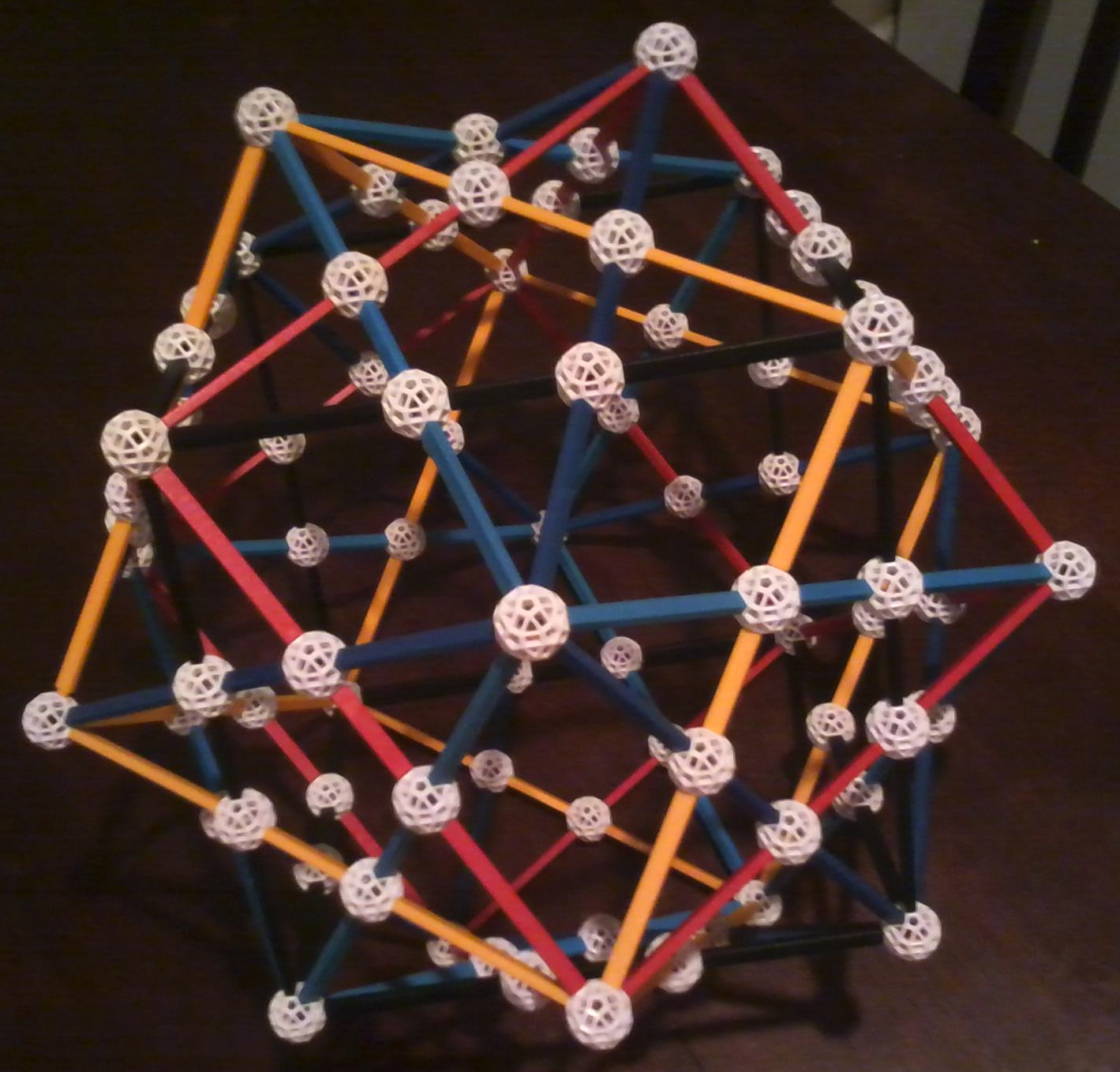
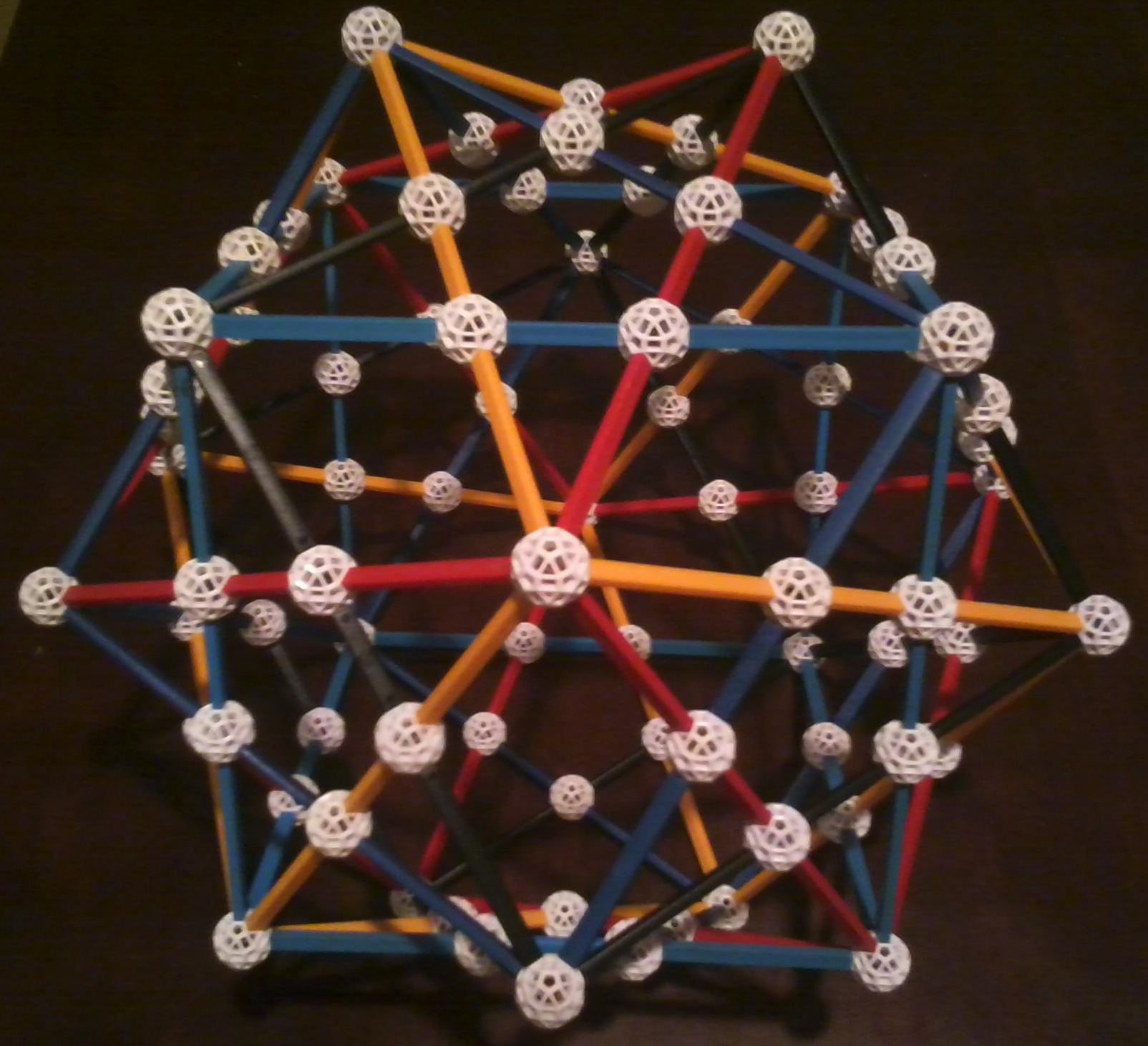
The Compound of Five Cubes, Rendered in Five Colors of Zome

151008_0000

Ordinarily, with Zometools, the compound of five cubes is an all-blue model. However, I wanted to build one in which each cube is a different color, so I made a special request to the Zometool Corporation (their website: http://www.zometool.com) for some off-color parts, to make this possible.

151008_0001

The five colors used in this model are standard blue, a darker shade of blue, red, yellow, and black.

151008_0002

I also received the struts needed to build this model with one cube in white, so I will be making a second version of this soon. I didn’t want the Zomeballs used to match any strut color, though, so I will have to wait for the shipment of purple Zomeballs I ordered, today, to arrive, before I can build that model.

Zome is a fantastic tool to use for mathematical investigations, as well as education, and other applications as well. I recommend this product highly, and without reservation.

On Teaching Students with Asperger’s Syndrome


teaching Aspies

Teaching students with Asperger’s Syndrome is a challenge. As a teacher who also has Asperger’s, I have some suggestions for how to do this, and wish to share them.

  1. Keep the administrators at your school informed about what you are doing.
  2. Know the laws regarding these matters, and follow them carefully. Laws regarding confidentiality are particularly important.
  3. Identify the special interest(s) of the student (these special interests are universally present with Asperger’s; they also appear, sometimes, with students on other parts of the autism spectrum). Do not expect this/these special interest(s) to match that of anyone else, however — people with Asperger’s are extremely different from each other, just as all human beings are. As is the case with my own special interests in mathematics and the “mathy” sciences, it’s pretty much impossible to get students with Asperger’s to abandon their special interest — and I know this because I, quite literally, cannot do much of anything without first translating it, internally, into mathematical terms — due to my own case of Asperger’s. Identifying the special interest of a student with Asperger’s requires exactly one thing: paying attention. The students themselves will make it easy to identify their special interest; it’s the activity that they want to do . . . pretty much all the time.
  4. Find out, by carefully reading it, if the student’s official Section 504 document, or Special Education IEP, permits item #5 on this list to be used. If it doesn’t, you may need to suggest a revision to the appropriate document. (Note: these are the terms used in the USA; they will be different in other countries.)
  5. Of things done in class which will be graded, if the relevant document permits it, alter them in such a way as to allow the student to use his or her special interest to express understanding of the concepts and ideas, in your class, which need to be taught and learned. This is, of course, the most difficult step, but I cannot overemphasize its importance.
  6. Use parental contact to make certain the parent(s) know about, and agree with, the proposed accommodations/modifications. (504 students get accommodations, while special education students receive modifications. Following both 504 plans, and Special Education IEPs, is not optional for teachers — it is an absolute legal requirement, by federal law, and the penalties for failure to do so are severe. It is also, of course, the ethical thing to do.)
  7. Do not make the mistake of punishing any student for behavior related to a documented condition of any kind, including Asperger’s Syndrome.

All the Classes I Have Taught, or Am Teaching (Updated for 2024-2025)

This is my 30th year teaching. Just as a test of my memory, I’m going to try to list every class I have ever taught, or am teaching now. The italics indicate the subjects which I am most confident I can teach well, whether I am teaching them currently, or not. Bold indicates courses which are in my current teaching assignment.  As for improving the ones not in italics, I’ll work more on that . . . when I have the time. 

  1. Algebra I
  2. Algebra II
  3. Algebra III
  4. Algebra Lab
  5. American History to 1877
  6. Anatomy
  7. A.P. Biology
  8. A.P. Physics
  9. Area I Mathematics at Arkansas Governor’s School — a course focusing on polyhedra
  10. Arkansas History
  11. Biology
  12. Bridge to Algebra II, which I can’t help thinking of as “Algebra 1.5”
  13. Chemistry
  14. Chemistry I (no, I have no idea why that particular school called it that; I never found “Chemistry II” there)
  15. Civics
  16. Economics
  17. Environmental Science
  18. Formal Geometry
  19. Geography
  20. Geometry
  21. Geometry Lab
  22. Informal Geometry
  23. Integrated Chemistry
  24. Integrated Science 8
  25. PAP Algebra II
  26. PAP Physical Science
  27. Physical Science
  28. Physics
  29. Pre-AP Chemistry
  30. Psychology
  31. Religion, 9th grade (at a private, religious school)
  32. Religion, 12th grade (at a private, religious school)
  33. Study Center / Credit Recovery
  34. Study Skills (while student teaching)
  35. Summer School Transition Camp (for incoming high school students)
  36. University Studies (my only foray into teaching at the college level; basically, an “Intro to College” course, for entering freshmen)
  37. U.S. History Since 1890
  38. World History (while student teaching)
  39. World History Since 1450

X. In-school Suspension (ISS), also known as SAC, which stands for the horribly-misleading euphemism, “Student Assistance Center.” I used an “X” instead of a number because, as a student or a teacher, SAC is not a class, nor a subject. It is, rather, a non-class which one endures until the merciful ringing of the bell at the end of the school day.

XX. “Saturday School,” which is like ISS/SAC, but even worse, for all concerned. (I really needed the extra money at that time.)

To anyone now working on becoming a teacher: you become much more employable if you become certified in multiple certification areas, as I have. This is a two-edged sword, though, for it definitely increases the number of subjects you may be asked to teach in any given year, and that’s also the reason my list above is so long.

One other thing I definitely remember is my first year’s salary, to the cent: $16,074.00, before any deductions. You can make a living in this field, in this country . . . after you’ve been in the classroom for a few years . . . but no one should expect making it, financially, to be easy, especially for the first 5-7 years.