A True Story of a Young Aspie Getting in Trouble with “Show and Tell”

In elementary school, in the 5th grade, I managed to get in trouble for a “show and tell” project. As usual, getting in trouble was not my objective, but it happened anyway. This was decades before I learned I have Asperger’s, but, looking back, none of this would have happened were I not an “Aspie,” as we call ourselves.

This image, which I found here, is very much like the poster I made, by hand, and used for this project:

nuclear chain reaction

That was the “show” part of this “show and tell” project. For the “tell” part, I explained how nuclear chain reactions work, and then explained how nuclear bombs are made. It’s very simple:  you have two slightly sub-critical masses of uranium-235 or plutonium-239, and physically bring them together, so that the total mass exceeds the critical mass. At that point: boom.

The hard part, of course, is actually obtaining the U-235 or Pu-239, for those aren’t things you can simply buy at the local hardware store. Ironically, I did know where to find both uranium and plutonium — at the very same university, about an hour away, where I’d spent far too much time conducting mostly-unsupervised experiments with both elements, along with lots of liquid mercury, before my tenth birthday. (I still suspect that all that radiation may have turned me into a mutant.) However, I also knew that the uranium and plutonium there would not have nearly enough of the correct isotope of either element, making this information irrelevant to my “show and tell” report, and so, for this reason, I did not tell them where to find the uranium and plutonium I had previously used for experiments.

I didn’t figure this out in class that day, since I’m not particularly good at “reading” emotions, facial expressions, and body language, but, apparently, I really upset, and scared, my teacher. This became apparent when she called my mother, and, later, my mother asked me to tell her what I’d done in school that day. Being excited about the “show and tell” presentation I’d given that day, I immediately told my mother all about it. When she told me the teacher had called her, concerned about me explaining to my class how to build atomic bombs, I was confused, since I didn’t understand, at all, why what I had actually said posed any problem. To explain this to my mother, I simply said, “But, Mom, I didn’t tell the class where to actually get the uranium-235 or plutonium-239! I don’t know where to find those isotopes!”

This was enough to convince my mother that I had not, in fact, done anything wrong. She called the teacher back, and simply asked if I had, or had not, included that critical bit of information: where to find the actual fissionable material needed for a nuclear bomb to work. When the teacher replied that I had not done that, my mother’s response was both sensible, and logical:  “Well, then, what’s the problem?”

—–

Postscript, for those who might be worried about the childhood experiments I mentioned above: at around age 40, I asked a physician about my worries regarding early exposure to mercury vapor and radiation. He told me that any problems I might have, as a result of such experiments, would have already showed up by then, and that I could, therefore, stop worrying about this. Thus reassured, I did exactly that.

My Complete List of Complaints About My New School

For the last three weeks, for the beginning of my twentieth year as a teacher, I’ve been teaching at a different high school. I am much happier, now, due to this change. This being a personal blog, it is my policy not to name my school, nor school district, here. However, I see no problem with posting my complete list of complaints about this new school. Here it is:

complaints

Public Schools in the United States Should Rename the “Free Lunch”

tanstaafl

If you live in the USA, you are probably familiar with the phrase “free lunch,” or “free and reduced lunch,” as used in a public-school context. For those outside the USA, though, an explanation of what that phrase means, in practice, may be helpful, before I explain why a different name for such lunches should be used.

The term “free and reduced lunch” originated with a federal program which pays for school lunches, as well as breakfasts, with money collected from taxpayers — for students whose families might otherwise be unable afford these meals. The program’s eligibility requirements take into account both family income and size. There’s a problem with it, though:  the inaccuracy of the wording used, especially the troublesome word “free.” The acronym above, “TANSTAAFL,” is familiar to millions, from the works of Robert A. Heinlein (science fiction author), Milton Friedman (Nobel-Prize-winning economist), and others. It stands for the informally-worded phrase, “There ain’t no such thing as a free lunch,” which gets to the heart of the problem with the terminology we use when discussing school lunches. (Incidentally, I have seen an economics textbook use the phrase “TINSTAAFL,” in its place, to change “ain’t no” to “is no.” I do not use this version, though, for I am unwilling to correct the grammar of a Nobel laureate.)

The principle that “free lunches” simply do not exist is an important concept in both physics and economics, as well as other fields. In physics, we usually call it the Law of Conservation of Mass and Energy, or the First Law of Thermodynamics. This physical law has numerous applications, and has been key to many important discoveries. Learning to understand it, deeply, is an essential step in the education of anyone learning physics. Those who teach the subject, as I have in many past years, have an even more difficult task:  helping students reach the point where they can independently apply the TANSTAAFL principle to numerous different situations, in order to solve problems, and conduct investigations in the laboratory. It is a fundamental statement of how the universe works:  one cannot get something for nothing.

TANSTAAFL applies equally well in economics, where it is related to such things as the fact that everything has a cost, and those costs, while they can be shifted, cannot be made to simply disappear. It is also related to the principle that intervention by governments in the economy always carries costs. For example, Congress could, hypothetically, raise the federal minimum wage to $10 per hour — but the cost of doing so would be increased unemployment, especially for those who now have low-paying jobs. Another possible cost of a minimum-wake hike this large would be a sudden spike in the rate of inflation, which would be harmful to almost everyone.

To understand what people have discovered about the fundamental nature of physical reality, physics must be studied. To understand what is known about social reality in the modern world, economics must be studied. Both subjects are important, and understanding the TANSTAAFL principle is vital in both fields. Unfortunately, gaining that understanding has been made more difficult, for those educated in the United States, simply because of repeated and early exposure to the term “free lunch,” from childhood through high school graduation. How can we effectively teach high school and college students that there are no free lunches, when they have already been told, incessantly, for many years, that such things do exist? The answer is that, in many cases, we actually can’t — until we have first helped our students unlearn this previously-learned falsehood, for it stands in the way of the understanding they need. It isn’t a sound educational practice to do anything which makes it necessary for our students to unlearn untrue statements.

I am not advocating abolition, nor even reduction, of this federal program, which provides essential assistance for many families who need the help. Because I am an American taxpayer, in fact, I directly participate in funding this program, and do not object to doing so. I do take issue, however, with this program teaching students, especially young, impressionable children in elementary school, something which is untrue.

We need to correct this, and the solution is simple:  call these school lunches what they actually are. They aren’t free, for we, the taxpayers, pay for them. Nothing is free. We should immediately replace the phrase “free and reduced lunch” with the phrase “taxpayer-subsidized lunch.” The second phrase is accurate. It tells the truth, but the first phrase does the opposite. No valid reason exists to try to hide this truth.

The Unintentional Bomb: A True Story

picric acid

Nineteen years ago, I began my teaching career at a small, private Arkansas high school. One of the classes I taught was Chemistry, and my principal happened to be a former chemistry teacher, himself.  We were both new to the school, and knew that there was a high turnover rate there for teachers in that field. They’d had perhaps eight teachers for that class in the previous five years. I stayed there six years, teaching chemistry every year.

The new principal saw the need for upgraded laboratory facilities, and we got them, including a new, larger chemical stockroom. The old stockroom was a nightmare, and the chemicals needed to be transferred to their new home. This was a massive undertaking, for many of my predecessors had ordered chemicals, not taking the time to inventory the stockroom to see if the school already had what they needed. Even worse, the chemicals were stored in approximate alphabetical order.

Experienced chemists and chemistry teachers know how scary the phrase “alphabetical order” is, in this context. For reasons of safety, chemicals need to be stored by families, using a shelving pattern that keeps incompatible chemicals far apart. I was not an experienced teacher of anything at this point, but the principal showed me the classification scheme he’d used before, himself. It’s the one recommended by Flinn Scientific, and you can see it at http://www.flinnsci.com/store/Scripts/prodView.asp?idproduct=16069. At his direction, over a couple of weeks, I took the chemicals from the old storage area to the new one, de-alphabetizing them into a much safer arrangement, onto category-labelled shelves. In the process, of course, I saw every laboratory chemical that school had, recognizing many (jar after jar of liquid mercury, for example) as highly dangerous, and making certain proper precautions were taken with such substances. If I didn’t recognize a chemical well enough to categorize it (sulfates together, halides together, etc.), I looked it up, in order to find its place. I wouldn’t even open a container with an unfamiliar chemical in it, until researching it. As it turned out, my caution with unfamiliar chemicals literally saved my life.

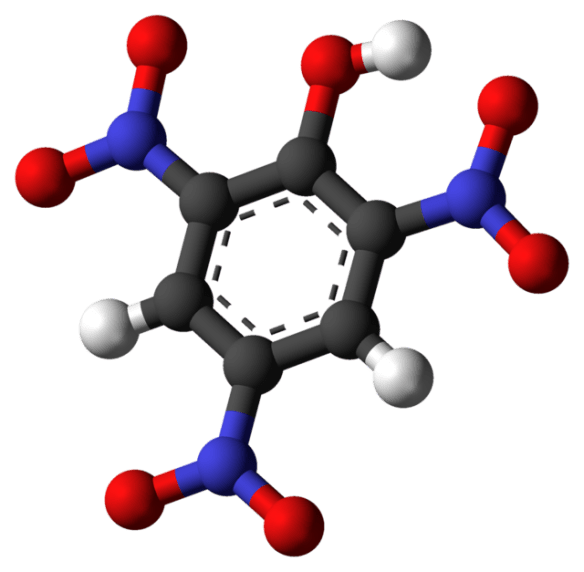
There are hundreds of different acids, and I doubt anyone knows them all. When I encountered a hand-labeled jar reading “picric acid,” I had never heard of that chemical, the structure for which is shown above. When I looked it up, I learned picric acid is safe if it is all in solution with water, but is a shock-sensitive explosive in solid form. I examined the liquid carefully, without actually touching the container. Sure enough, solid crystals had already started to form, over the years, as some of the water in the container slowly evaporated, and escaped.

Great, I thought, sarcastically — a shock-sensitive explosive. I then kept reading the hazard alerts, and noticed that they stated that picric acid should never be stored in any container with a metallic lid, because that invites the formation of explosive metal picrates which can be detonated simply by the friction caused by an attempt to open the lid. The picric acid I was dealing with, of course, not only had the dangerous solid crystals — it also had a metal lid, and a partially corroded one at that.

I never so much as touched that lid. Very carefully, I gently carried this container to the new stockroom, gave it a shelf all by itself, and didn’t so much as give it a nasty look, for the rest of the time I taught there. Leaving it alone, with me being the only person with access to that room, was the safest thing I could think of to do, as long as I was teaching there. For six school years, since it was carefully undisturbed, the picric acid behaved itself — and then, seeking a higher salary, I found a job for the following Fall, teaching at a public school. I knew I would not be able to leave this private school, though, without dealing with this picric acid problem once and for all, along with other dangerous chemicals the school did not need. I could have simply turned my keys in, and left, but that would have risked a potentially-fatal explosion in that school in future years, for I could not safely assume the next chemistry teacher would be familiar with, nor research, picric acid. My conscience would not permit that.

The school year being over, I went to see the school’s new principal. Unlike his predecessor, the new principal had never taught chemistry, but he’d been on the faculty, before his promotion, for longer than I had been there, and so we knew each other well. When I went into his office, with my keys, for end-of-the-year checkout, and calmly told him that there were many serious toxins and an unexploded bomb down the hall, he knew immediately that I wasn’t joking. With his permission, I kept my keys into the beginning of the Summer, getting things ready for professional chemical-disposal experts to come in and remove the dangerous materials. Before long, four cardboard boxes had been filled with dangerous chemicals the school did not need, slated for disposal — and that’s after I had already disposed of most things that needed to go, if I had the knowledge, and means, to dispose of them properly.

The first group of professionals who were called in, for help, were from the local fire department. They took some of the chemicals away, without charge, but only the ones that they knew how to deal with safely. The principal and I were informed that, for the remaining chemicals (down to one box now, in which was the picric acid), a professional “hazmat” team would need to be called in, and it wouldn’t be cheap.

It wasn’t. The bill from the hazmat team exceeded US$2000. They took away three or four kilograms of mercury, as well as a lot of other nasty stuff, but also told us, with apologies, that they weren’t taking the picric acid, it being too dangerous for a “mere” professional hazmat team. To get rid of that, we were told, we’d need to call in the bomb squad from the state’s capital city, Little Rock.

I had heard the phrase “bomb squad” in movies, and on TV, but not in real life. Judging from the look on his face, the same can be said for the principal. As it happened, I wasn’t in town on the day the bomb squad came to school, but I did hear numerous first-hand accounts of what transpired, when I came back the following day to turn in my keys.

One of many surprises reported to me by these witnesses is that the FBI arrived with the bomb squad, asking questions and interviewing people. Apparently there wasn’t supposed to be any picric acid in Arkansas schools, for a statewide sweep had been made to gather it all up, and dispose of it, in the 1970s. My guess, and that’s all it is, is that this very old bottle had been overlooked because of it being in a private, rather than a public, school. If the FBI wants to contact me now to ask me questions about this stuff, I’ll answer them, but, at the time, I didn’t mind a bit that I missed out on the interrogation-portion of these events. After the FBI had finished their on-site investigation, the bomb squad began their work.

This K-12 school has a very large campus, with multiple buildings, and my classroom was at one corner of it. The disposal site they chose — the nearest area sufficiently remote from people and buildings — was far behind the gymnasium, at least half a kilometer away, at the opposite corner of the campus. As it was described to me, two bomb squad guys put on what I call “moon suits,” wrapped the picric acid bottle up, with a lot of padding, and placed this padded bundle on a stretcher.  They then walked the stretcher, with its deadly cargo, around and between buildings, across railroad tracks and a street, around the gymnasium, and back into an empty lot, where a deep hole was dug. One of the guys in moon suits then put the picric acid container at the bottom of the hole, along with a stick of dynamite, the idea being to use the smaller dynamite explosion to trigger the much larger explosion of the picric acid.

The bomb-squad “astronaut” lit the long fuse on the dynamite, and scrambled out of the hole as quickly as his moon suit would permit. The fuse burned, right up to the dynamite — and then, just as everyone expected a deafening explosion, it fizzled out. They had unknowingly used a stick of dynamite with a defective fuse.

After waiting a while, just to give the dynamite time to, well, change its “mind” about exploding (which didn’t happen), the suited-up bomb squad guy was sent back into the hole, with a second stick of dynamite, which he placed next to the first one. I hope he got paid extra for this, for I would have quit, immediately, rather than re-enter that hole. He, however, did enter, lit the second dynamite stick, and got out in time. This time, the detonation was successful, and the picric acid and both sticks of dynamite were utterly obliterated.

At the time of the explosion, a former student of mine, who had graduated from this same school a few years before, was working in an office building, three or four kilometers away. I got an e-mail from him, and laughed when I read it. Apparently the entire building he was working in had just been shaken by an explosion in the direction of his former school, and he had one question for me:  had I had anything to do with this? I laughed, and replied with an honest answer.

How To Make Tic-Tac-Toe Interesting

Image

How To Make Tic-Tac-Toe Interesting

Tic-tac-toe, played by the traditional rules, is so simple a game that few people with two-digit ages ever play it — just because it’s boring. It is so simple a game, in fact, that chickens can be trained to play it, through extensive operant conditioning. Such chickens play the game at casinos, on occasion — with the rules stating that if the game ends in a tie, or the chicken wins, the human player loses the money they paid to play the game. If the human wins, however, they are promised a large reward — $10,000, for example. Don’t ever fall for such a trick, though, for casinos only use chickens that are so thoroughly trained, by weeks or months of positive reinforcement, negative reinforcement, and punishment, that they will not ever lose. You’d be better off simply saving the same money until it’s cold, and then setting it on fire, just for the heat. At least that way you’d be warm for a little while, and that certainly beats the humiliation of being beaten, at any game, by a literal bird-brain.

With a small, simple alteration, though, tic-tac-toe can actually become a worthwhile, interesting game, even for adults. I didn’t invent this variation, but have forgotten where I read about it. I call it “mutant tic-tac-toe.”

In this variation, each player can choose to play either “x” or “o” on each play — and the first person to get three “x”s or three “o”s, in a row, wins the game. That’s it — but, if you try it, you’ll find it’s a much more challenging game. I am confident chickens will never be trained to play it successfully.

Consider the board pictured above, which happens to match a game I lost, to a high school student, earlier today. Red (the student) moved first, starting with the “o” in the center. I was playing with a blue marker, and chose to play an “x” in a corner spot. This was a mistake on my part, for the student’s next move — another “x,” opposite my “x,” effectively ended the game. I had to play next — passing is not allowed — and my playing an “x” or an “o,” in any of the six open spaces, would have led to an immediate victory by the student. If you study the board, you’ll see why this is the case.

Mutant tic-tac-toe is a great activity for semester exam week, at any school. Students who finish final exams earlier than their classmates can be taught the game quickly and quietly, and then they’ll entertain themselves with this game, rather than distracting students who are still working on their tests. What’s more, students have to really think to play this version of the game well, especially when they first learn it — and isn’t getting students to think what education is supposed to be all about, anyway?

The Beauty of Uselessness

Image

The Beauty of Uselessness

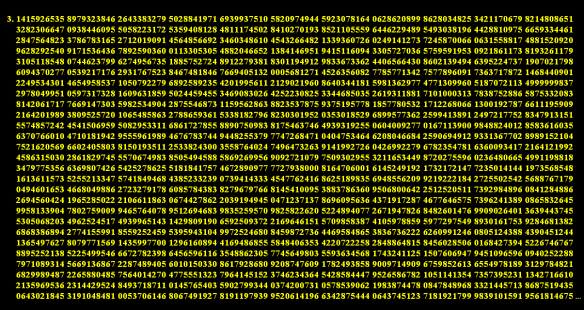
Given the name of this blog, and the familiarity of the number pictured above, I’m sure you recognize it as the beginning of my favorite number, pi. On various websites, you can find far more digits than are shown above. However, just the digits shown in the top row here are greater in number than that needed for any real-world, practical application. Is pi useful? Is mathematics itself useful? Of course they are . . . but those questions miss the point entirely.

Every teacher who has been in the field for long has heard the complaint, disguised as a question, “What are we ever going to use this for?” Unfortunately, most school systems, as well as teacher-training programs, have chosen to respond to this well-known complaint by repeatedly telling teachers, and teachers-in-training, that it is of extreme importance to show students how the curriculum is “relevant,” and adjust curricula to make them more so. This usually boils down, of course, to trying to convince students that learning is important because, supposedly, education = a better job in the future = more money. Sometime this “equation” works, and sometimes it does not, but it always misses a key point, one that should not be left out, but too often is.

It is a fallacy that learning has to have a practical application to be a worthwhile endeavor. There’s more to life than the fattening of bank accounts. Sadly, many of those making decisions in education do not realize this. Their attempts to reduce education to a strictly utilitarian approach are causing great harm.

This scenario has happened many times: a mathematician discovers an elegant proof to a surprising theorem, a physicist figures out something previously unknown about the nature of reality, or a researcher in another field does something comparable, and someone then asks them, “But what can this be used for?” On occasion, tired of hearing this utilitarian refrain, such researchers give unusually honest responses which surprise and confuse many people — such as, “Someone else might, at some point, find a practical application for this . . . but I sincerely hope that never happens.” Such a response is rarely understood, but it makes the person who says it feel better to vent some of their frustration with those who are obsessed with tawdry, real-world applications for everything.

Many humans — and this is a terrible shame — live almost their entire lives like rats in mazes, running down passages and around corners, chasing tangible rewards — cheese for the rats, or the ability to buy, say, a fancy new car, in the case of the people. People shouldn’t live like lab rats . . . and, unlike lab rats, we don’t have to. People are smart enough to find higher purposes in life. People can, in other words, find, understand, and appreciate beauty — in things which are useless, in the sense that they have no useful applications. We can appreciate things that transcend mere utility, if we choose to do so.

Much of life is utterly banal, for a great many people. They wake up each day, work themselves into exhaustion at horribly boring jobs, go home, numb themselves with television, massive alcohol consumption, or other hollow pursuits, fall asleep, and then get up and repeat the process the next day . . . and then they finally get old and die. Life can be so much more than that, though, and it should be.

The researchers I described earlier aren’t doing what they do for money, or even the potential for fame. Are such things as mathematics and physics useful? Yes, they are, but that isn’t why pure researchers do them. The same can be said for having sex: it’s useful because it produces replacement humans, but that isn’t why most people do it. People have sex, obviously, because they enjoy it. In simpler terms: it’s fun. Most people understand this concept as it relates to sex, but far fewer understand it when it relates to other aspects of life, particularly those of an academic nature.

Academic pursuits are of much greater value when the motivation involved is joy, and the fun involved, rather than avarice. As scrolling through this blog will show you, I enjoy searching for polyhedra which have not been seen before. I certainly don’t expect to get rich from any such discoveries I make in this esoteric branch of geometry, which is itself one subfield, among many, in mathematics. I do it because it is fun. It makes me happy.

Much of life is pure drudgery, but our lives can be enriched by finding joyous escapes from our routines. An excellent way to do that is to learn to appreciate the beauty of uselessness — uselessness of the type that elevates the human spirit, in a way that the pursuit of material goods never can.

This is the approach we should encourage students to have toward education. Learning is far too valuable an activity to be limited, in its purpose, to the pursuit of future wealth. It’s time to change our approach.

My Students’ Painting of the Periodic Table of the Elements

Image

My Students' Painting of the Periodic Table of the Elements

This is my last year teaching at my current school — I’ll be transferring to another school in the same district in the Fall. To create a farewell gift to the school where I have taught for the last three years, I brought a lot of paint and other art supplies from home, bought more when they ran out, and let my students (who are enrolled in Chemistry and Physical Science) paint a large painting of the periodic table on two large wooden boards, each measuring 4′ by 6′. In the Fall, the plan is for the painting to be mounted on the wall of the science wing of my current school, in a location to be chosen by my current department chair, a personal friend of mine.

I think my students did a very good job — better than this picture I took with my cell phone reveals, just due to camera-quality. I am proud of them.

Only Nine School Days Left This Year

Image

Only Nine School Days Left This Year

Due to an unusual amount of Winter weather this school year, the school year where I teach has been extended to June 6, creating what many are calling “the school year that will not end.” It will end, of course, but the already-long wait for Summer vacation is getting to many of us — students, parents, teachers, and administrators alike.

The countdown is now at nine school days left: four next week, and five the week after that. In honor of this point in the countdown, I created this image based on the number nine, using Geometer’s Sketchpad and MS-Paint.

Mark Twain, on Education and Cats

Image

Mark Twain, On Education and Cats

Can a Public School Student Read a Bible in Class?

Image

Can a public school student read a Bible in class?

Yes, but not loudly, waving it around, while I am explaining the safety protocols for laboratory use of silver nitrate in chemistry class.

It’s dangerous stuff, as you can see here: http://www.sciencelab.com/msds.php?msdsId=9927411.

Did this actually happen? Of course — I don’t think I could make up a story like that. It happened in a different class than the one I am teaching this year, though. The student’s name is being withheld, to protect his identity (and my job).