For John Lennon’s Birthday, the True Story of How I Observed This Holiday in 1983

lennon-306-1391778060

I’ve been a fan of John Lennon for as long as I can remember, and October 9, his birthday, has always been a special day for me. In 1983, when I was a high school junior, celebrating his birthday changed from something I simply did, by choice, into what, at the time, I considered a moral imperative.

In October of ’83, I was a student — a junior — at McClellan High School in Little Rock, Arkansas, and October 9th happened to be the day that all juniors were, according to that school’s administration, required to take the ASVAB: the Armed Services Vocational Aptitude Battery. While this is a standardized test, it isn’t like other standardized tests — it is actually a recruitment tool for the United States military.

At the time, Ronald Reagan was president, and we were in one of the many scary parts of the Cold War, with the threat of global thermonuclear war looming over us at all times. If you are too young to remember the Reagan era well, it may be hard to understand just how real, and how scary, it was to grow up with a president who did such things as making “jokes,” like this, in front of a microphone:

Reagan made this extremely unfunny “joke” the next year, in 1984, but the climate of fear in which he thought such a thing would be funny was already firmly in place in 1983, and I was already openly questioning the sanity of our president. My own anti-war attitudes, very much influenced by Lennon and his music, were already firmly in place. For the few unfamiliar with it, here is a sample of Lennon’s music.

So here I was, a high school junior, being told I had to take a test, for the military, on John Lennon’s birthday. I reacted to this in pretty much the same way a devout Jew or Muslim would react to being told to eat pork chops: I absolutely refused to cooperate. “Blasphemy” is not a word I use often now, and it wasn’t then, either, but to cooperate with this would have been the closest thing to blasphemy which I was capable of understanding at that age (I was 15 years old when this happened).

The other juniors got up and shuffled off, like good, obedient soldiers, when the intercom told them to go take the ASVAB. I simply remained seated.

The teacher told me it was time to go take the ASVAB. I replied, calmly, that no force on earth could compel me to take a test for the military on John Lennon’s birthday. At that point, I was sent to the office. Going to the office posed no ethical nor moral dilemmas for me, for I wanted the people there to know, also, that it was wrong for them to give a test for the military on October 9, of all days.

The principal, a man already quite used to dealing with me and my eccentricities, knew it would be pointless to argue with me about the ASVAB. He simply showed me a chair in the main office, and told me I could sit there that day, all day, and I did. To the school, this might have been seen as a single day of in-school suspension, but I saw it for what it really was: a one-person, sit-down protest for peace, in honor of the greatest activist for peace the world has ever known. It was an act of civil disobedience, and I regret nothing about it.

I will be sharing this story with Lennon’s widow, Yoko Ono, a woman I very much admire, and the greatest living activist for peace in the world today. Yoko, I do hope you enjoy this story. You and John have done great things, and they will not be forgotten, as long as people remain alive to tell about them.

Peace to all.

[Credits: photo from rollingstone.com; videos from YouTube.]

The Tragedy of Modern American History

usa outline map

The tragedy of modern American history: we fought our bloodiest war to date, and ended slavery, in the 1860s. Race, a difficult issue in the USA, to say the least, could have started to become less of an issue — at that point.

But . . . this didn’t happen. Instead, the “Jim Crow” era began, and, as a nation, we foolishly let it run for roughly another century before fixing that, and even then, we’ve left large parts of this problem unfixed, to this day — such as the problems that underlie high-profile police-brutality cases, which usually involve Black men being clobbered, to, or near, the point of death — by alleged “public servants,” who do a great disservice to the actual men and women of honor (yes, they do exist) who wear police uniforms. It is the fault of these “criminal cops” that police officers are not widely trusted, nor liked, in many African American communities.

All this, and Americans actually wonder why such things as an academic achievement gap still exist? Hint: DNA has absolutely nothing to do with it. The cause of this “gap” is easy to see: entrenched, pervasive racism, and the perfectly-understandable reaction to it, from a population with every reason to be utterly sick of being treated as less than fully human.

It’s 2015: well into the 21st Century. This situation is both absurd, and shameful.

June 4, 1989: An Ugly Day in History

Tank-Man1

If you’re old enough, you remember this iconic image, from June 4, 1989 — twenty-six years ago today.

If you don’t know what happened 26 years ago in Tiananmen Square, here’s a link to Wikipedia’s article describing the vicious crackdown there, on peaceful pro-democracy protesters in Beijing, China, on June 4, 1989: twenty-six years ago today. https://en.wikipedia.org/wiki/Tiananmen_Square_protests_of_1989

I was in college, as an undergraduate. So were many of the protesters. I watched the tanks roll in and murder them on live TV. This man, through an a amazing display of courage, held off a row of tanks alone, and unarmed, and delayed those tanks’ arrival at the massacre — but he couldn’t block every street to Tiananmen Square, and the Red Army was free to attack from any direction. This tense, but quiet, scene was not all I saw and heard those dark June days. When Deng Xiaoping gave the order, the Red Army came in, and took the college kids out. And thus, for decades, the hopeful light of freedom has dimmed almost to nothingness. People in college right now in China are quite likely not to even know about what happened in 1989. That’s forbidden information, so it isn’t freely shared, and much time has passed.

Think about that, please: “forbidden information.” The group that can hide the past can do anything they want in secret, and no one will ever know. That’s the position in which recline the decadent neo-“Communists” now in control of China. There, “to be rich is glorious,” as Deng rewrote Mao (who had rewritten Marx), and they fully intend to stretch the current period out for as long as they can.

China never gets in a hurry. Get things done, yes, but not on anyone else’s schedule.

Beijing still denies there was a large massacre in 1989, and still punishes anyone there who dares to discuss the topic, publicly, in any way that doesn’t “properly” defer to the regime. If you are ever in communication with anyone inside China, it’s important to avoid this topic — for the safety of that person, as well as his or her family.

“You Majored in WHAT?”

I’m in my twentieth year of teaching mostly science and mathematics, so it is understandable that most people are surprised to learn that I majored in, of all things, history.

It’s true. I focused on Western Europe, especially modern France, for my B.A., and post-WWII Greater China for my M.A. My pre-certification education classes, including student teaching, were taken between these two degree programs.

Student teaching in social studies did not go well, for the simple reason that I explain things by reducing them to equations. For some reason, this didn’t work so well in the humanities, so I took lots of science and math classes, and worked in a university physics department, while working on my history M.A. degree, so that I could job-hunt in earnest, a year later, able to teach physics and chemistry. As it ended up, I taught both my first year, along with geometry, physical science, and both 9th and 12th grade religion. Yes, six preps: for an annual salary of US$16,074.

History to mathematics? How does one make that leap? In my mind, this explains how:

  • History is actually the story of society over time, so it’s really sociology.
  • Sociology involves the analysis on groups of human minds in interaction. Therefore, sociology is actually psychology.
  • Psychology is the study of the mind, but the mind is the function of the brain, one of the organs of the human body. Psychology, therefore, is really biology.
  • Biological organisms are complex mixtures of interacting chemicals, and, for this reason, biology is actually chemistry.
  • Chemistry, of course, breaks down to the interactions of electrons and nuclei, governed by only a few physical laws. Chemistry, therefore, is really physics.
  • As anyone who has studied it knows, physics often involves more mathematics than mathematics itself.

…And that at least starts to explain how someone with two history degrees ended up with both a career, and an obsession, way over on the mathematical side of academia.

So an Ancestor of Mine Fed Insects to George Washington . . . .

“I have two cooks … one of them, Mr. Foutz … fancies himself quite the expert in worldly cuisine. … If we fed this army in the same manner Mr. Foutz has attempted to feed me, there would be mass desertion. He actually set out an elaborate dinner whose main attraction was bugs. Covered in some kind of sauce, mind you, but bugs nonetheless. I made the decision at that moment that Mr. Foutz would better serve this army by shouldering a musket.” ~George Washington, to Benjamin Franklin (Source: Rise to Rebellion, by Jeff Shaara, p. 385.)

I’ve just been told that this guy, whose name we know as Andrew Fouts, is an ancestor of mine. I rather like the idea of being descended from someone who fed insects to George Washington.

“The Whole World’s Wrong, and You’re Right!”

081007hoffman

I can’t think of a better response, Abbie.

A Historically-Accurate (But Not Recommended) Way to Observe Columbus Day

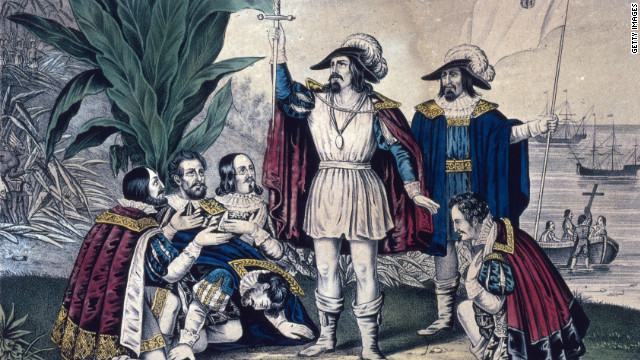
130205155638-christopher-columbus-story-top

Today is Columbus Day in the United States. While I do not recommend actually doing this, the following would be a historically-accurate way to observe this day.

  1. Break into the house where a family of your neighbors live.
  2. Announce to this family that you live there now.
  3. Kick the entire family outside, into the cold.
  4. If you notice them shivering, make them feel better by sharing your religious beliefs with them.
  5. If #4 does not work, use swords to put your former neighbors out of their misery.
  6. If step #5 seems a bit too excessive, use this option instead, based on the actions of those who followed Columbus:  “help” your shivering former neighbors keep warm . . . by throwing some smallpox-infested blankets to them.

Obviously, regarding Christopher Columbus:  I’m not a fan. I therefore call upon the United States Congress to remove Columbus Day from our list of official national holidays.

[Image credit:  see http://www.cnn.com/2014/10/10/opinion/perry-columbus-day-what-to-tell-your-kid/ — this is where I found the image above.]

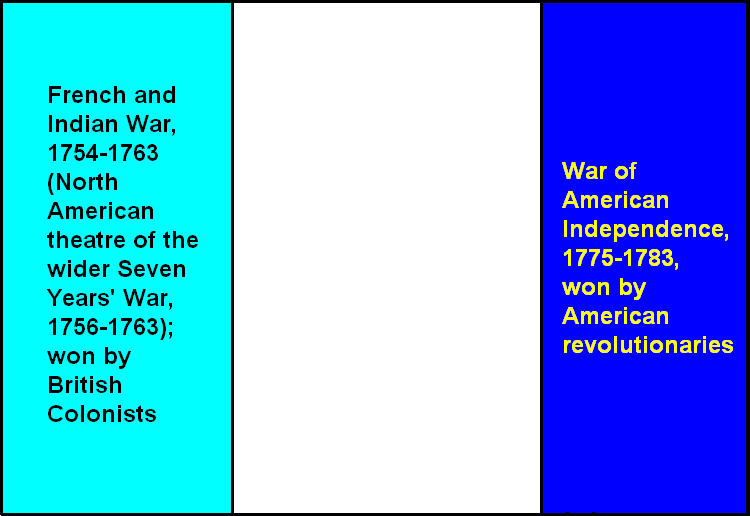
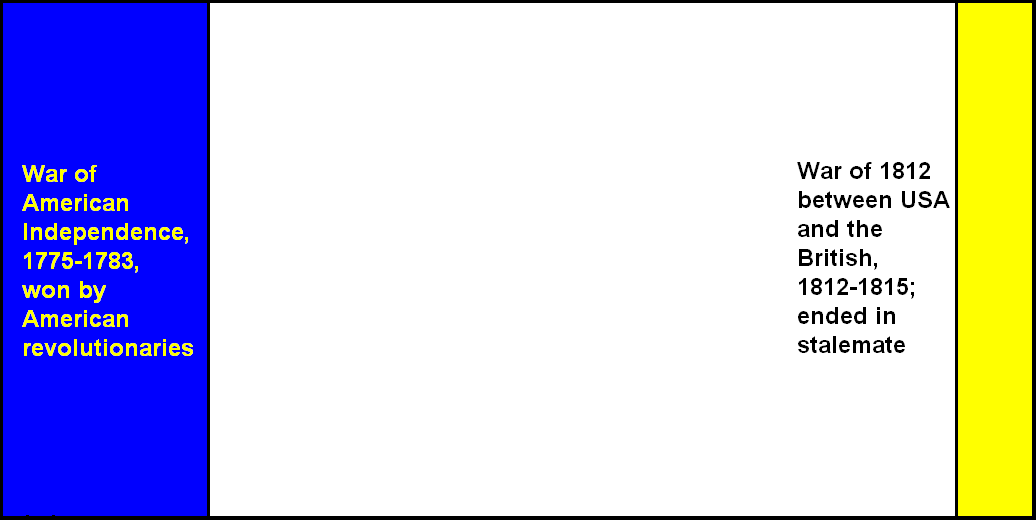
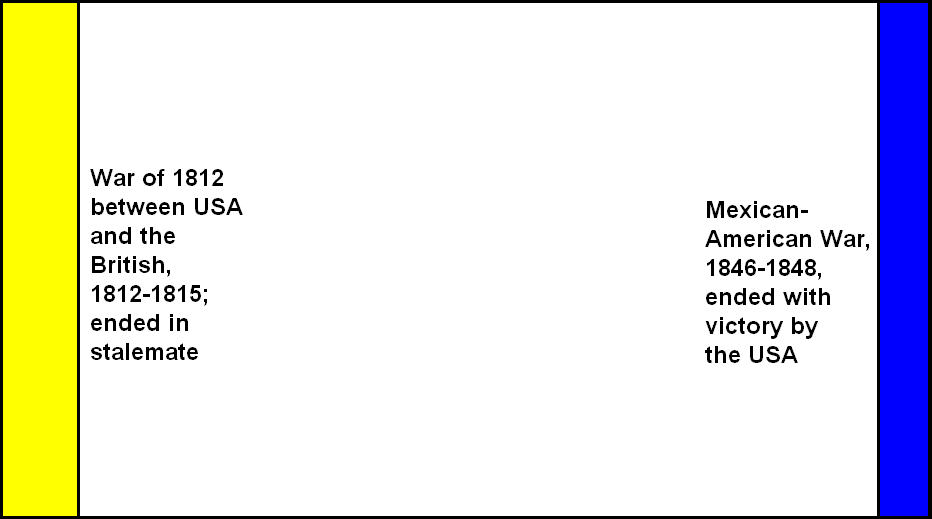
A Timeline of the Major Wars of the United States of America, in Our Brief History

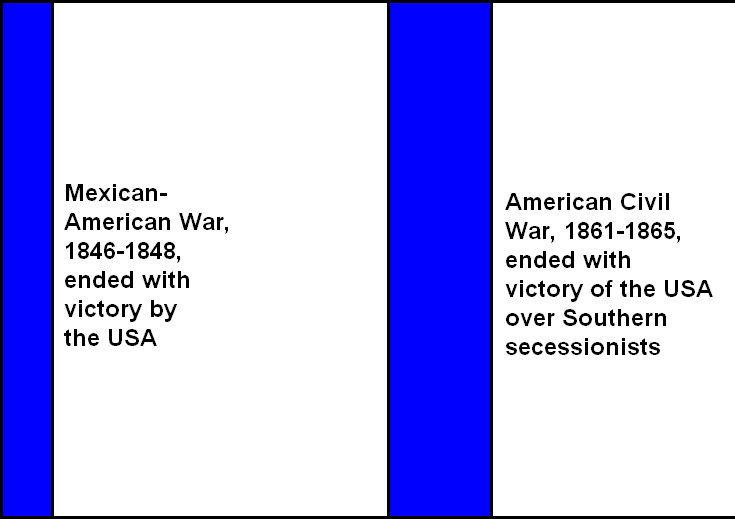
Because it was, in some ways, a precursor to the American Revolutionary War, this timeline begins with the pre-American-independence French and Indian War. American independence was formally declared during the Revolutionary War, in 1776.

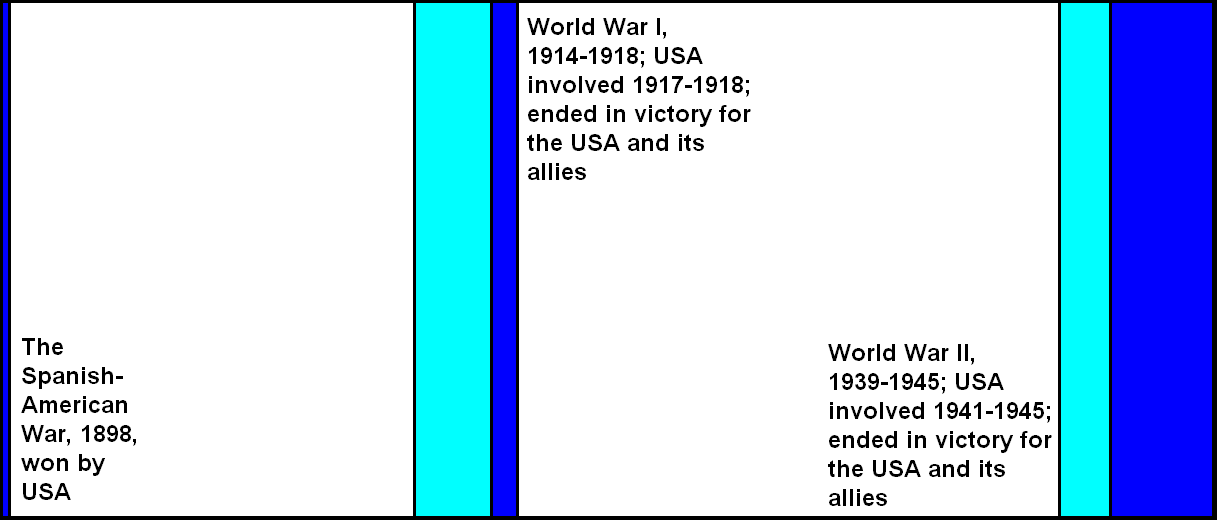
war1Light blue areas are for pre-American involvement in wars which ultimately ended in some form of victory for the USA, with dark blue areas representing American involvement in wars that ended in a victory for the side containing the United States, alone or with allies.

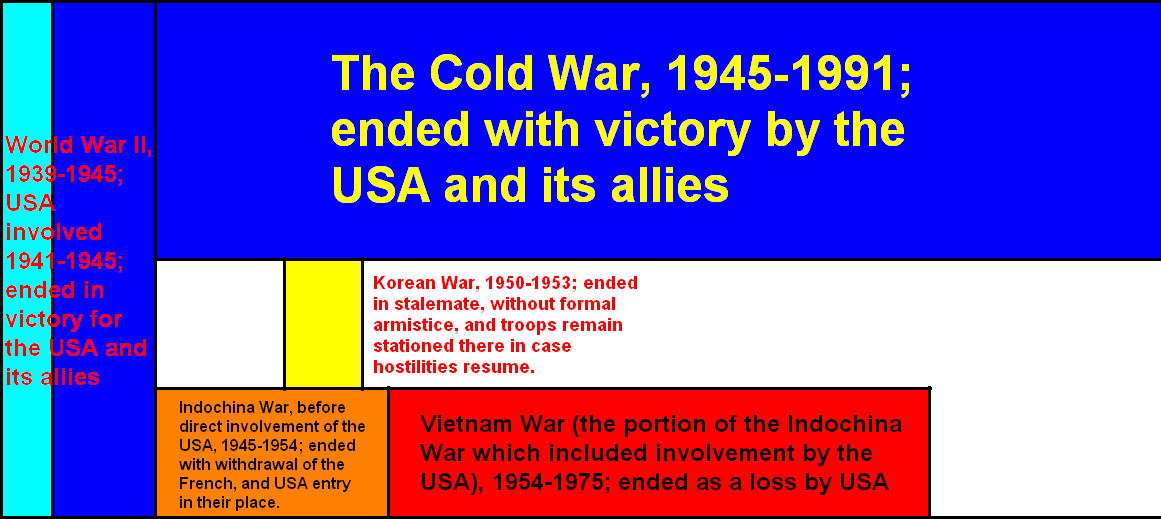
Each new part of this timeline contains the end of the previous one, and all wartimes within a single portion of this timeline are shown to scale. The white areas represent periods of peacetime, and are also shown to scale. Yellow wars are those that ended in stalemates, or conditions that could simply be called a tie.

war2war3war4war5

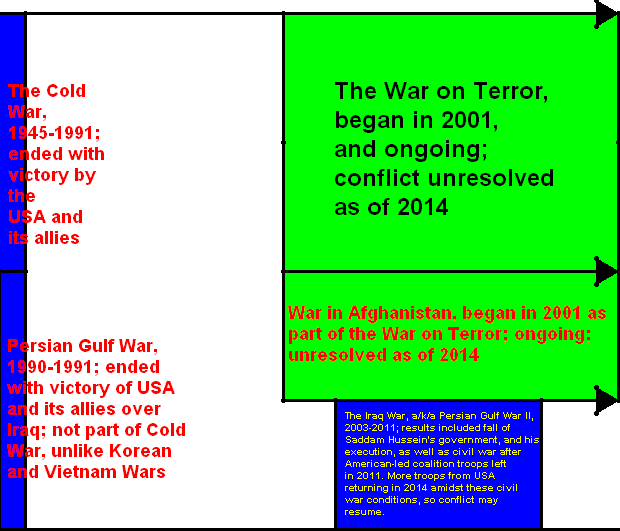
war6Beginning in 1945, things get complicated, with an ideological war (the Cold War) occasionally turning “hot,” as it did in Korea and Vietnam. A similar “it’s complicated” situation appears later, during the ongoing War on Terror. Also, the Vietnam War makes two new colors needed:  orange, for pre-USA-involvement in wars that ultimately lead to a defeat for the USA, and red, for the period leading up to a loss for the USA which actually involved American personnel.

war7

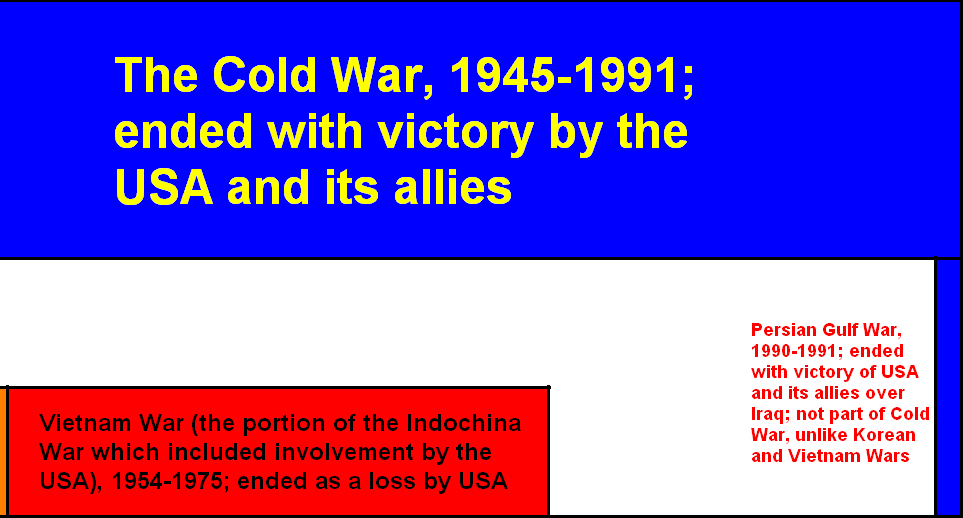
When the Soviet Union fell in 1991, ending the Cold War, some actually wrote of “the end of history,” as if the world had suddenly became uncomplicated. Subsequent events proved this idea to be premature.

war8

Since the War on Terror, as well as its component in Afghanistan, is unresolved as of now (2014), a new color, green, is used here for ongoing conflicts.

war9

Finally, it should be pointed out that the administration of George W. Bush tried to sell, to the American public and others, the idea that the 2003-2011 Iraq War was part of the War on Terror. Many Americans, however, myself included, do not accept this rationale, for no connection has been established between Iraq, on the one hand, and the 11 September 2001 terrorist attacks against multiple targets in the USA, on the other.

Something You Likely Did Not Know, About the “Pledge of Allegiance”

Image

I thought I knew the (rather complicated) history of the “Pledge of Allegiance” well — until I saw this picture. This was the original “flag salute” pose American students were taught to use, nationwide, until World War II was well underway. It had been in use since 1892, and was called the “Bellamy salute.”

The current “hand over the heart” gesture didn’t go into effect until 1942, and was changed in reaction to the Nazis using essentially the same salute which you see American schoolchildren displaying in this (circa 1941) photograph. From where did this gesture really originate? A common belief is that it started in ancient Rome, but the article at http://en.wikipedia.org/wiki/Roman_salute — and the sources cited there — throw doubt on this idea. It seems that, instead, this gesture was depicted in an 1874 painting of an ancient Roman scene, spread into other neoclassical artworks, then plays and other performances, until it was well-established in the public consciousness as something the ancient Romans did — but that belief appears to be unsupported by the relatively small number of actual writings, or works of art, which have survived from ancient times.

It was twelve years after the change in the civilian American flag-salute gesture that Congress made another, much better-known change — the 1954 addition (unconstitutional, in my opinion) of the words “under God.” Just as the early gesture-change was made, in wartime, as a reaction against the practices of an enemy, arguments have been made that this change in the wording of the Pledge was made for similar reasons, given that we were then in the early years of the Cold War, with America’s enemies, in that long struggle, being what were often called the “Godless Communists.”

[Additional source, beyond the one given above: http://en.wikipedia.org/wiki/Pledge_of_Allegiance (with more sources cited at the bottom of that article)].

Every American Who Is Old Enough Remembers 9/11/2001

Here’s the main thing I remember about that day. I was teaching 9th graders when the attacks occurred.

Student, 12 years ago today: “Mr Austin! Mr. Austin! Turn on the TV! Someone just flew an airplane into the World Trader Center!”

Me: “Yeah, RIGHT.” I was finally convinced to turn it on — just in time to see the second plane hit the other tower.

I don’t think I’ll ever live THAT one down. I had to spend the rest of the workday trying to reassure my students that Mayflower, Arkansas had zero strategic importance, and that they could relax about their fears of their small town being the next target. This was not easy.

The boiling anger set in after I no longer had to take care of students, and remained with me for days. Many (or most) Americans experienced this same emotion.