
I recently re-discovered this “lost work,” which I made using Geometer’s Sketchpad, in 2011 — before I started this blog, which is why it has not appeared here before.
I recently re-discovered this “lost work,” which I made using Geometer’s Sketchpad, in 2011 — before I started this blog, which is why it has not appeared here before.
Someone found this, and “liked” it, in my old Facebook pictures. I had forgotten all about it, until this happened. It is a mandala, made of rhombi, with nine-fold symmetry, made in 2010 with Geometer’s Sketchpad — two years before I started this blog.


Ordinarily, with Zometools, the compound of five cubes is an all-blue model. However, I wanted to build one in which each cube is a different color, so I made a special request to the Zometool Corporation (their website: http://www.zometool.com) for some off-color parts, to make this possible.
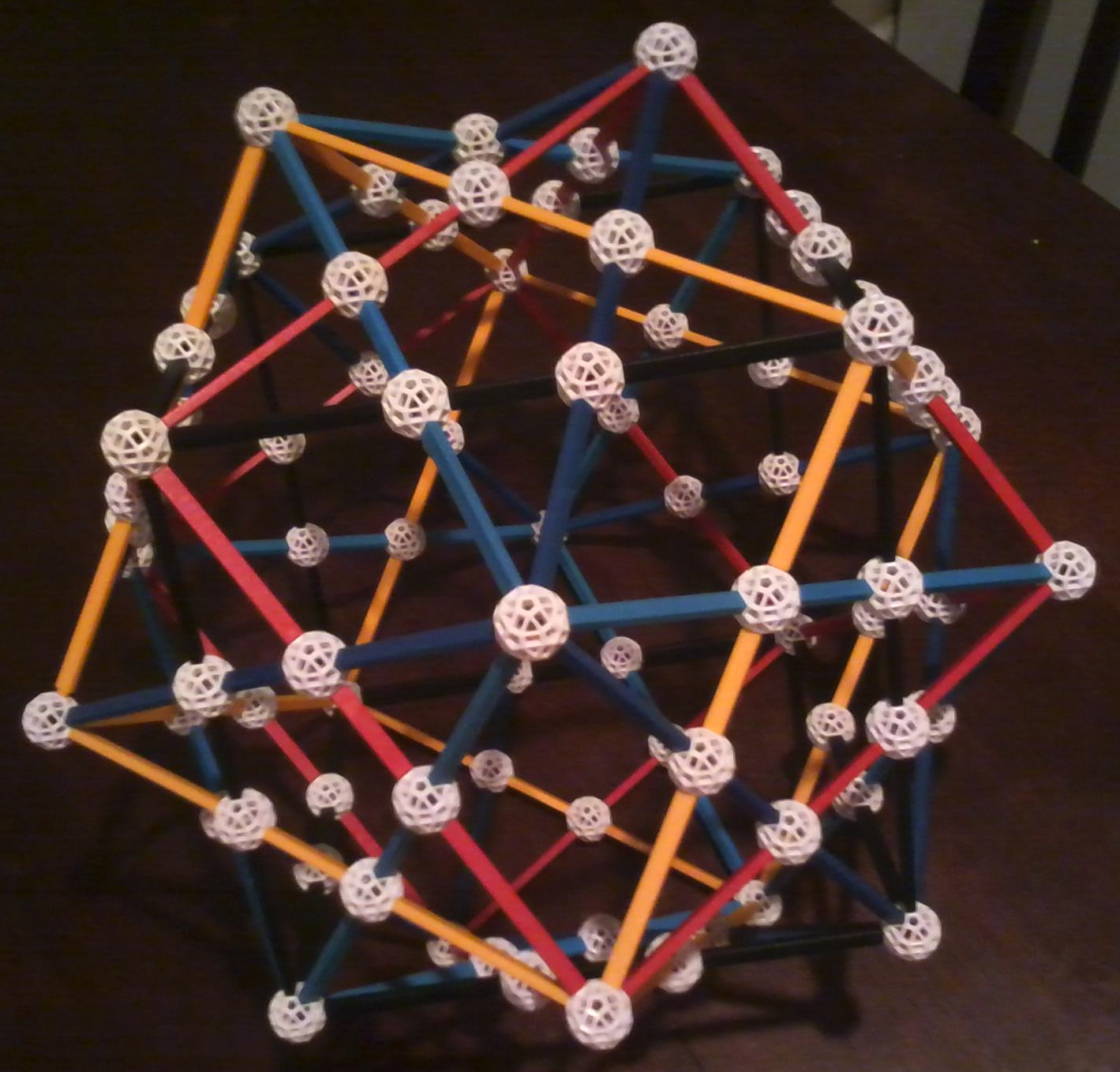
The five colors used in this model are standard blue, a darker shade of blue, red, yellow, and black.
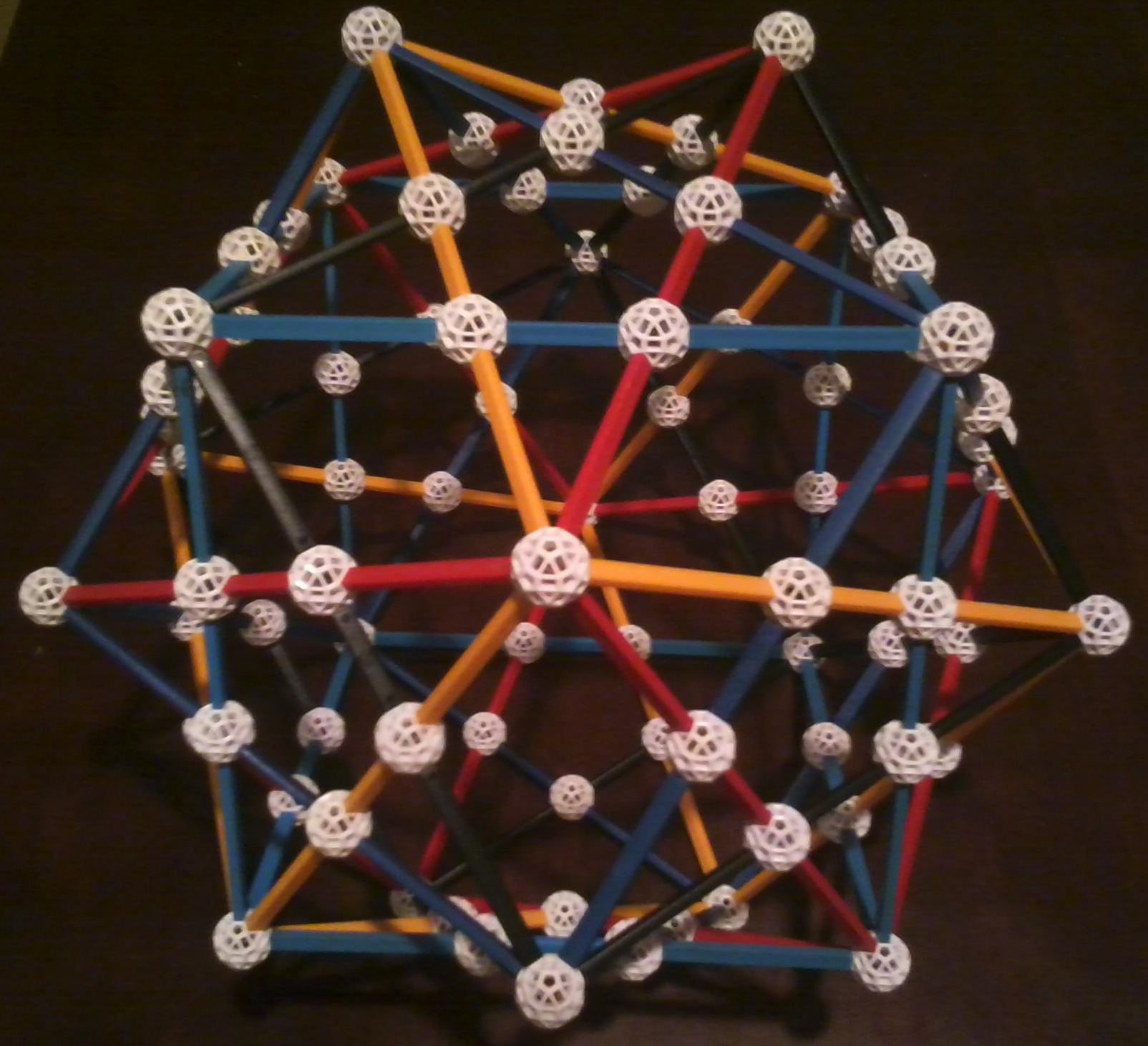
I also received the struts needed to build this model with one cube in white, so I will be making a second version of this soon. I didn’t want the Zomeballs used to match any strut color, though, so I will have to wait for the shipment of purple Zomeballs I ordered, today, to arrive, before I can build that model.
Zome is a fantastic tool to use for mathematical investigations, as well as education, and other applications as well. I recommend this product highly, and without reservation.

This was created by making the dual of the 32nd stellation of the strombic hexacontahedron, which is itself the dual of the rhombicosidodecahedron. This technique for finding facetings works because faceting is the reciprocal function of polyhedral stellation.
I did this using Stella 4d, which you can try for yourself, for free, at http://www.software3d.com/Stella.php.
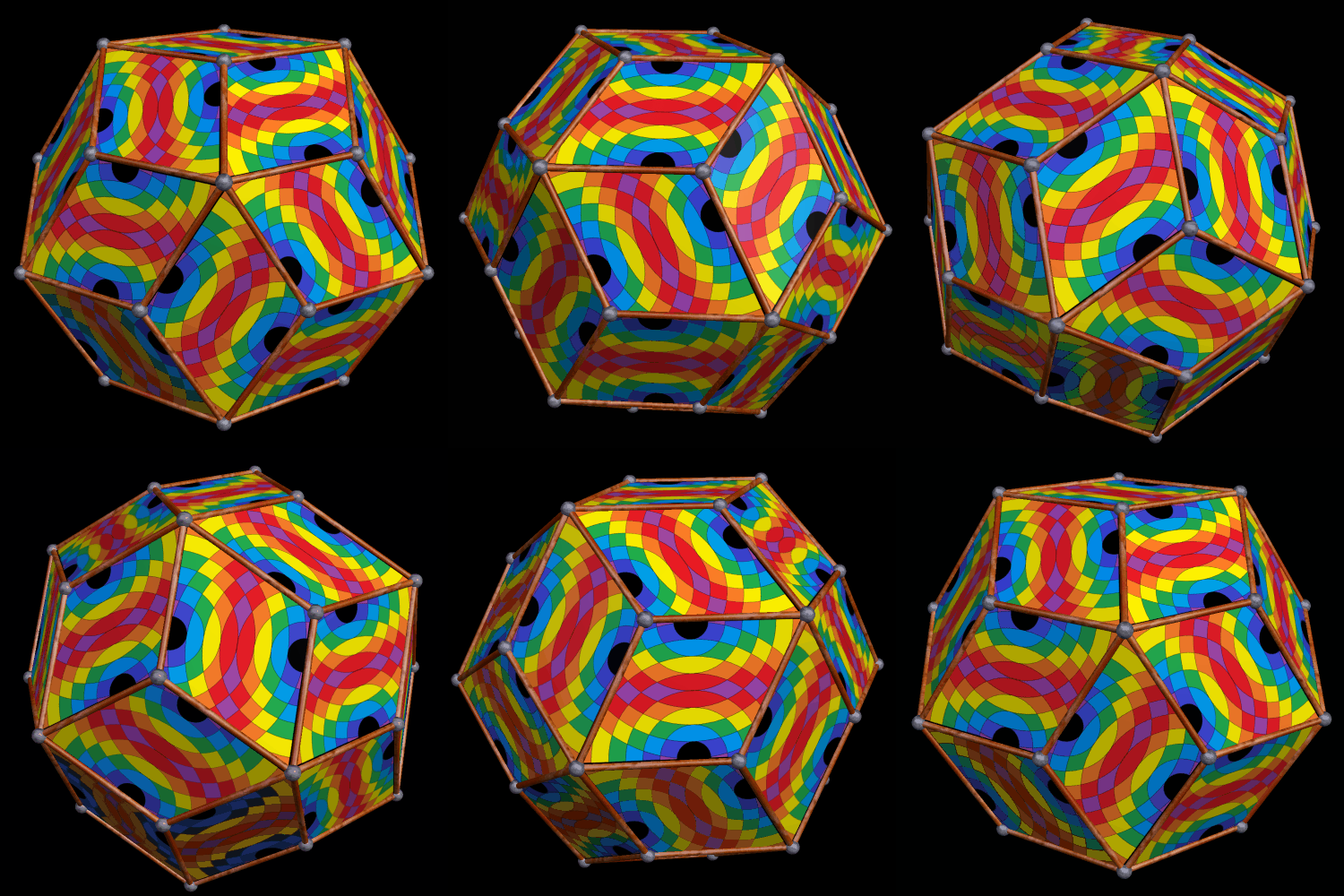
It took three programs to make this. First, outlines of the “double rainbow” patterns on each face were constructed using Geometer’s Sketchpad. A screenshot from that program was then pasted into MS-Paint, which was used to add color to the outline of the pattern on each face. Next, the colorized image was projected onto each face of a rhombic triacontahedron, using Stella 4d: Polyhedron Navigator — the program that put this all together, and what I used to generate the rotating .gif above. Stella is available at http://www.software3d.com/Stella.php, with a free trial download available.
Interestingly, while this polyhedron itself is not chiral, the coloring-pattern of it, shown above, is.
With only small modifications, Stella can produce a very different version:
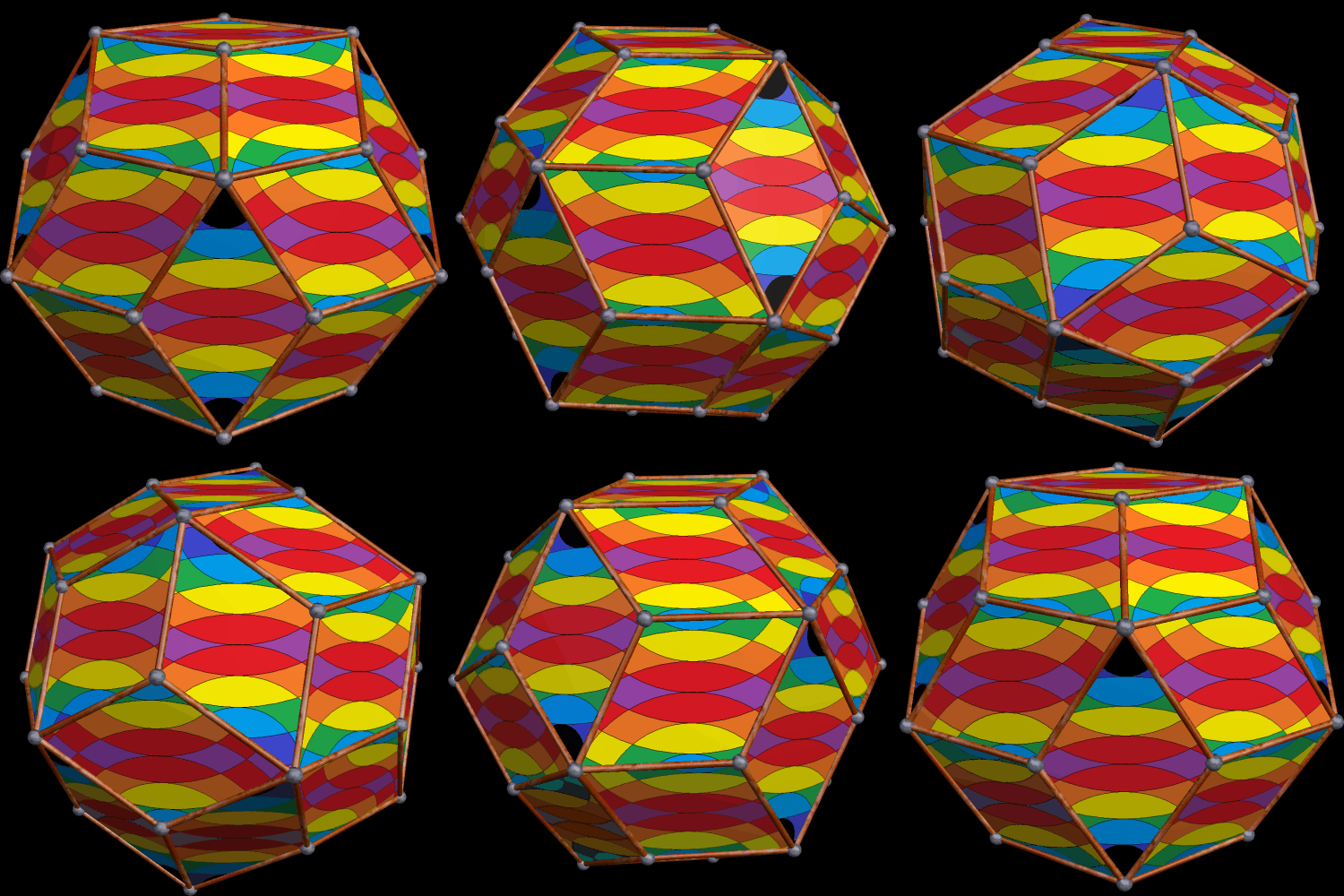
Which one do you like better?
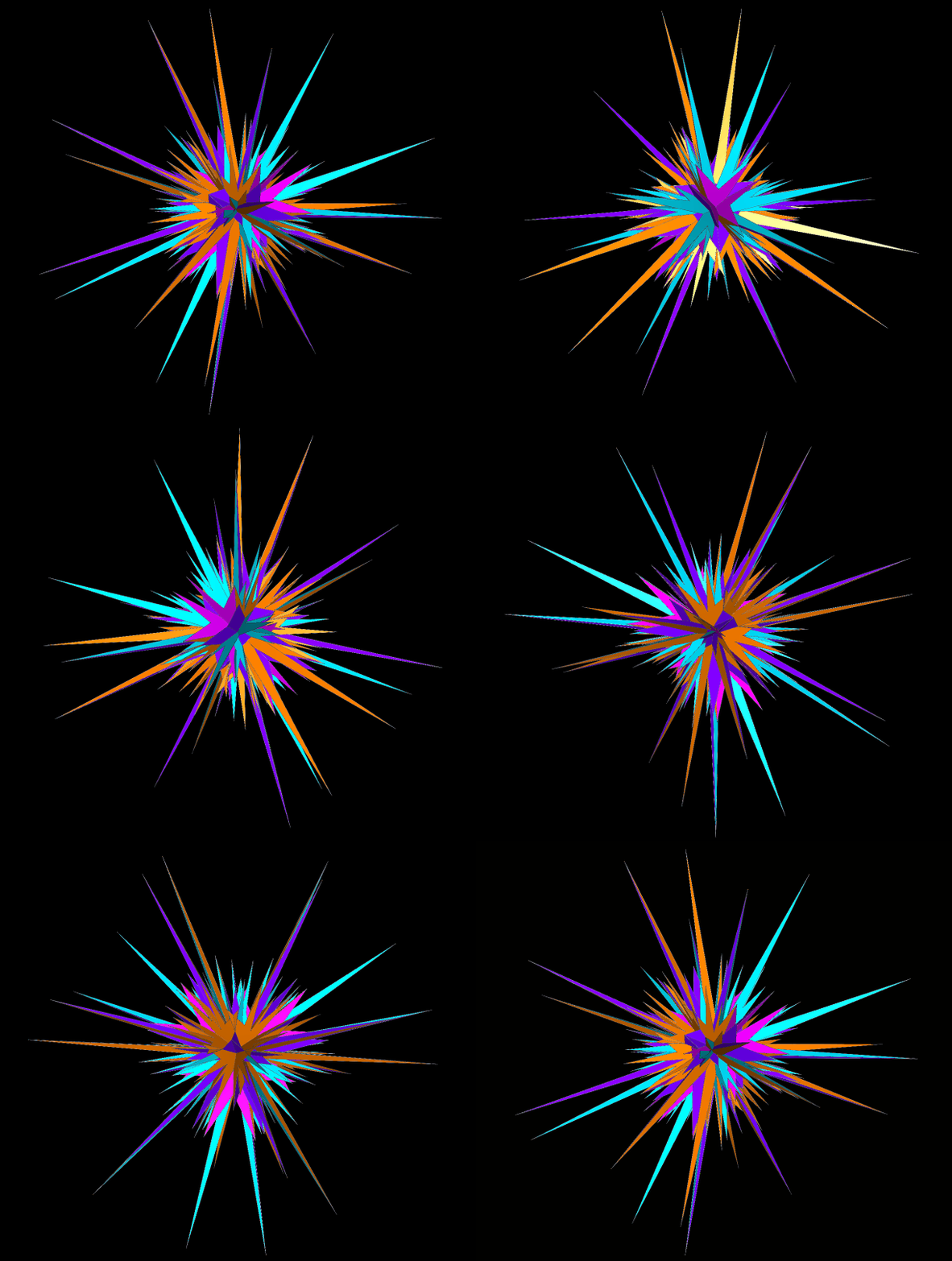
Image created using Stella 4d, available here.
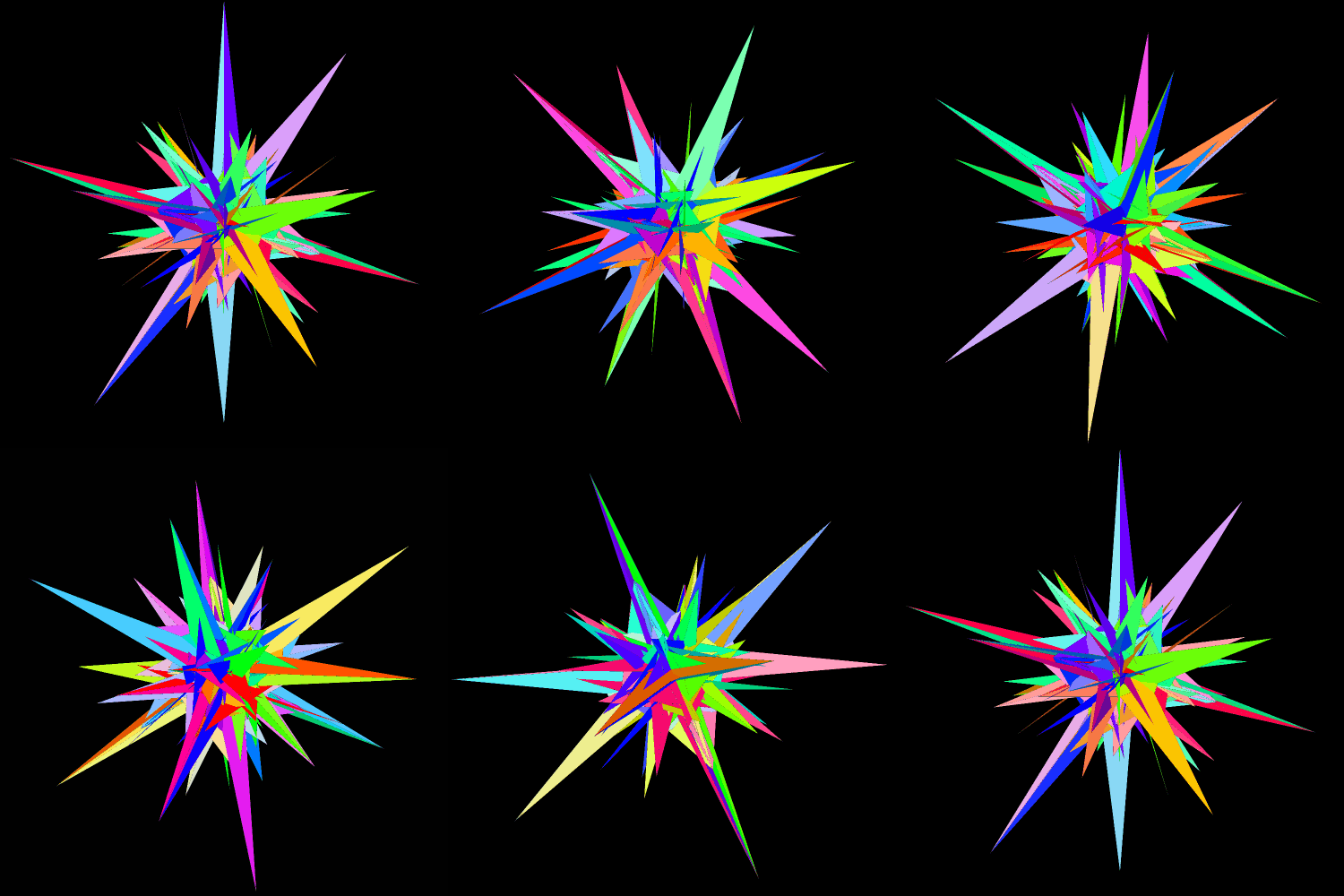
I made this using Stella 4d, which you can find here.

Created using Stella 4d, available here.
Recently, a reader of this blog contacted me about a polyhedron he wished to model. His name is Dave Smith, and he had already done much of the work involved, but needed help finishing off his project. Here’s the picture he e-mailed me.

The visible faces are regular pentagons — four of them. The invisible faces are isosceles trapezoids, in two “bowtie” pairs which share their shortest edges with those of their reflections. I e-mailed Smith, and told him the truth: I didn’t have a clue how to make this in Stella 4d, the program I use to make the rotating polyhedra on this blog (including the one below). I also told him I wasn’t giving up — merely enlisting help with his puzzle.
And, with that, I went to Facebook, posting the image above, along with an explanation, and request for help finishing it. This may not be what most people think of when they consider Facebook, but I have deliberately sought out experts there in many fields, including geometry, to make the social-networking site useful in unusual ways, such as getting help with geometrical puzzles I can’t solve alone. Three geometricians with skills which exceed mine (Wendy Krieger, Tom Ruen, and Robert Webb, who wrote Stella 4d) began discussing the figure. One of them, Tom Ruen, sent me .stel files (That’s what Stella 4d uses) for multiple figures, getting closer each time. With the last such virtual model Tom sent me, I was able to “tweak” it to get the pentagons regular.

This eight-faced figure has two edge lengths, the shorter appearing only twice, as the shared, shorter base within each “bowtie” pair of isosceles trapezoids — and these two edge lengths are in the golden ratio. A type of octahedron, it also has an interesting form of symmetry — it reminds me of pyritohedral symmetry, but is not; the features seen in pyritohedral symmetry in relation to the x-, y-, and z-axes of coordinate space only show up here in relation to two of these three axes. This symmetry-form is called dihedral symmetry.
And it only took five people to figure all of this out!
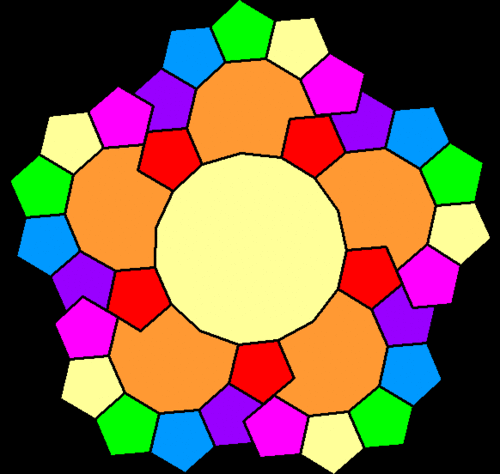
I recently found a bunch of my “lost” geometrical art which never found its way to this blog before, and here’s the latest piece of it. Created in 2012, it has a central pentadecagon, five orange decagons partially hidden behind other polygons, and many pentagons, all of them regular.
 RobertLovesPi.net