Canned Neutrinos

Image

canned neutrinos

A Proposal: An Ice-Tunneling Lander to Explore Extraterrestrial Sub-Surface Oceans

We have found compelling evidence for the existence of several sub-surface oceans in various places in our solar system. The most well-known of these bodies of liquid water is under the ice crust of Europa, a moon of Jupiter, with others located elsewhere. These oceans are logical places to look for signs of past or present extraterrestrial life. However, we have yet to obtain a sample of any of these oceans for analysis. It is time for that to change, but not without taking precautions to avoid damaging any such life, should it exist.

Europa-moon

Europa (source: NASA)

What follows is my idea, freely available for anyone who wishes to use it, to safely obtain and analyze such samples. These ice-tunneling probes could be ejected from a larger lander, or simply dropped directly onto the surface from orbit. This would be far less expensive than any sort of manned interplanetary exploration. Exposure to vacuum and radiation, in space, would thoroughly sterilize the entire apparatus before it even lands, protecting anything which might be alive in the ocean underneath from contamination by organisms from Earth.

Tunneling LASSO Probe (Lander for Analysis of Sub-Surface Oceans)

In this cross-sectional diagram, the light blue area represents the ice crust of Europa, or another solar-system body like that moon. The ice-tunneling lander is shown in red, orange, black, yellow, and green. The dark blue area is the vertical tunnel created by the probe, shown shortly after tunneling begins. As the probe descends, the dome shown in gray caps the tunnel, and stays on the surface, having been previously stored, folded up, in the green section of the egg-shaped probe. The gray section is designed as a geodesic dome, with holes of adjustable size to allow heat to escape into space. An extendable, data-carrying tether connects the egg-shaped tunneling module to the surface dome. Solar-energy panels and radio transmitters and receivers stay at the surface, attached to the gray dome.  

The computers necessary to operate the entire probe are in the yellow section. The black section that extends outward, slightly, from the body of the tunneler would contain mechanisms to obtain samples of water for analysis. The orange section is where actual samples are stored and analyzed.

The red part of the tunneler is weighted, so that gravity forces it to stay at the bottom. It is designed to heat up enough to melt the ice underneath it, allowing the entire “egg” to descend, attached to its tether. Water above the tunneling probe re-freezes, sealing the tunnel so that potentially-damaging holes are not left in the ice crust of Europa. The heating units in the red section can be turned on and off as needed, to slow, hasten, or stop the probe’s descent through the crust.

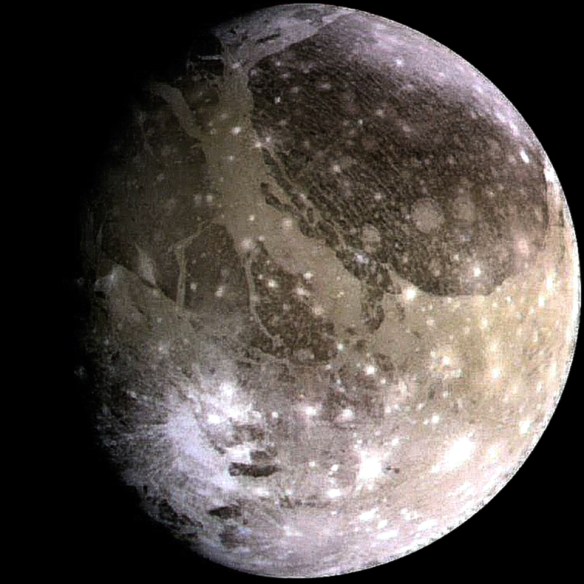
Oceans in other places in the solar system might require certain adjustments to this design. For example, Ganymede, another moon of Jupiter, is far rockier than Europa. If this design were used on Ganymede, the tunneling probe would likely be stopped by sub-surface rocks. For this type of crust, the probe’s design could be modified to allow lateral movement of the tunneler, in order to go around rocks.

Ganymede_g1_true-edit1

Ganymede (source: NASA)

On Europa, Ganymede, and elsewhere, one limitation of this design is imposed by the maximum length of the tether. We would not want to go all the way down to the subsurface oceans with the earliest of these probes, though. A better strategy would be to only tunnel part-way into the crust at first, capturing liquid samples of water before refreezing of the ice. After all, this ice in the crust could have been part of the lower, liquid ocean at some point in the past, and it should be analyzed thoroughly before heat-tunneling any deeper. The decision to make the tether long enough to go all the way through the crust, into the subsurface ocean itself, is not one to make lightly. It would be best to study what we find in molten crust-samples, first, before tunneling all the way through the protective crusts of these oceans. 

Thoughts on Colonizing Space

OSIRIS_Mars_true_color

[Image found here.]

It is no secret than I am not a fan of our current president, Donald Trump. I’ve been watching him carefully, and have found exactly one point of agreement with the man: humans should colonize the planet Mars. The two of us differ, however, on the details. What follows is my set of reasons — not Trump’s — for supporting colonization of Mars.

First, we should not start with Mars. We should start, instead, by establishing a colony on Luna, our own planet’s moon. There are several reasons for this. First, as seen in this iconic 1969 photograph brought to us by NASA, we’ve been to the Moon before; it simply makes sense to start space-colonization efforts there.

apollo-flag2

At its furthest distance, the Moon is ~405,000 km away from Earth’s center, according to NASA. By contrast, at its closest approach to Earth in recent history, Mars was 55,758,006 km away from Earth. With the Moon less than 1% as far away as Mars at closest approach, Luna is the first logical place for an extraterrestrial colony. It need not be a large colony, but should at least be the size of a small town on Earth — say, 100 people or so. There are almost certainly problems we haven’t even discovered — yet — about establishing a sustainable reduced-gravity environment for human habitation; we already know about some of them, such as muscular atrophy and weakening of bones. Creating a lunar colony would demand of us that we solve these problems, before the much more challenging task of establishing a martian colony. (To find out more about such health hazards, this is a good place to start.) Once we have a few dozen people living on the Moon, we could then begin working in earnest on a martian colony, with better chances for success because of what we learned while colonizing the Moon. 

An excellent reason to spend the billions of dollars it would take to colonize Mars (after the Moon) is that it is one of the best investment opportunities of the 21st Century. Space exploration has a fantastic record of sparking the development of new technologies that can help people anywhere. For example, the personal computers we take for granted today would not be nearly as advanced as they are without the enormous amount of computer research which was part of the “space race” of the 1960s. The same thing can be said for your cell phone, and numerous other inventions and discoveries. Even without a major space-colonization effort underway, we already enjoy numerous health benefits as a result of the limited exploration of space we have already undertaken. Space exploration has an excellent track record for paying off, big, in the long run.

Another reason for us to colonize Mars (after the Moon, of course) is geopolitical. The most amazing thing about the 20th Century’s Cold War is that anyone survived it. Had the United States and the Soviet Union simply decided to “nuke it out,” no one would be alive to read this, nor would I be alive to write it. We (on both sides) survived only because the USA and the USSR found alternatives to direct warfare: proxy wars (such as the one in Vietnam), chess tournaments, the Olympics, and the space race. In today’s world, we need safe ways to work out our international disagreements, just as we did then. International competition to colonize space — a new, international “space race” — would be the perfect solution to many of today’s geopolitical problems, particular if it morphs, over the years, into the sort of international cooperation which gave us the International Space Station.

Finally, there is the best reason to establish space colonies, and that is to increase the longevity of our species, as well as other forms of life on Earth. Right now, all our “eggs” are in one “basket,” at the bottom of Earth’s gravity well, which is the deepest one in the solar system, of all bodies with a visible solid surface to stand on. A 10-kilometer-wide asteroid ended the age of the dinosaurs 65 million years ago, and there will be more asteroid impacts in the future — we just don’t know when. We do know, however, that past and present human activity is causing significant environmental damage here, so we may not even need the “help” of an asteroid to wipe ourselves out. The point is, the Earth has problems. The Moon also has problems, as does the planet Mars — the two places are far from being paradises — but if people, along with our crops and animals, are located on Earth, the Moon, and Mars, we have “insurance” against a global disaster, in the form of interplanetary diversification. This would allow us to potentially repopulate the Earth, after the smoke clears, if Earth did suffer something like a major asteroid impact.

Since Moon landings ended in the 1970s, we’ve made many significant discoveries with space probes and telescopes. It’s time to start following them with manned missions, once again, that go far beyond low-Earth orbit. There’s a whole universe out there; the Moon and Mars could be our first “baby steps” to becoming a true spacefaring species.

[Later edit: Please see the first comment, below, for more material of interest added by one of my readers.]

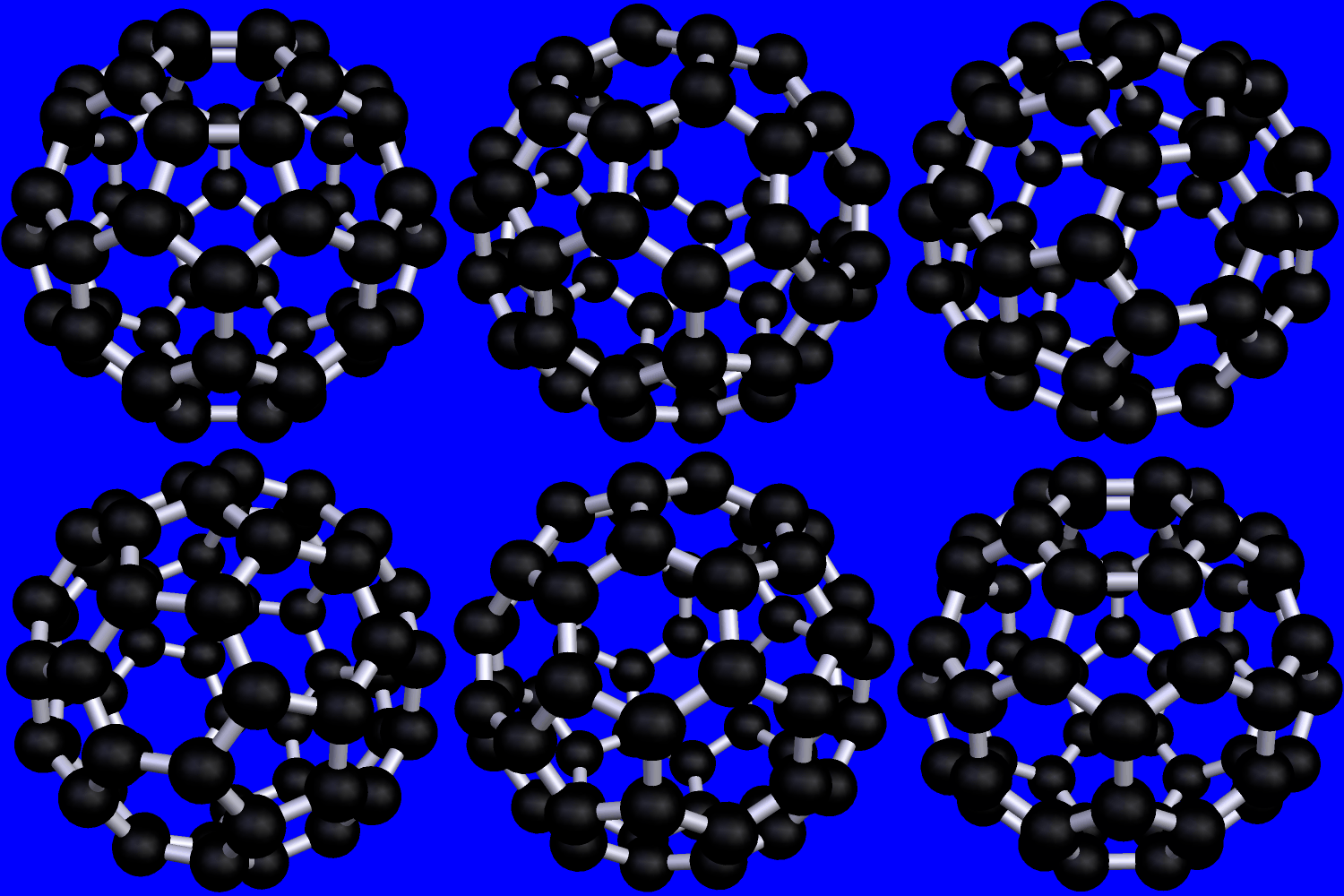
A Fullerene Molecule with 320 Carbon Atoms

C320

I created this image using Stella 4d: Polyhedron Navigator, which is available here.

Beautiful, Clean . . . Coal?!?

Type “beautiful clean” into Google, and it suggests these endings to the phrase:

beautiful clean coal

There is no such thing as “beautiful clean coal” — coal is actually, of all energy sources, the most harmful to the environment, as scientists have shown again and again. The phrase has been made famous by our current president, Donald Trump, who appears to have the lowest level of scientific literacy than any other American president, living or dead.

Move over, George W. Bush.

An Eighty-Atom Fullerene Molecule

c80-fullerene

The fullerene molecule that gets the most attention is C60, so I’m giving C80 a little bit of the spotlight, for balance. I made this using polyhedral modeling software called Stella 4d; you can try it for yourself at this website.

A “Thumbs Up” for Google Classroom

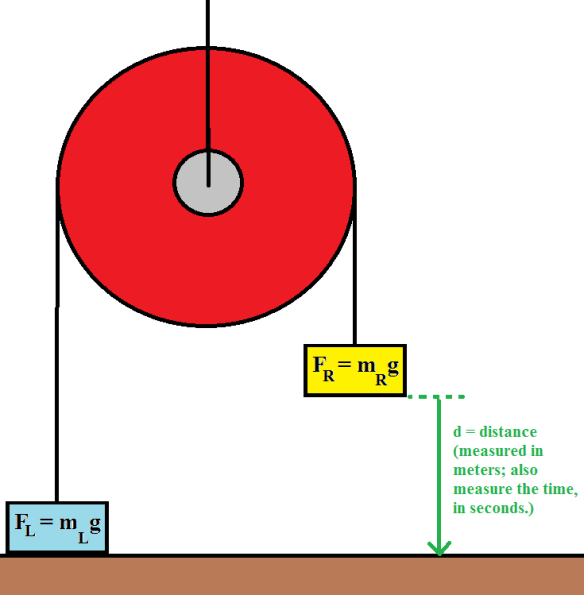
This is my 22nd year of teaching, but my first year using Google Classroom. We’re finding it to be a useful tool. This, for example, is the diagram for the Atwood’s machine lab we are doing in Pre-AP Physical Science, beginning today. My students will find this waiting for them in their virtual classroom (on Chromebooks my school district provides), with discussion-prompts to get us started:

atwoods-machine-diagram

I had no idea that four years of blogging, here on WordPress, had been preparing me to use this teaching tool. However, active blogging does require one to develop some transferable skills, especially in fields (such as what I teach) which are similar to the topics of one’s blog, as is the case here.

One Possible Definition of Physics

Visual definition of physics

With my metaphorical “mathematics of sets” hat on, this is what physics looks like, to me. The further you go in the field, the more challenging the mathematics gets; also, the better (and more expensive) the toys become.

We’re Going Back to School Tomorrow, and I’m the Teacher.

Trunc Icosa

This is my 22nd year teaching. This year, I teach in only one department. This is nice; I’ve spent much of my career in multiple departments, simply because I am certified in multiple subject areas. This year, in my building, I am one of three science teachers. Our high school has become so large that the 9th grade has been “spun off” to a new freshman campus, while remaining part of the high school, and I’m one of the teachers who gets to go to the new campus. This provides my students, my colleagues (especially at the new campus), and myself the opportunity for a fresh start, to a greater degree than is usually the case when a new school year begins.

My students are in just two subjects, this year: Physical Science, and Pre-AP Physical Science. I don’t want the students in the class without the “Pre-AP” prefix to feel that they are in a “lesser” class, in any sense of that word, so I am renaming “Physical Science,” slightly: “High School Physical Science.” It is my hope that this change in wording serves to communicate high expectations, and 9th grade is the first year of high school — which, in the USA’s public school systems, means 9th grade students must pass courses to earn credits toward graduation, usually for the first time.

In the other class, Pre-AP Physical Science, I am teaching that version of the course for the first time, but I feel well-prepared by the extensive training I had this Summer, and last school year, through my university, the school where the Summer training was held, and the College Board. Both classes will challenge students, but it is also true that the two classes will be different, for Pre-AP Physical Science have to leave students prepared to function effectively, later, in other Pre-AP and/or AP science courses. 

Physical Science is an introduction to two sciences: physics, and then chemistry, at least in my school district. It helps me that I have experience teaching both subjects as higher-level, “stand-alone” classes. In this class (both versions), we also touch on some other sciences which are also physical sciences, such as geology, astronomy, and the science of climate change. However, those sciences do not dominate these courses, as physics and chemistry do. The image above is from chemistry (and was created with Stella 4d, which you can try here), and shows a model of a sixty-atom all-carbon molecule called buckminsterfullerene, one of a class of roughly-spherical carbon allotropes called fullerenes. Mathematicians call this particular fullerene’s shape a “truncated icosahedron,” and, in sports, this same shape is known as the (non-American) “football” or “soccer ball.” Physical modes of this shape may be made with molecular model sets of various kinds, Zometools, and other materials. In both versions of my science classes this year, building models of this molecule will be one of many lab activities we will do; one of my goals this year is for my students to spend a third of their time doing labs. The legal requirement for science class time spent in lab, in my state, is at least one-fifth, so more than that is fine. Science classes helped me learn both science and mathematics, but what I remember the most is the labs. I don’t think that’s just me, either; students learn more effectively, I have observed, by conducting scientific experiments themselves, than by being “lectured at” for extended periods of time.

I’m looking forward to a good year — for all of us.

For Science Teachers: A Safer Alternative to Liquid Mercury

Liquid mercury, in schools, poses three major problems:

  1. It is extremely toxic,
  2. It has a high vapor pressure, so you can be poisoned by invisible mercury vapor leaving any exposed surface of liquid mercury, and
  3. Playing with liquid mercury is a lot of fun.

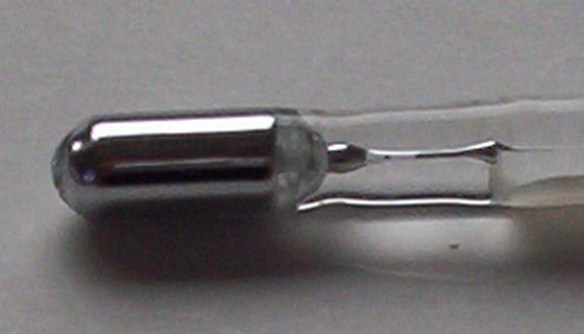
These are compelling reasons to leave use of mercury to those at the college level, or beyond. In the opinion of this science teacher, use of liquid mercury in science classes, up through high school chemistry, inside or outside thermometers, is a bad idea. If the bulb at the bottom of a thermometer, as well as the colored stripe, looks silvery, as in the picture below (found on Wikipedia), then that silvery liquid is mercury, and that thermometer should not be used in labs for high school, let alone with younger children. Your local poison control center can help you find the proper thing to do with mercury in your area; it should definitely not just be thrown away, for we do not need this serious environmental toxin in landfills, where it will eventually reach, and poison, water. Red-stripe thermometers without any silvery line, on the other hand, are far safer, although broken glass can still cause injury.
Maximum_thermometer_close_up_2

I turned ten years old in 1978, and, by that time, I had already spent many hours playing (unsupervised) with liquid mercury, pouring it hand-to-hand, etc., so I know exactly how irresistible a “plaything” mercury can be, to children. Luck was on my side, and I suffered no ill effects, but I can state from experience that children should not be tempted with highly-toxic “mercury as a toy,” for it’s not a toy at all. Mercury spills require special “hazmat” training to clean up safely; anyone encountering such a spill who does not have such training should simply notify the proper authorities. In the USA, this means evacuating the area immediately, and then calling 911 — from far enough away to keep the caller from breathing invisible mercury vapor.

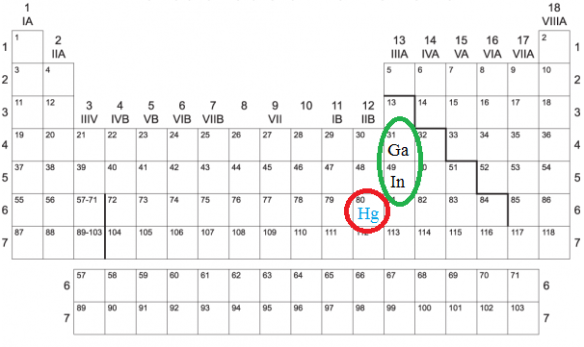
Fortunately, there is a safe alternative which can give students a chance to experiment with a room-temperature metal: an alloy of three parts gallium to one part indium, by mass. Gallium’s melting point is between normal human body temperature and room temperature, so it can literally melt in your hand (although a hot plate is faster). Indium, on the other hand, has a melting point of 156.6°C. For this reason, I will not buy a hot plate unless it can reach higher that that temperature. (Note: use appropriate caution and safety equipment, such as goggles and insulated gloves, with hot plates, and the things heated with them, to avoid burns.)

Once both elements are massed, in the proportions given above, they can then be melted in the same container. When they melt and mix together, they form an alloy which remains liquid at room temperature.

Some might wonder how mixing two elements can create an alloy with a melting point below the melting points of either of the two ingredients, and the key to that puzzle is related to atomic size. Solids have atoms which vibrate back and forth, but don’t move around each other. In liquids, the atoms are more disordered (and faster), and easily slip around each other. In solid, room-temperature gallium, all the atoms are of one size, helping the solid stay solid. Warm it a little, and it melts. With pure indium, this applies, also, but you have to heat it up a lot more to get it to melt. If the two metals are melted and thoroughly mixed, though, and then frozen (a normal freezer is cold enough), the fact that the atoms are of different sizes (indium atoms are larger than gallium atoms) means the atoms will be in a relatively disordered state, compared to single-element solids. In liquids, atoms are even more disordered (that is, they possess more entropy). Therefore, a frozen gallium/indium alloy, with two sizes of atoms, is already closer to a disordered, liquid state, in terms of entropy, than pure, solid gallium or indium at the same temperature. This is why the gallium-indium mixture has a melting point below either individual element — it requires a lower temperature to get the individual atoms to flow past each other, if they are already different atoms, with different sizes.
liquid metals

Those who have experience with actual liquid mercury will notice some important differences between it and this gallium-indium alloy, although both do appear to be silver-colored liquids. (This is why mercury is sometimes called “quicksilver.”) For one thing, their densities are different. A quarter, made of copper and nickel, will float on liquid mercury, for the quarter’s density is less than that of mercury. However, a quarter will sink in liquid 3:1 gallium-indium alloy. To float a metal on this alloy, one would need to use a less-dense metal, such as aluminum or magnesium, both of which sink in water, but float in liquid Ga/In alloy.

Other differences include surface tension; mercury’s is very high, causing small amounts of it on a floor to form little liquid balls which are difficult (and dangerous) to recapture. Gallium-indium alloy, by contrast, has much less surface tension. As a result, unlike mercury, this alloy does not “ball up,” and it will wet glass — and doing that turns the other side of the glass into a mirror. Actual mercury will not wet glass.

The most important differences, of course, is that indium and gallium are far less toxic than mercury, and that this alloy of those two elements has a much lower vapor pressure than that of mercury. Gallium and indium are not completely non-toxic, though. Neither indium nor gallium should be consumed, of course, and standard laboratory safety equipment, such as goggles and gloves, should be worn when doing laboratory experiments with these two elements.