Richard Feynman Explains When Rules Are Wrong

Image

richard-feynman quote

Richard Feynman, on Uncertainty in Science

Image

richard-feynman quote

A Hypothesized Method for Washing Away Anger

washing away anger

This particular method is simple: sleep. Eight hours usually does it for me, >90% of the time the anger originated on the previous day. For others for whom this works, I expect the amount needed will vary from person to person.

Relevant medical research comes from many sources I have read, speculating on the (still unknown) complete list of the purposes of sleep, which includes (in lay terms) “washing away” junk the brain doesn’t need any longer. I am of the opinion that anger qualifies for that category.

My evidence: repeatedly observing this happening to me, hundreds of times.

Replication of experiments, and creation of new ones, to search for more evidence, is obviously needed. While this is a testable hypothesis, I certainly have not conducted a definitive test. For one thing, this lies outside the fields I have studied, formally, the most, and my sample size (one) was far too small to count for much.

An important point, in case anyone is wondering: no, I do not think this ability is limited to any one segment of the population, such as those with Asperger’s. If “Aspies,” like myself, have any advantage at all in this area, it’s limited (in my opinion) to the fact that many of us spend an unusually-high amount of time studying our own minds, and how they work. However, my hypothesis does not require that one know what the hypothesis states, which is no more than this: in a majority of the human population, the activity of sleep reduces levels of anger. Clearly, more reliable results could best be obtained by double-blind studies.

If I’m right, chronically sleep-deprived people, as a consequence, will be more likely to be angrier, on average, than is the case, overall, in the general population. This offers another avenue for testing.

Comments are welcome, especially regarding other research on this subject.

Also, please comment if you know of a good method for anger-elimination, or anger-reduction, which does not require sleep — for I may wish to try it myself.

Speculation Regarding Future Human Speciation, Part II

tree

[My first post on this subject appeared here.]

In the future, the human race, homo sapiens, will do what all living organisms do when circumstances change, as they always do, sooner or later. We will adapt, migrate, and/or die. Since this is a post about speciation, I’m mentally setting that part of my brain which worries about extinction happening relatively soon to “hopeful,” for the duration of writing this post.

For speciation to happen, two things must happen first: reproductive isolation, and the passage of a lot of time. Migration (to off-earth colonies, for example) can produce reproductive isolation, but so can other things. As for adaptation, this is done in many ways by our species, consciously, as well as unconsciously. Evolution is always happening, but it is the slowest of all human adaptive processes. It is estimated that it has taken us (and everything else) 3.85 billion years to evolve, after all, and that’s roughly the most recent third of the time since the Big Bang.

Extra-terrestrial colonies would definitely be a huge “push” toward speciation, especially colonies with low gravity, relative to that experienced by other people. As well-described in Robert Heinlein’s novel The Moon Is a Harsh Mistress, return to a high-gravity environment, after many years in a low-gravity environment, would carry significant health effects, with serious risks of sever complications, up to, and including, death. If we ever establish colonies outside the solar system, this isolation will become even more extreme, simply due to the enormous distances and travel-times involved.

However, we will speciate, as will all other species, if we stay alive long enough, even if no more of us leave low-Earth orbit.

In my previous post on this subject, I speculated about the emergence of fully-speciated homo lunaris,  homo literaticus, homo illiteraticus, artificially-genetically-modified humans (whom I did not name then, but homo techogeneticus would do nicely), and homo cyberneticus. An increase in the number of infertile offspring between two groups, combined with a falling birthrate between them, persisting over millennia, would be an early warning signal that speciation might be happening — that’s how long this evolutionary process takes.

Given enough time, and increased reproductive isolation from non-“Aspies,” another group which could speciate is the population with Asperger’s, to form homo aspergerus, primarily because of the difficulties each group of people have communicating with the other group. However, I’ve written several posts already which seek to help Aspies and non-Aspies understand, and bridge, the communication-gap. What’s going on here? Simple: evolution is simply a process which happens. It has no ethics. It is neither good nor evil. More to the point, just because I can discern a possible future does not mean I want that possibility to become real.

In what other ways could speciation happen? A widenining gap between the rich and poor certainly seems possible as a “push” towards speciation, at least currently, which could create homo plutocraticus and homo povertus. It is easily possible to imagine this happening along with the emergence of homo cyberneticus.

Another interesting possibility would occur if humanity survived in the North and Southern hemispheres, near the poles, but extreme global warming made tropical regions uninhabitable, and the equator untraversable, or at least very rarely crossed. In this case, it is hard to imagine what direction the changes would take, for they could go in many directions. Names for such Northern and Southern humans could be homo borealis and homo australis, from our point of view. In theirs, of course, as in many of these scenarios, the likely terms each group will use for the other will translate, roughly, as “us” and “them,” unless they somehow manage to shed the primate characteristic of forming rival groups, one which long predates humanity.

How could the maximum number of new species emerge in the least time possible?  This is known: a mass extinction would be needed, one which leaves a small (but large enough) percentage of humanity alive, and fertile. This would open numerous ecological niches which we, and other extant species, would rapidly fill, by rapid speciation, into an amazing variety of forms. Again, this simply happens — that does not mean it is to be desired, and I am certainly not hoping for it to happen soon. I simply realize that it has happened before, and we have no reason to think it will not happen again.

On Asperger’s Syndrome, Honesty, Lies, and My New, Sonic Lie-Detector

house

The TV series House MD first aired in 2004. I quickly developed a fascination with both the title character, and the show, and watched the entire run of the show, until it ended in the Spring of 2012. The following Fall, I began to seriously suspect — at age 44 — something that had occurred to me only as a possibility for a few years before that: I’ve been an “Aspie” my whole life, a hypothesis which I could tell had great explanatory power to explain my numerous peculiarities, as you can tell in this early blog-post on the subject, not long after I came to WordPress. By the time 2013 arrived, shortly before I turned 45, I had begun the necessary tests of this idea, which included, of course, discussions of the possibility with a psychiatrist, as documented in another blog-post, here.

This was a breakthrough for me, for it helped with a long-term project I begun in my teens: development of the ability to reprogram my brain’s own software, which I became aware was happening at night. I first wrote about this sleep-reprogramming here, just over a year ago, almost two months after getting married — to another math teacher. Thanks to my wife, the critical error in that sleep-related post (that I was reprogramming in the deep parts of non-REM sleep) was later discovered, for she noticed that I frequently stopping breathing while asleep. Sometimes she would have to shake me awake, urging me to resume breathing; other times she would be awakened, herself, by my own gasping for air, which it turns out I had been doing for years. At her urging, I discussed the possibility with my primary care physician, who immediately referred me to a specialist for a sleep study. This resulted in a definitive diagnosis of sleep apnea, revealing that I was only getting stage 1 and 2 sleep, but no significant quantities of stage 3 sleep, nor stage 4 sleep, nor REM sleep. This ruled out my “deep-sleep reprogramming” hypothesis.

I’ve been a teacher for over twenty years, and have more experience teaching science than any other subject. I started learning science very early in life, simply by hanging around in the science building of a university, as a little kid, where I could avoid interacting with children my own age (whom I did not understand), and communicate exclusively with professors and their college students, as described, along with a 5th-grade “sequel” involving “show and tell,” here. For these reasons, I don’t have to consciously employ the scientific method when empirical evidence shows a hypothesis to be flawed — it is automatically what I jump to. My deep-sleep hypothesis did not have to be thrown out completely, but only modified. The evidence prior to the sleep study did indicate this auto-reprogramming was happening in my sleep, but the sleep study proved that it could not be happening during deep non-REM sleep. What was not ruled out, though, was the only type of sleep I had been getting before I got the CPAP machine I use now: Stage 1 and 2 sleep. It is my current position, subject to further testing, that I sleep-reprogram in the shallow parts of non-REM sleep, most likely Stage 1, or in the “twilight” regions between wakefulness and sleep, hypnagogia (the “going to sleep” transition period), and/or hypnopompia, the “waking up” transition period. With my CPAP machine, I have now had the better part of a year to recover from the negative effects of chronic sleep deprivation. I now get the REM, stage 3, and stage 4 sleep needed for good physical and mental health. Of course, I still get Stage 1 and Stage 2 sleep, so I can still sleep-reprogram — and, for the last few months, I have been using sleep-reprogramming to seek ways to reduce the social-interaction difficulties involved with Asperger’s, while retaining the advantages.

One night, and I suspect it was last night, I used sleep-reprogramming to prepare myself to learn to do something I have not been able to do before: detect lies, and employ certain specific, related social skills, using alternative methods than those used by most non-Aspies. The program required watching House MD to activate it, however, as I discovered while watching it today, after a couple of episodes, while resting last night, before going to sleep — the first time I have watched the show in months. The changes that happened while I watched a single episode (season one, episode four, “Maternity”) were both rapid and dramatic; it was quite clear to me that an already-prepared unconscious subroutine was being activated.

Before this lie-detecting subroutine was activated, these had been long-term statements which accurately described me:

  • I was rarely able to detect sarcasm in others — but could dish it out in large quantities.
  • Although I sometimes made jokes (linguistic wordplay; made-up words, etc.), or even pulled pranks, I rarely recognized the same behavior for what it was when it was turned around, and aimed in my direction, by others, leading to numerous serious misunderstandings, in both childhood and adulthood.
  • I could not “read” other people’s emotional states, and, for most of my life, would not even acknowledge that the ability to do so was a useful skill. Most people do this by analyzing such things as facial expressions and body language; analysis of sound is, for most people, secondary to this.
  • I found it nearly impossible to detect dishonesty, and, while I can lie, I learned (as a teenager) that I could not do so effectively. If I try to lie, I figured out decades ago, there is a very good chance that another person will know I am lying. Under these conditions, having lies detected (and then experiencing the consequences of this) led me to consciously make the choice to be honest.
  • I have often behaved in ways which unintentionally offended, angered, or irritated people, simply due to my lack of awareness of any emotions which are not my own, and, 99+% of the time, I was not even aware that I had done so, until later, when informed that I had. My usual reaction has been surprise and confusion, for my emotions are not like those of non-Aspies. When younger, I spent absurd amounts of time stuck in intensely angry states, for reasons connected to another condition I have, PTSD (post-traumatic stress disorder). I recognize anger; early exposure to far too much of it was involved in creating my PTSD in the first place. However, as I have recently learned, anger is not binary — most people experience a whole range of “shades of grey” related to, but less intense than, white-hot fury, such as simply being annoyed, or irritated. It was only recently that I became aware that other people experience such intermediate states between “angry” and “not angry,” although I know of no other person who made such a “discovery” in their 40s . . . and, without help from my wife, I might never have made it at all.

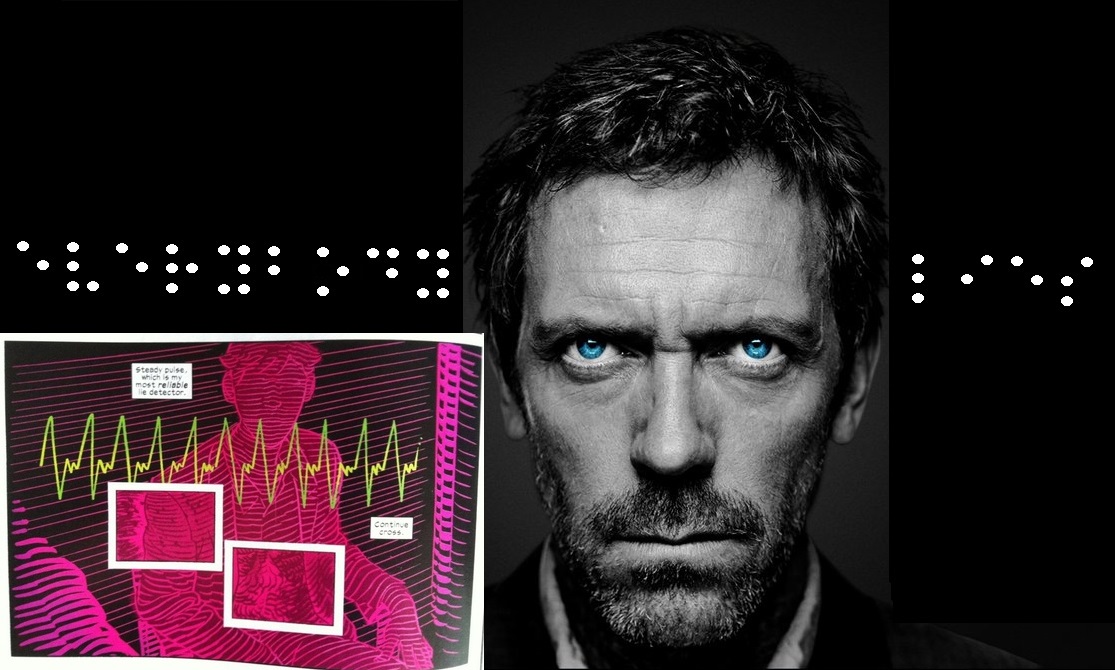
There is an important subgroup of the general population who form an exception to one of the common-among-Aspies characteristics above: not reading facial expressions or body language well. This group is the blind, and, to a lesser degree, the visually impaired. I wear glasses at work, and while driving, for mild-to-moderate myopia, but do not need them to function indoors, especially in familiar settings, such as home. Lately, I have simply stopped wearing my glasses while home. However, I certainly use my vision a lot, and think visually; the sheer volume of geometry (with apologies for the pun) on this blog is evidence enough of that. I have more familiarity with blindness than most sighted people, though, for three reasons: (1) I have read comic books since I was a kid (sometimes while hanging out in some science lab, although I was more likely to be found playing with a some dangerous chemical when very young), and my favorite title for most of my life has been Daredevil, the source of the lower-left part of the image above, (2) I have had close friends who were blind, and (3) I learned to read and write Braille as a college undergraduate, so that I could communicate with these friends by mail, and have not forgotten this skill, although it has lost speed — but I made the Braille lettering in the image above, which simply reads “everybody lies,” a line made famous by House MD.

There is also a fourth reason, unrelated to blindness, which is a common characteristic of those with Aspergers: periods of time when my senses become painfully over-sensitive, so that the sun, indoor lighting, etc., appear to be turned up extra-bright, everything is incredibly loud, etc. — except for my sense of smell, weakened by allergies, and exposure to chemical fumes. This used to happen during migraine headaches; now, I no longer get this state with headaches, but the amplified sensory perceptions are now so intense, at times, that this state is actually worse than a migraine headache, for at least those had pain to distract me, at least somewhat, from overwhelming sensory overload. When this happens, I blindfold myself to eliminate the visual overload, but I cannot silence the world, and you can read a description of what it sounds like, when I am in “Matt Murdock mode,” as I call it, in this blog-post. My perceptions don’t become so acute that I can hear the heartbeats of those around me (as the fictional Murdock can), and I’m fine with that; I don’t need, nor want, to have the volume turned up any further.

When House MD was airing new episodes, as I remember the show,  Dr. Gregory House would be an incredible jerk to people at least six to ten times per episode, sometimes more, and I found it hilarious. Only tonight, while watching the episode mentioned above, “Maternity,” did I realize (after nearly everyone else on the planet who has seen even one episode of this show), that House is incredibly rude at a rate far closer to six to ten times per minute. I had no idea!

This made me quite surprised. I then suddenly noticed something else: Dr. Allison Cameron — lying. Next, Chase lied. Later, Foreman lied. A patient lied, but of course they always do — “everybody lies” is a recurring theme of the show, and the consequences of lying are the show’s most-used plot-device. While thinking about this, I caught House lying. And I knew about each and every one of these lies before House revealed them, as lies, later in the episode. How was I noticing these lies I had never heard, as lies, before?

Of course, I have seen every episode of House MD, so memory is definitely a factor, but had not watched season one in years. I began to focus on this puzzle. About ten detected-lies later, I figured it out: I was hearing not an increased volume, but tiny changes in pitch, no more than a half-step on the musical scale. Lying is a risky activity, and liars know this, so it causes increased anxiety when people lie — and, due to this anxiety, I reasoned, their airways constrict, at least slightly, at the end of a lie, causing an increase in the pitch and frequency of the sound of their voices at the end of a lie. House was the ideal tool for teaching this, for it allowed me to “calibrate” my internal lie-detector, by focusing on the voices intently, while using long-stored memories of Dr. House revealing lies to help me catch what I had never caught before.

Of course, House is a TV show. This needed to be tested — with something which did not involve actors, nor writers. And so, I devised a way to test it. I asked a scientifically-minded person I know to help me test a hypothesis, by choosing a random order for a true statement and a lie, and then simply telling both to me, and then see if I could accurately identify the true statement, as well as the lie.

The pitch of this person’s voice unexpectedly went down, slightly, at the end of one of the statements, but did not change when speaking the other statement. What was going on, I wondered? I then figured it out: I had chosen a scientifically-minded person — who was trying to outsmart my experimental test! I then noticed that one statement of the two — the lie — concerned the number of items in a box, and was therefore testable. The other statement was not testable. The other person, who is quite intelligent, had taken a minute or two to formulate both the true statement, and the lie — and clearly intended me to fail the test, and then be able to prove it had failed, by simply opening the box. Using logical reasoning (an old skill) and my new, sonic lie-detector, together, I can now even detect a lie that a police polygraph might not have been able to detect!

I then realized I was detecting more subtle emotions . . . catching more jokes . . . and generally doing, by rapidly analyzing sound, what other people do by somehow “reading” body language and facial expressions.

It is a myth that Aspies can’t do such things as understanding emotions. It is not a myth that Aspies think in different ways, however. Sometimes, individual Aspies simply have to figure out their own methods for doing something which comes naturally to non-Aspies — and that’s exactly what I did.

I could, presumably, use this new frequency-sensitivity to train myself to lie convincingly, by deliberately avoiding the “tell” of a slight pitch-increase at the end of a lie. However, I choose not to do that. The first week I went without telling a single lie, in my teens, was difficult, but the second week was much easier, and the third was easier still. Not having to try to keep track of previous lies began to give me a persistent, liberated feeling that can only be enjoyed by those who are honest — and that feeling would, of course, vanish if I chose to invest time, energy, and thought into becoming a skilled liar. To do that would be to move backwards in my life, rather than forwards, and I see no reason to do that. In other words, I’m still me . . . just the latest version of me, that’s all.

A Lesson Involving the Social Use of Color

colors

RobertLovesPi’s social-interaction lesson of the day: different colors of fabric can actually mean something else, besides simply reflecting different wavelengths of light, and these meanings can shift quickly. (I already knew this could happen once per day, but was only just taught that this is also possible for n = 2, allowing me to extrapolate that, for the general case, n > -1, presumably with an upper limit set by the individual’s speed at changing clothes.)

As far as I can tell, n = 0 on weekends and legal holidays, in most cases, and n = 1 on most workdays (but not today, when the needed reflection-wavelength shifts from ~475 nm to ~550 nm after I leave the city of Sherwood, Arkansas, bound for a spot approximately 20 km South of there, in Little Rock, which is still in the same county).

Apparently my key to understanding this stuff is finding a way to analyze it mathematically. Also, posting such “new” discoveries to my blog increases the odds of me remembering them. However, unlike my last such finding (it involved chocolate chips not being a sandwich topping at Subway), I did NOT figure these things out “all by myself.” In fact, without help from two very important people, I doubt I ever would have figured them out at all!

An Ethical Dilemma Involving a Polyhedral Crystal

I just ordered a crystal rhombcuboctahedron on eBay because I like its geometrical properties, despite the mystical claims in the item listing. I did so with the full knowledge and expectation that these claims are almost certainly false, because, well, they’re mystical claims.

Rhombicubocta

Here’s my ethical dilemma: would it be ethical to lab-test those claims, then post the results in the feedback I leave?

[Image created using Stella 4d, available at http://www.software3d.com/Stella.php. This isn’t a picture of the crystal on eBay; it is made of quartz, and not rainbow-colored. It is of the same shape, however.]

A Tour of the Periodic Table of the Elements, Part 1

Periodic-Table-of-Elements 1st one with alkali metal and such

(click to enlarge)

In this, and the some upcoming posts, I’ll be showing you various collections of elements on the horizontally-extended version of the periodic table — one that includes the f-block elements in their proper place, rather than relegating them to two separate rows below the other elements. (I’m also suggesting the purple letters A – N for the usually-unrecognized groups in the f-block, and keeping the group numbers 1-18, with which many are familiar, for other groups).

For this first post, I’ll start with some sets of elements which are familiar to most who have studied the subject, plus some others which are much less well-known.

  • Light blue — the alkali metals.
  • Black background with red symbol and atomic number — hydrogen, which is definitely not an alkali metal, despite it sharing group 1 with them.
  • Dark blue — the alkaline-earth metals.
  • Dark yellow — the lanthanides.
  • Orange — these two elements are included with the lanthanides in some sources, and with the transition metals in others.
  • Bright pink — the actinides.
  • Light pink — these two elements are included with the actinides is some sources, and with the transition metals in others.
  • Red — the transition metals, also known as the transition elements, and d-block elements.
  • Light purple — group 13 is often called the “boron group,” but it also goes by other names, such as the “icosagens” and the “triels.”
  • Dark purple — group 14 is often called the “carbon group,” but it also goes by other names, such as “tetragens” and “crystallogens.” In semiconductor physics, these elements are referred to as group IV elements. 
  • Dark green — group 15 elements are referred to as the pnictogens, or nitrogen-group elements.
  • Bright yellow — bright yellow is used here for the chalcogens, also known as the group 16 elements, or oxygen-group elements.
  • Light green — the halogens.
  • Gray — the noble gases.

One Dozen Precious Metal Cubes: A Problem Involving Geometry, Chemistry, and Finance (Solution Provided, with Pictures)

The troy ounce is a unit of mass, not weight, and is used exclusively for four precious metals. At this time, the prices per troy ounce, according to this source for current precious metal prices, for these four elements, are:

  • Gold, $1,094
  • Palladium, $600
  • Platinum, $965
  • Silver, $14.82

(As a side note, it is rare for platinum to have a lower price per troy ounce than gold, as is now the case. I would explain the reasons this is happening, except for one problem: I don’t understand the reasons, myself, well enough to do so. Yet.)

A troy ounce equals 31.1034768 grams, but, for most purposes, 31.103 g, or even 31.1 g, works just fine.

Also, as you can see here, these “troy elements” are all in one part of the periodic table. This is related to the numerous similarities in these elements’ physical and chemical properties, which is itself related, of course, to the suitability of these four elements for such things as jewelry, coinage, and bullion.

1371846764_periodic_table_of_elements

To determine the volume of a given mass of one of these metals, it is also necessary to know their densities, so I looked them up, using Google (they are not listed on the periodic table above):

  • Gold, 19.3 g/cm³
  • Palladium, 11.9 g/cm³
  • Platinum, 21.46 g/cm³
  • Silver, 10.49 g/cm³

In chemistry, of course, one must often deal with elements (as well as other chemicals) in terms of the numbers of units (such as atoms or molecules), except for one problem: this is absurdly impractical, due to the outrageously small size of atoms. Despite this, though, it is necessary to count such things as atoms in order to do much chemistry at all, so chemists have devised a “workaround” for this problem: when counting units of pure chemicals, they don’t count such things as atoms or molecules directly, but count them a mole at a time. A mole is defined as a number of things equal to the number of atoms in exactly 12 grams of pure carbon-12. To three significant figures, this number is 6.02 x 10²³. To deal with moles, since atoms have differing masses, we need to know the molar mass (mass of one mole) of whatever we are dealing with to convert, both directions, between moles and grams. Here are the molar masses of the four troy-measured elements, as seen on the periodic table above, below each element’s symbol.

  • Gold, 196.97 g
  • Palladium, 106.42 g
  • Platinum, 195.08 g
  • Silver, 107.87 g

I’ve given these numbers  as the information needed to solve the following problem: rank one dozen precious metal cubes (descriptions follow) by ascending order of volume. There are three cubes each of gold, palladium, platinum, and silver. Four of the twelve (one of each element) have a mass of one troy ounce each. Another four each have a value, at the time of this writing, of $1,000. The last set of four each contain one mole of the element which composes the cube, and, again, there is one of each of these same four elements in the set.

If you would like to do this problem for yourself, the time to stop reading is now. Otherwise (or to check your answers against mine), just scroll down.

.

.

.

.

.

.

.

.

.

.

.

In the solutions which follow, a rearrangement of the formula for density (d=m/v) is used; solved for v, this equation becomes v = m/d. In order, then, by both volume and edge length, from smallest to largest, here are the twelve cubes:

Smallest cube: one troy ounce of platinum

One tr oz, or 31.103 g, of platinum would have a volume of v = m/d = 31.103 g / (21.46 g/cm³) = 1.449 cm³. A cube with this volume would have an edge length equal to the its volume’s cube root, or 1.132 cm. (This explanation for the calculation of the edge length, given the cube’s volume, is omitted in the items below, since the mathematical procedure is the same each time.)

Second-smallest cube: $1000 worth of gold

Gold worth $1000, at the time of this posting, would have a troy mass, and then a mass in grams, of $1000.00/($1,094.00/tr oz) = (0.914077 tr oz)(31.103 g/tr oz) = 28.431 g. This mass of gold would have a volume of v = m/d = 28.431 g / (19.3 g/cm³) = 1.47 cm³. A cube with this volume would have an edge length of  1.14 cm.

Third-smallest cube: $1000 worth of platinum

Platinum worth $1000, at the time of this posting, would have a troy mass, and then a mass in grams, of $1000.00/($965.00/tr oz) = (1.0363 tr oz)(31.103 g/tr oz) = 32.231 g. This mass of platinum would have a volume of v = m/d = 32.231 g / (21.46 g/cm³) = 1.502 cm³. A cube with this volume would have an edge length of  1.145 cm.

Fourth-smallest cube: one troy ounce of gold

One tr oz, or 31.1 g, of gold would have a volume of v = m/d = 31.1 g / (19.3 g/cm³) = 1.61 cm³. A cube with this volume would have an edge length of 1.17 cm.

Fifth-smallest cube: one troy ounce of palladium

One tr oz, or 31.1 g, of palladium would have a volume of v = m/d = 31.1 g / (11.9 g/cm³) = 2.61 cm³. A cube with this volume would have an edge length of 1.38 cm.

Sixth-smallest cube: one troy ounce of silver 

One tr oz, or 31.103 g, of silver would have a volume of v = m/d = 31.103 g / (10.49 g/cm³) = 2.965 cm³. A cube with this volume would have an edge length of 1.437 cm.

Sixth-largest cube: $1000 worth of palladium

Palladium worth $1000, at the time of this posting, would have a troy mass, and then a mass in grams, of $1000.00/($600.00/tr oz) = (1.6667 tr oz)(31.103 g/tr oz) = 51.838 g. This mass of palladium would have a  volume of v = m/d = 51.838 g / (11.9 g/cm³) = 4.36 cm³. A cube with this volume would have an edge length of  1.63 cm.

Fifth-largest cube: one mole of palladium

A mole of palladium, or 106.42 g of it, would have a volume of v = m/d = 106.42 g / (11.9 g/cm³) = 8.94 cm³. A cube with this volume would have an edge length of 2.07 cm.

Fourth-largest cube: one mole of platinum

A mole of platinum, or 195.08 g of it, would have a volume of v = m/d = 195.08 g / (21.46 g/cm³) = 9.090 cm³. A cube with this volume would have an edge length of 2.087 cm.

Third-largest cube: one mole of gold

A mole of gold,  or 196.97 g of it, would have a volume of v = m/d = 196.97 g / (19.3 g/cm³) = 10.2 cm³. A cube with this volume would have an edge length of  2.17 cm.

Second-largest cube: one mole of silver

A mole of silver, or 107.87 g of it, would have a volume of v = m/d = 107.87 g / (10.49 g/cm³) = 10.28 cm³. A cube with this volume would have an edge length of 2.175 cm.

Largest cube: $1000 worth of silver

Silver worth $1000, at the time of this posting, would have a troy mass, and then a mass in grams, of $1000.00/($14.82/tr oz) = (67.48 tr oz)(31.103 g/tr oz) = 2099 g. This mass of gold would have a volume of v = m/d = 2099 g / (10.49 g/cm³) = 200.1 cm³. A cube with this volume would have an edge length of  5.849 cm.

Finally, here are pictures of all 12 cubes, with 1 cm³ reference cubes for comparison, all shown to scale, relative to one another.

dozen cubes

A third of these cubes change size from day-to-day, and sometimes even moment-to-moment during the trading day, if their value is held constant at $1000 — which reveals, of course, which four cubes they are. The other eight cubes, by contrast, do not change size — no precious metal prices were used in the calculation of those cubes’ volumes and edge lengths, precisely because the size of those cubes is independent of such prices, due to the way those cubes were defined in the wording of the original problem.

The Physics of Cats, Copperheads, Centipedes, Catbounce, and Catbouncemax

catbouncemax

Definition of catbouncemax (shortened form of “maximum catbounce”): for any particular cat, its catbouncemax is equal to the takeoff kinetic energy of that cat if it suddenly and unexpectedly finds itself face-to-face with an adult copperhead snake.

I’ve actually seen this happen. Really. The cat reached a height I estimate as 1.4 meters.

Measured in joules, a cat’s catbouncemax can most easily be approximated by observing and estimating the maximum height of the cat under these conditions. For ethical and safety reasons, of course, one must simply be observant, and wait for this to happen. Deliberately introducing cats and copperheads (or other dangerous animals) to each other is specifically NOT recommended. Staying away from copperheads, on the other hand, IS recommended. Good science requires patience!

After the waiting is over (be prepared to wait for years), and the cat’s maximum height h, in meters, has been estimated, the cat’s catbouncemax can then be determined by energy conservation, since its takeoff kinetic energy (formerly stored as feline potential energy, until the moment the cat spots the copperhead) is equal to the gravitational potential energy (PE = mgh) of the cat at the top of the parabolic arc. In the catbounce I witnessed, the cat who encountered a copperhead (while walking through tall grass, which is why the cat didn’t see the snake coming) was a big cat, at an estimated mass of 6.0 kg. His catbouncemax was therefore, by energy conservation, equal to mgh = (6.0 kg)(1.4 m)(9.81 m/s²) = ~82 joules, which means this particular cat had 82 J of ophidiofeline potential energy stored, specifically for use in the event of an encounter with a large, adult copperhead, or other animal (there aren’t many) with the ability to scare this cat equally as much as such a copperhead. (I’m using a copperhead in this account for one reason: that’s the type of animal which initiated the highest catbounce I have ever witnessed, and I seriously doubt that this particular cat could jump any higher than 1.4 m, under any  circumstances.)

It should be noted that the horizontal distance covered by a catbounce is not needed to calculate a cat’s catbouncemax. However, this horizontal distance will not be zero, as is apparent in the diagram above. Why? Simple: cats don’t jump straight up in reaction to copperheads, for they are smart enough not to want to fall right back down on top of such a snake.

It is more common, of course, for cats to jump away from scary things which are less scary than adult copperheads. For example, there certainly exist centipedes which are large enough to scare a cat, causing it to catbounce, but with that centipede-induced catbounce being less than its catbouncemax. The following fictional dialogue demonstrates how such lesser catbounces can be most easily described. (Side note: this dialogue is set in Arkansas, where we have cats and copperheads, and where I witnessed the copperhead-induced maximum catbounce described above.)

She: Did you see that cat jump?!?

He: Yep! Must be something scary, over there in that there flowerpatch, for Cinnamon to jump that high. At least I know it’s not a copperhead, though.

She: A copperhead? How do you know that?

He: Oh, that was quite a jump, dear, but a real copperhead would give that cat of yours an even higher catbounce than that! The catbounce we just saw was no more than 75% of Cinnamon’s catbouncemax, and that’s being generous.

She: Well, what IS in the flowerpatch? Something sure scared poor Cinnamon! Go check, please, would you?

He: [Walks over from the front porch, where the couple has been standing this whole time, toward the flowerpatch. Once he gets half-way there, he stops abruptly, and shouts.] Holy %$#@! That’s the biggest centipede I’ve ever seen!

She: KILL IT! KILL IT NOW!