On Binary Planets, and Binary Polyhedra

Faceted Augmented Icosa

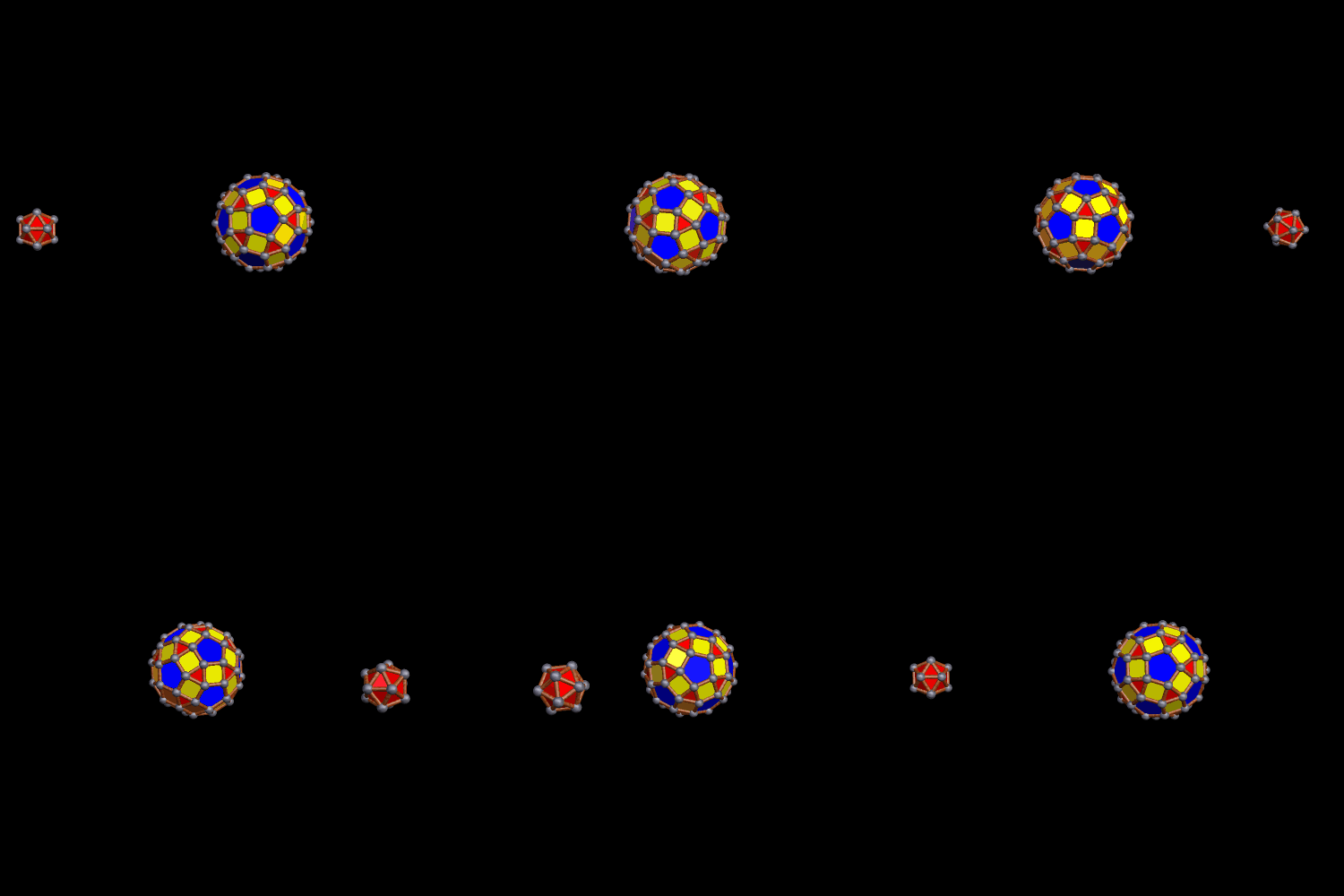
This image of binary polyhedra of unequal size was, obviously, inspired by the double dwarf planet at the center of the Pluto / Charon system. The outer satellites also orbit Pluto and Charon’s common center of mass, or barycenter, which lies above Pluto’s surface. In the similar case of the Earth / Moon system, the barycenter stays within the interior of the larger body, the Earth.

I know of one other quasi-binary system in this solar system which involves a barycenter outside the larger body, but it isn’t one many would expect: it’s the Sun / Jupiter system. Both orbit their barycenter (or that of the whole solar system, more properly, but they are pretty much in the same place), Jupiter doing so at an average orbital radius of 5.2 AU — and the Sun doing so, staying opposite Jupiter, with an orbital radius which is slightly larger than the visible Sun itself. The Sun, therefore, orbits a point outside itself which is the gravitational center of the entire solar system.

Why don’t we notice this “wobble” in the Sun’s motion? Well, orbiting binary objects orbit their barycenters with equal orbital periods, as seen in the image above, where the orbital period of both the large, tightly-orbiting rhombicosidodecahedron, and the small, large-orbit icosahedron, is precisely eight seconds. In the case of the Sun / Jupiter system, the sun completes one complete Jupiter-induced wobble, in a tight ellipse, with their barycenter at one focus, but with an orbital period of one jovian year, which is just under twelve Earth years. If the Jovian-induced solar wobble were faster, it would be much more noticeable.

[Image credit: the picture of the orbiting polyhedra above was made with software called Stella 4d, available at this website.]

The First High-Resolution Images from Pluto Have Arrived, and They Bring a Major Mystery: Where Are the Impact Craters?

pluto-observations-through-the-years

As new pics from the Pluto/Charon system become available, you can’t beat the image gallery at the New Horizons portion of NASA’s website to keep up with them, which is where I found this .gif file showing images of Pluto itself throughout the years. It culminates in the latest, and most detailed, image of any part of Pluto — a small portion of its surface. To see more of the latest pics, as they are released, I refer you to that web-page. NASA plans to keep it updated with the latest from the Pluto/Charon system, for months to come, as new images are transmitted, received, and processed.

The big surprise today is not the “heart of Pluto” that’s gotten so much press this week, but something newly discovered (and completely unexpected) with the latest small batch of new pics: on both Pluto and Charon, they can’t find a single impact crater. Not one. And that is just flat-out weird. Here, see for yourself (same image source): unexpected ice mountains, check; unexpectedly-smooth plains, check; craters — hey, the craters are missing!

nh-plutosurface

According to everything we know, impact craters should be there. The ice mountains and numerous plains are mysteries, also, but it is the lack of craters which really has scientists puzzled this morning. Everyone expected to see lots of impact craters, myself included. Small worlds, so far from the sun, should have frozen internally long ago, based on present models, making them geologically dead, and therefore unable to “erase” impact craters (seen on dozens of other planets, dwarf planets, satellites, and asteroids) with surface-altering geological activity. This mass-erasure-of-craters happens on a only a few other solid bodies in the solar system, such as Earth, and Jupiter’s moon Io — both larger, and much warmer, than anything in the Pluto/Charon system. Some scientists are already going public with conjectures for the energy source needed to keep Pluto and Charon crater-free. However, I have yet to read any such conjecture which I find convincing, which is why I am not including them in this post. (Such guesswork is easy to find, though, here, among other places.)

On the other hand, the scientific community has had very little time, yet, to explain this new puzzle; there might be a convincing explanation out there by this time next week — or this could persist, as one of many mysteries in astronomy, for decades. At this point, it is too early to even venture a guess regarding when, if ever, this mystery will be solved.

An Image, from Outside All of the Numerous Event Horizons Inside the Universe, During the Early Black Hole Era

late universe

This image shows exactly what most of the universe will look like — on a 1:1 scale, or many other scales — as soon as the long Black Hole Era has begun, so this is the view, sometime after 1040 years have passed since the Big Bang. This is such a long time that it means essentially the same thing as “1040 years from now,” the mere ~1010 years between the beginning of time, and now, fading into insignificance by comparison, not even close to a visible slice of a city-wide pie chart.

This isn’t just after the last star has stopped burning, but also after the last stellar remnant (such as white dwarfs and neutron stars), other than black holes, is gone, which takes many orders of magnitude more time. What is left, in the dark, by this point? A few photons (mostly radio waves), as well as some electrons and positrons — and lots — lots — of neutrinos and antineutrinos. There are also absurd numbers of black holes; their mass dominates the mass of the universe during this time, but slowly diminishes via Hawking radiation, with this decay happening glacially for large black holes, and rapidly for small ones, culminating in a micro-black-hole’s final explosion. Will there be any baryonic matter at all? The unanswered question of the long-term stability of the proton creates uncertainty here, but there will, at minimum, be at least be some protons and neutrons generated, each time a micro-black-hole explodes itself away.

Things stay like this until the last black hole in the cosmos finally evaporates away, perhaps a googol years from now. That isn’t the end of time, but it does make things less interesting, subtracting black holes, and their Hawking radiation, from the mix. It’s still dark, but now even the last of the flashes from a tiny, evaporating black hole has stopped interrupting the darkness, so then, after that . . . nothing does. The universe continues to expand, forever, but the bigger it becomes, the less likely anything complex, and therefore interesting, could possibly have survived the eons intact.

For more on the late stages of the universe, please visit this Wikipedea article, upon which some of the above draws, and the sources cited there.

Testing a Climate Change Claim: Does Burning a Gallon of Gasoline Really Put Twenty Pounds of Carbon Dioxide Into the Atmosphere?

OLYMPUS DIGITAL CAMERA

OLYMPUS DIGITAL CAMERA

When I read, recently, that “every gallon of gas you save not only helps your budget, it also keeps 20 pounds of carbon dioxide out of the atmosphere,” (source) I reacted with skepticism. Twenty pounds? That seemed a bit high to me.

Just because it seems high, to me, though, doesn’t mean it’s wrong, any more than “about.com” putting it on the Internet makes the statement correct. No problem, I thought: I’ll just do the math, and check this for myself.

So, in this problem, we start with a gallon of gasoline. In units I can more easily work with, that’s 3.785 liters (yes, they rounded it incorrectly on the gas can shown above). Google tells me that the density of gasoline varies from 0.71 to 0.77 kg/L (reasonable, since it floats on water, but is still heavy to lug around), so I’ll use the average of that range, 0.74 kg/L, to find the mass of a gallon of gasoline: (3.785 L)(0.74 kg/L) = 2.8 kg.

Next, I need to find out how much of that 2.8 kg of gasoline is made of carbon. That would be an easy chemistry problem if gasoline were a pure chemical, but it isn’t, so I’ll estimate. First, I’ll ignore the elements which only make up a minor part of gasoline’s mass, leaving only hydrogen and carbon to worry about. Next, I consider these things:

  1. Alkanes larger than methane (major gasoline components), whether branched-chain or not, have slightly more than two hydrogen atoms for every carbon atom. This ratio doesn’t exceed three, though, and is equal to three only for ethane, which has too high a boiling point to remain in liquid form at typical temperatures and pressures, anyway.
  2. Cycloalkanes, another major component of gasoline, have exactly two hydrogen atoms for every carbon atom.
  3. Aromatic hydrocarbons can have fewer than two hydrogen atoms for every carbon atom, and these chemicals are also a major component of gasoline. For the simplest aromatic hydrocarbon, benzene, the H:C ratio drops to its lowest value: 1:1.

For the reasons above, I’m choosing two to one as a reasonable estimate for the number of atoms of hydrogen for every atom of carbon in gasoline. Carbon atoms, however, have twelve times the mass of hydrogen atoms. Gasoline is therefore ~12/14ths carbon, which reduces to ~6/7. I can now estimate the mass of carbon in a gallon of gasoline: (6/7)(2.8 kg) = 2.4 kg.

So how much carbon dioxide does that make? Well, first, does a car actually burn gasoline completely, so that every carbon atom in gasoline goes out the tailpipe as part of a carbon dioxide molecule? The answer to this question is simple: no.

However, this “no” doesn’t really matter, and here’s why. In addition to carbon dioxide, automobile exhaust also contains carbon present as carbon monoxide, unburned carbon, and unburned or partially-burned hydrocarbons. To have an environmental impact, though, it isn’t necessary for a given carbon dioxide molecule to come flying straight out of the tailpipe of one’s car. In our oxygen-rich atmosphere, those carbon atoms in car exhaust which are not yet fully combusted (to each be part of a carbon dioxide molecule) are quite likely to end up reacting with oxygen later on — certainly within the next year, in most cases — and the endpoint of carbon reacting with oxygen, once combustion is complete, is always carbon dioxide. What’s carbon monoxide, then? Well, one way to look at it is this: molecules of carbon monoxide are simply half-burned carbon atoms. When the other half of the burning (combustion) happens, later, carbon dioxide is the product. So, for purposes of this estimate, I am assuming that all 2.4 kg of carbon in a gallon of gasoline ends up as carbon dioxide — either directly produced by the car, or produced in other combustion reactions, later, outside the car.

The molar mass of elemental carbon is 12 grams. For oxygen, the corresponding figure is 16 g, but that becomes 32 g of oxygen in carbon dioxide, with its two oxygen atoms per molecule. Add 12 g and 32 g, and you have carbon dioxide’s molar mass, 44 g. Therefore, 12 g of carbon is all it takes to make 44 g of carbon dioxide; the rest of the mass comes from oxygen in the air. By use of ratios, then, I can now find the mass of carbon dioxide formed from burning a gallon of gasoline, with its 2.4 kg of carbon.

Here is the ratio needed: 2.4 kg of carbon / unknown mass of carbon dioxide produced = 12 g of carbon / 44 g of carbon dioxide. By cross-multiplication, and using “x” for the unknown, this equation becomes (12 g)(x) = (44 g)(2.4 kg), which simplifies to 12x = 105.6 kg, so, by division, x = 8.8 kg of carbon dioxide produced from one gallon of gasoline.

Each kilogram (of anything), near sea level on this planet, weighs about 2.2 pounds. This 8.8 kg of carbon dioxide, then, translated into “American,” becomes (8.8 kg)(2.2 pounds/kg) = 19.36 pounds. Given the amount of estimation I had to do to obtain this answer, this is close enough to twenty pounds for me to conclude that the statement I was examining has survived my testing. In other words, yes: burning a gallon of gasoline goes, indeed, put about twenty pounds of carbon dioxide into the atmosphere.

However, I’m not quite finished. Carbon dioxide is an invisible gas, making it quite difficult to picture what twenty pounds of it “looks” like. To really understand how much carbon dioxide this is, it would be helpful to know its volume. So I have a new problem: 8.8 kg of pure carbon dioxide is trapped, in a balloon, at standard temperature and pressure. What is the balloon’s volume?

To solve this problem, one needs the density of carbon dioxide under these conditions, which chemists refer to as “STP” (standard temperature and pressure). According to Google, the density of carbon dioxide at STP is about 1.98 kg per cubic meter. Since 8.8 kg / (1.98 kg/m³) = 4.44 m³, this means that a gallon of gasoline can produce enough carbon dioxide, held at STP, to inflate this balloon to a volume of 4.44 cubic meters. For the benefit of those who aren’t used to thinking in metric units, that volume equals the volume of a perfect cube with an edge length of ~5.4 feet. You could fit a bunch of people into a cube that large, especially if they were all on friendly terms.

Now, please consider this: all of that was from one gallon of gasoline. How many gallons of gas do you typically buy, when you fill up your car’s gas tank? Well, multiply by that number. How many times do you fill up your car, on average, in a year? Multiply again. Next, estimate the total number of years you will drive during your lifetime — and multiply again. You now have your own personal, lifetime carbon dioxide impact-estimate from just one activity: driving.

This may sound like a change of topic, but it isn’t: what’s the hottest planet in the solar system? Even though Mercury is much closer to the Sun, the answer is Venus, and there is exactly one reason for that: Venus has a thick atmosphere which is chock-full of carbon dioxide. In other words, yes, the planet nearest the Earth, and the brightest object in the sky (behind the Sun and the Moon), Venus, is one of the best warnings about global warming known to exist, and we’ve known this for many decades. One wonders if any theologian has ever speculated that the creator of the universe designed Venus this way, and then put it right there “next door,” on purpose, specifically as a warning, to us, about the consequences of burning too much carbon.

The science, and the math which underlies it, are both rock-solid: climate change is real. Lots of politicians deny this, but that’s only because of the combined impact of two things: their own stupidity, plus lots of campaign contributions from oil companies and their political allies. Greed and stupidity are a dangerous combination, especially when further combined with a third ingredient: political power. Voting against such politicians helps, but it isn’t enough. One additional thing I will do, immediately, is start looking for ways to do the obvious, in my own life: reduce my own consumption of gasoline. Since I’m putting this on the Internet, perhaps there will be others persuaded to do the same.

The truth may hurt, but it’s still the truth: the United States is a nation of petroleum junkies, and we aren’t just harming ourselves with this addiction, either. It’s time, as a people, for us to invent, and enter, fossil-fuel rehab.

[Image credit: “GasCan” by MJCdetroit – Own work. Licensed under CC BY 3.0 via Wikimedia Commons – https://commons.wikimedia.org/wiki/File:GasCan.jpg#/media/File:GasCan.jpg]

Richard Feynman, on Solving New Problems

richard-feynman on solving new problems

Does Everything Move at the Speed of Light?

everything moves at c

I have a friend who once explained to me his way of understanding spacetime, and what Einstein discovered about it, which was to start with the idea that, as he put it, “everything is traveling at c,” and proceed from there. Light travels at c, of course, but time does not pass for light, forming vector AG, shown in purple. A spatially-stationary rock is still traveling — temporally, into the future, at a rate of sixty seconds per minute, as represented by dark green vector AN. My friend’s idea was to interpret this rate of time-passage — the normal time passage-rate we generally experience — as another form of c. Sublight moving objects are moving at c, according to this idea, as a vector sum of temporal and spatial velocities. In this diagram, all spatial dimensions are collapsed into one direction (parallel to the x-axis), while time runs up (never down) the y-axis, into the future (never the past).

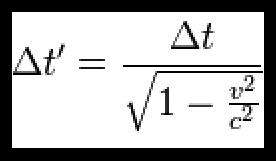
I don’t know why it took me perhaps a decade to see that my friend’s idea is testable. Better than that, the data needed to test it already exist! All I need to do is cross-check the predictions of my friend’s idea against a thoroughly-tested formula regarding relativistic time dilation. The relevant equation for time dilation is this one, which you can find in any decent Physics textbook:

equation for time dilation

In the diagram at the top of this post, the blue horizontal component-vector NM represents a spatial velocity of (c)sin(10º) = 0.173648c. It is a component of the total velocity of the object represented by blue vector AM, which is, if my friend is correct, is c, as a vector-sum total velocity — the sum, that is, of temporal and spatial velocities. By the equation shown above, then, the measured elapsed time for an event — say, the “minute,” in “seconds per minute” — to take place, at an object with that speed, as measured by a stationary observer, should be 1/sqrt[1-(0.173648)²] = 1/sqrt(1 – 0.0301537) = 1/sqrt(0.969846) = 1/0.984808 = 1.01543 times as long as the duration of the same event, for the observer, with the event happening at the observer’s location.

Now, if time is taking longer to pass by, then an object’s temporal speed is shrinking, so this slightly longer elapsed time corresponds to a slightly slower temporal speed. As seen in the equations above, near the end of the calculation, the two have a reciprocal relationship, so such an object’s temporal speed would only be 0.984808(temporal c) = 0.984808(60 seconds/minute) = 59.0885 seconds per minute. Therefore, an object moving spatially at 0.173648c would experience time at 0.984808k, where k represents the temporal-only c of exactly 60 seconds per minute — according to Einstein.

Next, to check this against my friend’s “everything moves at c” idea, I need only compare 0.984808 to the cosine of 10º, since, in the diagram above, based on his idea, vector BM = (vector AM)cos(10º). The cosine of 10º = 0.984808, which supports my friend’s hypothesis. It has therefore just passed its first test.

As for the other sets of vectors in the diagram, they provide opportunities for additional testing at specific relativistic spatial velocities, but I’m going to skip ahead to a generalized solution which works for any spatial velocity from zero to c, corresponding to angles in the diagram from zero to ninety degrees. Substituting θ for 10º, the spatial velocity, (c)sin(10º), becomes simply (c)sinθ, which corresponds to a temporal velocity of (c)cosθ, with it then necessary to show that the “cosθ” portion of this expression is equivalent to the reciprocal of 1/sqrt[1 -(sinθ)²],  after the cancellation of c² in the numerator and denominator of the fraction, under the radical, in the denominator of Einstein’s equation for time dilation. By substitution, using the Pythagorean trigonometric identity 1 = (sinθ)² + (cosθ)², rearranged as 1 – (sinθ)² = (cosθ)², the expression 1/sqrt[1 -(sinθ)²] = 1/sqrt[(cosθ)²] = 1/cosθ, the reciprocal of which, is, indeed, cosθ, which is what needed to be shown for a generalized solution.

My friend’s name is James Andrew Lemley. When I started writing this post (after the long process of preparing the diagram), I did not know what result I would get, comparing what logically follows from Andrew’s idea with the well-tested conclusions of Einstein’s time-dilation formula, at even one specific relativistic speed. Andrew, I salute you, and think this this looks quite promising. Based on the calculations above, and after all these years, I must tell you that I now think you are, indeed, correct: in a sense that allows us to better understand spacetime, we are all moving at c.

Star and Protostar

First, Protostar:

2012 protostar ic

In nature, protostars collapse under their own gravity until enough heat is generated to ignite nuclear fusion, at which point they become stars. The image above is my interpretation of a protostar, just before the moment it becomes a star. As for Star, my post-ignition interpretation, here it is:

2012 star ic

While I did just make these images, they are simply inverted-color versions of images I made back in 2012, using Geometer’s Sketchpad. Here are the original-color versions (which I don’t like as much, myself), presented in a smaller size. You may enlarge either or both with clicks, if you wish.

2012 protostar2012 star

Buckminsterfullerene Molecular Models: Three Different Versions

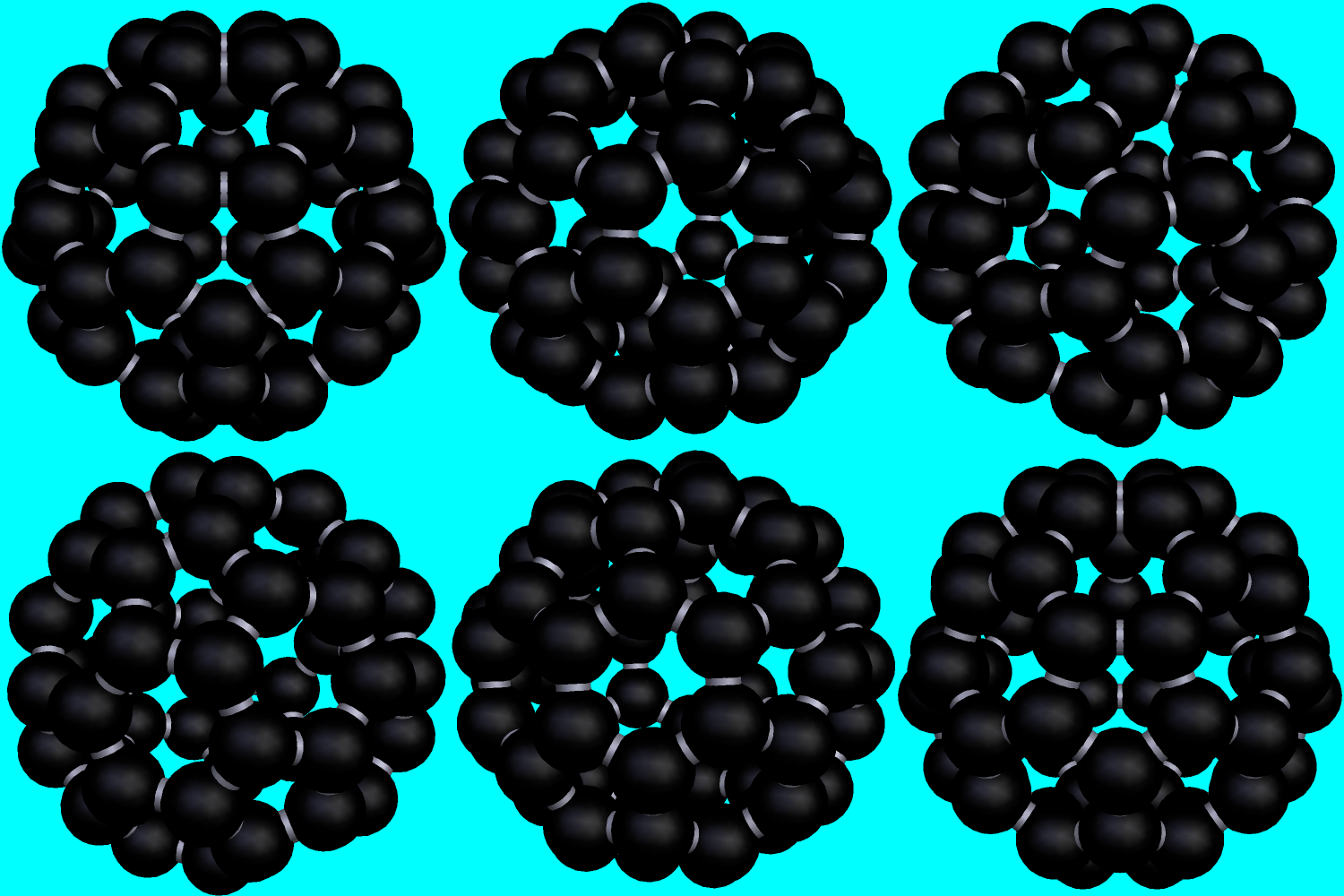
Buckminsterfullerene, a molecule made of 60 carbon atoms, and having the shape of a truncated icosahedron, is easily modeled with Stella 4d: Polyhedron Navigator (see http://www.software3d.com/Stella.php to try or buy this program). The first image shows the”ball and stick” version used by chemists who want the bonds between atoms to be visible.

Trunc Icosa
The second model is intermediate between the ball-and-stick version, and the space-filling version, which follows it.

Trunc Icosa2

Here’s the “closely packed” space-filling version, taken to an extreme.

Trunc Icosa3

Which version better reflects reality depends on the certainty level you want for molecular orbitals. A sphere representing 99% certainty would be larger than one for 95% certainty.

“How Tall Are You?”

metric system

When I am asked for my height, anywhere — especially at school — I answer the question honestly. I am 1.80 meters tall.

I also live in the USA, one of only three remaining countries (the other two holdouts are Liberia and Myanmar) which have stubbornly refused to adopt the metric system. However, I am every bit as stubborn as other Americans, but, on this issue, I choose to be stubborn in the opposite direction.

It should surprise no one who knows me well that my classroom, whether I am teaching science or mathematics, is, by design, an all-metric zone. After all, like >99% of people, I have ten fingers (assuming thumbs are counted as fingers), ten toes, and almost always use the familiar base-ten number system when counting, measuring, doing arithmetic, or doing actual mathematics. (Doing arithmetic is not the same thing as doing real mathematics, any more than spelling is equivalent to writing.) Using the metric system is consistent with these facts, and using other units is not.

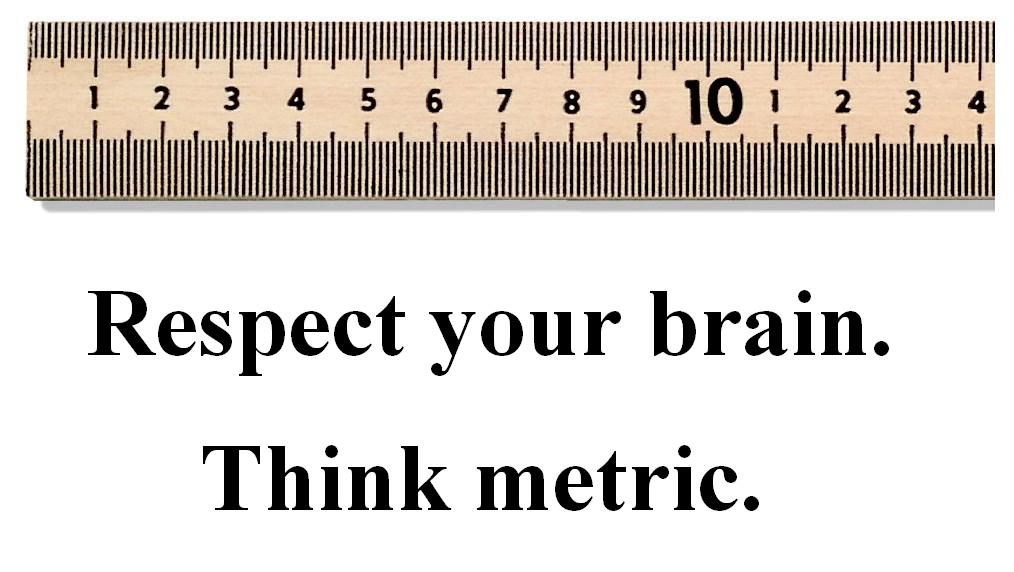
Admittedly, I do sometimes carry this to an extreme, but I do so to make a point. Metric units are simply better than non-metric units. Why should anyone need to memorize the fact that there are 5,280 feet in one mile? It actually embarrasses me that I have that particular conversion-factor memorized. By “extreme,” I mean that I have been known to paint the non-metric side of meter sticks black, simply to make it impossible for students in my classes to confuse inches and centimeters, and prevent them from measuring anything with the incorrect units.

To those who object that American students need to understand non-metric units, I simply point out that there are plenty of other teachers who take care of that. This is, after all, the truth.

Often, after giving my height as 1.80 meters, I am asked to give it in other units. Unless the person asking is a police officer (in, say, a traffic-stop situation), however, I simply refuse to answer with non-metric units. What do I say, instead? “I’m also 180 centimeters tall. Would you like to know my height in kilometers?”

If pressed on this subject in class — and it comes up, because we do lab exercises where the height of people must be measured — I will go exactly this far:  I am willing to tell a curious student that there are 2.54 centimeters in an inch, 12 inches in a foot, and 3.28 feet in a meter. Also, I’m willing to loan calculators to students. Beyond that, if a student of mine really wants to know my height in non-metric units, he or she simply has to solve the problem for themselves — something which has not yet happened. I do not wish to tell anyone my height in feet and inches, for I do not enjoy headaches, and uttering my height, in those units I despise, would certainly give me one. Also, obviously, you won’t find my height, expressed in non-metric units, on my blog, unless someone else leaves it here, in a comment — and I am definitely not asking anyone to do that.

I might, just for fun, at some point, determine my height in cubits. For all I know, a person’s height, measured with their own cubits, might be a near-constant. That would be an interesting thing to investigate, and my students, now that I’ve thought about the question, might find themselves investigating this very issue, next week. The variability of cubits, from one person to another, makes them at least somewhat interesting. It also makes cubits almost completely useless, which explains why they haven’t been used since biblical times, but that’s not the point. One can still learn things while investigating something which is useless, if one is sufficiently clever about it.

Feet and inches, however, are not interesting — at all. They are obsolete, just as cubits are, and they are also . . . offensive. It is not a good thing to insult one’s own brain.

My Aqua Regia Story

This is my twentieth year teaching, but only the first year when I have not taught at least one class in chemistry, and I miss it. One of my fondest memories of chemistry lab involves the one time I experimented with aqua regia — a mixture of acids which, unlike any single acid, can dissolve both gold and platinum, the “noble metals.” I had read a story of a scientist’s gold Nobel Prize being protected from the Nazis by dissolving it in aqua regia, and then recovering the gold from solution after World War II had ended. Having read about this, I wanted to try it myself, and also thought it would make an excellent lab for classroom use — if I could figure out how to recover the gold, and also learn what precautions would be needed to allow high school students to perform this experiment safely. For sensible and obvious reasons, I conducted a “trial run” without students present, but with another chemistry teacher nearby, since aqua regia, and the gases it produces when dissolving gold, are quite dangerous. Someone else has put a video on YouTube, showing aqua regia dissolving gold, so you can see something much like what I saw, simply by watching this video.

First, I obtained one-tenth of a troy ounce of gold, which cost about $80 at the time. I had read about the extreme malleability of gold, one of the softest metals, and wanted to see evidence for it for myself — so, before I prepared the the aqua regia, I used a hammer to try flattening the gold sample into a thin sheet. That didn’t work, but it didn’t take long for me to figure out why — I had accidentally bought gold coin-alloy, which is 10% copper, not pure gold. Since this alloy is far less malleable than pure gold, my attempt to flatten it had failed, but I also knew this would not pose a problem for my primary experiment — the one involving aqua regia. Also, I didn’t have another spare $80 handy, to purchase another 1/10 troy ounce of pure gold, so I proceeded to make, for the first time in my life, a small amount of aqua regia — Latin for “royal water.”

Unlike what is shown in the video above, I prepared the acid-mixture first, before adding the gold, using a slightly-different recipe:  the traditional 1:4 ratio, by volume, of concentrated nitric acid to concentrated hydrochloric acid. Both these acids look (superficially) like water, but the mixture instantly turned yellow, and started fuming, even before anything was added to it. Wearing full protective gear, I watched it for a few minutes — and then, using tongs held by gloved hands, lowered my hammer-bashed sample of gold into the fuming, yellow mixture of concentrated acids.

It worked. It was a fascinating reaction, and a lot of fun to watch. At approximately the same time that the last of my gold sample dissolved, something occurred to me:  I had failed to research how to recover the dissolved gold from the resulting solution! No problem, I thought — I can figure this out. (I am seldom accused of lacking self-confidence, even when I’m wrong.)

My first idea was to use a single-replacement reaction. Many times, I have had students extract pure silver from a solution of silver nitrate by adding a more-active metal, such as copper. The copper dissolves, replacing the silver in the silver nitrate solution, and silver powder forms, as a precipitate, on the surface of the copper. Thinking that a similar process could be used to precipitate out the gold from my gold / aqua regia mixure, I simply added come copper to the reaction beaker. The corrosive properties of my aqua regia sample had not yet been exhausted, though, and so the remaining aqua regia simply “ate” the copper. The result was a mess — I had only succeeded in turning an already-complicated problem into an even-more-complicated problem, by adding more chemicals to the mixture. More attempts to turn the gold ions back into solid gold dust, using other chemicals, followed, but all of them failed. Finally, I used a strong base, sodium hydroxide, to neutralize the still-acidic mixture, and then, disgusted by my failure to recover the gold, found a way to safely dispose of the mixture, and did so.

In retrospect, I think I know where I messed up — I should have neutralized the remaining acids in the mixture with sodium hydroxide first, before adding copper to cause the gold to precipitate out, in a no-longer-acidic solution of ions with much less hydronium present. That, I think, will work, and I do intend to try it sometime — after doing more research first, to increase my level of certainty, and also after waiting for the current price of gold to drop to less-expensive levels. Right now, after all, a tenth of a troy ounce of gold costs roughly $120, not a mere $80.

As for the lost $80, I’m not upset about that anymore. I definitely learned things while doing this, and now view the $80 spent as simply the cost of tuition for an educational experience.