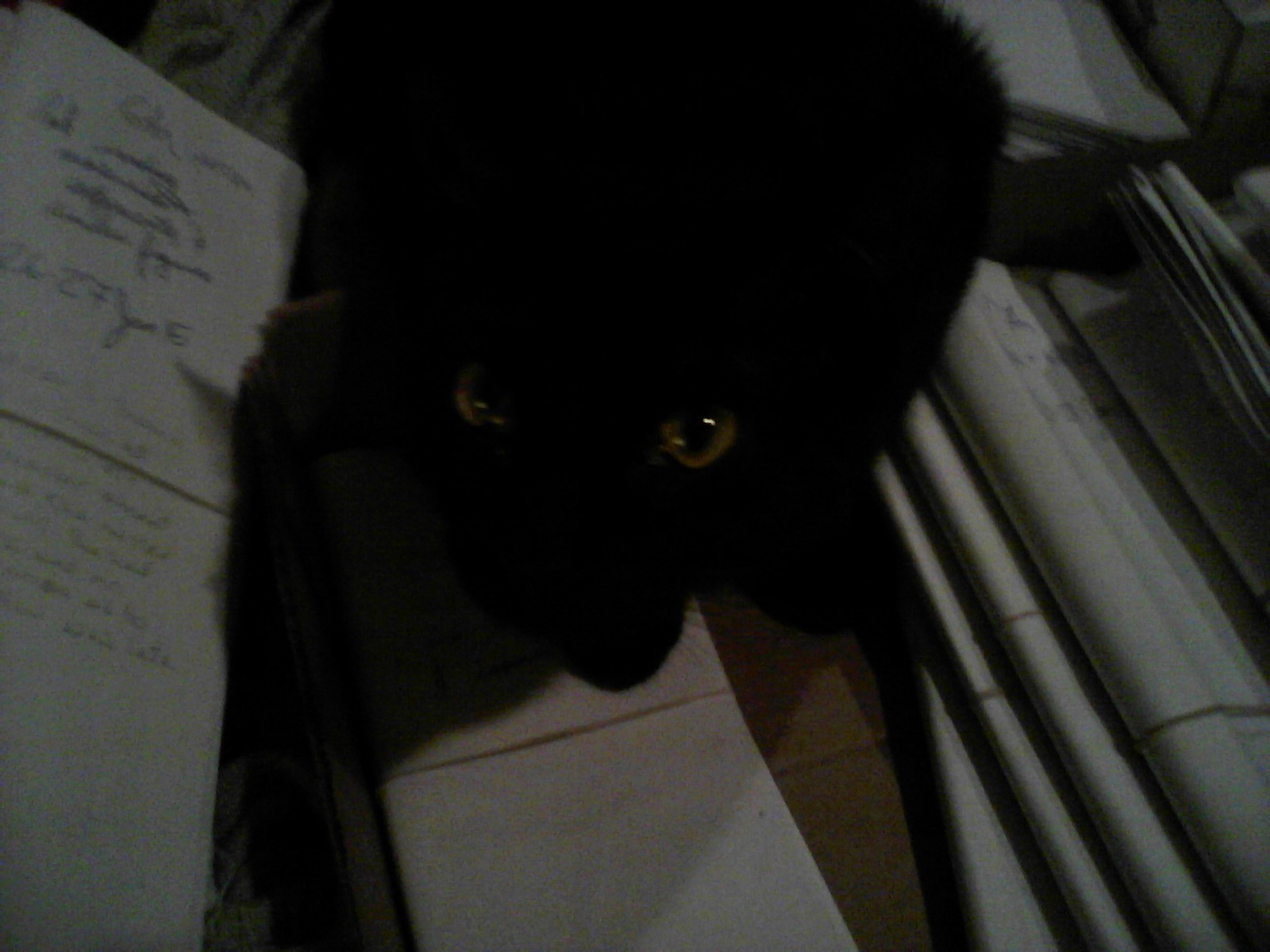
The Misadventures of Jynx the Kitten, Chapter Four: Jynx “Helps” with Grading Papers, and Discovers a New Talent

Pic-03292015-001

This is the last day of Spring Break, and grades for the third quarter are due tomorrow, so it should surprise no one that I’m grading papers. Things were going well, too, until Jynx the Kitten decided to “help.”

I told Jynx that I did not need his “help,” since I already know how to grade papers; I even told him that I very much needed not to have his “help.” Jynx did not care. Papers were there, and he was determined to grade them.

The only problem (for Jynx) was that, before Spring Break even began, I had sorted all the papers to be graded, folded each set separately, and fastened each bundle shut with a separate rubber band, simply to organize the papers to be graded. Some of us in education call this sorting-process “pre-grading,” or something like that. Jynx didn’t like it, though, for the rubber bands kept him from getting to the papers he so desperately wanted to grade (or eat, or shred, or something).

He could, of course, get to the rubber bands, for they were on the outside of each of the bundles of papers. He has claws to pluck them, and did so. He also started trying to pull off the rubber bands with his teeth. Each time a rubber band got plucked, by tooth or claw, twang! Different rubber bands on different bundles were stretched with varying tensions, producing rubber-band-twanging sounds of varying frequency. In other words: Jynx played different musical notes.

Soon, Jynx had forgotten all about grading papers, and was simply having fun playing music for the first time. He was delighted to be playing music . . . or frustrated that he couldn’t get the bundles open . . . or possibly both.

I had also forgotten all about grading papers, and simply sat, listening in amazement, for I’ve had cats all my life, and, aside from the familiar “cat on a piano” song many people have heard, I have never before heard a cat, nor a kitten, attempt to play music.

Jynx’s improvisational rubber-band piece started to improve rapidly with practice, and soon Jynx’s music was much better than even the best-rendered version of “cat on a piano” I have ever heard before — and he’s still a kitten!

Unfortunately, I was not able to open software to record Jynx’s music in time, before he moved on to other things, as kittens do fairly often. As a result, only my wife and I know what Jynx’s music actually sounds like. I did manage to snap the picture above, of him looking up at me from his “musical instruments,” before he moved on to the next of his hijinks for the day, of which there are always many.

And, now that Jynx has decided it’s nap time, I’ll get back to grading these papers.

Zome: Strut-Length Chart and Product Review

This chart shows strut-lengths for all the Zomestruts available here (http://www.zometool.com/bulk-parts/), as well as the now-discontinued (and therefore shaded differently) B3, Y3, and R3 struts, which are still found in older Zome collections, such as my own, which has been at least 14 years in the making.

Zome

In my opinion, the best buy on the Zome website that’s under $200 is the “Hyperdo” kit, at http://www.zometool.com/the-hyperdo/, and the main page for the Zome company’s website is http://www.zometool.com/. I know of no other physical modeling system, both in mathematics and several sciences, which exceeds Zome — in either quality or usefulness. I’ve used it in the classroom, with great success, for many years.

My Complete List of Complaints About My New School

For the last three weeks, for the beginning of my twentieth year as a teacher, I’ve been teaching at a different high school. I am much happier, now, due to this change. This being a personal blog, it is my policy not to name my school, nor school district, here. However, I see no problem with posting my complete list of complaints about this new school. Here it is:

complaints

How To Make Tic-Tac-Toe Interesting

Image

How To Make Tic-Tac-Toe Interesting

Tic-tac-toe, played by the traditional rules, is so simple a game that few people with two-digit ages ever play it — just because it’s boring. It is so simple a game, in fact, that chickens can be trained to play it, through extensive operant conditioning. Such chickens play the game at casinos, on occasion — with the rules stating that if the game ends in a tie, or the chicken wins, the human player loses the money they paid to play the game. If the human wins, however, they are promised a large reward — $10,000, for example. Don’t ever fall for such a trick, though, for casinos only use chickens that are so thoroughly trained, by weeks or months of positive reinforcement, negative reinforcement, and punishment, that they will not ever lose. You’d be better off simply saving the same money until it’s cold, and then setting it on fire, just for the heat. At least that way you’d be warm for a little while, and that certainly beats the humiliation of being beaten, at any game, by a literal bird-brain.

With a small, simple alteration, though, tic-tac-toe can actually become a worthwhile, interesting game, even for adults. I didn’t invent this variation, but have forgotten where I read about it. I call it “mutant tic-tac-toe.”

In this variation, each player can choose to play either “x” or “o” on each play — and the first person to get three “x”s or three “o”s, in a row, wins the game. That’s it — but, if you try it, you’ll find it’s a much more challenging game. I am confident chickens will never be trained to play it successfully.

Consider the board pictured above, which happens to match a game I lost, to a high school student, earlier today. Red (the student) moved first, starting with the “o” in the center. I was playing with a blue marker, and chose to play an “x” in a corner spot. This was a mistake on my part, for the student’s next move — another “x,” opposite my “x,” effectively ended the game. I had to play next — passing is not allowed — and my playing an “x” or an “o,” in any of the six open spaces, would have led to an immediate victory by the student. If you study the board, you’ll see why this is the case.

Mutant tic-tac-toe is a great activity for semester exam week, at any school. Students who finish final exams earlier than their classmates can be taught the game quickly and quietly, and then they’ll entertain themselves with this game, rather than distracting students who are still working on their tests. What’s more, students have to really think to play this version of the game well, especially when they first learn it — and isn’t getting students to think what education is supposed to be all about, anyway?