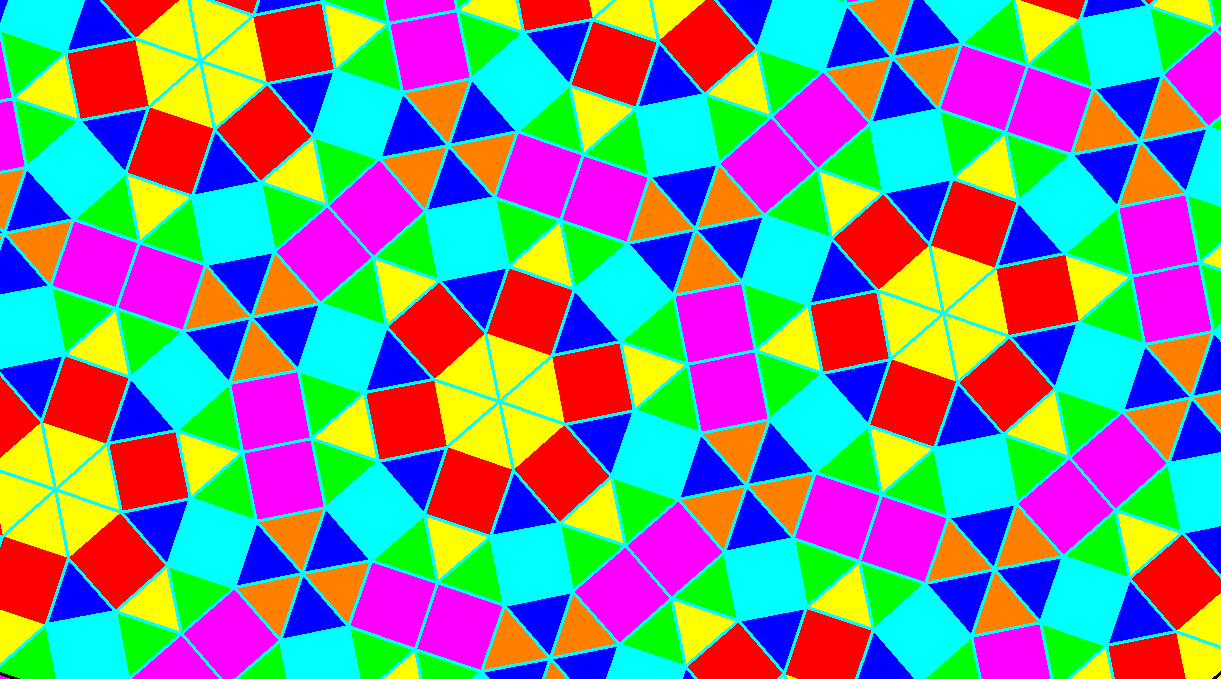
Five Versions of a Tessellation Using Squares and Equilateral Triangles

Image

Tessellation Using Squares and Triangles

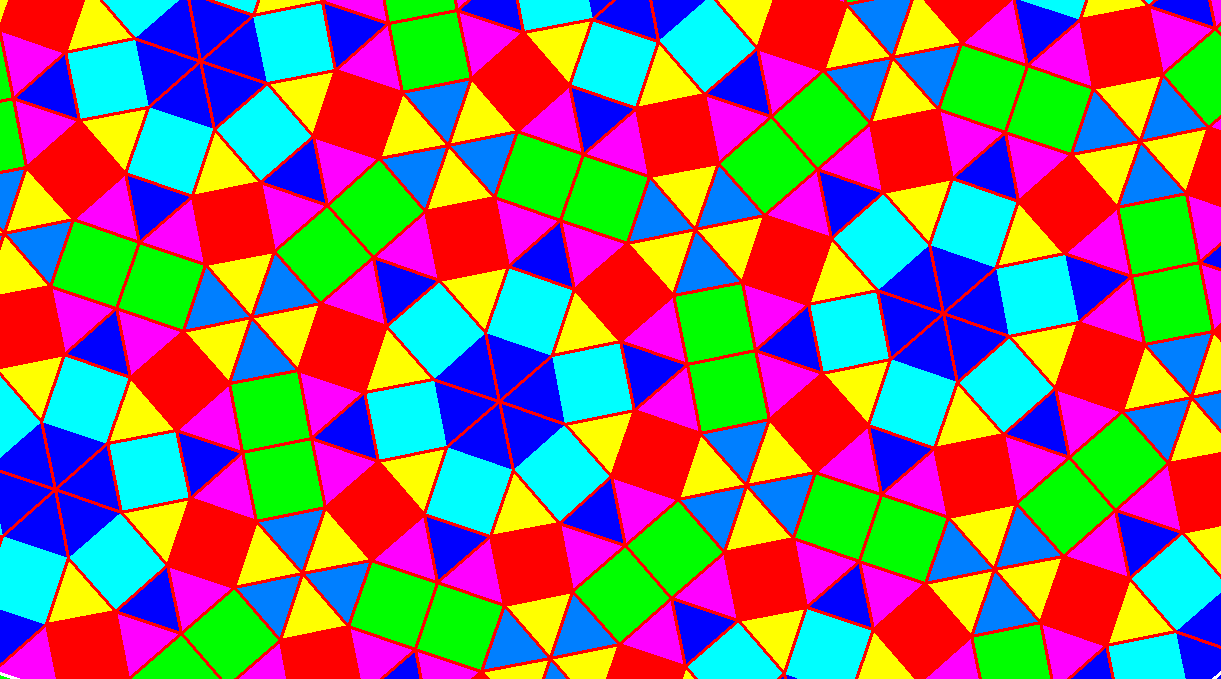
I used four other color-schemes with this same tessellation, and those other images are shown below.

texx 2texx 3texx 4texx 5

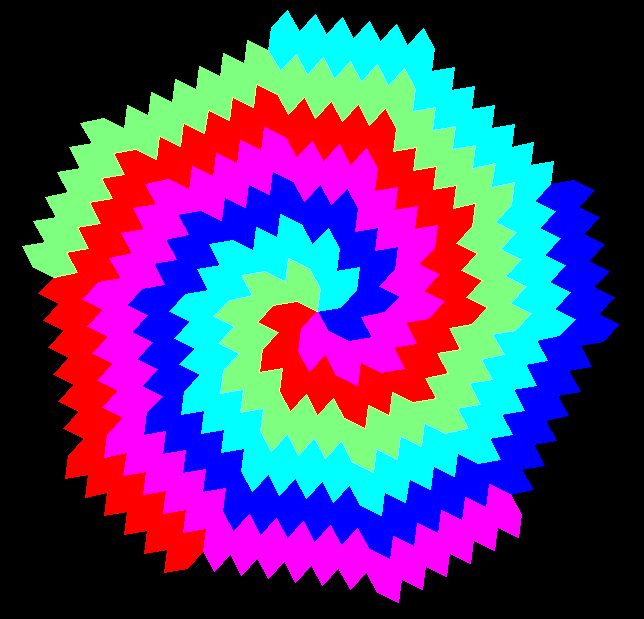
Camping In Hexagonal Tents On a Tessellated Plane

Image

Camping In Hexagonal Tents On a Tessellated Plane

Squares and Triangles

Image

Squares and Triangles

Here’s what it looks like with different colors (click to enlarge it):

tess with sq & tri 2

A Gallery of Nine Tessellations Using Hexagons

Image

hextess

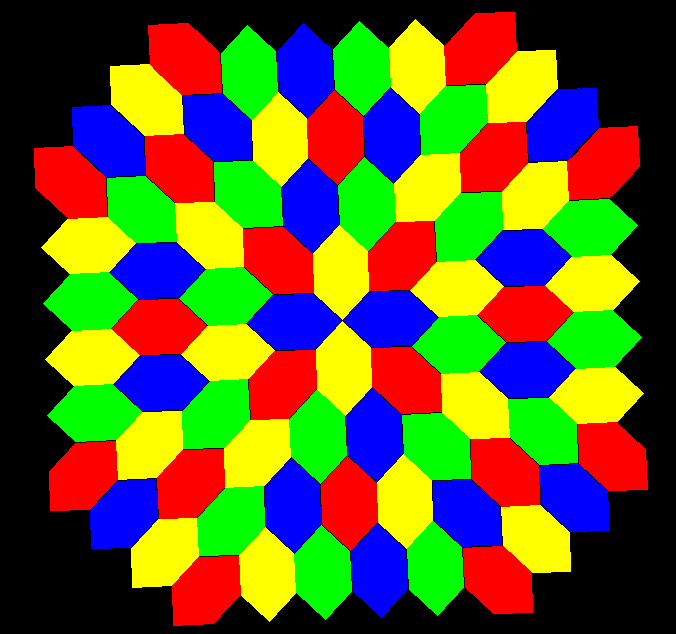
Pictured above is the most familiar hexagonal tessellation. I’ve found some additional tessellations which use equilateral (but non-equiangular) hexagons, and have radial symmetry. They appear, using various coloring-schemes, below.

Hex radial tessellationHex radial tessellation 2Hex radial tessellation 3Hex radial tessellation 4radial octagonal mandala 2radial octagonal mandala 2Buntitleduntitled ic

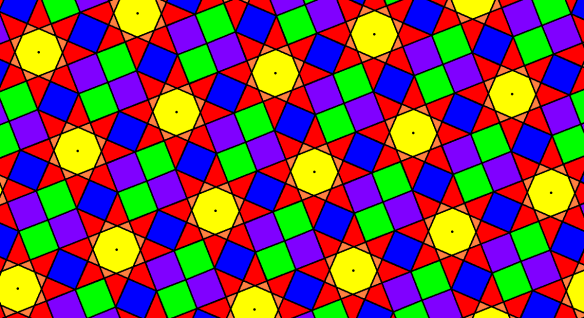
Tessellation of the Plane with Regular Hexagons, Squares, and Tetraconcave, Equilateral Octagons, #1

Image

Tessellation of the Plane with Regular Hexagons, Squares, and Tetraconcave, Equilateral Octagons

If you’d like to see the second version of this tessellation, made over a decade later, simply click right here.

Tessellation Using {8/3} Star Octagons and Squares

Image

Tessellation Using {8/3} Star Octagons and Squares

The tessellation of the plane which uses regular convex octagons and squares is well-known. This related tessellation, however, is not. I didn’t know it existed until I stumbled across it . . . although I very much doubt I am the first person to do so.

Three-Color Tessellation: A Modification of the Tiling of the Plane with Regular Hexagons

Image

Three-Color Tessellation:  A Modification of the Tiling of the Plane with Regular Hexagons

In each case, modifications along hexagon-edges were made using equilateral triangles. Every segment in this tessellation has equal length, also, which required trisection of the original hexagons’ sides.

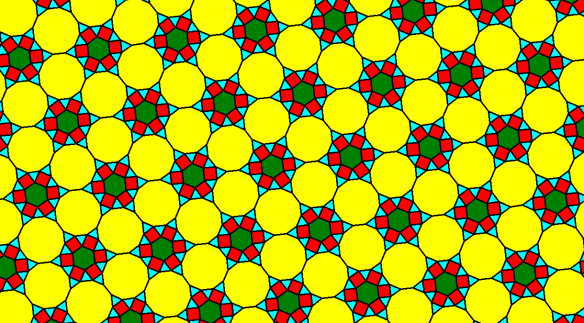
Tessellation of Regular Dodecagons and Regular Enneagons, Together with “Bowtie” Hexagons

Image

A Tessellation Featuring Regular Heptagons

Image

Tessellation Featuring Regular Heptagons

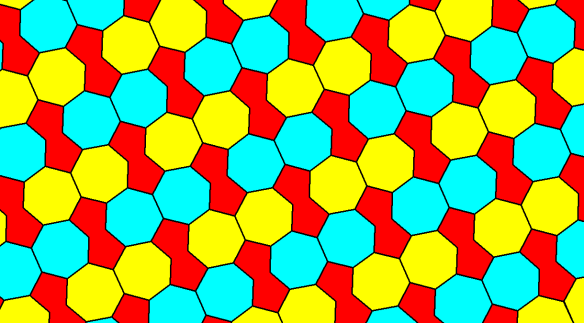
Regular heptagons, of course, can’t tile a plane by themselves. Of all tessellations of the plane which include regular heptagons, I think this is the one which minimizes between-heptagon gap-size (the parts of the plane outside any heptagon). However, I do not have a proof of this. The shape of each of the polygons which fill the “heptagon-only gaps” is a biconcave, equilateral octagon. With these octagons, this is a tessellation, but without them, it wouldn’t fit the definition of that term.

[Later edit:  on Facebook, a friend showed me two others with smaller gap-sizes. In other words, the conjecture above has now been shown to be wrong.]

A Tessellation of Regular Polygons for the New Year MMXIV

Image

A Quasi-Regular Tessellation for the New Year MMXIV

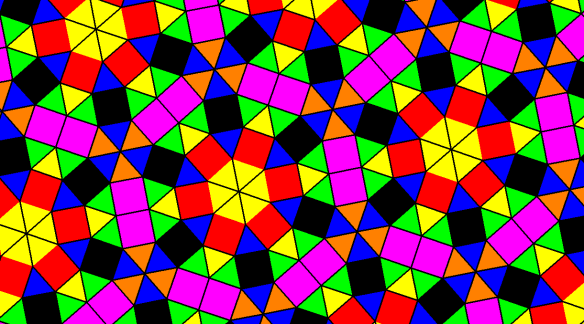
All of the polygons in this tessellation are regular. There are only three regular tessellations, and they use, respectively, equilateral triangles, squares, and regular hexagons to tile a plane. There is also a set of eight semi-regular (or Archimedean) tessellations, which you may see here. Archimedean tessellations include more than one type of polygon, but they are vertex-transitive, meaning that each vertex has the same set of polygons surrounding it.

This is a tessellation of regular polygons, but it lacks vertex-transitivity, so it cannot be called a semi-regular (or Archimedean) tessellation. In other words, in this tessellation, there is more than one type of vertex.

There are many such tessellations with an indefinitely repeating pattern. Has this particular one been seen before? I do not know the answer to this question — but if you do, please let me know, in a comment.