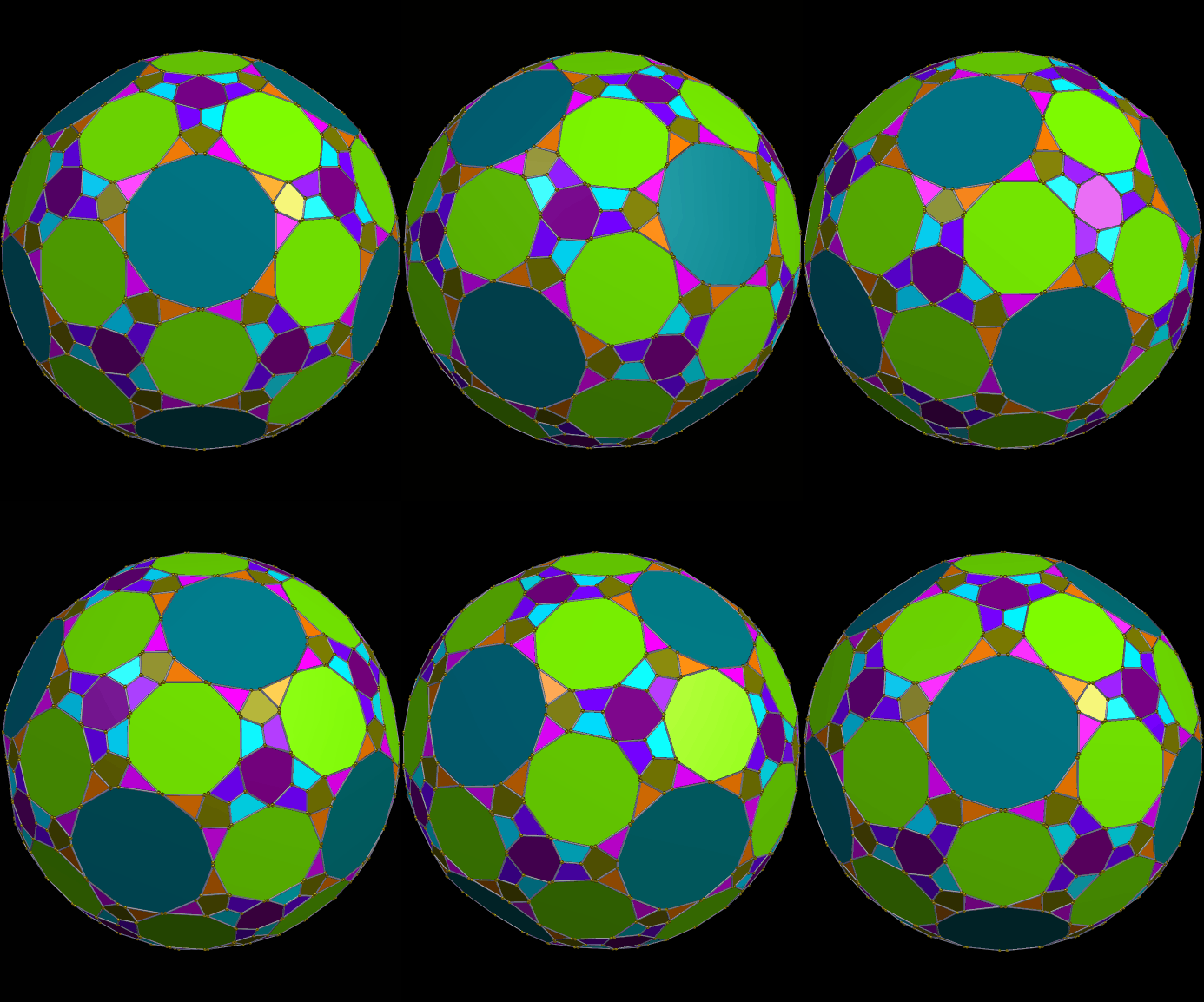
Polyhedron with 362 Faces

Image

Polyhedron with 362 Faces

I’d like to find a polyhedron with the same number of faces as there are days of the year. This is the closest I’ve come, so far.

The software I used, Stella 4d, may be purchased at http://www.software3d.com/Stella.php. There is also a free trial download available.

Attention, Tumblr: Learn the Meaning of the Word “Literally”

I just got an e-mail, from Tumblr (I used to blog a lot there, before coming here to WordPress). The e-mail has the title, “Your Dashboard is literally on fire.” I’m now afraid to go look at my car, OR log on to my old Tumblr account. I dislike being burned.

Pie Chart for Main-Belt Asteroid Masses

Image

Pie Chart for Main-Belt Asteroid Masses

I looked up enough asteroid masses to use them to make this pie chart. I now have three reactions.

First: oh, that’s why only Ceres is round!

Second: who was stupid enough to name an asteroid Europa? That name is taken!

Third: wow — those small ones sure do make up a lot of the total!

A Simulation of Crystalline Growth Using Polyhedral Augmentation

Crystals and crystalline growth have been studied for centuries because of, at least in part, their symmetry. Crystals are cut in such a way as to increase this symmetry even more, because most people find symmetry attractive. However, where does the original symmetry in a crystal come from? Without it, jewelers who cut gemstones would not exist, for the symmetry of crystalline minerals themselves is what gives such professionals the raw materials with which to work.

To understand anything about how crystals grow, one must look at a bit of chemistry. The growth of crystals:

  • Involves very small pieces:  atoms, molecules, ions, and/or polyatomic ions
  • Involves a small set of simple rules for how these small pieces attach to each other

Why small pieces? That’s easy:  we live in a universe where atoms are tiny, compared to anything we can see. Why is the number of rules for combining parts small, though? Well, in some materials, there are, instead, large numbers of ways that atoms, etc., arrange themselves — and when that happens, the result, on the scale we can see, is simply a mess. Keep the number of ways parts can combine extremely limited, though, and it is more likely that the result will possess the symmetry which is the source of the aesthetic appeal of crystals.

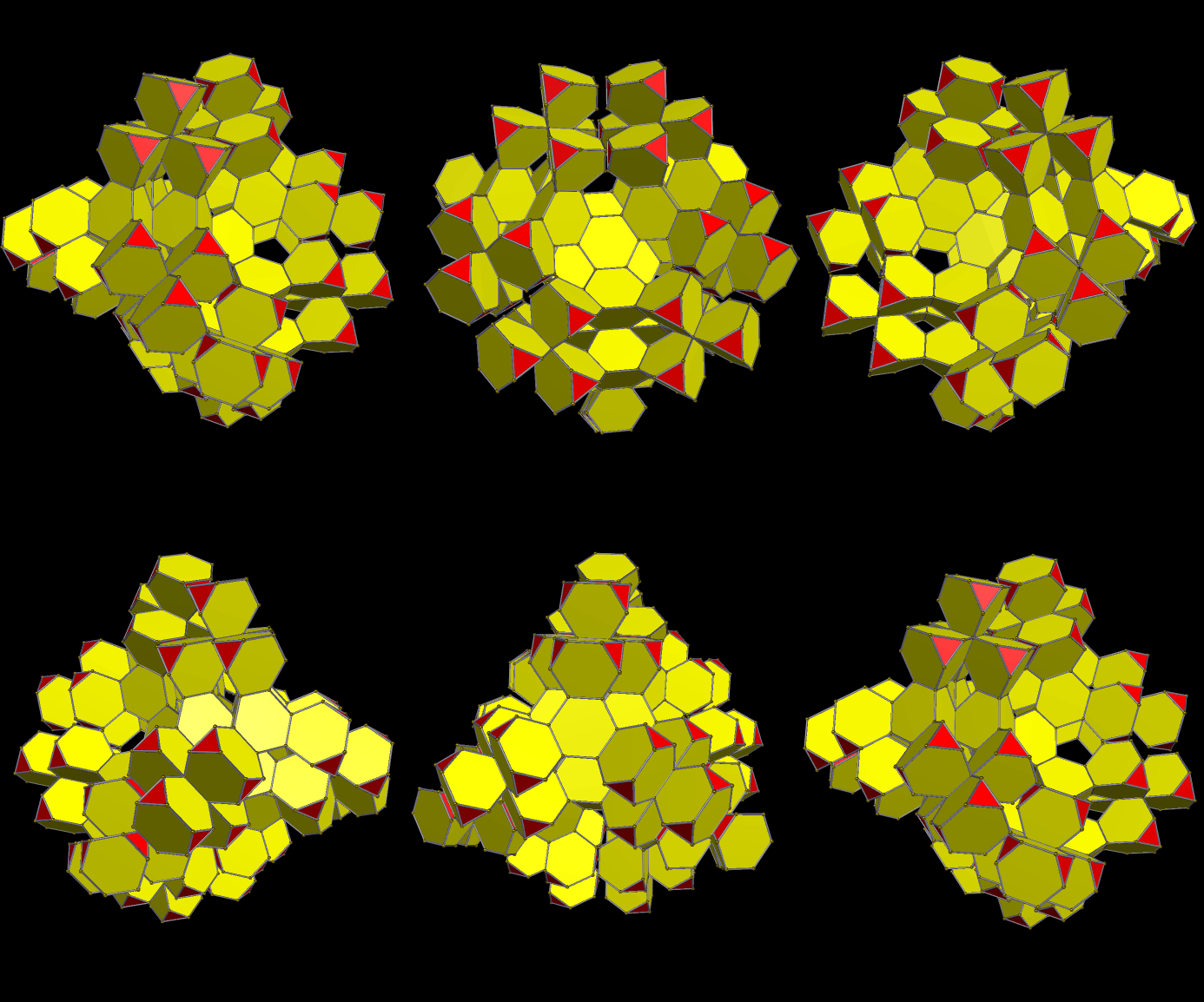
This can be modeled, mathematically, by using polyhedral clusters. For example, I can take a tetrahedron, and them augment each of its four faces with a rhombicosidodecahedron. The result is this tetrahedral cluster:

Image

Next, having chosen my building blocks, I need a set of rules for combining them. I choose, for this example, these three:

  1. Only attach one tetrahedral cluster of rhombicosidodechedra to another at triangular faces — and only use those four triangles, one on each rhombicosidodecahedron, which are at the greatest distance from the cluster’s center.
  2. Don’t allow one tetrahedral cluster to overlap another one.
  3. When you add a tetrahedral cluster in one location, also add others which are in identical locations in the overall, growing cluster.

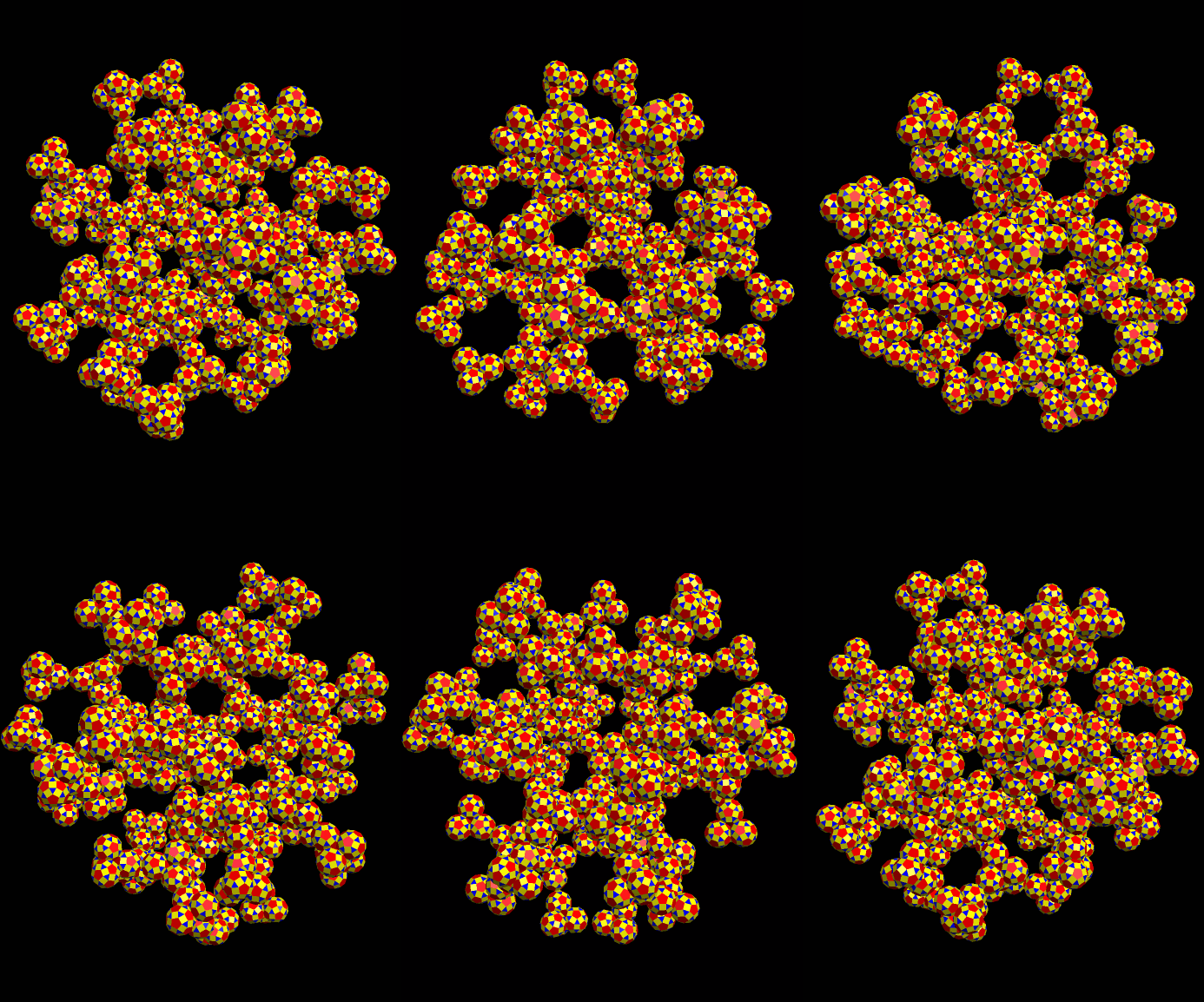
Using these rules, the first augmentation produces this:

Image

That, in turn, leads to this:

Image

Next, after another round of augmentation:

Image

One more:

Image

In nature, of course, far more steps than this are needed to produce a crystal large enough to be visible. Different crystals, of course, have different shapes and symmetries. How can this simulation-method be altered to model different types of crystalline growth? Simple:  use different polyhedra, and/or change the rules you select as augmentation guidelines, and you’ll get a different result.

[Note:  all of these images were created using Stella 4d: Polyhedron Navigator. This program is available at http://www.software3d.com/Stella.php.]


Sprawling Clusters of Truncated Tetrahedra

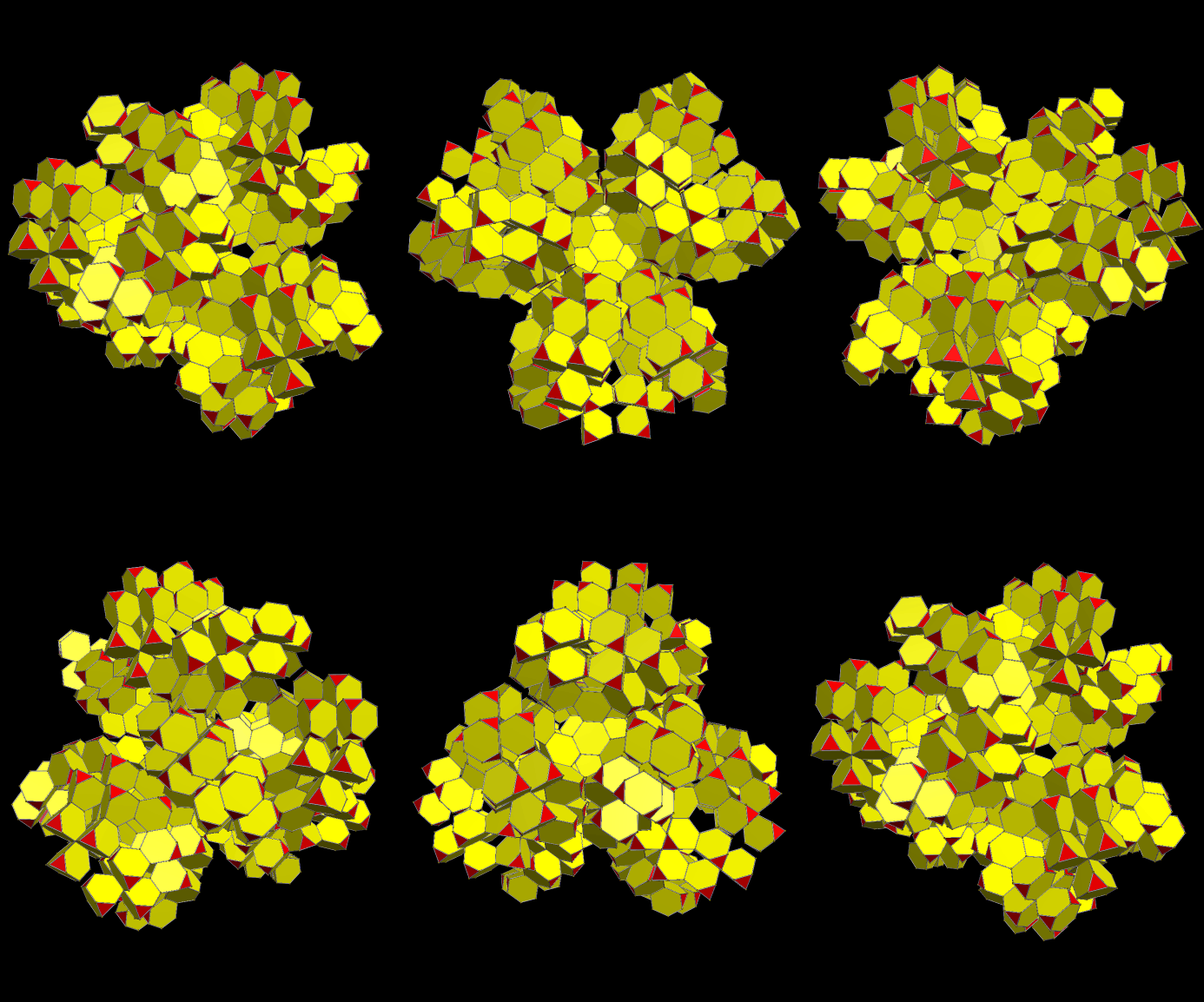
Truncated tetrahedra make interesting building blocks. In the images below, the truncated tetrahedron “atoms” are grouped into four-part “molecules,” each with a triangular face pointed toward the molecular center, which is found in a small tetrahedral hole between the four truncated tetrahedra. These four-part “molecules” are then attached to other,  always with three coplanar triangular faces from one “molecule” meeting three from the other. If you start from a central “molecule,” and let such a cluster grow for a small number of iterations, you get this:

Cluster Truncateed Tetra

What does the cluster above look like if even more truncated tetrahedra are added, but without allowing overlap to occur? Like this:

Image

Like the truncated tetrahedron itself, these sprawling clusters have tetrahedral symmetry. To keep such symmetry while building these clusters, of course, one must be careful about the exact placement of the pieces — and doing this becomes more difficult as the cluster grows ever larger. I was able to take this one more step:

Image

All of these images were created using Stella 4d: Polyhedron Navigator. This program is available at http://www.software3d.com/Stella.php.


Multiple Octahedra, in a Rotating Cluster with Tetrahedral Symmetry

Image

Multiple Octahedra, in a Rotating Cluster with Tetrahedral Symmetry

I created this cluster using Stella 4d: Polyhedron Navigator. This program is available at http://www.software3d.com/Stella.php.

A Comparison of the Areas of Some of the Triangles Formed By Connecting Three Noncollinear Triangle Centers

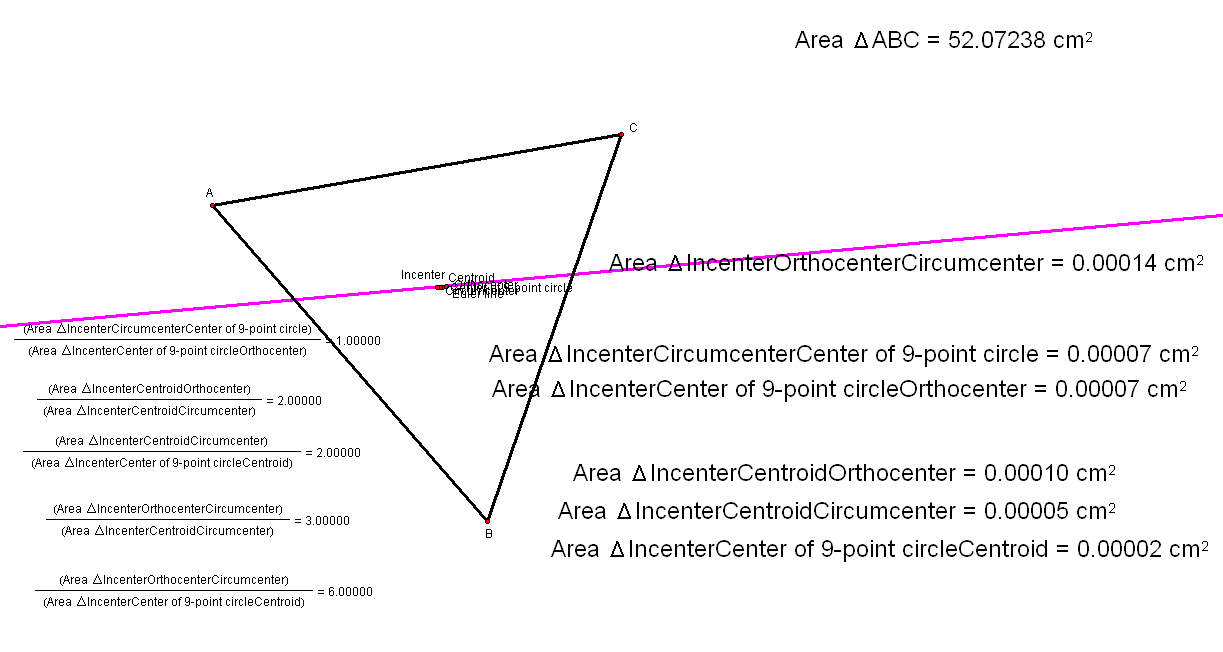
The five most well-known triangle centers are the centroid (where a triangle’s medians meet), the orthocenter (where the lines containing the altitudes meet), the incenter (where a triangle’s three interior angle bisectors meet), the circumcenter (where the perpendicular bisectors of a triangle’s three sides meet), as well as the center of a triangle’s 9-point circle (see https://en.wikipedia.org/wiki/Nine-point_circle for more information on this circle, and how it is defined). In the diagram below, the constructions for all five of these triangle centers have been performed, for obtuse, scalene triangle ABC.

Image

The thick pink line is called the Euler line, and four of the five triangle centers mentioned above — all of them except the incenter — are always located on this line, no matter a triangle’s shape or size. The incenter, however, is only found on the Euler line for isosceles or equilateral triangles, so, for such triangles, all five of these triangle centers are collinear — and, as a consequence, no triangles can be made by connecting any set of three of them. If the triangle is scalene, however, the incenter will leave the Euler line, and these triangles may then be defined (with construction-clutter removed, but for the same triangle ABC as shown in the first diagram):

Image

If A, B, and/or C are moved around, the area of triangle ABC changes, as do, of course, the areas of the colored triangles above, of which there are six:  yellow, red, blue, yellow and red together, blue and red together, and all three taken as one triangle. For the original configuration of triangle ABC, you can see those triangle areas on the right side of the image above. On the left side, various ratios are given:

  • The triangle which joins the incenter, 9-point circle center, and circumcenter has the same area as the triangle joining the incenter, 9-point circle center, and the orthocenter.
  • The triangle joining the incenter, centroid, and orthocenter has twice the area of the triangle joining the incenter, centroid, and circumcenter — and this latter triangle, itself, has twice the area of the triangle joining the incenter, centroid, and 9-point circle center.
  • The area of the triangle connecting the incenter, orthocenter, and circumcenter has an area three times as large as the triangle connecting the incenter, centroid, and circumcenter.
  • As a consequence of the last two bulleted statements, the area of the triangle connecting the incenter, orthocenter, and circumcenter is six times the area of the triangle connecting the incenter, centroid, and 9-point circle center.

In both diagrams above, the original triangle ABC is scalene and obtuse. If A, B, and/or C are moved around, but the triangle remains scalene (so that the five triangle centers in question remain noncollinear), all six of the colored triangles described above still exist — and the area ratios given in the bulleted statements above remain constant, also. I do not yet have proofs for the constancy of these area ratios, but am confident that it is possible to write them.

If A, B, and C are positioned in such a way that triangle ABC is almost equilateral, the five triangle centers discussed here get very close together — because for a triangle which actually is regular, all five are located in exactly the same spot. Here’s what the almost-regular case looks like:

Image

As you can see, the area ratios described above (left side of diagram) remain the same, even as the actual colored-triangle areas (right side) all approach zero. If I complete a proof for the constancy of any or all of these area ratios, I’ll post such proofs in subsequent posts on this blog — or readers are welcome to write their own proofs, and are invited to leave them as comments on this post.

Four Octahedra, Rotating in Tetrahedral Formation

Image

Four Octahedra, Rotating in Tetrahedral Formation

I created this cluster by augmenting each face of a tetrahedron with an octahedron, using Stella 4d: Polyhedron Navigator. This program is available at http://www.software3d.com/Stella.php.

A Triangle’s Tridpoint-Hexagon

Image

A Triangle's Tridpoint-Hexagon

Any triangle may be named triangle ABC. Each of its sides will contain exactly two points — called “tridpoints” — which divide that side into three segments of equal length. In triangle ABC above, the tridpoints are named in such a way that two of them, E and F, are encountered, in that order, if one moves from A to B. On the way from B to C, two more tridpoints are encountered: first F, and then G. Finally, going from C back to A, the last two tridpoints are found: first H, and then J. If a polygon is formed using those six tridpoints in alphabetical order (matching the order of their placement), that polygon is a convex hexagon, DEFGHJ. Another name for it is hexagon DJHGFE, which I mention only because Geometer’s Sketchpad called it that, in the picture above, when I asked it for the area of this hexagon, shown in green. The original triangle, ABC, includes both the yellow and green regions, and I asked Sketchpad for the area of this triangle, also, as well as the hexagon-to-triangle area ratio, which is shown above as the familiar “decimalized” version of the fraction 2/3.

A nice feature of Sketchpad is that you can do things like this — and then move points around, to see what effect that has on measured and calculated values. When I move points A, B, and/or C, the triangle and hexagon areas, of course, change. Their area ratio, however, remains at a decimal which is a rounded-off version of 2/3. It doesn’t change at all, no matter where A, B, and C are placed. Any triangle’s tridpoint-hexagon has an area exactly 2/3 that of the original triangle.

This is not yet a theorem — because what is written above is an explanation, not a proof. I’ve started working on a proof for this conjecture in my head, and will post it on this blog when/if I successfully complete it.

[Later edit — one of my readers provided a proof, so now it’s a theorem. For his proof, see the first comment on this post.]

Triangle Investigations

I just spent a couple of hours playing with triangles, their centers, and related things, using Geometer’s Sketchpad. Much of what I found was already known, but some of the things I found may not be. It will take more research to sort out which is which.

Image

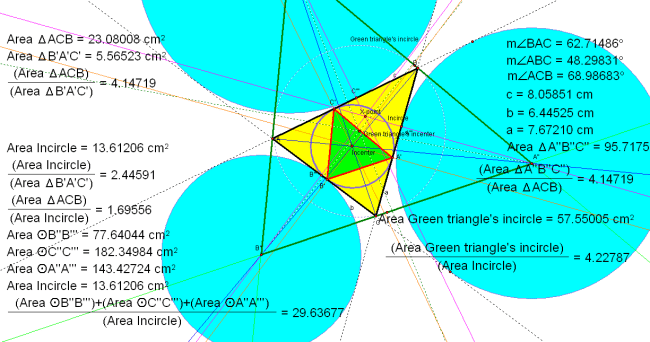
This is where I started. My original triangle, ABC, has heavy black sides and a yellow interior. The sides of ΔABC are extended as black dashed lines. I constructed ΔABC’s three angle bisectors to find its incenter, then constructed perpendicular lines to each side of the triangle from the incenter to find the three “touchpoints,” called A’, B’, and C’, allowing me to construct the incircle of my starting triangle. I also wanted the three excircles, and they are centered at A”, B”, and C” — the three excenters of triangle ABC. These points are found by bisecting all exterior angles of the original triangle, and then looking for the three point of concurrency among themselves, and the three interior angle bisectors previously used to locate the incenter. The heavy green, large triangle is the triangle which connects the three excenters, and probably has an established name, but I couldn’t find it — so I’ll just be calling it the “green triangle.” It is not to be confused with the small triangle in the diagram’s center, which has red sides and a green interior. This small triangle is simply formed by connecting the touchpoints A’, B’, and C’, and has several names already:  the Gergonne triangle, the contact triangle, and the intouch triangle of ΔABC.

I set this up in such a way that I could move points A, B, and C around, and watch what happened to angle measures, segment lengths, areas, and area ratios. The picture above shows what happens near regularity, with all three interior angles very close to 60°. This is how I learned that certain area ratios are at a minimum when the triangle is equilateral — as you’ll see, they are all larger in subsequent pictures. At regularity, the green triangle has an area exactly four times that of the original triangle, which, in turn, has an area four times larger than the Gergonne triangle — and, away from regularity, these two area ratios remain equal to each other.

I also found that the green triangle’s incircle’s area is, at minimum, four times that of the original triangle’s incircle — but if you deviate from regularity even slightly, it can be seen that this “just above four” is not equal to the “just above four” area ratios described at the end of the last paragraph.

I also tried adding the areas of all three excircles, then dividing this sum by the area of the incircle. At regularity, this ratio is 27, so each excircle would have exactly nine times the area of an incircle for an equilateral triangle. From that, it follows that an equilateral triangle’s excircle’s radius is three times that of the radius of the incircle. These numbers are minimums; the get bigger if the triangle deviates from regularity in any way.
Image

This second picture shows what happens when regularity is abandoned. I noticed that the green triangle’s incenter, the original triangle’s incenter, and a third point of concurrency I am calling the “x-point” (because I suspect it already has a name, but I don’t know what that name is) appeared as if they might be collinear — but might not be. I checked, and they are non-collinear. I then decided to investigate this x-point further. The x-point is the one point of concurrency of the three lines, one for each excircle, which contain that excircle’s center, as well as the point of tangency between that excircle and the original triangle.

Image

To investigate this x-point further, I started locating other triangle centers, and also continued moving A, B, and C around. The picture above shows the Gergonne point added to the diagram. The Gergonne point is a point of concurrency of three lines — each being a line containing a triangle’s vertex, and the touchpoint opposite that vertex. As you can see, these points still refused to line up. I therefore decided to go all-out, and add many more triangle centers.

Image

In this last picture, I’ve added the circumcenter (point of concurrence of the triangle’s sides’ three perpendicular bisectors), centroid (point of concurrence of the three medians), orthocenter (point of concurrence of the lines containing the triangle’s three altitudes), and several other things for which you can easily find definitions on Wikipedia — such as the 9-point circle, its center, the Nagel point, the Nagel line, and the Euler line. As you can see, the Euler Line (shown as a heavy orange line) passes through the orthocenter, the center of the nine-point circle, the centroid, and the circumcenter. It does not, however, contain the incenter. What does? The Nagel line (shown in heavy purple), for one thing, which also holds the Nagel point, as well as the centroid, where it intersects the Euler line.

Neither the Euler line nor the Nagel line contains the x-point I was investigating, though — but I found a line which does. It is shown in heavy grey, and passes through (in addition to the x-point) the circumcenter (where it intersects the Euler line) and the Gergonne point, which was completely unexpected. I suspect this line has already been discovered and named, but, until I find out what that name is, I’m calling it the “x-line.”

If anyone who reads this knows more about the x-point or x-line, such as their already-existing names (assuming they’ve been discovered before), please leave this information in a comment here.