Given Equations for Two Circles, How Does One Find the Coordinates of Their Point(s) of Intersection, If Any?

Image

Given Equations for Two Circles, How Does One Find the Coordinates of Their Point(s) of Intersection, If Any?

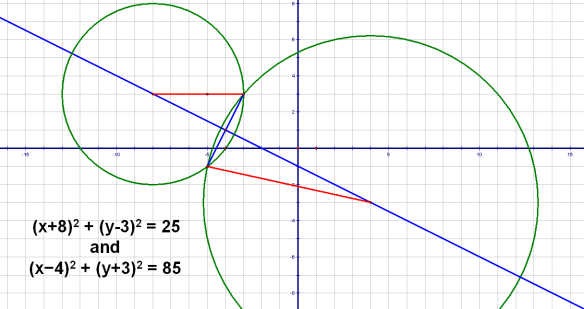
Before attempting to create a method for solving this problem with any given circles, I’m going to attempt solving it for this arbitrary pair of circles. The small circle has radius 5, is centered at (-8,3), and has the equation (x+8)² + (y-3)² = 25. The larger circle has a radius of √85, is centered at (4,-3), and has the equation (x-4)² + (y+3)² = 85.

The first thing I will do is add 60 to each side of the equation of the smaller circle, changing that equation to (x+8)² + (y-3)² + 60 = 85. There are now two equations with 85 on one side, so I will set their other sides equal to each other:  (x+8)² + (y-3)² + 60 = (x-4)² + (y+3)². Next, I square each term in parentheses, turning this equation into x² + 16x +64 + y² -6y +9 + 60 = x² – 8x +16 + y² + 6y +9. After x², y², and 9 are each cancelled from each side, the equation looks like this:  16x +64 – 6y +60 = -8x + 16 + 6y. This simplifies further to -12y + 124= -24x +16, then -12y = -24x -108, then, after dividing both sides -12, that yields the simplified equation for the straight line y = 2x + 9. Any solutions which exist, therefore, must be found on the line y = 2x + 9.

(x+8)² + (y-3)² = 25 is the equation of the smaller circle, and substituting 2x + 9 for y in this equation turns it into (x+8)² + (2x + 9 – 3)² = 25, which is equivalent to (x+8)² + (2x + 6)² = 25. By squaring the terms in parentheses found in this last equation, this turns into x² + 16x +64 + 4x² + 24x + 36 = 25, which simplifies further to 5x² +40x + 75 = 0, and then x² +8x + 15 = 0.

Applying the quadratic formula (because I don’t enjoy factoring trimonials) to this last equation, x = {-8 ± sqrt[64 – (4)(1)15)]}/2, which means that x has two values in this case:  x = (-8 + 2)/2 = -6/2 = -3, and x = (-8 – 2)/2 = -10/2 = -5. When x = -3, then y = 2(-3) +9 = -6 + 9 = 3, so one solution is the ordered pair (-3,3). By constrast, when x = -5, then y = 2(-5) +9 = -10 + 9 = -1, so the other solution is the ordered pair (-5,-1).

For other circle-pairs, the method is the same, but appropriate substitutions will need to be made in the numbers with which I started, likely leading, of course, to different answers. For some pairs of circles, the quadratic formula will not yield two real ordered pairs as solutions. If all values of x and y are nonreal, this simply means that the two circles do not touch at all. If, on the other hand, only ordered pair can be found as a solution, this means the circles are tangent to each other — touching only at a single point.

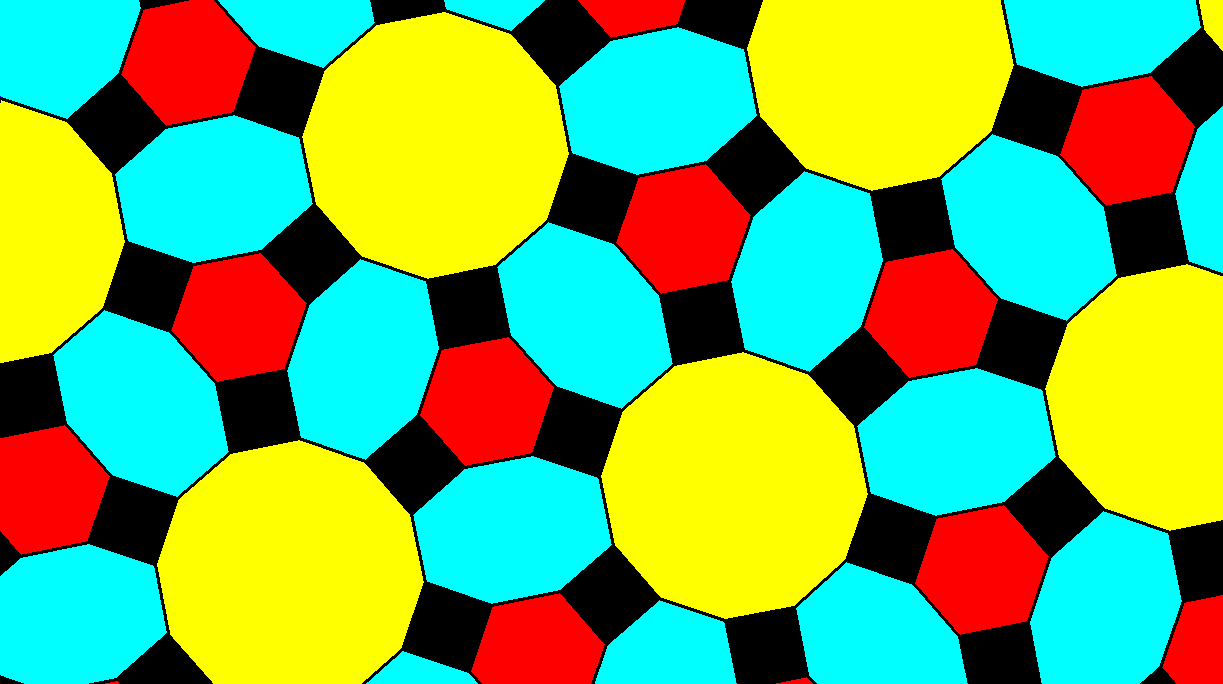
Op Art Based On an Elongated Dodecagon

Image

Op Art Based On an Elongated Dodecagon

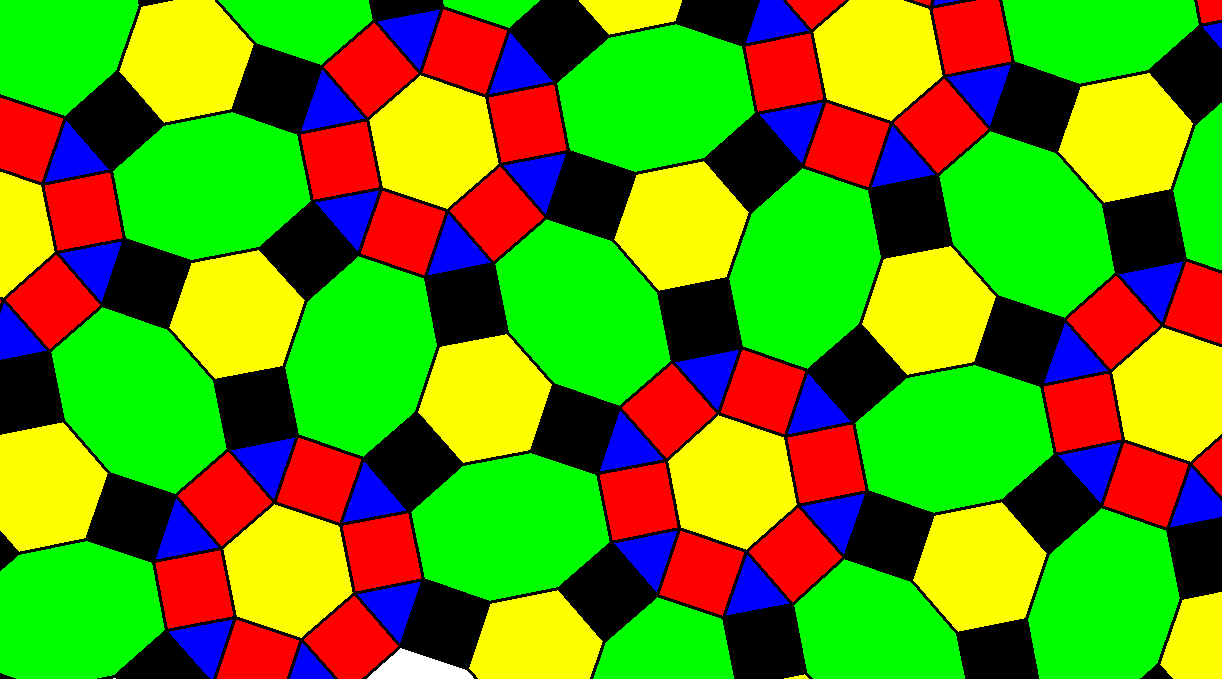
Elongated Dodecagon with Sides and Diagonals Extended As Lines

Image

Elliptical Dodecagon with Sides and Diagonals Extended As Lines

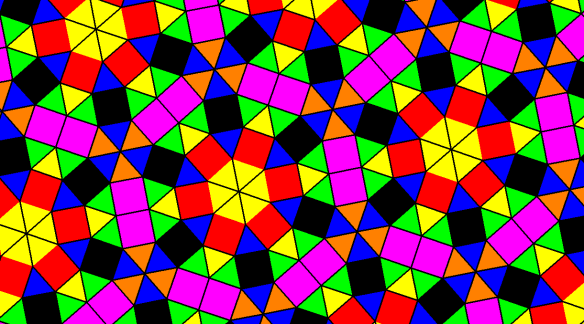
Three Similar Tessellations

Image

Three Similar Tessellations

You can click on the smaller ones, if you wish, to make them larger.

tess 4tess 3

My New Spider Tattoo

Image

My New Spider Tattoo

I just got a new tattoo on my right wrist, and got it as the Golden Lotus Tattoo Shop in Sherwood, Arkansas. Kendal Harkey is the tattoo artist who created this tattoo.

Since this was cover-work, I simply asked Kendal to do a Google-image-search for “spider,” then pick which one would best work best for that purpose. Here’s what he selected:

140616_0000

I’m now left with a puzzle:  I tried to find this same image with Google, but couldn’t . . . and I want to know what kind of spider this is! If you recognize it, or find it on-line, please leave its scientific name in a comment here.

[Update:  I found the source on Google, at http://coloringhub.com/dangerous-spider-coloring-pages/spider-picture/ — but it’s a drawing, not a photograph, and so it may or not be a drawing of a real spider species . . . so I still need assistance, if anyone else knows more details.]

Tetrakaiicosagon with Diagonals

Image

Tetrakaiicosagon with Diagonals

How many diagonals does a polygon with 24 sides have?

First, consider that there are 24 vertices for diagonals to come from, and they each have 21 places to go, since they can’t go to themselves, or to the adjacent vertices. (24)(21) therefore equals twice the number of diagonals, since I just counted each one twice (once per endpoint). There are therefore (24)(21)/2 = 252 diagonals.

A Rhombic Triacontahedron with Tessellated Faces

Image

A Rhombic Triacontahedron with Tessellated Faces

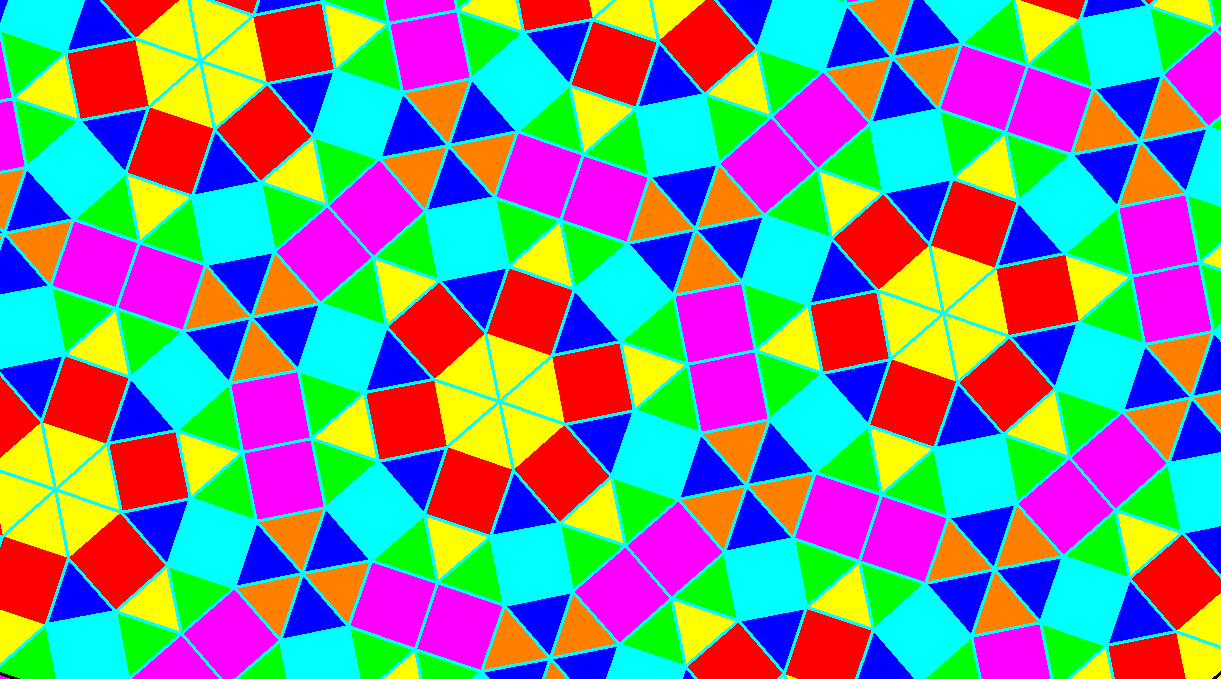
The faces of this polyhedron all have the same tessellation projected on them, but with five different coloring schemes. These five different tessellations appear in non-moving form in the last post on this blog, and I used Geometer’s Sketchpad and MS-Paint to make them. Stella 4d, another program, was then used to put the whole thing together, and it may be tried for free at http://www.software3d.com/Stella.php.

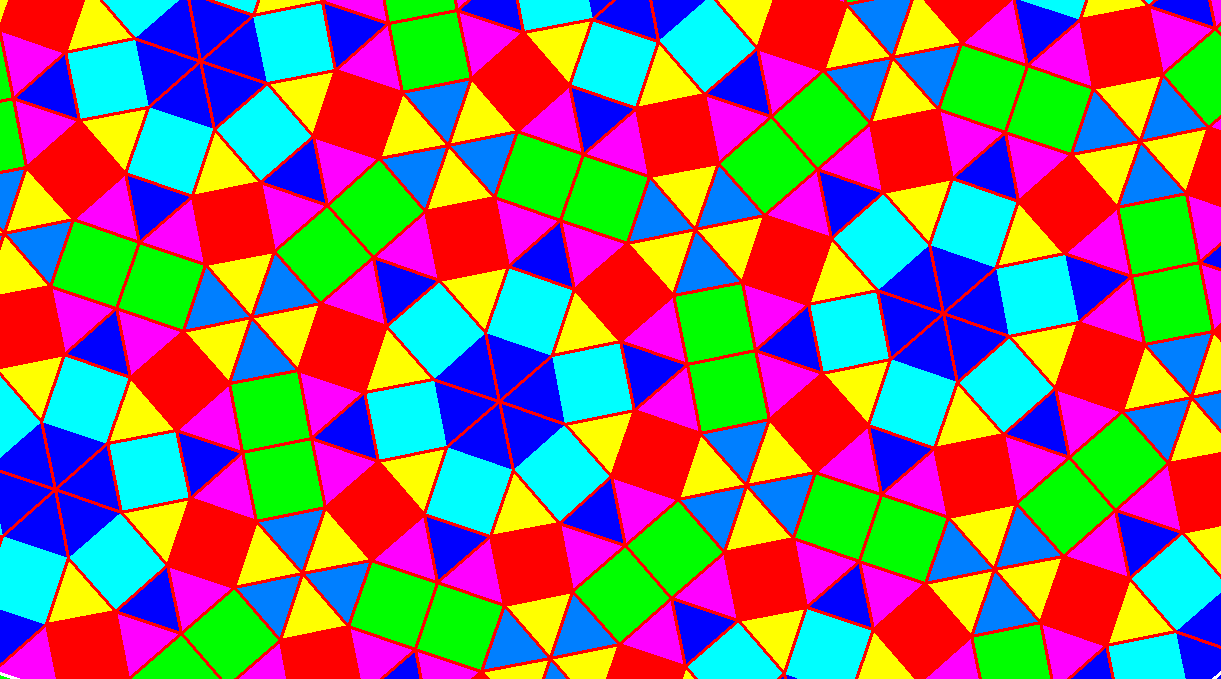
Five Versions of a Tessellation Using Squares and Equilateral Triangles

Image

Tessellation Using Squares and Triangles

I used four other color-schemes with this same tessellation, and those other images are shown below.

texx 2texx 3texx 4texx 5

The Truncated Truncated Icosahedron

Image

The Truncated Truncated Icosahedron

The icosahedron has twenty triangular faces. Truncate it once, and the triangles become hexagons, with pentagons appearing under the pyramids removed in the truncation. This is the “soccer ball” shape familiar to millions.

If you take this figure and truncate it again, the twenty hexagons become twenty dodecagons, the twelve pentagons each become decagons, and sixty isosceles triangles appear under the pyramids removed by this second truncation.

I made this image using Stella 4d, a program you can find at www.software3d.com/Stella.php. Also, just for fun, here’s a version of it with the colors switched around, and with a slight bounce as it rotates in the other direction.

truncated trunctaed icosahedron

Three Stellations of the Icosidodecahedron

Image

Three Stellations of the Icosidodecahedron

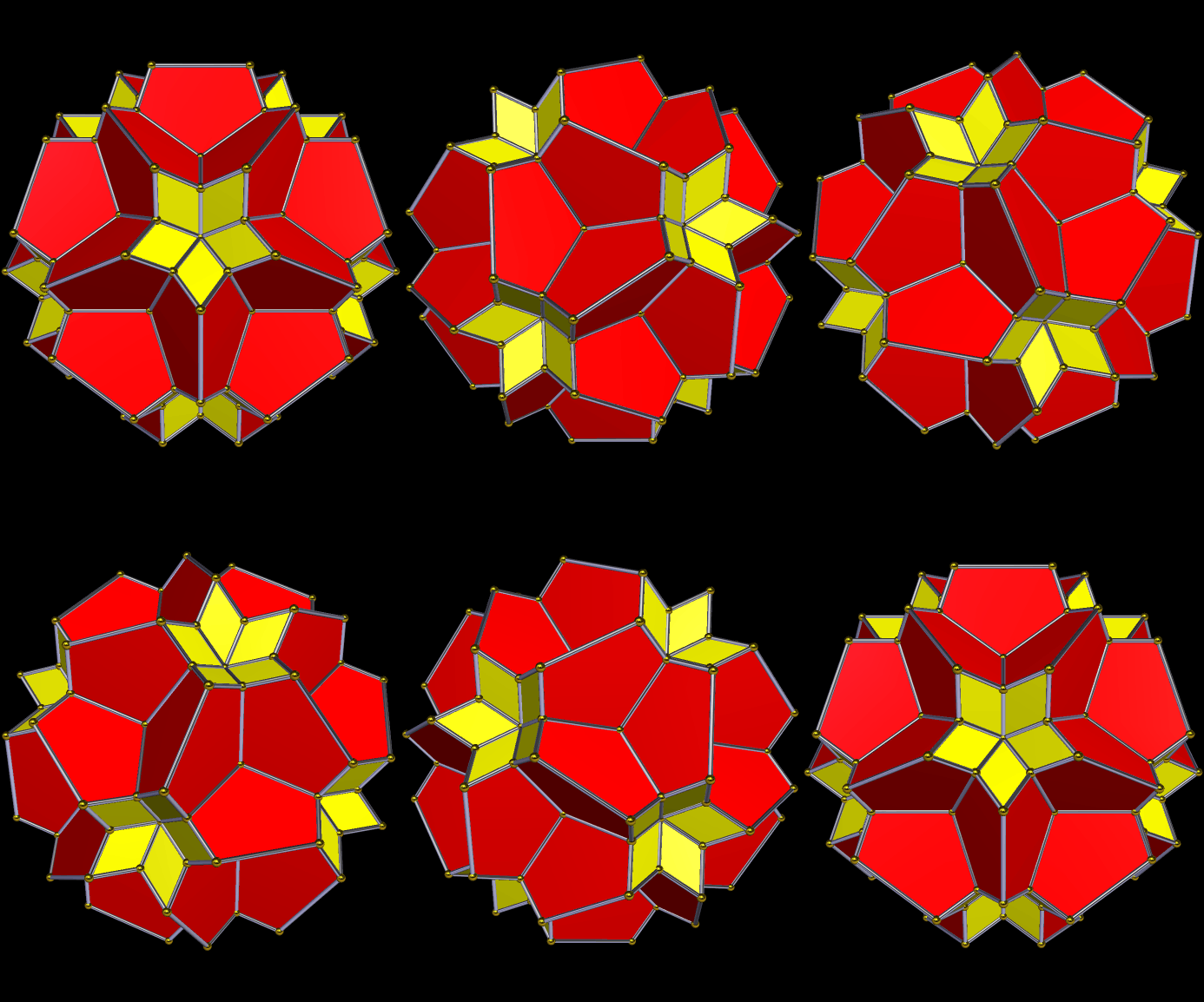
The icosidodecahedron’s 24th stellation is above, and the 32nd, then the 36th, are below.

Icosidodeca 32nd StellationIcosidodeca 36th Stellation

I made these images using Stella 4d, a program you can find at www.software3d.com/Stella.php.