“How Tall Are You?”

metric system

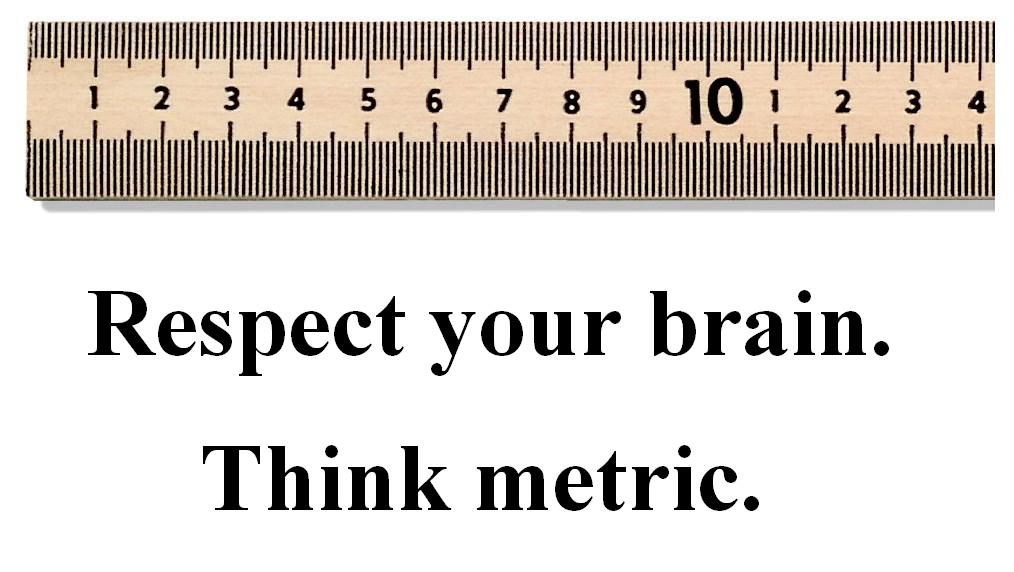
When I am asked for my height, anywhere — especially at school — I answer the question honestly. I am 1.80 meters tall.

I also live in the USA, one of only three remaining countries (the other two holdouts are Liberia and Myanmar) which have stubbornly refused to adopt the metric system. However, I am every bit as stubborn as other Americans, but, on this issue, I choose to be stubborn in the opposite direction.

It should surprise no one who knows me well that my classroom, whether I am teaching science or mathematics, is, by design, an all-metric zone. After all, like >99% of people, I have ten fingers (assuming thumbs are counted as fingers), ten toes, and almost always use the familiar base-ten number system when counting, measuring, doing arithmetic, or doing actual mathematics. (Doing arithmetic is not the same thing as doing real mathematics, any more than spelling is equivalent to writing.) Using the metric system is consistent with these facts, and using other units is not.

Admittedly, I do sometimes carry this to an extreme, but I do so to make a point. Metric units are simply better than non-metric units. Why should anyone need to memorize the fact that there are 5,280 feet in one mile? It actually embarrasses me that I have that particular conversion-factor memorized. By “extreme,” I mean that I have been known to paint the non-metric side of meter sticks black, simply to make it impossible for students in my classes to confuse inches and centimeters, and prevent them from measuring anything with the incorrect units.

To those who object that American students need to understand non-metric units, I simply point out that there are plenty of other teachers who take care of that. This is, after all, the truth.

Often, after giving my height as 1.80 meters, I am asked to give it in other units. Unless the person asking is a police officer (in, say, a traffic-stop situation), however, I simply refuse to answer with non-metric units. What do I say, instead? “I’m also 180 centimeters tall. Would you like to know my height in kilometers?”

If pressed on this subject in class — and it comes up, because we do lab exercises where the height of people must be measured — I will go exactly this far:  I am willing to tell a curious student that there are 2.54 centimeters in an inch, 12 inches in a foot, and 3.28 feet in a meter. Also, I’m willing to loan calculators to students. Beyond that, if a student of mine really wants to know my height in non-metric units, he or she simply has to solve the problem for themselves — something which has not yet happened. I do not wish to tell anyone my height in feet and inches, for I do not enjoy headaches, and uttering my height, in those units I despise, would certainly give me one. Also, obviously, you won’t find my height, expressed in non-metric units, on my blog, unless someone else leaves it here, in a comment — and I am definitely not asking anyone to do that.

I might, just for fun, at some point, determine my height in cubits. For all I know, a person’s height, measured with their own cubits, might be a near-constant. That would be an interesting thing to investigate, and my students, now that I’ve thought about the question, might find themselves investigating this very issue, next week. The variability of cubits, from one person to another, makes them at least somewhat interesting. It also makes cubits almost completely useless, which explains why they haven’t been used since biblical times, but that’s not the point. One can still learn things while investigating something which is useless, if one is sufficiently clever about it.

Feet and inches, however, are not interesting — at all. They are obsolete, just as cubits are, and they are also . . . offensive. It is not a good thing to insult one’s own brain.

On Boiling Eggs, William Shakespeare, and Richard Feynman

Not long ago, I boiled a dozen eggs.

After accidentally misquoting Shakespeare, while watching these eggs boil (“Boil, boil, toil and trouble, fire burn and cauldron bubble”), I then correctly quoted Shakespeare at the eggs, by shouting, “You egg!” at them, as they boiled.

What . . . you’ve never talked to your food? If not, just try it some time, for it makes life more interesting. If you’re worried about people thinking you’re crazy, I have another quote, from the physicist Richard Feynman, for you to consider:  “What do you care what other people think?”

Little seems to be going right today, for correctly quoting Shakespeare meant being, at the same time, mathematically incorrect. Twelve and one are, of course, not the same number, but I’m not willing to deliberately misquote Shakespeare, for that would be, well, wrong.

I was then asked, by someone who heard me, um, shouting at boiling eggs, exactly which of Shakespeare’s plays it is, in which the line “you egg” appears. Since I did not know the answer to this question, I immediately used this situation as an opportunity to test the alleged omniscience of Google, which I test, and re-test, frequently. (So far, Google always passes these experimental tests, but I will post an announcement here if this fact ever changes.) I also googled my earlier, failed attempt to quote Shakespeare, which is how I now know that I was misquoting him.

In case you’re wondering why I was fact-checking myself, here’s another Feynman quote, offered as explanation:  “The first principle is that you must not fool yourself — and you are the easiest person to fool.” Those are words to live by — and I do.

Not only did Google know that the two-word quote I remembered (from 10th grade English class, over thirty years ago, simply because I found it funny) comes from Macbeth, Act 4, Scene 2, but it also, very helpfully, showed me the way to the YouTube video which you can see below.

For those few readers of my blog who have not already noticed this, I lead a strange life.

Of course, I certainly wouldn’t want a normal one, but, clearly, I don’t need to worry about that.

On Omniscience and Omnipresence

Anyone who does not believe in omniscience should reconsider Google, and anyone who does not believe in omnipresence should reconsider Walmart.

Information, and Misinformation, About Ebola

ebola

Much is now being written about ebola, for obvious reasons. I previously addressed the subject, on this blog, before the news became flooded with ebola-stories (my post was made in late July), and I did so mathematically (because that’s the way I am), right here: https://robertlovespi.wordpress.com/2014/07/31/a-graph-of-infections-and-deaths-during-the-first-four-months-of-the-2014-ebola-outbreak/.

While I am pleased that ebola is now getting more attention in the media, I am not at all pleased about the continuing spread of this epidemic — and am also utterly horrified by the misinformation being disseminated, by many writers, on the subject. Some of what is now being written makes sense, but much of it does not. Here are four examples of logical, and well-written, information on this timely subject:

1. http://www.vox.com/2014/10/10/6953637/ebola-out-break-lesson-outbreaks-public-health/in/5712456

2. http://www.vox.com/2014/10/10/6954071/the-nightmare-ebola-scenario-that-keeps-scientists-up-at-night

3. http://www.abc.net.au/news/2014-07-31/ebola-timeline-deadliest-outbreak/5639060

4. http://www.cnn.com/2014/10/09/opinion/osofsky-ebola-wildlife/index.html?hpt=wo_r1

By contrast, the three articles which follow are, well, not helpful at all. They either are hysterical nonsense, or are helping spread hysterical nonsense. Neither of these things benefit anyone.

A. http://www.liberianobserver.com/security/ebola-aids-manufactured-western-pharmaceuticals-us-dod

B. http://www.theepochtimes.com/n3/993247-ebola-zombies-article-says-3rd-person-rose-from-the-dead-still-false/ (only “likely false,” according to the opening sentence)

C. http://www.examiner.com/article/liberia-ebola-zombies-supposedly-rise-from-the-dead

I enjoy zombie movies as much as anyone, but let’s be clear on this:  people who have died from ebola do not rise from the dead! Also, no, the ebola viruses were not created deliberately for genocidal purposes, or any other purpose. Conspiracy theories, on any subject, are all false, for one simple reason: large-scale conspiracies require many human beings to keep real information (as opposed to misinformation) secret, for long periods of time, and that simply doesn’t happen. As an old saying puts it, “three men can keep a secret — if two of them are dead.”

There is an out-of-control ebola epidemic raging in several African nations, and a real risk exists of widespread outbreaks forming on other continents, since cases already exist in both North America and Europe. However, there is also a second problem:  we are already in the middle of a worldwide ebola panic. This second problem will not help with the first problem — at all. In fact, the exact opposite is true.

What will help? Rational, clear thinking — as well as deliberate, well-considered, intelligent, rapid, and well-funded action. The unfortunate truth is that no such action happened much earlier, but that error cannot be unmade, for time travel into the past is physically impossible. What is possible is for intelligent action to be taken now.

What will not help? Hysteria, panic, superstition, ignorance, greed, the “blame game,” and, especially, old-fashioned human stupidity.

How does one separate the “wheat from the chaff” — or, in this case, the real information from the misinformation? I know of only a few ways to do this: think about what you read, and think, then rethink, about what you write (and then post on the Internet) — and, if you don’t know what you’re talking about, well . . . just shut up. Please.

A Historically-Accurate (But Not Recommended) Way to Observe Columbus Day

130205155638-christopher-columbus-story-top

Today is Columbus Day in the United States. While I do not recommend actually doing this, the following would be a historically-accurate way to observe this day.

  1. Break into the house where a family of your neighbors live.
  2. Announce to this family that you live there now.
  3. Kick the entire family outside, into the cold.
  4. If you notice them shivering, make them feel better by sharing your religious beliefs with them.
  5. If #4 does not work, use swords to put your former neighbors out of their misery.
  6. If step #5 seems a bit too excessive, use this option instead, based on the actions of those who followed Columbus:  “help” your shivering former neighbors keep warm . . . by throwing some smallpox-infested blankets to them.

Obviously, regarding Christopher Columbus:  I’m not a fan. I therefore call upon the United States Congress to remove Columbus Day from our list of official national holidays.

[Image credit:  see http://www.cnn.com/2014/10/10/opinion/perry-columbus-day-what-to-tell-your-kid/ — this is where I found the image above.]