Information, and Misinformation, About Ebola

ebola

Much is now being written about ebola, for obvious reasons. I previously addressed the subject, on this blog, before the news became flooded with ebola-stories (my post was made in late July), and I did so mathematically (because that’s the way I am), right here: https://robertlovespi.wordpress.com/2014/07/31/a-graph-of-infections-and-deaths-during-the-first-four-months-of-the-2014-ebola-outbreak/.

While I am pleased that ebola is now getting more attention in the media, I am not at all pleased about the continuing spread of this epidemic — and am also utterly horrified by the misinformation being disseminated, by many writers, on the subject. Some of what is now being written makes sense, but much of it does not. Here are four examples of logical, and well-written, information on this timely subject:

1. http://www.vox.com/2014/10/10/6953637/ebola-out-break-lesson-outbreaks-public-health/in/5712456

2. http://www.vox.com/2014/10/10/6954071/the-nightmare-ebola-scenario-that-keeps-scientists-up-at-night

3. http://www.abc.net.au/news/2014-07-31/ebola-timeline-deadliest-outbreak/5639060

4. http://www.cnn.com/2014/10/09/opinion/osofsky-ebola-wildlife/index.html?hpt=wo_r1

By contrast, the three articles which follow are, well, not helpful at all. They either are hysterical nonsense, or are helping spread hysterical nonsense. Neither of these things benefit anyone.

A. http://www.liberianobserver.com/security/ebola-aids-manufactured-western-pharmaceuticals-us-dod

B. http://www.theepochtimes.com/n3/993247-ebola-zombies-article-says-3rd-person-rose-from-the-dead-still-false/ (only “likely false,” according to the opening sentence)

C. http://www.examiner.com/article/liberia-ebola-zombies-supposedly-rise-from-the-dead

I enjoy zombie movies as much as anyone, but let’s be clear on this:  people who have died from ebola do not rise from the dead! Also, no, the ebola viruses were not created deliberately for genocidal purposes, or any other purpose. Conspiracy theories, on any subject, are all false, for one simple reason: large-scale conspiracies require many human beings to keep real information (as opposed to misinformation) secret, for long periods of time, and that simply doesn’t happen. As an old saying puts it, “three men can keep a secret — if two of them are dead.”

There is an out-of-control ebola epidemic raging in several African nations, and a real risk exists of widespread outbreaks forming on other continents, since cases already exist in both North America and Europe. However, there is also a second problem:  we are already in the middle of a worldwide ebola panic. This second problem will not help with the first problem — at all. In fact, the exact opposite is true.

What will help? Rational, clear thinking — as well as deliberate, well-considered, intelligent, rapid, and well-funded action. The unfortunate truth is that no such action happened much earlier, but that error cannot be unmade, for time travel into the past is physically impossible. What is possible is for intelligent action to be taken now.

What will not help? Hysteria, panic, superstition, ignorance, greed, the “blame game,” and, especially, old-fashioned human stupidity.

How does one separate the “wheat from the chaff” — or, in this case, the real information from the misinformation? I know of only a few ways to do this: think about what you read, and think, then rethink, about what you write (and then post on the Internet) — and, if you don’t know what you’re talking about, well . . . just shut up. Please.
A Historically-Accurate (But Not Recommended) Way to Observe Columbus Day

130205155638-christopher-columbus-story-top

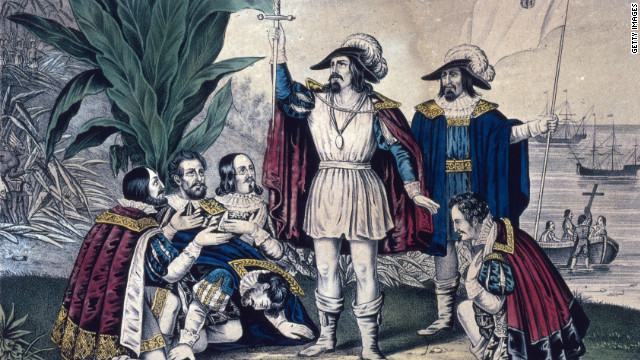
Today is Columbus Day in the United States. While I do not recommend actually doing this, the following would be a historically-accurate way to observe this day.

  1. Break into the house where a family of your neighbors live.
  2. Announce to this family that you live there now.
  3. Kick the entire family outside, into the cold.
  4. If you notice them shivering, make them feel better by sharing your religious beliefs with them.
  5. If #4 does not work, use swords to put your former neighbors out of their misery.
  6. If step #5 seems a bit too excessive, use this option instead, based on the actions of those who followed Columbus:  “help” your shivering former neighbors keep warm . . . by throwing some smallpox-infested blankets to them.

Obviously, regarding Christopher Columbus:  I’m not a fan. I therefore call upon the United States Congress to remove Columbus Day from our list of official national holidays.

[Image credit:  see http://www.cnn.com/2014/10/10/opinion/perry-columbus-day-what-to-tell-your-kid/ — this is where I found the image above.]

Daylight Saving Time: The One (and Only) Way the Rest of America Should Be More Like Arizona

Entering_Arizona_on_I-10_Westbound

I’m not used to saying that the rest of America should be more like Arizona . . . but my passionate hatred of Daylight Saving Time forces me to agree with them, when the clock-changes remind me of this fact, twice each year.

Five Mandalas

15

151032

mandala1

mandala30

wheelof40

Yoko Ono Explains How to Change the World

yoko-ono

A Sheryl Crow Quote: “Write About What’s Going On”

sheryl-crow-20051117-84892

I couldn’t have phrased that any better, myself, so I didn’t try to.

The Five Fictional Characters Who Have Most Strongly Influenced My Life

These five fictional characters have strongly influenced me, and I will always be grateful to the brilliant people who created them. I am presenting them in chronological order — using the time when this influence started, rather than their date of creation.

#1: Snoopy

Snoopy2

When I was very young — before my memory-record begins, actually — I was given Peanuts books. They were simply left in my possession, as far as I know; no explanation was necessary. The antics of Snoopy, in particular, were extremely entertaining to the little-kid version of me. Since I could see Snoopy dancing around, playing baseball, typing, irritating Lucy, etc., I wanted to understand what was actually going on with all this activity — and this provided the necessary motivation for me to teach myself how to read. There wasn’t any other way for me to tell what was going on in these comic strips!

The fact that I learned to read in this manner led to some very funny moments, due to the fact that the number of words whose meaning I understood, generally from context, exceeded the number of words I knew how to pronounce — and, no doubt, still does. Once, in elementary school, I was laughed at by an entire class, after saying something about the “Eeffel Tower” (yes, that’s how I pronounced it). I also remember pronouncing the “b” in “doubt,” much to the amusement of my parents. Even in graduate school, I made a history professor groan in agony when I made a reference to the Weimar Republic — and pronounced the “W” as it is pronounced in English, rather than German.

#2: Mr. Spock

Spock

A scientist aboard a starship, exploring the galaxy, who uses logic to try to understand two things:  the nature of the universe (much of which he understood), and the behavior of illogical humans (something which confuses me to this day, just as it often confounded him). The first person I remember seeing on television had pointed ears, and there were several of them in that episode, “Amok Time.” In other episodes, of course, few Vulcans other than Mr. Spock appeared, and I always found him, to use one of his favorite words, “fascinating.” He influenced me in several ways, and still does, to this day. I am grateful to the creators of this character for inspiring my passion for science, ability to use logic, appreciation of diversity, and strong desire to maintain control of my emotions.

#3: Matt Murdock / Daredevil

daredevil

I may not have red hair, but I share many other characteristics with Daredevil — and I mean the character from comic books, not that disappointing B-movie (which deserves no further mention). Other than amplified senses — which I experience (unpleasantly) when I get migraines — Daredevil has no superpowers, yet he faces, and does battle with, super-powered villains, and usually wins. He is also a study in contradictions: a lapsed Catholic, who spends a lot of time dressed in a devil costume; a lawyer, with a second “career” as a costumed vigilante; and a blind man, who nonetheless perceives the world around him more clearly than anyone else. Matt Murdock has inspired me to respect the concept of justice, has influenced me to study what laws I need to understand, and, most importantly, has shown me, by example, how to face down those who would do harm to those I care about — and do it, as Daredevil does, without fear. I have also developed my “never give up” attitude, toward my adversaries (bullies, mostly), with inspiration from this character.

Matt Murdock and I have also had very rocky histories when it comes to romantic relationships. I have (finally) found happiness in this aspect of life, and am writing this next to my beloved, sleeping wife. Unfortunately, the writers of Daredevil, while they will let Matt Murdock enjoy temporary happiness in relationships with women, will never allow him to keep it.

#4: Data

Data2366

Data is amazing to me:  a sentient android, and an artificial person. He actually had to go on trial to assert his rights to personhood, and, with the aid of Captain Picard, won the case. He has a lightning-speed calculator, built right in to his positronic brain, which far exceeds the abilities of my own, not-too-shabby mental calculator. I have long had the ambition to gain the ability to reprogram my own brain’s “software,” and have written, on this blog, about how I finally gained that ability, after working on developing it for roughly thirty years. Data, of course, had this ability from the moment he was activated, but, unlike me, he does not have to sleep for it to work.

Despite his claim to experience no emotions, Data often expressed a feeling of being perpetually alone, for there was no one else like him anywhere — until he met his brother, another android, who turned out to be malicious. That feeling of being unlike everyone else is quite familiar to me.

Both Data, and Mr. Spock, display many characteristics of Asperger’s Syndrome, and my study of these two characters helped me figure out that I am, myself, an “Aspie” — our nickname for ourselves.

#5: Calvin

Calvin_by_Watterson

When I am playing (and, yes, I play a lot, especially with mathematics), and someone asks me why I, an adult, am playing, I have a standard reply: “Because I’m six.” This is a reference to Calvin, who was six years old during the entire ten-year run of Calvin and Hobbes, the best comic strip ever created. I read it from the first day it appeared in newspapers, and have the boxed set of the complete collection of these comic strips only a meter away, as I write this. Calvin is a six-year old prodigy, as one can tell from his expansive vocabulary, but is prone to making social errors, due to a lack of understanding of social conventions — and both of these things mirror my own life. (I grew up, literally, in science laboratories, unsupervised for hours at a time, designing and conducting my own experiments, and that sort of thing simply doesn’t happen without having profound effects on a child’s development — but, then again, why would I want to be normal?) Calvin, like myself, found elementary school boring in the extreme, and so he slipped, frequently, into his own inner life of fantasy. The fact that, being socially isolated (no siblings, and no friends, other than his stuffed tiger), he is usually alone, never stopped Calvin from having fun. Just like Calvin, I can have unlimited fun, in solitude — because I choose to be this way. Some adults lose the child within them, but, thanks to Calvin’s inspiration, that will never happen to me. I’m actually 46 years old now — so I’m pretty sure that, if I was ever going to lose the ability to have fun, it would have happened already.

To those brilliant people who invented these five characters: thank you.

On Divorce and Remarriage

divorce and remarriage

Rampant Islamophobia At “The Gun Cave” — an Indoor Firing Range in Hot Springs, Arkansas, With an Owner Who Wants Her Range to Be A “Muslim Free Zone”

ani-hello

When I heard there was a indoor firing range in Hot Springs, Arkansas, only an hour away from me, and that this establishment doesn’t want Muslims there, I looked up their phone number, 1-501-767-9944, and called them. Before accusing them of Islamophobia, and threatening to urge others to boycott the place, I wanted to know if they had changed their policy to something more, well, sane.

The woman I spoke to corrected me, by telling me that her establishment was not banning Muslims, but simply making it known, on the Internet, that Muslims are not welcome there. She asked me, rather than reading all the stuff on the Internet written against her position, to read her statement at http://janmorganmedia.com/2014/09/business-muslim-free-zone/ — and I agreed to do so. Why not read her statement first? I saw no reason not to.

When I read it, I found one of the most shockingly ignorant pieces of writing on the subject of Islam which I have ever encountered. Just for starters, she uses the word “Islamist” in place of the word “Muslim,” an error I have never seen before, even though I have read plenty of disgusting anti-Islamic material. The two words don’t even have definitions which are close to each other!

Here’s a particularly appalling excerpt from the site:  “I view Islam as a theocracy, not a religion. Islam is the union of political, legal, and religious ideologies. In other words, law, religion and state are forged together to form what Muslims refer to as ‘The Nation of Islam.'” (Clearly, even though she claims to have read the Qur’an in its entirety, she has not heard of such things as the long, bloody Iran-Iraq War, fought between two majority-Muslim nations, only one of which — Iran — is, or was then, a theocracy.)

In actuality, many real Muslims (and well-educated non-Muslims, also) know that the Nation of Islam (or NOI, as I call it, for clarity) is a small, non-Islamic religion founded in Detroit, Michigan in 1930 — and that there is absolutely no connection, other than a similarity in the name, between the religion called Islam, which originated in the Middle East, and the very different religion practiced by the NOI. You can find the original religion called Islam (the real one) described right here — https://en.wikipedia.org/wiki/Islam — on Wikipedia, which is an objective source, precisely because anyone can edit it. If, on the other hand, you look at Wikipedia’s corresponding article on the Nation of Islam — at https://en.wikipedia.org/wiki/Nation_of_Islam — you’ll see that Islam, and the NOI, have nothing in common except for a proper noun appropriated, without justification, from a centuries-old religion. The beliefs and practices of Islam, and the NOI, are no more alike than those of, say, Christians and Hindus.

I won’t try to catalog the numerous other mistakes in the post on her website, simply because they are so plentiful, but I do encourage you to look at this appalling website for yourself — just as the woman I spoke to on the phone asked me to do. If nothing else, the numerous writing errors (for example, “Muslims” should always be capitalized, and the writer really needs to use spell-check) should convince you that this place is a hotbed of ignorance.

This place deserves to be boycotted, permanently. They also deserve to go out of business, as all bigots should. They deserve to be “called out” for their ignorance, also, and that’s exactly what I am doing in this blog-post.

Let the boycott begin! Also, please call these people, and tell them what you think of their incredibly misinformed position. Their phone number, again, is 1-501-767-9944. Places like this are not helping the world become what it needs to be — a world where Christians, Muslims, those of other faiths, and the non-religious can coexist peacefully.

[Image credit:  I found the “empty head” image above, online, at http://school.discoveryeducation.com/clipart/images/ani-hello.gif — and believe it to be legal to repost this image. If I am mistaken, however, I will remove it, or pay reasonable royalties, at the request of the image’s owner.]

A Polyhedral Journey, Beginning with a Near-Miss Johnson Solid Featuring Enneagons

When Norman Johnson first found, and named, all the Johnson solids in the latter 1960s, he came across a number of “near-misses” — polyhedra which are almost Johnson solids. If you aren’t familiar with the Johnson solids, you can find a definition of them here. The “near-miss” which is most well-known features regular enneagons (nine-sided polygons):

ennneagonal-faced near-miss

This is the dual of the above polyhedron:

ennneagonal-faced near-miss dual

As with all polyhedra and their duals, a compound can be made of these two polyhedra, and here it is:

ennneagonal-faced near-miss base=dual compound

Finding this polyhedron interesting, I proceeded to use Stella 4d (polyhedron-manipulation software, available at http://www.software3d.com/Stella.php) to make its convex hull.

Convex hull of near-miss base-dual compound

Here, then, is the dual of this convex hull:

dual of Convex hull of near-miss base-dual compound

Stella 4d has a “try to make faces regular” function, and I next used it on the polyhedron immediately above. If this function cannot work, though — because making the faces regular is mathematically impossible — one sometimes gets completely unexpected, and interesting, results. Such was the case here.

attempt no make latest polyhedron have regular faces

Next, I found the dual of this latest polyhedron.

attempt no make latest polyhedron have regular faces's dual

The above polyhedron’s “wrinkled” appearance completely surprised me. The next thing I did to change it, once more, was to create this wrinkled polyhedron’s convex hull. A convex hull of a non-convex polyhedron is simply the smallest convex polyhedron which can contain the non-convex polyhedron, and this process often has interesting results.

Convex hull of wrinkled dual

Next, I created this latest polyhedron’s dual:

dual of Convex hull of wrinkled dual

I then attempted “try to make faces regular” again, and, once more, had unexpected and interesting results:

dual of latest polyhedron

The next step was to take the convex hull of this latest polyhedron. In the result, below, all of the faces are kites — two sets of twenty-four each.

convex hull of last polyhedron with two sets of two dozen kites each

I next stellated this kite-faced polyhedron 33 times, looking for an interesting result, and found this:

33rd stellation of latest polyhedron

This looked like a compound to me, so I told Stella 4d to color it as a compound, if possible, and, sure enough, it worked.

33rd stellation of latest polyhedron colored as a compound

The components of this compound looked like triakis tetrahedra to me. The triakis tetrahedron, shown below, is the dual of the truncated tetrahedron. However, I checked the angle measurement of a face, and the components of the above compound-dual are only close, but not quite, to being the same as the true triakis tetrahedron, which is shown below.

Triakistetra -- ANGLES AREN'T QUITE A MATCH for last polyhedron

This seemed like a logical place to end my latest journey through the world of polyhedra, so I did.