
This polyhedron has sixteen faces: four equilateral triangles, and a dozen kites. It was created using Stella 4d, which may be found at http://www.software3d.com/Stella.php.
This polyhedron has sixteen faces: four equilateral triangles, and a dozen kites. It was created using Stella 4d, which may be found at http://www.software3d.com/Stella.php.

Software used: Stella 4d, available here.

First, here is where to find Part I of this post. In it, I explained the reasons for my view that my phobias are among the uncommon ones, while I actually like many things (such as mathematics, darkness, and spiders) which are feared by those with more common phobias. I find such self-analysis, and reflective writing, helpful. This is unusual, of course, but those with Asperger’s Syndrome tend to be unusual in many ways, and this includes being different from each other.
For Part II, I used Google, and searched for “100 most common phobias.” My goal was to determine the extent to which my current and past phobias are atypical, when compared to the incidence of various phobias within the general population. The top search result was http://www.fearof.net/, where 100 common phobias are listed, in descending order of world-wide incidence. These 100 phobias were then split into the seven categories, ranging from phobias about things I like a lot, to things about which I am phobic myself, as seen below.
Category 1: I have a strong affinity (a philia) for these things which people commonly fear, and I have never feared them myself. There are 17 phobias in this category, including four of the ten most common phobias.
Category 2: I like these things people commonly fear, but not with high enough intensity for the word “philia” to apply. There are 23 phobias in this category, including three more of the top ten.
Category 3: I used to fear these commonly-feared things, although not to the level of a phobia, but now I no longer fear them at all. This category has a mere six phobias.
Category 4: I am indifferent to these commonly-feared things, or have a like/dislike balance. In other words, for these things. . . meh. This is the largest category, which I view as healthy. It contains 25 phobias.
Category 5: I currently have an aversion to these commonly-feared things, but my aversion, in this category, does not reach the level of a phobia, and never has. This category contains only nine phobias, and none are in the top 32.
Category 6: I used to be phobic regarding these things, and still don’t like them. However, I can manage, now, to keep my aversion below the intensity of a phobia. This is also the category that has involved the most work, for it is difficult to shed a phobia. This category has three of the top ten, and 14 total — but these are former phobias, not current ones.
Category 7: I am phobic, now (or very recently), about these things, and still actively try to avoid them, when I can. There are only six left in this category, and, with professional help, I am working on eliminating them, as well. Nothing left in this category is ranked in the top 35, which is consistent with my idea that my remaining phobias are among the less common ones.
Further evidence that my phobias are rare was discussed in Part I. I may actually have some which are unique to me, such as my dread of the 16th of each month, which has plagued me since my mother’s death, last November 16th. Since fear of the number thirteen is called triskaidekaphobia, fear of the number sixteen is hexakaidekaphobia. This is what July looked like, to me, as I approached the 16th.

Yesterday was the 16th of July, and that is when I wrote Part I of this post, which is no coincidence. The 16th is now over. By focusing on improving my mental health, and using therapeutic writing (which I am also doing right now), I made it through yesterday without falling apart, although it was not easy. Sixteen is a rational number, and it is time for me to resume being rational about it.
This makes me hopeful that hexakaidekaphobia will now stay in the past, where it belongs. No one need suggest that I get medical help, including seeing a mental health professional, for the appointments to do exactly those things, before school resumes, are already scheduled.

On numerous occasions, I have repeated this experiment, in keeping with the scientific method. I have obtained the same null result as Carlin obtained, each and every time.


The image above contains three colors: white, black, and red. The words appear in red because I see it as a color denoting positive or negative intensity, and phobias and philias are both certainly intense. To “see red,” I have learned, does not usually mean what it would mean if I said it myself. Consistent with Asperger’s Syndrome, which I have, I tend to be almost completely literal in the words I use, while the non-Aspie majority often uses words in confusing (to me) non-literal ways. Over the years, I have figured out that this phrase means, when non-Aspies say it, that they are extremely angry. (I, however, would only say “I see red” if I was actually seeing light with the wavelength-range, ~620 to ~740 nm, which our species has labeled, in English, as “red.”) On the other hand, red roses and Valentine’s Day hearts are popularly used to symbolize romantic love, which is an intensely positive emotion, while extreme anger is extremely negative. White and black, the other colors above, in much of the world, are commonly associated with, respectively, positive and negative things. I, on the other hand, view these colors the opposite way: I have avoided sunlight for much of my life, and continue to do so (to the point where I need to take supplements of vitamin D), while also reveling in darkness, in much the same way that I revel in my “Aspieness.” Right now, it is daytime here, and I am writing this inside, in a dark room, with the only artificial light reaching me coming from computer screens.
It is a common misconception that Aspies (an informal term many people with Asperger’s use for ourselves) are non-emotional. After all, two well-known fictional characters from different incarnations of Star Trek, Spock and Data, are based, in my opinion, on Aspie stereotypes. Stereotypes, I have observed, are usually based on some real phenomenon, and in this case, that phenomenon is that many Aspies experience emotions in radically different ways from the non-Aspie majority — so differently that we are sometimes perceived by non-Aspies to be emotionless, although that is not the case. This causes a considerable amount of tension, and no small amount of outright hostility, between the community of Aspies and the non-Aspie majority. When I write on the subject of Asperger’s Syndrome, I try to do so with the goal of explaining and understanding our differences, in order to reduce Aspie/non-Aspie misunderstanding, which is both common and unhelpful — in both directions. This is the reason I use the factual, non-hostile term “non-Aspie,” in place of the unhelpful and perjorative term “neurotypical” (a word in common use within the Aspie community), one of three unfortunate words discussed in this post.
Explaining my choices of colors in the image above was a prelude to a personal, mathematical analysis of the inverted popularity of my own phobias and philias. I have long observed that I have an intense, inexplicable affinity (in many cases, reaching the level of a “philia,” an often-misunderstood word and suffix, for reasons I will discuss below) for things which the majority, in my part of the world (the American South) hates and/or fears. Examples include spiders, cats, the number thirteen (and all other prime numbers), mathematics in general, geometry in particular (strangely, even many people who like mathematics still dislike the subfield of geometry), being different from those around me, darkness, the color black, night, the physical sciences, evolution (which happens, like it or not), enclosed spaces, heights, flying on airplanes, women, and Muslims. I have also struggled with phobias, working (with professional help) on eliminating them, one by one, but they tend to be less common. Examples of targets for my current and past phobias include light, especially sunlight, to the point where I actually have to take vitamin D supplements; as well as voice calls on cell phones (human voices coming out of small boxes freak me out); death; the life sciences; insurance; sports (and related events, such as pep rallies); loud noises; efforts to control me; and, since my mother died, last November 16, the 16th day of any month, especially at, and after, six months after her death.
I’m a teacher, and it’s the 16th of July, and I simply do not have the option of falling apart on the 16th of every month when school starts again next month, at a new school, with new students, for, as the saying goes, the students will arrive — whether I’m ready or not. That’s no way to start a school year.
I have much to be optimistic about, for I will be teaching in a different building, but on a much-improved schedule, with far fewer different subjects to prepare for each day than I had last year. When I fell asleep last night, after completing four full days of training to teach Pre-AP Physical Science for the first time, starting next month, some part of me knew that mental health improvement — before the 16th hit again, today — was essential. Was that something about which I was consciously thinking? No. I apparently rewrote my mental software (again) last night, an ability I have worked on developing for over thirty-five years. When this brain-software-debugging process first became evident, a few years back, it was happening in my sleep, just as happened again last night, and it took some time for me to figure out exactly what was going on, and how my ability to rapidly adapt to change had improved.
In Part II of this post, I will analyze, mathematically, the inverted popularity of my phobias, compared to the most common phobias, ranked by incidence among the population. First, however, it is necessary for me to explain what I mean — and do not mean — by the word “philia.” There is a serious problem with this word, in English, when it appears as a suffix, and that is due to an unfortunate linguistic error: the incorrect application of a Greek idea, and word, to the horrific, disgusting, and criminal behavior of child molesters, as well as those who have sex with corpses. The ancient Greeks, as is well-known, used four different words for different kinds of love, and “philia” (φιλία) referred specifically to fraternal, or “brotherly,” love. This was not a word the ancient Greeks used for any type of sexual act. The words “pedophilia” and “necrophilia” are, for this reason, historical anomalies. Both terms are misnomers, meaning, simply, that they are messed-up words, and their existence creates the potential for misunderstanding. A philia, properly understood, is simply the opposite of a phobia. Phobias are better-understood, of course, and require no detailed explanation.
One example of what I mean by my own philias should suffice. I have, for many years, had an abnormally strong fascination with spiders. I like them — a lot — so much so, in fact, that I actually have a tattoo of a spider, and often wear a spider necklace, to express how much I like this one biological order, the largest within the class of arachnids. Despite my strong affinity for spiders, however, I have zero sexual interest in them. It is accurate to call me an arachnophiliac, which is the opposite of an arachnophobe.
It is now near 9 pm on Saturday, November 16, and Friday night’s sleep therapy gave me the energy to work on the needed improvements to my mental health during the day today, by using reflective writing as a therapeutic technique. I also have a new appreciation for sleep, which will come soon. Part II will be posted soon, but it will not be written until after I have enjoyed a full night of sleep — starting, hopefully, in a few minutes. Goodnight, and thank you for reading Part I.
[Update, July 17: Part II is now posted here.]

Whether one is a Christian, or not, we should all be able to agree that the Bible is an important book, and that greater understanding of it will benefit anyone who lives on this planet. There are, after all, well over a billion people, alive today, living in families which try to use the Bible as a guidebook for life. (As an aside: is it also true that anyone on earth can benefit from improving their understanding of the Qur’an? Of course it is — and for exactly the same reason.)
Before today, I had never encountered a website which serves that purpose — greater understanding of this important book we call the Bible — with the purity of Bible Hub. I found it by accident, while discussing, with my wife, the original languages in which the Bible was written: Hebrew for the Old Testament, and, in the New Testament, an ancient form of Greek — plus one important sentence (depicted as the last pre-death-and-resurrection words spoken by Jesus) in Aramaic. The New Testament was not written for an audience which understood Aramaic, so the books of the Bible which include this sentence (Matthew and Mark), as originally written (as far as we can tell), follow the Aramaic words of this sentence with a translation into the same form of Greek (Koine, or the ancient Greek of the common people, as opposed to the ruling class) in which the rest of the New Testament is written. The influence of Greek culture (which could have spread along with the Greek language) could only have affected the New Testament, not the Old Testament, for historical reasons. The two of us were discussing the possibility that the absence, then presence, of a Greek influence might help explain why the Old and New Testaments are so radically different from each other. For quite some time, though, I became sidetracked by my inability to remember the last words of Jesus on the cross, in Aramaic, and I decided to investigate that topic more closely.
I do not read Greek, so I have read the words in this important New Testament sentence (“My God, My God, why have you forsaken me?”) only in English translations of the Bible. I simply used Google to do a search for this sentence — and that’s how I found Bible Hub.
On the two pages at this website related to the verses I was researching, the first thing I found was an amazing variety of English translations of each verse, clearly labeled, including many translations of which I was previously unaware. Navigating to other languages is easy, at the upper right. Below the numerous English translations, there is commentary, but it is clearly labeled as such, so that no one will confuse the commentary with the various translations of the verses in question. If one wants to read sermons related to a given verse, there is an easy-to-find link provided for that purpose, but it is easier, of course, to not click on a hyperlink than it is to click on it.
My favorite feature of this website, by far, is that I was able to get the information I wanted quickly, without anything at all telling me how to interpret what I read. At Bible Hub, the default format is to let readers interpret the various parts of the Bible for themselves. For that reason, in addition to other features described above, I give this website an A+ grade.

In this polyhedron, half the faces are the two dozen light-blue kites, and the other half are isosceles triangles. I made it using Stella 4d, software you can buy, or try for free, at this website.
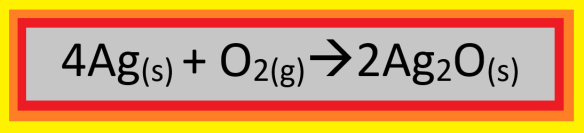
Because of the price of silver being literally on fire, they will not be buying and selling troy ounces of metallic silver when the markets open in New York tomorrow morning. Instead, they will be selling “oxide ounces” of silver oxide, in sealed-plastic capsules of this black powder, with an oxide ounce of silver oxide being defined as that amount of silver oxide which contains one troy ounce of silver.

A troy ounce of silver is 31.1 grams of that element, which has a molar mass of 107.868 g/mole. Therefore, a troy ounce of silver contains (31.1 g)(1 mol/107.868 g) = 0.288 moles of silver. An oxide ounce of silver oxide would also contain oxygen, of course, and the formula on the front side of a silver oxide capsule (shown above; information on the back of the capsule gives the number of oxide ounces, which can vary from one capsule to another) is all that is needed to know that the number of moles of oxygen atoms (not molecules) is half the number of moles of silver, or (0.288 mol)/2 = 0.144 moles of oxygen atoms. Oxygen’s non-molecular molar mass is 15.9994 g, so this is (0.144 mol)(15.9994 g/mol) = 2.30 g of oxygen. Add that to the 31.1 g of silver in an oxide ounce of silver oxide, and you have 31.1 g + 2.30 g = 33.4 grams of silver oxide in an oxide ounce of that compound.
In practice, however, silver oxide (a black powder) is much less human-friendly than metallic silver bars, coins, or rounds. As you can easily verify for yourself using Google, silver oxide powder can, and has, caused health problems in humans, especially when inhaled. This is the reason for encapsulation in plastic, and the plastic, for health reasons, must be far more substantial than a mere plastic bag. For encapsulated silver oxide, the new industry standard will be to use exactly 6.6 g of hard plastic per oxide ounce of silver oxide, and this standard will be maintained when they begin manufacturing bars, rounds, and coins of silver oxide powder enclosed in hard plastic. This has created a new unit of measure — the “encapsulated ounce” — which is the total mass of one oxide ounce of silver oxide, plus the hard plastic surrounding it on all sides, for a total of 33.4 g + 6.6 g = 40.0 grams, which will certainly be a convenient number to use, compared to its predecessor-units.
# # #
[This is not from The Onion. We promise. It is, rather, a production of the Committee to Give Up on Getting People to Ever Understand the Meaning of the Word “Literally,” or CGUGPEUMWL, which is fun to try to pronounce.]

Source: Soon to be a Major Motion Picture, p. 214.
 RobertLovesPi.net