Unknown's avatar

About RobertLovesPi

I go by RobertLovesPi on-line, and am interested in many things, a large portion of which are geometrical. Welcome to my own little slice of the Internet. The viewpoints and opinions expressed on this website are my own. They should not be confused with those of my employer, nor any other organization, nor institution, of any kind.

How I Hit My Personal Mathematical Wall: Integral Calculus

Hitting the wall

To the best of my recollection, this is the first time I have written publicly on the subject of calculus. The fundamental reason for this, explained in detail below, is something I rarely experience: embarrassment.

Unless this is the first time you’ve read my blog, you already know I like mathematics. If you’re a regular follower, you know that I take this to certain extremes. My current conjecture is that my original motivation to learn how to speak, read, and write, before beginning formal schooling, was that I had a toddler-headful of mathematical ideas, no way to express them (yet), and learned to use English in order to change that. Once I could understand what others were saying, read what others had written, write things down, and speak in sentences, I noticed quickly that interaction with other people made it possible to bounce mathematical ideas around, using language — which helped me to develop and expand those mathematical ideas more quickly. Once I started talking about math, as anyone who knows me well can verify, I never learned how to shut up on the subject for longer than ten waking hours at a time.

A huge part of the appeal of mathematics was that I didn’t have to memorize anything to do it, or learn it. To me, it was simply one obvious concept at a time, with one exposure needed to “get it,” and remember it as an understood concept, rather than a memorized fact. (Those math teachers of mine who required lots of practice, over stuff I already knew, did not find me easy to deal with, for I hated being forced to do that unnecessary-for-me chore, and wasn’t shy about voicing that dislike to anyone and everyone within hearing range, regardless of the situation or setting. The worst of this, K-12, was long division, especially the third year in a row that efforts were made to “teach” me this procedure I had already learned, on one specific day, outside school, years earlier.) It might seem like I have memorized certain things, such as, say, the quadratic formula, but I never actually tried to — this formula just “stuck” in my mind, from doing lots of physics problems, of different types, which required it. Similarly, I learned the molar masses of many commonly-encountered elements by repeatedly using them to show students how to solve problems in chemistry, but at no time did I make a deliberate attempt to memorize any of them. If I don’t try to memorize something, but it ends up in memory anyway, that doesn’t count towards my extremely-low “I hate memorizing things” threshhold.

When I first studied calculus, this changed. Through repeated, forced exposure in A.P. Calculus class my senior year of high school, with a teacher I didn’t care for, I still learned a few things that stuck: how to find the derivative of a polynomial, the fact that a derivative gives you the slope a function, and the fact that its inverse function, integration, yields the area under the curve of a function. After I entered college, I then landed in Calculus I my freshman year. Unbeknownst to me, I was approaching a mental wall.

My college Cal I class met early in the morning, covered material I had already learned in high school, and was taught by an incomprehensible, but brilliant, Russian who was still learning English. Foreign languages were uninteresting to me then (due to the large amount of memorization required to learn them), and I very quickly devised a coping strategy for this. It involved attending class as infrequently as possible, but still earning the points needed for an “A,” by asking classmates when quizzes or tests had been announced, and only waking up for class on those mornings, to go collect the points needed for the grade I wanted.

This was in 1985-86, before attendance policies became common for college classes, and so this worked: I got my “A” for Cal I. “That was easy,” I thought, when I got my final grade, “so, on to the next class!”

I did a lot of stupid things my freshman year of college, as is typical for college freshmen around the world, ever since the invention of college. One of these stupid things was attempting to use the same approach to Calculus II, from another professor. About 60% of the way through that course, I found myself in a situation I was not used to: I realized I was failing the class.

Not wanting an “F,” I started to attend class, realizing I needed to do this in order to pass Cal II, which focuses on integral calculus. A test was coming up. In class, the professor handed out a sheet of integration formulas, and told us to memorize them.

Memorize them.

I read the sheet of integration formulas, hoping to find patterns that would let me learn them my way, rather than using brute-force memorization-by-drill. Since I had been skipping class, I saw no such patterns. All of a sudden, I realized I was in a new situation, for me: mathematics suddenly was not fun anymore. My “figure it out on the fly” method, which is based on understanding, rather than memorization, had stopped working.

A few weeks and a failed test later, I began to doubt I would pass, and tried to drop the class. This is how I learned of the existence of drop dates for college classes, but I learned it too late: I was already past the drop date.

I did not want an F, especially in a math class. Out of other options, I started drilling and memorizing, hated every minute of it, but did manage to bring my grade up — to the only “D” I have on any college transcript. Disgusted by this experience, I ended up dropping out of college, dropped back in later, dropped out again, re-dropped back in at a different university, and ended up changing my major to history, before finally completing my B.A. in “only” seven years. I didn’t take another math class until after attempting to do student teaching, post-graduation . . . in social studies, with my primary way of explaining anything being to reduce it to an equation, since equations make sense. This did not go well, so, while working on an M.A. (also in history) at a third college, I took lots of science and math classes, on the side, to add additional teaching-certification areas in subjects where using equations to explain things is far more appropriate, and effective. This required taking more classes full of stuff I already knew, such as College Algebra and Trigonometry, so I took them by correspondence (to avoid having to endure lectures over things I already knew), back in the days when this required the use of lots of postage stamps — but no memorization. To this day, I would rather pay for a hundred postage stamps than deliberately memorize something.

In case you’re wondering how a teacher can function like this, I will explain. Take, for example, the issue of knowing students’ names. Is this important? Yes! For teaching high school students, learning the names of every student is absolutely essential, as was quite evident from student teaching. However, I do this important task by learning something else about each student — how they prefer to learn, for example, or something they intensely like, or dislike — at which point memorization of the student’s name becomes automatic for me. It’s only conscious, deliberate memorization-by-drill that bothers me, not “auto-memorization,” also known as actually understanding something, or, in the case of any student, learning something about someone.

I don’t know exactly why my to-this-point “wall” in mathematics appeared before me at this point, but at least I know I am in good company. Archimedes knew nothing of integral calculus, nor did his contemporaries, for it took roughly two millennia longer before Isaac Newton and Gottfried Leibniz discovered this branch of mathematics, independently, at roughly the same time.

However, now, in my 21st year as a teacher, I have now hit another wall, and it’s in physics, another subject I find fascinating. Until I learn more calculus, I now realize I can’t learn much more physics . . . and I want to learn more physics, for the simple reason that it is the only way to understand the way the universe works, at a fundamental level — and, like all people, I am trapped in the universe for my entire life, so, naturally I want to understand it, to the extent that I can. (A mystery to me: why isn’t this true for everyone else? We’re all trapped here!) Therefore, I now have a new motivation to learn calculus. However, I want to do this with as much real understanding as possible, and as little deliberate memorization as possible, and that will require a different approach than my failed pre-20th-birthday attempt to learn calculus.

I think I need exactly one thing, to help me over this decades-old wall: a book I can read to help me teach myself calculus, but not a typical textbook. The typical mathematics textbook takes a drill-and-practice approach, and what I need is a book that, instead, will show me exactly how various calculus skills apply to physics, or, failing that, to geometry, my favorite branch of mathematics, by far. If any reader of this post knows of such a book, please leave its title and author in a comment. I’ll then buy the book, and take it from there.

One thing I do not know is the extent to which all of this is related to Asperger’s Syndrome, for I was in my 40s when I discovered I am an “Aspie,” and it is a subject I am still studying, along with the rest of the autism spectrum. One thing Aspies have in common is a strong tendency to develop what we, and those who study us, call “special interests,” such as my obsession with polyhedra, evident all over this blog. What Aspies do not share is the identity of these special interests. Poll a hundred random Aspies, and only a minority will have a strong interest in mathematics — the others have special interests in completely different fields. One thing we have in common, though, is that the way we think (and learn) is extremely different from the ways non-Aspies think and learn. The world’s Aspie-population is currently growing at a phenomenal rate, for reasons which have, so far, eluded explanation. The fact that this is a recent development explains why it remains, so far, an unsolved mystery. One of things which is known, however, is the fact that our status as a rapidly-growing population is making it more important, by the day, for these differences to be studied, and better understood, as quickly as the speed of research will allow, in at least two fields: medicine, and education.

Only one thing has fundamentally changed about me, regarding calculus, in nearly 30 years: I now want to get to the other side of this wall, which I now realize I created for myself, when I was much younger. I am also optimistic I will succeed, for nothing helps anyone learn anything more than actually wanting to learn it, no matter who the learner is, or what they are learning. In this one respect, I now realize, I am no different than anyone else, Aspie or non-Aspie. We are all, after all, human beings.

A Lesson Involving the Social Use of Color

colors

RobertLovesPi’s social-interaction lesson of the day: different colors of fabric can actually mean something else, besides simply reflecting different wavelengths of light, and these meanings can shift quickly. (I already knew this could happen once per day, but was only just taught that this is also possible for n = 2, allowing me to extrapolate that, for the general case, n > -1, presumably with an upper limit set by the individual’s speed at changing clothes.)

As far as I can tell, n = 0 on weekends and legal holidays, in most cases, and n = 1 on most workdays (but not today, when the needed reflection-wavelength shifts from ~475 nm to ~550 nm after I leave the city of Sherwood, Arkansas, bound for a spot approximately 20 km South of there, in Little Rock, which is still in the same county).

Apparently my key to understanding this stuff is finding a way to analyze it mathematically. Also, posting such “new” discoveries to my blog increases the odds of me remembering them. However, unlike my last such finding (it involved chocolate chips not being a sandwich topping at Subway), I did NOT figure these things out “all by myself.” In fact, without help from two very important people, I doubt I ever would have figured them out at all!

An Ethical Dilemma Involving a Polyhedral Crystal

I just ordered a crystal rhombcuboctahedron on eBay because I like its geometrical properties, despite the mystical claims in the item listing. I did so with the full knowledge and expectation that these claims are almost certainly false, because, well, they’re mystical claims.

Rhombicubocta

Here’s my ethical dilemma: would it be ethical to lab-test those claims, then post the results in the feedback I leave?

[Image created using Stella 4d, available at http://www.software3d.com/Stella.php. This isn’t a picture of the crystal on eBay; it is made of quartz, and not rainbow-colored. It is of the same shape, however.]

Geometry Problem Involving Two Circles (See Comments for Solution)

This is a puzzle I made up not long ago. After trying to solve it for a bit (no success yet, but I haven’t given up), I decided to share the fun.

A small circle of radius r is centered on a large circle of radius R. It is a given that 0 < r < R. In terms of r and R, what fraction of the smaller circle’s circumference lies outside the larger circle?

two circles

I am 90% certain there is an extremely simple way to do this, using only things I already know. It’s frustrating that the answer isn’t simply leaping out of the computer screen, at me. For simple math problems, that’s what usually happens . . . so either this is merely deceptively simple, or I am missing something.

Two Views of the Truncated Tesseract

19 truncated tesseract orthogonal projection

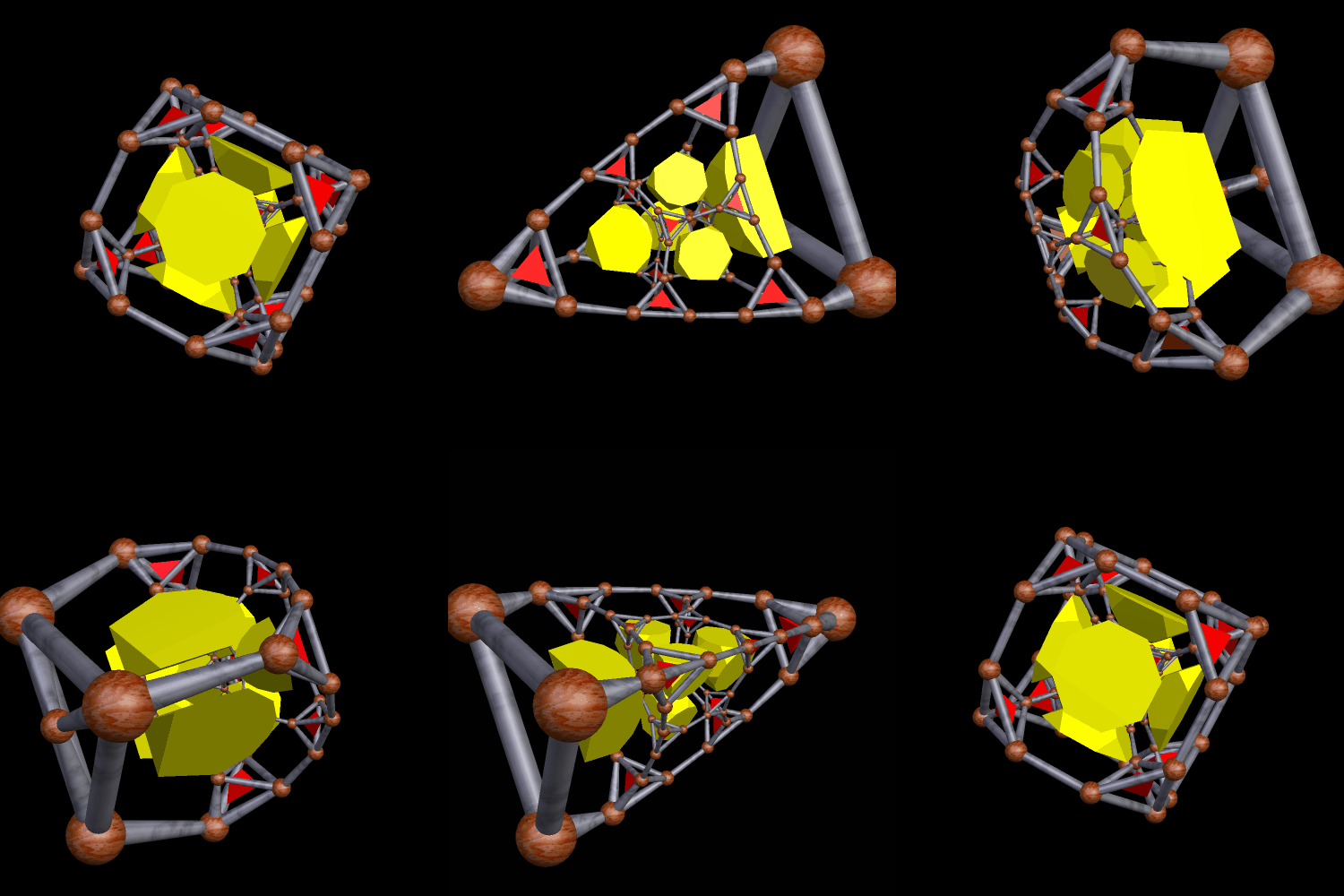
The figure above, rotating in hyperspace, is an orthogonal projection of a four-dimensional polychoron known as the truncated tesseract. It is analogous to the truncated cube, one of the Archimedean solids. The image below is of the same figure, but is shown as a perspective projection.

19-Tat perspective projection

Both images were created using Stella 4d, software you can buy (with a free trial download available, first) at http://www.software3d.com/Stella.php. It’s great software, and a friend of mine wrote it — but no, he doesn’t pay me to give his program free advertising, as some have wondered.

On Deciphering Informal Medical Language, from an “Aspie” Point of View

Confusion

Confusion

A major challenge for many Aspies (an informal name many of those with Asperger’s use for ourselves) is communication with the larger, non-Aspie population. Frustration and anger are common reactions to this challenge — sometimes from both sides. The reasons for this are known: these two parts of the population use language quite differently. Aspies tend to use and interpret language in absolute, literal terms, to a point that seems odd to most. Non-Aspies, by contrast, are often more flexible with use of language, and are (somehow) able to convey ideas between themselves using words which mean the exact opposite of their literal meaning. (Several examples will follow.) This difference is all that is required to explain why Aspies and non-Aspies often have trouble communicating with each other.

Just as with most people, Aspies are quite different from each other, but we also have some traits in common. For example, an intense urge to study and analyze some esoteric subject, which few others care about, is common — but the identity of that subject, or subjects, varies widely from one Aspie to another. My special interests all involve puzzles; I enjoy trying to figure out mathematical, scientific, and linguistic problems, in particular. Another Aspie might share none of those interests, but might be able to rattle off, say, hundreds of sports statistics, as easily as I can list the names of dozens of polyhedra. The existence of these “special interests,” as they are known, is (nearly?) universal among Aspies, but the topic of these special interests is not. For example, fewer than 1% of the Aspie population shares my obsession with polyhedra — a fact I know because the world’s most-focused “polyhedra people” are so uncommon that we have established many lines of communication between each other, enabling the formation of a rough estimate of this population. My estimate is ~300 people, worldwide. Even if I am off by a factor of ten, that simply isn’t nearly as many people as 1/10th of 1% of the world’s rapidly-growing Aspie population.

In my experience, medical terminology, in particular, has provided large numbers of baffling puzzles over the years. When talking to medically-trained professionals, I always let them know I am a teacher of science and mathematics. This lets them know that they need not hold back with medical jargon, which has a large overlap with scientific and mathematical jargon. I can understand it fairly well, and, when an unfamiliar term is used, I simply ask for a definition. When I need to, I take notes. If medical instructions are not clear, precise, literal, and detailed, people can die as a result. For this reason, such instructions generally are written in a precise, literal form of English which is a beter match for “Aspiespeak” than what we typically hear from non-Aspies.

On the other hand, when I speak to non-Aspies about medical subjects, I often get quite confused, and I suspect this happens with many other Aspies, as well. Examples follow.

“Nerve pills” — As someone who takes prescribed medication for the relief of anxiety (which is the way a doctor or pharmacist would likely phrase it), I have occasionally been asked if I might benefit from taking a “nerve pill.” Before remembering the translation of this term, I always think, and sometimes say, something along these lines: “I’m already nervous. Why would I take a pill to make me more nervous?” It’s the implied, omitted parts of the phrase, of course, that contribute to my confusion. As it is, this practice makes me wonder why we don’t call deodorant “oderant” instead, a term coined by Jerry Seinfeld, since that would make equally little sense, but would at least be consistent.

The related phrase “pain pills” elicits a similar response from me. Due to a fall over twenty years ago, I already hurt, and, sometimes, I need something that relieves pain — but I never need anything to cause more pain! Fortunately, the people I actually see for such medication, when it is needed, are physicians and pharmacists, and they use literal, precise terms for such medication. They also know the risks of such medication, and conversations with such people are important for anyone needing such medication, for obvious reasons: such medications should only be used in ways consistent with advice from doctors and pharmacists. Patients cannot obtain such advice without having honest conversations with these knowledgeable professionals.

The most confusing informal medical term like this which I hear, though, is the term “crazy pills.” I don’t hide the fact that I obtain professional help for mental health issues, and explained my reasons for this openness here. Most of those who do seek treatment for mental health problems, though, are not Aspies, and so it is quite common to hear such treatment, in the form of medication, referred to by this confusing term, which I must admit I intensely dislike. For one thing, the word “crazy” is not one to use lightly, due to the fact that it has been used, historically, to stigmatize those who need help maintaining or restoring mental health. For another, the literal meaning of “crazy pills” is the exact opposite of its in-use meaning.

The term I use to replace “crazy pills,” in my own speech, is “sanity pills.” Sanity is, after all, my preferred state, and that is the reason the psychiatry-related category on this blog is named “Mental Health,” not “Mental Illness.” Reminders that mental health is the goal are helpful; the opposite focus is not.

Puzzles like this (figuring out non-literal terms used by non-Aspies) are not my favorite kind; in fact, I don’t enjoy them at all, for little or no logic is involved, and any pattern which might help me learn these things more easily has, so far, eluded me. Non-Aspies seem to just intuitively “know” what such phrases mean, as if they got a memo which was deliberately withheld from Aspies — and that is, for me (and many of us), both baffling, and irritating. Can I understand these things? Yes, with difficulty — I have to figure them out, step by step, each time, due to the fact that they do not make logical, literal sense, and thus do not come naturally to me. In fact, studying calculus was easier than understanding these common phrases which nearly everyone else just seems to somehow “know,” as if the knowledge was sent to them telepathically, but deliberately withheld from me, for reasons unknown.

For a fictional depiction of Aspie/non-Aspie confusion, this clip from Star Trek: The Next Generation, while not medically-oriented, does illustrate this commuication-problem in a humorous fashion. When the character of Data was created, some “Aspie” characteristics were deliberately included, just as they were for Mr. Spock, his predecessor. Some Aspies have criticized the Star Trek franchise for these practices, but I, personally, think they have been helpful, in that they use humor to try to bridge the currently-existing comprehension-gap. This gap is not helpful, so anything that narrows it is something I like.

Is the Moon a Magnet for Ignorance?

is the moon

Google’s search-suggestions for “is the moon,” shown above, clearly indicate support for the “magnet for ignorance” conjecture.

My favorite one from this list: “is the moon real”? I’ve looked into this, and there are apparently quite a few people utterly convinced that the Moon is a hologram, created by NASA, for reasons I have not been able to discern.

A Proven Method for Getting Teenagers to Read

read

Although I am a teacher, I am not an English teacher — but I also believe that, as a teacher of anything, I have an ethical and professional responsibility to promote literacy.

Many such methods for doing so exist. This is the one I use. The authors I have gotten teens reading most often, with this method, are Richard Feynman, Robert Heinlein, Neil deGrasse Tyson, Jung Chang, Flannery O’Connor, and Stephen Hawking. If a teenager in a science class, a subject I do teach, completes his work from me, with a high level of accuracy, and in an unusually short time, I keep books by these authors on hand as my set of “emergency back-up teachers.” Turning bored students into engaged and interested students is, I am learning, the key to avoiding teacher-burnout — at least for me.

Next on my list to add to the books I use for this ongoing project: multiple copies of The Autobiography of Malcolm X. I haven’t read it since I was in high school myself, and its impact still lingers.

Why I Do Not Write Books

not writing

It’s very simple: errors in writing, of any kind, horrify me. If I wrote a book, and it were published, some would likely slip through, such as the one in the image above. If a book with my name on the cover had been published, and I then discovered an error, I would end up trying to get corrected copies to every buyer of the first edition, eating all profits, and then some. I also just don’t need that type of stress.

Please do not misunderstand: I love books.

Therefore, I do two other things, in lieu of actually writing a book (which has been suggested, to me, more than once). First, I read other peoples’ books. I seek higher-quality books to avoid those irritating typos, for they actually cause me pain when I see them. Even so, some slip through — ouch! — but at least the mistakes aren’t mine. I am almost immune to conventional causes of embarrassment, but this isn’t a conventional cause, and I certainly have no immunity to it.

The other thing I do is to blog, which is, of course, another form of writing. It’s a perfect forum for someone with this writing-quirk — because, when I discover a mistake in my writing, even months or years later, I can edit it away in seconds. This is why, for me, blogging > writing books. However, I am grateful that there are good writers for whom the inequality symbol points in the other direction.

On the Problem of Evangelical Atheism

evangelical atheism

The term “evangelical atheism” may seem like a contradiction, but, hopefully, the image above clarifies what it means. It’s the zealous pushing of others to abandon religious beliefs, and it isn’t helpful to anyone.

John Lennon never, to my knowledge, publicly proclaimed a personal religious belief, but he didn’t apply the word “atheist” to himself, either; others did that. The same thing has happened repeatedly to Neil deGrasse Tyson, as he explains further, below. In both cases, these are people who are fiercely independent in their thinking, and not afraid to offend others — but that doesn’t mean they want to be associated with evangelical atheists, whose hostility to religion, and religious people, makes the world a more dangerous place. The more logical goal is a peaceful world, and that means one where the faithful and the skeptical can coexist peacefully.

For this to happen, work is needed on both sides, by the people on each side. The reasonable and moderate religious millions have religious extremists to (try to) calm down, each in their own groups, and they’ve got their hands full with that. It falls to non-religious people to deal with the extremists on the other side — the type who go beyond Richard Dawkins, Sam Harris, and the late Christopher Hitchens, all three of whom conceded, in books of theirs which I have read, that they would change their minds on the subject of the existence of a deity, shown adequate empirical evidence for the existence of one. This was a consequence of the fact that all three men have written things based on rational thought. (They’ve also let their emotions get in the way sometimes, and become overly angry, but I’m referring to their better works, especially that of Harris.)

Evangelical atheists don’t write books. They can’t calm down long enough for that. Instead, they are more likely to speak out through angry and insulting videos they post on YouTube, harassment of believers (or agnostics, or those who simply don’t want to be labeled by others) on Facebook, and, of course, old-fashioned, face-to-face bullying.

I prefer the term “skeptic” for myself, as I have explained here before, for I like that balance struck by that term: insistence on evidence, balanced by openness to new evidence, even if it contradicts previous views (about anything). I also don’t want to associate myself with the evangelical atheists, which is the primary reason I abandoned use of the word “atheist” for myself, some time ago.

This made a few evangelical atheists angry, some to the point of losing all ability to reason (predictably), to the point of open warfare on my Facebook. To stop this, I literally deactivated that account for several days, that being the easiest option to shut that down quickly.

As for Neil deGrasse Tyson and John Lennon, I will let them speak for themselves.

Religious people aren’t going away any time soon. Neither are the non-religious. If we’re going to enjoy “living life in peace,” the hatred and hostility both need to go, from both sides of the “divide of belief” . . . and that isn’t too much to ask.