Bible Hub: A Website Review

http://biblehub.com/

bible hub

Whether one is a Christian, or not, we should all be able to agree that the Bible is an important book, and that greater understanding of it will benefit anyone who lives on this planet. There are, after all, well over a billion people, alive today, living in families which try to use the Bible as a guidebook for life. (As an aside: is it also true that anyone on earth can benefit from improving their understanding of the Qur’an? Of course it is — and for exactly the same reason.)

Before today, I had never encountered a website which serves that purpose — greater understanding of this important book we call the Bible — with the purity of Bible Hub. I found it by accident, while discussing, with my wife, the original languages in which the Bible was written: Hebrew for the Old Testament, and, in the New Testament, an ancient form of Greek — plus one important sentence (depicted as the last pre-death-and-resurrection words spoken by Jesus) in Aramaic. The New Testament was not written for an audience which understood Aramaic, so the books of the Bible which include this sentence (Matthew and Mark), as originally written (as far as we can tell), follow the Aramaic words of this sentence with a translation into the same form of Greek (Koine, or the ancient Greek of the common people, as opposed to the ruling class) in which the rest of the New Testament is written. The influence of Greek culture (which could have spread along with the Greek language) could only have affected the New Testament, not the Old Testament, for historical reasons. The two of us were discussing the possibility that the absence, then presence, of a Greek influence might help explain why the Old and New Testaments are so radically different from each other. For quite some time, though, I became sidetracked by my inability to remember the last words of Jesus on the cross, in Aramaic, and I decided to investigate that topic more closely.

I do not read Greek, so I have read the words in this important New Testament sentence (“My God, My God, why have you forsaken me?”) only in English translations of the Bible. I simply used Google to do a search for this sentence — and that’s how I found Bible Hub.

On the two pages at this website related to the verses I was researching, the first thing I found was an amazing variety of English translations of each verse, clearly labeled, including many translations of which I was previously unaware. Navigating to other languages is easy, at the upper right. Below the numerous English translations, there is commentary, but it is clearly labeled as such, so that no one will confuse the commentary with the various translations of the verses in question. If one wants to read sermons related to a given verse, there is an easy-to-find link provided for that purpose, but it is easier, of course, to not click on a hyperlink than it is to click on it.

My favorite feature of this website, by far, is that I was able to get the information I wanted quickly, without anything at all telling me how to interpret what I read. At Bible Hub, the default format is to let readers interpret the various parts of the Bible for themselves. For that reason, in addition to other features described above, I give this website an A+ grade.
Have you noticed what silver’s been doing lately? The price of silver is literally on fire!

silver is literally on fire

Because of the price of silver being literally on fire, they will not be buying and selling troy ounces of metallic silver when the markets open in New York tomorrow morning. Instead, they will be selling “oxide ounces” of silver oxide, in sealed-plastic capsules of this black powder, with an oxide ounce of silver oxide being defined as that amount of silver oxide which contains one troy ounce of silver.

silver oxide capsule

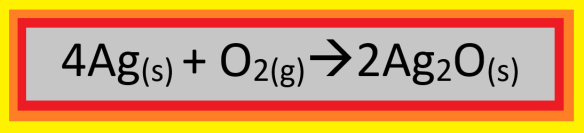
A troy ounce of silver is 31.1 grams of that element, which has a molar mass of 107.868 g/mole. Therefore, a troy ounce of silver contains (31.1 g)(1 mol/107.868 g) = 0.288 moles of silver. An oxide ounce of silver oxide would also contain oxygen, of course, and the formula on the front side of a silver oxide capsule (shown above; information on the back of the capsule gives the number of oxide ounces, which can vary from one capsule to another) is all that is needed to know that the number of moles of oxygen atoms (not molecules) is half the number of moles of silver, or (0.288 mol)/2 = 0.144 moles of oxygen atoms. Oxygen’s non-molecular molar mass is 15.9994 g, so this is (0.144 mol)(15.9994 g/mol) = 2.30 g of oxygen. Add that to the 31.1 g of silver in an oxide ounce of silver oxide, and you have 31.1 g + 2.30 g = 33.4 grams of silver oxide in an oxide ounce of that compound.

In practice, however, silver oxide (a black powder) is much less human-friendly than metallic silver bars, coins, or rounds. As you can easily verify for yourself using Google, silver oxide powder can, and has, caused health problems in humans, especially when inhaled. This is the reason for encapsulation in plastic, and the plastic, for health reasons, must be far more substantial than a mere plastic bag. For encapsulated silver oxide, the new industry standard will be to use exactly 6.6 g of hard plastic per oxide ounce of silver oxide, and this standard will be maintained when they begin manufacturing bars, rounds, and coins of silver oxide powder enclosed in hard plastic. This has created a new unit of measure — the “encapsulated ounce” — which is the total mass of one oxide ounce of silver oxide, plus the hard plastic surrounding it on all sides, for a total of 33.4 g + 6.6 g = 40.0 grams, which will certainly be a convenient number to use, compared to its predecessor-units.  

# # #

[This is not from The Onion. We promise. It is, rather, a production of the Committee to Give Up on Getting People to Ever Understand the Meaning of the Word “Literally,” or CGUGPEUMWL, which is fun to try to pronounce.]


An Abbie Hoffman Quote, for Independence Day

hoffman2

Source: Soon to be a Major Motion Picture, p. 214.

Election 2016: Not Enough Clothespins

no

Many Americans are experiencing the same dilemma right now — we’re trying to decide whether to vote against Donald Trump for president (by casting a vote “for” Hillary Clinton), or vote against Hillary Clinton (by casting a vote “for” Trump). Voters who actually want to vote for either of the major-party candidates are much rarer, this time, than is typically the case, as recent news stories have documented.

I’ve said for months that I would vote against Trump (again — for I already voted against him once, by voting in my state’s G.O.P. primary election). As November gets closer, though, I am finding the idea of voting against Trump in November, by holding my nose, and casting a vote for Clinton, to be a progressively less palatable idea. I like to have both hands free when I vote, you see, so I’d need to use a clothespin, for my nose, to actually do this. The problem is, of course, that I’m far from alone with my opinions about this election — and I’m not sure exactly how many clothespins we have in the USA. There might actually not be enough for all the “against” votes people intend to cast.

In the face of this potentially-devastating, nationwide clothespin shortage, I finally decided to do something else: look for someone I can actually vote for, in good conscience, without fear of being horribly embarrassed by my vote within days of our new president taking the oath of office.

I didn’t find one such person. I actually found two. (Image source: here.)

sick of the Trump and Clinton show

I’m not a Libertarian, nor am I a member of the Green Party. Having examined both of these candidates, though, I find that I agree with each of them on many things, and disagree with them on a smaller number of issues. The major thing they have in common is also their major political “selling point” in this election — not being Trump, nor Clinton.

Once I make a decision between Gary Johnson and Jill Stein, I will have accomplished two things which are important to me: (1) finding someone to actually vote for, rather than casting a 100% “against” vote, and (2) finding a way to vote against the two major-party candidates — both of them — at the same time.

While comments on this post are welcome, please don’t simply point out to me that either Hillary Clinton or Donald Trump will almost certainly win the election in November. This is something I already know, and it does not affect my decision. Either of them could win in November . . . but neither of them will get any help from me to do so.

“What’s Your Favorite Color?”

It’s a mystery to me why this happens, but the parallels between different conversations which start with this question are simply amazing. First, I don’t get asked this question unless talking to a teenager . . . and then, nearly every time this happens, the rest of the conversation follows the same pattern.

First, I answer the question honestly, with a single word, by simply naming my favorite color.

black

After telling this one-word, five-letter truth, I then get a response which has become utterly predictable: “Black’s not a color!”

Even stranger: such inquisitions only seem to come from teenagers who are dressed in such a way as to let the following response work: “What color is your t-shirt?”

Sometimes they even look down at that point, presumably to check, which lets them see the answer to my question for themselves:

black

After that one question from me, for some reason, they tend not to say much more. 

JMS, On Our Eagerness to Shout

Image

eagerness to shout

I figured it out.

My New Math Project: Calculus

calculus

Now that I’ve let the whole world know this, I have to follow through on my plan. It is difficult to embarrass me, unless I deliberately set up a situation that uses embarrassment on a global scale, as a self-motivational tool, and that’s what I am doing right now. I fully intend to learn calculus in June, and this will help.

I already have books, and a plan of attack. I am not working for pay in June, nor taking any classes, so that gives me the time, and you can’t beat a tuition-price of zero.

The key was moving calculus from my mental “incomprehensible” Venn diagram bubble to my “I can do this” Venn diagram bubble. I never should have created that “incomprehensible” bubble in the first place, but it took a lot of time (30 years or so) to figure that out.

~~~

Update, 14June2016: I have decided to turn this from a project for the current month into an ongoing project . . . for the rest of my life. 

On Peace (Thanks, Mom)

peace

I am posting this to make one fact obvious: I want my blog to be a place where believers (of various types), and non-believers, can interact peacefully. There is a need for such places. This is one of the things my mother taught me.

Asperger’s Syndrome and “Emotional Vision”

ties-articleLarge

The source of the term “emotional vision” is the same as the source of the image above: this New York Times article. This blog-post is my response, so I recommend reading the NYT article before you continue.

The story was written by, and about, a man on the autistic spectrum, and, if you’re on the autistic spectrum and get published in that newspaper, you’re high-functioning. High-fuctioning autism (HFA) and Asperger’s syndrome were “merged” in the United States in 2013, shortly before I started figuring out that I am, myself, an Aspie. By the time I discussed the idea with my doctor, it was too late to get an “official” diagnosis. (Yes, that does mean no diagnosis for me, but that’s simply the way things happened, and I’m fine with that.)

Many in the Asperger’s community have a form of emotional blindness — an inability to “read” the emotions of others — and that described me accurately until, well, this week, when I awakened my own emotions, and also gained the ability to understand emotions of some other people. Which people? Only the ones I know well, generally by having contact with them for at least a year. Shortening this time is high on my mental “to-do” list.

In the article linked above, the author voluntarily had his emotional light-switch “turned on” in an experimental treatment designed by other people. That, I believe, is the key difference between his case and mine, for I made the decision to turn mine on myself, wrote the “mental software” behind it myself, and am testing it at every opportunity, in accordance with the way I think. This ability to reprogram my own brain’s software isn’t magic, nor a super-human ability power, but simply a project I have been working on, for, well, over thirty years.

The author of the article above has many regrets about accepting the experimental medical treatment he had to turn his emotions “on.” This treatment involved letting doctors mess around with his brain. My own doctor knows me well, and therefore does not try to force any sort of treatment on me, for he knows that my biggest compulsion involves an intense need to be free from control by other people. Not all Aspies have compulsions, but some of us do, and I am one of them.

Something most Aspies do have are “special interests,” as they are called, but they vary widely. My special interest is mathematics. I learned to speak, read, and write so that I could express my own mathematical ideas. My parents provided me with books about mathematics, one they realized the intensity of my need, driven by curiosity, to absorb mathematical ideas which were new, at the time, to me. I have never stopped wanting more.

My interest in science came later, but not much later, due to that same curiosity. Once I learned how linked the physical sciences and mathematics are, this was inevitable. The more mathematical a given subject was, the faster I could learn it. Without mathematics involved, however, learning was a chore, and deciphering the mysteries of human behavior has been, for this reason, very difficult. Why did people do such bizarre and confusing things? For a long time, I had no idea, and wasn’t willing to do the hard work of figuring it out, either. I puzzled other people, and they puzzled me right back. I made little progress, on this front, for many years.

Why did understanding anything about emotions come so much later in life, for me? That’s an easy question to answer: emotions are more complicated than anything else I have learned, in the sense that emotions are extremely difficult to understand, or express, mathematically. To do this in a way that would work well, I had to rewrite my “software” myself, and that took a lot of hard work, time, and thought. This is entirely unlike the case of the man who told his story in the New York Times, who was thrown into an emotional nightmare by an experimental treatment he willingly received, but did not design. He has my sympathy, and I hope his life gets better in the future.