Names for Black Cats and Kittens

Once our new kitten came home today, I asked my Facebook-friends for suggestions for a name. That particular, very simple status message (“Name suggestions for a black kitten, please?”) now has well over fifty comments. In alphabetical order, here are most of the names which have been mentioned, so far, in that lengthy conversation. The kitten, by the way, is male.

  • Akiko
  • Aleister
  • Bear
  • Bluebird
  • Box
  • Cantabell
  • Chunk
  • Cinder
  • Coco
  • Darwin
  • Dark Chocolate Thunder
  • Demon
  • Dingus
  • Doom Kitty
  • Eisenhower
  • Eris
  • Feline X
  • Felix
  • Flip
  • Friday
  • Graphite
  • Grimm
  • Helga
  • Helicopter
  • Illidan Stormrage the Betrayer
  • Inkspot
  • Jesus (I’m unclear on which pronunciation of that name was being suggested)
  • Jinks
  • Jitter
  • Jynx
  • Licorice
  • Lint
  • Loudmouth
  • Lucky
  • Madalyn
  • Maleficent
  • Marley
  • Maurice
  • Michael
  • Midnight
  • Mischief
  • Moonbeam
  • Mudflap
  • Noir
  • Obama (to which I replied that, if I ever named a cat after a president, I’d go with “Thomas Jefferson”)
  • Obsidian
  • Ol’ Scratch
  • Olive
  • Oliver
  • Onyx
  • Peter
  • Puss
  • Pusschief
  • Satan
  • Shade
  • Shadow
  • Smudge
  • Snowflake
  • Spectre
  • Squirt
  • Sratch (Scratch?)
  • Sthylvether
  • Sumi
  • Thumb
  • Tyson
  • Waldo

We went with “Jynx,” with “Jynxy” as a nickname. Considering what happened, just a little later (see the post right before this one), that name turned out to be quite appropriate.

The Misadventures of Jynx the Kitten, Chapter One

We have a new kitten, and his name is Jynx. He’s between four and five months old, and has short black fur.

As the adults of the house were enjoying a nice, peaceful, Saturday afternoon nap, we were suddenly awakened by multiple crashes, along with the sound of glass breaking, from the nearby bathroom. According to eyewitness reports, my reaction was to jump straight up into the air, hair standing on end, yelling a long, colorful string of profanity, which I shall not post here. It’s difficult for me to remember what I do, or say, immediately upon waking, and I don’t want to misquote myself, you see.

As it turns out, Jynx had been running back and forth along the counter in the bathroom, trying to get to the “other kitten” in the mirror, and knocking just about everything off the counter in the process. Our evidence: horizontally-smeared, feline nose-prints, at kitten-height, on the mirror — plus a big mess, all over the bathroom floor. Jynx, having scared himself silly, is now hiding under the bed, and I’ve thrown away all the tiny glass-shards I could find.

Blog-posts here usually come with pictures, and I tried to obtain one . . . but Jynx isn’t ready to come out from under the bed yet. My camera doesn’t have a flash, and it’s pretty obvious what a “no-flash” picture of a black kitten, hiding under a bed, would look like, is it not?

Public Schools in the United States Should Rename the “Free Lunch”

tanstaafl

If you live in the USA, you are probably familiar with the phrase “free lunch,” or “free and reduced lunch,” as used in a public-school context. For those outside the USA, though, an explanation of what that phrase means, in practice, may be helpful, before I explain why a different name for such lunches should be used.

The term “free and reduced lunch” originated with a federal program which pays for school lunches, as well as breakfasts, with money collected from taxpayers — for students whose families might otherwise be unable afford these meals. The program’s eligibility requirements take into account both family income and size. There’s a problem with it, though:  the inaccuracy of the wording used, especially the troublesome word “free.” The acronym above, “TANSTAAFL,” is familiar to millions, from the works of Robert A. Heinlein (science fiction author), Milton Friedman (Nobel-Prize-winning economist), and others. It stands for the informally-worded phrase, “There ain’t no such thing as a free lunch,” which gets to the heart of the problem with the terminology we use when discussing school lunches. (Incidentally, I have seen an economics textbook use the phrase “TINSTAAFL,” in its place, to change “ain’t no” to “is no.” I do not use this version, though, for I am unwilling to correct the grammar of a Nobel laureate.)

The principle that “free lunches” simply do not exist is an important concept in both physics and economics, as well as other fields. In physics, we usually call it the Law of Conservation of Mass and Energy, or the First Law of Thermodynamics. This physical law has numerous applications, and has been key to many important discoveries. Learning to understand it, deeply, is an essential step in the education of anyone learning physics. Those who teach the subject, as I have in many past years, have an even more difficult task:  helping students reach the point where they can independently apply the TANSTAAFL principle to numerous different situations, in order to solve problems, and conduct investigations in the laboratory. It is a fundamental statement of how the universe works:  one cannot get something for nothing.

TANSTAAFL applies equally well in economics, where it is related to such things as the fact that everything has a cost, and those costs, while they can be shifted, cannot be made to simply disappear. It is also related to the principle that intervention by governments in the economy always carries costs. For example, Congress could, hypothetically, raise the federal minimum wage to $10 per hour — but the cost of doing so would be increased unemployment, especially for those who now have low-paying jobs. Another possible cost of a minimum-wake hike this large would be a sudden spike in the rate of inflation, which would be harmful to almost everyone.

To understand what people have discovered about the fundamental nature of physical reality, physics must be studied. To understand what is known about social reality in the modern world, economics must be studied. Both subjects are important, and understanding the TANSTAAFL principle is vital in both fields. Unfortunately, gaining that understanding has been made more difficult, for those educated in the United States, simply because of repeated and early exposure to the term “free lunch,” from childhood through high school graduation. How can we effectively teach high school and college students that there are no free lunches, when they have already been told, incessantly, for many years, that such things do exist? The answer is that, in many cases, we actually can’t — until we have first helped our students unlearn this previously-learned falsehood, for it stands in the way of the understanding they need. It isn’t a sound educational practice to do anything which makes it necessary for our students to unlearn untrue statements.

I am not advocating abolition, nor even reduction, of this federal program, which provides essential assistance for many families who need the help. Because I am an American taxpayer, in fact, I directly participate in funding this program, and do not object to doing so. I do take issue, however, with this program teaching students, especially young, impressionable children in elementary school, something which is untrue.

We need to correct this, and the solution is simple:  call these school lunches what they actually are. They aren’t free, for we, the taxpayers, pay for them. Nothing is free. We should immediately replace the phrase “free and reduced lunch” with the phrase “taxpayer-subsidized lunch.” The second phrase is accurate. It tells the truth, but the first phrase does the opposite. No valid reason exists to try to hide this truth.

On “Digging to China”

hole

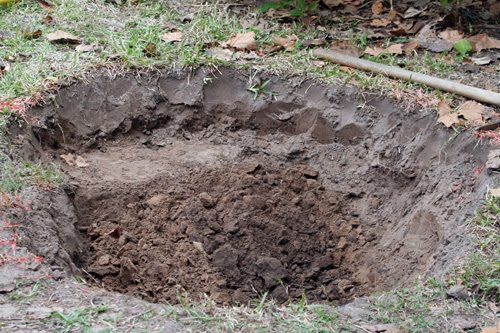
When I was a little kid, my sister and I dug a big hole, in our front yard, and simply called it “the digging-hole.” It looked a lot like the hole shown above, except for the fact that, during daylight hours, our digging-hole usually included two small, dirt-covered, determined children, armed with plastic shovels. We tried, for years, to dig that hole as deep as possible. My personal goal, of course, was the Earth’s molten core, not India, and certainly not China.

Why do Americans so often talk about digging a hole straight down to China, anyway? Even if the Earth were solid all the way through its interior, digging straight down, from almost anywhere in the contiguous 48 states of the USA, would not put you in China, nor even India (which is, at least, closer to being correct than is China), but at the bottom of the Southern Indian Ocean. Salty water would suddenly rush into your newly-dug tunnel, killing you instantly, as soon as you got close to enough to the other side for the extreme water-pressure there to finish your digging project for you. The only exceptions to this watery doom would be coming out of the tunnel on one of the islands in that ocean, which would require great precision to hit deliberately.

Also, the fact that China and the USA are both Northern-hemisphere nations easily rules China out as the hypothetical “solid-earth” destination for Americans who dig straight down, and all the way through. If you could go through the center of the earth from North of the equator, you’d have to end up South of the equator. Isn’t that obvious? Don’t people look at globes?

A Quote from Voltaire, on Absurdities and Atrocities

Voltaire-lisant

Examples abound. Here are two:

Absurdity #1:  Pure human races exist.

A resulting atrocity:  the Holocaust (~20 million people, including ~6 million Jews, killed by the Nazis in the 1930s and 1940s).

Absurdity #2:  Acts which are both suicidal and homicidal can be wonderful things, and can earn a person an eternal reward in paradise after death.

A resulting atrocity:  the destruction of the World Trade Center, and attacks on other targets, on September 11, 2001, which killed over three thousand people, including the hijackers themselves.

Please note that this list is far from complete. A complete list would fill several very large books. Beware of absurdities in your thinking, for they can actually be fatal.

A Graph of Infections and Deaths During the First Four Months of the 2014 Ebola Outbreak

Ebola

Source of data for this graph:  http://www.abc.net.au/news/2014-07-31/ebola-timeline-deadliest-outbreak/5639060.

The date I used as “day zero,” March 25, 2014, is the day when the Ministry of Health in Guinea announced an outbreak of ebola was in progress, according to this source: https://en.wikipedia.org/wiki/Ebola_2014. It started earlier, of course, but was not widely known before that date. The last data points shown are for July 27, 2014, the most recent date for which I have the needed information.

The Unintentional Bomb: A True Story

picric acid

Nineteen years ago, I began my teaching career at a small, private Arkansas high school. One of the classes I taught was Chemistry, and my principal happened to be a former chemistry teacher, himself.  We were both new to the school, and knew that there was a high turnover rate there for teachers in that field. They’d had perhaps eight teachers for that class in the previous five years. I stayed there six years, teaching chemistry every year.

The new principal saw the need for upgraded laboratory facilities, and we got them, including a new, larger chemical stockroom. The old stockroom was a nightmare, and the chemicals needed to be transferred to their new home. This was a massive undertaking, for many of my predecessors had ordered chemicals, not taking the time to inventory the stockroom to see if the school already had what they needed. Even worse, the chemicals were stored in approximate alphabetical order.

Experienced chemists and chemistry teachers know how scary the phrase “alphabetical order” is, in this context. For reasons of safety, chemicals need to be stored by families, using a shelving pattern that keeps incompatible chemicals far apart. I was not an experienced teacher of anything at this point, but the principal showed me the classification scheme he’d used before, himself. It’s the one recommended by Flinn Scientific, and you can see it at http://www.flinnsci.com/store/Scripts/prodView.asp?idproduct=16069. At his direction, over a couple of weeks, I took the chemicals from the old storage area to the new one, de-alphabetizing them into a much safer arrangement, onto category-labelled shelves. In the process, of course, I saw every laboratory chemical that school had, recognizing many (jar after jar of liquid mercury, for example) as highly dangerous, and making certain proper precautions were taken with such substances. If I didn’t recognize a chemical well enough to categorize it (sulfates together, halides together, etc.), I looked it up, in order to find its place. I wouldn’t even open a container with an unfamiliar chemical in it, until researching it. As it turned out, my caution with unfamiliar chemicals literally saved my life.

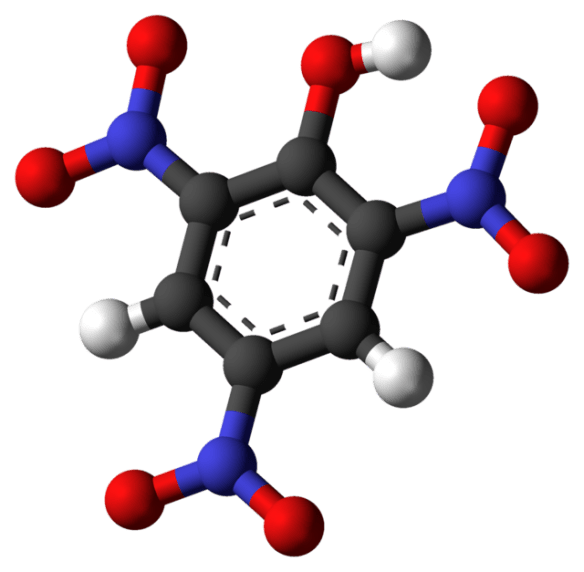
There are hundreds of different acids, and I doubt anyone knows them all. When I encountered a hand-labeled jar reading “picric acid,” I had never heard of that chemical, the structure for which is shown above. When I looked it up, I learned picric acid is safe if it is all in solution with water, but is a shock-sensitive explosive in solid form. I examined the liquid carefully, without actually touching the container. Sure enough, solid crystals had already started to form, over the years, as some of the water in the container slowly evaporated, and escaped.

Great, I thought, sarcastically — a shock-sensitive explosive. I then kept reading the hazard alerts, and noticed that they stated that picric acid should never be stored in any container with a metallic lid, because that invites the formation of explosive metal picrates which can be detonated simply by the friction caused by an attempt to open the lid. The picric acid I was dealing with, of course, not only had the dangerous solid crystals — it also had a metal lid, and a partially corroded one at that.

I never so much as touched that lid. Very carefully, I gently carried this container to the new stockroom, gave it a shelf all by itself, and didn’t so much as give it a nasty look, for the rest of the time I taught there. Leaving it alone, with me being the only person with access to that room, was the safest thing I could think of to do, as long as I was teaching there. For six school years, since it was carefully undisturbed, the picric acid behaved itself — and then, seeking a higher salary, I found a job for the following Fall, teaching at a public school. I knew I would not be able to leave this private school, though, without dealing with this picric acid problem once and for all, along with other dangerous chemicals the school did not need. I could have simply turned my keys in, and left, but that would have risked a potentially-fatal explosion in that school in future years, for I could not safely assume the next chemistry teacher would be familiar with, nor research, picric acid. My conscience would not permit that.

The school year being over, I went to see the school’s new principal. Unlike his predecessor, the new principal had never taught chemistry, but he’d been on the faculty, before his promotion, for longer than I had been there, and so we knew each other well. When I went into his office, with my keys, for end-of-the-year checkout, and calmly told him that there were many serious toxins and an unexploded bomb down the hall, he knew immediately that I wasn’t joking. With his permission, I kept my keys into the beginning of the Summer, getting things ready for professional chemical-disposal experts to come in and remove the dangerous materials. Before long, four cardboard boxes had been filled with dangerous chemicals the school did not need, slated for disposal — and that’s after I had already disposed of most things that needed to go, if I had the knowledge, and means, to dispose of them properly.

The first group of professionals who were called in, for help, were from the local fire department. They took some of the chemicals away, without charge, but only the ones that they knew how to deal with safely. The principal and I were informed that, for the remaining chemicals (down to one box now, in which was the picric acid), a professional “hazmat” team would need to be called in, and it wouldn’t be cheap.

It wasn’t. The bill from the hazmat team exceeded US$2000. They took away three or four kilograms of mercury, as well as a lot of other nasty stuff, but also told us, with apologies, that they weren’t taking the picric acid, it being too dangerous for a “mere” professional hazmat team. To get rid of that, we were told, we’d need to call in the bomb squad from the state’s capital city, Little Rock.

I had heard the phrase “bomb squad” in movies, and on TV, but not in real life. Judging from the look on his face, the same can be said for the principal. As it happened, I wasn’t in town on the day the bomb squad came to school, but I did hear numerous first-hand accounts of what transpired, when I came back the following day to turn in my keys.

One of many surprises reported to me by these witnesses is that the FBI arrived with the bomb squad, asking questions and interviewing people. Apparently there wasn’t supposed to be any picric acid in Arkansas schools, for a statewide sweep had been made to gather it all up, and dispose of it, in the 1970s. My guess, and that’s all it is, is that this very old bottle had been overlooked because of it being in a private, rather than a public, school. If the FBI wants to contact me now to ask me questions about this stuff, I’ll answer them, but, at the time, I didn’t mind a bit that I missed out on the interrogation-portion of these events. After the FBI had finished their on-site investigation, the bomb squad began their work.

This K-12 school has a very large campus, with multiple buildings, and my classroom was at one corner of it. The disposal site they chose — the nearest area sufficiently remote from people and buildings — was far behind the gymnasium, at least half a kilometer away, at the opposite corner of the campus. As it was described to me, two bomb squad guys put on what I call “moon suits,” wrapped the picric acid bottle up, with a lot of padding, and placed this padded bundle on a stretcher.  They then walked the stretcher, with its deadly cargo, around and between buildings, across railroad tracks and a street, around the gymnasium, and back into an empty lot, where a deep hole was dug. One of the guys in moon suits then put the picric acid container at the bottom of the hole, along with a stick of dynamite, the idea being to use the smaller dynamite explosion to trigger the much larger explosion of the picric acid.

The bomb-squad “astronaut” lit the long fuse on the dynamite, and scrambled out of the hole as quickly as his moon suit would permit. The fuse burned, right up to the dynamite — and then, just as everyone expected a deafening explosion, it fizzled out. They had unknowingly used a stick of dynamite with a defective fuse.

After waiting a while, just to give the dynamite time to, well, change its “mind” about exploding (which didn’t happen), the suited-up bomb squad guy was sent back into the hole, with a second stick of dynamite, which he placed next to the first one. I hope he got paid extra for this, for I would have quit, immediately, rather than re-enter that hole. He, however, did enter, lit the second dynamite stick, and got out in time. This time, the detonation was successful, and the picric acid and both sticks of dynamite were utterly obliterated.

At the time of the explosion, a former student of mine, who had graduated from this same school a few years before, was working in an office building, three or four kilometers away. I got an e-mail from him, and laughed when I read it. Apparently the entire building he was working in had just been shaken by an explosion in the direction of his former school, and he had one question for me:  had I had anything to do with this? I laughed, and replied with an honest answer.

North American Geographical Oddity

You’re standing on the mainland of North America — not on an island. From where you are, you can travel due East, and you’ll come to the Pacific Ocean. If you travel due West, however, you will come to the Atlantic Ocean. What’s more, this is true for a relatively large percentage of locations in the country where you are located — a greater percentage than would be the case for any other country on the North American continent, if there even are others.

In what country are you standing?

(Scroll down for the answer.)

.

.

.

.

.

.

.

.

.

.

.

panama

You’re in Panama! Now, before anyone protests that Panama is in Central America, not North America, let me point out that Central America is part of the North American continent, just as Europe and India are part of the Eurasian continent. (Yes, I looked them up.)

Do You Like “Like?”

like

Another Modest Proposal (with Apologies to Swift)

The day on this planet is 84,600 seconds long. That’s not far from 100,000 — so we could shorten the second a bit, call it something else, and get 100,000 of them each day to create a decimal clock. 100 of these “jiffies” could make a “stretch,” and then 100 “stretches” could make a deciday (the new version of an hour). Ten decidays, of course, make a day, so these neo-hours are pretty long, compared to the hours we’re used to experiencing. This is just practice for making an improved 10-month calendar, of course.

Why go to all this trouble? To get rid of astrology forever, that’s why!