On the Direction of Motion of Spinning Polyhedra, the Rotating Earth, and Both the Rotation and Orbital Revolution of Other Objects in the Solar System

twistedIn which direction is the polyhedron above rotating? If you say “to the left,” you’re describing the direction faces are going when they pass right in front of you, on the side of the polyhedron which faces you. However, “to the left” won’t really do . . . for, if you consider the faces hidden on the side facing away from you, they’re going to the right. What’s more, both of these statements reverse themselves if you either turn your computer over, or stand upside-down and look at the screen. Also, if you do both these things, the situation re-reverses itself, which means it reverts to its original appearance.

Rotating objects are more often, however, described at rotating clockwise or counterclockwise. Even that, though, requires a frame of reference to be made clear. If one describes this polyhedron as rotating clockwise, what is actually meant is “rotating clockwise as viewed from above.” If you view this spinning polyhedron from below, however, it is spinning counterclockwise.

Since I live on a large, spinning ball of rock — of all solid objects in the solar system, Earth has the greatest mass and volume, both — I tend to classify rotating objects as having Earthlike or counter-Earthlike rotation, as well. Most objects in the Solar system rotate, and revolve, in the same direction as Earth, and this is consistent with current theoretical models of the formation of the Solar system from a large, rotating, gravitationally-contracting disk of dust and gas. The original proto-Solar system rotated in a certain direction, and the conservation of angular momentum has caused it to keep that same direction of spin for billions of years. Today, it shows up in the direction that planets orbit the sun, the direction that most moons orbit planets, and the direction that almost everything in the Solar system rotates on its own axis. Because one direction dominates, astronomers call it the “prograde” direction, with the small number of objects with rotation (or revolution, in the case of orbital motion) in the opposite direction designated as moving in the “retrograde” direction.

So which is which? Which non-astronomical directional terms, as used above when describing the spinning polyhedron there, should be used to describe the prograde rotation of Earth, its prograde orbital revolution around the sun, and the numerous other examples of prograde circular or elliptical motion of solar system objects? And, for the few “oddballs,” such as Neptune’s moon Triton, which non-astronomical terms should be used to describe retrogade motion? To find out, let’s take a look at Earth’s revolution around the Sun, and the Moon’s around the Earth, for those are prograde is well. This diagram is not to scale, and the view is from above the Solar, Terran, and Lunar North poles.

animation

[Image found reblogged on Tumblr, creator unknown.]

Prograde (Earthlike) motion, then, means “counterclockwise, as viewed from above the North pole.” To describe retrograde (counter-Earthlike) motion, simply substitute “clockwise” for “counterclockwise,” or “South pole” for “North pole,” but not both. Here’s the spinning Earth, as viewed from the side:

just_earth_800

[Image source: http://brianin3d.wordpress.com/2011/03/17/animated-gif-of-rotating-earth-via-povray/ ]

If you’ll go back and check the polyhedron at the top of this page, you’ll see that its spin is opposite that of this view of the Earth, and it was described as moving clockwise, viewed from above. That polyhedron, and the image of Earth above, would have the same direction of rotation, though, if either of them, but not both, were simply viewed upside-down, relative to the orientation shown.

Stella 4d, the software I use to make rotating polyhedral .gifs (such as the one that opened this post), then, has them spin, by default, in the same direction as the Earth — if the earth’s Southern hemisphere is on top! As I live in the Northern hemisphere, I wondered if that was deliberate, for the person who wrote Stella 4d, available at www.software3d.com/Stella.php, lives in Australia. Not being shy, I simply asked him if this were the case, and he answered that it was a 50/50 shot, and simply a coincidence that it came out the way it did, for he had not checked. He also told me how to make polyhedral .gifs which rotate as the Earth does, at least with the Northern hemisphere viewed at the top:  set the setting of Stella 4d to make .gifs with a negative number of rotations per .gif-loop. Sure enough, it works. Here’s an example of such a “prograde” polyhedron:

negative spin

A Graph Showing Approximate Mass-Boundaries Between Planets, Brown Dwarfs, and Red Dwarf Stars

planet and brown dwarfs and red dwarf stars


I found the data for this graph from a variety of Internet sources, and it is based on a mixture of observational data, as well as theoretical work, produced by astronomers and astrophysicists. The mass-cutoff boundaries I used are approximate, and likely to be somewhat “fuzzy” as well, for other factors, such as chemical composition, age, and temperature (not mass alone), also play a role in the determination of category for individual objects in space.

Also, the mass range for red dwarf stars goes much higher than the top of this graph, as implied by the thick black arrows at the top of the chart. The most massive red dwarfs have approximately 50% of the mass of the Sun, or about 520 Jovian masses.

Proposed Mechanisms for New and Different Types of Novae

Theoretical New Type of Nova

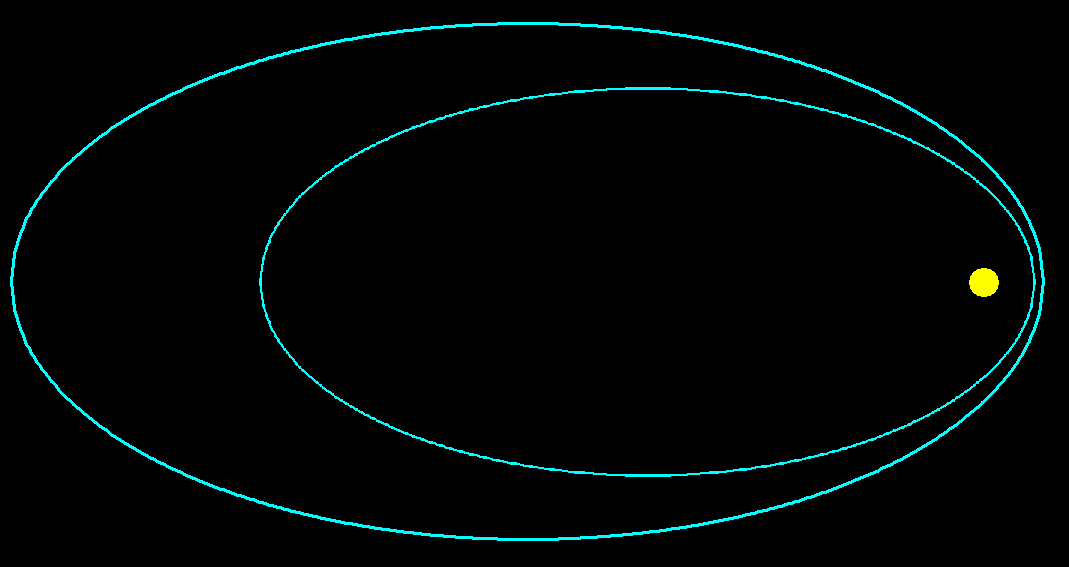
The picture above shows a proposed model for the production of a sudden increase in the brightness of a star — or rather, what is apparently a single star, optically, but would actually be a suddenly-produced binary stellar system.

The yellow object is a star, the system’s primary, and it has high mass (at least a few solar masses), when its mass is compared to those of the brown dwarfs in the two highly elliptical orbits shown in blue. These brown dwarfs aren’t quite stars, lacking enough mass to fuse hydrogen-1, which requires 75 to 80 Jupiter masses, but one of them (the larger one) is close to that limit. The smaller brown dwarf has perhaps half the mass of the larger brown dwarf. Their high orbital eccentricities give them very long orbital periods, on the order or 100,000 years. In a very small fraction of orbits, both brown dwarfs will be near perihelion (closest point to the primary) at the same time, and, during those rare periods, the two brown dwarfs become much closer to each other than they are to the primary.

When the two brown dwarfs become close enough to each other, matter from the smaller one could be drawn, by gravity, into the larger brown dwarf, increasing its mass, at the expense of its smaller sibling. At some point, in such a system, the larger brown dwarf’s mass could then reach the threshold to begin fusing hydrogen-1, and “turn on” as a true star — a red dwarf. From Earth, this red dwarf would not be distinguishable from the system’s most massive star, shown in yellow, until much later, when the two moved further apart. There would, however, be a sudden increase in luminosity from the system as a whole. Unlike other types of novae, this increase in luminosity would not fade away quickly, for red dwarfs have very long lifespans. This would enable them, upon discovery, to be distinguished from other single-brightening stellar events. Confirmation could then come from resolution of the new red dwarf component, as it recedes from the primary, making detection easier.

For a variation on this mechanism, the primary star could be somewhat more massive, and the two large brown dwarfs could be replaced by two large red dwarf stars. The larger red dwarf could draw matter from the smaller one, until the larger red dwarf became large enough to cross a higher mass threshold, and brighten substantially, with its color suddenly changing to orange or yellow.

A problem for this model:  no such events are known to have happened. If they do happen, a likely explanation for their rarity is the likelihood that such orbits would be unstable, in a large fraction of similar cases, preventing the stellar-brightening event from having time to happen — in all but a few cases, none of which humans have (yet) both seen, and understood. If one of these things goes off nearby, though, we will learn about it quickly, for it will make itself known.

For another possible mechanism, there is another option:  remove the primary altogether, and let the two objects of near-threshold mass orbit their common center of mass directly. They could then create a new star, or brighter star, by the mechanism described, one which might even produce a detectable accretion disk. A actual merger of the two brown dwarfs, or red dwarf stars, would be a variation of this idea, and would presumably be more likely if the two objects had masses very close to each other, so that neither would have an advantage in the gravitational tug-of-war.

Craters and Slopes Near the South Pole of the Moon Adorn the Faces of a Rhombic Enneacontahedron

Zonohedrified Dodeca

The images on the faces of this polyhedron are based on information sent from NASA’s Lunar Reconnaisance Orbiter, as seen at http://lunar.gsfc.nasa.gov/lola/feature-20110705.html and tweeted by @LRO_NASA, which has been happily tweeting about its fifth anniversary in a polar lunar orbit recently. I have no idea whether this is actually an A.I. onboard the LRO, or simply someone at NASA getting paid to have fun on Twitter.

To get these images from near the Lunar South Pole onto the faces of a rhombic enneacontahedron, and then create this rotating image, I used Stella 4d:  Polyhedron Navigator. There is no better tool available for polyhedral research. To check this program out for yourself, simply visit www.software3d.com/Stella.php.

Surface Gravitational Field Strengths for Numerous Solar System Objects

It isn’t difficult to find rankings for the most massive objects in the solar system, rankings of objects in terms of increasing distance from the sun, or rankings of objects by radius. However, ranking objects by surface gravitational field strength is another matter, and is more complicated, for it is affected by both the mass and radius of the object in question, but in different ways. If two objects have different masses, but the same radius, the gravitational field strength will be greater for the more massive object. However, increasing the radius of an object decreases its surface gravitational field strength, in an inverse-square relationship.

Gravitational field strength is measured in N/kg, which are equivalent to m/s², the units for acceleration. The terms “gravitational field strength” and “acceleration due to gravity,” both of which are symbolized “g,” are actually synonymous. I prefer “gravitational field strength” because referring to acceleration, when discussing the weight of a stationary object on the surface of a planet, can cause confusion.

Use of the numbers given below is easy:  given the mass of a thing (an imaginary astronaut, for example), in kilograms, simply multiply this figure by the given gravitational field strength, and you’ll have the weight of the thing, in newtons, on the surface of that planet (or other solar system object).  If, for some odd reason, you want the weight in the popular non-metric unit known as the “pound,” simply divide the weight (in newtons) by 4.45, and then change the units to pounds.

How is surface gravitational field strength determined? To explain that, a diagram is helpful.

gravity

The large green circle represents a planet, or some other solar system object, and the blue thing on its surface, which I’ll call object x, can be pretty much anything on the solar system object’s surface. There are two formulas for Fg, the force of gravity pulling the planet and the thing on its surface toward each other. One is simply Fg= mxg, a form of Newton’s Second Law of Motion, where “g” is the gravitational field strength, and mx is the mass of the object at the surface. The other formula is more complicated:  Fg= (Gmxmp)/r².  This is Newton’s Law of Universal Gravitation, where “G” (not to be confused with “g”) is the universal gravitational constant, 6.67259 x 10⁻¹¹ Nm²/kg², and mp and r are the mass and radius of the planet (or other solar system object). Because they each equal Fg, the expressions mxg and (Gmxmp)/r² can be set equal to each other, yielding the equation mxg = (Gmxmp)/r², which becomes g = (Gmp)/r² after mis cancelled. The mass of the object on the surface is not needed — “g” is simply a function of mp and r.

There is a problem, however, with the idea of “surface” gravitational field strength — and that is the fact that the five largest objects in the solar system, the sun and the gas giants, all lack visible solid surfaces. One cannot stand on Jupiter — if you tried, you’d simply fall inside the planet. Therefore, for Jupiter, picture a solid platform floating at the top of the visible clouds there, and place the test object on this solid platform. Under those conditions, multiplying the test object’s mass by the Jovian value of “g” will, indeed, yield the weight of the object there, as it could be measured by placing it on a bathroom scale, at rest on the floating platform. For the other gas giants, as well as the sun, the idea is the same.

The objects included in the list below are the sun, all eight major planets, all dwarf planets (and dwarf planet candidates) with known values of “g,” all major satellites, some minor satellites, and a few of the largest asteroids. Many more objects exist, of course, but most have values for “g” which are not yet known.

Here are the top five:

Sun/Sol,      274.0 N/kg

Jupiter,          24.79 N/kg

Neptune,       11.15 N/kg

Saturn,          10.44 N/kg

Earth/Terra,    9.806 65 N/kg

The top five, alone, make me glad I undertook this project, for I did not realize, before doing this, that our planet has the highest surface gravitational field strength of any object in the solar system with a visible solid surface.

The next five include the rest of the major planets, plus one Jovian moon.

Venus,    8.87 N/kg

Uranus,   8.69 N/kg

Mars,      3.711 N/kg

Mercury, 3.7 N/kg

Io,           1.796 N/kg

The third set of five are all planetary moons, starting with earth’s own moon. The others are Jovian moons, except for Titan, which orbits Saturn.

Moon/Luna, 1.622 N/kg

Ganymede,  1.428 N/kg

Titan,           1.352 N/kg

Europa,        1.314 N/kg

Callisto,        1.235 N/kg

The fourth set of five begins with the largest dwarf planet, Eris, and includes two other dwarf planets as well.

Eris,        0.827 N/kg           (dwarf planet)

Triton,     0.779 N/kg          (Neptune’s largest moon)

Pluto,      0.658 N/kg           (dwarf planet)

Haumea, 0.63 N/kg             (dwarf planet)

Titania,   0.38 N/kg             (largest moon of Uranus)

The fifth set of five includes the remaining dwarf planets with known values of “g.”

Oberon,          0.348 N/kg   (moon of Uranus)

1 Ceres,         0.28 N/kg       (dually classfied:  dwarf planet and largest asteroid)

Charon,          0.278 N/kg    (largest moon of Pluto)

Ariel,               0.27 N/kg      (moon of Uranus)

90482 Orcus, 0.27 N/kg      (probable dwarf planet)

The sixth set of five are dominated by Saturnian moons.

Rhea,          0.265 N/kg         (Saturnian moon)

4 Vesta,      0.25 N/kg           (2nd largest asteroid)

Dione,         0.233 N/kg        (Saturnian moon)

Iapetus,     0.224 N/kg         (Saturnian moon)

Umbriel,    0.2 N/kg             (moon of Uranus)

The seventh set of five are mostly asteroids.

704 Interamnia,  0.186 N/kg          (5th most massive asteroid)

2 Pallas,                0.18 N/kg            (3rd most massive asteroid)

Tethys,                 0.147 N/kg          (Saturnian moon)

52 Europa,           0.14 N/kg            (7th most massive asteroid)

3 Juno,                 0.12 N/kg            (large asteroid, w/~1% of mass of the asteroid belt)

Starting with the eighth group of five, I have much less certainty that something may have been omitted, although I did try to be thorough. My guess is that most future revisions of this list will be necessitated by the discovery of additional dwarf planets. Dwarf planets are hard to find, and there may be hundreds of them awaiting discovery.

Enceladus,    0.114 N/kg          (Saturnian moon)

Vanth,           0.11 N/kg             (moon of probable dwarf planet 90482 Orcus)

10 Hygiea,    0.091 N/kg          (4th most massive asteroid)

15 Eunomia, 0.08 N/kg            (large asteroid, with ~1% of mass of asteroid belt)

Miranda,       0.079 N/kg          (moon of Uranus)

Here is the ninth group of five:

Nereid,      0.072 N/kg  (Neptunian moon; irregular in shape)

Proteus,    0.07 N/kg    (Neptunian moon; irregular in shape)

Mimas,      0.064 N/kg  (Saturnian moon / smallest gravitationally-rounded object in                                                                                the solar system)

Puck,         0.028 N/kg  (6th largest moon of Uranus)

Amalthea, 0.020 N/kg  (5th largest Jovian moon)

Finally, here are “g” values for the two tiny moons of Mars, included because they are nearby, and are the only moons Mars has to offer. A more exhaustive search would reveal many asteroids and minor satellites with “g” values greater than either Martian moon, but smaller than Amalthea, the last solar system object shown in the last set of five.

Phobos, 0.0057 N/kg

Deimos, 0.003 N/kg

Seven Moving Lights in the Sky, the Seven Days of the Week, and Other Significant Sets of Seven

days of week and lights in the sky

Have you ever wondered why the number seven appears in all the places it does? We have seven days in the week. Churches teach about the seven deadly sins, and “seven heavens” is a common phrase. There are seven wonders of the ancient world, and seven of the modern world. The number seven has appeared in many other socially significant ways, in societies all over the world, for millennia.

It is no coincidence, I think, that the ancients were able to see seven lights in the sky which are either visible in daylight, or move against the background of “fixed” stars at night. They ascribed great significance to what went on in the sky, since they viewed “the heavens” as the realm of the gods in which they believed. The evidence for this lives on today, in the names of the seven days of the week, and numerous other sets of seven, all over the world.

It is possible to see the planet Uranus without a telescope, but it is very dim, and you have to know exactly where to look. No one noticed it until after the invention of the telescope. If Uranus were brighter, and had been seen in numerous ancient societies, I have no doubt that we would have eight days in the week, etc., rather than seven.

Pie Chart for Main-Belt Asteroid Masses

Image

Pie Chart for Main-Belt Asteroid Masses

I looked up enough asteroid masses to use them to make this pie chart. I now have three reactions.

First: oh, that’s why only Ceres is round!

Second: who was stupid enough to name an asteroid Europa? That name is taken!

Third: wow — those small ones sure do make up a lot of the total!

Astronomy Update

Image

Astronomy Update

The brightest star in the picture above is Mintaka, from Orion’s Belt. We just adopted a cat, and named her Mintaka. I think that calls for an astronomy update — just the basics, stuff that everyone should know much of.

  1. Starting with our solar system:
    1. Planets:
      1. Mercury, smaller than earth’s moon, no atmosphere to speak of, no moons, tidally locked with the sun
      2. Venus, no moons, hottest planet in solar system due to thick carbon dioxide atomsphere
      3. Earth, one planet-sized moon, only known location of life
      4. Mars, thin carbon dioxide atmosphere, two small, irregularly-shaped moons
      5. (Many asteroids in main asteroid belt, between orbits of Mars and Jupiter)
      6. Jupiter, largest of four gas giants and everything else in the solar system except the sun, 67 known moons (four are planet-sized, and three of those four have known or suspected sub-surface water oceans — Europa, Callisto, and Ganymede)
      7. Saturn, gas giant with most extensive ring system in the solar system, 150 known moons and moonlets, including one planet-sized moon, Titan, with a thick atmosphere and possible subsurface ocean, and another moon with a known subsurface water ocean, Enceladus)
      8. Uranus, planet with axis of rotation closest to the ecliptic, 27 known moons
      9. Neptune, one large moon, Triton, among 14 known moons
    2. Dwarf Planets:
      1. Ceres, only dwarf planet in the asteroid belt
      2. Pluto/Charon double dwarf planet system
      3. Haumea
      4. Makemake
      5. Eris, largest dwarf planet
      6. Sedna
  2. Other known solar systems:
    1. 1,795 exoplanets
    2. 461 exoplanets in multiplanet systems
    3. Total of 1,114 exoplanet systems, all within our galaxy
  3. Nearest known star, other than the sun: Proxima Centauri, 4.2 light-years distant
  4. Number of stars in the Milky Way, our galaxy:  ~300 billion
  5. Number of galaxies in the known universe:  ~100-200 billion

Twelve Rotating Images of Barred Spiral Galaxy NGC1300

Image

Twelve Rotating Images of Barred Spiral Galaxy NGC 1300

After using Google to find the image of this galaxy, I used software called Stella 4d (available at http://www.software3d.com/Stella.php) to project it onto the twelve pentagonal faces of an icosidodecahedron, and then hid the triangular faces, as well as the vertices and edges — and then set the galaxies to rotate on the faces, as well as around the axis of the polyhedron.

The Sun, On a Trip Through the Electromagnetic Spectrum

Image

The Sun, On a Trip Through the Electromagnetic Spectrum

The image above shows the sun’s output of radio waves, which have the longest wavelengths, lowest frequencies, and lowest energies of any part of the electromagnetic spectrum.

IDL TIFF file

This image, above, shows the sun’s microwave output.

Next, infrared:

sun infrared

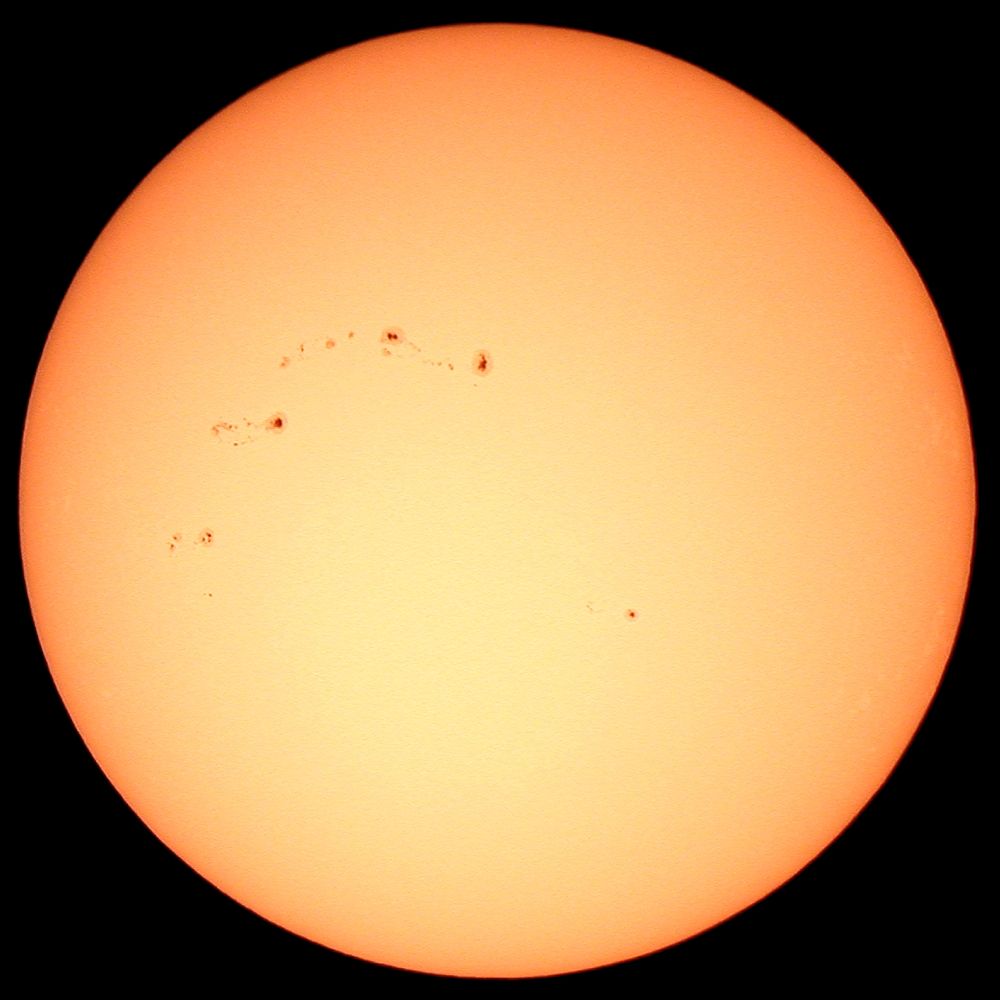
This next one should be familar. It’s visible light. (Don’t stare at the sun, though.)

Sun visible light

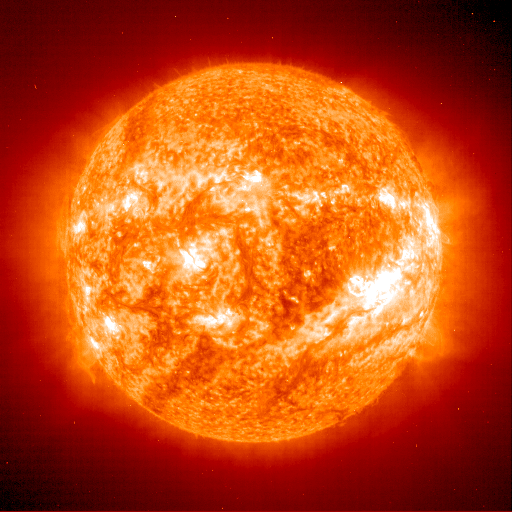
Moving on through the spectrum, ultraviolet is next:

sun ultraviolet

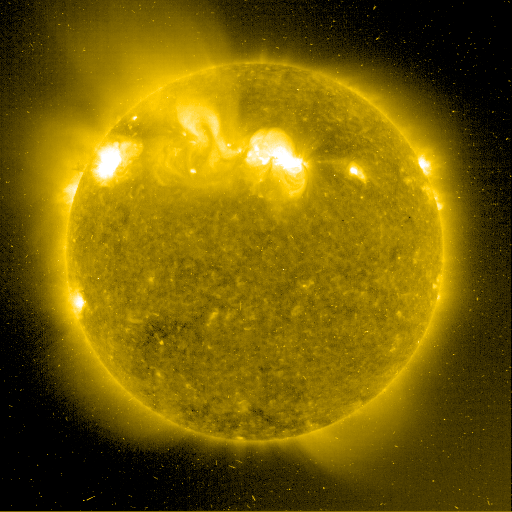
After that, x-rays:

sun xray

And, finally, we arrive at the other side of the spectrum, where the electromagnetic radiation has its shortest wavelengths, and highest frequencies, as well as energy per photon. This is the sun in gamma rays:

sun gamma

Most of these images, all found using Google image-searches, use false colors, of course . . . or you wouldn’t be able to see them!