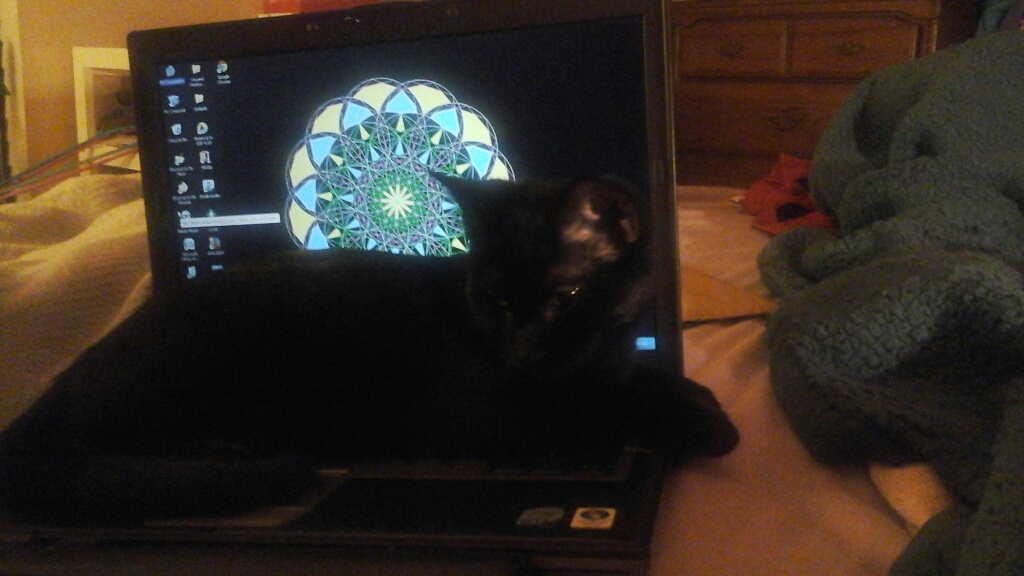
The Misadventures of Jynx the Kitten, Chapter Three: Jynx Tries To Help Wash the Dishes

The thing is, kittens really aren’t very good at housework — but at least he’s trying, right?

20141006_175239_resized

Of course, he might have been wanting a shower instead. It’s hard to tell what Jynx is thinking sometimes.

20141006_175227_resized

This did cause a delay in the dishes getting done, for we were laughing too hard to load any dishes for quite some time, even after these pictures were taken.

20141006_175218_resized

No kittens were harmed in the making of this blog-post . . . but I will admit that the temptation to close the dishwasher, and then start it, did exist. However, we unanimously decided against it.

What Is a Mathematician?

erdos

Fort Smith? Pine Bluff? What’s the Difference?

Fort Smith is Pine Bluff

Unless you also live in the American state of Arkansas, you may not have even heard of Fort Smith and Pine Bluff. For those who grew up in this state, though, they’re considered (by our peculiar standards) to be major cities. Fort Smith is on the far West side of the state, on the Oklahoma border, while Pine Bluff is in the Southeastern part of the state, also known as the Mississippi Delta.

I didn’t learn Arkansas geography in school. Instead, when I was a child, my family traveled, mostly within the state — a lot. By the time I was ten years old, I’d been in all 75 counties of Arkansas, and knew quite a bit about where things are here . . . except for these two cities, Fort Smith and Pine Bluff.

If you’re from Arkansas, you know these two cities are nothing alike. What I noticed in childhood, above all else, was the fact that the two cities smelled so different from each other. The reason is simple:  Pine Bluff has a lot of paper mills, and the smell near paper mills is not entirely unlike being locked in a small closet with several dozen rotten eggs. Fort Smith, by contrast, is relatively odorless.

What perplexed my parents, though, is the fact that I would consistently confuse these two cities. I’d refer to the “horrible smell of Fort Smith,” or, if I knew we were going to Pine Bluff, I might ask if we’d be crossing the border into Oklahoma. My parents always corrected these mistakes, but I kept making them, repeatedly, which is not like me at all. When young, I never had more than a 50% chance of correctly identifying either of these cities. Once I figured out what I was doing, though — at around age twelve — this repeated error made perfect sense.

When I try to understand something, I examine it, and consider it, mathematically. Often, I’m not even conscious I’m doing that — it’s simply how I think. Both Fort Smith and Pine Bluff are two-word city names. To make matters even worse, the first word of each city-name has four letters, and the second word in each has five. Once I realized these parallels, though, it all made sense:  no wonder I couldn’t tell these places apart, with names which, examined through the lens of childhood mathematics, looked exactly alike.

To my knowledge, no one else has ever had a long-term problem confusing these two Arkansas cities. However, when those who know me well hear this story, they are never surprised that I would do such a thing.

My Australia Story

australia

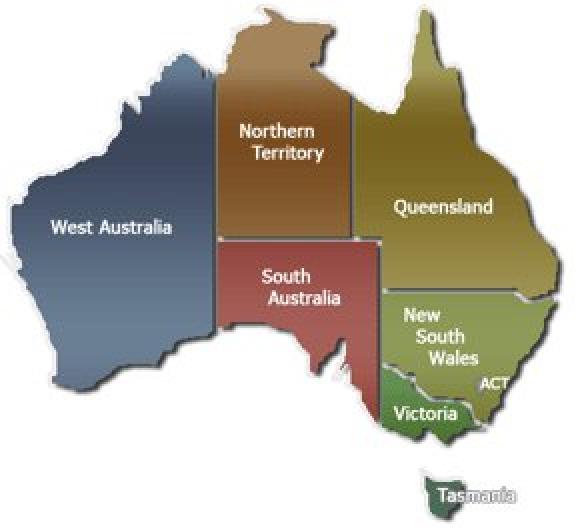
I once got into a huge argument, as a 7th grade student, in a “talented and gifted” section of Social Studies. The issue:  how many countries are there in the continent of Australia?

The assignment was to choose a continent, and draw a map of it on a full-size posterboard. I had worked for hours on this map, only to get it back, ruined, for the teacher had taken a red ball-point pen, slashed through my line “state and territorial boundaries” in my map’s key, and had written, as a correction, “not states — COUNTRIES.” She also docked points from my grade, but that was a minor issue, to me, compared to her ruining my map. She could have, at least, written her incorrect comment on the back of my map!

When I confronted her about her mistake, she maintained that the political divisions you see above are independent countries. In my opinion, “Northern Territory,” especially, doesn’t sound particularly sovereign, and I said so, but she may not have understood the definition of “sovereign,” for that did not work. Confronted with this absurd situation, I proceeded to grab the “Q” volume of a nearby encyclopedia, and began reading the article about Queensland, loudly enough for the entire class to hear: “Queensland: one of the states of Australia….” I freely admit that, at the time, my goal was to embarrass and humiliate her right out of the teaching profession — for the benefit of her present and future students. I’ve changed my approach, a lot, since then.

A huge brouhaha ensued, and we ended up taking each other to the assistant principal’s office:  her, to report a disruptive and defiant student; and me, to report an incompetent teacher, who, in my view, at that age, should have been fired on the spot. Dealing with this situation was probably one of the stranger, and more difficult, situations of that assistant principal’s career, for he knew that Australia is both a single country, and a continent — but he could not, for political reasons I did not yet understand, agree with me in front of this teacher. As for me, I was simply incredulous that someone could be a certified social studies teacher, and not know this basic fact about world geography. The whole scenario, to me, was surreal.

The assistant principal handled it well. To the teacher, he said, “You can go back to class — I’ll handle Robert.” He then “handled” me, after she left, in the only way that could have possibly worked: with an apology, and a polite request to do my best to endure her ignorance until the upcoming end of the year. I respect honesty, was being given a request, not an order, and he had conceded that I was correct. I therefore chose to cooperate — with his polite request.

If he had not taken this approach, I likely would have added him to the list I had, at the time, of people (a mixture of administrators and teachers) whom I was trying to drive out of the education profession, for the benefit of all — but he did the right thing, thus earning my respect.

As for the teacher, I survived the rest of her class, brain intact, and assume she is now retired, this being well over thirty years ago. I’m now in my twentieth year as a teacher, myself, and am pleased to report that average teacher quality has dramatically improved since this fiasco happened. (I wish I could say the same about average administrator quality, but there are, at least, a few competent people working in that field, as well.) During my years of teaching, I haven’t encountered a single teacher who lacked this basic bit of knowledge about world geography. In fact, I count, among my colleagues, many of the smartest people I know.

I am glad, however, that I don’t have to call the teacher in this story a colleague. I simply cannot respect willful, stubborn ignorance, especially in the face of evidence that one is wrong. When one of my students catches me making a mistake, I do the right thing: I thank them, make certain everyone understands the correction, and then we move on with the lesson. That’s what this 7th grade teacher of mine should have done, as well.

On Coming Out of the Closet

I have a strong belief that asking nosy questions is an incredibly rude thing to do, and I find it particularly appalling when person A asks person B to identify his or her sexual orientation. What could be more personal, and private, than what consenting adults do in their own bedrooms? For this reason, I don’t ask questions on this subject, nor do I tell (when asked). To ask would be rude, and to answer such a nosy question would be to encourage rudeness. I don’t wish to do either.

There is exactly one situation I can think of where person A needs such information from person B, and that is if person A wants to have sex with person B. Even then, though, are there not far better ways to begin a flirtatious conversation?

At a school where I used to teach, I co-sponsored a student-initiated GSA, or Gay-Straight Alliance. On the basis of this co-sponsorship, plus my wearing a rainbow-colored wristband, many assumed that I was gay. To make a statement about how such things do not matter, I refused to ever confirm, nor deny, such rumors. On Facebook, I didn’t answer the “interested in” questions, nor did my blog reveal my sexual orientation — until now.

At this time, having considered the ramifications carefully, I’ve decided it is time to come out. I’m teaching at a new school, and am no longer co-sponsoring a GSA. I’ve kept quiet on the subject of my own sexual orientation long enough to make my point. And, now, I’m going to make another point . . . by coming out, here and now.

coming out straight

Yes, world, I admit it . . . I am a raving heterosexual, and one who has finally decided to come out — as a straight person. I’m not ashamed of it; this is part of who I am. There may be some who do not approve of this, but I do not have to care what they think.

In case my point is escaping you, please consider what it is like for gays, lesbians, bisexuals, and others who don’t conform to society’s norms, to do what I just did. Imagine what it would be like, for “heteros,” if social pressure favored homosexuality, rather than heterosexuality. How many “straights,” in such a world, would be willing to risk being ostracized, losing their jobs, being shunned by former friends and family, etc., simply for admitting they have a preference for the other sex, rather than the same one? If you, yourself, are also straight, and lived in a gay-dominated world, would you have the courage to come out as one of “those people,” the “heteros,” with their allegedly-“disgusting” sexual practices?  

It’s ridiculous that anybody has to think about such things. “Live and let live” is not too much to ask — of anyone.

A True Story of a Young Aspie Getting in Trouble with “Show and Tell”

In elementary school, in the 5th grade, I managed to get in trouble for a “show and tell” project. As usual, getting in trouble was not my objective, but it happened anyway. This was decades before I learned I have Asperger’s, but, looking back, none of this would have happened were I not an “Aspie,” as we call ourselves.

This image, which I found here, is very much like the poster I made, by hand, and used for this project:

nuclear chain reaction

That was the “show” part of this “show and tell” project. For the “tell” part, I explained how nuclear chain reactions work, and then explained how nuclear bombs are made. It’s very simple:  you have two slightly sub-critical masses of uranium-235 or plutonium-239, and physically bring them together, so that the total mass exceeds the critical mass. At that point: boom.

The hard part, of course, is actually obtaining the U-235 or Pu-239, for those aren’t things you can simply buy at the local hardware store. Ironically, I did know where to find both uranium and plutonium — at the very same university, about an hour away, where I’d spent far too much time conducting mostly-unsupervised experiments with both elements, along with lots of liquid mercury, before my tenth birthday. (I still suspect that all that radiation may have turned me into a mutant.) However, I also knew that the uranium and plutonium there would not have nearly enough of the correct isotope of either element, making this information irrelevant to my “show and tell” report, and so, for this reason, I did not tell them where to find the uranium and plutonium I had previously used for experiments.

I didn’t figure this out in class that day, since I’m not particularly good at “reading” emotions, facial expressions, and body language, but, apparently, I really upset, and scared, my teacher. This became apparent when she called my mother, and, later, my mother asked me to tell her what I’d done in school that day. Being excited about the “show and tell” presentation I’d given that day, I immediately told my mother all about it. When she told me the teacher had called her, concerned about me explaining to my class how to build atomic bombs, I was confused, since I didn’t understand, at all, why what I had actually said posed any problem. To explain this to my mother, I simply said, “But, Mom, I didn’t tell the class where to actually get the uranium-235 or plutonium-239! I don’t know where to find those isotopes!”

This was enough to convince my mother that I had not, in fact, done anything wrong. She called the teacher back, and simply asked if I had, or had not, included that critical bit of information: where to find the actual fissionable material needed for a nuclear bomb to work. When the teacher replied that I had not done that, my mother’s response was both sensible, and logical:  “Well, then, what’s the problem?”

—–

Postscript, for those who might be worried about the childhood experiments I mentioned above: at around age 40, I asked a physician about my worries regarding early exposure to mercury vapor and radiation. He told me that any problems I might have, as a result of such experiments, would have already showed up by then, and that I could, therefore, stop worrying about this. Thus reassured, I did exactly that.

How Richard Feynman Saved Eastern Tennessee from Getting Nuked

feynman

I’m reading the book shown above for the second time, and am noticing many things that escaped my attention the first time through. The most shocking of these items, so far, is finding out that history’s first nuclear explosion almost occurred by accident, in Oak Ridge, Tennessee, during World War II. One person prevented this disaster, and that person was Richard Feynman, my favorite scientist in any field. If you’d like to read Feynman’s account of this, in his own words, it’s in the chapter “Los Alamos from Below,” which starts on page 107.

Feynman, a physicist, was one of many civilians involved in the Manhattan Project, doing most of his work in New Mexico. At one point, though, he obtained permission to visit Oak Ridge, in order to try to solve problems which existed there. These problems were caused by the American military’s obsession with secrecy, which was caused, in turn, by the fact that it was known, correctly, that at least one spy for the Nazis was among the people working on the Manhattan Project. The military’s “solution” to this problem was to try to keep each group of civilians working for them in the dark about what the other groups of civilians were doing. Most of them had no idea that they were working to develop a bomb, let alone an atomic bomb. In Tennessee, they thought they were simply working on developing a way to separate uranium isotopes, but did not know the underlying purpose for this research.

The military men in charge knew (because the physicists in New Mexico figured it out, and told them) a little bit about the concept of critical mass. In short, “critical mass” means that if you get too much uranium-235 in one place, a runaway chain-reaction occurs, and causes a nuclear explosion. The military “brass” had relayed this information to the civilian teams working in Tennessee, by simply telling them to keep the amount of U-235 in one place below a certain, specific amount. However, they lacked enough knowledge of physics to include all the necessary details, and they deliberately withheld the purpose for their directive. Feynman, by contrast, did not share this dangerous ignorance, nor was he a fan of secrecy — and, as is well known, the concept of respecting “authority” was utterly meaningless to him.

While in Tennessee, Feynman saw a large amount of “green water,” which was actually an aqueous solution of uranium nitrate. What he knew, but those in Tennessee did not, is that water slows down neutrons, and slow neutrons are the key to setting off a chain reaction. For this reason, the critical mass for uranium-235 in water is much less than the critical mass of dry U-235, and the “green water” Feynman saw contained enough U-235 to put it dangerously close to this lower threshhold. In response to this, Feynman told anyone who would listen that they were risking blowing up everything around them.

It wasn’t easy for Feynman to get people to believe this warning, but he persisted, until he found someone in authority — a military officer, of course — who, although he didn’t understand the physics involved, was smart enough to realize that Feynman did understand the physics. He was also smart enough to carefully listen to Feynman, and decided to heed his warning. The safety protocols were modified, as were procedures regarding sharing of information. With more openness, not only was a disaster in Tennessee avoided, but progress toward developing an atomic bomb was accelerated. It turns out that people are better at solving problems . . . when they know the purpose of those problems.

Had this not happened, not only would Eastern Tennessee likely have suffered the world’s first nuclear explosion, but overall progress on the Manhattan Project would have remained slow — and the Nazis, therefore, might have developed a controlled nuclear bomb before the Americans, making it more likely that the Axis Powers would have won the war. Richard Feynman, therefore, dramatically affected the course of history — by deliberately putting his disdain for authority to good use. 

save lives

The Misadventures of Jynx the Kitten, Chapter Two: Jynx vs. My Computer

20140827_204903_resized (2)

Jynx: 1, Computer: 0.

Tonight’s feline insanity started while we were watching Star Trek — the episode where Captain Kirk and Mr. Spock go up against a planet full of nuclear-armed Space Nazis.

Apparently, cats — or, at least, this cat — find Nazis disturbing, which, of course, they were — and will be again, if they appear in the 23rd Century . . . because some half-crazed future historian went and violated the Prime Directive, becoming, a few years later, a fully-crazed future historian. Jynx was so incredibly disturbed by the Space Nazis, in fact, that he bounced over pillows and blankets, in a series of nicely Newtonian . . .


&^ (Stop that, Jynx!)

. . . parabolic arcs, to land on my computer. He then proceeded to pause the episode — then close my browser (the picture-moment, with my wife laughing hysterically as she took it), and finally tried to bite the heads off several Space Nazis as the screen slowly darkened. After due consideration, Jynx decided this was not enough, and so, next, he reached out a paw, and quickly turned my computer completely off. A smug look followed. You haven’t seen a look this smug, unless, maybe, you’ve also seen one on the face of a kitten.

Getting it (my computer, not Jynx) turned back on was not easy. For a little while, in fact, I thought Jynx had destroyed the Internet. In reality, the Internet had been fine all along, for this picture, taken a little earlier, with a tablet, got to my e-mail account almost instantly. It took much longer, however, for me to actually get to my e-mail account.

My computer now has tiny bite marks all over it, and plays Radiohead’s song “2 + 2 = 5” so slowly that it’s turned the song into “1.5 + 1.5 = π” – and that song sounds terrible.

I hope my computer lives long enough for this post to make it to my blog. In the meantime, Jynx reigns — OW! — triumphant.

[2016 update: that computer is now officially dead. Jynx the Cat lives on.]

The Misadventures of Jynx the Kitten, Chapter One

We have a new kitten, and his name is Jynx. He’s between four and five months old, and has short black fur.

As the adults of the house were enjoying a nice, peaceful, Saturday afternoon nap, we were suddenly awakened by multiple crashes, along with the sound of glass breaking, from the nearby bathroom. According to eyewitness reports, my reaction was to jump straight up into the air, hair standing on end, yelling a long, colorful string of profanity, which I shall not post here. It’s difficult for me to remember what I do, or say, immediately upon waking, and I don’t want to misquote myself, you see.

As it turns out, Jynx had been running back and forth along the counter in the bathroom, trying to get to the “other kitten” in the mirror, and knocking just about everything off the counter in the process. Our evidence: horizontally-smeared, feline nose-prints, at kitten-height, on the mirror — plus a big mess, all over the bathroom floor. Jynx, having scared himself silly, is now hiding under the bed, and I’ve thrown away all the tiny glass-shards I could find.

Blog-posts here usually come with pictures, and I tried to obtain one . . . but Jynx isn’t ready to come out from under the bed yet. My camera doesn’t have a flash, and it’s pretty obvious what a “no-flash” picture of a black kitten, hiding under a bed, would look like, is it not?

Why Is Arkansas Political Geography Such a Mess?

Image

Why Is Arkansan Political Geography Such a Mess?

Technically, we live within the city limits of North Little Rock, but we’re surrounded by Maumelle, and also live in the Pulaski County Special School District, not the North Little Rock School District. Telling people we live in NLR causes confusion, so we say “Maumelle” instead, but mail won’t reach us unless it includes “North Little Rock” in the address. What’s more, that’s all in one county, Pulaski, near the center of the state.

The weirdness doesn’t stop there. Nearby is a city named Conway. I went to college there. It isn’t located in Conway County, though; that’s further West.

Head Southwest on I-30 from Little Rock, and you’ll soon encounter Benton (not in Benton County, although at least Bentonville is), and then get a chance to take an exit to go visit Hot Springs — but you won’t find it in Hot Spring County. Van Buren is right next to Oklahoma, and a long drive from Van Buren County. Is the City of Jacksonville to be found in Jackson County? Of course not — not in this state. Boonville, similarly, is not located in Boone County.

We have a Mississippi County here, and it borders two other states. We also have a long border with the state of Mississippi. However, Mississippi County, Arkansas isn’t one of several counties which do border the State of Mississippi. Instead, it borders Tennessee and Missouri.

Even things which seem intuitively obvious about my state’s political geography end up being wrong. Ask someone familiar with a U.S. map which state(s) you can find South of Arkansas, and they’ll almost certainly answer with Louisiana, perhaps including Texas, as well. However, the states of Oklahoma, Missouri, Tennessee, and Mississippi also include land that is South of carefully-chosen points in Arkansas. Here’s visual proof, which you can enlarge with a click:

arinus

Yes, all six states which border Arkansas are technically South of us, in a sense.

Perhaps the strangest thing about Arkansan political geography is that the town of Lonoke is actually in Lonoke County. It’s even their county seat. What are they trying to do there, confuse people?