“Math Problems for Fun”: The Source of My Blog’s New Header-Image

cyanide and happiness without black border

I don’t usually post the work of others here, but, since I am now using this as my blog’s header-image (in slightly altered form), it seemed appropriate to make an exception for this cartoon, in its original format. I didn’t know that the cartoonists at Cyanide and Happiness monitored my life, but, clearly, that guy in the blue shirt is me!

A Euclidian Construction of the Regular Pentadecagon (from 2011)

pentadecagon construction 2011

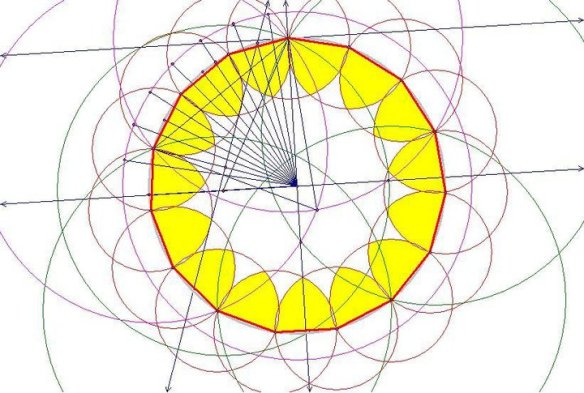
Because I did not start this blog until mid-2012, I sometimes encounter things I made before then, but have not yet posted here. I made this image in 2011, after reading that the ancient Greeks discovered how to combine the Euclidean constructions of the regular pentagon and the equilateral triangle, in order to create a construction for the regular pentadecagon. Having read this, I felt compelled to try this for myself, without researching further how the Greeks did it — and, as evidenced by the image above, I successfully figured it out, using the Euclidean tools embedded in a computer program I often use, Geometer’s Sketchpad.

What I did not do at that time was show the pentagon’s sides (so it is rather hard to find in the image above, but its vertices are there), nor record step-by-step instructions for the construction. For those who wish to try this themselves, I do have some advice: construct the pentagon before you construct the triangle, and not the other way around, and you are likely to find this puzzle easier to solve than it would be, if this polygon-order I recommend were reversed.

I also have two more hints to offer: 108º – 60º = 48º, and half of 48º is 24º. Noticing this was, as I recall, the key to cracking the puzzle.

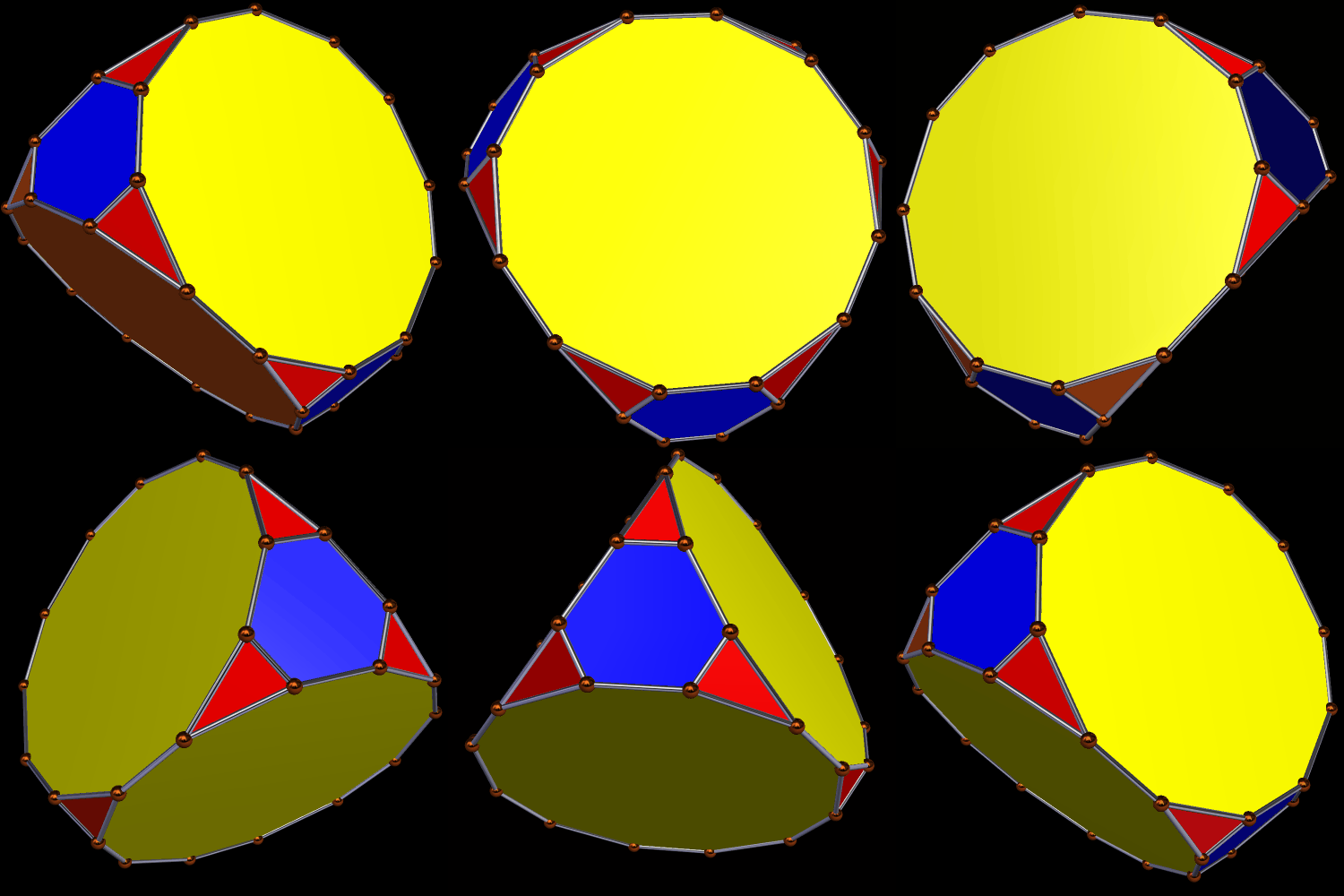
The Truncated Truncated Tetrahedron

twice truncated tet

This is the result, if one performs a second truncation to the truncated tetrahedron, in such as a way as to make the resulting dodecagons regular. To do this, however, regularity of the triangles and hexagons must be sacrificed — they are merely isosceles and equiangular, respectively.

[Image made using Stella 4d, software available here.]

Zome Hyperdodecahedron

This is one projection of the four-dimensional hyperdodecahedron, or 120-cell, rendered in Zome. All the part for this come in a single kit, and, if you want it for yourself, you can find it for sale at this website.

hyperdo

I did have student help with the construction of this, for which I am grateful. However, for legal and ethical reasons, I cannot credit the students by name.

Here’s a closer view, through the “core” of all-blue pentagons:

160114_0001

Zome is a great product. I recommend it strongly, and without reservation (and no, they aren’t paying me anything to write this).

Older Birthday Stars, From When I Was Younger

I started this blog in July of 2012, so the birthday stars I made in January 2012 (when I turned 44) and January 2011 (when I turned 43) did not appear here in those years. I found them, though, and will post them now.

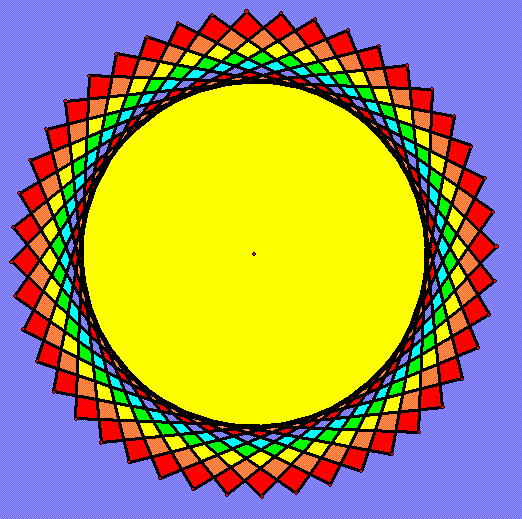
The first two are different colorings of a 44-pointed star, from January 12, 2012, the day I turned 44:

birthday star 44 from 2012 Bbirthday star 44 from 2012

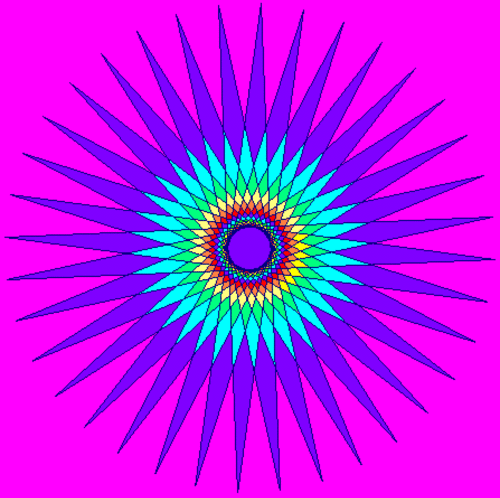
These three are different color-versions of 43-pointed stars, from a year earlier — January 12, 2011:

43 star{36_slash_17} schlafli symbol star 2012

43

I turn 48 today, so please visit the post right before this one, if you’d like to see this year’s birthday stars. =)

My Birthday Stars for 2016

This year, I’m continuing my personal tradition of making stars on my birthday with numbers of points which increase each year. I’ve done this for years, and it’s based on a game I started when I turned three, and claimed the three stars of Orion’s belt as my personal property, on the grounds that they were obviously put in the sky for my benefit. Most recently, a year ago, when I turned 47, I posted a 47-pointed star on this blog.

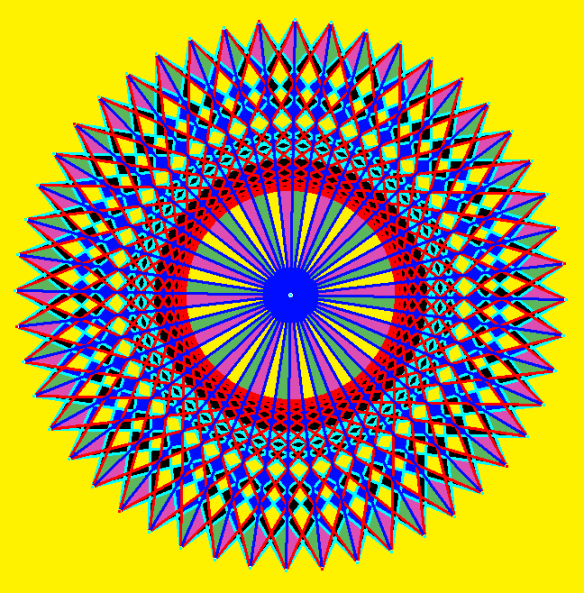
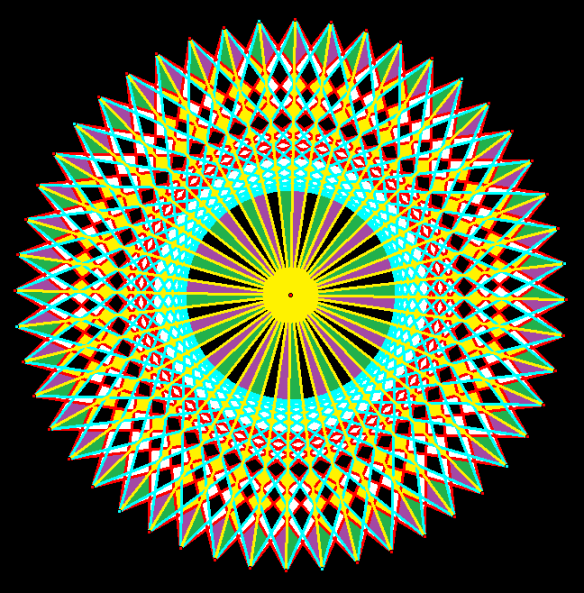
I’m turning 48 today, so here are a couple of different colorings of 48-pointed stars containing segments through the center, {6/2} compound-triangle stars, and {8/3) star octagons, made possible by the fact that 48 = (6)(8).

star 48b

star 48a

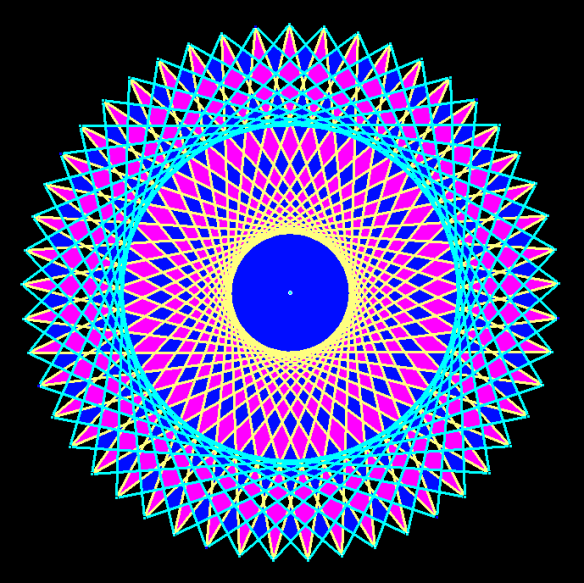
Of course, I am turning 48 on my 49th birthday (and if that makes no sense to you, here’s the explanation), so this year I also made 49-pointed stars. They are based on 49 being the square of seven, and so contain seven each of the two types of star heptagram possible, in two different colors. For this star, also, I made two versions.

star49a

star49b

Polyhedral Modeling, Using Steel Balls and Cylindrical Magnets

Many commercial products are available to model polyhedra, such as Zometools, Stella 4d, Polydrons, Astro-Logix, and magnetic spheres which can be assembled into polyhedral shapes, sometimes with brightly-colored struts for the edges of the polyhedron. The first three tools, I can recommend without reservation (and I simply haven’t tried Astro-Logix, yet), but there is a problem with using rare-earth “ball magnets” to model polyhedra: the magnets don’t last long, for, while their magnetic fields are powerful, the neodymium-iron-boron alloy used to make these magnets is not durable, and such spherical magnets break easily.

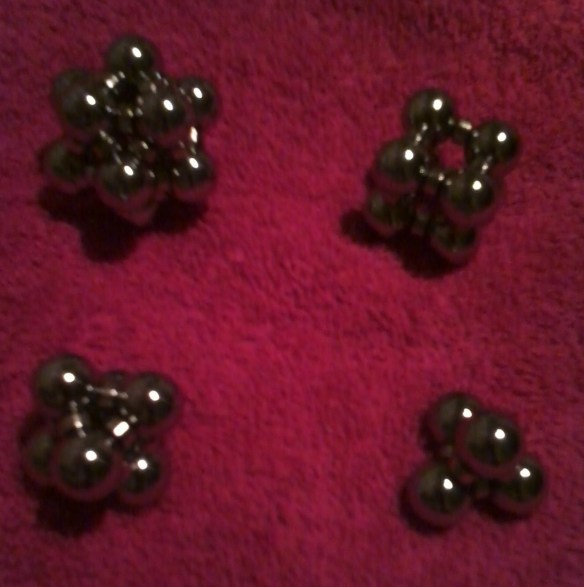
For this reason, I decided to try a variation of the “ball magnet” idea, and instead obtained some (non-magnetic) steel balls, along with small, cylindrical rare-earth magnets to go between them, thus serving as polyhedral edges, while the steel balls serve as polyhedral vertices. With the steel balls keeping these cylindrical magnets separated (rather than smashing into each other), the magnets are more durable, and the steel balls, of course, do not have a durability problem. Here’s what I was able to produce when I attempted to make a set of Platonic solids, using this method:
160110_0000

The icosahedron, cube, octahedron, and tetrahedron shown above were easy to make, but attempting to construct a dodecahedron from these materials was an exercise in frustration. Forming one pentagon of this type is easy, but pentagons of this type lack the rigidity of triangles, or even the lesser rigidity of squares, and I was never able to get twelve such pentagons formed into a dodecahedron without the whole thing collapsing into a big ferromagnetic glob, which isn’t what I wanted at all.

Every polyhedron-modeling system has advantages and disadvantages, and the weakness of this particular system was made apparent by my failed attempt to construct a dodecahedron. I next tried adding triangles to pentagons, hoping the rigidity of the triangles would stabilize the pentagons, and allow me to construct an icosidodecahedron, the Archimedean solid which combines the twenty triangles of an icosahedron with the twelve pentagons of a dodecahedron. This method of combining triangles with pentagons did work, and I was able to construct an icosidodecahedron.

160110_0001

A major advantage of this medium for polyhedral modeling is that it is incredibly economical, compared to most specialized-purpose polyhedron-building tools. The materials are readily available on eBay. Non-magnetized steel balls are much less expensive than their magnetic counterparts; also, small cylindrical magnets are inexpensive as well, especially in large quantities. These will not be the last polyhedra I build using these materials — but they are suited for certain polyhedra, more so than others. With this system, the more equilateral triangles a given polyhedron has as faces, the better, for the rigidity of triangles adds to the overall stability of triangle-containing polyhedral models.

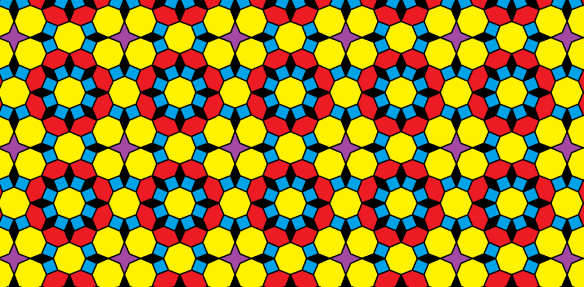
Two Color-Patterns of a Tessellation Using Squares, Rhombi, Equilateral Hexagons, Tetraconcave Octagons, and Regular Octagons

new tessnew tess 2

Octagons Can Tile a Plane III

Unlike my previous octagon-tiling discoveries (see previous post), this is a chiral, radial tessellation, with the colors chosen to highlight that fact.

tessoct radial

Octagons Can Tile a Plane II

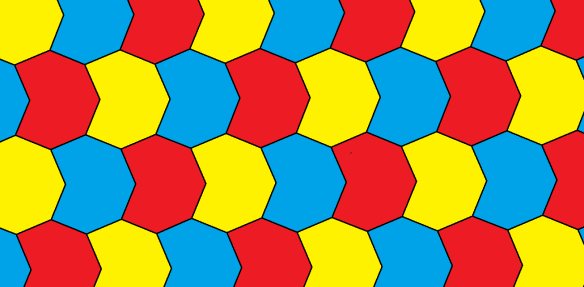
In April 2014, I found a tessellation of the plane which uses two kinds of octagons — both types equilateral, but only one type regular.

Now, I have found two more ways to tessellate a plane with octagons, and these octagons are also equilateral. However, in these new tessellations, only one type of octagon is used. One of them appears below, twice (the second time is with reversed colors), and the other one appears, once, in the next post.

tessoct

tessoct 2