A Serious Government Reform Proposal for the State of Arkansas

News item (http://www.thv11.com/story/life/2015/04/15/slide-the-city/25859617/): giant Slip-‘n’-Slide may be coming to downtown Little Rock, Arkansas. Here’s a photo from the news story.

635647384804566213-slide-the-city

To reform state government, I think we should have this event come here every time the state legislature is in session, and have it on the capitol grounds, right here in Little Rock. Why? That’s simple: if Arkansas lawmakers spent each session on a Slip-‘n’-Slide, they’d do a lot less harm.

Mathematipolitically Speaking….

I estimate that the Democratic Party only gets about half its votes from Democrats. The other half come from people who, like me, are not Democrats . . . but also can’t stand Republicans, and make a habit of voting against them.

If you switch “Democrat” and “Republican” in that sentence, and remove “like me,” I wonder if it’s also true, the other way around?

Oh, wait . . . it is, as evidenced by numerous non-GOP supporters of the Tea Party.

[Shock]

Now I realize I am, mathematipolitically, a reflection of the Tea Party, over the line dividing Democrats and Republicans. No wonder they bug me so much.

Can Defenders of the Police in Ferguson, Missouri Explain These Numbers?

fergusonThe source of this image is an official website of Missouri’s state government: http://ago.mo.gov/VehicleStops/2013/reports/161.pdf.

As shown above, when white residents of Ferguson, Missouri are stopped by the police, there is a higher contraband hit rate than is the case with Black residents. However, Blacks there have traffic-stop rates, search rates, and arrest rates far higher than those of whites.

Blacks in Ferguson are 63% of the population. In 2013, Blacks were stopped by the police there 4,632 times, compared to only 686 times for white drivers.

If anyone wants to convince me that the Ferguson Police Department is not a racist organization, operating, as a group, to continue America’s long history of oppression by skin color, they’ll need to explain these numbers first.

DWB (“Driving While Black”) should never be a cause for a traffic stop, but it still is, all over the USA. If you don’t believe me, conduct this simple test:  ask a Black person, old enough to drive, what a “DWB” is, and then ask if it really happens, in America, in 2014.

It would be going too far to state that all police officers are racist criminals. The fact is that many police officers do not fit that description at all. However, it is also true that many other police officers are criminals of this type, and they tarnish the reputation of all police officers, and police departments, by their actions. America should do something, now, about our “criminal police” problem. It isn’t limited just to Ferguson, nor only to Missouri.

[Credit:  Thank you, to the Tumblr-bloggers at http://sassygayklavierspieler.tumblr.com/ and http://fishingboatproceeds.tumblr.com/, for bringing this chart to my attention.]

Arkansas, Meet the New Legislature You Just Elected

ArkLegSources:

On Demagogues, and the 2014 American Midterm Elections

This Wikipedia article needs to be updated to include many winners from yesterday’s election in the USA: http://en.wikipedia.org/wiki/Demagogue.

From the article: “They exploit a fundamental weakness in democracy: because ultimate power is held by the people, nothing stops the people from giving that power to someone who appeals to the lowest common denominator of a large segment of the population.”

That’s exactly what happened in yesterday’s election.

On Voting, and Encouraging, or Discouraging, Others from Doing the Same

Ballot-Box-4x3

I don’t like TV ads, mailings, etc. that encourage people to vote. If I had money to burn, I’d buy advertising with the opposite message: please don’t bother voting.

Reason 1: When more people vote, the impact of my single vote is diluted.

Reason 2: When fewer people vote, the impact of my vote increases.

Reason 3: If, hypothetically, my “please don’t vote” campaign convinced everyone else not to vote, I still would vote, and then I’d get my way — for everything on the ballot. =D

[Image credit:  this picture of a ballot box was found at http://www.nbcwashington.com, and does not appear to be copyrighted. If I am mistaken, I will remove it upon request.]

Public Schools in the United States Should Rename the “Free Lunch”

tanstaafl

If you live in the USA, you are probably familiar with the phrase “free lunch,” or “free and reduced lunch,” as used in a public-school context. For those outside the USA, though, an explanation of what that phrase means, in practice, may be helpful, before I explain why a different name for such lunches should be used.

The term “free and reduced lunch” originated with a federal program which pays for school lunches, as well as breakfasts, with money collected from taxpayers — for students whose families might otherwise be unable afford these meals. The program’s eligibility requirements take into account both family income and size. There’s a problem with it, though:  the inaccuracy of the wording used, especially the troublesome word “free.” The acronym above, “TANSTAAFL,” is familiar to millions, from the works of Robert A. Heinlein (science fiction author), Milton Friedman (Nobel-Prize-winning economist), and others. It stands for the informally-worded phrase, “There ain’t no such thing as a free lunch,” which gets to the heart of the problem with the terminology we use when discussing school lunches. (Incidentally, I have seen an economics textbook use the phrase “TINSTAAFL,” in its place, to change “ain’t no” to “is no.” I do not use this version, though, for I am unwilling to correct the grammar of a Nobel laureate.)

The principle that “free lunches” simply do not exist is an important concept in both physics and economics, as well as other fields. In physics, we usually call it the Law of Conservation of Mass and Energy, or the First Law of Thermodynamics. This physical law has numerous applications, and has been key to many important discoveries. Learning to understand it, deeply, is an essential step in the education of anyone learning physics. Those who teach the subject, as I have in many past years, have an even more difficult task:  helping students reach the point where they can independently apply the TANSTAAFL principle to numerous different situations, in order to solve problems, and conduct investigations in the laboratory. It is a fundamental statement of how the universe works:  one cannot get something for nothing.

TANSTAAFL applies equally well in economics, where it is related to such things as the fact that everything has a cost, and those costs, while they can be shifted, cannot be made to simply disappear. It is also related to the principle that intervention by governments in the economy always carries costs. For example, Congress could, hypothetically, raise the federal minimum wage to $10 per hour — but the cost of doing so would be increased unemployment, especially for those who now have low-paying jobs. Another possible cost of a minimum-wake hike this large would be a sudden spike in the rate of inflation, which would be harmful to almost everyone.

To understand what people have discovered about the fundamental nature of physical reality, physics must be studied. To understand what is known about social reality in the modern world, economics must be studied. Both subjects are important, and understanding the TANSTAAFL principle is vital in both fields. Unfortunately, gaining that understanding has been made more difficult, for those educated in the United States, simply because of repeated and early exposure to the term “free lunch,” from childhood through high school graduation. How can we effectively teach high school and college students that there are no free lunches, when they have already been told, incessantly, for many years, that such things do exist? The answer is that, in many cases, we actually can’t — until we have first helped our students unlearn this previously-learned falsehood, for it stands in the way of the understanding they need. It isn’t a sound educational practice to do anything which makes it necessary for our students to unlearn untrue statements.

I am not advocating abolition, nor even reduction, of this federal program, which provides essential assistance for many families who need the help. Because I am an American taxpayer, in fact, I directly participate in funding this program, and do not object to doing so. I do take issue, however, with this program teaching students, especially young, impressionable children in elementary school, something which is untrue.

We need to correct this, and the solution is simple:  call these school lunches what they actually are. They aren’t free, for we, the taxpayers, pay for them. Nothing is free. We should immediately replace the phrase “free and reduced lunch” with the phrase “taxpayer-subsidized lunch.” The second phrase is accurate. It tells the truth, but the first phrase does the opposite. No valid reason exists to try to hide this truth.

How to Fix the Gay Marriage Debate, and All Other Legal Problems Related to Marriage and Divorce, All At Once

Image

How to Fix the Gay Marriage Debate, and All Other Legal Problems Related to Marriage and Divorce, All At Once

The government is now deeply involved in the process of people getting into and out of marriages, but this was not always so. Marriage is simply an agreement — a contact — between at least two people. Or a person and a toaster, perhaps, for that doesn’t really hurt any of us, now, does it?

Churches do lots of weddings, and they’re used to this role. They can keep doing it the same way they have been, except for parts which involve government. Churches could issue marriage licenses; we don’t need the state doing it.

Now, of course, people shouldn’t be required to be religious, or pretend to be, to get married. Any organization or individual could issue marriage licenses. For that matter, we could simply have official recognition of people’s relationship statuses on Facebook.

Yes, I mean that. Why not?

It used to be really simple. There’s no good reason for it to have become so complicated. Let’s fix that, with separation of marriage and the state.

Now, at the same time, we will need to change certain other things. Right now, the state encourages people to marry, with varying tax rates for married and single people. I contend that this is not a proper role for the state. There should be no reward for marrying, nor should there be any kind of penalty. They’re our marriages, not the government’s. Government should simply have stayed out of such matters, and should get out of them now.

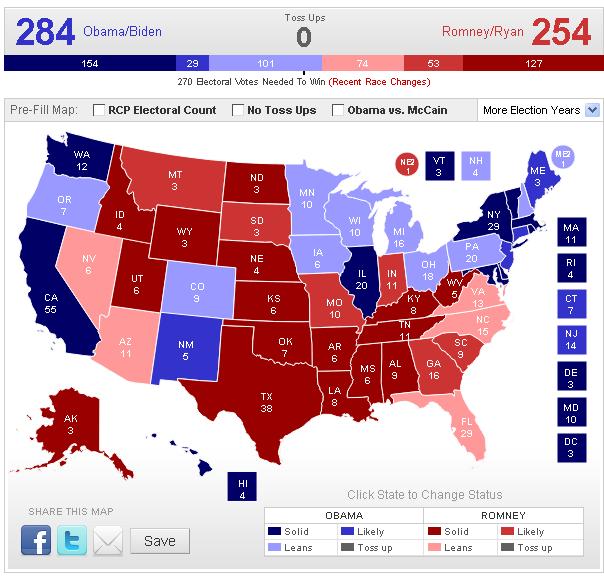
My 2012 Election Predictions (Obama vs. Romney)

The website www.realclearpolitics.com has a “create you own electoral map” feature, and I used it to make this. I’m going on record with my prediction before the polls open:  a narrow Obama victory, without Florida, in the electoral college. I also predict Obama will narrowly win the popular vote.

Soon, we’ll see how close to right I was when I made this.