Because I’m a Teacher

Image

Because I'm a teacher

Special PCSSD Board Meeting, 3:00 pm, Saturday, April 28 — Please Attend, and Spread the Word!

Dr. Janice Warren is the interim superintendent of the Pulaski County Special School District. It has become clear in recent weeks that she is not being treated fairly by the PCSSD’s Board of Education — even though she is, in my opinion, the best superintendent I’ve ever seen (and I have seen many).

Dr. Warren now needs our help, at a special meeting of the PCSSD school board, at 3:00 pm tomorrow. I’m asking teachers, parents, and other members of our community to come to this meeting, to show our support for Dr. Warren.

Please come to this important meeting if you can — and even if you cannot be there yourself, please help spread the word to others. We need to pack the boardroom tomorrow afternoon!

On Taxation, and Representation, in Public Education

The last few years have been rough for education in central Arkansas. The Pulaski County Special School District (PCSSD) suffered for years under state control, but local control has now been restored there. The neighboring Little Rock School District (LRSD) was more recently taken over by our state’s Department of Education, and is still in that unpleasant, and unhelpful, state.

When the state government takes over a school district, the people’s representatives (the local school board) are simply dismissed, and the Commissioner of our Department of Education functions as a one-man, unelected “school board.” It’s a situation which robs taxpayers (also known as voters) of any voice in how their schools are run. It doesn’t help instruction at all, which I know because I’ve observed it myself, as a teacher. In my opinion, all laws allowing state takeovers of school districts, nationwide, should be repealed. 

During this tumultuous period, there have been three elections about school millages: two in the PCSSD, and one in the LRSD. In the PCSSD, one vote (which failed) happened with that district still under state control. The second in the PCSSD happened yesterday, and this time, the measure passed by a 2-1 margin. What’s the key difference? Simple: when faced with a “taxation without representation” situation, the voters said no. Once local control was restored, the voters said yes.

In the neighboring LRSD, only one millage-related election has taken place recently, and it happened under state control, just like the first of the recent two in the PCSSD. In the LRSD, with their right to representation still denied to them, this ballot measure failed.

The lesson to be learned here is simple: to get support from voters, local control of public school districts must be maintained. We’re Americans; “no taxation without representation” was one of the primary reasons we fought for independence in the first place. Nationwide, it’s part of our story, as a people. Taxation without representation does not work here — specifically because it is un-American. That should be the lesson learned from these three elections.

The PCSSD is free from state control, and things are now improving there. Hopefully, the LRSD will enjoy the same benefit — soon — along with other school districts in the same situation, in our state, and nationwide.

June 13 Special Election in the PCSSD

Voters in the Pulaski County Special School District in central Arkansas vote, June 13, on a millage extension. This isn’t a new tax, but just an extension of what we already pay in property taxes. The schools need this money to build classroom space, etc. for our growing student population. If you live in the PCSSD, please vote FOR this measure on June 13.

A “Thumbs Up” for Google Classroom

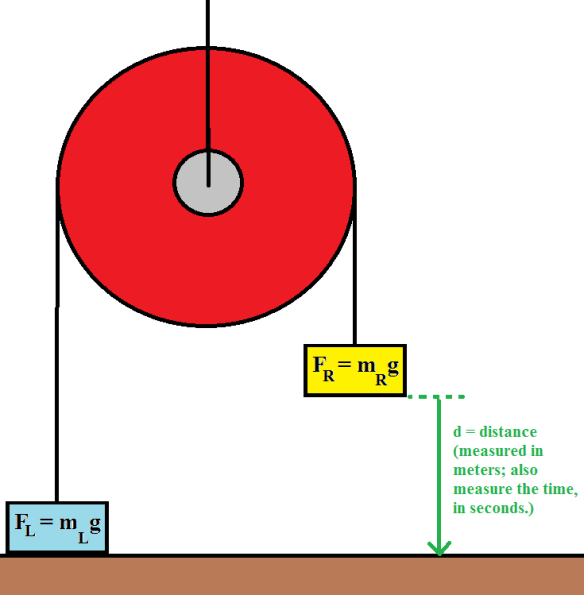
This is my 22nd year of teaching, but my first year using Google Classroom. We’re finding it to be a useful tool. This, for example, is the diagram for the Atwood’s machine lab we are doing in Pre-AP Physical Science, beginning today. My students will find this waiting for them in their virtual classroom (on Chromebooks my school district provides), with discussion-prompts to get us started:

atwoods-machine-diagram

I had no idea that four years of blogging, here on WordPress, had been preparing me to use this teaching tool. However, active blogging does require one to develop some transferable skills, especially in fields (such as what I teach) which are similar to the topics of one’s blog, as is the case here.

A Scenario I Would Like to See: Friendly Competition, Between Teachers’ Unions and School Administrators, to Help School Libraries Everywhere

school libraries

During the Cold War, the usual way nations compete (direct warfare) was taken off the table by the invention of the hydrogen bomb. With the alternative being mutually-assured destruction, the two sides, led by the USA and the USSR, had to find other ways to compete. Some of those ways were harmful, such as proxy wars, as happened in Vietnam. Others, however, were helpful, such as the space race. The United States put men on the Moon in order to beat the Soviet Union there, as this iconic 1969 photograph makes evident (source: NASA).

planting the flag

We are all still reaping the benefits of the technological and scientific advances made during this period, and for this purpose. The most obvious example of such a benefit is the computer you are using to read this blog-post, for computer technology had to be advanced dramatically, on both sides, in order to escape the tremendously-challenging gravity-well of the Earth.

Wouldn’t it be wonderful if other conflicts in society took beneficial forms, as happened in this historical example?

This could happen in many ways, but the one that gave me the idea for this post is the conflict between teachers’ unions and school districts’ administrators, now taking place in school districts all over the place. I think it would be awesome if this previously-harmful competition changed, to take a helpful form: book drives, to help school libraries.

Please do not misunderstand, though: I’m not talking about taxpayer money, nor union dues. My idea need not, and should not, affect the budget of any school district, nor union budget. All that need happen is for individual people — teachers and administrators  — to go home, look at their own bookshelves, and help students directly, by donating some of their already-paid-for books to school libraries.

While I make no claim to represent any organization, I am a teacher, and a member of the NEA (the National Education Association) in the United States, as well as my state and local NEA affiliates. In an effort to start this new, helpful way to compete, I will give books to the school library where I teach, next week, which is the second week of the new school year. That’s a lot easier than, well, putting men on the Moon. 

This is something we can all do. All of us in the education profession, after all, already agree that we want students reading . . . and this is something we can easily do, to work together towards that goal. School libraries need hardcover books which are student-friendly, meaning that they appeal to a young audience, on a wide variety of subjects. Both fiction and non-fiction books are helpful.

Lastly, in the hope that this idea catches on, I will simply point out one fact: helping turn this idea into a reality is as easy as sharing a link to this blog-post. 

We’re Going Back to School Tomorrow, and I’m the Teacher.

Trunc Icosa

This is my 22nd year teaching. This year, I teach in only one department. This is nice; I’ve spent much of my career in multiple departments, simply because I am certified in multiple subject areas. This year, in my building, I am one of three science teachers. Our high school has become so large that the 9th grade has been “spun off” to a new freshman campus, while remaining part of the high school, and I’m one of the teachers who gets to go to the new campus. This provides my students, my colleagues (especially at the new campus), and myself the opportunity for a fresh start, to a greater degree than is usually the case when a new school year begins.

My students are in just two subjects, this year: Physical Science, and Pre-AP Physical Science. I don’t want the students in the class without the “Pre-AP” prefix to feel that they are in a “lesser” class, in any sense of that word, so I am renaming “Physical Science,” slightly: “High School Physical Science.” It is my hope that this change in wording serves to communicate high expectations, and 9th grade is the first year of high school — which, in the USA’s public school systems, means 9th grade students must pass courses to earn credits toward graduation, usually for the first time.

In the other class, Pre-AP Physical Science, I am teaching that version of the course for the first time, but I feel well-prepared by the extensive training I had this Summer, and last school year, through my university, the school where the Summer training was held, and the College Board. Both classes will challenge students, but it is also true that the two classes will be different, for Pre-AP Physical Science have to leave students prepared to function effectively, later, in other Pre-AP and/or AP science courses. 

Physical Science is an introduction to two sciences: physics, and then chemistry, at least in my school district. It helps me that I have experience teaching both subjects as higher-level, “stand-alone” classes. In this class (both versions), we also touch on some other sciences which are also physical sciences, such as geology, astronomy, and the science of climate change. However, those sciences do not dominate these courses, as physics and chemistry do. The image above is from chemistry (and was created with Stella 4d, which you can try here), and shows a model of a sixty-atom all-carbon molecule called buckminsterfullerene, one of a class of roughly-spherical carbon allotropes called fullerenes. Mathematicians call this particular fullerene’s shape a “truncated icosahedron,” and, in sports, this same shape is known as the (non-American) “football” or “soccer ball.” Physical modes of this shape may be made with molecular model sets of various kinds, Zometools, and other materials. In both versions of my science classes this year, building models of this molecule will be one of many lab activities we will do; one of my goals this year is for my students to spend a third of their time doing labs. The legal requirement for science class time spent in lab, in my state, is at least one-fifth, so more than that is fine. Science classes helped me learn both science and mathematics, but what I remember the most is the labs. I don’t think that’s just me, either; students learn more effectively, I have observed, by conducting scientific experiments themselves, than by being “lectured at” for extended periods of time.

I’m looking forward to a good year — for all of us.

For Science Teachers: A Safer Alternative to Liquid Mercury

Liquid mercury, in schools, poses three major problems:

  1. It is extremely toxic,
  2. It has a high vapor pressure, so you can be poisoned by invisible mercury vapor leaving any exposed surface of liquid mercury, and
  3. Playing with liquid mercury is a lot of fun.

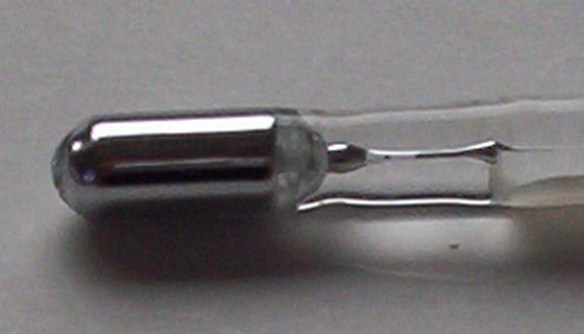
These are compelling reasons to leave use of mercury to those at the college level, or beyond. In the opinion of this science teacher, use of liquid mercury in science classes, up through high school chemistry, inside or outside thermometers, is a bad idea. If the bulb at the bottom of a thermometer, as well as the colored stripe, looks silvery, as in the picture below (found on Wikipedia), then that silvery liquid is mercury, and that thermometer should not be used in labs for high school, let alone with younger children. Your local poison control center can help you find the proper thing to do with mercury in your area; it should definitely not just be thrown away, for we do not need this serious environmental toxin in landfills, where it will eventually reach, and poison, water. Red-stripe thermometers without any silvery line, on the other hand, are far safer, although broken glass can still cause injury.

Maximum_thermometer_close_up_2

I turned ten years old in 1978, and, by that time, I had already spent many hours playing (unsupervised) with liquid mercury, pouring it hand-to-hand, etc., so I know exactly how irresistible a “plaything” mercury can be, to children. Luck was on my side, and I suffered no ill effects, but I can state from experience that children should not be tempted with highly-toxic “mercury as a toy,” for it’s not a toy at all. Mercury spills require special “hazmat” training to clean up safely; anyone encountering such a spill who does not have such training should simply notify the proper authorities. In the USA, this means evacuating the area immediately, and then calling 911 — from far enough away to keep the caller from breathing invisible mercury vapor.

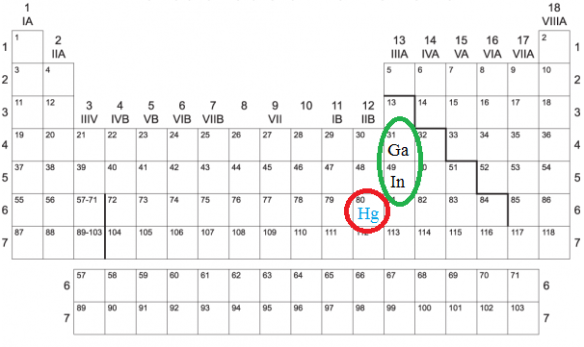
Fortunately, there is a safe alternative which can give students a chance to experiment with a room-temperature metal: an alloy of three parts gallium to one part indium, by mass. Gallium’s melting point is between normal human body temperature and room temperature, so it can literally melt in your hand (although a hot plate is faster). Indium, on the other hand, has a melting point of 156.6°C. For this reason, I will not buy a hot plate unless it can reach higher that that temperature. (Note: use appropriate caution and safety equipment, such as goggles and insulated gloves, with hot plates, and the things heated with them, to avoid burns.)

Once both elements are massed, in the proportions given above, they can then be melted in the same container. When they melt and mix together, they form an alloy which remains liquid at room temperature.

Some might wonder how mixing two elements can create an alloy with a melting point below the melting points of either of the two ingredients, and the key to that puzzle is related to atomic size. Solids have atoms which vibrate back and forth, but don’t move around each other. In liquids, the atoms are more disordered (and faster), and easily slip around each other. In solid, room-temperature gallium, all the atoms are of one size, helping the solid stay solid. Warm it a little, and it melts. With pure indium, this applies, also, but you have to heat it up a lot more to get it to melt. If the two metals are melted and thoroughly mixed, though, and then frozen (a normal freezer is cold enough), the fact that the atoms are of different sizes (indium atoms are larger than gallium atoms) means the atoms will be in a relatively disordered state, compared to single-element solids. In liquids, atoms are even more disordered (that is, they possess more entropy). Therefore, a frozen gallium/indium alloy, with two sizes of atoms, is already closer to a disordered, liquid state, in terms of entropy, than pure, solid gallium or indium at the same temperature. This is why the gallium-indium mixture has a melting point below either individual element — it requires a lower temperature to get the individual atoms to flow past each other, if they are already different atoms, with different sizes.

liquid metals

Those who have experience with actual liquid mercury will notice some important differences between it and this gallium-indium alloy, although both do appear to be silver-colored liquids. (This is why mercury is sometimes called “quicksilver.”) For one thing, their densities are different. A quarter, made of copper and nickel, will float on liquid mercury, for the quarter’s density is less than that of mercury. However, a quarter will sink in liquid 3:1 gallium-indium alloy. To float a metal on this alloy, one would need to use a less-dense metal, such as aluminum or magnesium, both of which sink in water, but float in liquid Ga/In alloy.

Other differences include surface tension; mercury’s is very high, causing small amounts of it on a floor to form little liquid balls which are difficult (and dangerous) to recapture. Gallium-indium alloy, by contrast, has much less surface tension. As a result, unlike mercury, this alloy does not “ball up,” and it will wet glass — and doing that turns the other side of the glass into a mirror. Actual mercury will not wet glass.

The most important differences, of course, is that indium and gallium are far less toxic than mercury, and that this alloy of those two elements has a much lower vapor pressure than that of mercury. Gallium and indium are not completely non-toxic, though. Neither indium nor gallium should be consumed, of course, and standard laboratory safety equipment, such as goggles and gloves, should be worn when doing laboratory experiments with these two elements.

A Mathematical Model for Human Intelligence

Curiosity and Intelligence

People have been trying to figure out what intelligence is, and how it differs from person to person, for centuries. Much has been written on the subject, and some of this work has helped people. Unfortunately, much harm has been done as well. Consider, for example, the harm that has been done by those who have had such work tainted by racism, sexism, or some other form of “us and them” thinking. This model is an attempt to eliminate such extraneous factors, and focus on the essence of intelligence. It is necessary to start, therefore, with a clean slate (to the extent possible), and then try to figure out how intelligence works, which must begin with an analysis of what it is.

If two people have the same age — five years old, say — and a battery of tests have been thrown at them to see how much they know (the amount of knowledge at that age), on a wide variety of subjects, person A (represented by the blue curve) may be found to know more, at that age, than person B (represented by the red curve). At that age, one could argue that person A is smarter than person B. Young ages are found on the left side of the graph above, and the two people get older, over their lifespans, as the curves move toward the right side of the graph.

What causes person A to know more than person B, at that age? There can be numerous factors in play, but few will be determined by any conscious choices these two people made over their first five years of life. Person B, for example, might have been affected by toxic substances in utero, while person A had no such disadvantage. On the other hand, person A might simply have been encouraged by his or her parents to learn things, while person B suffered from parental neglect. At age five, schools are not yet likely to have had as much of an impact as other factors.

An important part of this model is the recognition that people change over time. Our circumstances change. Illnesses may come and go. Families move. Wars happen. Suppose that, during the next year, person B is lucky enough to get to enroll in a high-quality school, some distance from the area where these two people live. Person B, simply because he or she is human, does possess curiosity, and curiosity is the key to this model. Despite person B‘s slow start with learning, being in an environment where learning is encouraged works. This person begins to acquire knowledge at a faster rate. On the graph, this is represented by the red curve’s slope increasing. This person is now gaining knowledge at a much faster rate than before.

In the meantime, what is happening with person A? There could be many reasons why the slope of the blue curve decreases, and this decrease simply indicates that knowledge, for this person, is now being gained at a slower rate than before. It is tempting to leap to the assumption that person A is now going to a “bad” school, with teachers who, at best, encourage rote memorization, rather than actual understanding of anything. Could this explain the change in slope? Yes, it could, but so could many other factors. It is undeniable that teachers have an influence on learning, but teacher quality (however it is determined, which is no easy task) is only one factor among many. Encouraging the “blame the teacher” game is not the goal of this model; there are already plenty of others doing that.

Perhaps person A became ill, suffered a high fever, and sustained brain damage as a result. Perhaps he or she is suddenly orphaned, therefore losing a previous, positive influence. There are many other possible factors which could explain this child’s sudden decrease of slope of the blue “learning curve” shown above; our species has shown a talent for inventing horrible things to do to, well, our species. Among the worst of the nightmare scenarios is that, while person B is learning things, at a distant school, the area where person A still lives is plunged into civil war, and/or a genocide-attempt is launched against the ethnic group which person A belongs to, as the result of nothing more than an accident of birth, and the bigotry of others. Later in life, on the graph above, the two curves intersect; beyond that point, person B knows more than person A, despite person B‘s slow start.  To give credit, or blame, to either of these people for this reversal would clearly be, at best, a severely incomplete approach.

At some point, of course, some people take the initiative to begin learning things on their own, becoming autodidacts, with high-slope learning curves. In other words, some people assume personal responsibility for their own learning. Most people do not. Few would be willing to pass such judgment on a child who is five or six years old, but what about a college student? What about a high school senior? What about children who have just turned thirteen years old? For that matter, what about someone my age, which is, as of this writing, 48? It seems that, the older a person is, the more likely we are to apply this “personal responsibility for learning” idea. Especially with adults, the human tendency to apply this idea to individuals may have beneficial results. That does not, however, guarantee that this idea is actually correct.

I must stop analyzing the graph above for now, because the best person for me to examine, at this point, in detail, is not on the graph above. He is, however the person I know better than anyone else: myself. I’ve been me now for over 48 years, and have been “doing math problems for fun” (as my blog’s header-cartoon puts it) for as long as I can remember. This is unusual, but, if I’m honest, I have to admit that there are inescapable and severe limits on the degree to which I can make a valid claim that I deserve credit for any of this. I did not select my parents, nor did I ask either of them to give me stacks of books about mathematics, as well as the mathematical sciences. They simply noticed that, when still young, I was curious about certain things, and provided me with resources I could use to start learning, early, at a rapid rate . . . and then I made this a habit, for, to me, learning is fun, if (and only if) the learning is in a field I find interesting. I had absolutely nothing to do with creating this situation. My parents had the money to buy those math books; not all children are as fortunate in this respect. Later still, I had the opportunity to attend an excellent high school, with an award-winning teacher of both chemistry and physics. To put it bluntly, I lucked out. As Sam Harris, the neuroscientist, has written, “You cannot make your own luck.”

At no point in my life have I managed to learn how to create my own luck, although I have certainly tried, so I have now reached the point where I must admit that, in this respect, Sam Harris is correct. For example, I am in college, again, working on a second master’s degree, but this would not be the case without many key factors simply falling into place. I didn’t create the Internet, and my coursework is being done on-line. I did not choose to be born in a nation with federal student loan programs, and such student loans are paying my tuition. I did not create the university I am attending, nor did I place professors there whose knowledge exceeds my own, regarding many things, thus creating a situation where I can learn from them. I did not choose to have Asperger’s Syndrome, especially not in a form which has given me many advantages, given that my “special interests” lie in mathematics and the mathematical sciences, which are the primary subjects I have taught, throughout my career as a high school teacher. The fact that I wish to be honest compels me to admit that I cannot take credit for any of this — not even the fact that I wish to be honest. I simply observed that lies create bad situations, especially when they are discovered, and so I began to try to avoid the negative consequences of lying, by breaking myself of that unhelpful habit. 

The best we can do, in my opinion, is try to figure out what is really going on in various situations, and discern which factors help people learn at a faster rate, then try to increase the number of people influenced by these helpful factors, rather than harmful ones. To return to the graph above, we will improve the quality of life, for everyone, if we can figure out ways to increase the slope of people’s learning-curves. That slope could be called the learning coefficient, and it is simply the degree to which a person’s knowledge is changing over time, at any given point along that person’s learning-curve. This learning coefficient can change for anyone, at any age, for numerous reasons, a few of which were already described above. Learning coefficients therefore vary from person to person, and also within each person, at different times in an individual’s lifetime. This frequently-heard term “lifelong learning” translates, on such graphs, to keeping learning coefficients high throughout our lives. The blue and red curves on the graph above change slope only early in life, but such changes can, of course, occur at other ages, as well.

It is helpful to understand what factors can affect learning coefficients. Such factors include people’s families, health, schools and teachers, curiosity, opportunities (or lack thereof), wealth and income, government laws and policies, war and/or peace, and, of course, luck, often in the form of accidents of birth. Genetic factors, also, will be placed on this list by many people. I am not comfortable with such DNA-based arguments, and am not including them on this list, for that reason, but I am also willing to admit that this may be an error on my part. This is, of course, a partial list; anyone reading this is welcome to suggest other possible factors, as comments on this post. 

On your nth birthday, you turn n – 1 years old.

birthday cake

As a teacher, I have had variants of this conversation many times. The specific details, however, are fictional, for this changes, somewhat, each time it happens.

  • Student: Guess what? It’s my birthday!
  • Me: Congratulations! How old are you?
  • Student: I’m seventeen!
  • Me: Well, happy 18th birthday, then!
  • Student: Huh?
  • Me: Look, on that one day, 17 years ago, when you were born, that was your birthday. That day has a better claim on being your birthday than any other day, because it’s the day you were born. That was your first birthday. But you weren’t one year old yet. You turned one year old a year later, on your next birthday . . . your second birthday. A year later, on your third birthday, you turned two years old. Do I need to continue?
  • Student: So I’m 18? I can buy cigarettes without a fake ID, and vote, and stuff?
  • Me: No, not for another year, because you’re only 17 years old — but you have had 18 birthdays. Say, here come some of your friends. Use this bit yourself, if you want to, and have fun with it.
  • Student, to other students: Hey, guys, it’s my birthday! I’m 18 today!

…At least I try. Also, sometimes, the educational outcome is better than in this fictionalized example.


[Image source: http://www.decorationnako.tk/birthday-cake/]