Unknown's avatar

About RobertLovesPi

I go by RobertLovesPi on-line, and am interested in many things, a large portion of which are geometrical. Welcome to my own little slice of the Internet. The viewpoints and opinions expressed on this website are my own. They should not be confused with those of my employer, nor any other organization, nor institution, of any kind.

Two Versions of Mandalas Centered on Regular Octadecagons

18

18b

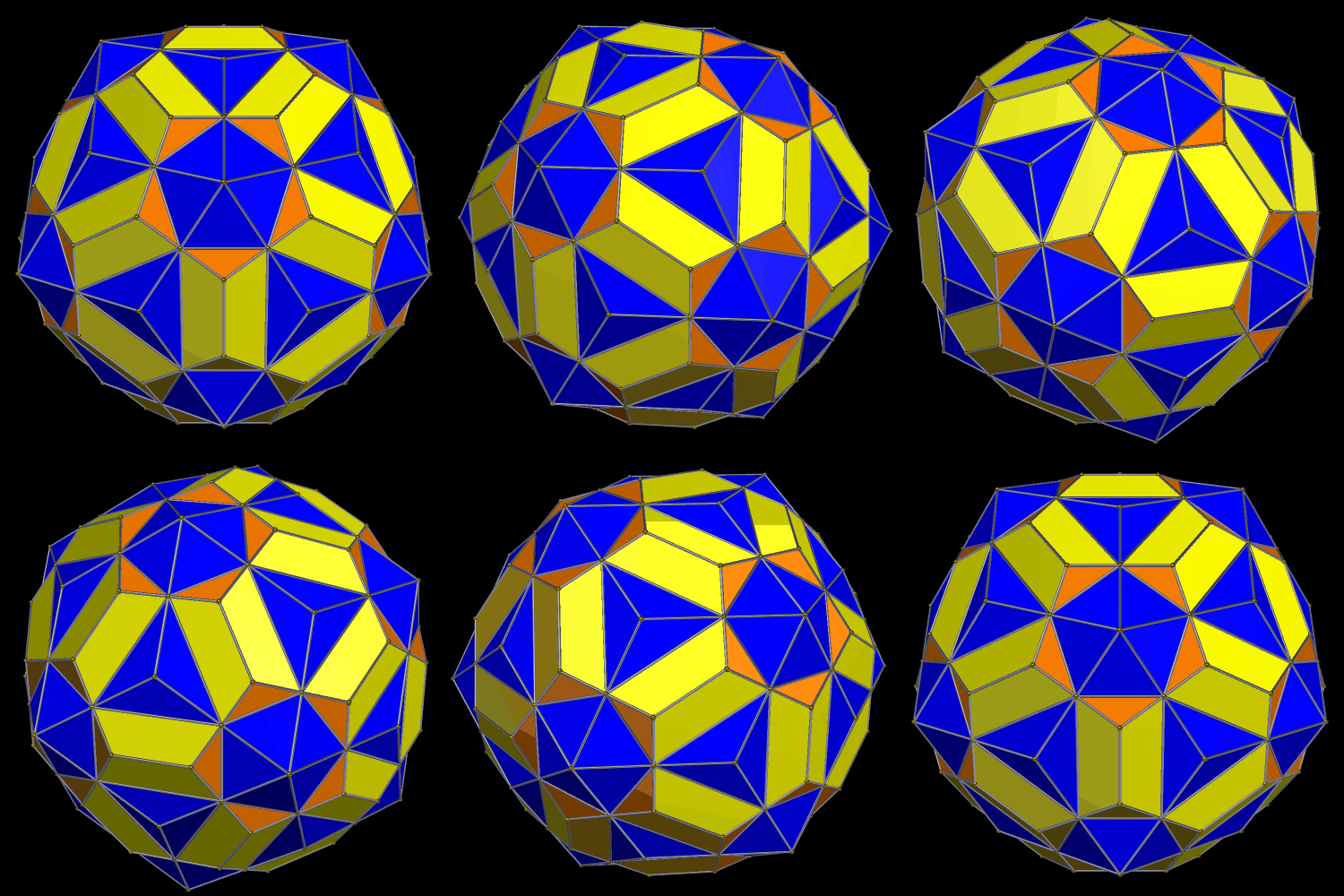
A Compound of the Rhombic Triacontahedron and a Truncation of the Icosahedron

Stellated Dual Morph 50.0%

In the compound above, the yellow hexagons are not quite regular, which is why I’m calling the yellow-and-orange polyhedron a truncation of the icosahedron, rather than simply the truncated icosahedron. I stumbled upon it while playing with Stella 4d, which you may try for free at http://www.software3d.com/Stella.php.

Microsoft, the Misfit

Fact One: Microsoft’s trading symbol is “MSFT.”
Fact Two: If you try to pronounce “MSFT,” it sounds like “misfit.”
Conclusion: We must never call this company “Microsoft,” ever again. “Misfit” is its name, from now on.

On Leaving the Brick-and-Mortar Classroom

I’ve been a high school teacher for the last 25 years. I’m also leaving the classroom — but I’m not leaving teaching. Next year will be my 26th year teaching, and I’ve been told that I’ll be teaching on-line, from an office.

screensharing

This is how we all taught during the fourth quarter of the last school year, except we did it from home, since brick-and-mortar schools shut down, all over the world, due to the COVID-19 pandemic. We used screensharing in Google Hangouts (shown above), Google Classroom, e-mail, and lots of other things to finish the school year . . . and we did finish it, successfully. This year, teachers won’t be at home (unless things change, due to the coronavirus), but many of our students will be staying home.

After I’d finished everything up for the 2019-2020 year, I went to school to turn in my keys. At that point, it was obvious that we were likely to have some sort of dual-track system for 2020-2021, with some students receiving instruction at school, and others at home, remotely, using their district-issued Chromebooks. I told my principal that if we did end up doing such a system, that I wanted to be on the “home team.” I don’t want to have to go to school and risk COVID-19 infection, which could then be spread to my family, some of whom are in high-risk groups for this disease. I’ve now received confirmation that I will be a remote-learning instructor next year, presumably working with students from all over the district.

I’m going to miss my old school, both the Sylvan Hills High North Campus and the Sylvan Hills High Main Campus. Sylvan Hills taught me a lot about being a better teacher. As a result, I’m leaving with an improved ability to help students, compared to six years ago, when coming to Sylvan Hills from other schools. My principals at these two campuses deserve a lot of the credit for this. I’ve worked with many administrators over the years, and these two are the ones who have helped me the most in my efforts to become a better teacher.

The coming year will present many challenges. To teach effectively, you have to get to know your students. We’ll be doing instruction and discussions with computers, webcams, microphones, and speakers, so I’m going to have to make a lot of adjustments to get to know my students as real people, while teaching remotely for a full year. The end of the last school year gave me a lot of experience I can build on.

This next year should be interesting, and I am looking forward to it.

Soothing Fingers (a painting from 2009)

Soothing Fingers

16″ x 20,” acrylic on canvas.


The COVID Rebound, Defined

COVID rebound

Example:

“Honey, why are you home from the store so fast?”

“I didn’t make it all the way there. This is just a COVID rebound.”

I’ve submitted this to Urban Dictionary, so hopefully it will appear there soon.

My Predicted 2020 Presidential Electoral Map

I’m predicting that Joe Biden will win a slim electoral majority, as well as a large popular-vote advantage, over Donald Trump.

election 2020

In this particular scenario, the swing states all go for Trump, except for Arizona and Florida, which Biden wins. Both Arizona and Florida have large elderly populations, and I don’t think they’re much caring for the way Trump is treating them as disposable people when it comes to the COVID-19 pandemic.

If you would like to make your own prediction-map, the website to visit to do so is www.270towin.com.

Cubes Made of Lux Blox

What is a cube? That’s a simple question, and I thought it had a simple answer . . . until I took on the project of building cubes with Lux Blox. Lux can be bought at this website, but one thing you won’t find there, or in shipments of Lux, are directions. This was a little frustrating at first, but I understand it now: the makers of Lux don’t want directions getting in the way of customers’ creativity.

A cube has six square faces. This is the six-piece Lux model based on that statement.

20200510_161402_resized

This first cube model is interesting, but it is also severely limited. Lux Blox connect at their edges, and all edges in this model are already used, joining one face to another. The model has no openings where more can be attached, and added to it.

Next, I made a cube out of Lux Blox which is open, in the sense that more Lux Blox can be attached to it. It also has an edge length of two.

20200510_161427_resized

Besides the openness of this model to new attachments, it also has another characteristic the smaller cube did not have: it can be stretched. If you take two opposite corners of this model and gently pull them away from each other, here’s what you get:

20200514_125856

Stretching a cube in this manner creates a six-faced rhombic polyhedron known as a parallelopiped.

The third cube model I’ve built of Lux Blox uses Lux Trigons in addition to the normal square-based Lux Blox.

20200510_161458_resized

In this model, the black pieces in the center are the Lux Trigons — twelve of them, occupying the positions of twelve of the twenty faces of an icosahedron. The other eight faces are where the orange triangles (or triangular prisms, if you prefer) are attached. The orange triangles mark the eight corners of a cube. This model has pyritohedral symmetry — the symmetry of a volleyball — as I hope this last picture, a close-up of this third type of cube, helps to illustrate.

20200510_161506_resized

On Picking Stocks and Mutual Funds: An Experimental Proposal

[Important disclaimer: I am not a registered investment advisor. If you choose to try the experiment described below, which is shared with everyone for free, the risk is yours alone.]

Lots of people have jumped into the stock market lately, many of them with little experience. That isn’t stopping them, though; they’re creating Robinhood accounts and trading penny stocks at a blinding rate. I’m writing this to propose an experiment individuals can use to evaluate their own skills at picking stocks and mutual funds. This experiment does require some experience investing, but not much.

First, divide your investment capital into three parts of equal size. With the first part, buy either QQQ or SPY, or equal amounts of each. These are ETFs which track well-known stock indices: the technology-heavy NASDAQ 100 and the broader S&P 500, respectively. This chart shows how the S&P 500 has performed over the last five years.

stock chart

This first third of the investment money is analogous to a control group; it is the standard by which we measure the performance of the other two-thirds.

The second third is to be invested in no-load, open-ended, actively-managed mutual funds. You should try to choose the best ones you can find. Two that I’ve bought shares of, myself, are TRBCX (a fund which invests mostly in large-capitalization blue-chip stocks), and WAMCX (a fund investing in small, rapidly-growing companies’ stocks).

The final third is made of stocks you pick and buy/hold/sell yourself, using whatever criteria you choose. If you run this experiment for six months (or longer), and this third is the largest at the end of this period, you have good evidence that your stock-picking methods work well, justifying continuing investing in this manner.

If, on the other hand, your hand-picked mutual funds do best, then the data supports the idea that you’re a good fund-picker, but should probably not invest in individual stocks.

Finally, what if SPY and/or QQQ do best? If that is the case, I wouldn’t try to beat the market with my own picks, but would simply invest in open-ended index funds, or ETFs.

I’m trying this experiment myself. So far, my hand-picked mutual funds are doing best. If the running of this experiment continues in this way, I’ll abandon the picking of individual stocks, in favor of mutual funds. Of course, it’s always possible to study and learn new things. If this running of the experiment yields the answer “funds,” there’s nothing stopping me from studying stock-picking some more, and then repeating the experiment to see if I get better results for the choosing of individual stocks. One could also abandon the experiment, but continue to invest in those particular stocks which did well.

There are some types of investment I haven’t mentioned here. Cash, money market funds, CDs, and bonds were not mentioned because interest rates are at historic lows, limiting the return one can get from such investments. As for derivatives, such as options or futures, those have not been included simply because I have no experience with derivatives. Traditional hedges against inflation, such as gold and silver, are not included because inflation is almost non-existent.

One last thing: Robinhood’s customers will have a hard time doing this experiment, for that company does not offer mutual funds. Schwab does, though; that’s the broker I use — and the one I recommend. You can find them online at http://www.schwab.com.

GNUS

Image

gnus