“Math Problems for Fun”: The Source of My Blog’s New Header-Image

cyanide and happiness without black border

I don’t usually post the work of others here, but, since I am now using this as my blog’s header-image (in slightly altered form), it seemed appropriate to make an exception for this cartoon, in its original format. I didn’t know that the cartoonists at Cyanide and Happiness monitored my life, but, clearly, that guy in the blue shirt is me!

Purple: Connecting Fiction, and Personal Trauma

Purple is not my favorite color (black is, but that’s another story), but it is a significant color for me, for complicated reasons I shall try to explain here. In some regards, this blog-post can be seen as a review of Netflix’s new series, Jessica Jones. My opinion of the series, in brief: five stars — watch it!

Do not expect watching this show to be easy, though. Like Flannery O’Connor’s fiction, it plumbs the depth of human depravity, through the character of Killgrave, also known as The Purple Man, a character who has existed in comic books since 1964, when he appeared in issue #4 of Daredevil.

Purple_Man

[Art by Tom Grummett; image found here, and from a comic book cover other than Daredevil #4.]

Killgrave’s skin is not purple in the new TV series, but he’s every bit as horrible a person as in comic book stories. He has one superpower, but it’s a nearly-impossible one to overcome: when he tells people to do things, they immediately do what he says, even to the point of killing themselves or others.

I was interested in Killgrave (and Jessica Jones) from the first time I saw either of them in a comic book, long before this TV series was planned. However, about halfway through the first season, I suddenly realized why Killgrave held such personal fascination for me as a truly horrible character — and why I hated him so intensely. It’s the fact that he controls the minds of other people, using his voice.

My father did the same thing, although he certainly did not have purple skin, and never, to my knowledge, killed anyone (but he did leave a string of damaged people in his wake). His voice had a hypnotic quality. There are people, to this day, who will claim to have seen him float straight up into the air — because they were told to see him levitate. I never saw that, but I do have faint memories, from a very early age, of seeing other unreal things, at his verbal suggestion, such as four or five finger-to-finger “ribbons of energy” called “orgone” connecting my hands, held in front of me, at night. Other children my age were with me; they saw these “orgone energy ribbons,” and more. I got away from this insanity as quickly, and as often, as I was able to do. Avoiding my father became my habit early, and often.

Many people have had horrible things done to them, due to abuse of this ability. In fiction, Killgrave, The Purple Man, is the best example of such a monster using his voice as a mind-control weapon. In reality, my father (and others with a similar ability, such as leaders of religious cults, a role my father did play, more than once) is another example.

When I realized the similarity between Killgrave and my now-deceased father, I had to stop watching Jessica Jones for about 24 hours. Having been a survivor of mind control left me (in real life) and Jessica Jones (in fiction) with PTSD, and I had to have a break from watching the show for this reason.

During this 24 hours, I remembered something about my father (who died in 2010) and my mother (who died less than two weeks ago): a story my mother told me, many years later.

Apparently my father hated the color purple, although I have no idea why. She was under his voice-control for years. So was I. We broke completely free of this manipulative monster at about the same time, in the mid-1980s. She left, and then divorced, him. I came up with my own way to “divorce” him as a parent, myself: I legally changed my last name to my mother’s maiden name. These things I knew already; the new thing Mom told me was what she did to celebrate her breaking free of his influence: buying a purple dress, and going out, wearing it, to celebrate her freedom.

After remembering this, I was able to watch the rest of the first season of Jessica Jones. I will not leave specific spoilers here, but I will say this: watching the rest of it helped with the ongoing process of recovering from my own “purple trauma.”

Rebecca West, on Feminism — and My Own, Personal Reasons for Calling Myself a Feminist

feminism

Of my two parents, one (no longer living) was a misogynistic, manipulative, abusive monster, with a list of surviving victims longer than this entire blog-post. My mother, however, is living, and has always been a feminist. I was raised by one loving, feminist parent, while constantly doing mental, verbal, and sometimes even physical battle, in self-defense, against my other parent — as a matter of survival.

This accounts, I am certain, with the fact that, to this day, it is far easier for me to form friendships with women than with men. Simply put, it is difficult for me to trust men. Men commit an overwhelming majority of the murders which happen, as well as virtually all of the rapes, and it is male politicians, as a rule, who start most — perhaps all — of the world’s far-too-numerous wars, both in the present, and the past. When one’s earliest memory is having one’s mother save one’s own life, from death by shaken baby syndrome, at age 2 ½, inflicted by one’s own father, there is no escape from lifelong psychological fallout from such a traumatic event. This is my earliest memory, and one of the causes of my PTSD, with which I will have to struggle with for the rest of my life, for this condition, unfortunately, has no cure.

When my parents (finally) divorced, around my 20th birthday, I actually went to the trouble (and expense) to legally change my last name to my mother’s maiden name, and I did this to show everyone whose side I was on — and to shed a surname which I associate, to this day, only with negative things in my life. I regret nothing about this decision. I am glad that the monster found out about this name-change, shortly after I did it, for he deserved the pain I deliberately inflicted on him by this action.

I can follow exactly half of the Biblical commandment to “Honor thy father and they mother” (Exodus 20:12), but I cannot follow the other half, for this particular monster had no honor, nor did he deserve any, now, or at any time I can remember.

I also regret nothing about the fact that my deceased parent — the monster — is no longer able to hurt anyone, since what’s left of him is, well, underground, in the literal sense of the word. I did not attend the monster’s funeral, nor was I saddened, even in the slightest, when I learned of his death. He is completely unmourned by me — and I make no apologies for any of these things.

I do not speak, nor do I write, my original last name. There are over 1400 posts on this blog, and that name appears in none of them. The reason is simple: it is not my name.

I completely agree with Rebecca West’s perfectly-reasonable definition of feminism, shown above, and, since I do subscribe to the “radical notion” that women are actually people, I see no problem whatsoever with applying the word “feminist” to myself. I’m male, after all, only as an accident of birth, and am not going to let that “coin-flip” keep me from adopting labels of my own choosing. “Feminist” is a label I wear with pride, and for highly personal reasons, as explained above. I always have been, and will remain, opposed to any efforts (such as those from the radical religious right in America) to oppress the female majority of the population. If those efforts end up destroying the Republican Party in America — which will happen, unless they reform themselves first — then Republicans will have no one to blame but themselves, and their willingness to tolerate extreme misogyny among their own ranks.

Daredevil Fan-Fiction: Why Did Matt Murdock’s Mother Leave His Father?

150926_0000

I will start with an introduction, to set the context of this story.

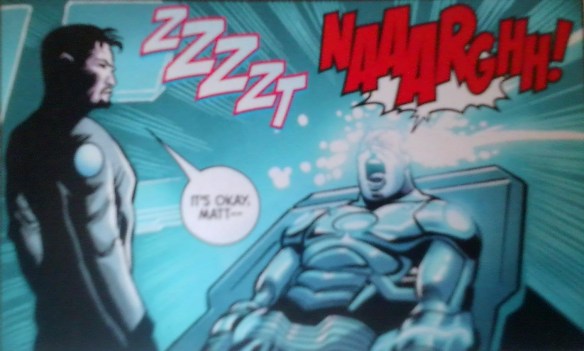
In the issue of Superior Iron Man shown above (#4, published in 2015), Tony Stark, also known as Iron Man (having had a “moral inversion,” or good/evil reversal), is the villain of the story, while Matt Murdock, also known as Daredevil, is the hero. It isn’t a typical comic book, for, in this story, the bad guy wins. Stark uses advanced technology to overpower Murdock, and then this happens, near the end of the issue.
150926_0001

In the next panel, Matt wakes up, in a hospital, with no memories of the conflict with Stark.

150926_0002

It is important to note that, earlier in this multi-issue story, which begins in Superior Iron Man #1, Stark restores Murdock’s ability to see. Realizing that the price of this is far too high, Murdock deliberately shuns this “gift” from Stark, and voluntarily allows his blindness to return.

Now that the stage is set, on to the fan-fiction, which takes place, mostly, in the mind of Matthew Murdock, who is also an attorney, in-between the two panels shown above.

~~~

Matt Murdock was blinded in a childhood accident, so he is used to darkness — but the darkness now enveloping him is far emptier than usual. His enhanced senses are gone. Hearing nothing, smelling nothing, tasting nothing, feeling nothing, and his “radar-sense” gone, he is now blind — really blind. Deprived of all sensory input, he also has no idea what is going on. However, he can think, and can also remember.

The first thing he remembers is a single name: STARK!

That name triggers a recent memory: the brief, recent period where one of Tony Stark’s inventions restored his sight. For a time — an unknown amount of time — he simply watches, as if watching a TV show, the things he saw during this short time. The show plays itself out, as if on a large screen. His anger at Stark forgotten, Matt watches the show of his recent memories, as one might passively watch a movie. He feels he is floating, in a void, as he watches. As this “movie” plays, there is a sudden freeze-frame: the pictures stop moving. Context is immediately forgotten. All he sees is a single image, which is what he happened to be looking at when the “movie” of his recent memories was suddenly, and unexpectedly, put on “pause.”

150926_0004

A jar of peanut butter? Why did the images freeze at this spot? What’s going on? Did I see this in a store? Did I see it in my home? Where did I . . . ?

Daredevil is popularly-known as “The Man Without Fear,” but he’s always known that this description is inaccurate. For example, he fears the possibility of those he loves getting injured, or killed, by any of his numerous enemies, because of his exploits as a costumed hero — for that has already happened to him, more than once. He also realizes that he fears something else, but only if he sees it: peanut butter.

Peanut butter? Why that, of all things?

An earlier, strongly-repressed, memory then surfaces, and a great many things fall painfully into place for Matthew Murdock.

Oh, no . . . anything but this . . . . 

He is no longer seeing recalled memories from a few days ago, but from early childhood — before the accident that blinded him. He was very young, had a bad head cold, and could smell nothing, explaining why the smell of peanut butter never triggered this memory before.

Young Matthew looks around. He sees the kitchen of his childhood home. His parents, Jack and Margaret Murdock, are still together. He is wearing the clothes of a toddler, because that is what he was at this time. He’s on top of a counter in the kitchen, having climbed up there, using chairs to make a crude “staircase.” And there, on the floor, is a five-pound jar of peanut butter, surrounded by shards of broken glass. 

Matt, as a toddler, had only been looking for some cookies. He had not meant to knock his father’s gigantic glass jar of peanut butter off the counter, but the deed was done. The jar was broken, and could not be unbroken. There was broken glass in the peanut butter now; it could not safely be eaten. His family didn’t have much money, for his father’s career as a professional boxer was going nowhere, and his mother only made a little money, at the elementary school down the street, working as a substitute teacher. “Battlin’ Jack” Murdock, whom the adult Matt Murdock had idolized for years, was eating as much peanut butter as he could, simply to gain weight, and protein, in the hopes that this would, somehow, make him a better boxer.

The crash of the glass jar hitting the floor echoed throughout the family’s small Hell’s Kitchen apartment. With his earliest memories now unlocked, he knew what was coming next. Matt tried desperately to stop the memory-playback.

He failed, and his mind filled with fear.

Loud footsteps . . . Dad? No! Please, please don’t . . . I don’t need to see this happen again . . . not again . . . . never again . . . .

“MATT!” His father had just burst into the room, having heard the crash. He saw the broken jar of peanut butter on the floor. His son started to cry, afraid of what he knew, in hindsight, was about to happen. “You clumsy little %$#@! Do you have any idea how much that jar COST me?” An incoherent, deep-voiced, roar of rage followed — and the noise from his father seemed louder than anything the adult Murdock had ever heard, even from his arch-enemy, Wilson Fisk, the Kingpin of Crime, and even with his enhanced senses taken into account.

Matt’s father, already drunk, in the middle of the afternoon, kept yelling at his son: “I’ll KILL you for this, you worthless little son of a &*%$#!!”

And, with that, the enraged “Battlin’ Jack” Murdock grabbed his only son, by both shoulders, with his son facing him, and started shaking him as hard as he could. Young Matt’s head flopped back and forth, rapidly, just like a worn-out rag doll. Matt heard a sharp “crack!” sound from one of the bones in his neck. The shaking continued.

The adult Matt Murdock then remembered a legal case he had refused to take, over ten years earlier, defending a man who was then put on trial for murdering his son via shaken baby syndrome, which can kill children up to the age of three. Later, he learned the man had not only been convicted, but eventually put to death — the last legal execution in the state of New York, for killing his 2½-year-old son. He remembered smiling when he learned of this, but had not known, at the time, why this news had made him happy.

Now, all at once, he knew.

Luckily for Matt, the toddler, help was on the way. School had been dismissed, and his mother, Margaret Murdock, was just arriving home. She walked in on the most horrible scene she had ever witnessed: her husband attacking their only child.

She didn’t hesitate, and had, fortunately for her young son, entered the apartment unseen by “Battlin’ Jack.” She ran at her husband, a trained boxer, jumped onto his back, and began clawing at her husband’s face with every ounce of strength she could find, screaming as she did so. Not only that, but it worked — she saved her son’s life. 

“You rotten little %$#@*! This is all YOUR fault!” She had saved Matt, but only by getting her husband to redirect his fury at the only other target available — herself. This was not the first time Jack Murdock had beaten his wife, but it was the worst beating she ever took from him, and it was also the last such beating.

This was the last time Matt Murdock ever saw his mother — and, until many years later, as an adult, this was also the last time Matt heard her voice. Unknown to her son, or her monster of a husband, she escaped, to a shelter for battered women at a nearby church, but was unable to take young Matthew with her — her husband changed the locks after she left, and she was not able to gain access to him, in order to rescue him. She did, however, make contact with a friend who worked with New York’s Child Protective Services agency, and begged her friend for her help. She was (incorrectly, she later found out) told that, with no hard evidence available, there was no point in calling the police: an arrest of Jack Murdock would be, she was informed, impossible. However, she did convince her friend to have CPS keep an eye on the situation, for years, in order to ensure her son’s safety.

The toddler Matt, of course, knew none of this. In fact, even as an adult, he never did find out about the CPS-monitoring which his mother had arranged, for his protection.

As his mother was savagely beaten, young Matt laid limp, on the floor, his neck forming a very odd-looking angle, as the result of the trauma he had suffered. He could not move, nor could he speak, for he was in shock for over an hour. He could, however, see and hear. He heard his mother crying, and screaming, as her husband continued to beat her. He saw two of his mother’s bloody teeth fly across his field of vision. He heard some of her bones break, but could not turn his head to see which ones the monster of their lives had broken. He saw a calendar on the wall, and his adult self did the math, and figured out how old he had been when this happened: two and a half years old.

This was now Matt Murdock’s earliest memory — but not for long. The weapon Tony Stark had designed, built, and used against him was programmed to seek out (and record) a person’s most traumatic, but still repressed, memory, and then force them to relive it, vividly, and, next, allow that person to suppress the memory once again — and then keep going, wiping out all memories for several days before the device was activated. When Matt Murdock awoke in the hospital, he remembered nothing about either the conflict with Stark, or with his father. However, Tony Stark examined the recorded data about Murdock’s childhood, and filed it away, in case he ever decides to use it. And, of course, Matt Murdock’s earliest memory is not gone, but merely repressed. If Stark’s technology ever fails, which is certainly possible, these memories could always come back.

Tony Stark now understands Matt Murdock’s prime motivation for putting on a devil costume (despite the fact that he is Catholic), going out almost every night, and selectively beating only those people who seriously deserve to be beaten, and Stark enjoys knowing that he is the only person in the world with this information, to use however he sees fit, at any time.

150926_0003

~~~

CREDITS

I took the picture of the jar of peanut butter myself. All other images in this post are from Superior Iron Man #4, published by Marvel Comics, written by Tom Taylor, penciled by Yildiray Cinar, and with cover art created by Mike Choi. For other credits, I refer you to this comic book.

The “fuzziness” of the comic book images is deliberate, and done with the intent of avoiding copyright infringement, while leaving the dialogue readable.

While writing this short story, I made every effort to keep it consistent with the decades-long story of Matt Murdock / Daredevil, a work which has involved dozens of talented people. Without their work to build on, I could not have written this story.

The information in this story regarding shaken baby syndrome is factual, as of the date of publication. A search of medical sources with Google will reveal that it does kill large numbers of babies, as well as children up to age three. Everyone needs to know this: shaking can kill babies and young children. In this story, Matt Murdock survived. In real life, the author of this short fan-fiction story also survived; it is my earliest clear memory. Not everyone survives shaken baby syndrome: 25% of us die, and of those who survive, 80% have to deal with permanent damage.

Obviously, I’m among those who survived, but I’m also among the 80% of survivors with permanent damage. PTSD doesn’t just “wear off” once you get it, either . . . or at least, I haven’t found a cure for mine yet.

A Hypothesized Method for Washing Away Anger

washing away anger

This particular method is simple: sleep. Eight hours usually does it for me, >90% of the time the anger originated on the previous day. For others for whom this works, I expect the amount needed will vary from person to person.

Relevant medical research comes from many sources I have read, speculating on the (still unknown) complete list of the purposes of sleep, which includes (in lay terms) “washing away” junk the brain doesn’t need any longer. I am of the opinion that anger qualifies for that category.

My evidence: repeatedly observing this happening to me, hundreds of times.

Replication of experiments, and creation of new ones, to search for more evidence, is obviously needed. While this is a testable hypothesis, I certainly have not conducted a definitive test. For one thing, this lies outside the fields I have studied, formally, the most, and my sample size (one) was far too small to count for much.

An important point, in case anyone is wondering: no, I do not think this ability is limited to any one segment of the population, such as those with Asperger’s. If “Aspies,” like myself, have any advantage at all in this area, it’s limited (in my opinion) to the fact that many of us spend an unusually-high amount of time studying our own minds, and how they work. However, my hypothesis does not require that one know what the hypothesis states, which is no more than this: in a majority of the human population, the activity of sleep reduces levels of anger. Clearly, more reliable results could best be obtained by double-blind studies.

If I’m right, chronically sleep-deprived people, as a consequence, will be more likely to be angrier, on average, than is the case, overall, in the general population. This offers another avenue for testing.

Comments are welcome, especially regarding other research on this subject.

Also, please comment if you know of a good method for anger-elimination, or anger-reduction, which does not require sleep — for I may wish to try it myself.

On Asperger’s Syndrome, Honesty, Lies, and My New, Sonic Lie-Detector

house

The TV series House MD first aired in 2004. I quickly developed a fascination with both the title character, and the show, and watched the entire run of the show, until it ended in the Spring of 2012. The following Fall, I began to seriously suspect — at age 44 — something that had occurred to me only as a possibility for a few years before that: I’ve been an “Aspie” my whole life, a hypothesis which I could tell had great explanatory power to explain my numerous peculiarities, as you can tell in this early blog-post on the subject, not long after I came to WordPress. By the time 2013 arrived, shortly before I turned 45, I had begun the necessary tests of this idea, which included, of course, discussions of the possibility with a psychiatrist, as documented in another blog-post, here.

This was a breakthrough for me, for it helped with a long-term project I begun in my teens: development of the ability to reprogram my brain’s own software, which I became aware was happening at night. I first wrote about this sleep-reprogramming here, just over a year ago, almost two months after getting married — to another math teacher. Thanks to my wife, the critical error in that sleep-related post (that I was reprogramming in the deep parts of non-REM sleep) was later discovered, for she noticed that I frequently stopping breathing while asleep. Sometimes she would have to shake me awake, urging me to resume breathing; other times she would be awakened, herself, by my own gasping for air, which it turns out I had been doing for years. At her urging, I discussed the possibility with my primary care physician, who immediately referred me to a specialist for a sleep study. This resulted in a definitive diagnosis of sleep apnea, revealing that I was only getting stage 1 and 2 sleep, but no significant quantities of stage 3 sleep, nor stage 4 sleep, nor REM sleep. This ruled out my “deep-sleep reprogramming” hypothesis.

I’ve been a teacher for over twenty years, and have more experience teaching science than any other subject. I started learning science very early in life, simply by hanging around in the science building of a university, as a little kid, where I could avoid interacting with children my own age (whom I did not understand), and communicate exclusively with professors and their college students, as described, along with a 5th-grade “sequel” involving “show and tell,” here. For these reasons, I don’t have to consciously employ the scientific method when empirical evidence shows a hypothesis to be flawed — it is automatically what I jump to. My deep-sleep hypothesis did not have to be thrown out completely, but only modified. The evidence prior to the sleep study did indicate this auto-reprogramming was happening in my sleep, but the sleep study proved that it could not be happening during deep non-REM sleep. What was not ruled out, though, was the only type of sleep I had been getting before I got the CPAP machine I use now: Stage 1 and 2 sleep. It is my current position, subject to further testing, that I sleep-reprogram in the shallow parts of non-REM sleep, most likely Stage 1, or in the “twilight” regions between wakefulness and sleep, hypnagogia (the “going to sleep” transition period), and/or hypnopompia, the “waking up” transition period. With my CPAP machine, I have now had the better part of a year to recover from the negative effects of chronic sleep deprivation. I now get the REM, stage 3, and stage 4 sleep needed for good physical and mental health. Of course, I still get Stage 1 and Stage 2 sleep, so I can still sleep-reprogram — and, for the last few months, I have been using sleep-reprogramming to seek ways to reduce the social-interaction difficulties involved with Asperger’s, while retaining the advantages.

One night, and I suspect it was last night, I used sleep-reprogramming to prepare myself to learn to do something I have not been able to do before: detect lies, and employ certain specific, related social skills, using alternative methods than those used by most non-Aspies. The program required watching House MD to activate it, however, as I discovered while watching it today, after a couple of episodes, while resting last night, before going to sleep — the first time I have watched the show in months. The changes that happened while I watched a single episode (season one, episode four, “Maternity”) were both rapid and dramatic; it was quite clear to me that an already-prepared unconscious subroutine was being activated.

Before this lie-detecting subroutine was activated, these had been long-term statements which accurately described me:

  • I was rarely able to detect sarcasm in others — but could dish it out in large quantities.
  • Although I sometimes made jokes (linguistic wordplay; made-up words, etc.), or even pulled pranks, I rarely recognized the same behavior for what it was when it was turned around, and aimed in my direction, by others, leading to numerous serious misunderstandings, in both childhood and adulthood.
  • I could not “read” other people’s emotional states, and, for most of my life, would not even acknowledge that the ability to do so was a useful skill. Most people do this by analyzing such things as facial expressions and body language; analysis of sound is, for most people, secondary to this.
  • I found it nearly impossible to detect dishonesty, and, while I can lie, I learned (as a teenager) that I could not do so effectively. If I try to lie, I figured out decades ago, there is a very good chance that another person will know I am lying. Under these conditions, having lies detected (and then experiencing the consequences of this) led me to consciously make the choice to be honest.
  • I have often behaved in ways which unintentionally offended, angered, or irritated people, simply due to my lack of awareness of any emotions which are not my own, and, 99+% of the time, I was not even aware that I had done so, until later, when informed that I had. My usual reaction has been surprise and confusion, for my emotions are not like those of non-Aspies. When younger, I spent absurd amounts of time stuck in intensely angry states, for reasons connected to another condition I have, PTSD (post-traumatic stress disorder). I recognize anger; early exposure to far too much of it was involved in creating my PTSD in the first place. However, as I have recently learned, anger is not binary — most people experience a whole range of “shades of grey” related to, but less intense than, white-hot fury, such as simply being annoyed, or irritated. It was only recently that I became aware that other people experience such intermediate states between “angry” and “not angry,” although I know of no other person who made such a “discovery” in their 40s . . . and, without help from my wife, I might never have made it at all.

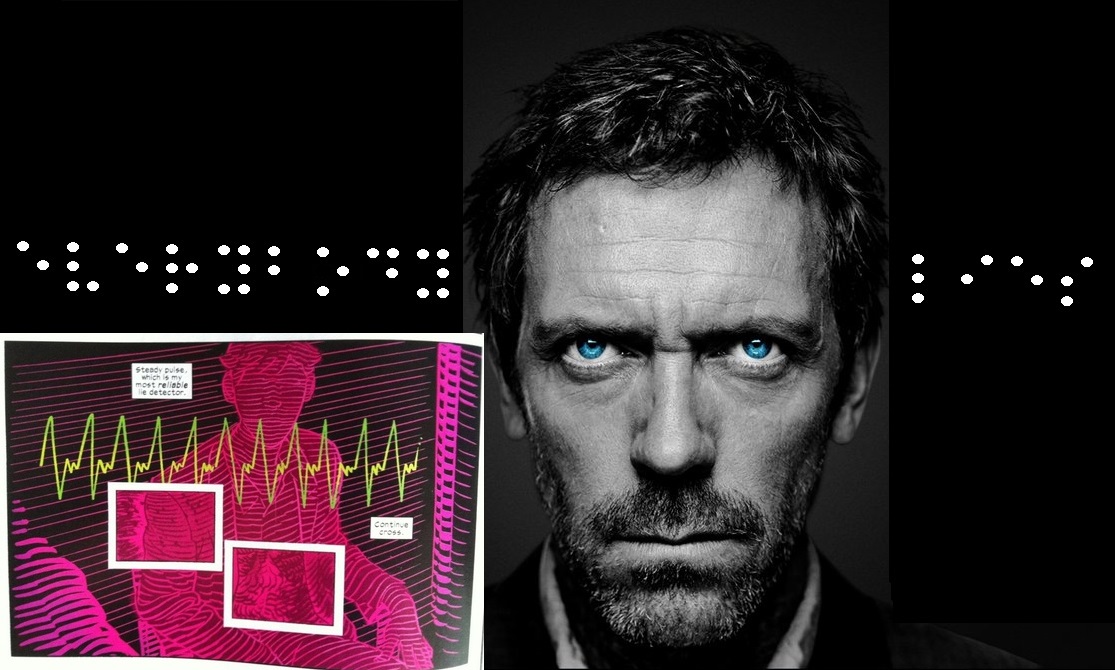
There is an important subgroup of the general population who form an exception to one of the common-among-Aspies characteristics above: not reading facial expressions or body language well. This group is the blind, and, to a lesser degree, the visually impaired. I wear glasses at work, and while driving, for mild-to-moderate myopia, but do not need them to function indoors, especially in familiar settings, such as home. Lately, I have simply stopped wearing my glasses while home. However, I certainly use my vision a lot, and think visually; the sheer volume of geometry (with apologies for the pun) on this blog is evidence enough of that. I have more familiarity with blindness than most sighted people, though, for three reasons: (1) I have read comic books since I was a kid (sometimes while hanging out in some science lab, although I was more likely to be found playing with a some dangerous chemical when very young), and my favorite title for most of my life has been Daredevil, the source of the lower-left part of the image above, (2) I have had close friends who were blind, and (3) I learned to read and write Braille as a college undergraduate, so that I could communicate with these friends by mail, and have not forgotten this skill, although it has lost speed — but I made the Braille lettering in the image above, which simply reads “everybody lies,” a line made famous by House MD.

There is also a fourth reason, unrelated to blindness, which is a common characteristic of those with Aspergers: periods of time when my senses become painfully over-sensitive, so that the sun, indoor lighting, etc., appear to be turned up extra-bright, everything is incredibly loud, etc. — except for my sense of smell, weakened by allergies, and exposure to chemical fumes. This used to happen during migraine headaches; now, I no longer get this state with headaches, but the amplified sensory perceptions are now so intense, at times, that this state is actually worse than a migraine headache, for at least those had pain to distract me, at least somewhat, from overwhelming sensory overload. When this happens, I blindfold myself to eliminate the visual overload, but I cannot silence the world, and you can read a description of what it sounds like, when I am in “Matt Murdock mode,” as I call it, in this blog-post. My perceptions don’t become so acute that I can hear the heartbeats of those around me (as the fictional Murdock can), and I’m fine with that; I don’t need, nor want, to have the volume turned up any further.

When House MD was airing new episodes, as I remember the show,  Dr. Gregory House would be an incredible jerk to people at least six to ten times per episode, sometimes more, and I found it hilarious. Only tonight, while watching the episode mentioned above, “Maternity,” did I realize (after nearly everyone else on the planet who has seen even one episode of this show), that House is incredibly rude at a rate far closer to six to ten times per minute. I had no idea!

This made me quite surprised. I then suddenly noticed something else: Dr. Allison Cameron — lying. Next, Chase lied. Later, Foreman lied. A patient lied, but of course they always do — “everybody lies” is a recurring theme of the show, and the consequences of lying are the show’s most-used plot-device. While thinking about this, I caught House lying. And I knew about each and every one of these lies before House revealed them, as lies, later in the episode. How was I noticing these lies I had never heard, as lies, before?

Of course, I have seen every episode of House MD, so memory is definitely a factor, but had not watched season one in years. I began to focus on this puzzle. About ten detected-lies later, I figured it out: I was hearing not an increased volume, but tiny changes in pitch, no more than a half-step on the musical scale. Lying is a risky activity, and liars know this, so it causes increased anxiety when people lie — and, due to this anxiety, I reasoned, their airways constrict, at least slightly, at the end of a lie, causing an increase in the pitch and frequency of the sound of their voices at the end of a lie. House was the ideal tool for teaching this, for it allowed me to “calibrate” my internal lie-detector, by focusing on the voices intently, while using long-stored memories of Dr. House revealing lies to help me catch what I had never caught before.

Of course, House is a TV show. This needed to be tested — with something which did not involve actors, nor writers. And so, I devised a way to test it. I asked a scientifically-minded person I know to help me test a hypothesis, by choosing a random order for a true statement and a lie, and then simply telling both to me, and then see if I could accurately identify the true statement, as well as the lie.

The pitch of this person’s voice unexpectedly went down, slightly, at the end of one of the statements, but did not change when speaking the other statement. What was going on, I wondered? I then figured it out: I had chosen a scientifically-minded person — who was trying to outsmart my experimental test! I then noticed that one statement of the two — the lie — concerned the number of items in a box, and was therefore testable. The other statement was not testable. The other person, who is quite intelligent, had taken a minute or two to formulate both the true statement, and the lie — and clearly intended me to fail the test, and then be able to prove it had failed, by simply opening the box. Using logical reasoning (an old skill) and my new, sonic lie-detector, together, I can now even detect a lie that a police polygraph might not have been able to detect!

I then realized I was detecting more subtle emotions . . . catching more jokes . . . and generally doing, by rapidly analyzing sound, what other people do by somehow “reading” body language and facial expressions.

It is a myth that Aspies can’t do such things as understanding emotions. It is not a myth that Aspies think in different ways, however. Sometimes, individual Aspies simply have to figure out their own methods for doing something which comes naturally to non-Aspies — and that’s exactly what I did.

I could, presumably, use this new frequency-sensitivity to train myself to lie convincingly, by deliberately avoiding the “tell” of a slight pitch-increase at the end of a lie. However, I choose not to do that. The first week I went without telling a single lie, in my teens, was difficult, but the second week was much easier, and the third was easier still. Not having to try to keep track of previous lies began to give me a persistent, liberated feeling that can only be enjoyed by those who are honest — and that feeling would, of course, vanish if I chose to invest time, energy, and thought into becoming a skilled liar. To do that would be to move backwards in my life, rather than forwards, and I see no reason to do that. In other words, I’m still me . . . just the latest version of me, that’s all.

On Deciphering Informal Medical Language, from an “Aspie” Point of View

Confusion

Confusion

A major challenge for many Aspies (an informal name many of those with Asperger’s use for ourselves) is communication with the larger, non-Aspie population. Frustration and anger are common reactions to this challenge — sometimes from both sides. The reasons for this are known: these two parts of the population use language quite differently. Aspies tend to use and interpret language in absolute, literal terms, to a point that seems odd to most. Non-Aspies, by contrast, are often more flexible with use of language, and are (somehow) able to convey ideas between themselves using words which mean the exact opposite of their literal meaning. (Several examples will follow.) This difference is all that is required to explain why Aspies and non-Aspies often have trouble communicating with each other.

Just as with most people, Aspies are quite different from each other, but we also have some traits in common. For example, an intense urge to study and analyze some esoteric subject, which few others care about, is common — but the identity of that subject, or subjects, varies widely from one Aspie to another. My special interests all involve puzzles; I enjoy trying to figure out mathematical, scientific, and linguistic problems, in particular. Another Aspie might share none of those interests, but might be able to rattle off, say, hundreds of sports statistics, as easily as I can list the names of dozens of polyhedra. The existence of these “special interests,” as they are known, is (nearly?) universal among Aspies, but the topic of these special interests is not. For example, fewer than 1% of the Aspie population shares my obsession with polyhedra — a fact I know because the world’s most-focused “polyhedra people” are so uncommon that we have established many lines of communication between each other, enabling the formation of a rough estimate of this population. My estimate is ~300 people, worldwide. Even if I am off by a factor of ten, that simply isn’t nearly as many people as 1/10th of 1% of the world’s rapidly-growing Aspie population.

In my experience, medical terminology, in particular, has provided large numbers of baffling puzzles over the years. When talking to medically-trained professionals, I always let them know I am a teacher of science and mathematics. This lets them know that they need not hold back with medical jargon, which has a large overlap with scientific and mathematical jargon. I can understand it fairly well, and, when an unfamiliar term is used, I simply ask for a definition. When I need to, I take notes. If medical instructions are not clear, precise, literal, and detailed, people can die as a result. For this reason, such instructions generally are written in a precise, literal form of English which is a beter match for “Aspiespeak” than what we typically hear from non-Aspies.

On the other hand, when I speak to non-Aspies about medical subjects, I often get quite confused, and I suspect this happens with many other Aspies, as well. Examples follow.

“Nerve pills” — As someone who takes prescribed medication for the relief of anxiety (which is the way a doctor or pharmacist would likely phrase it), I have occasionally been asked if I might benefit from taking a “nerve pill.” Before remembering the translation of this term, I always think, and sometimes say, something along these lines: “I’m already nervous. Why would I take a pill to make me more nervous?” It’s the implied, omitted parts of the phrase, of course, that contribute to my confusion. As it is, this practice makes me wonder why we don’t call deodorant “oderant” instead, a term coined by Jerry Seinfeld, since that would make equally little sense, but would at least be consistent.

The related phrase “pain pills” elicits a similar response from me. Due to a fall over twenty years ago, I already hurt, and, sometimes, I need something that relieves pain — but I never need anything to cause more pain! Fortunately, the people I actually see for such medication, when it is needed, are physicians and pharmacists, and they use literal, precise terms for such medication. They also know the risks of such medication, and conversations with such people are important for anyone needing such medication, for obvious reasons: such medications should only be used in ways consistent with advice from doctors and pharmacists. Patients cannot obtain such advice without having honest conversations with these knowledgeable professionals.

The most confusing informal medical term like this which I hear, though, is the term “crazy pills.” I don’t hide the fact that I obtain professional help for mental health issues, and explained my reasons for this openness here. Most of those who do seek treatment for mental health problems, though, are not Aspies, and so it is quite common to hear such treatment, in the form of medication, referred to by this confusing term, which I must admit I intensely dislike. For one thing, the word “crazy” is not one to use lightly, due to the fact that it has been used, historically, to stigmatize those who need help maintaining or restoring mental health. For another, the literal meaning of “crazy pills” is the exact opposite of its in-use meaning.

The term I use to replace “crazy pills,” in my own speech, is “sanity pills.” Sanity is, after all, my preferred state, and that is the reason the psychiatry-related category on this blog is named “Mental Health,” not “Mental Illness.” Reminders that mental health is the goal are helpful; the opposite focus is not.

Puzzles like this (figuring out non-literal terms used by non-Aspies) are not my favorite kind; in fact, I don’t enjoy them at all, for little or no logic is involved, and any pattern which might help me learn these things more easily has, so far, eluded me. Non-Aspies seem to just intuitively “know” what such phrases mean, as if they got a memo which was deliberately withheld from Aspies — and that is, for me (and many of us), both baffling, and irritating. Can I understand these things? Yes, with difficulty — I have to figure them out, step by step, each time, due to the fact that they do not make logical, literal sense, and thus do not come naturally to me. In fact, studying calculus was easier than understanding these common phrases which nearly everyone else just seems to somehow “know,” as if the knowledge was sent to them telepathically, but deliberately withheld from me, for reasons unknown.

For a fictional depiction of Aspie/non-Aspie confusion, this clip from Star Trek: The Next Generation, while not medically-oriented, does illustrate this commuication-problem in a humorous fashion. When the character of Data was created, some “Aspie” characteristics were deliberately included, just as they were for Mr. Spock, his predecessor. Some Aspies have criticized the Star Trek franchise for these practices, but I, personally, think they have been helpful, in that they use humor to try to bridge the currently-existing comprehension-gap. This gap is not helpful, so anything that narrows it is something I like.

I Can’t Stop Listening to the Unsilent Quiet

An incomplete list of things I can hear right now:

1. The spinning of my laptop’s hard drive
2. The spinning of the blades of the exhaust fans that keep my laptop from overheating
3. This apartment’s air conditioning
4. The ringing in my own ears, which I blame on living in a noisy world
5. The “sixty-cycle hum” — a 60 Hz humming sound produced by pretty much anything running off alternating current (refrigerators are the worst)
6. The sound of my own fingers typing on the keyboard of my laptop
7. The whirling blades of ceiling fans in several places in this apartment, and adjacent apartments
8. Traffic on nearby roads
9. My never-ending internal monologue

Except during power failures, which shorten the list a lot, this is about as quiet as it ever gets here. Another person might call this “silence.” It isn’t.

There is no silence.

Ever.

Revise, and Re-install, Unconscious Mental Subroutine

tess chiral 2012

Sleep eventually takes your awareness from you, and, at the end, you don’t even resist.

Asleep now. Initialization of nREM startup program in progress.

Stop. Evaluate time elapsed since last sleep-reprogramming. Identify areas of concern.

Rank items of concern in priority order,

Schedule upcoming REM cycle to allow the “playing out” out of necessary “real-word” drama to address the top priority concern. Maintain focus on that concern until it is replaced by another one, new, and of more importance. Keep an eye on all areas of past conflict, while watching for new ones, hoping for early detection.

If unavoidable, implement “the best you can fake it” multitasking coping-mode.

Realize that memory of this sleeping activity will be fragmentary at best.

Know also, nonetheless, that you are the one one writing the program, at both ends of the consciousness-spectrum, the autism spectrum, and any other spectra I find myself standing on.

To answer the obvious question: yes, this blog-post is deliberately being written in the grey zone between sleep and wakefulness. If parts of it make no sense, that’s the reason.

~~~

Note upon waking: I found this, written but not published, on my computer, when my alarm clock went off. I guess I’ll post it now!

Phobias? What phobias?

The Scream by Edvard Munch, 1893

It just occurred to me that there are an absurd number of common phobias, such as claustrophobia or acrophobia, for which I have the polar opposite — an unusual attraction to the commonly-feared thing or situation. (Since I am no stranger to anxiety, so this is rather odd.) Claustrophobics fear enclosed spaces, while those with acrophobia fear heights. If someone told me that a sensory deprivation tank was available for my use, atop the nearest mountain, I’d drive straight there, climb the mountain, get in the tank, and seal myself in for hours, for two reasons: I love being in enclosed spaces, and also absolutely love heights. Combining the two would be awesome!

There exists a proper word-ending for a phobia’s opposite: “-philia.” Unfortunately, though, using words which end with “-philia” is problematic, due to the fact that the most familiar words with this ending refer to criminal acts. There’s nothing wrong with the words “claustrophilia,” nor “acrophilia,” to a linguistic purist. To a pragmatist, though — which I am — the undesirable effect of reminding the reader of such horrors as pedophilia must be taken into account. For this reason, I find it preferable to state that I have the opposite of both claustrophobia, and acrophobia.

In alphabetical order, then, here are some common phobias for which I have the polar opposite:

  • Acrophobia, fear of heights — See first paragraph, above.
  • Aerophobia, fear of flying — Just being a passenger on an airplane is thrilling, especially at take-off. Once, at about age twelve, I actually got to take the controls of a small plane for a little while, and that will remain one of the peak experiences of my life.
  • Ailurophobia, fear of cats — We have cats, and I’ve had cats all my life. I admire their “cattitudes,” for one thing; they are somewhat like my own.
  • Arachnophobia, the fear of spiders — I try my best to protect every spider I see, wear a spider necklace, have a spider tattoo, and have spider-decorations in my classroom year-round, just because I like spiders that much.
  • Atychiphobia, fear of failure — If I had this, I would never begin work on any challenging math problem, and . . . well, what would be the point of existing like that?
  • Autophobia, fear of being alone — The fact that I traveled over 11,000 km, alone, in my late teens, proves I don’t have this problem.
  • Barophobia, fear of gravity — A bad idea for anyone with mass! If I had it, I wouldn’t be writing this, for I’d be too busy freaking out. All. The. Time.
  • Bibliophobia, fear of books — Yeah, well, I can’t even narrow down my favorite-author list to fewer than four, as seen here.
  • Claustrophobia, fear of enclosed spaces — See first paragraph, above.
  • Cyberphobia, fear of computers — Wow, that would make it difficult to maintain a blog!
  • Glossophobia, fear of speaking in public — As a teacher, I actually get paid to run my mouth, so this one is . . . out!
  • Gynophobia, fear of women — They may scare a lot of lawmakers, judging from the political “war against women” in America, but I’ve always preferred the company of women to that of men (sorry, guys).
  • Islamophobia, fear/hatred of Muslims and Islam — I’ve blogged about this; you can find those posts here.
  • Melanophobia, fear of the color black — My favorite color!
  • Negrophobia, fear of Black people — It’s a common affliction where I live, this being the American South, but I couldn’t do my job if I had this problem, for a majority of my students are Black. I can’t think of any reason why a person’s albedo, high or low, should be a problem for me. I’m not allergic to melanin, after all, and have viewed racism as evil since I first became aware of it, as a child.
  • Nyctophobia, fear of darkness and night — If I could get away with it, I would be completely nocturnal.
  • Ombrophobia, fear of rain — I don’t even own an umbrella.
  • Ophidiophobia, fear of snakes — Have you ever had a twenty-minute stand-off with a copperhead? I have. I was probably fifteen or so at the time. My reasoning: running toward or away from the snake might be dangerous, and walking away wasn’t an option, since I was standing on a rock in the middle of a river, with the snake on the next rock — so I held my ground, and simply stayed on “my” rock. The snake did the same on his rock, for about twenty minutes, and then it jumped into a river and swam away, ending the standoff. This wouldn’t have been possible with ophidiophobia.
  • Triskaidekaphobia, fear of the number thirteen — Why would anyone fear a number, especially one of the smaller primes? Wouldn’t that mean not being able to count more than a dozen things at once? There’s plenty of evidence on this blog that numbers don’t scare me.

The next time anxiety is a problem for me, I’ll try to remember to think about this list of anxiety-problems I don’t have, but which do affect many other people. I could certainly have it worse when it comes to anxiety, and it harms nothing to keep that in mind. In fact, it might even help.